Russian nuclear ties persist in the West
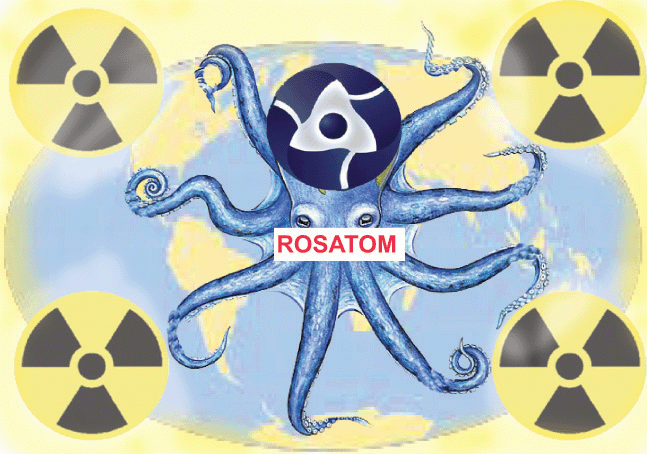
Bellona September 14, 2026, https://bellona.org/news/nuclear-issues/2026-09-russian-nuclear-ties-persist-in-the-west-as-war-claims-another-life-at-zaporizhzhia
Germany allows VVER fuel production using Russian technology
Germany, meanwhile, has approved a controversial plan that will preserve another form of Russian involvement in Europe’s nuclear industry.
On July 22, authorities in Lower Saxony approved an application by Advanced Nuclear Fuels, a subsidiary of France’s Framatome, to expand its Lingen plant to manufacture hexagonal fuel assemblies for Russian-designed VVER reactors.
The fuel will be manufactured under Russian licenses and using Russian technology through cooperation with Rosatom’s fuel subsidiary TVEL. The decision came despite objections from some 11,000 people and concerns about espionage, sabotage, cyberattacks and Russian access to critical German infrastructure. Authorities imposed safeguards, including restrictions on access by Rosatom and TVEL personnel and security inspections of Russian equipment.
Bellona nuclear expert Dmitry Gorchakov calls the decision “rather strange” and warns that it undermines efforts to reduce European dependence on Russia.
“Unfortunately, this shows the absence of a single clear policy and principles regarding contacts with official Russian structures, both within Germany itself and within the EU,” Gorchakov writes.
More importantly, he argues, allowing Framatome to meet its VVER fuel commitments with Rosatom’s involvement “may slow the development of its own French VVER fuel independent of Rosatom and prolong Rosatom’s dependence and influence on this market in Europe.”
“Bellona does not approve of this decision by the German authorities or of this cooperation between Framatome and Rosatom,” Gorchakov concludes.
Western uranium markets remain dependent on Russia
New figures published in July show why severing those ties remains difficult.
The Euratom Supply Agency reported that European suppliers significantly expanded uranium enrichment services in 2025, increasing their share of the EU market from 63.9% to 72.9%. The volume of Russian enrichment services also increased by 11.6% in physical terms. However, their share of the total volume of European orders declined by 22.55% compared with 23.55% a year earlier and 37% in 2023. Russia supplied nearly 16% of the EU’s natural uranium and 24.4% of its conversion services.
The situation is likewise complicated in the United States. According to the U.S. Energy Information Administration, Russia remained the largest single source of enrichment services purchased by American nuclear operators in 2025, providing 3.284 million SWU — about 26% of the total. That was more than the share supplied by U.S. enrichment capacity itself.
“The published statistics in the EU and the US show the continuing dependence of Western nuclear power plant operators and nuclear fuel cycle enterprises on Russian supplies of uranium and its conversion and enrichment services,” Gorchakov says.
“Despite the existence of major European competitors to Rosatom and technical alternatives, up to 20–25% of nuclear materials and nuclear fuel cycle services in European and US markets still originate in Russia.”
For Gorchakov, market forces alone are unlikely to break that dependence. “Only official restrictions and sanctions can break this trend,” he writes, arguing that firm limits would both force reductions in Russian purchases and give Western suppliers confidence that investments in new capacity will pay off.
Taken together, the developments underline a contradiction that has persisted since the beginning of the war. Russia’s occupation of Zaporizhzhia has created unprecedented nuclear safety risks in Ukraine, yet Rosatom remains deeply embedded in nuclear supply chains in the countries supporting Kyiv. Europe and the United States are developing alternatives, but July’s figures — and Germany’s decision in Lingen — suggest that breaking those ties will require political decisions as much as new technology and production capacity.
No comments yet.
1 This Month





PLEASE OPPOSE HR 8255 AND S.3639 – bills would accelerate satellite deployment, with no environmental review or safeguards – https://ncstd5li.quorum.us/campaign/169331/
To see nuclear-related stories in greater depth and intensity – go to https://nuclearinformation.wordpress.com
-
Archives
- October 2026 (81)
- September 2026 (339)
- August 2026 (330)
- July 2026 (355)
- June 2026 (287)
- May 2026 (306)
- April 2026 (356)
- March 2026 (251)
- February 2026 (267)
- January 2026 (308)
- December 2025 (358)
- November 2025 (359)
-
Categories
- 1
- 1 NUCLEAR ISSUES
- business and costs
- climate change
- culture and arts
- ENERGY
- environment
- health
- history
- indigenous issues
- Legal
- marketing of nuclear
- media
- opposition to nuclear
- PERSONAL STORIES
- politics
- politics international
- Religion and ethics
- safety
- secrets,lies and civil liberties
- spinbuster
- technology
- Uranium
- wastes
- weapons and war
- Women
- 2 WORLD
- ACTION
- AFRICA
- Atrocities
- AUSTRALIA
- Christina's notes
- Christina's themes
- culture and arts
- Events
- Fuk 2022
- Fuk 2023
- Fukushima 2017
- Fukushima 2018
- fukushima 2019
- Fukushima 2020
- Fukushima 2021
- general
- global warming
- Humour (God we need it)
- Nuclear
- RARE EARTHS
- Reference
- resources – print
- Resources -audiovicual
- Weekly Newsletter
- World
- World Nuclear
- YouTube
-
RSS
Entries RSS
Comments RSS


Leave a Reply