Wall Street sounds alarm on nuclear stock with 40% downside
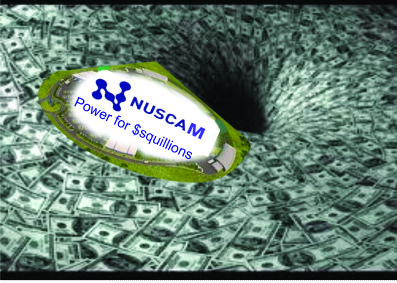
making a choice to invest and having a nuclear power plant that is up and running are completely different achievements.
NuScale has lost money since company was founded and recorded a cumulative deficit of $824.4 million as of June 30.
Cash spent in operating operations was $372.9 million during the first six months of 2026, compared with $56.1 million for the same period in 2025.
A key analyst has slashed its price target for the stock.
Sep 16, 2026,The Street, By Faizan Farooque
Nuclear energy has become one of Wall Street’s more closely watched investment themes as artificial intelligence and data centers put new pressure on the U.S. power grid.
Due to data centers, AI, and industrial growth, the U.S. Department of Energy expects electricity demand to rise significantly.
The federal government has supported that forecast with dollars.
In March of 2025, the Energy Department published a request for $900 million to assist the development of American-made Generation III+ small modular reactors.
The market opportunity is so much bigger.
The Energy Department has predicted the U.S. may need as much as 200 gigawatts of new nuclear capacity by 2050 to fulfill rising energy demand.
That suggests a potentially huge opportunity for those that can get new reactors into commercial operation.
One company aiming to get there is NuScale Power (SMR).
But Wall Street doesn’t think every nuclear stock will necessarily emerge as a winner.
UBS downgraded NuScale Power to Sell from Neutral and cut its price target to $6 from $10.
That implied roughly 40% downside from the stock’s level when the analyst call was issued.
And the questions raised by UBS go to the heart of the conundrum hanging over the growing small modular reactor industry: How soon can promising reactor technology be turned into a working commercial power plant?
UBS slashes NuScale Power stock price target
UBS’s negative argument is about execution.
Competitors are going into construction, whereas NuScale has an expected build time of more than five years and no concrete client commitments, the analyst said.
UBS said such circumstances presented “meaningful challenges.”
The bank now forecasts just one NuScale project breaks ground in 2028 and sees a cumulative cash burn of $700 million from 2026 through 2028.
That provides a stark contrast between excitement for nuclear power and the dangers of actually bringing a new reactor design to market.
Those dangers are not exclusive to NuScale.
Energy Department officials have recognized utilities’ and other prospective consumers’ worries about cost overruns in development and abandonment of projects.
DOE has also projected that order books of five to 10 deployments of at least one reactor type may be required to support advanced nuclear and reach commercial scale.
NuScale has already passed a big regulatory barrier.
NuScale’s US460 standard plant design received approval from the U.S. Nuclear Regulatory Commission in May 2025.
The design has six modules each generating 77 megawatts of power, making the overall plant capacity 462 megawatts.
The NRC said its clearance means the design may be cited in applications for building permits, operating licenses and combination licenses.
The agency finished its review in 22 months, two months ahead of schedule.
The NRC also has the underlying regulatory documentation for the approval of NuScale’s US460 design, giving investors the key record of the company’s regulatory development.
That gives NuScale a distinctive position.
We see concrete regulatory progress.
The bigger issue is the commercial timeframe.
NuScale Power has substantial liquidity but is burning cash
The $700 million cash-burn estimate from UBS is more substantial against NuScale’s most recently disclosed balance sheet.
NuScale reported $766.5 million in cash and cash equivalents as of June 30, 2026, in its quarterly filing with the Securities and Exchange Commission.
The company also held $305.7 million of short-term investments and $820.8 million of investments.
The total of these three categories is over $1.89 billion.
NuScale reported no debt and stated it anticipates that its cash, investments, and continuous access to capital markets would be adequate to satisfy its cash needs for at least the next 12 months and beyond.
But the other side of the company’s financials provides insight into why cash burn is critical to UBS’s theory.
NuScale has lost money since company was founded and recorded a cumulative deficit of $824.4 million as of June 30.
Cash spent in operating operations was $372.9 million during the first six months of 2026, compared with $56.1 million for the same period in 2025.
The increase was mostly due to a $259.9 million payment to commercialization partner ENTRA1 and reduced collections from customers and vendor prepayments for long-lead supplies, NuScale said.
NuScale too has gone to its stockholders for a big financial infusion.
The corporation sold roughly 89.7 million Class A shares via an at-the-market program in the first six months of 2026.
Those sales yielded $1 billion in gross profits, or around $984.5 million after issuance expenses, the document said.
The weighted average price of sales was $11.14 per share.
That funding gave NuScale a major cash boost but also speaks to a key portion of the investment equation.
Until commercial projects generate sufficient cash, access to capital markets remains an important source of funding.
NuScale’s annual report also gives further insight on the company’s commercialization agreements including its ties with RoPower Nuclear and ENTRA1 Energy.
NuScale’s Romania project offers a counterpoint to UBS concerns
The bearish thesis isn’t without important counterarguments.
But there are significant counterarguments to the pessimistic view. One of the biggest is Romania.
NuScale has been collaborating with RoPower Nuclear on a planned 6-module small modular reactor project at the old Doiceşti coal-power facility.
Next came a milestone of greater importance.
On Feb. 12, 2026, shareholders approved the final investment decision for the Doicești small modular reactor project.
That is substantial development for a corporation that is being challenged on its ability to transform technology into practical projects.
But making a choice to invest and having a nuclear power plant that is up and running are completely different achievements.
Nuclear plants take years to license, finance, build and complete before they generate power.
And that is the gap UBS regards as a concern.
NuScale also has a potentially far bigger possibility in the US.
TVA and NuScale have announced support for an ENTRA1 Energy initiative, with plans to install up to 6 gigawatts of NuScale small modular reactor capacity throughout TVA’s seven-state area in September 2025.
The size is substantial, but investors need to differentiate a projected deployment program from reactors currently under construction or in operation.
That divergence is especially noteworthy in light of UBS’s concern regarding solid customer agreements.
So whether NuScale can turn theoretical deployments into commercial off-take agreements and ultimately construction might be one of the most
NuScale Power faces competitors moving toward construction
The rivalry makes NuScale’s timeframe extremely relevant.
The Nuclear Regulatory Commission’s advanced-reactor docket shows other developers and utilities pushing projects through construction-related regulatory milestones.
For example, in May 2025, TVA filed the last part of its building permit application for a BWRX-300 small modular reactor at its Clinch River plant in Tennessee.
That helps explain why UBS is focused not simply on whether NuScale can eventually deploy its technology but on when that deployment can happen.
Timing is key in a market where utilities, IT corporations, and other big electrical consumers are looking for more dependable power.
The Department of Energy’s advanced-nuclear study projects the U.S. will require around 200 gigawatts of new nuclear power by 2050.
The agency also cautioned that the time it would take to ramp up deployment might make the ultimate buildout substantially harder.
A DOE scenario that begins large-scale deployment by 2030 and reaches 13 gigawatts per year by 2040 could put the U.S. on track to add 200 gigawatts of nuclear capacity by 2050.
A five-year delay might mean more than 20 gigawatts a year of deployment and could raise capital needs by as much as 50%.
Thus, the opportunity is potentially immense.
But speed counts.
Wall Street downgrade raises stakes for NuScale Power stock
The downgrading by UBS has left NuScale’s investors with two very different views of the company’s tale………………………………………………………………………………………………..
For NuScale stockholders, the more pressing issue is whether this specific nuclear business can transform regulatory clearances, alliances and planned projects into running reactors swiftly enough to justify its value.
UBS isn’t buying it. https://www.thestreet.com/investing/wall-street-sounds-alarm-on-nuclear-stock-with-40-downside
8 instances of radioactive material incidents in the UK since 2015

20 Working Days, Tom Pashby, Sep 21, 2026, https://tompashby.substack.com/p/8-instances-of-radioactive-material?utm_source=post-email-title&publication_id=6735486&post_id=216635328&utm_campaign=email-post-title&isFreemail=true&r=ln98x&triedRedirect=true&utm_medium=email
There were eight instances of nuclear or radioactive materials being lost, stolen or otherwise out of regulatory control in the past 10 years in the UK, according to data released to 20 Working Days.
The data, released by the Home Office, was already reported voluntarily by the UK Government to the International Atomic Energy Agency’s (IAEA’s) Incident and Trafficking Database (ITDB), which publishes aggregated data annually.
The IAEA Incident and Trafficking Database (ITDB): 2026 factsheet explained: “When originally established, the ITDB recorded incidents of illicit trafficking of nuclear and 145 participating States other radioactive material.
“Its scope was later expanded to include all incidents in which nuclear and other radioactive material is or was out of regulatory control.
“The ITDB scope covers all types of nuclear material as defined by the Statute of the Agency (i.e. uranium, plutonium and thorium), naturally occurring and artificially produced radioisotopes and radioactively contaminated material, such as scrap metal.”
It found that, as of the 2026 report: “The trafficking or malicious use intent of 86.6% of thefts remains undetermined.”
“In 2025, 236 incidents were reported to the ITDB by 34 States, an increase of 89 incidents from 2024,” it said.
“The noticeable increase in reported incidents in 2025 is primarily attributable to retrospective reporting.”
The factsheet also reported that “transport remains a key vulnerability, with over half of all thefts since 1993 — and approximately 70% in the past decade — occurring during authorised transport, underscoring the need for sustained attention to transport security measures.”
Under a section titled “Confidentiality and security of ITDB information”, the factsheet said: “The ITDB is a resource for information sharing among State authorities and the IAEA.
“In order to protect the confidentiality of information reported by States, the IAEA upholds strict procedures for handling and dissemination of sensitive ITDB information.
“Information on reported incidents is only communicated via the PoC (points of contact) network. Access to the complete database is limited to a small number of IAEA staff.”
20 Working Days asked the UK Home Office for the UK’s submissions to the database since 2015.
In response, the Home Office listed eight incidents it had reported to the database. It provided the following table: [on original]
It is unclear whether all of the incidents were disclosed to the public.
The list does, however, include one of the highest profile incidents in the UK involving radioactive materials – the malicious use of Polonium-210 which resulted in the lethal poisoning of Alexander Litvinenko in 2006.
The Litvinenko inquiry: report into the death of Alexander Litvinenko was published in 2016, which may explain why the incident was listed as 2016 by the Home Office.
Meanwhile, the 2021 incident of F-18 being lost and found appears to have been reported by the PA news agency in the same year.
The Home Office was approached for comment.
The Agentic State: Why We Obey Without Question
Encyclopedia of psychology, By Mohammed looti/August 21, 2026
Defining the Agentic State
The Agentic State refers to a fundamental psychological condition where an individual perceives themselves not as acting on their own volition, but rather as an instrument for carrying out the instructions of an authority figure. This state is characterized by a profound shift in responsibility; the individual transfers the moral accountability for their actions to the perceived authority, thereby mitigating the internal conflict that might otherwise arise when asked to perform morally questionable or harmful tasks. In essence, the person operating within the Agentic State views their behavior as dictated, rather than chosen, functioning merely as an agent in a hierarchical structure. This mechanism is crucial in understanding how people comply with demands within large organizations, militaries, or bureaucratic systems based upon status, as the original emotional or mental condition is designed to facilitate adherence to the commands their superiors deliver unto them, often overriding personal conscience.
The core definition posits that the Agentic State is not necessarily a permanent personality trait but rather a situational psychological adaptation that occurs when an individual acknowledges a legitimate authority figure within a defined social setting. When this acknowledgement occurs, the person adopts an “agentic” frame of mind, which radically alters their perception of self and action. Instead of feeling responsible for the consequences of their actions, the agent feels responsible to the authority figure for performing the tasks competently. This psychological distance from the outcome is what allows individuals to perform actions that they would never contemplate when acting in their own capacity, often leading to behaviors that defy normal ethical boundaries, provided the command originates from the recognized higher power.
The Transition from Autonomy to Agency
Psychologists distinguish the Agentic State from the Autonomous State, which is the default condition where individuals perceive themselves as responsible for their own actions and consequences, acting according to their own conscience and free will. The transition between these two states is known as the “agentic shift.” This shift is triggered when the individual enters a social situation where the hierarchy is clearly defined and accepts the legitimacy of the authority figure’s power……………..
Historical Foundations: Stanley Milgram’s Research………………………………………………………………………………………………………………………..
Psychological Significance and Ethical Implications……………………………………………………………………………………………….
The practical application of understanding the Agentic State extends across various domains,………………………………………………………………….. the Agentic State is often implicitly cultivated to ensure rapid, unquestioning obedience to authority in high-stress situations. In these contexts, the transfer of responsibility is considered necessary for efficiency and coordination………………………. https://encyclopedia.arabpsychology.com/agentic-state/
NATO member warns bloc seeking pretext for war with Russia

“I don’t want Slovakia to be part of any military conflict because of some Article 5,” he stressed, adding that, though his country still “cares about collaboration and fulfilling obligations”. “As prime minister, I will do everything to ensure that Slovakia is never drawn into a war,” Fico stressed.
Slovak Prime Minister Robert Fico says he does not want his country to be dragged into a conflict
18 Sep, 2026 , https://www.rt.com/news/645940-west-pretext-russia-nato-war/
Europe is moving dangerously close to a direct clash between NATO and Russia, Slovak Prime Minister Robert Fico has warned, accusing the West of seeking a “pretext” for a major conflict between the two sides.
Fico made the comment in a Facebook post on Thursday, which accompanied the remarks he delivered before traveling to Ukraine for a meeting with Vladimir Zelensky and several European leaders.
“I am deeply concerned that they are merely looking for a pretext for a major conflict between NATO and Russia,” he wrote.
Reflecting on the Ukraine conflict, Fico said that the hostilities had “gotten out of control,” while accusing European nations of engaging in increasingly bellicose rhetoric which he said risked dragging the continent into a broader war. “The situation has never been as serious and tense regarding the possibility of a pan-European war conflict as it is now,” he said.
Fico also warned that Bratislava could face pressure from NATO to commit troops if the bloc’s Article 5 – a collective defense clause applied if a member state is attacked – is invoked. “Can anyone imagine being told to prepare 5,000 soldiers, 10,000 soldiers, and that they would go somewhere to fight? We don’t know with whom, why, or for what reason,” Fico said.
“I don’t want Slovakia to be part of any military conflict because of some Article 5,” he stressed, adding that, though his country still “cares about collaboration and fulfilling obligations”. “As prime minister, I will do everything to ensure that Slovakia is never drawn into a war,” Fico stressed.
Fico has consistently opposed military support for Ukraine since returning to office in 2023 while halting government weapons shipments to Kiev. He has also opposed Kiev’s accession to NATO, and insisted that Ukraine’s EU membership is only possible if it meets all the requirements.
He has also argued that the West’s strategy to “bring Russia to its knees” had “completely failed.” “The European Union does not need more weapons and Russophobia. The European Union needs more diplomacy and concrete plans to help the economy,” Fico said last month.
Russia has accused the EU of rapid militarization, with Kremlin spokesman Dmitry Peskov saying the bloc is directing increasing military capabilities against Moscow while portraying it as an enemy.
President Vladimir Putin has consistently rejected claims that Moscow intends to attack NATO countries, but warned last week that deploying European forces to Ukraine “would mean war with Russia.” Foreign Minister Sergey Lavrov also stressed that Russia has no intention of attacking the West but warned that if Europe attacked first, the resulting conflict would be “very short.
Britain deepens nuclear ties with France and Australia
By George Allison, September 19, 2026, https://ukdefencejournal.org.uk/britain-deepens-nuclear-ties-with-france-and-australia/
Britain is deepening its nuclear relationships with the United States, France and Australia, with the Northwood Declaration recognising that there is no extreme threat to Europe which would not prompt a response by both Britain and France, according to the annual update to Parliament published this week.
The declaration, agreed in July 2025, reaffirmed and strengthened what the update describes as longstanding nuclear cooperation between the two countries. On the AUKUS partnership, the update records an important development in February this year when HMS Anson docked at HMAS Stirling near Perth.
The United States is described as Britain’s closest defence ally, with the relationship underpinned by long-standing cooperation on all nuclear matters including policy, operations and technology.
The practical expression of that relationship runs through the missile system, since Trident and its supporting systems fitted to the Vanguard class are manufactured in the United States, with Britain having bought title to a number of missiles drawn from a shared pool of assets under the 1963 Polaris Sales Agreement as amended for Trident in 1982. The system is operated independently by both the Royal Navy and the United States Navy.
The warhead fitted to those missiles is sovereign to Britain, with the Mk4A design maintained by AWE at Aldermaston, which also leads development of the replacement warhead, Astraea. Wes Streeting writes that the increase in investment across the enterprise “sends a clear signal of our commitment to global security, and to our Allies”, with the deterrent remaining declared to the defence of NATO.
The update states that nuclear deterrence is the cornerstone of NATO security and that the independent strategic nuclear forces of the United Kingdom contribute significantly to the overall security of the alliance, a declaration maintained since 1962.
Nuclear Industry groups call for governments commitment for nuclear growth

The statement was signed by the heads of the Canadian Nuclear Association, GIFEN, Japan Atomic Industrial Forum, Korean Atomic Industrial Forum, Nuclear Energy Institute, Nuclear Industry Association, Nucleareurope and World Nuclear Association
WNN, Friday, 18 September 2026
Nine industry associations participating in the Roadmaps to New Nuclear conference in Paris have reaffirmed the industry’s commitment to advancing the peaceful use of nuclear technology and called on governments to support this growth.
The OECD Nuclear Energy Agency (NEA) and the US Department of Energy co-hosted the 4th Roadmaps to New Nuclear conference in Paris, France, on 17-18 September. This annual event brings together government and industry leaders to address the most pressing issues for delivering new nuclear energy construction at the scale and pace required to meet the growing global expectations for nuclear energy.
In the opening session, Mathias Cormann, Secretary-General of the Organisation for Economic Co-operation and Development (OECD) said: “Today we are at the start of a nuclear resurgence……………………………………….
Delivering new nuclear capacity at scale presents significant challenges, the NEA says, including workforce development, supply chain readiness, financing, fuel supply security, regulatory preparedness and project delivery. Roadmaps to New Nuclear 2026 aimed to focus on addressing these challenges, sharing recent experiences and identifying practical solutions……………………………………………..
According to the statement, governments need to take action to: pursue attribute-based, consistent long-term energy policies; safeguard energy security and resilience; facilitate access to finance; strengthen international regulatory cooperation; strengthen resilient and trusted nuclear supply chains; and build skills, industrial capability and innovation…………………………….
The statement was signed by the heads of the Canadian Nuclear Association, GIFEN, Japan Atomic Industrial Forum, Korean Atomic Industrial Forum, Nuclear Energy Institute, Nuclear Industry Association, Nucleareurope and World Nuclear Association………………https://www.world-nuclear-news.org/articles/industry-groups-call-for-government-commitment-for-nuclear-growth
Major energy and nuclear supply chain showcase connects Cumbrian firms
Business Crack, September 18, 2026
Hundreds of millions of pounds’ worth of infrastructure work took centre stage as energy sector businesses gathered for a major nuclear showcase in West Cumbria.
The BECBC Nuclear Group Showcase at Energus at Lillyhall, near Workington, brought together 250 members and nearly 50 exhibitors alongside major project owners and supply chain partners.
Representatives from Sellafield Ltd, Sizewell C, Nuclear Restoration Services Dounreay and Morgan Sindall Infrastructure shared updates on forthcoming opportunities and pipelines of work.
The event also featured presentations and a question-and-answer session with three candidates for next year’s Cumbria mayoral election.
Labour’s David Allen, Conservative Mike Starkie and Liberal Democrat Libby Bateman all spoke at the showcase to field questions from the local supply chain………………………………………………………………………………………………………………………… https://businesscrack.co.uk/2026/09/18/major-energy-and-nuclear-supply-chain-showcase-connects-cumbrian-firms/
The Peril of Trump’s Final Act: Would He Use a Tactical Nuclear Weapon in Iran?

The real straits of Trump are dire: He is trapped in a war that has already been lost, a reality that he will never allow himself to admit. Under Republican control, the House has voted repeatedly to end the war. With Democrats likely to take the majority in the midterms, Trump faces the prospect minimally of investigative hearings that will bare the true extent of the losses, costs, and internal military opposition to his folly. He has to find a way to declare victory and get out, and soon.
Trump is trapped in a war that has already been lost, a reality that he will never allow himself to admit.
Robert L. Borosage, https://www.thenation.com/article/world/trump-iran-war-tactical-nuclear-weapon/
Donald Trump is trapped: His war of choice against Iran is lost, an abject strategic catastrophe. Now Trump has to choose: sustain another forever war until Iran breaks, a strategy his own generals oppose, or produce a grand finale to get out without admitting defeat. And there is the rub.
Reality has shattered Trump’s conceits. Instead of a few days, the war has lasted six months and counting. Instead of regime change and popular uprising, the Iranian regime stands with new hardened leadership. Instead of another display of US military prowess, the US military has been driven out of major bases across the region, stockpiles of vital offensive and defensive missiles have been depleted, and the US Navy has been overstretched and exhausted.
And Iran keeps ratcheting up the pressure. It controls the Strait of Hormuz, and its Houthi allies have just seized control of the alternative route through the Bab el-Mandeb Strait and blown up Saudi Arabia’s key east-west pipeline. Crude oil is now over $110 per barrel and rising; the price of diesel—the fuel of commerce—is at record levels. The cost of fertilizer, fuel, and virtually anything that requires transport is going up, with the global economy at risk.
In response, Trump grows ever more delusional. “The failing Nation of Iran,” he claims, “wants to make a deal, quickly and badly.” He suggests that Iran is waiting until after our midterm elections to sue for peace, at which point the price of gasoline will “drop like a rock.” Then he muses that we might just stay in Iran: “We’ll ultimately get out, unless we decide to stay and keep the oil like Venezuela.” He turned to Oman as a mediator on reopening the Strait of Hormuz and then threatened that if it “gets in the way, we’ll bomb the shit out of them.”
He dismisses the war as “small potatoes,” claims full control of the Strait, suggests that the “Countries of the World…should and will reimburse the United States of America when this SCAM Confligration [sic] is over,” and jokes that he might rename the Strait “Trump Strait,” saying, “I should get something out of it.”
The real straits of Trump are dire: He is trapped in a war that has already been lost, a reality that he will never allow himself to admit. Under Republican control, the House has voted repeatedly to end the war. With Democrats likely to take the majority in the midterms, Trump faces the prospect minimally of investigative hearings that will bare the true extent of the losses, costs, and internal military opposition to his folly. He has to find a way to declare victory and get out, and soon.
Many experts report that the United States and Israel are gearing up to launch another full-scale operation, probably just after the US midterms. The Trump administration has just approved a $2.8 billion Israeli arms package that includes 40,000 bombs, half of which are 2,000-pound bombs. Even so, skeptics question how much a new bombing wave could achieve, given the depletion of US weapons stocks, naval power, and base support, without the use of nuclear weapons.
And that caveat makes the situation truly alarming.
Recently released satellite photos are said to show renewed construction activity under Iran’s remote Pickaxe Mountain. Heavily fortified underground facilities are thought to be located there beneath hundreds of meters of solid granite rock, a ceiling deemed impenetrable by conventional weapons. This makes it a natural spot for Iran to rebuild its nuclear program. Trump recently warned that the US would be bombing the mountain “very soon.”
At the same time, Hegseth’s Pentagon has been moving to integrate tactical nuclear weapons into conventional war strategy. The aim, as Under Secretary of Defense Elbridge Colby put it in the chilling language of the megadeath intellectuals, is to provide “credible, rational nuclear options that a President of the United States adopting the simple principle of being a normal human being with common sense would actually implement.”
The United States, the only country ever to drop a nuclear weapon, has repeatedly refused to adopt a “no first use” policy. The president has sole authority to order the use of a tactical nuclear weapon. Neither Congress nor the public would be given prior notice. Would Trump use a tactical nuclear weapon on relatively isolated Pickaxe Mountain in Iran as his exit line?
According to the Bulletin of the Atomic Scientists, using a nuclear weapon against a non-nuclear nation is a violation of international customary law. But Trump, as his noxious deputy chief of staff, Stephen Miller, infamously asserted, dismisses international law and treaties as “international niceties,” arguing that “the real world…is governed by strength, by force…by power.” Trump boasts that the only limit on his international power is “one thing. My own morality. My own mind. It’s the only thing that can stop me.”
Long-standing US policy, reaffirmed in the Trump administration’s 2018 Nuclear Posture Review, states that the United States “will not use or threaten to use nuclear weapons against non-nuclear weapons states that are party to the NPT [Nuclear Nonproliferation Treaty] and in compliance with their nuclear nonproliferation obligations.” This promise extends to over 190 countries, including Iran —at least until last week, when the Trump administration pushed through an International Atomic Energy Agency resolution declaring Iran in violation of its obligations under the treaty. Iranian analysts warned, probably correctly, that the move presaged an imminent attack on Iranian nuclear facilities.
Dropping a nuclear weapon on Iran would not only be criminal; it would be incredibly dumb. Iran would respond by unleashing an assault on oil and desalination and energy platforms across the Emirates and an unprecedented assault on Israel.
It would also set off a race for nuclear weapons, as countries across the globe would understand that the reason Iran was targeted and not North Korea is that the latter has nuclear weapons and the former does not. Trump made that clear when he bizarrely told the zealots gathered at the Republican Midterm Convention that if Iran had nuclear weapons, “I’d be calling the supreme leader, and I’d be saying, ‘Mr. Supreme Leader, how are you, sir? Is there anything we can do for you?’ as opposed to bombing the crap out of him.” As one commentator noted, the video of that could serve as a nuclear proliferation promo ad.
Use of a tactical nuclear weapon would set a precedent for Russia or China to invoke if they chose to use or threaten the use of nuclear weapons against Ukraine or Taiwan or other adversaries. It would put the nuclear arms race, already gaining dangerous momentum, into hyperdrive. And it would indelibly brand the US as a dangerous, pariah nation, feared but despised across the globe.
For these and other reasons, it is hard to imagine any president making that decision. But Trump, trapped, desperate, angry, delusional, intent on punishing his enemies and displaying his prowess, could well be tempted. And the anticipated Democratic election victories this fall will corner him—and that will make him even more dangerous, as we saw with the sacking of the Capitol after his 2020 loss in the presidential race.
These harrowing prospects should intensify efforts to bring the war to an end, and to warn clearly against escalation. The war is already opposed by a growing majority of Americans. Congress will be out of session until the midterms, but citizens can make certain that candidates are pressed on this issue as they campaign. Editorialists should weigh in against escalation. China’s President Xi, slated to meet with Trump in September, could put ending the war high on the agenda. US Arab allies in the region have an existential stake in avoiding a final cataclysm in this misbegotten war and should both demand restraint from the US and intensify negotiations with Iran and its Houthi allies. Recently, progress toward a settlement on Iranian “administration” of the Strait of Hormuz was interrupted by the Houthi offensive in Yemen and attacks on Saudi Arabia. European leaders could play a role, publicly warning Israel’s Netanyahu not to sabotage negotiations.
The last weeks of reduced military activity and apparent stalemate have been misleading. The economic costs of the war—now with oil transport through both Hormuz and the Red Sea constricted—are escalating. The pressure on Trump to escalate, to unleash another round of bombing in order to declare victory and get out, is rising. Without a concerted movement toward a settlement, the unimaginable is becoming more conceivable.
IAEA says cooling tower at Russia’s Kursk Nuclear Power Plant hit by drone

UN nuclear watchdog says it was informed that drone hit cooling tower of a reactor unit; no fire broke out, operating status not changed
Rabia İclal Turan, 19 September 2026
WASHINGTON DC
The International Atomic Energy Agency (IAEA) said Friday it was informed that a drone hit the cooling tower of a reactor unit at the Kursk Nuclear Power Plant in Russia.
A statement by the UN nuclear watchdog on US social media platform X said the drone hit the facility, located in the Kursk region bordering Ukraine, early Thursday, but did not specify who informed the IAEA of the incident.
“It was reported that the unit was operating at the time, but its operating mode did not change and there was no fire,” it said.
Quoting IAEA chief Rafael Grossi, the statement said that all attacks on nuclear facilities are “unacceptable” as they could “endanger nuclear safety and security, irrespective of where they occur.”
Grossi reiterated demands for “maximum military restraint” to prevent the risk of a nuclear accident.
The IAEA did not provide details on the source of the drone or circumstances surrounding the incident.
The agency has regularly warned Moscow and Kyiv about dangers to nuclear safety amid the Russia-Ukraine war, which began in February 2022.
In a later statement, Russia’s nuclear state corporation Rosatom confirmed that a drone detonated upon striking the cooling tower of the plant’s no. 1 power unit, causing “minor damage.”
It stated the incident did not affect the facility’s operations and that power unit no. 1 continues to operate at 100% capacity.
“The safety of the plant’s operation is ensured. Radiation levels remain unchanged and consistent with natural background values,” it added.
US Million Person Study on low dose rate exposures to radiation: Preliminary Findings

What is significant is that the study runs directly contrary to the views of the US President and can be viewed as a direct riposte to them. So far, no collective quantitative risk estimates from this study have been published in the US.
September 16, 2026, https://www.ianfairlie.org/news/us-million-person-study-on-low-dose-rate-exposures-to-radiation-preliminary-findings/
This article requires an extensive introduction, so bear with me .
Current risk estimates for radiation are based by the ICRP principally on the Japanese survivors of the US bombs dropped on Hiroshima and Nagasaki in 1945. This is the Life Span Study (LSS). However it has several shortcomings including that it is based on instantaneous exposures (lasting less than a second) to high blasts of gamma radiation and neutrons. Other shortcomings were that the studies did not commence until 5 years after the explosions and many unrecorded deaths occurred during the interval. Also the translation of the estimated risks in the acutely-exposed Japanese population to people in different countries exposed to lower doses over lengthier time periods introduces large uncertainties in the LSS risk estimates.
Finally the LSS only covered ~80,000 people. A better, larger study covering ~300,000 workers – was the INWORKS study of nuclear industry workers in the US, UK and France which found radiation risks higher than the risks observed by the Life Span Study but broadly similar to it. (It is explained that the phrase “broadly similar to” means that the uncertainty ranges of the two studies overlapped.) The INWORKS study has been examined and discussed by me previously -see https://www.ianfairlie.org/news/important-new-bmj-article-increases-our-perception-of-radiation-risks/
A third, even larger, study – the US Million Person Study- has been underway in the US for several years. For its history, see – Boice Jr JD., André Bouville, Lawrence T. Dauer, Ashley P. Golden, Richard Wakeford (2022) Introduction to the special issue on the US Million Person Study of health effects from low-level exposure to radiation. International Journal of Radiation Biology, Volume 98, 2022 – Issue 4.
The quantitative results of this US study have not yet been published formally, it seems, in any academic scientific article. However, rather strangely, an article containing its preliminary findings has been just published in the UK magazine of the UK Society for Radiological Protection. See https://srp-uk.org/professional-resources/radiation-protection-today
I say “rather strangely”, but perhaps it’s unsurprising for a US study to first release in the UK controversial findings on radiation risks, given the US President’s recent attacks on internationally-accepted cornerstones of radiation protection, such as the linear no threshold model of radiation risks and ALARA.
The US Million Person Study of Low-Dose-Rate Health Effects (https://www.millionpersonstudy.org/) is the largest radiation occupational epidemiologic study that I’m aware of. It eventually will cover about a million US nuclear workers and military veterans etc. It is examining cancer and non-cancer morbidity (cases) and mortality (deaths) after exposures to low rates of radiation. It includes nuclear industry workers who predominately received about 300 mGy over their working lives. In other words, it is not a low level study but a low rate study. It includes workers from Los Alamos National Laboratory, Oak Ridge Mound Nuclear Facility, Rocky Flats plant, civilian nuclear utilities, industrial radiographers, medical radiation radiographers, and workers at military nuclear weapons test sites.
Early findings based on ~ 600,000 US workers and US military veterans include the following
- an association between occupational radiation exposures and Parkinson’s disease
- a low risk of lung cancer
- a risk of leukemia (excluding chronic lymphocytic leukemia)
- some evidence of increases in all solid cancers and
- evidence that chromosomal damage could be detected 65 years after veteran exposure to fallout from nuclear weapons testing.
These findings are unsurprising and fit in with evidence elsewhere , especially the INWORKS studies. What is significant is that the study runs directly contrary to the views of the US President and can be viewed as a direct riposte to them. So far, no collective quantitative risk estimates from this study have been published in the US.
The Million Person Study continues at large US DoE facilities including Hanford and Oak Ridge, and US Navy personnel, including nuclear submarine sailors and naval shipyard workers. interestingly, is also re-examining the US radium dial workers from the 1920s and 1930s. The ongoing Million Person Study also covers
- safe and secure cleanup of historically contaminated US nuclear sites
- protection from radiation exposures during space travel
- the development of new forms of nuclear power designs and
- resilience preparation for response to emergency radiological incidents.
The SRPS article was written by two US academics, Dr Nicole Martinez and Dr Laurence Dauer. They conclude– somewhat courageously given the US President’s outspoken views –
“A better understanding of potential impacts of radiological exposure enables more informed decisions which in turn can support a more sustainable and prosperous future. See http://www.millionpersonstudy.org”
Leak forces Point Lepreau to shut down for 2nd time this month
Challenging location of the problem requires nuclear plant to go off-line for fix, official says
Sam Farley · CBC News · Sep 17, 2026, https://www.cbc.ca/news/canada/new-brunswick/point-lepreau-leak-shutdown-9.7345240
The Point Lepreau Nuclear Generating Station is shut down again, this time because of a heavy-water leak on an instrumentation line.
The line is part of the heat transport system, which is part of the heavy water station at the plant, Joel Armstrong, the deputy site vice-president at Point Lepreau, said in an interview.
Last week, there was an indication of a problem, he said, and the early indication systems worked exactly as planned, “allowing us to conduct a safe and predictable shutdown to facilitate the work.”
Heavy water carries heat from the reactor out to conventional boilers filled with regular water, creating steam to run the plant turbines.
Heavy water itself is not radioactive but over time when used in a reactor it begins to produce tritium as a primary source of radiation, according to the Canadian Nuclear Safety Commission’s website.
The page goes on to say that tritium is a “relatively weak source of beta radiation, which itself is too weak to penetrate the skin. However, it can increase the risk of cancer if consumed in extremely large quantities.”
CBC News has tried to ask N.B. Power about the radioactivity of the heavy water leaked at Lepreau and is waiting for an answer.
“We identified that there was potential for a leak,” Armstrong said. “We have lots of early monitoring at the station that gave us early indication that there was an issue,
Trump administration announces it has placed weapons in orbit, in major step in the militarization of space
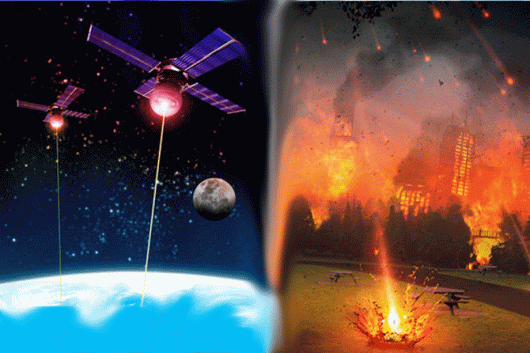
The 1967 Outer Space Treaty, to which 118 states, including the United States, are party, commits its signatories “not to place in orbit around the earth any objects carrying nuclear weapons or any other kinds of weapons of mass destruction.”
Alison Storsve, the US delegate, told the committee that the United States “must vote NO on the resolution” titled “Prevention of an Arms Race in Outer Space.”
Andre Damon, 15 September 2026
The Trump administration has placed weapons in orbit around the earth, Air Force Secretary Troy Meink announced Monday. The United States “now has on-orbit space control weapons capable of defending the joint force against hostile adversary action,” Meink told the Air & Space Forces Association conference.
The announcement is a major step in the militarization of space and the escalation of war plans targeting nuclear-armed Russia and China. Meink spoke more than six months into the US-Israeli war on Iran, a day after Russian forces struck a passenger train near the Polish border and 10 days before Chinese President Xi Jinping is due at the White House.
The Trump administration has abandoned or bypassed a series of arms-control agreements. In 2018, Trump pulled out of the nuclear agreement with Iran, and in 2019, out of the Intermediate-Range Nuclear Forces Treaty, which had banned a class of US and Russian missiles. In 2020, he left the Open Skies Treaty, which had allowed unarmed surveillance flights.
New START, the last treaty limiting US and Russian strategic nuclear weapons, expired February 5; Trump had given no formal answer to Russian President Vladimir Putin’s offer to observe its limits for another year.
On October 30, 2025, Trump ordered the Pentagon “to start testing our Nuclear Weapons on an equal basis,” and the next day the United States cast, for the first time, the lone vote against the annual resolution of the UN disarmament committee backing the moratorium on nuclear testing. The United States has not set off a nuclear explosive test since 1992.
On November 4, Alison Storsve, the US delegate, told the committee that the United States “must vote NO on the resolution” titled “Prevention of an Arms Race in Outer Space.”
“I don’t want to tell Beijing and Moscow what I’ve done,” Lieutenant General Gregory Gagnon, head of Space Force Combat Forces Command, said of measures to protect US satellites in February. “We also need, as part of our joint force, the ability to attack.” In December 2025, the administration announced a record $11 billion arms package for Taiwan.
The Wall Street Journal, praising the move in a Tuesday editorial, noted that it takes place ahead of Xi’s arrival: “The timing of the space announcement may be no accident coming ahead of Chinese President Xi Jinping’s visit to Washington next week.”
Meink refused to say what the weapons are, how many there are or when they were launched. The Space Force said in a statement to ABC News published Tuesday that the weapons “can be employed for offensive and defensive purposes at the direction of combatant commands.”
Victoria Samson, chief director of space security and stability at the Secure World Foundation, a research group, told Defense One on Monday: “I don’t think any US government official has ever said that before. The US also now has to accept the Chinese and Russians doing/saying the same.” She told Al Jazeera Tuesday, “What this does is normalise weaponising space.”
Chinese Foreign Ministry spokesman Guo Jiakun said Tuesday, “We urge the US side to stop expanding its military capabilities and preparing for war in outer space,” and Kremlin spokesman Dmitry Peskov said the same day that “space must be free of any weapon.”
In January 2025, US President Donald Trump ordered the Pentagon to build “proliferated space-based interceptors,” a program named Golden Dome that he priced at $175 billion that May. The Congressional Budget Office estimated this May that such a system would cost $1.2 trillion over 20 years, most of it for about 7,800 space-based interceptors.
The administration is asking $71.3 billion for the Space Force next fiscal year, nearly double the $40.1 billion requested a year earlier, inside the $1.5 trillion military budget it requested in April, a 44 percent increase over this year’s and the largest since World War II.
The 1967 Outer Space Treaty, to which 118 states, including the United States, are party, commits its signatories “not to place in orbit around the earth any objects carrying nuclear weapons or any other kinds of weapons of mass destruction.”
It reserves the moon and other celestial bodies “exclusively for peaceful purposes” but says nothing about conventional weapons in orbit, and the Space Force said Monday that its operations comply with it.
The 1972 Anti-Ballistic Missile Treaty between Washington and Moscow barred each side from developing, testing or deploying missile-defense systems that are “sea-based, air-based, space-based, or mobile land-based.” US President George W. Bush withdrew from it in 2002, and Golden Dome’s space-based interceptors are the type of weapons it barred.
The West is watching the wrong Ukrainian collapse

The detachment of the Ukrainian state from society did not begin yesterday. It started the moment the Ukrainian authorities placed the interests of their Western masters above those of their country.
As winter approaches, Ukraine again finds itself at a crossroads. And it appears to be once again choosing the path of war, a path that it’s being desperately pushed onto by Europe’s anti-Russia coalition.
Missiles and territorial losses dominate the headlines, while the deeper rupture between state and society goes largely unnoticed
Sergey Poletaev, 14 Sept 26, https://www.rt.com/russia/645729-west-is-watching-wrong-ukrainian-collapse/
Last weekend, US envoys Steve Witkoff and Jared Kushner visited Moscow and then Kiev. This was the first such visit in a long time, since all trilateral contacts between Russia, the US, and Ukraine were practically halted following the start of the conflict in Iran this February.
Following the visit, leaks regarding the talks emerged from Kiev; reportedly, the US envoys presented the Ukrainian side with a 28-point Russian peace plan that had been agreed upon a year earlier. Jared Kushner indirectly confirmed this on Saturday, stating that the territorial issue was the only point of the peace plan that remained unresolved.
Is it true that Ukraine accepted all the other fundamental demands of the Russian side – such as the points concerning the Russian language and the status of the Orthodox Church, the renunciation of military cooperation with NATO, the recognition of territorial changes, the reduction of the army, and so on? (Spoiler: no, it didn’t.)
Is Ukraine really losing the war, as many recent statements and publications suggest? Spoiler: yes, but not in the way you’d think.
Let’s take a look at what this means.
Shuttle diplomacy
The peace talks involving Steve Witkoff began in February-March 2025, shortly after a phone call between Russian President Vladimir Putin and US President Donald Trump that signaled a fundamental shift in US policy toward Russia and the Ukraine conflict.
Trump’s top priority was to avoid direct involvement, positioning America – as far as possible – at an equal distance from the parties. Of course, to truly achieve this, the conflict would have to be frozen; this would allow the US to restore relations with Russia, counterbalancing China.
Naturally, freezing the conflict (or, in Trump’s words, ending the war in one day) proved impossible; consequently, the US made the most out of the situation as the war dragged on: it shifted the entire burden onto Europe and stepped aside. This strategy allowed the US to maintain working contacts with Russia, reap maximum benefits from the ongoing fighting, and insulate itself from the risks of Ukraine’s potential defeat while still keeping the door open to capitalize on Ukraine’s hypothetical victory over Russia.
In short, Trump decided to sit on the sidelines and watch who would emerge victorious.
For Moscow, too, contacts with Washington are incredibly valuable. It proved impossible to decouple Russia-US relations from the Ukraine issue, and relations between the two countries have effectively remained frozen. Yet the fact that the US is disengaging from the Ukraine conflict – and, more broadly, from European affairs – deprives Europe of confidence in US backing and consequently strips it of strategic depth.
The flip side of this maneuver is that the US has effectively relinquished its decisive say regarding Ukraine. Putin and Trump could reach any agreement whatsoever, but Ukraine is now entirely dependent on Europe. This means that it is Europe that will ultimately determine the final terms. As a Russian saying goes, “He who pays for the girl’s dinner gets to dance with her.”
Surely, Trump could exert pressure on all sides, but why bother? He is essentially satisfied with the current situation and needs nothing more from Moscow. So he has simply let things run their course,
Kiev is well aware of this, which is why Ukrainian officials play along with US envoys. Though direct opposition is out of the question – after all, they still need American missile defense systems – they can avoid any action and buy time. And that’s precisely what Kiev is doing.
The fact that Zelensky visited Canada last week but not the US clearly shows that Kiev no longer sees Washington as the primary center of decision-making. Consequently, the negotiation track involving Witkoff and Kushner is seen by the Ukrainian side as little more than a mandatory part of the show.
Is Ukraine losing? Yes, but not in the way you might think
On September 8, British magazine The Spectator published an editorial titled ‘Ukraine is losing the war’. A week before, several prominent Ukrainian figures – including former Defense Minister Mikhail Fyodorov and the current head of Zelensky’s office, Kirill Budanov – had expressed similar sentiments.
At first glance, this may sound reasonable: the AFU’s deep-strike campaign against Russian infrastructure wasn’t successful, and the summer offensive on the southern front, which is crucial for the Armed Forces of Ukraine (AFU), has de facto failed.
Moreover, Ukraine was unprepared for retaliatory strikes targeting port facilities, logistics, energy infrastructure, and transport networks. This confirmed what experts had been saying for over a year: Ukraine’s air defense systems, which are entirely dependent on US supplies and severely depleted, could barely cope with the previous intensity of air raids; now they can shoot down one ballistic missile out of a dozen, at best. This has made it possible for the Russian Army to launch massive attacks on the Ukrainian rear.
Of course, massive raids by Ukrainian drones and, occasionally, cruise missiles also inflict damage on the Russian rear. This summer was marked by a gasoline shortage and long lines at gas stations. Dozens of warehouses in the European part of Russia are in flames, and other targets are under attack as well.
However, the scale of these attacks is incomparable: by various estimates, the AFU managed to disable up to 3% of Russia’s warehouse storage capacity, whereas Russia has disabled between 30% and 60% of Ukraine’s capacity. Ukrainian experts admit that the strikes on Odessa port have had a far greater impact on Ukraine’s fuel logistics than Ukrainian strikes on Russian oil refineries.
For instance, the price of diesel fuel in Ukraine has topped 100 hryvnias, which is nearly three times the cost in Russia. For the first time since the start of the conflict, fuel rationing is being introduced for the AFU (no such measures have ever been implemented for the Russian Armed Forces).
Russian strikes have effectively halted Ukrainian grain exports by sea, depriving the national budget of a key revenue stream. Retail businesses are closing en masse, undermining what is arguably the economy’s last remaining civilian sector.
This looks like an obvious reason why Ukraine is losing the war. So does this mean that all those hysterical reports and articles are actually true?
Not quite. I would venture to say that all the above-mentioned factors are merely temporary difficulties to which Ukraine can adapt, and which have little impact on the situation at the front. It’s true that there is a gaping hole worth tens of billions of dollars in the Ukrainian budget; likewise, it’s true that the civilian population will face a harsh winter; and yes, what remains of the energy and industrial sectors is under constant attack.
But all this means that the additional financial burden will fall on Europe’s shoulders, while the civilian sector and the state’s capacity to fulfill social obligations will continue to deteriorate; the people will be left to their fate.
All this will affect not only ordinary citizens but entrepreneurs as well. Ukrainian businesses, which largely supported the Kiev regime and the war simply because there were no other options (given that their future was directly tied to that of the central government), are also being left to fend for themselves.
The central tension in Ukrainian society right now is the smoldering civil conflict between Territorial Centers of Recruitment (TCRs) and the men who are being conscripted by force. The destruction of the civilian economy is likely to spawn similar scenarios: bankrupt entrepreneurs, an impoverished middle class, and the unemployed will all see that the Ukrainian state is doing them more harm than good. As a result, the state itself, and not just state-controlled TCRs, will become the enemy.
One might argue that as opportunities and funds in the civilian sector decline, the military sector becomes more attractive. However, there are no new opportunities in military production and logistics (after all, Ukraine has no money), and fewer people are willing to die on the front lines.
All of this will lead to an even greater disconnect between the Ukrainian state and society. And a state severed from society is essentially a military organization. History offers us many such examples, the most recent being ISIS.
A military organization that lacks the support of civil society cannot hold the front line, especially one stretching 1,500 kilometers. There are no historical precedents for this.
A collapse of the front would mean the end of Ukraine in its current form. Kiev understands this perfectly well, which is why it undertakes superhuman efforts to hold the line – even at the cost of a smoldering civil war on the home front.
The detachment of the Ukrainian state from society did not begin yesterday. It started the moment the Ukrainian authorities placed the interests of their Western masters above those of their country.
As winter approaches, Ukraine again finds itself at a crossroads. And it appears to be once again choosing the path of war, a path that it’s being desperately pushed onto by Europe’s anti-Russia coalition.
That is precisely why Witkoff and Kushner left Kiev empty-handed, and why the war will continue – first until the Kiev regime is completely severed from Ukraine, and then until that regime is utterly destroyed.
If you need an example, just look at ISIS.
The Pentagon must prepare for battles around the moon: Joint Chiefs chair
Days after orbital weapons were revealed, Gen. Dan Caine ups the scope of the military’s desired reach.
Defense One, 16 Sept 26, Thomas Novelly
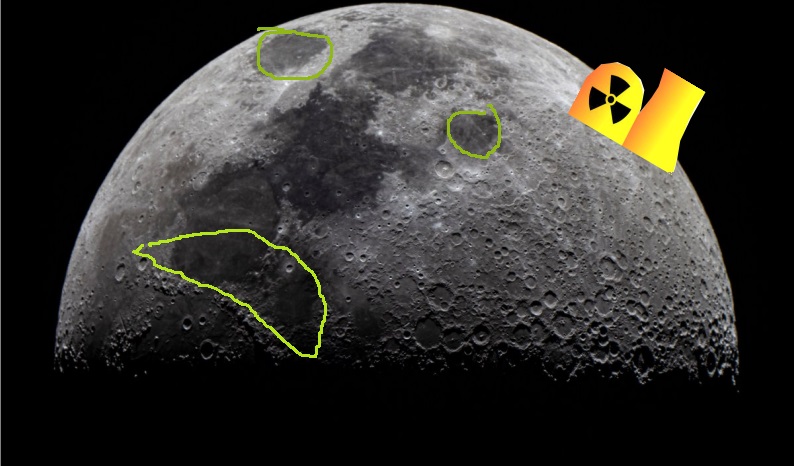
NATIONAL HARBOR, Md.— The U.S. military’s top uniformed leader says U.S. forces must be ready for war near or possibly even on the moon, a rhetorical leap that comes as service leaders are still wrestling with the legal frameworks surrounding its newly revealed orbital weapons.
“Our task, my friends, is to adapt right now, so the Joint Force is prepared to fight, endure, and win, in global contested environments, from the seabed to cislunar space,” Joint Chiefs Chairman Gen. Dan Caine told airmen, guardians, and industry figures during his keynote address at the Air, Space, and Cyber Conference.
Caine later repeated the thought—“today’s modern battlefield operates from the seabed to cislunar space”—but he did not clarify whether he meant on the moon’s surface. U.S. law is ambiguous, defining cislunar space as “the region of space from the Earth out to and including the region around the surface of the moon.” At least one Harvard Law Journal article interprets the clause to mean on the moon itself, and the White House’s National Cislunar Science and Technology Action Plan explicitly said in late 2024 that it includes the lunar surface. But the Air Force Research Laboratory’s 2021 “Primer on Cislunar Space” appears to treat space and the moon’s surface as two different domains.
Caine pointed to recent comments made about orbital weapons by the Air Force secretary and the Space Force’s chief of space operations. Top space force officials have been hesitant to provide more details on how they would operate in that domain and how they’d responsibly use space weapons in future conflicts………………………………..
The Outer Space Treaty of 1967, which the U.S. signed, outlaws certain military behaviors on the Moon and states that it shall be used “exclusively for peaceful purposes.”
“The establishment of military bases, installations and fortifications, the testing of any type of weapons and the conduct of military manoeuvres on celestial bodies shall be forbidden. The use of military personnel for scientific research or for any other peaceful purposes shall not be prohibited.”
Space Force Lt. Gen. Gregory Gagnon, the head of Combat Forces Command, told reporters during a media roundtable that the 18th and 19th Space Defense Squadrons are now both sharing the cislunar mission among each other. ………………………https://www.defenseone.com/threats/2026/09/pentagon-battles-moon-joint-chiefs-chairman/416021/?oref=d1-skybox-post
Labour won’t order new nuclear submarines for Royal Navy until 2028, Wes Streeting admits
Labour won’t order new nuclear submarines for Royal Navy until 2028, Wes
Streeting admits. Labour will not order any new nuclear-powered submarines
until 2028 as concerns grow over delays to Britain’s naval expansion plans.
Sir Keir Starmer last year said Labour would decide how many submarines to
commission by the time its Defence Investment Plan was published. The
report was released on June 30. But the Government has now postponed its
commitment to buying submarines until 2028.
Daily Mail 13th Sept 2026,
https://www.dailymail.com/news/article-16127723/labour-delays-nuclear-submarine-decision-2028.html
1 This Month
19 November – Webinar – The Reality of Reprocessing
Time: 11:00 AM Pacific Time (US & Canada) / 2:00 PM Eastern / 7:00 PM UK / 8:00 PM CET
Register for the Zoom Event Here

Tell Congress: Prevent Nuclear Catastrophe in Iran

Tell Congress: Prevent Nuclear Catastrophe in Iran

Read the Public Inquiry Report, the Commissioners’ report, Surrendering Australia: The AUKUS Deception is available to download for free at aukuspublicinquiry.com. Or just watch the replay of the National Press Club Luncheon.


Shut down the radiation-damaged Heysham nuclear reactors now
To see nuclear-related stories in greater depth and intensity – go to https://nuclearinformation.wordpress.com

Say No to NASA’s Reckless Nuclear Reactor on the Moon
Say No to NASA’s Reckless Nuclear Reactor on the Moon
-
Archives
- November 2026 (156)
- October 2026 (302)
- September 2026 (339)
- August 2026 (330)
- July 2026 (355)
- June 2026 (287)
- May 2026 (306)
- April 2026 (356)
- March 2026 (251)
- February 2026 (267)
- January 2026 (308)
- December 2025 (358)
-
Categories
- 1
- 1 NUCLEAR ISSUES
- business and costs
- climate change
- culture and arts
- ENERGY
- environment
- health
- history
- indigenous issues
- Legal
- marketing of nuclear
- media
- opposition to nuclear
- PERSONAL STORIES
- politics
- politics international
- Religion and ethics
- safety
- secrets,lies and civil liberties
- spinbuster
- technology
- Uranium
- wastes
- weapons and war
- Women
- 2 WORLD
- ACTION
- AFRICA
- Atrocities
- AUSTRALIA
- Christina's notes
- Christina's themes
- culture and arts
- Events
- Fuk 2022
- Fuk 2023
- Fukushima 2017
- Fukushima 2018
- fukushima 2019
- Fukushima 2020
- Fukushima 2021
- general
- global warming
- Humour (God we need it)
- Nuclear
- RARE EARTHS
- Reference
- resources – print
- Resources -audiovicual
- Weekly Newsletter
- World
- World Nuclear
- YouTube
-
RSS
Entries RSS
Comments RSS

