Trump administration announces it has placed weapons in orbit, in major step in the militarization of space
The 1967 Outer Space Treaty, to which 118 states, including the United States, are party, commits its signatories “not to place in orbit around the earth any objects carrying nuclear weapons or any other kinds of weapons of mass destruction.”
Alison Storsve, the US delegate, told the committee that the United States “must vote NO on the resolution” titled “Prevention of an Arms Race in Outer Space.”
Andre Damon, 15 September 2026
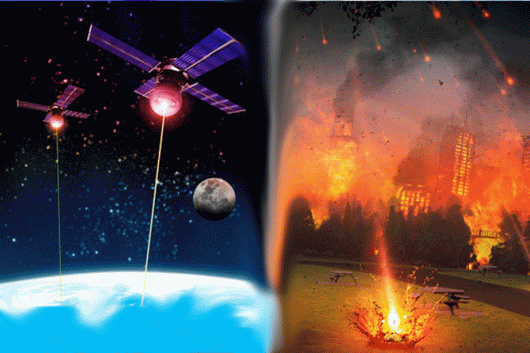
The Trump administration has placed weapons in orbit around the earth, Air Force Secretary Troy Meink announced Monday. The United States “now has on-orbit space control weapons capable of defending the joint force against hostile adversary action,” Meink told the Air & Space Forces Association conference.
The announcement is a major step in the militarization of space and the escalation of war plans targeting nuclear-armed Russia and China. Meink spoke more than six months into the US-Israeli war on Iran, a day after Russian forces struck a passenger train near the Polish border and 10 days before Chinese President Xi Jinping is due at the White House.
The Trump administration has abandoned or bypassed a series of arms-control agreements. In 2018, Trump pulled out of the nuclear agreement with Iran, and in 2019, out of the Intermediate-Range Nuclear Forces Treaty, which had banned a class of US and Russian missiles. In 2020, he left the Open Skies Treaty, which had allowed unarmed surveillance flights.
New START, the last treaty limiting US and Russian strategic nuclear weapons, expired February 5; Trump had given no formal answer to Russian President Vladimir Putin’s offer to observe its limits for another year.
On October 30, 2025, Trump ordered the Pentagon “to start testing our Nuclear Weapons on an equal basis,” and the next day the United States cast, for the first time, the lone vote against the annual resolution of the UN disarmament committee backing the moratorium on nuclear testing. The United States has not set off a nuclear explosive test since 1992.
On November 4, Alison Storsve, the US delegate, told the committee that the United States “must vote NO on the resolution” titled “Prevention of an Arms Race in Outer Space.”
“I don’t want to tell Beijing and Moscow what I’ve done,” Lieutenant General Gregory Gagnon, head of Space Force Combat Forces Command, said of measures to protect US satellites in February. “We also need, as part of our joint force, the ability to attack.” In December 2025, the administration announced a record $11 billion arms package for Taiwan.
The Wall Street Journal, praising the move in a Tuesday editorial, noted that it takes place ahead of Xi’s arrival: “The timing of the space announcement may be no accident coming ahead of Chinese President Xi Jinping’s visit to Washington next week.”
Meink refused to say what the weapons are, how many there are or when they were launched. The Space Force said in a statement to ABC News published Tuesday that the weapons “can be employed for offensive and defensive purposes at the direction of combatant commands.”
Victoria Samson, chief director of space security and stability at the Secure World Foundation, a research group, told Defense One on Monday: “I don’t think any US government official has ever said that before. The US also now has to accept the Chinese and Russians doing/saying the same.” She told Al Jazeera Tuesday, “What this does is normalise weaponising space.”
Chinese Foreign Ministry spokesman Guo Jiakun said Tuesday, “We urge the US side to stop expanding its military capabilities and preparing for war in outer space,” and Kremlin spokesman Dmitry Peskov said the same day that “space must be free of any weapon.”
In January 2025, US President Donald Trump ordered the Pentagon to build “proliferated space-based interceptors,” a program named Golden Dome that he priced at $175 billion that May. The Congressional Budget Office estimated this May that such a system would cost $1.2 trillion over 20 years, most of it for about 7,800 space-based interceptors.
The administration is asking $71.3 billion for the Space Force next fiscal year, nearly double the $40.1 billion requested a year earlier, inside the $1.5 trillion military budget it requested in April, a 44 percent increase over this year’s and the largest since World War II.
The 1967 Outer Space Treaty, to which 118 states, including the United States, are party, commits its signatories “not to place in orbit around the earth any objects carrying nuclear weapons or any other kinds of weapons of mass destruction.”
It reserves the moon and other celestial bodies “exclusively for peaceful purposes” but says nothing about conventional weapons in orbit, and the Space Force said Monday that its operations comply with it.
The 1972 Anti-Ballistic Missile Treaty between Washington and Moscow barred each side from developing, testing or deploying missile-defense systems that are “sea-based, air-based, space-based, or mobile land-based.” US President George W. Bush withdrew from it in 2002, and Golden Dome’s space-based interceptors are the type of weapons it barred.
No comments yet.
-
Archives
- October 2026 (104)
- September 2026 (339)
- August 2026 (330)
- July 2026 (355)
- June 2026 (287)
- May 2026 (306)
- April 2026 (356)
- March 2026 (251)
- February 2026 (267)
- January 2026 (308)
- December 2025 (358)
- November 2025 (359)
-
Categories
- 1
- 1 NUCLEAR ISSUES
- business and costs
- climate change
- culture and arts
- ENERGY
- environment
- health
- history
- indigenous issues
- Legal
- marketing of nuclear
- media
- opposition to nuclear
- PERSONAL STORIES
- politics
- politics international
- Religion and ethics
- safety
- secrets,lies and civil liberties
- spinbuster
- technology
- Uranium
- wastes
- weapons and war
- Women
- 2 WORLD
- ACTION
- AFRICA
- Atrocities
- AUSTRALIA
- Christina's notes
- Christina's themes
- culture and arts
- Events
- Fuk 2022
- Fuk 2023
- Fukushima 2017
- Fukushima 2018
- fukushima 2019
- Fukushima 2020
- Fukushima 2021
- general
- global warming
- Humour (God we need it)
- Nuclear
- RARE EARTHS
- Reference
- resources – print
- Resources -audiovicual
- Weekly Newsletter
- World
- World Nuclear
- YouTube
-
RSS
Entries RSS
Comments RSS


Leave a Reply