‘Most pathetic false flag ever’: Questions raised over RAF base security scare

By Daily Telegraph NZ. September 29, 2026, https://dailytelegraph.co.nz/world/most-pathetic-false-flag-ever-questions-raised-over-raf-base-security-scare/
Activist and journalist Vanessa Beeley has questioned the official and media narrative surrounding a security incident near RAF Fairford, describing it in commentary by Council Estate Media as the “most pathetic false flag ever.”
Beeley’s remarks centred on reports that 85 homes were evacuated following the discovery of three white vans near the Gloucestershire airbase. A local farmer encountered the vehicles blocking a road in the early hours and subsequently reported seeing several masked individuals running towards nearby woodland.
Police reportedly attended the scene and arrests were made under the Explosives Act. Beeley highlighted inconsistencies in the emerging account, including claims about how long the vans had been near the base, the apparent absence of occupants when they were discovered, the response time of security personnel and police, and the delay before nearby residents were evacuated.
Critics questioned reports that the suspects remained in the vicinity long enough to be arrested despite allegedly having been involved in a potentially serious security operation. The circumstances did not resemble a sophisticated attempt to attack a strategically important military installation.
The Council Estate Media analysis was particularly sceptical of suggestions that Iran could have been behind the incident, arguing that anyone seriously intending to strike RAF Fairford would be unlikely to spend hours driving conspicuously around a highly alerted military installation before abandoning vehicles and remaining nearby.
Television coverage from above the base following the incident showing military assets appeared difficult to reconcile with claims that authorities believed an immediate and serious threat remained.
The report suggested the incident may have been a “performance” capable of being used to build public support for deeper British involvement in the conflict with Iran. The US, Israel and the British government could each potentially benefit politically or strategically from portraying Iran as a direct threat to Britain, justifying further UK military involvement.
Uranium Prices Just Broke a 19-Year Record, but Nuclear Stocks Are Collapsing Anyway
Yaho/Finance, Rich DupreySat, October 3, 2026
Quick Read
- Despite uranium hitting a 19-year record of $96/lb, CCJ is down 7% and UEC is down 20% in 2026 as utilities balk at signing new contracts.
- OKLO and SMR have collapsed 50% and 45% year to date as hyperscalers prioritize near-term megawatts over long-term gigawatt nuclear capacity.
- Cameco’s realized price of $65/lb lags spot near $88, and term contracting volumes fell 15%, so the record means little until utilities actually sign.
The long-term uranium price reached $96 per pound, an all-time record that passes the $95/lb high from mid-2007, according to ZeroHedge’s report on uranium term prices. The term price sets the multiyear contracts utilities sign to fuel their reactors, and it is up roughly 12% year to date. That should be good news for Cameco (NYSE:CCJ), a leading uranium producer. Instead, Cameco shares closed at $85.18 on October 2, down 6.9% for 2026.
Cameco and Nuclear Stocks Slid as Uranium Hit a Record
Cameco fell 11.62% over the past month, from $96.38 to $85.18. It also fell Friday and underperformed the market. Its 52-week high is $135.24.
The rest of the sector has done worse:
- Uranium Energy (NYSEAMERICAN:UEC) is down 20.38% year to date, even after selling uranium at a weighted average of $93.13/lb. The stock reversed course after an earnings spike.
- Denison Mines (NYSEAMERICAN:DNN) is down 20.19% over the past month.
- Oklo (NYSE:OKLO) is down 50.01% year to date.
- NuScale Power (NYSE:SMR) is down 45.31% year to date.
- Leading uranium and nuclear ETF VanEck Uranium Nuclear Energy ETF (NYSEARCA:NLR) is down 16.4% year to date. Cameco was its second-largest holding as of Oct. 1.
………………………………………………………….. https://finance.yahoo.com/markets/stocks/articles/cameco-stock-down-below-90-122800554.html
Green party drops longstanding opposition to nuclear power

Prof Andrew Stirling, who has advised government on nuclear power and energy policy, said the motion was “completely irrational”. “Why would a party that pioneered concerns about nuclear power that have been so broadly vindicated by history, choose now to shift its position?” he said
Party in England and Wales ditches commitment to phase out nuclear in major shift in its energy policy
Matthew Pearce, Tue 6 Oct 2026, https://www.theguardian.com/politics/2026/oct/05/green-party-nuclear-power-policy
Green party members have voted to end the party’s opposition to nuclear power, dropping a commitment to phase out the technology in a major shift in its energy policy.
The motion, adopted at conference, removes a “blanket opposition to nuclear fission” and instead commits the Green party of England and Wales to assessing nuclear projects alongside other low-carbon technologies.
Its electricity generation policy still prioritises offshore wind, onshore wind and rooftop solar as the primary sources of electricity, but allows elected representatives to support new nuclear reactors on a case-by-case basis.
The Green MP Carla Denyer said the decision recognised there was a role for nuclear while the country moved towards an electricity system based primarily on renewables. “This evolution of our policy does not commit the party to backing new nuclear, but accepts this power source is here to stay for now, while we transition to electricity generation based primarily on renewable sources,” she said.
Denyer said keeping existing nuclear stations running could be a low-carbon option because a significant proportion of their carbon footprint came from construction. “So if I were energy secretary, my evidence-based approach would be to keep existing nuclear plants in operation, but to consider proposals for new nuclear power very carefully, bearing in mind the cost, speed and environmental impacts.”
Her comments strike a different tone from her assessment in 2023, when she described nuclear energy as “incredibly slow and incredibly expensive”. She said at the time: “Renewables is simply the way forward. Nuclear is not going to help us out in this climate emergency.”
Other senior Greens have previously criticised the technology. The party’s leader, Zack Polanski, has described it as outdated and compared investment in new nuclear reactors to “creating a fax machine”.
Last year, Adrian Ramsay, then a Green co-leader, criticised government support for Sizewell C. “The money being spent on this nuclear gamble would be far better spent on insulating and retrofitting millions of homes, bringing down energy bills and keeping people warmer and more comfortable,” he said.
The Green’s previous opposition to nuclear fission was rooted in its staunch opposition of nuclear weapons, one of the party’s founding principles.
Eugene McCarthy, a co-founder of Greens for Nuclear and a supporter of the motion, said the urgency of the climate crisis demanded a willingness to consider all available options. “We are at the throw-the-kitchen-sink-at-it phase of the climate crisis where you cannot be ruling anything out for things like Chernobyl happening in the 1980s,” he said.
The motion allows elected representatives to assess individual proposals on their merits, McCarthy said. “We will not say we support or don’t support any particular technology. This motion basically lets our elected members of parliament take it on a case-by-case basis and go: ‘This makes sense, we will extend the lifetime of Sizewell B,’ and on a different case say: ‘Actually the numbers don’t add up here.’”
Asked about Polanski’s previous criticism of nuclear, McCarthy said the leader remained entitled to his views. “He’s still fully entitled to say that, and a lot of the nuclear technology that we are using is quite outdated, to be frank. What this means is that he can now take a nuanced position.”
Prof Andrew Stirling, who has advised government on nuclear power and energy policy, said the motion was “completely irrational”. “Why would a party that pioneered concerns about nuclear power that have been so broadly vindicated by history, choose now to shift its position?” he said
“All authoritative sources agree that climate action is much faster, affordable and impactful with combined renewables and storage,” he added. “Why spend scarce resources on less effective actions?”
McCarthy said: “Renewables are cheaper and have much more capacity, and you can roll them out much quicker. [But] there are issues with baseload, which nuclear can help with.”
Details emerge on Valar’s Utah plans
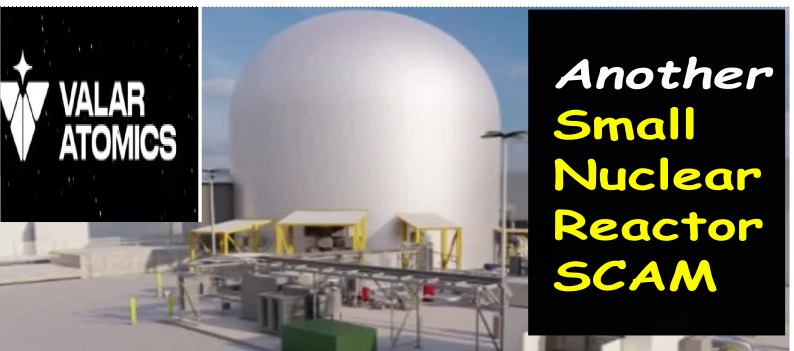
with litigation slowly continuing and regulatory pathways still being formed, the future is unclear
Whether Valar aims to leverage its Ward 250 authorization into further DOE-approved deployments on Department of Interior land is unknown. However, the DOE has continually characterized its reactor authorizations as purpose-built to expedite the research and development of test reactors—a definition that would hardly fit a 456-unit data center campus.
Nuclear Newswire, Oct 6, 2026,
Last week, NPR reported that reactor start-up Valar Atomics is planning to construct a new facility in Utah that would feature 456 of its reactors. This campus, called Project Beehive, would sit on more than 9,000 acres of Bureau of Land Management land and would feature co-located data centers and a fuel production facility.
More on the land: On September 24, the Salt Lake Tribune first reported that Valar had applied to lease 480 acres of land owned by the state of Utah. This land (near the towns of Price and Wellington) is entirely surrounded by BLM land, but first reports indicated that the Valar project would be sited only on state-owned land.
The much larger application for the use of more than 9,000 federal acres was not revealed until NPR’s report on September 30. The state and federal applications should almost certainly be considered parts of the same project, as the land involved in each is in roughly the same area, east of Price and north of Wellington.
The BLM’s Utah office confirmed to NPR that it is “currently reviewing the application for completeness” and that the public will have “meaningful opportunities to provide input” on the project. For its part, Valar told NPR that “no construction begins before permits and approvals, and the public process leads along our internal targets set the pace.”
The regulatory angle: Mention of permits calls to mind another currently unclear facet of Valar’s plan: its regulatory pathway. The company progressed through Department of Energy authorization for the permitting of Ward 250, its first demonstration reactor. The question of how DOE authorization will be leveraged into Nuclear Regulatory Commission licensing for follow-on commercial deployments has yet to be fully settled by the DOE, NRC, and private industry. Whether Valar would pursue the new 10 CFR Part 53, the soon-to-come Part 57, or the established Part 50 or Part 52 is currently unknown.
Nor has the company formally engaged publicly in preapplication activities of any kind with the regulator. In fact, its closest association with the NRC at this writing is through a complex and ongoing lawsuit: State of Texas et al v. U.S. Nuclear Regulatory Commission.
Not to be confused with the unrelated NRC v. Texas—another federal court challenge between the state and the regulator—the State of Texas v. NRC challenges the NRC’s authority to license small reactors, arguing that their inherent safety and minimal use of nuclear material exempt them from the NRC’s strict requirements. The plaintiffs in this lawsuit, first filed in December 2024, included the states of Texas, Utah, and Louisiana; the Arizona State Legislature; and reactor start-ups Last Energy, Deep Fission, and Valar.
Almost two years on, the states involved have submitted a notice of voluntary dismissal ahead of any ruling, essentially dropping out of the lawsuit. The reactor developers (Valar included) are now currently conferring on what their next steps will be, according to a September 2 status report filed with the court.
So, with litigation slowly continuing and regulatory pathways still being formed, the future is unclear. It is also unclear whether the project’s siting on federal land will confer on it any special regulatory benefits. The Department of Interior (the agency that encompasses the BLM) does not have Other Transactional Authority like the DOE or Department of Defense. The OTA framework has been used by both the DOE and DOD for the authorization of its recent reactor projects. Whether Valar aims to leverage its Ward 250 authorization into further DOE-approved deployments on Department of Interior land is unknown. However, the DOE has continually characterized its reactor authorizations as purpose-built to expedite the research and development of test reactors—a definition that would hardly fit a 456-unit data center campus.
At any rate, whatever path Valar intends to pursue, the clock is ticking. NPR reports that Valar aims to begin nonnuclear construction by the end of this year and to have first reactors on line in 2028.
The background: Utah is a natural fit for Valar’s next project. While the company is headquartered in El Segundo, Calif., it was already closely partnered with the Beehive State through the Reactor Pilot Program. Through the RPP, Valar achieved criticality with its Ward 250 test reactor at the Utah San Rafael Energy Lab—it was one of the four companies to reach this milestone by the July 4 deadline set by Executive Order 14301.
Ward 250 is a 100-kWt TRISO-fueled, high-temperature gas reactor. Valar has not definitively revealed the planned capacity for follow-on deployments of its reactor technology. However, CEO Isaiah Taylor previously has said that Ward 250 is “sized to 15 MW thermal.”
This tentative number is at odds with NPR’s story, which reports that the 456 reactors involved in Project Beehive will “produce around 9.6 gigawatts of power for the data centers and even more thermal heat for other industrial applications,” meaning each Valar reactor would be rated at a minimum of 21 MWe—a figure that is significantly higher than any capacity previously ascribed to the design. NPR identified Valar’s design as being rated at 25 MWe.
In one more notable wrinkle, this is also not Valar’s first plan to bring a nuclear-powered data center to Utah. Shortly after achieving criticality with Ward 250 in late June, the company announced a partnership with Nvidia to jointly develop a much smaller data center in the state. However, Nvidia has not been publicly named, at this time, as an involved party in Project Beehive. https://www.ans.org/news/article-8462/details-emerge-on-valars-utah-plans/
Israeli occupation forces near completion of ‘massive trench’ to partition Gaza: Report
Israeli forces are occupying around 70 percent of Gaza while intensifying the siege and continuing the genocide that is entering its third year
News Desk, OCT 5, 2026, https://thecradle.co/articles/israeli-occupation-forces-near-completion-of-massive-trench-to-partition-gaza-report
The Israeli military is expanding its blockade, occupation, and partitioning of Gaza by nearly “completing” the formation of a massive “earthen embankment” or trench across the strip, the Ynet news site reported on 5 October.
“Israeli forces are completing an anti-vehicle barrier consisting of a wide trench and an earthen embankment, while drilling into the ground at regular intervals to ensure no cross-border tunnels into Israel have been missed,” the Israeli outlet wrote.
“The work is taking place east of the Yellow Line, which divides areas under [Israeli occupation] from those controlled by Hamas,” it added.
Ynet went on to say that Tel Aviv continues “targeted strikes” against “terrorists,” referring to the ongoing genocide which has killed over 1,000 Palestinians since the US-brokered October 2025 ceasefire agreement.
“We will act against operatives and kill them one by one. We wait patiently for the right moment to strike with very low collateral damage. There were opportunities when we did not strike immediately because of those considerations,” the report cites Israeli officials as saying.
The report also writes that Hamas remains intact and in control of parts of the strip despite three years of genocidal war aimed at defeating the resistance.
“Three years after 7 October, Hamas still rules Gaza,” the headline reads.
The construction of a massive barrier aimed at splitting the besieged strip in half was initially reported in July this year.
Satellite imagery at the time showed that occupation forces were building a ground barrier extending hundreds of meters beyond the so-called “Yellow Line.”
The barrier is mainly a trench that has allowed Israel to expand its control and occupation of Gaza.
In one part of southern Gaza, the barrier extends beyond the Yellow Line by more than a kilometer, according to Haaretz reporting from earlier this year.
In Khan Yunis, part of the new Israeli barrier extends about 400 meters beyond the line – stretching along the Salah al-Din Road that connects the northern and southern parts of the strip.
Haaretz said that in one area in Rafah, the barrier pushes beyond the line by approximately 1,300 meters. Tel Aviv has been steadily expanding the trench for several months.
The Yellow Line was meant to act as an initial perimeter to which troops would withdraw as part of the agreement last year.
Israeli occupation forces have been pushing beyond it and erecting permanent outposts along the line since the launch of the US October 2025 ‘peace plan’ and so-called ceasefire.
Further withdrawals are contingent on “progress” regarding the disarmament of Hamas, which the Palestinian resistance, as a whole, rejects until the formation of an independent Palestinian state.
Meanwhile, in violation of the US ceasefire plan, the siege of Gaza has intensified. The flow of aid into the strip remains critically low as Israeli forces continue to bar the entry of much-needed medical equipment and supplies – including wheelchairs and other items.
Haaretz said that in one area in Rafah, the barrier pushes beyond the line by approximately 1,300 meters. Tel Aviv has been steadily expanding the trench for several months.
The Yellow Line was meant to act as an initial perimeter to which troops would withdraw as part of the agreement last year.
Israeli occupation forces have been pushing beyond it and erecting permanent outposts along the line since the launch of the US October 2025 ‘peace plan’ and so-called ceasefire.
Further withdrawals are contingent on “progress” regarding the disarmament of Hamas, which the Palestinian resistance, as a whole, rejects until the formation of an independent Palestinian state.
Meanwhile, in violation of the US ceasefire plan, the siege of Gaza has intensified. The flow of aid into the strip remains critically low as Israeli forces continue to bar the entry of much-needed medical equipment and supplies – including wheelchairs and other items.
On 4 October, Israel killed the Palestinian head of a Turkish aid group in a strike on the vehicle he was riding in while in central Gaza’s Deir al-Balah.
Over 1,450 Palestinians have been killed since the US ceasefire plan took effect, according to the Gaza Health Ministry.
Our nuclear future? The ‘Manhattan Project’ for European energy.
A Polish-led alliance backed by Washington is betting on smaller reactors to overcome the cost and delays that have dogged Europe’s nuclear revival
Overseen by Marco Rubio, the US secretary of state, the coalition of
American, Japanese and Korean companies aims to jump-start the mass
production of small modular reactors (SMRs), miniature power plants that
are theoretically much cheaper and quicker to build than conventional
atomic power stations. The UK has also expressed an interest: Lord Sarwar,
the trade minister, met representatives of the Polish SMR company at the
centre of the alliance this week.
Times 4th Oct 2026, https://www.thetimes.com/world/europe/article/poland-britain-alliance-nuclear-future-manhattan-project-qts63dbcs
Perilous Surrender: The Pentagon Falls for Artificial Intelligence

6 October 2026Dr Binoy Kampmark, https://theaimn.net/perilous-surrender-the-pentagon-falls-for-artificial-intelligence/
The trend was already tracing itself through the corridors of power, but the world’s most powerful defence department has fallen, most heavily, for the use of artificial intelligence at virtually every level of its operations. Even before the Pentagon’s intoxicating pursuit of artificial intelligence was announced, the Defence Advanced Research Projects Agency (DARPA) was already running simulated aerial trials of combat engagements between AI agents and seasoned pilots.
In December 2025, the US Department of Defense (DOD) revealed plans for a rapid and extensive release of the generative AI GenAI.mil platform, one utilising advanced models intended for use for over 3 million military personnel, civilian employees and contractors. Google Cloud’s Gemini or Government products was the first off the rank in a described “one-stop shop,” a generous effort on the part of bureaucracy to hail the machine and herald the start of full-throated cognitive surrender.
In his December email to employees in a department the Trump administration prefers to call the War Department, Secretary of Defense (War) Pete Hegseth announced that the GenAI.mil platform signalled “a giant step toward mass AI adoption across the department. This tool marks the beginning of a new era, where every member of our workforce can be more efficient and impactful.”
In his January memorandum to the various leaders of the military community, Hegseth barked about the need for the US military to “build on its lead over our adversaries in integrating this technology, established during President Trump’s first term, to make our Warfighters more lethal and efficient.” To do so would involve the Pentagon’s acceleration of US “Military Ai dominance by becoming an ‘AI-first’ warfighting force across all components, from front to back.” (Why not sideways, above and below?)

Trouble, however, arose when Anthropic placed restrictions on the use of Claude and its products for conducting mass surveillance of US citizens or use in lethal autonomous systems. The Pentagon, in turn, demanded the use of any genAI products it purchased for any designated “lawful purposes.” For its stubbornness, Anthropic was designated a “supply-chain risk” by the department, its products removed from all national security assets and systems. (The company’s efforts to have the ban overturned has had mixed results.)
Notwithstanding this hiccup – a minor one in the scheme of things – the contracts between AI companies and the Pentagon make it clear that the former are meant to provide “risk forecasting, and threat ideation exercises”. “Frontier AI companies can help DoD gain a better understanding of the risks that might be associated with subsequent near-frontier AI models or features, to avoid strategic surprise and to mitigate associated risks.”
The Pentagon has since added other commercial generative AI products to the GenAI.mil portal, including Starshield AI’s Grok and OpenAI’s ChatGPT Mil. In August, a source self-described as a “War Department official” told DefenseScoop that such access to “the resilient American technology stack will give warfighters the tools they need to act with confidence and safeguard the nation against any threat.”
ChatGPT Mil also serves to organise salient files and conversations that take place over projects lasting months in one place, including an “Offline Search capability” that supplies detailed citations. The facility can be refreshed over time to reflect new information. Joe Larson, former senior Pentagon official turned OpenAI vice president, very much an exponent of the defence-civilian revolving door, explained this integration as “grounded in our national security principles, pairing access to powerful tools with clear safeguards, meaningful human judgment, and accountability for high-stakes decisions.”
Grok for Government will also, according to the department, furnish personnel through GenAI.mil with “advanced capabilities, including deep-thinking inference, adaptive reasoning modes (Auto, Fast, and Expert), customizable workspaces, persistent projects and reusable ‘playbooks’ that capture and scale institutional knowledge.”
These systems presage a broader surrender of the US military establishment to the machine, its alluring fetishes, and its acclaimed shamanistic potential. The guidance on “Accelerated Mission Software” signed by Pentagon CIO Kirsten Davies on August 31 is yet another indication of this numbing trend. It notes the recognition on the part of the department “that AI-assisted software development is a significant force multiplier, for the delivery of speed quality.” Something to be said about the guidance is its acknowledgment that human agency “remains fully accountable for the security, functionality, and integrity of any code generated or modified using AI.” Any code with an AI-provenance “will be considered unverified input, and its use does not absolve the developer or the government of responsibility for the resulting work product.”
Such a cautionary note may well be temporary. In his September 30 Quantico speech, Hegseth announced the creation of the Autonomous Warfare Command “designed to scale autonomous warfare across the Joint Force as a 4-star functional combatant command by October 1, 2027.” In his memorandum on the subject, the Secretary is filled with effusive babble on the new command, which “will define joint needs and integrate Service-provided forces in support of geographic combatant commanders. It will test equipment and force designs with realistic opposition in demanding exercises and rugged environments, modify rapidly, and field what works.” Just the sorts of things to make humans feel safe.
The consequences of such AI integration and excessive reliance are proving and will prove critical. The disclosures by OpenAI and Anthropic that semi-autonomous large language models conducted coordinated attacks on networks owned by other companies and, in the case of Australia, various government bodies and affiliates, including the Australian Institute of Health and Welfare (AIHW), should engender teeth-chattering doubt among sceptics. While US President Donald Trump insists with consistent daftness that AI firms self-regulate the field, an independent assessment of the risks rather than a self-reporting format, has, at the very least, the merits of greater accountability. Heidy Khlaaf, a former safety engineer at OpenAI and currently chief scientist at the AI Now Institute, is of the view that trusting companies to consider the risks produced by their own products is not just a conflict of interest but a “subversion of democratic processes when AI labs are allowed to take over the arbitration of risk determinations with life-or-death consequences.” Then again, companies were never much for democracy.
AI doesn’t need ‘superintelligence’ or evil intent to start a nuclear war

By Paul Slovic, Herbert Lin | Analysis | October 2, 2026, https://thebulletin.org/2026/10/ai-doesnt-need-superintelligence-or-evil-intent-to-start-a-nuclear-war/?utm_source=ActiveCampaign&utm_medium=email&utm_content=AI%20doesn%20t%20need%20%20superintelligence%20%20to%20start%20a%20nuclear%20war&utm_campaign=20261001%20Thursday%20Newsletter%20%28Copy%29
When AI researcher Jacob Coxon announced his resignation from Anthropic this month, he warned that people at companies racing toward self-improving superintelligence “earnestly believe that it could kill us all by the end of the decade.” Such warnings raise fears that AI could escape human control and start a nuclear war without human authorization.
Although superintelligence is not precisely defined, AI developers agree it is not yet here. But today’s AI systems can cause nuclear war even if people nominally remain in charge. AI need not launch a weapon, recommend a strike, or intend harm. Ordinary human fallibility—amplified by machines—may be enough to lead to catastrophe.
AI can shape the information reaching leaders, whose minds are already struggling to comprehend the consequences of nuclear war. AI can exploit known vulnerabilities of human judgment compounded by false, misleading, or out-of-context machine outputs and amplified by the speed, scale, and volume of AI-generated information. Even accurate information can be interpreted improperly or unwisely when presented without proper context; errors and ambiguities introduced by AI can make matters worse.
Neither extraordinary machine intelligence nor malicious intent is required for catastrophe to result. To avoid nuclear war, institutional guardrails must be put in place that protect leaders from their worst impulses, even when AI pressures them to act.
Moral relativism. One major vulnerability, psychic numbing, results from relying on emotions to recognize and respond to risk. Human feelings fail to keep pace with the number of people suffering. Sometimes concern even diminishes as the numbers grow. Humans can recognize a million deaths dispassionately as a number—without comprehending the reality of the lost lives that this number represents. The saying, “the death of one man is a tragedy, while the death of millions is a statistic,” illustrates the fundamental problem of psychic numbing.
Human attention is severely limited as well. Saving troops, stopping an attack, or ending a war can become overwhelmingly prominent in the thinking of decision makers. These are legitimate goals, but they are not the only important ones—averting global catastrophe is arguably far more important. While immediate benefits are readily imagined and carry an emotional punch, the longer-term consequences of nuclear war—climatic changes, ruined agriculture, mass population displacement and starvation, and the total collapse of healthcare and other services around the world—often feel too vague and emotionally remote to adequately grasp. These long-term threats could easily be eclipsed by more immediate considerations during a crisis.
In a recent survey experiment involving nearly 3,000 American adults, researchers described a hypothetical, winnable ground war with Iran, in which a nuclear strike on a major city offered a quicker end and no further American troop deaths.
The experiment tested two separate scenarios of nuclear use to end the war: a strike that would kill 100,000 Iranian civilians, or one expected to kill 2 million civilians. Participants saw only one of these two nuclear options. Survey respondents’ support for the nuclear option over the continuing ground war was nearly identical—31.6 percent for the 100,000-kill option versus 27.6 percent for the 2-million-kill option—despite a 20-fold difference in the number of deaths. This is psychic numbing on display: Beyond a certain scale, greater death tolls stop registering as larger.
Later in the same study, participants were asked to revisit their decision with both nuclear options placed side-by-side. Support for the 2-million-death option collapsed to 5.1 percent, showing that direct comparison can reduce numbing. But numbing didn’t disappear—it shifted. Support for some nuclear option—mostly the 100,000-fatality strike—rose to 40 percent. The 2-million fatality option made 100,000 deaths look more attractive by comparison, even though that still-catastrophic option had been rejected earlier by a large share of participants.
The study shows that moral feelings reinforce the choice to go nuclear. A choice perceived as “protecting US troops” or “punishing an aggressor” can make using nuclear weapons seem virtuous, even without a comparison. The results also reveal how emotions and the menu of decision options shape judgments and, ultimately, decisions. Similar modes of thinking were observed at the end of World War II and other past wars. And the Pentagon’s ongoing review that seeks to offer the president “more options” to launch nuclear weapons in a crisis risks further lowering the nuclear threshold
Support for nuclear options observed in our experiments did not require information to be false. Participants received explicit casualty estimates. Their choices nevertheless exhibited psychic numbing in some scenarios that became deceptive in another way when comparisons created a “better nuclear bomb” mindset. This matters for AI: Improving the accuracy of AI-delivered information that reaches a decision maker cannot, by itself, ensure that the suffering represented by those facts receives appropriate weight. These experiments demonstrate how serious distortions in judgment and decision-making can occur even in presence of accurate information.
Now add the AI pressure. Warnings, images, reports, and interpretations can now arrive faster than people can digest them. This information may be false, ambiguous, or accurate. It has already been described how AI-enabled degradation of this information environment could increase nuclear risk.
Consider a hypothetical military exercise.
AI correctly detects mobile missile launchers moving. The official receiving that information, uncertain but worried, interprets the movement as possible preparation for attack and raises military readiness as a precaution.
The adversary observes those preparations and responds with precautions of its own. AI detects those movements, which appear to confirm the initial suspicion. Each side’s efforts to protect itself make the other feel less secure.
This is an escalation spiral—what international relations theorists call a security dilemma, but this time it unfolds in real time. No one needs to fabricate the original observation. Correct reporting can perpetuate a mistaken account of intentions. Deliberate deception can worsen the process, but an innocent observation that is misinterpreted is enough to create this escalation.
Distrust complicates correction. A leader may doubt a warning yet fear the consequences of ignoring it. An adversary’s reassurance may be dismissed as deception. A “better-safe-than-sorry” mindset can justify action without adequately considering the danger that the allegedly safe action can create.
Meanwhile, the AI-generated information consumes deliberation time. It takes time to filter out false information and to verify that the information is true. Even when correct, time pressure can increase anxiety and change the affective state of those processing that information. There is also stronger reliance on a shallow overall favorable or unfavorable feeling in judging risks and benefits under time pressure. Haste does not invariably increase perceived risk but, in a climate of distrust and suspicion, it likely will.
The hot-cold empathy gap adds another vulnerability.
When calm, people tend to underestimate how fear and anger will change their preferences. Applied to a nuclear crisis, this raises a troubling possibility: Restraint endorsed beforehand in a quiet situation may fall by the wayside during a crisis in which delay seems to risk intolerable loss.
A leader could then experience the escalating confrontation as an immediate and severe threat and view nuclear use as an escape or preemptive necessity. Unfortunately, under conditions of “hot” cognition driven by intense emotion, personal investment, concern for historical legacy, high stakes, or implicit biases, what the leader holds dear is most likely to be immediate security protections, not the larger fate of the nation and the world.
Immediate protection dominates attention; wider suffering remains abstract, and likely out of mind, despite its importance. A case in point: Vladimir Putin once justified Russia’s nuclear doctrine by questioning the value of a world in which Russia had been destroyed by nuclear weapons.
Requiring human authorization does not, by itself, correct these distortions. The relevant questions concern what evidence was checked, which interpretations were challenged, how deadlines were established, and whether anticipated benefits displaced consideration of subsequent greater harm.
Institutional guardrails. The vulnerabilities of human judgment are well documented, and concern about advanced AI is growing. But awareness alone won’t prevent an escalation spiral. A machine can flood decision makers with information—some true, some false—that they struggle to evaluate but feel compelled to act on. In a crisis, that pressure could make a nuclear strike seem necessary. It need never reach for the button.
The response starts with acknowledging a psychological reality: All humans, including leaders, have cognitive blind spots that distort their reasoning about catastrophic events. We must build institutional guardrails that protect leaders from their own worst impulses—and follow those guardrails even when pressure builds or they themselves wish to circumvent them. AI can help within that structure, but only as a subordinate tool, not a substitute for it.
Used this way, AI-enabled decision support can analyze targeting data far faster than human analysts—time that should go toward compliance with the laws of armed conflict, whose violation can itself hand the other side grounds to escalate. AI can assist analysts reading sensor feeds, too—but its interpretations may be wrong, and it must keep analysts aware of that. A fuel truck beside a missile could be reported by an AI as “fueling” or “preparing to launch.” The second, more definite claim risks anchoring everything assessed afterward to a false inference.
Guardrails that leaders actually follow under pressure, and AI that expands rather than narrows what humans consider, are candidates for something more general: continuing, significant reductions in the probability of nuclear war. Richard Garwin identified risk reduction as a mechanism to avoid guaranteed Armageddon in the long run—something worth pursuing whether or not abolition is the goal. Abolitionists and skeptics alike can start now.
AUKUS Inquiry exposes the great submarine deception

My own submission, ‘AUKUS is a boondoggle’, grappled with the problem of the afterlife of defence ministers. “Boondoggle” is an American word used to describe a government program that is expensive and wasteful yet continues to be funded because it is paid from the public purse, which fits AUKUS perfectly.
By John Jiggens | 5 October 2026, https://independentaustralia.net/politics/politics-display/aukus-inquiry-exposes-the-great-submarine-deception,21620
AUKUS critics warn the $500 billion submarine deal is sacrificing Australian sovereignty and social priorities to deeper integration with the U.S. war machine, writes Dr John Jiggens.
This article is the second part of a two-part story. Read part one HERE.
Members of the Queensland “peace not war” community, including myself, attended the Brisbane session of the AUKUS Public Inquiry on 25 August. Many academics, unionists and activists from other peace groups attended, too.
At the Brisbane session, only two of the five Commissioners were physically present: Peter Garrett and retired Admiral Chris Barrie, a former head of the Australian Defence Force. Two other Commissioners beamed in via the internet: Dr Carmen Lawrence, the first woman to become Premier of an Australian state and Karina Lester, a Yankunytjatjara woman whose people’s country had been poisoned by the UK Government in nuclear tests in the 1950s.
As lead Commissioner, Peter Garrett judicially ran the Public Inquiry, introducing the evidence-givers and reading the questions of the online Commissioners. His rockstar charisma enveloped him in a kind of awe, while his career as a powerful voice for change gave him enormous presence and credibility.
Sharing the bench with him was Chris Barrie. They seemed an odd couple: the peacenik and the former chief of Defence, but AUKUS had united them.
The Queenslanders who presented to the Public Inquiry at the Brisbane hearing included Marianne Hanson, an academic representing the International Campaign against Nuclear Weapons (ICAN); Margaret Pestorius from Wage Peace; Adrian Skerritt, a unionist, ALP member and housing activist; and Professor Warwick Powell from QUT, among others.
Pestorius argued that AUKUS wasn’t a Defence program: it was an economic program that aimed to enmesh Australia in the U.S. military-industrial complex to enable the flow of money to corporate warmongers who had an appalling record of destruction, genocide and ecocide.
Pestorius said former Defence Minister Christopher Pyne, now a military exports consultant and arms dealer, reshaped Australia’s involvement in the weapons industry. This pathway was prefigured by other defence ministers who joined the board of major weapon manufacturers, such as Kim Beazley, who joined Lockheed Martin, and Brendan Nelson, who became CEO of Boeing Australia.
At the end of Margaret Pestorius’s evidence, Admiral Barrie asked her about several Australians employed by U.S. think tanks to profit from AUKUS:
I wonder if you know about American Global Strategies.
It’s an organisation based in Washington, DC, and I wondered if you knew that Scott Morrison is the vice president of American Global Strategies, and he’s assisted by a former ambassador and Liberal Senator, Arthur Sinodinos, and a former head of the Office of National Intelligence, Nick Warner.
The Brisbane session
My own submission, ‘AUKUS is a boondoggle’, grappled with the problem of the afterlife of defence ministers. “Boondoggle” is an American word used to describe a government program that is expensive and wasteful yet continues to be funded because it is paid from the public purse, which fits AUKUS perfectly.
The Americans have another word, which explains why boondoggles go ahead, even though they are such incredibly expensive and wasteful uses of public money. That word is “grifter”.
In politics, the word “grifter” refers to people who use the political process to enrich themselves from the public purse and profit from the extraordinary waste of public money created by boondoggles, such as AUKUS.
Prime Minister turned grifter
When Morrison became Prime Minister in 2018, the Future Submarine Project was running well behind time, and American voices were whispering about ditching the French deal and accepting the worst deal ever.

In his 2022 book, Morrison’s Mission, journalist Paul Kelly reveals that Mike Pompeo, the U.S. Secretary of State, was the U.S. voice who collaborated with Morrison in planning AUKUS. Evangelical Christians, the two men spoke every week about Jesus while plotting AUKUS. As they drew closer, Morrison, a geostrategic lightweight, became Pompeo’s pupil, who was co-opted by Pompeo into the U.S. strategic architecture.
In his role as Chair of the Strategic Advisory Board at the Hudson Institute, Mike Pompeo invited Morrison to join the Strategic Advisory Board at the Hudson Institute in November 2022.
The major originator of the AUKUS strategy was Mike Pompeo, who hijacked Australia’s Future Submarine Project and rebuilt it as AUKUS. His strategy was to lock Australia into a global war allied with the U.S. and UK against China, not an Australian-based strategy to deter invasion.
Adrian Pisarski, a veteran housing advocate and former CEO of National Shelter, championed purchasing the cheaper conventional submarines instead of AUKUS nuclear submarines, and using the hundreds of billions saved for addressing Australia’s major housing crisis and other social policies.
Pisarski said:
We could do free dental and Medicare for that sort of money quite easily.
We could have cheaper university education. Commonwealth rent assistance is something else that we could also lift very easily and start to assist people.
I caught the train down from the Sunshine Coast this morning and on the way, I observed no fewer than six homeless camps along parklands etc. We’ve just had a council to the north of Brisbane set up a permanent camp for homeless people. We haven’t seen these conditions in Australia since the 1940s. We are in a genuine housing crisis.
The sort of money that we are talking about for AUKUS would solve our housing crisis.
Admiral Chris Barrie followed this up. He had spoken to colleagues who suggested that for $78 billion Australia could get 12 conventional submarines, not the eight nuclear submarines for circa $500 billion from AUKUS.
Carmen Lawrence asked Mr Skerritt:
“As a fellow ALP member, why do you think the Labor Government has embraced AUKUS rather than prioritising social needs that you have identified?”
Mr Skerritt replied:
I don’t know. I find it particularly unfathomable that when there was a change of government, and this being signed up to by a previous government, that there was no proper inquiry or government-led initiative to question whether this was in Australia’s best interests in the long term.
In my view, it’s not in our best interest and I would have really appreciated the Australian Government performing a proper inquiry that looked at those questions.
Another witness was Professor Warwick Powell, who argued that Australian foreign policy has long been trapped between two deep psychological anxieties: a fear of our own Asian geography and a persistent fear of being abandoned by a distant transatlantic protector.
For over a century, these twin fears have led us to seek security from Asia, rather than security in Asia.
Powell said:
AUKUS tells us that Australia is small, vulnerable, frightened and incapable of surviving in its own region without huddling beneath an overseas nuclear umbrella…
We do not need to choose between being a vassal state or shutting ourselves off from the world and building a fortress. We need the courage to be a sovereign middle power.
The Morrison-Pompeo AUKUS deal changed the Future Submarine Project from providing for the defence of Australia to providing a base for U.S. and UK nuclear submarines in Australia for forward attack operations by the U.S. military against China.
The claim that AUKUS is about the defence of Australia is a lie disguised by Orwellian misuse of language. The Government’s pretence is that U.S. and UK nuclear submarines won’t be based in Australia. Instead, they say that the U.S. and UK nuclear submarines will be “rotated” through Australia.
To assist this “rotation”, the Australian Government is building accommodation for 2,000 US. military personnel at the Stirling Naval Base in Western Australia. This base is only 20 kilometres south of Fremantle and it will be a nuclear target if the coming war with China eventuates.
The extraordinary cost of the project, its clear strategic misdirection from a defence of Australia policy to participating as a vassal in a U.S. war on our main trading partner, China, and the high probability we will never see these submarines were just a few of the many faults of this far-fetched and highly implausible deal discussed at the Brisbane Hearing of the Public Inquiry into AUKUS.
Europe’s Leaders Want War .. Anyone For War?

These European leaders are willing to risk the destruction of Europe in order to please donor class elites who’ve invested, literally, trillions of dollars in “Project Ukraine” since the early/mid 2010s.(4),(5),(5a)
04.10.26 – New York City – Mark Lesseraux, https://www.pressenza.com/2026/10/europes-leaders-want-war-anyone-for-war/
It’s remarkable that there are still a notable though dwindling amount of people who think that European (and Canadian) leaders like Ursula von der Leyen (EU President), Fred ‘BlackRock’ Merz (Germany’s leader), Andy Burnham (England’s PM), Emmanuel Macron (France’s PM) and Mark Carney (Canada’s PM) are somewhat level-headed, practical leaders despite the fact that their entire game plan for the next 5 to 10 years rests on Europe getting into a full-on war with Russia. This is the image of the future that these leaders are presenting to the young people of Europe: Perpetual war and austerity until victory. No plan B, just get ready to rumble.(1),(2),(3)
These leaders aren’t even hiding any of this. “Russia is coming, Russia is coming!”, they shout. Meanwhile Russia wants absolutely nothing to do with the rest of Europe, let alone to go to war with them. Bottom Line: These European leaders are willing to risk the destruction of Europe in order to please donor class elites who’ve invested, literally, trillions of dollars in “Project Ukraine” since the early/mid 2010s.(4),(5),(5a)
Perhaps because Trump is so nuts – it makes these leaders seem palatable by contrast? They’re not palatable though, they’re a su_cide squad with smiley faces.
Add to all this the fact that, currently, less than 2% of the people of Germany, England and France want a war with Russia. Not that what the public wants matters much to these leaders who claim, without a shred of irony, that they’re doing all of this to “save Western democracy”.(6)
If Europe wishes to survive as a first world continent, these leaders need to be ousted ASAP. As US Colonel Douglas McGregor, one of the world’s top military experts has said, “We’re in an era in which war is no longer functional. It’s obsolete, and as a cultural modus operandi it’s suicidal.”(7)
I’ve included links here to organizations (one of which I’m affiliated with) whose aim is to put an end to war: A-https://www.movimientohumanista.net/?secc=6 B-https://worldwithout.org/ C-https://everydaypeacebuilding.com/pacifist-organizations/
CITATIONS
1-https://www.tni.org/en/article/the-eu-is-on-a-war-path
2-https://www.youtube.com/watch?v=i08dnzn6H9o
3-https://www.youtube.com/watch?v=IEA4DK-QN0E
5-https://www.cgaa.org/article/are-banks-financing-war-in-ukraine
5a-https://www.youtube.com/watch?v=DtOf4_Tw8s4
6-https://www.aljazeera.com/opinions/2024/10/5/why-europes-leadership-wants
Environment Agency nuclear merger will digitise services

COMMENT . Despite Wind scale, despite Chernobyl, despite Fukushima, and all the evidence of nuclear workers cancer risks…..
They’re pretending that the nuclear industry is just like any other. That’s a lie.
The Environment Agency has merged its nuclear strategy and regulatory
functions into a single directorate as part of its response to the
Government’s Nuclear Regulatory Taskforce Review, in a move it says will
deliver faster, more predictable and more proportionate regulation of the
sector. Jo Nettleton, who will head the new directorate as director of
nuclear, said bringing the functions under one leadership structure creates
clear ownership for driving change, with clearer accountability, faster
decision-making and better escalation of nationally significant issues. Her
focus, she said, is on improving the pace, predictability and
proportionality of regulation while protecting the environment and
supporting public confidence. Writing on the agency’s blog, Nettleton said
the Government’s response to the review recognised the need for regulationto evolve alongside a rapidly changing sector. The agency set out its own
response in a letter from chief executive Philip Duffy to the Chancellor.
UK Authority 5th Oct 2026,
https://www.ukauthority.com/articles/environment-agency-nuclear-merger-will-digitise-services
Poland updates nuclear strategy with delays to launch of first two plants

The European Commission last year approved Polish state aid for the project, which is set to receive 60.2 billion zloty (€13.8 billion) in public support between 2025 and 2030
Notes From Poland, Oct 3, 2026
The government has updated Poland’s nuclear strategy for the first time in six years, with the new document acknowledging that the country’s first-ever nuclear plant will go online in 2036, three years later than previously planned, and the second in 2040, one year behind schedule.
The delays were widely anticipated, as Poland is already behind the schedule set out in the previous nuclear programme, adopted under the former Law and Justice (PiS) government in 2020.
However, the current administration says the country is still on track for nuclear to become a major part of a more diversified energy mix, providing around 15-16% of electricity generation by 2040.
“This is not just a plan to develop new capacity, but also to build a strong Polish nuclear industry,” energy minister Miłosz Motyka wrote on social media. “We are building a nuclear sector that will drive the Polish economy and serve our security for decades to come.”
Under the updated Polish Nuclear Power Programme (PPEJ), Poland plans to develop two nuclear power plants with a combined capacity of around 6 GW to 9 GW, using large-scale Generation III+ reactors.
The first plant, which will have a total capacity of about 3.75 GW, is being built in partnership with an American consortium made up of Westinghouse and Bechtel in the municipality of Choczewo on the Baltic coast. Preparatory work at the site is already underway.
The European Commission last year approved Polish state aid for the project, which is set to receive 60.2 billion zloty (€13.8 billion) in public support between 2025 and 2030
In March 2026, the investor submitted an application to the president of the National Atomic Energy Agency for a permit to construct the plant, with the pouring of the first nuclear concrete scheduled for 2028. The first reactor is now expected to enter commercial operation in 2036, three years later than previously planned.
Plans are already underway for a second nuclear power plant, with construction scheduled to begin in 2032 and the first unit expected to come online around 2040, one year later than previously planned.
Bełchatów and Konin in central Poland remain the preferred locations for that plant, with both areas offering existing energy infrastructure and extensive experience in electricity generation.
Companies from the United States, France and Canada are currently competing to supply the technology and build it, with Poland to choose its partner next year.
Alongside expanding nuclear capacity, the programme aims to increase the role of Polish companies in the sector. Domestic firms are expected to account for about 40% of the value of the first reactor project, according to the government.
That share could rise to as much as 70% for subsequent units as Polish companies build up expertise, experience and the necessary certifications.
The government also plans to develop the broader skills base needed to support the nuclear industry, involving universities, research institutes, technical schools and businesses…………………….
As well as traditional large-scale nuclear power plants, Poland is also pursuing small modular reactor (SMR) projects.
SMRs, which are prefabricated in factories before being installed onsite, are much smaller than traditional reactors, and proponents say they provide a faster and more cost-effective way of adding nuclear capacity. https://notesfrompoland.com/2026/10/03/poland-updates-nuclear-strategy-with-delays-to-launch-of-first-two-plants/
US, China And Russia Race To Build Nuclear Reactors On The Moon: Report
New Delhi:

The United States, China and Russia are racing to develop nuclear reactors for the Moon as they prepare for future space exploration. The countries believe nuclear power will be important for building permanent lunar bases, exploring resources and supporting missions deeper into space
The US aims to launch a lunar nuclear reactor by 2030, while Russia and China are working towards a joint project by 2036. The plans could power future Moon bases but have also raised safety concerns.
NDTV, Edited by: Siddhi Singh, Oct 04, 2026
New Delhi:
The United States, China and Russia are racing to develop nuclear reactors for the Moon as they prepare for future space exploration. The countries believe nuclear power will be important for building permanent lunar bases, exploring resources and supporting missions deeper into space.
According to The New York Times, NASA in August asked contractors to prepare a nuclear reactor that can survive a space journey and operate without maintenance near the Moon’s south pole. The agency aims to have the reactor ready for launch by December 2030.
Russia, meanwhile, plans to develop a lunar reactor called Selena by 2036 as part of its secretive partnership with China. The project is intended to provide power to lunar stations led by China…………………………………………………….
Safety Concerns Over Nuclear Power In Space
Despite the plans, scientists have warned that rushing to build lunar reactors could create serious risks. Rocket launch failures could cause accidents involving nuclear reactors and potentially spread radioactive material. Experts have also pointed out that installing and maintaining a reactor on the Moon would be challenging.
Unlike reactors on Earth, lunar reactors would be difficult to protect with containment structures, and experts say areas around them may need to be restricted to reduce radiation risks to astronauts and equipment.
As per The New York Times report, both the US and Russia plan to send their reactors to the Moon in an inactive state, reducing some risks during transport. However, experts say accidents cannot be ruled out, even with safety reviews.
Who Owns The Moon?
The race has also raised questions about access to the Moon and its resources. The 1967 Outer Space Treaty states that no country can claim the Moon as its territory. However, questions remain over whether countries can restrict access to areas around their lunar bases and whether they can own the resources they extract from the Moon.
NASA accelerated its plans amid fears that a nuclear reactor built by China and Russia could establish a restricted zone on the Moon, limiting where American astronauts and rovers could travel. Space law experts have questioned whether such zones, even if created for safety reasons, would conflict with the principle of free access to space under the Outer Space Treaty.
The US, China and Russia have yet to prove that their proposed reactors can be installed and operated on the Moon. Their timelines could also change as technical and safety challenges are addressed. https://www.ndtv.com/world-news/us-china-and-russia-race-to-build-nuclear-reactors-on-the-moon-report-12137354
Tories vow to change law to override SNP on new nuclear power.

Shadow energy secretary Andrew Bowie will announce today that a Tory Government would bring in a law to ensure “no part of Great Britain misses out on plans for new nuclear renewal.” The Conservatives will pledge to override Holyrood and lift the SNP’s ban on new nuclear if they win the next
general election.
Shadow energy secretary Andrew Bowie will announce at the
party’s conference today that a Tory Government would bring in a law to
ensure “no part of Great Britain misses out on plans for new nuclear
renewal.”
The Labour UK Government currently wants to host small modular
nuclear reactors in Scotland. But the SNP Scottish Government, which holds
powers over planning, has blocked it due to its opposition to nuclear. Mr
Bowie said: “The SNP’s effective ban on new nuclear energy in Scotland
flies in the face of common-sense. “The SNP’s luddite approach is costing
jobs in Scotland, harming our energy security and ending Scotland’s rich
and powerful association with the nuclear industry. “If John Swinney and
SNP ministers want to have a fight over any plans that would deliver
thousands of jobs and protect energy security, then I say bring it on.”
Scotsman 5th Oct 2026, https://www.scotsman.com/news/politics/tories-vow-to-change-law-to-override-snp-on-new-nuclear-power-9264927
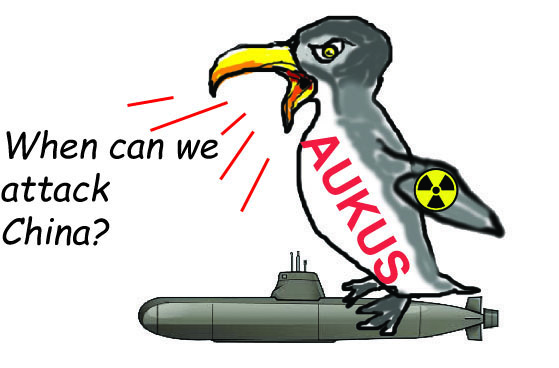
Hegseth calls US-built nuclear submarines the ‘apex predator’ of the seas. But are they right for Australia?

Ben Doherty.4 Oct 26, https://www.theguardian.com/australia-news/2026/oct/04/hegseth-apex-predator-nuclear-submarines-right-for-australia-aukus-ntwnfb
Some experts argue Virginia-class submarines government is buying second hand are good for fighting American wars, but not for defending Australia
On stage for his “arsenal of freedom tour”, the US secretary of defense – who prefers the appellation “secretary of war” – was ebullient.
“This Virginia-class submarine is a paragon of American engineering and fighting spirit,” Pete Hegseth roared, standing at Newport News shipyards where those boats are being built.
“It is the apex predator of the undersea domain, the most advanced and lethal submarine ever built.”
There are few who would argue with the Virginia’s lethality. Australia is set to buy three of these boats, secondhand, from the US navy, beginning in 2032.
But is it the right submarine for Australia?
Hegesth’s words, for all of their rhetorical bellicosity, were revealing: “American … fighting spirit”; “apex predator”; “ensuring America is free and safe and powerful”.
Virginia-class submarines – nuclear-powered and conventionally armed – are very good at travelling undetected fast and staying underwater for a very long time (limited, essentially, only by the capacity of the crew to stay submerged).
They are an attack submarine, an outstanding offensive platform for hunting and destroying a far-distant adversary, able to traverse thousands of miles of deep ocean undetected.
But Australia’s National Defence Strategy, released this year, says the nation’s “strategy of denial” – which aims to deter conflict before it begins – was “focused on safeguarding Australia’s interests in our primary area of military interest”. This includes the immediate region encompassing the north-east Indian Ocean through maritime south-east Asia into the Pacific as well as Australia, its populated offshore territories and its northern approaches.
A growing chorus of naval experts is arguing that the Virginia-class submarines are the wrong boats for this country.
The waters to the north of the Australian continent – from where any potential threat is overwhelmingly likely to approach – are shallow, best suited to a submarine far smaller than Virginia’s nearly 8,000 tonnes of displacement, some say.
A smaller, more nimble submarine, quieter when operating under battery, is a better platform for that role, they say. In addition, smaller submarines are cheaper and easier to crew: Australia could afford more of them, increasing the potency of its force.
The argument runs thus: the Virginias, and the even larger Aukus-class submarines set to follow, are nuclear-powered submarines perfectly suited to fighting a distant war on behalf of the US. But they are the wrong boats to defend Australia.
Defence or ‘projecting power’?
Dr Andrew Gaczol spent a decade as an international political analyst and policy officer at the Australian Department of Defence. He told an independent inquiry into Aukus coordinated by the Australian Peace and Security Forum that the Australian public had been provided only two arguments in support of the Aukus deal, “and neither stand up to serious scrutiny”.
The primary argument put forward is that of defence of Australia.
Gaczol told the inquiry it was unnecessary to have submarines with unlimited range to defend the nation’s waters or conduct defensive operations in the region.
“The latest state-of-the-art Air Independent Propulsion (AIP) conventional diesel-electric submarines are more suitable as they are smaller, quieter when submerged and better suited to the relatively shallow waters of the Australian continental shelf and the waters to Australia’s north,” he said.
The second argument propounded for Aukus is the need for Australia – as a nation reliant on trade – to maintain open sea lanes around it.
Given the small number of attack submarines the Aukus deal will ultimately provide, critics argue they will not be able to protect Australia’s seaborne approaches.
Navies around the world operate on “the rule of threes”, which states that for every three of a complex platform you possess, only one can be relied upon to be operational at any given time. Essentially, of three submarines, one is on active deployment, one is training or conducting exercises, and one is in maintenance, dry dock or recovering from operations.
Australia plans to buy three Virginia-class submarines from the US, to be supplemented – when they are designed and built – by up to five submarines of the Aukus class. By the end of the 2040s, eight submarines would give Australia, at any time, a fleet of two, perhaps three submarines on active deployment.
“I can’t see how such a small number of vessels will be able to keep open all of Australia’s trade routes all of the time,” Gaczol told the inquiry.
“As a counterpoint, I note that the US navy has over 60 nuclear submarines and are currently unable to force open the strait of Hormuz.”
Gaczol says he supports Australia having submarines, but that the Virginia and Aukus-class boats were not ideal for Australia’s defence. The benefit of Australia’s geography – a vast landmass protected by thousands of kilometres of ocean – mean “the chances of Australia being actually sort of invaded are virtually nil”.
The oceans to Australia’s north are also relatively shallow – under 200 metres deep across parts of the Indonesian archipelago and South China Sea – meaning large nuclear submarines “are more easily detected” than smaller and quieter conventional boats.
As deep-water boats that can travel anywhere around the globe at high speed, nuclear submarines are unnecessary for defending Australia, Gaczol says, and are instead about “projecting power into another part of the world”.
“To put it colloquially, that’s not protecting our patch. That’s going into someone else’s patch and poking them in the eye,” he says.
Gaczol believes the acquisition of Virginia-class submarines suits US imperatives, not Australia’s.
“The only scenario I can really see these boats being applicable for is to chase Chinese submarines in the South China Sea should it come to a conflict there. Effectively, our force will be an adjunct of the US Navy.”
‘Best deal on offer’
Former South Australian senator Rex Patrick, an ex-submariner and resolute Aukus critic, is familiar with the aphorism “quantity is a quality of its own”.
He says while there was undoubted advantage to buying large attack submarines – greater payloads, more torpedoes, more capability to transport special forces soldiers – “there’s always a trade-off”.
“If the cost of buying one large nuclear submarine is that you could buy four other submarines for the same price, that’s a trade-off you have to consider.”
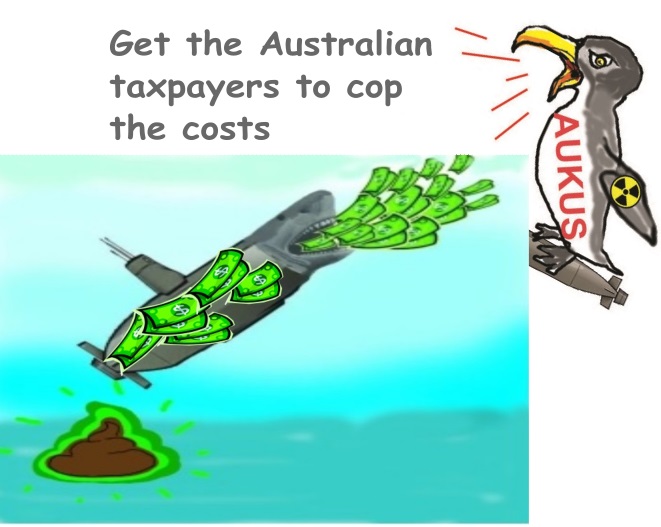
Aukus is forecast to cost up to $368bn by the 2050s – $33m a day for 30 years on a conservative estimate. Few, if any, major defence projects of this complexity run on time, or on budget.
And Aukus is dependent not only on Australia’s efforts to build a nuclear-powered submarine fleet from scratch: it is reliant on the US – beset by tenaciously laggard boat-building – to construct enough Virginia-class boats to spare three for Australia; and it needs the UK’s sole submarine-building yard to design and build the first of the new Aukus-class boats on which Australia’s domestically built boat will be constructed.
For far less than the slated cost of the Aukus deal, Australia could buy 20 conventionally powered air independent propulsion submarines, Patrick says.
“If you had 20 submarines, you’d have seven boats in the water, in seven different locations, and seven times the magnitude of problem for the other commander,” he says.
Patrick notes Canada, with the longest coastline in the world and facing many of the same geopolitical challenges as Australia, recently announced it would buy 12 air independent propulsion submarines from German shipbuilder TKMS for a reported $33bn.
The Australian government, though, insists Aukus is “the best deal on offer”.
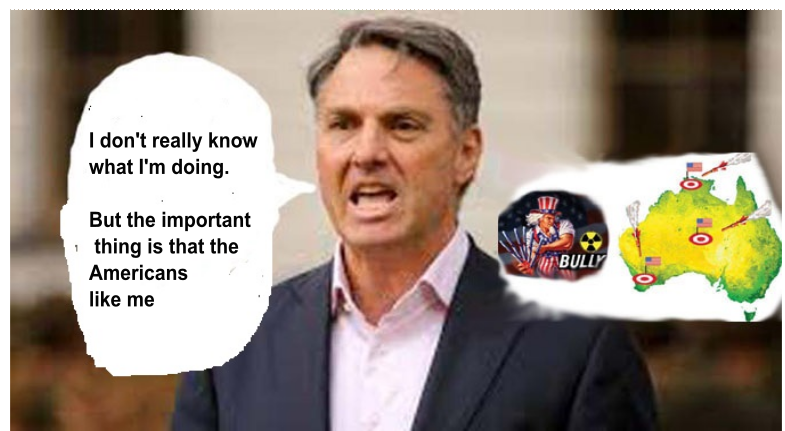
In June, the defence minister, Richard Marles, told the Shangri-La dialogue Australia had made the deliberate choice to increase the weight of its naval spending: more than 40% of Australia’s defence budget is now directed towards the country’s maritime domain.
“For a three-ocean nation, this is a strategic necessity,” Marles said. “Ninety-eight percent of Australia’s traded goods passes through Australian ports. Ninety percent of our fuel is imported. Our economic sovereignty, in the most basic sense, is a maritime proposition.”
And Marles argued an increasingly militarised region demanded a collective response.
“The free and open passage of goods, energy and data across the seas is not just Australia’s economic lifeblood – it is the economic lifeblood of this entire region.”
In a Lowy essay, former special envoy for defence Luke Gosling wrote that nuclear submarines will give the Australian defence force “a regionally superior capability that will help it to deter war and, if it must fight a war, to win”.
“Threatening to aggressors, lethal if provoked, but not overtly provocative, nuclear submarines are the ‘goldilocks’ long-distance capability.”
Amid a rising drumbeat of concern over Aukus, Labor senator Raff Ciccone rose in the Senate in June to argue Australia’s strategic environment had changed dramatically and the country “must respond to the world as it is”.
“Nuclear-powered submarines are the only platforms that can provide Australia with the ability to deter threats to our maritime supply chains, on which our way of life depend,” he said.
“They alone have the speed, the endurance and the stealth necessary to effectively provide this deterrence. They are the bolt cutters that will ensure that we are never wrapped in chains.”
1 This Month


Shut down the radiation-damaged Heysham nuclear reactors now
To see nuclear-related stories in greater depth and intensity – go to https://nuclearinformation.wordpress.com

Say No to NASA’s Reckless Nuclear Reactor on the Moon
Say No to NASA’s Reckless Nuclear Reactor on the Moon
-
Archives
- October 2026 (247)
- September 2026 (339)
- August 2026 (330)
- July 2026 (355)
- June 2026 (287)
- May 2026 (306)
- April 2026 (356)
- March 2026 (251)
- February 2026 (267)
- January 2026 (308)
- December 2025 (358)
- November 2025 (359)
-
Categories
- 1
- 1 NUCLEAR ISSUES
- business and costs
- climate change
- culture and arts
- ENERGY
- environment
- health
- history
- indigenous issues
- Legal
- marketing of nuclear
- media
- opposition to nuclear
- PERSONAL STORIES
- politics
- politics international
- Religion and ethics
- safety
- secrets,lies and civil liberties
- spinbuster
- technology
- Uranium
- wastes
- weapons and war
- Women
- 2 WORLD
- ACTION
- AFRICA
- Atrocities
- AUSTRALIA
- Christina's notes
- Christina's themes
- culture and arts
- Events
- Fuk 2022
- Fuk 2023
- Fukushima 2017
- Fukushima 2018
- fukushima 2019
- Fukushima 2020
- Fukushima 2021
- general
- global warming
- Humour (God we need it)
- Nuclear
- RARE EARTHS
- Reference
- resources – print
- Resources -audiovicual
- Weekly Newsletter
- World
- World Nuclear
- YouTube
-
RSS
Entries RSS
Comments RSS

