Horror as Russia ‘plans nuclear weapon in space’ that could cause global chaos
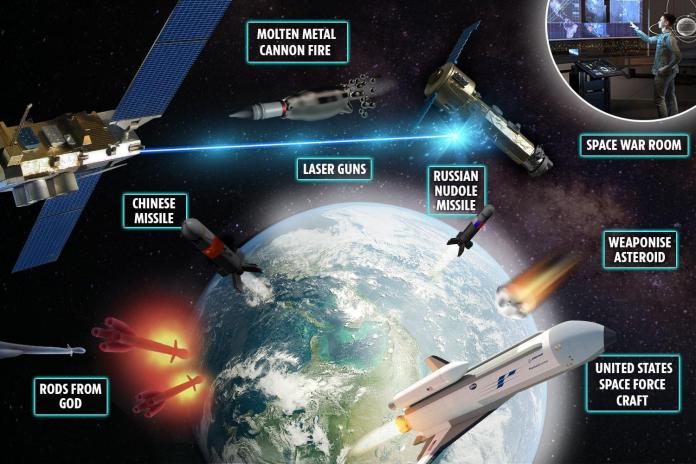
Gen Whiting believes the next major global conflict will “likely be a war that starts in space”. He said rival nations have watched how heavily the US and its allies rely on satellites and space technology for modern warfare
General Stephen Whiting, head of US Space Command, said America was ‘very concerned’ about Russian plans to put a nuclear weapon in space that would target satellites
Tim Hanlon News Reporter and Catherine Mackinlay, 16 Apr 2026
Russia is feared to be planning to put a nuclear weapon in space that is capable of sparking global chaos by targeting satellites.
A United States military chief has warned Moscow is considering using a nuclear anti-satellite weapon which could destroy thousands of satellites and cause communications disruption across the world, dubbing it a “Space Pearl Harbor”.
General Stephen Whiting, head of US Space Command, said America was “very concerned” about the Kremlin’s plans, which he said form part of a wider pattern of Russian aggression in space since the war in Ukraine began.
The four-star general warned Russia has already been carrying out “sustained satellite communication and GPS jamming” on such a scale that it is “putting civilian airliners at risk”.
Speaking on The Times podcast The General & The Journalist, Gen Whiting said: “Russia remains a sophisticated space power and they continue to invest in counter-space weapons. They are thinking about placing in orbit a nuclear anti-satellite weapon that would hold at risk everyone’s satellites in low Earth orbit, and that would be an outcome that we just couldn’t tolerate.”
He said Russia sees the US and NATO as too strong in conventional warfare and believes attacking space systems could “level the battlefield”.
Gen Whiting said: “From a Russian perspective, they look at the United States, they look at NATO and they see an overmatch there of conventional arms.
“And they believe that novel ways of trying to undermine the United States and NATO, such as by neutralising our space capabilities, helps them to level the battlefield. I won’t speak about our intelligence sources and methods, but obviously it’s a report that we’re very concerned about.”
A nuclear weapon in orbit would be a major breach of the Outer Space Treaty, which Russia has signed. The warning is the strongest public intervention yet from a senior US military officer on the threat posed by Moscow.
Russia’s alleged ambitions first emerged in February 2024 when Pentagon officials briefed members of Congress behind closed doors. Since then, the US House intelligence committee has been pressing the White House to declassify information about the project so politicians can discuss the scale of the threat.
Experts fear a nuclear blast in low Earth orbit could destroy up to 10,000 satellites – around 80% of all those currently in space. Military intelligence, communications, internet, mobile phone services and GPS could all be crippled.
Gen Whiting also warned Russia’s GPS jamming is already affecting civilian flights across eastern and southern Europe. He said: “When we put at risk civilian airliners full of citizens just trying to go on business or holiday, that’s incredibly problematic.”
He said both Russia and China are rapidly building space weapons, with Beijing developing jammers, directed energy weapons and anti-satellite rockets. The general urged Sir Keir Starmer’s government to spend far more on Britain’s space defences, with the UK spending less than 1% of its defence budget on space, compared with 4% in Germany and 3% in France.
Gen Whiting believes the next major global conflict will “likely be a war that starts in space”. He said rival nations have watched how heavily the US and its allies rely on satellites and space technology for modern warfare.
Despite the growing space arms race, he insisted a conflict in orbit is “not inevitable”. He added: “Our goal each and every day is to wake up and deter that from happening so that mankind can continue to take advantage of all the benefits of space.”
No comments yet.
1 This Month



26 September – International Day for the Total Elimination of Nuclear Weapons


PLEASE OPPOSE HR 8255 AND S.3639 – bills would accelerate satellite deployment, with no environmental review or safeguards – https://ncstd5li.quorum.us/campaign/169331/
To see nuclear-related stories in greater depth and intensity – go to https://nuclearinformation.wordpress.com
-
Archives
- September 2026 (269)
- August 2026 (330)
- July 2026 (355)
- June 2026 (287)
- May 2026 (306)
- April 2026 (356)
- March 2026 (251)
- February 2026 (267)
- January 2026 (308)
- December 2025 (358)
- November 2025 (359)
- October 2025 (375)
-
Categories
- 1
- 1 NUCLEAR ISSUES
- business and costs
- climate change
- culture and arts
- ENERGY
- environment
- health
- history
- indigenous issues
- Legal
- marketing of nuclear
- media
- opposition to nuclear
- PERSONAL STORIES
- politics
- politics international
- Religion and ethics
- safety
- secrets,lies and civil liberties
- spinbuster
- technology
- Uranium
- wastes
- weapons and war
- Women
- 2 WORLD
- ACTION
- AFRICA
- Atrocities
- AUSTRALIA
- Christina's notes
- Christina's themes
- culture and arts
- Events
- Fuk 2022
- Fuk 2023
- Fukushima 2017
- Fukushima 2018
- fukushima 2019
- Fukushima 2020
- Fukushima 2021
- general
- global warming
- Humour (God we need it)
- Nuclear
- RARE EARTHS
- Reference
- resources – print
- Resources -audiovicual
- Weekly Newsletter
- World
- World Nuclear
- YouTube
-
RSS
Entries RSS
Comments RSS


Leave a comment