Regulating the regulators: How the nuclear power industry steers the Nuclear Regulatory Commission
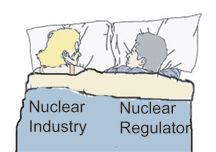
Regulators are regulated by the industry — not the other way around.
by Arnie Gundersen | Apr 17, 2026, https://www.climateandcapitalmedia.com/regulating-the-regulators-the-extraordinary-influence-of-the-nuclear-power-industry-on-the-nuclear-regulatory-commission/
The Nuclear Energy Institute approves NRC commissioners, oversees its workers and, staff say, undermines its independence and public safety mandate
The US Nuclear Regulatory Commission (NRC) mission statement provides a dual — and, critics say, contradictory — mandate that it “protects public health and safety” but also that it “advances the nation’s common defense and security by enabling the safe and secure use and deployment of civilian nuclear energy technologies…”
Given the history of nuclear accidents and lack of fully safe and permanent ways to address nuclear accidents and waste, critics see the mandate to protect public safety but also “advance” nuclear power as a conflict of interest. And given the nuclear industry’s heavy influence — some say control — over the nation’s regulatory agency, many both inside and outside the agency believe the industry has successfully turned the NRC into its advocate rather than its regulator.
Concerns about NRC objectivity
Concerns about the NRC’s objectivity and balance of support for public health versus industry support have taken on added urgency since President Trump last year signed an executive order calling for 10 new large nuclear reactors to be under construction by 2030 and for the Nuclear Regulatory Commission to speed reactor approvals. The first five or 10 new planned US nuclear reactors will “almost certainly” receive loans from the US Energy Department’s lending office, Energy Secretary Chris Wright told lawmakers Thursday.
The NRC employs several thousand technical staff. But it’s led by a commission of five people appointed by the US President and confirmed by the Senate. But the President and Senate see potential nominees only if they’ve already been approved by a well-funded industry group. That means the regulators are regulated by the industry — not the other way around.
Regulators are regulated by the industry — not the other way around.
The real control over nuclear power in Washington, D.C. lies in the nonprofit Nuclear Energy Institute (NEI). Every member of the NRC for the last decade has been screened by the NEI, which is the lobbying, campaign financing, and public relations organization for the nuclear industry.
The industry chooses its regulators
One does not become a Commissioner unless NEI finds that you are acceptable. Never has a member of a non-governmental organization or a safety critic been appointed to the Commission. Even nuclear proponents who’ve raised any questions about the nuclear industry, or worked for people who did, have been blocked.
While the NRC puts “public health and safety” first in its mission statement, the NEI’s charter says:
NEI is the unified voice of the commercial nuclear energy industry, influencing policies that affect its members, their customers, and the industry’s future. NEI represents the industry’s interests before Congress, the executive branch, state and local legislatures, federal regulators, international organizations, courts, and influential platforms where policy matters affecting the industry are discussed.
The NEI’s 2024 budget for direct lobbying was $1,570,000 while its total yearly operating budget was $57,500,000. According to IRS filings, its President & CEO earned a total compensation of $3,594,043,000 while its other 12 top executives together earned $7,222,173 with other staff salaries adding an additional $17,188,000, Propublica reported. That’s a lot of money to “represent the industry’s interest before Congress… and… federal regulators...”
“Regulatory Capture”
More significant to the public interest, however: Industry access to and even control of the NRC through informal channels euphemistically called “drop-in meetings” by NEI, nuclear reactor vendors, and plant owners has long been a concern of the NRC’s staff engineers.
In its 2022 audit prepared for the five Commissioners by the NRC’s Inspector General acknowledged that those concerns pose risks to the public:
Perceived Asymmetry of Access to NRC Management and Risk of Regulatory Capture Undermine NRC Transparency Goals
During our audit, the OIG identified chronic concerns, expressed by NRC staff and external stakeholders alike, about drop-in meetings and similar non-public informal interactions. One of these concerns was regulatory capture, which in relation to drop-in meetings is the concern that the NRC is serving to advance the interests of the very industry it regulates. Regulatory capture is often intangible and not measurable.
At a September 5, 2024 all-staff “Briefing on Human Capital” video call, with NRC leadership, eight top staff and two union leaders present, an intrepid staffer noted that the nuclear industry was unduly influencing regulatory policy:
Question: With NRC staff trust in the objectivity and integrity of NRC Commissioners and NRC executive leadership at an all-time low, with an annual exodus for sweetheart positions in the industry, what can be done to restore credibility and confidence that executive-level decision-making is not industry biased and actually serves the public interest?
Chairman Hanson: …everybody in this room, everybody up on this dais, are dedicated public servants, and I don’t question that at all…
Later in the same meeting, from an engineer:
Question: Okay. This question has a little bit of a background in it. The way outside stakeholders treat NRC staff is a factor in staff morale and workload, but it is often ignored. This has turned out to be a major issue with respect to advanced reactors where some company representatives and lobbying organizations have been downright abusive to agency workers. What’s worse, senior management is perceived as taking the side of the outside stakeholders and leaving the NRC project teams to take the brunt of the criticism. This is both demoralizing and time consuming for project staff. What can be done to limit repeated and unproductive industry interactions with project staff so that they can focus on doing the projects, rather than on handling difficult people of all the things that could help NRC meet tighter schedules?
Chairman Hanson: So thank you for the question. I wasn’t aware that this was an issue, so I appreciate the question just in kind of raising the awareness to me.
Think about that response. The Chairman of the US federal government’s Nuclear Regulatory Commission claimed that he “wasn’t aware” that stakeholders’ heavy-handed interaction with staff — and NRC leaderships’ support of those stakeholders over its own staff — was an issue, even though it had already been reported in an Inspector General’s audit that any self-respecting chairman of a public regulatory agency with fiduciary duty to taxpayers would have been obligated to read — and to respond to.
Chairman Hanson’s 2024 claim — either reckless and irresponsible, or simply not credible — also flies in the face of comments by one of his predecessors, former NRC Chairman Greg Jaczko. Five years earlier, in 2019, Jaczko publicly stated,
“I saw things up close that I was not meant to see: an agency overwhelmed by the industry it was supposed to regulate and a political system determined to keep it that way… honesty and integrity mean nothing if you are perceived to be critical of nuclear power…”
Clearly, the NRC and its five Commissioners have failed to live up to the agency’s core mission to put the public first.
The NEI presents itself as an impartial source of nuclear science and wisdom. Yet it also funds “astroturf” advocacy groups, including Nuclear Matters and Third Way. Schedule I of NEI’s 2024 990 tax filing shows that NEI paid $2.3 million to Washington, D.C.-based nonprofit Nuclear Matters, which on its website claims:
Nuclear Matters is a national coalition of grassroots advocates, working to inform the public and policymakers about the clear benefits of nuclear energy.
The 2024 IRS 990 tax filing for Nuclear Matters states that its operating income was $2,309,945, showing that 99.5% of its income came from the NEI. Its form 990 identified three executives whose combined total compensation was $2,206,460. That means 95% of the Nuclear Energy Institute’s donation to the nonprofit Nuclear Matters was compensation to just three people. That’s highly irregular in the world of nonprofits.
Moreover, you might think that an organization claiming to represent a “nationwide coalition of grassroots advocates” should be funded by actual coalitions of grassroots advocates. But with 95% of its funding from NEI, Nuclear Matters is not.
Grassroots or astroturf?
You might also expect that an organization claiming to represent a “nationwide coalition of grassroots advocates” would work with, find substantial support from, and list a significant nationwide coalition. However, Nuclear Matters’ “Advocacy Council” includes 21 people, virtually all of whom are current or former nuclear industry representatives, policymakers or regulators. And its 16 listed “partners” are pro-nuclear organizations, many of which have received industry funding.
Does that fit your definition of “grass roots”?
The NEI’s reach extends beyond the NRC and into the Department of Energy, which controls funding of future nuclear reactor designs through DOE’s Office of Energy Dominance Financing. Membership in NEI is not limited to the owners of existing nuclear power plants, but also is open to newer companies seeking government funds to design the next generation of atomic power plants.
No comments yet.
1 This Month
23-25 October – on Zoom – World BEYOND War’s annual global conferenc


Shut down the radiation-damaged Heysham nuclear reactors now
To see nuclear-related stories in greater depth and intensity – go to https://nuclearinformation.wordpress.com

Say No to NASA’s Reckless Nuclear Reactor on the Moon
Say No to NASA’s Reckless Nuclear Reactor on the Moon

-
Archives
- October 2026 (199)
- September 2026 (339)
- August 2026 (330)
- July 2026 (355)
- June 2026 (287)
- May 2026 (306)
- April 2026 (356)
- March 2026 (251)
- February 2026 (267)
- January 2026 (308)
- December 2025 (358)
- November 2025 (359)
-
Categories
- 1
- 1 NUCLEAR ISSUES
- business and costs
- climate change
- culture and arts
- ENERGY
- environment
- health
- history
- indigenous issues
- Legal
- marketing of nuclear
- media
- opposition to nuclear
- PERSONAL STORIES
- politics
- politics international
- Religion and ethics
- safety
- secrets,lies and civil liberties
- spinbuster
- technology
- Uranium
- wastes
- weapons and war
- Women
- 2 WORLD
- ACTION
- AFRICA
- Atrocities
- AUSTRALIA
- Christina's notes
- Christina's themes
- culture and arts
- Events
- Fuk 2022
- Fuk 2023
- Fukushima 2017
- Fukushima 2018
- fukushima 2019
- Fukushima 2020
- Fukushima 2021
- general
- global warming
- Humour (God we need it)
- Nuclear
- RARE EARTHS
- Reference
- resources – print
- Resources -audiovicual
- Weekly Newsletter
- World
- World Nuclear
- YouTube
-
RSS
Entries RSS
Comments RSS


Leave a Reply