Background to Proposed radioactive waste dump in Deep River -opposition from indigenous and non-indigenous groups

| Gordon Edwards 11 Aug 23 |
A consortium of multinational corporations, headed by SNC-Lavalin, was hired by the government of Canada in 2015 to “reduce the liability” associated with federally owned radioactive wastes. The dollar value of that liability has been estimated to exceed $7 billion.
For the last 5 1/2 years, the consortium has been proposing to store the most voluminous waste in a “megadump” intended to hold about one million cubic metres of radioactive and nonradioactive toxic wastes in perpetuity. The proposed dump is essentially a landfill operation one kilometre from the Ottawa River, a heritage river that courses through the nation’s capital and feeds into the St Lawrence River at Montreal.
The project is opposed by all but one of the 11 Algonquin communities on whose unsurrendered territory the megadump is to be sited. It is part of the Chalk River Nuclear Laboratories site – land that was stolen from the Algonquin Nation in 1944. The federal government expropriated the site on national security grounds, required for the World War II Atomic Bomb Project, without asking or notifying or compensating the Algonquins for whom the site had cultural and religious significance for thousands of years.
On Thursday August 10, 2023, three Algonquin communities gave their final arguments to two members of the Canadian Nuclear Safety Commission (CNSC). Both of these Commissioners had previously worked for many years for the nuclear industry. The Algonquins were not allowed to present in person before the Commissioners, so they rented a hall for $8000 and had their own live audience to witness the proceedings as they made their presentations to the Commissioners by zoom.
In addition to Chiefs, elders, councillors, researchers and lawyers from three Algonquin communities – Kebaowek First Nation, Kitigan Zibi Anishinabeg, and Barriere Lake First Nation – there were in attendance members of several Algoquin communities, as well as many non-Indigenous people. The latter included representatives from federal parliamentarians, mayors of local communities, Ottawa city councillors, and representatives of the following Non-Governmental Organizations:
Ottawa Riverkeeper, Grennspace Alliance of Canada’s Capital, Ecology Ottawa, Ottawa River Institute, Canadian Coalition for Nuclear Responsibility, Canadian Environmental Law Association, The Atomic Photographers’ Guild, First United Church Water Care Allies, Old Fort William Cottagers’ Association, Ottawa Charter of the Council of Canadians, Sierra Club Canada Foundation, Pontiac Environmental Protection, Friends of the Earth, Ottawa Raging Grannies, Canadian Parks and Wilderness Society (Ottawa Valley), Biodiversity Conservancy International, Bonnechere River Watershed Project, Council of Canadians Regional, Coalition Against Nuclear Dumps on the Ottawa River, National Capital Peace Council.
Mony of the non-Indigenous representatives who came to hear the Algonquin Nations final arguments before the Canadian Nuclear Safety Commission (CNSC) signed their names to the following statement:
“NO CONSENT, NO DUMP. August 10, 2023″Today, CNSC conducts its final hearings on the planned ‘megadump’ at Chalk River – a gigantic mound of radioactive and non-radioactive toxic wastes, seven stories high, one kilometre from the Ottawa River. Most of the radionuclides to be dumped have half-lives of more than 5000 years. 99 percent of the initial radioactivity is from profit-making companies – waste that is imported for permanent disposal at public expense.
“Chalk River is sited on the unceded traditional territory of the Algonquin Nation. The Kebaowek and Kitigan Zibi Anishinabeg Algonquin communities do not consent to this radioactive and toxic dump, which is euphemistically called a Near Surface Disposal
Facility (NSDF).“We are non-Indigenous citizens. We do not presume to speak on behalf of Indigenous peoples, but as proud Canadians we wish to state clearly that if CNSC grants permission for the NSDF despite the lack of free, prior and informed consent from the Kebaowek and Kitigan Zibi Anishinabeg, it will be an act that dishonours all Canadians.
“We – and many others across Canada – regard such a decision as a blow to the process of reconciliation. It will set a dire precedent by suggesting that Indigenous consent is not a priority. Such a development could set back the cause of reconciliation for generations.”[56 signatures by attendees]
TODAY. Nuclear trash on indigenous land ?- a court decision puts Australia in a very difficult spot
Nuclear waste on Aboriginal land ?- and the Voice to Parliament?
The Australian government is in the process of holding a referendum that would give the indigenous people a Voice to Parliament. Imposing nuclear waste on Aboriginal land is not a good look, is it?
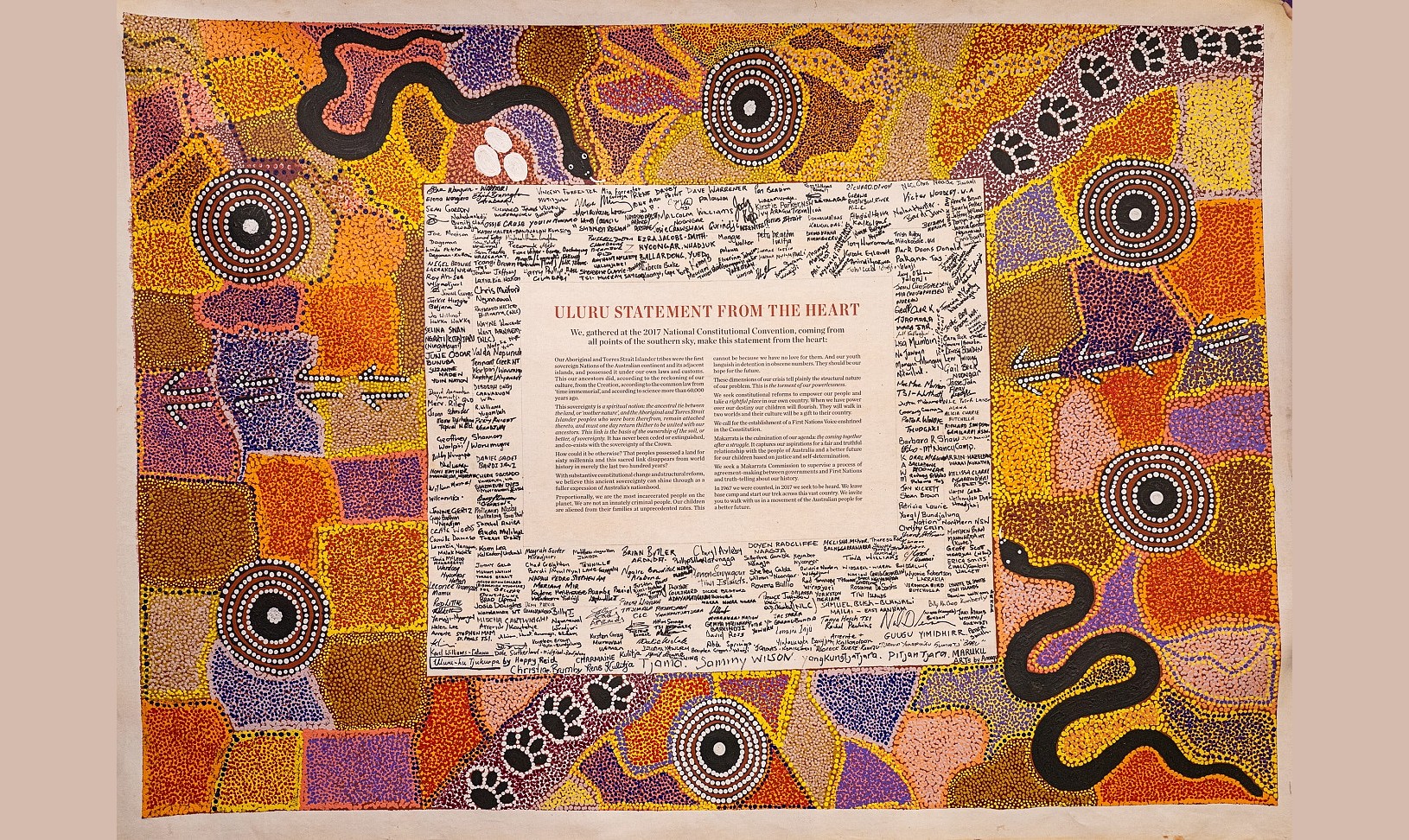
This morning, I heard Professor Ian Lowe, talking to a English journalist, about yesterday’s court decision, which supported the Barngarla people’s opposition to nuclear waste dumping on their land.
Prof Lowe eloquently summarised the importance of this legal decision:
-the Aboriginal people were not consulted when the Morrison Liberal Coalition decided to make a nuclear waste dump on their traditional land.
– this raises problems for the Australian government in selecting any land in this country for nuclear waste dumping
-this has international implications – about any country where the rulers want to impose a nuclear waste dump on indigenous land
-this has implications for the ill-advised (corrupt firm PWC was the advisor) AUKUS decision by the Albanese government to buy U.S nuclear submarines at $369billion. That decision included Australia taking responsibility for the high level radioactive trash from the nuclear submarines. Where to dump that trash?
Of course, the Australian government does have the power to impose the nuclear waste dump anyway, against indigenous wishes, even against South Australian State government wishes,
The Australian government is in the process of holding a referendum that would give the indigenous people a Voice to Parliament. Imposing nuclear waste on Aboriginal land is not a good look, is it?

Nuclear waste issue must be resolved before new facility can be explored, says Saugeen Ojibway Nation
APTN News, By Kierstin Williams, Jul 11, 2023
The Bruce Nuclear Station was built in the 1960s without the consultation or consent of the Saugeen Ojibway Nation.
The Saugeen Ojibway Nation is not making any commitments on the proposed expansion of the Bruce Power nuclear plant until the issue of whether nuclear waste will be stored on its territory is resolved.
Last week, Todd Smith, Ontario’s minister of energy, announced preliminary studies with Bruce Power to explore the expansion of Canada’s largest nuclear plant. The expansion would see an additional 4,800 megawatts of nuclear generation at the site.
The Bruce Power Nuclear Generating Station is located on the eastern shore of Lake Huron, the traditional territory of the Saugeen Ojibway Nation (SON), which is comprised of Saugeen First Nation and the Chippewas of Nawash First Nation.
“We have stated clearly that SON will not support any future projects until the history of the nuclear industry in our Territory is resolved and there is a solution to the nuclear waste problems that is acceptable to SON and its People,” said both chiefs in a letter on behalf of Saugeen and Nawash.
SON says the Bruce Nuclear Station was built in the 1960s without its consultation or consent.
The Nuclear Waste Management Organization (NWMO), the federal agency responsible for the long-term management of Canada’s used nuclear waste, plans to select a host site for its proposed deep geological nuclear waste facility by the fall of 2024. The facility would hold used nuclear fuel in a vault approximately 500 metres underground.
The two possible sites are within Saugeen Ojibway’s traditional territory and Wabigoon Lake Ojibway Nation near Ignace, Ont.
“The long overdue resolution of the nuclear legacy issues must occur before any future project is approved,” said Chief Conrad Ritchie and Ogimaa Kwe Veronica Smith in the letter. “Similarly, we must also have a plan in place that has been agreed to by SON to deal with all current and future nuclear waste before any future projects could go ahead.
“In no way does this announcement commit the SON to new nuclear development on SON territory,” added the letter posted on the band’s Facebook page…………………………………………..
In response to SON’s letter, NWMO said the storage site plan “will only proceed in an area with informed and willing hosts, where the municipality, First Nation communities, and others in the area are working together to implement it.
“This means the proposed South Bruce site would only be selected to host a deep geological repository with Saugeen Ojibway Nation’s willingness,” said the NWMO. https://www.aptnnews.ca/featured/nuclear-waste-issue-must-be-resolved-before-new-facility-can-be-explored-says-saugeen-ojibway-nation/
First Nations won’t back nuclear plant expansion until waste questions are answered
By Matteo Cimellaro | July 7th 2023 (The National Observer) https://www.nationalobserver.com/2023/07/07/news/first-nations-wont-back-nuclear-plant-expansion-until-waste-questions-are-answered#:~:text=Two%20First%20Nations%20near%20the,obtained%20by%20Canada’s%20National%20Observer.
Two First Nations near the proposed expansion of Canada’s largest nuclear power plant will not support any new projects until there is a solution to the nuclear waste problem on their territory, the Saugeen Ojibway Nation wrote in a letter to its membership obtained by Canada’s National Observer.
Bruce Power, the operator of the Bruce Nuclear Generating Station, will have to demonstrate safe nuclear waste management, the Ontario government said in a press release announcing the province’s first large-scale nuclear development in three decades. However, the release stopped short of mentioning the development of a deep geological repository set to be the solution for long-term nuclear waste storage for the country.
The Saugeen Ojibway Nation, composed of the Saugeen First Nation and the Chippewas of Nawash Unceded First Nation, is one of two possible hosts for the Nuclear Waste Management Organization’s (NWMO) proposed nuclear waste facility, along with Ignace, Ont., located 250 kilometres northwest of Thunder Bay.
The NWMO, a Canadian non-profit tapped to address the disposal of used nuclear fuel, will select a site to store Canada’s nuclear waste roughly 500 feet underground — as deep as the CN Tower is high — in a geological repository in March 2024.
“Until the Saugeen Ojibway are comfortable on the plan on how we’re going to resolve that waste issue, it’s really hard for us to buy into 100 per cent of what the province is doing,” Veronica Smith, chief of the Chippewas of Nawash Unceded First Nation, told Canada’s National Observer.
There will be compensation for the communities chosen to host the deep geological repository, Smith added. But it’s unclear if host First Nations might benefit from a nuclear waste facility revenue-sharing model or a lump sum payment. Those conversations haven’t even started between Saugeen Ojibway Nation and the NWMO, Smith said.
It’s also unclear if community members of both First Nations will be comfortable with the NWMO’s plan for a nuclear waste facility. Smith notes community members are the ultimate decision-makers over a proposed agreement to host the waste facility, not the elected chief and council.
Nishnawbe Aski Nation, the political organization that represents 49 First Nations in northern Ontario, including all those in Treaty 3 where the Ignace site is located, has vehemently opposed building the waste facility in the North. In 2022, the organization passed a resolution stating concerns over watersheds that lead up into Hudson Bay.
Within the northern First Nations, there are also worries a nuclear spill from transport trucks carrying waste could cut off the northern communities’ winter road access, cutting a vital supply route to several communities.
“What is NWMO going to say if both communities say no?” Smith asked.
In its letter to membership, the Saugeen Ojibway Nation also wrote that it wants a resolution and reconciliation over the historical legacy issues of nuclear power on their territory.
In the 1960s, the Bruce Power Station, one of the largest nuclear power stations in the world, was constructed on Saugeen Ojibway Nation’s territory without consultation and consent.
“What is NWMO going to say if both communities say no?” Smith asked.
In its letter to membership, the Saugeen Ojibway Nation also wrote that it wants a resolution and reconciliation over the historical legacy issues of nuclear power on their territory.
In the 1960s, the Bruce Power Station, one of the largest nuclear power stations in the world, was constructed on Saugeen Ojibway Nation’s territory without consultation and consent.
Local colleges train students to work in a plutonium pit factory, but at what cost?
It carries a legacy of illness, death and environmental racism for countless others. History tells of a long practice of hiring local Hispano and Pueblo communities to staff some of the most dangerous positions.
History tells of a long practice of hiring local Hispano and Pueblo communities to staff some of the most dangerous positions, a practice that has its origins in the early years of the lab, as Myrriah Gómez describes in her 2022 book Nuclear Nuevo México.
- By Alicia Inez Guzmán Searchlight New Mexico, Jun 10, 2023 https://www.santafenewmexican.com/news/local_news/local-colleges-train-students-to-work-in-a-plutonium-pit-factory-but-at-what-cost/article_068bd3b2-0589-11ee-b8ba-93e1230989e7.html
Every day, thousands of people from all parts of El Norte make the vertiginous drive up to Los Alamos National Laboratory. It’s a trek that generations of New Mexicans have been making, like worker ants to the queen, from the eastern edge of the great Tewa Basin to the craggy Pajarito Plateau. All in the pursuit of “good jobs.”
Some, inevitably, are bound for that most secretive and fortified place, Technical Area 55, the very heart of the weapons complex — home to PF-4, the lab’s plutonium handling facility, with its armed guards, concrete walls, steel doors and sporadic sirens. To enter “the plant,” as it’s known, is to get as close as possible to the existential nature of the nuclear age.
For 40 years, some 250 workers were tasked, mostly, with research and design. But a multibillion-dollar mission to modernize the nation’s nuclear arsenal has brought about “a paradigm shift,” in the words of the Defense Nuclear Facilities Safety Board, a federal watchdog. Today, the plant is in the middle of a colossal expansion — growing from an aged building to what the safety board calls “a large-scale production facility for weapon components with the largest number of workers in its history.”
In short, the plant is slated to become a factory for making plutonium pits, the essential core of every nuclear warhead.
Four years ago, LANL began laying the groundwork for this expansion by searching out and shaping a highly trained labor pool of technicians to handle fissile materials, machine the parts for weapons, monitor radiation and remediate nuclear waste. The lab turned to the surrounding community tapping New Mexico’s small regional institutions — colleges that mostly serve minority and low-income students. The plan, as laid out in a senate subcommittee meeting, set forth a college-to-lab pipeline — a “workforce of the future.”
Taken altogether, Santa Fe Community College, Northern New Mexico College and the University of New Mexico’s Los Alamos campus have accepted millions of federal dollars for their role in preparing that workforce. They’ve graduated 74 people to date, many of whom will end up at TA-55.
As Kelly Trujillo, associate dean of SFCC’s School of Sciences, Health, Engineering and Math, put it, “A lot of these jobs are high-paying jobs and they allow [workers] to stay in their home, in the area that they love.”
The trade-offs, like so much involving LANL’s history in Northern New Mexico, are not without controversy. For many local families, the lab has been a gateway to the American dream. Its high wages have afforded generations of Norteños a chance at the good life — new houses, new cars, land ownership, higher education for their kids. To work there is to become part of the region’s upper crust.
It carries a legacy of illness, death and environmental racism for countless others. History tells of a long practice of hiring local Hispano and Pueblo communities to staff some of the most dangerous positions, a practice that has its origins in the early years of the lab, as Myrriah Gómez describes in her 2022 book Nuclear Nuevo México.
New Mexico’s academic institutions have for decades served as LANL’s willing partner, feeding students into the weapons complex with high school internships; undergraduate student programs; graduate and postdoc programs; and apprenticeships for craft trades and technicians. The lab heavily recruits at most local colleges, too.
Talavai Denipah-Cook can still remember LANL representatives plying her with promises of a high-paying job and good benefits at an American Indian Sciences and Engineering Society conference years ago. At the time, she was a student at a private high school in Española, and the future that they painted looked bright.
“I was like, ‘Wow, that sounds really intriguing.’ We don’t get that around here, especially as people of color,” said Denipah-Cook, now a program manager in the Environmental Health and Justice Program at Tewa Women United, an Indigenous nonprofit based in Española.
Then she remembered the words of her grandmother, a field nurse from Ohkay Owingeh, who once tended to Navajo Nation tribal members affected by uranium mining and saw the health impacts of radiation exposure firsthand.
“She used to tell me, ‘Don’t ever, ever work at Los Alamos National Labs.’”
‘The snake road’
For nearly eight decades, LANL’s repeated attempts to expand have run up against the plateau’s geography. During the Manhattan Project, the site proved problematic in terms of housing, transportation and access along the road that old-timers called el camino de la culebra — the snake road. In more recent years, the lab’s footprint has stretched to encompass a nearly 40-square-mile campus that abuts Bandelier National Monument, U.S. Forest Service lands, the cities of Los Alamos and White Rock, and San Ildefonso Pueblo.
One of its smallest areas, TA-55, sits at the north-central edge of campus. Within is “the plant” — a 233,000-square-foot building that ranks, according to the U.S. Department of Energy, as the only “fully operational, full capability plutonium facility in the nation.”
This is where plutonium and other irradiated materials are conveyed by a trolley system from a vault to rooms lined with gloveboxes, sealed and oxygen-free. Workers, their hands protected by bulky gloves, weigh and handle plutonium in all its forms — molten, metal and powder. They disassemble and inspect existing weapons from the stockpile; forge parts for nuclear batteries that help power spacecrafts; and perfect the dimensions of plutonium “hemishells” on hand-built machines. According to a retired machinist, each pit has to be so precisely crafted that the difference between it and others can vary no more than the width of a strand of hair.
A mass of certifications and protocols are required for every task; there is little margin for error. Should radiation escape its enclosure, a radiation control technician stands by with a Geiger counter to detect it and stop work immediately.
Plant employees earn an extra $20,000 of environmental pay — in order “to attract people, quite frankly, to work in our more challenging facilities,” said Stephen Schreiber, who works in weapons production as the technical director of the lab’s office of Science, Technology and Engineering.
When Joaquin Gallegos, the former chair of NNMC’s Biology, Chemistry and Environmental Sciences Department, recruited high school students to join the college pipeline, he cited the competitive salaries and drew upon his own family history: the aunts and uncles who worked at LANL while continuing to tend multigenerational land.
The lab “subsidized” their lifestyle and made it possible not to “sell out,” Gallegos said. “People who have 10 or 15 acres of agricultural land, that’s not enough to support a family. But if you work at the labs, you could still maintain that culture. You could still raise animals and maintain that as part of your family.”
Pendulum swings for pits
It’s been almost 75 years since LANL last produced plutonium pits at an industrial scale. In 1996, the lab was sanctioned to produce up to 20 plutonium war reserve pits a year for the W88 warhead. It produced 30 pits in a five-year period, until 2012 when all major plutonium operations were suspended, after four pieces of weapons-grade plutonium were placed side by side for a photo op — a positioning that could have caused a runaway neutron chain reaction and a flash of potentially fatal radiation.
“The lab has never had to be accountable for their promises,” said Greg Mello, of the Los Alamos Study Group, an influential anti-nuclear nonprofit based in Albuquerque. “Could they be a factory? Could they produce pits reliably? No. Not at all.”
LANL, regardless, was tapped as one of two sites — the other being South Carolina’s Savannah River plutonium processing facility — to produce no fewer than 80 pits annually by 2030, according to the Fiscal 2020 National Defense Authorization Act. The law authorized LANL to produce 30 pits per year by 2026.
What’s being proposed is so huge it has no precedent, said Jay Coghlan, executive director of Nuclear Watch New Mexico, an anti-nuclear advocacy organization in Santa Fe.
“Here we have this arrogant agency that thinks it can just impose expanded bomb production on New Mexico,” said Coghlan, referring to the National Nuclear Security Administration, the lead agency for pit production. “They do not have credible cost estimates and they do not have a credible plan for production. But yet they expect New Mexicans to bear the consequences.”
The costs, according to the Los Alamos Study Group, will come to some $46 billion by 2036 — the earliest the NNSA says it can hit 80 pits per year at the two sites. It’s roughly the same amount of money it would take to rebuild every single failing bridge in America.
The NNSA estimates the lab will need 4,100 full-time employees, including scientists and engineers, security guards, maintenance, craft workers, and “hard-to-fill positions,” as LANL has dubbed the pipeline jobs.
It is the most costly program in the agency’s history. It is also destined, Coghlan and others say, to collapse under its own weight. Both Los Alamos and Savannah River are, according to federal documents, billions of dollars over budget and years behind schedule.
Money, waste and risk
More than $20 billion is slated for paying personnel and underwriting the construction in and around TA-55, including parking structures, office buildings, facilities to process transuranic liquid waste, and demolishing and decontaminating hundreds of old gloveboxes and installing hundreds of new ones. Construction is taking place at night, while staff work toward meeting LANL’s new quota by day.
Safety and controlling risk are paramount, said Schreiber, the LANL technical director. “We really do instill that in our workers.” But observers at the Union of Concerned Scientists say the pace doesn’t bode well.
“When you have new employees who are not very experienced in a new facility running new procedures in a high-risk environment — trying to do it fast, trying to meet a quota — that’s a recipe for something bad to happen,” said Dylan Spaulding, a senior scientist in the nonprofit’s global security program.
New Mexico’s all-Democratic congressional delegation, whatever the controversies, supports the project wholeheartedly. It was Heinrich and South Carolina’s Republican Sen. Lindsey Graham who rallied behind pit production in their states — ushering it into law in the 2020 National Defense Authorization Act. Then-Congressman Ben Ray Luján helped shepherd money to the pipeline programs.
Radiation 101
Last spring, assistant professor Scott Braley taught two back-to-back introductory courses to 13 future radiation control technicians at NNMC. His lectures covered a host of topics: the history of “industrial-scale” radiation accidents worldwide, algebraic formulas to determine the correlation between individual cancer and workplace exposure, and maximum permissible doses for future workers like themselves. The rates are higher than for the general public, Braley explained, because, for one, radiation workers “have accepted a higher risk.”
Once they get their associate degree, NNMC graduates proceed to the second part of their training, in a Los Alamos classroom. There, they learn how to don and doff personal protective gear — a suit not unlike the one that recent NNMC graduate Karen Padilla said she once used to keep bees. Padilla, 42, participated in simulations of scenarios that she and others might one day face, learning the proper ways to detect radiation around trash and 55-gallon barrels of waste, for instance.
“Long-term, I don’t have really any fears about this because I feel like my instructors are doing a good job of helping me understand how to protect myself” and others, said Padilla. “I think ultimately that’s my job as a [radiation control technician], to protect people who are working, to make sure they’re not getting into something that could be harmful.”
Much of the college programs center around minimizing risk. And yet they present an ethical dilemma, said Eileen O’Shaughnessy, co-founder of Demand Nuclear Abolition.
“What does it mean to assume that exposure is acceptable at all? Because the thing about radiation is it’s cumulative and any amount is unsafe.”
Generations of Northern New Mexicans have faced the same time-worn question: Are the good jobs worth the trade-offs?
“You realize, yes, they are paying you well, but you’re being put in situations that you have no idea about,” said the retired machinist, with over two decades of experience working at the lab, much of it at the plant. He asked to remain anonymous for fear of retaliation. “It’s the mentality at the lab,” he said. “They don’t really think that people that are techs are even really worth much.”
A powerful neighbor
Dueling perspectives reveal the chasms around the lab and, in particular, what some consider the Manhattan Project’s original sin: Its use of eminent domain to force Indigenous and Hispano people off their farms and sacred lands on the Pajarito Plateau. Its arrival, oral histories hold, spelled the end of land-based living.
“When did we stop farming to sustain ourselves?” Kayleigh Warren recalled asking a relative from Santa Clara Pueblo. The answer: “When the labs came in.”
Now an environmental health and justice program coordinator at Tewa Women United, Warren has borne witness to the region’s change in values. The lab has so deeply carved itself into Northern New Mexico’s psyche that imagining another future and means of survival has come to seem impossible.
As the single largest employer in northern New Mexico, LANL’s horizon of influence is vast. And with billions more dollars flooding in, its sway in almost every sphere seems only to grow.
Despite the lab’s omnipresence, economic gains have been relatively limited. While Los Alamos County has one of the highest median household incomes in the nation, the surrounding communities — including Española — are among the poorest in the state.
“LANL has been a bad neighbor,” Warren said. “If the economic benefits are so good for them to continue their work and expand, you would think the communities around here would be doing better. But we’re not.”
A nuclear site is on tribes’ ancestral lands. Their voices are being left out on key cleanup talks
KNKX Public Radio | By The Associated Press, June 23, 2023
Three federally recognized tribes have devoted decades to restoring the condition of their ancestral lands in southeastern Washington state to what they were before those lands became the most radioactively contaminated site in the nation’s nuclear weapons complex, the Hanford Nuclear Reservation.
But the Yakama Nation, Confederated Tribes of the Umatilla Indian Reservation and Nez Perce Tribe have been left out of negotiations on a major decision affecting the future cleanup of millions of gallons of radioactive waste stored in underground tanks on the Hanford site near Richland.
In May, federal and state agencies reached an agreement that hasn’t been released publicly but will likely involve milestone and deadline changes in the cleanup, according to a spokesperson for the Washington State Department of Ecology, a regulator for the site. As they privately draft their proposed changes, the tribes are bracing for a decision that could threaten their fundamental vision for the site.
“As original stewards of that area, we’ve always been taught to leave it better than you found it,” said Laurene Contreras, program administrator for the Yakama Nation’s Environmental Restoration/Waste Management program, which is responsible for the tribe’s Hanford work. “And so that’s what we’re asking for.”
From World War II through the Cold War, Hanford produced more than two-thirds of the United States’ plutonium for nuclear weapons, including the atomic bomb dropped on Nagasaki, Japan, in 1945. Production ceased in 1989, and the site’s mission shifted to cleaning up the chemical and radioactive waste left behind.
For these tribes, which have served as vital watchdogs in the cleanup process, the area’s history dates back long before Hanford, to pre-colonization. It was a place where some fished, hunted, gathered and lived. It’s home to culturally significant sites. And in 1855 treaties with the U.S. government in which the tribes ceded millions of acres of land, they were assured continued access.

The U.S. Department of Energy, the Environmental Protection Agency and the Washington State Department of Ecology have held confidential negotiations since 2020 on revising plans for the approximately 56 million gallons of radioactive waste stored in 177 underground tanks at Hanford. The discerning eyes of the tribal experts have been kept out, though EPA and Ecology have said there will eventually be opportunities for the tribes to meet with them about this.
The revisions are expected to affect an agreement among the three agencies that outlines the Hanford cleanup. Mason Murphy, program manager for the Confederated Tribes’ Energy and Environmental Sciences program, points out that the tribes also weren’t consulted in that original 1989 agreement.
“It’s an old scabbed-over wound,” Murphy said…………………………………………………….. https://www.knkx.org/government/2023-06-23/a-nuclear-site-is-on-tribes-ancestral-lands-their-voices-are-being-left-out-on-key-cleanup-talks
—
‘We need to wake up’: Algonquin leaders sound alarm over planned nuclear waste facility near Ottawa River
By Matteo Cimellaro | News, Urban Indigenous Communities in Ottawa | June 20th 2023
Four Algonquin chiefs spoke out on Tuesday, calling out the government and its private-sector contractor over what they say are inadequate consultations over a planned nuclear waste storage facility.
Last year, the Canadian Nuclear Safety Commission (CNSC) paused its decision to move ahead with the planned waste facility, located at the Canadian Nuclear Laboratories in Chalk River, Ont. The site is 180 kilometres north of Ottawa and sits within a kilometre of the Ottawa River, otherwise known as the Kichi Sibi in Algonquin.
The pause was intended to give more time for consultations with Kebaowek First Nation and Kitigan Zibi Anishinabeg, whose traditional territories circle the Ottawa River on both sides of Quebec and Ontario.
“It’s a huge victory for us,” Coun. Justin Roy of Kebaowek First Nation told Canada’s National Observer at the time.
But now, Algonquin leaders are slamming the CNSC for failing to give adequate time for meaningful consultation. The process only lasted six months, which the leaders argued is a short time frame given the challenges of negotiating funding agreements for Indigenous-led environmental assessments.
Still, the Algonquin-led assessment found the proximity to the Ottawa River, which supplies water to millions, including Algonquins, a major red flag. The river was given status of a Canadian Heritage River by Ontario and Quebec and it holds the utmost spiritual and historical importance for the Algonquin nation.
The assessment also pointed to potential risks to Indigenous harvesting rights and the environment, including contamination concerns to local moose, migratory birds and fish.
There are also concerns about tritium, a radioactive form of hydrogen, leaching from the nuclear waste into the Ottawa River, Chief Lance Haymond of Kebaowek First Nation said.
“We need to wake up and recognize what a danger Chalk River poses not only to the Algonquin people but to all Canadians, especially those living in the Ottawa-Gatineau area,” he added.
At the press conference, Haymond was flanked by Dylan Whiteduck, chief of Kitigan Zibi, and grand chiefs Savanna McGregor and Lisa Robinson, who are leaders of the Algonquin Anishinabeg Nation Tribal Council and Algonquin Nation Secretariat, respectively.
Elizabeth May, co-leader of the federal Green Party, sponsored the press conference. In brief comments, she pointed to the primary shareholder of the company that manages Canadian Nuclear Laboratories, criticizing the decision to build the facility so close to the Ottawa River.
Canadian Nuclear Laboratories is a subsidiary of the Crown corporation Atomic Energy Limited Corporation, but it is operated under contract by the Canadian National Energy Alliance, a private-sector consortium led primarily by SNC-Lavalin. The Canadian National Energy Alliance is responsible for the daily operations of the nuclear laboratories, as well as the decommissioning and management of nuclear waste from the facilities, according to the SNC-Lavalin website.
“I don’t think we had in mind that SNC-Lavalin would once again get its way,” she said, alluding to the company’s role in a scandal that rocked the federal government four years ago.
The Algonquin leaders are also calling foul on the consultation process for a divide-and-conquer strategy of picking which Algonquin nations to consult with, which Haymond calls a “continuation of colonialism.” Pikwakanagan First Nation signed a long-term relationship agreement with Canadian Nuclear Laboratories on June 9.
“It’s a First Nation who seemed to have forgotten their responsibilities and priorities as protectors of the land, protectors of the water,” he said.
Haymond notes Pikwakanagan was given years of consultation through the controversial organization Algonquins of Ontario, which local Algonquins have accused of dividing the nation and giving free passes to false Indigenous identity claims. The organization even named a building in Algonquin at the Canadian Nuclear Laboratories site.
An official hearing for the near-surface nuclear waste facility is scheduled for Aug. 10.
“We’ve been here for millennia, the Algonquin nation and our people,” Chief Whiteduck said.
“We’re still here, and we’re gonna be here for another 1,000 years. We’re hoping to deal with these contaminants that will be poured into our river.”
— With files from Natasha Bulowski
Pacific leaders remain steadfast against nuclear waste disposal
National Indigenous Times, Gorethy Kenneth (PNG Post Courier) – May 11, 2023
Pacific has a combined voice on “no nuclear waste” in the Pacific, Prime Minister James Marape told reporters in Port Moresby on Tuesday.
He was asked by reporters if the country would support Japan on its nuclear waste issue.
Mr Marape said that he would release a statement at a later date on the latter.
Japan allegedly reported that it was due to start dumping one million tonnes of nuclear waste from the damaged Fukushima Daiichi nuclear power plant into the Pacific ocean in only a few months.
And according to Japan’s government, the waste water was to be treated by an Advanced Liquid Processing System, which would remove nuclides from the water.
However, the Pacific island leaders united and demanded that Japan share pivotal information about the plan.
Japan, however, assured the Pacific leaders that there was no such threat, and instead defended that the country and their government had no plans to dump more than one million tonnes of radioactive waste water into the Pacific ocean……….. https://nit.com.au/11-05-2023/5922/pacific-leaders-remain-steadfast-against-nuclear-waste-disposal-png23
The Quiet Warrior: Russell Jim’s Struggle Against Nuclear Colonialism
CounterPunch, MAY 12, 2023, BY JOSHUA FRANK
The following is an excerpt from the award-winning Atomic Days: The Untold Story of the Most Toxic Place in America (Haymarket Books, 2022).
He was the catalyst in my belief that Indian tribes should be treated as full, equal participants in the process.
— James Asselstine
There are not a lot of heroes out here. Few in recent memory have risen to the daunting challenge, immersing themselves in Hanford’s scientific complexities and its historic and cultural implications. If there are any champions of the cause, Russell Jim (Kii’ahł) was certainly one of them. The “Quiet Warrior,” Jim was a lifelong advocate for the Yakama Nation. The “conscience of the cleanup,” Jim was considered by many to be the spiritual leader of the Hanford resistance. Jim served as the head of the Confederated Tribes and Bands of the Yakama Indian Nation’s Environmental Restoration and Waste Management Program (ERWM), a position he essentially created. In 2018, Jim passed away after battling heart trouble and pneumonia after a long bout of cancer, which he believed was a direct result of the time he spent in and around Hanford’s radioactive haze.
“I think he’s been a major player in the Hanford cleanup and he’s been one of the sharpest critics of the process and a very constructive one,” said John Bassett, president of Heritage University, when Jim was awarded an honorary doctorate in 2017.
By all accounts, Jim had an unwavering moral compass and was the rare advocate who possessed the ability to peer through the layers of Hanford’s bureaucratic stratum. He was able to envision its future while never losing sight of the past and the gainful lives that the region provided his people over many centuries. The Yakama Nation, in defiance of their forced relocation, refused compensation from the federal government. They have never stopped fighting back against the settler colonialism that has destroyed their Native lands…………………………………………………………………………
For those keeping tabs on Hanford throughout the 1980s, like the Yakama, the situation was ominous. By 1985, four decades after Hanford began producing plutonium, not a single independent study looked at the cumulative damage the site had unleashed on nearby communities or Native tribes. DOE officials blew off calls for such an inquiry and contended that it would be unworthy of the department’s time. They argued that radioactivity was all but nonexistent outside of Hanford’s boundaries. Citizen activists noted an uptick in certain cancers in their communities and believed a longitudinal study on the human population was the only way to get a handle on Hanford’s long-term impacts………………………………
Terry R. Strong, who served as head of the Radiation Control Section of the Washington Department of Social and Health Services in 1985, strongly disagreed with the DOE’s lack of monitoring and openly criticized the state of Washington for allocating a meager $87,000 a year to keep an eye on Hanford’s environmental impact. The threat was so grave, Strong believed, that the state should have been spending at least $2.5 million. Others, including British physician Dr. Alice M. Stewart, who helped author a study of Hanford workers during the early 1980s, argued the government was also far too lenient with its radiation safety levels.
The study found a connection between low radiation doses and cancer deaths—particularly multiple myeloma—among workers. Hanford employees, the study reported, experienced at least a 5 percent higher risk of developing cancer than the general population. “If they stick to present safety levels,” warned Dr. Stewart, “they will have more trouble than they think they are going to have.”
A Challenging Adversary
Russell Jim knew there was a major problem at Hanford and the government was planning to make it worse. By the late 1970s, Hanford and Yucca Mountain were the two prime contenders to become depots for spent nuclear fuel. While the Western Shoshone stood their ground and tried to fight the use of Yucca as a repository, they ultimately lost. Jim, representing Yakama Nation, took the lead on keeping the stuff out of Hanford. The waste was to sit in man-made tombs for the next ten thousand years. Flabbergasted at the thought of such an idiotic undertaking, Jim took his fight to the United States Senate. Testifying before a Senate subcommittee on nuclear regulation in 1980, Jim made an impassioned plea to the senators about his peoples’ connection to the land, hoping they’d consider viewing the Hanford issue from his point of view: “There is something you need to understand that is unique between my people and yours. Yakama Indian people do not get most of their food supply from the local A&P or Safeway store,” said Jim. ………….
Jim not only intimately understood the science behind the nuclear mess at Hanford, he also was well-versed in the laws and the rights of his people. The time he spent in Washington speaking at various hearings and meeting personally with numerous Senators and staffers was beginning to pay off. When the Nuclear Waste Policy Act of 1982 was passed, it included specific language that recognized Indian sovereignty. It was powerful language. As a result of Jim’s efforts, tribes like the Yakama, along with states, could veto their lands from becoming nuclear waste depositories. And it would take a majority of both houses of Congress to overturn such vetoes……………………
Jim’s activism during this time forced the federal government to drop their insidious idea of using Hanford as a nuclear dumping zone. He had won. His people had won, and so had the environment that had sustained them for generations. While others had joined the cause, without Jim’s tenacious work, Native voices would have been ignored, as many senators admitted they believed the states would speak up in Natives’ interest. Jim, of course, straightened them out, making it clear they were more than capable of speaking for themselves………………
Jim’s activism during this time forced the federal government to drop their insidious idea of using Hanford as a nuclear dumping zone. He had won. His people had won, and so had the environment that had sustained them for generations. While others had joined the cause, without Jim’s tenacious work, Native voices would have been ignored, as many senators admitted they believed the states would speak up in Natives’ interest. Jim, of course, straightened them out, making it clear they were more than capable of speaking for themselves……
………………….. Abnormally high incidence[s] of thyroid tumors and cancers have been observed in populations living downwind from Hanford,” reported Dr. Helen Caldicott, a scientist and anti-nuclear activist. “Strontium-90, Cesium-137, and Plutonium-239 have been [atmospherically] released in large quantities, as was, between 1952 and 1967, Ruthenium-106. People in adjacent neighborhoods were kept uninformed about these releases—before, during, and after—and none were warned that they were at risk for subsequent development of cancer.”
Jim knew the toll on the Yakama was great, not only to cultural heritage, but to their health. No big decision was made at Hanford without input from Jim, and while it didn’t always go his way, he never backed down. He was prescient and brave. He was able to articulate the lunacy of the Hanford project and the government’s continued ignorance and outright deception. His quest for information and knowledge about what was actually taking place at Hanford forced an immeasurable amount of transparency, which remains all too important if the DOE and its contractors are to ever be held accountable. Up until his death in April 2018 at the age of eighty-two, Jim was working hard to fight the federal government’s effort to declassify Hanford’s nuclear waste, which would allow the radioactive leftovers to be more freely transported and dumped, with obviously grave implications………………………………………………….. https://www.counterpunch.org/2023/05/12/the-quiet-warrior-russell-jims-struggle-against-nuclear-colonialism/
AUKUS high-level nuclear waste dump must be subject to Indigenous veto

there is no question Defence would require the free, prior and informed consent of Indigenous people before a high-level nuclear waste facility could proceed on their land. …. in those circumstances the government must provide a veto right, because the project would eliminate future access to traditional Indigenous land.
If Plibersek knew about the radioactive waste facility and its intended siting in remote Australia at the time AUKUS was announced she has kept quiet about it.
A far more substantial inequality of power now exists between the Indigenous groups to be consulted about the site of the radioactive waste facility and the Defence Department. The facility has solid bipartisan support. In addition, it is essential to the AUKUS submarine deal, meaning Defence embodies the combined wishes of the Australian, British and United States governments.
Bipartisan secrecy and Defence’s poor record with Indigenous groups at Woomera are red flags for the consultation over AUKUS high-level nuclear waste facility.
Undue Influence MICHELLE FAHY, MAY 6, 2023
This is part one of a two-part series
The federal government had no public mandate for any of the AUKUS decisions: no mandate to enter the agreement, none to acquire eight nuclear-powered submarines for up to $368 billion, and none to establish a high-level radioactive waste facility. On this last, in fact, it had long term evidence to suggest Australians would likely oppose the proposition.
Perhaps this is why both major political parties concealed for 18 months, a period including the federal election, their shared knowledge that AUKUS requires a high-level radioactive waste facility to be built.
The AUKUS agreement was revealed on 15 September 2021. On 14 March 2023, deputy prime minister and defence minister, Richard Marles, announced the nuclear waste facility. Next day, opposition leader Peter Dutton said: ‘The Labor Party signed up to AUKUS knowing they would have to deal with the waste, and now that they’re in government they know that’s a part of the deal.’ The government has not denied Dutton’s claim.

Meanwhile, the Albanese government continues its work to establish an Indigenous Voice to Parliament. Just nine days after the prime minister was in San Diego announcing the AUKUS submarine deal and his deputy Marles came clean about the radioactive waste facility, Anthony Albanese released the proposed Voice wording. The prime minister noted in his speech the importance of consultation, ‘it’s common courtesy and decency to ask people before you take a decision that will have an impact on them’.
Governments have been trying for decades to put a radioactive waste dump in outback Australia. They have been rebuffed time and time again. Yet the Albanese government is trying once more.
Legal experts have pointed out the international legal requirement to obtain the free, prior and informed consent of Indigenous peoples before making significant decisions that affect them. This process includes giving Indigenous peoples full information about a development in advance and respecting their choice to give or withhold consent.
The UN Declaration on the Rights of Indigenous Peoples, which Australia has pledged to support ‘in both word and deed’, says: ‘[No] storage or disposal of hazardous materials shall take place in the lands or territories of indigenous peoples without their free, prior and informed consent.’
As to whether the government can claim ‘national security’ as a reason to avoid these obligations and dictate a radioactive waste site, international human rights law expert John Podgorelec says: ‘States may not derogate from their responsibilities on the basis of national security unless a “state of emergency” has been formally invoked.’
He adds, ‘A lesson to come out of the Iraq calamity is that manufactured or undisclosed national security intelligence cannot be used to subvert democracy.’
Unfortunately, the Defence Department’s fact sheet on nuclear stewardship and waste is light on detail. It does not mention free, prior and informed consent. Defence commits only to ‘consultation and engagement’ – a lesser standard – and adds that it will also consider ‘wider social license and economic implications’. Globally, the ‘economic implications’ of significant projects habitually undermine human rights, particularly those of Indigenous peoples.
Furthermore, Defence has a poor track record of engagement with Indigenous people in one of its key locations, South Australia’s Woomera Prohibited Area (explored further in part two).
Woomera is used by Australian and foreign military forces, in close partnership with multinational weapons corporations, for extensive weapons testing and military training activities.
‘When militaries around the world need a place to test their weapons and fly their new fighter jets, there’s nowhere better than the rugged expanses of South Australia,’ enthused US weapons giant Raytheon in 2016, talking up ‘a further expansion of US-Australian cooperation’.
The Woomera weapons testing range covers one-eighth of South Australia, occupying more than 122,000km2. Before Defence took over, less than a century ago, Indigenous people had inhabited the region for tens of thousands of years.
Despite the international outcry at the destruction of Juukan Gorge, the Defence Department has not changed its behaviour. For example, it continues to use a registered Indigenous heritage site in Woomera as a target zone for high explosive weapons tests. (I visited this and other sites inside Woomera last year at the invitation of Andrew and Bob Starkey, senior Kokatha lawmen and traditional owners.)
Defence is aware of the site’s significance, just as Rio Tinto was aware of the significance of Juukan Gorge. Defence’s heritage management plan, relevant sections of which I have seen, says the site has a ‘high level of Aboriginal heritage value’ and is a place of ‘sensitive cultural significance that can be easily impacted’. The public might wonder how Defence can know this yet still decide it’s acceptable to direct high explosive munitions onto the site.
‘The Commonwealth cannot give with one hand and take with the other,’ says Podgorelec, who acts for the Starkeys, on the tensions between federal commitments to Indigenous heritage protection and to AUKUS. He says there is no question Defence would require the free, prior and informed consent of Indigenous people before a high-level nuclear waste facility could proceed on their land. He also says in those circumstances the government must provide a veto right, because the project would eliminate future access to traditional Indigenous land.
Australia is not alone in being unable to find a radioactive waste solution. The UK has failed for decades to make meaningful progress on dismantling decommissioned nuclear submarines – it currently has 21 of them floating in dockyards awaiting disposal, mirroring its wider failure to resolve its nuclear waste problems. The US has also failed in this regard: spent fuel from its nuclear submarines remains in temporary storage. Griffith University’s Emeritus Professor Ian Lowe has written that the nuclear waste from US military and civilian reactors ‘is just piling up with no long-term solution in sight’.
Defence does not mention this pertinent information in its brief positive account of US and UK nuclear stewardship.
The federal government gave its response to the Juukan Gorge inquiry report in November 2022. Minister Tanya Plibersek, whose Environment portfolio encompasses Indigenous heritage protection, said:
[T]hese are thorough and considerate reports… the recommendations speak to the principles and priorities that will shape our [heritage protection] legislation. Free, prior, and informed consent.
If Plibersek knew about the radioactive waste facility and its intended siting in remote Australia at the time AUKUS was announced she has kept quiet about it.
Free, prior and informed consent requires that intimidation and coercion be avoided. Plibersek is well aware of the possibility of abuses of power in high stakes developments. In her speech, she noted partnership agreements were signed under ‘gross inequalities of power’ between the traditional owners of Juukan Gorge and Rio Tinto.
A far more substantial inequality of power now exists between the Indigenous groups to be consulted about the site of the radioactive waste facility and the Defence Department. The facility has solid bipartisan support. In addition, it is essential to the AUKUS submarine deal, meaning Defence embodies the combined wishes of the Australian, British and United States governments.
Podgorelec is adamant. ‘Australia cannot enact domestic laws that undermine its international legal obligations. If a project will take away Indigenous cultural connection to land forever – as a high-level nuclear waste facility will do – then the government is obliged to give a right of veto.’
Note: The legal basis for free, prior and informed consent was explained by John Podgorelec as lead author of Adelaide University’s submission to the 2015 SA Nuclear Fuel Cycle Royal Commission. Unfortunately, having been available until recently, the Royal Commission’s website is presently inaccessible. Email us if you would like a copy of the submission: undueinfluence@protonmail.com
Maori workers exposed to radiation in cleaning up USA’s failed nuclear reactor in Antarctica
Detour: Antarctica – Kiwis ‘exposed to radiation’ at Antarctic power plant, https://www.nzherald.co.nz/travel/detour-antarctica-kiwis-exposed-to-radiation-at-antarctic-power-plant/NY5WTQ72JF4OFUW4F35ZSUCB6U/ 8 Jan, 2022 By Thomas Bywater, Thomas Bywater is a writer and digital producer for Herald Travel
In a major new Herald podcast series, Detour: Antarctica, Thomas Bywater goes in search of the white continent’s hidden stories. In this accompanying text series, he reveals a few of his discoveries to whet your appetite for the podcast. You can read them all, and experience a very special visual presentation, by clicking here. To follow Detour: Antarctica, visit iHeartRadio, or wherever you get your podcasts.
The Waitangi Tribunal will consider whether NZ Defence Force personnel were appropriately warned of potential exposure to radiation while working at a decommissioned nuclear reactor in Antarctica.
It’s among a raft of historic claims dating from 1860 to the present day before the Military Veterans Inquiry.
After an initial hearing in 2016, the Waitangi Tribunal last year admitted the Antarctic kaupapa to be considered alongside the other claims.
“It’s been a bloody long journey,” said solicitors Bennion Law, the Wellington firm representing the Antarctic claimants.
Between 1972 and the early 1980s, more than 300 tonnes of radioactive rubble was shipped off the continent via the seasonal resupply link.
Handled by US and New Zealand personnel without properly measuring potential exposure, the submission argues the Crown failed in its duty of care for the largely Māori contingent, including NZ Army Cargo Team One.
“This failure of active protection was and continues to be in breach of Te Tiriti o Waitangi,” reads the submission.
The rubble came from PM3A, a portable nuclear power unit on Ross Island, belonging to the US Navy. Decommissioned in 1972, its checkered 10-year operating history led it to be known as ‘Nukey Poo’ among base inhabitants. After recording 438 operating errors it was shut off for good.
Due to US obligations to the Antarctic Treaty, nuclear waste had to be removed.
Peter Breen, Assistant Base Mechanic at New Zealand’s Scott Base for 1981-82, led the effort to get similar New Zealand stories heard.
He hopes that NZDF personnel involved in the cleanup of Ross Island might get medallic recognition “similar to those who were exposed at Mururoa Atoll”. Sailors were awarded the Special Service Medal Nuclear Testing for observing French bomb sites in the Pacific in 1973, roughly the same time their colleagues were helping clear radioactive material from Antarctica.
A public advisory regarding potential historic radiation exposure at McMurdo Station was published in 2018.
Since 1975 the Waitangi Tribunal has been a permanent commission by the Ministry of Justice to raise Māori claims relating to the Crown’s obligations in the Treaty of Waitangi.
The current Military Veterans’ Kaupapa includes hearings as diverse as the injury of George Nepata while training in Singapore, to the exposure of soldiers to DBP insecticides during the Malayan Emergency.
Commenced in 2014 in the “centenary year of the onset of the First World War” the Māori military veterans inquiry has dragged on to twice the duration of the Great War.
Of the three claimants in the Antarctic veterans’ claim, Edwin (Chaddy) Chadwick, Apiha Papuni and Kelly Tako, only Tako survives.
“We’re obviously concerned with time because we’re losing veterans,” said Bennion Law.
Detour: Antarctica is a New Zealand Herald podcast. You can follow the series on iHeartRadio, Apple Podcasts, Spotify or wherever you get your podcasts.
Local Indigenous peoples protest possible licence renewal for world’s largest uranium mine.
In June, the Canadian Nuclear Safety Commission will hold hearings about renewing the licence for Cameco’s McArthur River uranium mine, located in the Athabasca basin in Saskatchewan’s rugged far north.
Davis Legree, Apr 13, 2023 https://www.ipolitics.ca/news/local-indigenous-peoples-protest-possible-licence-renewal-for-worlds-largest-uranium-mine
The operator of the world’s largest uranium mine is seeking a new 20-year licence from Canada’s nuclear regulator but some Indigenous peoples in northern Saskatchewan are calling for the application to be rejected or scaled back, citing health concerns.
“The Athabasca River basin is under siege,” said Candyce Paul, outreach coordinator for the advocacy group Committee for Future Generations. “The people here have had enough of this industrial colonialism that is going on.”
In June, the Canadian Nuclear Safety Commission will hold hearings about renewing the licence for Cameco’s McArthur River uranium mine, located in the Athabasca basin in Saskatchewan’s rugged far north.
Paul, a member of English River First Nation, on whose territory several of Cameco’s mining sites are located, said her community is frustrated by the company’s lack of transparency, as well as human health concerns associated with uranium mining.
“Quite frankly, some of the community members are getting really fed up with the footprint this industry is having on the land and there’s been actual talk of blocking the main road from the mine,” said Paul.
Uranium, which ranges in use from atomic weapons to powering nuclear reactors, was initially discovered in the Athabasca Basin in the late 1960s. According to Gordon Edwards, president of the Canadian Coalition for Nuclear Responsibility, the volume and grade of the deposits found in northern Saskatchewan have led those in the industry to dub the area “the Saudi Arabia of uranium.”
“Canada has the richest uranium mines in the world around the Athabasca Basin,” said Edwards, who explained uranium ‘richness’ refers to the grade and what percentage of uranium there is in a ton of ore.
According to Edwards, uranium in the Athabasca Basin is considerably richer than uranium deposits found elsewhere in Canada, which makes it more lucrative. However, Edwards continued, mining rich uranium deposits can be problematic for the health of local communities.
“When you mine uranium, since it’s radioactive, there’s a chain of progeny, which are radioactive by-products of uranium,” explained Edwards. “These include radium, radon gas, certain isotopes of thorium, and polonium – all highly toxic materials.”
Edwards said that around 85 per cent of the radioactivity in mined uranium ore is left behind in “voluminous sand, like tailings from a mill,” adding that Canada has around “220 million tonnes of this stuff.”
These radioactive and toxic tailings areas should be of concern to communities in the Athabasca Basin, said Edwards, because richer uranium ore means the radioactivity is more concentrated in the waste.
Paul believes her community has been adversely affected from living in close proximity to large-scale uranium mining activities. She cited issues regarding increased cancer rates among English River members, which she said “could be related to radiation exposure.”
Paul said her community has contacted Health Canada, Saskatchewan’s Ministry of Health, and several epidemiologists about conducting health studies in the area, only to be told that their population is too small to justify an assessment.
That being said, Cameco’s licence renewal application to the CNSC referenced a federally funded human health risk evaluation that was conducted in the English River First Nation in 2017.
Regardless, Paul said she would intervene in the upcoming licence renewal hearings, which are scheduled to be held June 7-8 in Saskatoon. Initially, Cameco had requested an indefinite licence term for McArthur River and several other sites, but, following Indigenous consultation activities, the company has since walked back their application to 20 years.
When asked if local Indigenous communities were satisfied with a 20-year term, Cameco spokesperson Veronica Baker said in an email that the application for an indefinite licence was abandoned because “communities expressed uncertainty with what an indefinite licence term means and how it fits within existing regulatory and engagement frameworks.” However, she did not clarify whether these communities approved of the 20-year application.
According to Paul, the CNSC would set a dangerous precedent by granting Cameco a 20-year licence.
“Twenty years is too long,” she told iPolitics. “It would be nice to see the CNSC reject a 20-year licence and go for something for reasonable, like five or ten years, although even ten is too much.”
Neither Paul nor Edwards has much confidence that the CNSC will reject Cameco’s 20-year application.
“From our perspective, it will look like a rubber stamp,” said Paul.
According to Edwards, the current iteration of the CNSC, which has only existed since 2000, has “never refused to grant a licence to any major nuclear facility in their entire existence.”
“The public has very little opportunity to question the practices going on,” he continued. “There’s a widespread feeling in the NGO community that we have a captured regulator in the CNSC, which reports to the natural resources minister, who is also responsible for promoting uranium mining and exports.”
A review of Lobby Canada’s registry reveals Cameco officials met in recent months with Rumina Velshi, the CNSC’s president and CEO, and Ramzi Jammal, the regulator’s executive vice-president. However, both Cameco and the CNSC denied that the upcoming licence renewal hearing was discussed.
Edward said Cameco’s initial attempt at securing an indefinite licence term is indicative of an industry trend that is seeing longer licensing periods being granted and, as a result, less public oversight, and [fewer opportunities] for accountability.
“Unfortunately, that’s the direction they’re moving in,” he said.
According to CNSC spokesperson Renée Ramsey, individuals and organizations who want to intervene in the hearing have until April 24 to submit their requests, at which point the submissions from intervenors will be made publicly available. Ramsey also said the CNSC panel that will be leading the upcoming hearing has yet to be appointed.
An obnoxious clause in Canada’s draft Act for Implementing the United Nations Declaration on the Rights of Indigenous Peoples (UNDRIP)

First -let’s see what the Assembly of First Nations of Canada (AFN) say about Small Modular Nuclear Reactors
The AFN resolution from 2018 against SMRs, available HERE says:
THEREFORE BE IT RESOLVED that the Chiefs-in-Assembly:
1. Demand that free, prior and informed consent is required to ensure that no storage or disposal of hazardous
materials shall take place in First Nations lands and territories.
2. Demand that the Nuclear Industry abandon its plans to operate Small Modular Nuclear Reactors in Ontario and
elsewhere in Canada.
3. Demand that the Government of Canada cease funding and support of the Small Modular Nuclear Reactors
program.
4. Direct that the National Chief and appropriate staff work to ensure that the Nuclear Industry and the Canadian Government abandon this program.
Now see what the Government includes in this draft Act
In the Environment section of Canada’s draft Act for Implementing the United Nations Declaration on the Rights of Indigenous Peoples (UNDRIP)- the specific SMRs text is found, in Chapter 1, Shared priorities. https://www.justice.gc.ca/eng/declaration/ap-pa/ah/p3.html
The Government of Canada will take the following actions……………
44. Increase capacity for Indigenous peoples to meaningfully engage, make informed decisions, and participate financially in clean energy alternatives like Small Modular Reactors (SMRs). SMRs in Canada are developing along three parallel streams including near-term on-grid, next generation and micro/off-grid, and there is potential for multiple benefits including use in remote Indigenous communities for abating emissions of heavy industry and increasing energy security. (Natural Resources Canada)
Canadian First Nations do not want small nuclear reactors on their lands

Decolonizing energy and the nuclear narrative of small modular reactors https://policyoptions.irpp.org/magazines/february-2022/decolonizing-energy-and-the-nuclear-narrative-of-small-modular-reactors/
Kebaowek First Nation is calling for an alternative to a planned SMR project, one that won’t undermine proper consultation and leave a toxic legacy.
by Lance Haymond, Tasha Carruthers, Kerrie Blaise, February 7, 2022 In early 2021, the Canadian Nuclear Safety Commission began reviewing the application from a company called Global First Power to build a nuclear reactor at the Chalk River Laboratories site about 200 kilometres northwest of Ottawa.
This project, known as a micro modular reactor project, is an example of the nuclear industry’s latest offering – a small modular reactor (SMR).SMRs are based on the same fundamental physical processes as regular (large) nuclear reactors; they just produce less electricity per plant. They also produce the same dangerous byproducts: plutonium and radioactive fission products (materials that are created by the splitting of uranium nuclei). These are all dangerous to human health and have to be kept away from contact with people and communities for hundreds of thousands of years. No country has so far demonstrated a safe way to deal with these.
Despite these unsolved challenges, the nuclear industry promotes SMRs and nuclear energy as a carbon-free alternative to diesel for powering remote northern communities. The Canadian government has exempted small modular reactors from full federal environmental assessment under the Impact Assessment Act. Many civil society groups have condemned this decision because it allows SMRs to escape the public scrutiny of environmental, health and social impacts.
The proposed new SMR in Chalk River, like the existing facilities, would be located on Algonquin Anishinabeg Nation territory and the lands of Kebaowek First Nation – a First Nation that has never been consulted about the use of its unceded territory and that has been severely affected by past nuclear accidents at the site.
At this critical juncture of climate action and Indigenous reconciliation, Kebaowek First Nation is calling for the SMR project at Chalk River to be cancelled and the focus shifted to solutions that do not undermine the ability of First Nations communities to be properly consulted and that do not leave behind a toxic legacy.
While these reactors are dubbed “small,” it would be a mistake to assume their environmental impact is also “small.” The very first serious nuclear accident in the world involved a small reactor: In 1952, uranium fuel rods in the NRX reactor at Chalk River melted down and the accident led to the release of radioactive materials into the atmosphere and the soil. In 1958, the same reactor suffered another accident when a uranium rod caught fire; some workers exposed to radiation continue to battle for compensation.
What makes these accidents worse – and calls into question the justification for new nuclear development at Chalk River – is that this colonized land is the territory of the Algonquin Anishinabeg Nation territory (which consists of 11 First Nations whose territory stretches along the entire Ottawa River watershed straddling Quebec and Ontario). Kebaowek First Nation, part of the Algonquin Nation, was among those First Nations never consulted about the original nuclear facilities on their unceded territory, and is still struggling to be heard by the federal government and nuclear regulator. Its land has never been relinquished through treaty; its leaders and people were never consulted when Chalk River was chosen as the site for Canada’s first nuclear reactors; and no thought was given to how the nuclear complex might affect the Kitchi Sibi (the Ottawa River).
History is being repeated at Chalk River today as the government pushes ahead with the micro modular reactor project without consent from Kebaowek. Assessments of the project have been scoped so narrowly that they neglect the historical development and continued existence of nuclear facilities on Kebaowek’s traditional territory. The justification for an SMR at this location without full and thorough consideration of historically hosted nuclear plants – for which there was no consultation nor accommodation – is a tenuous starting point and one that threatens the protection of Indigenous rights.
The narrative of nuclear energy in Canada is one of selective storytelling and one that hides the reality of the Indigenous communities that remain deeply affected, first by land being taken away for nuclear reactor construction, and later by the radioactive pollution at the site. All too fitting is the term radioactive colonialism coined by scholars Ward Churchill and Winona LaDuke, to describe the disproportionate impact on Indigenous people and their land as a result of uranium mining and other nuclear developments. In country after country, the uranium that fuels nuclear plants has predominantly been mined from the traditional lands of Indigenous Peoples at the expense of the health of Indigenous Peoples and their self-determination.
Kebaowek First Nation has been vocal in its objection to the continuation of the nuclear industry on its lands without its free prior and informed consent, as is its right under the United Nations Declaration on the Rights of Indigenous Peoples (UNDRIP). Despite requests for the suspension of the SMR project, pending adequate provisions for Indigenous co-operation and the Crown’s legal duty to initiate meaningful consultation, Kebaowek has yet to see its efforts reflected in government decisions and Crown-led processes.
Nuclear is a colonial energy form, but it is also bio-ignorant capitalism – a term coined by scholars Renata Avila and Andrés Arauz to describe the ways in which the current economic order ignores the planetary climate emergency, human and ecological tragedies, and the large-scale impact on nature. The narrative of nuclear as a “clean energy source” is a prime example of this bio-ignorance. Decision-makers have become fixated on carbon emissions as a metric for “clean and green,” ignoring the radioactive impacts and the risks of accidents with the technology.
It is more than 70 years since Chalk River became the site for the splitting of the nucleus. The continuation of nuclear energy production on unceded Indigenous territory without meaningful dialogue is a telling example of continued colonial practices, wherein companies extract value from Indigenous land while polluting it; offer little to no compensation to impacted communities; and abide by timelines driven by the project’s proponents, not the community affected. We need to move away from this colonial model of decision-making and decolonize our energy systems.
The challenge of climate change is urgent, but responses to the crisis must not perpetuate extractivist solutions, typical of colonial thinking, wherein the long-term impacts – from the production of toxic waste to radioactive releases – lead to highly unequal impacts.
The authors thank Justin Roy, councilor and economic development officer at Kebaowek First Nation, and M.V. Ramana, professor at the School of Public Policy and Global Affairs at the University of British Columbia, for contributing to this article.
‘David and Goliath’ – legal case, as indigenous group fights the Australian government to stop a nuclear waste dump on their traditional land

Stephanie Richards, 6 March 23, https://indaily.com.au/news/2023/03/06/david-and-goliath-kimba-nuke-waste-fight-heads-to-federal-court/?utm_medium=email&utm_campaign=InDaily%20Lunchtime%20%206%20March%202023&utm_content=InDaily%20Lunchtime%20%206%20March%202023+CID_654499187b614fa7e1f09bd8ceb7100e&utm_source=EDM&utm_term=READ%20MORE
Barngarla Traditional Owners’ fight to stop a nuclear waste facility being built near Kimba on South Australia’s Eyre Peninsula has reached the Federal Court, with the first substantive case hearing in Adelaide today.
They were supporting the Barngarla Determination Aboriginal Corporation, which has applied for judicial review in an attempt to thwart construction of the federal government’s planned radioactive waste storage facility at Napandee near Kimba.
“We’re fighting against injustices that have been happening to the Barngarla people regarding this waste dump in Kimba,” Barngarla Traditional Owner Harry Dare told InDaily outside court.
“We’re actually fighting for a seven sisters and women’s dreaming site and we’re fighting for a vote in our local governance.
“The Australian Government has given back our Native Title, but they haven’t given us a voice in those Native Title areas, so we’re fighting for equality and for all of Australia to be nuclear free.”
The Napandee site was selected by the former Morrison Government, with then Resources Minister Keith Pitt saying the government had secured “majority support” from the local community after more than “six years of consultation”.
But Barngarla Traditional Owners opposed the project and argued they were not included in the consultation.
During today’s hearing, the Federal Court was told of how the decision to locate the dump at Napandee, near Kimba, played out.
After beginning the process to select the site through its administrative powers, the then Coalition Government changed tack and decided to legislate, partly to avoid delays through legal challenges.
However, when the legislation failed in the Senate, the government restarted the administrative process.
Counsel for the Barngarla told Justice Natalie Charlesworth that raised questions over whether Pitt, who ultimately named the Napandee location and who strongly supported the legislative approach, could properly carry out his administrative role.
“That, of itself, would excite a reasonable apprehension that the minister might be unable or unwilling to approach the matter with an open mind,” he said.
“Because, effectively, the decision had already been made.”
The court was also told that the Barngarla disagreed with the former government’s view that the dump had wide community support in Kimba and would also argue the decision on the dump was unreasonable given the lack of proper consultation with the Indigenous owners.
Given Pitt’s correspondence with the Barngarla people and his other statements, the impression that might arise was that consultation would largely amount to “matters around the edges”.
“In terms of identifying culture and the like in the implementation of the site, which had already been selected and to which the minister was committed,” counsel said.
With the case listed for several days, the federal government is expected to argue that much of the material to be relied on by the applicants is subject to parliamentary privilege.
The Barngarla launched their action in 2021 after being denied the right to participate in a community ballot to gauge local support for the Napandee site because many did not live in the Kimba council area.
The community ballot returned about 61 per cent in favour of the dump.
But when the Barngala conducted their own ballot among their community members, 83 voted no and none voted yes.
They argue they were denied the right to participate in a community ballot to gauge local support for the site, because many did not live in the Kimber council area.
Traditional Owner Linda Dare told protestors ahead of this morning’s hearing that the proposed location for the nuclear waste facility was near an important women’s site for the Barngarla people.
“It just seems to be that every time the government wants to put something it’s always around a women’s site,” she said.
“We need to fight as women around Australia to protect our sites.
“We need to say ‘no’ because it’s going to affect the waterways, not just in South Australia but everywhere.”
InDaily reported in September that the federal government was spending three times more than Barngarla Traditional Owners fighting the project in the Federal Court.
Information released to SA Greens Senator Barbara Pocock showed that between December and July, the government had spent $343,457.44 on legal fees.
That compares to the approximate $124,000 spent by the Barngarla Determination Aboriginal Corporation over the same period.
The Native Title group estimates that the total cost incurred by the federal government would run into the millions.
Barngarla Determination Aboriginal Corporation chairperson Jason Bilney told InDaily the judicial review was a “David and Goliath battle”.
“But, we’re dedicated. It took us 21 years to win our Native Title, come out of Native Title six months later and we’re fighting a nuclear waste dump on our country,” he said.
“What does that tell you about truth telling, the Statement From The Heart or the Voice?
“Our Voice isn’t being heard, truth telling isn’t being told and they’re going to break the First Nations’ heart – Barngarla – and put it (the nuclear waste dump) on our country.”
Bilney said Traditional Owners expected the Federal Court would take months to reach a decision, with hearings scheduled each day this week.
“It could take a year, but we would like it to have it sooner than later,” he said.
It comes after the Barngarla Native Title group last month won a separate Supreme Court bid to overturn former Premier Steven Marshall’s decision to allow a mineral exploration company to drill at Lake Torrens in the state’s outback.
At the time, Bilney said the group was buoyed by the win as they continued their legal fight to stop the Napandee nuclear waste facility from going ahead.
South Australian Labor has long called for Barngarla people to have the right to veto the project, with Premier Peter Malinauskas previously saying that the state government had expressed its views to the federal government.
1 This Month
23-25 October – on Zoom – World BEYOND War’s annual global conferenc


Shut down the radiation-damaged Heysham nuclear reactors now
To see nuclear-related stories in greater depth and intensity – go to https://nuclearinformation.wordpress.com

Say No to NASA’s Reckless Nuclear Reactor on the Moon
Say No to NASA’s Reckless Nuclear Reactor on the Moon

-
Archives
- October 2026 (247)
- September 2026 (339)
- August 2026 (330)
- July 2026 (355)
- June 2026 (287)
- May 2026 (306)
- April 2026 (356)
- March 2026 (251)
- February 2026 (267)
- January 2026 (308)
- December 2025 (358)
- November 2025 (359)
-
Categories
- 1
- 1 NUCLEAR ISSUES
- business and costs
- climate change
- culture and arts
- ENERGY
- environment
- health
- history
- indigenous issues
- Legal
- marketing of nuclear
- media
- opposition to nuclear
- PERSONAL STORIES
- politics
- politics international
- Religion and ethics
- safety
- secrets,lies and civil liberties
- spinbuster
- technology
- Uranium
- wastes
- weapons and war
- Women
- 2 WORLD
- ACTION
- AFRICA
- Atrocities
- AUSTRALIA
- Christina's notes
- Christina's themes
- culture and arts
- Events
- Fuk 2022
- Fuk 2023
- Fukushima 2017
- Fukushima 2018
- fukushima 2019
- Fukushima 2020
- Fukushima 2021
- general
- global warming
- Humour (God we need it)
- Nuclear
- RARE EARTHS
- Reference
- resources – print
- Resources -audiovicual
- Weekly Newsletter
- World
- World Nuclear
- YouTube
-
RSS
Entries RSS
Comments RSS

