Traditional owners fight to stop South Australian nuclear waste dump
Peth Now, Tim Dornin, AAP, March 6, 2023
Issues with the decision-making process and questions over consultation have been raised by traditional owners in their court bid to block the federal government’s plans for a nuclear waste dump on South Australia’s Eyre Peninsula.
The case for a judicial review brought by the Barngarla people opened on Monday, with the Federal Court in Adelaide told of how the decision to locate the dump at Napandee, near Kimba, played out.
After beginning the process to select the site through its administrative powers, the then coalition government changed tack and decided to legislate, partly to avoid delays through legal challenges.
However, when the legislation failed in the Senate, the government restarted the administrative process.
Counsel for the Barngarla told Justice Natalie Charlesworth that raised questions over whether former resources minister Keith Pitt, who ultimately named the Napandee location and who strongly supported the legislative approach, could properly carry out his administrative role.
“That, of itself, would excite a reasonable apprehension that the minister might be unable or unwilling to approach the matter with an open mind,” he said.
“Because, effectively, the decision had already been made.”
The court was also told that the Barngarla disagreed with the former government’s view that the dump had wide community support in Kimba and would also argue the decision on the dump was unreasonable given the lack of proper consultation with the Indigenous owners.
Given minister Pitt’s correspondence with the Barngarla people and his other statements, the impression that might arise was that consultation would largely amount to “matters around the edges”.
“In terms of identifying culture and the like in the implementation of the site, which had already been selected and to which the minister was committed,” counsel said.
With the case listed for several days, the federal government is expected to argue that much of the material to be relied on by the applicants is subject to parliamentary privilege.
Before Monday’s hearing began, members of the Barngarla community and their supporters gathered outside the court, vowing to continue the fight no matter the result of the court proceedings.
“If it goes against the government, they are going to appeal it. If it goes against us, we are going to appeal it,” Elder Harold Dare said.
“We are going to appeal it as long and as hard as we can.
“It’s not just about the Barngarla, it’s about all of Australia and ultimately the world.
“We’re fighting for the protection of a sacred Aboriginal women’s site. It’s about the respect we are showing to our women’s sites.”
“We’re fighting for the protection of a sacred Aboriginal women’s site. It’s about the respect we are showing to our women’s sites.”
The Barngarla launched their action in 2021 after being denied the right to participate in a community ballot to gauge local support for the Napandee site because many did not live in the Kimba council area.
The community ballot returned about 61 per cent in favour of the dump.
But when the Barngala conducted their own ballot among their community members, 83 voted no and none voted yes……. more https://www.perthnow.com.au/news/crime/traditional-owners-fight-to-stop-sa-nuclear-waste-dump-c-9947910
Canada’s Nuclear Waste Management Organization looks to First Nations to back waste storage, AND small nuclear reactors
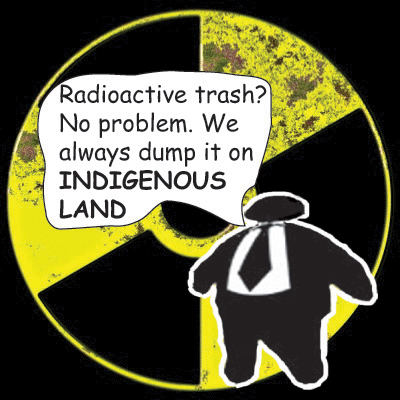
Ontario sites short-listed for nuclear waste storage, The organization developing a place to store spent nuclear fuel in Canada has settled on two potential sites in Ontario. The move rules out 20 other potential sites across Canada, including three in northern Saskatchewan.
The Nuclear Waste Management Organization recently announced the Wabigoon Lake Ojibway Nation-Ignace area in northwestern Ontario, and the Saugeen Ojibway Nation-South Bruce area in southern Ontario, are both under consideration.
“These communities are now working through their timelines to determine willingness,” Russell Baker, manager of media relations for the NWMO, said in an e-mail.
Baker said the NWMO hopes to settle on one of the two Ontario sites by the fall of 2024, but only “with informed and willing hosts, where the municipality, First Nation and Métis communities are working together to implement it.”
Disposing of spent nuclear fuel has been an issue for the nuclear industry for decades. A variety of countries, including Canada, are looking at deep geological repositories, where the waste can be safely stored for thousands of years within stable rock formations, like the Precambrian Shield. Finland is already building one.
Back in 2010, the NWMO announced there were 22 potential sites for underground storage across Canada, including sites near Pinehouse, English River First Nation, and Creighton, in northern Saskatchewan.
According to Guy Lonechild, executive director of the First Nations Power Authority (FNPA), coming up with a shortlist of potential sites is another step.
“There were some previous sites looked at in northern Saskatchewan but there’s been a lot of time and energy put into a deep geological repository in the province of Ontario. And those are the two viable options that that we would support for further study,” Lonechild, who is also a former FSIN chief, said.
Lonechild added the FNPA has been looking seriously at the possibility of Small Modular Nuclear Reactors (SMNR) for Indigenous and northern communities for several years.
……………. However, even though SMR’s are relatively small, the cost could easily be a billion dollars or more. Which is why FNPA would be looking for partnerships to help Indigenous communities get involved.
“So it is going to take a significant amount of capital. And so we’re looking at developing consortium groups to participate on an equity basis.”
………………….. “The only way we’re going to get there is if First Nations that are informed, that give free prior informed consent. And they identify ways that they want to participate in, in clean energy jobs and in the nuclear industry,” he said.
Some, but not all, First Nations support small nuclear reactors in New Brunswick

Moltex CEO says company has full support of all 15 First Nations in N.B. to develop SMRs
Jennifer Sweet · CBC News Feb 15, 2023
Companies trying to develop small modular nuclear reactors in New Brunswick are getting some support from an unlikely source.
An energy crisis is looming large, and SMRs have better potential than renewables in the short term, said Chief Terry Richardson of Pabineau First Nation, near Bathurst.
Richardson said he sees nuclear power as consistent with his cultural values.
“As First Nations, we are stewards of the land. Well, when we look at nuclear technology, it’s not a carbon emitter. So it’s not going to cause a problem. It’s going to actually solve the problem of carbon.
“If we don’t do something, we all know what’s happening with climate change.”
Pabineau has signed memoranda of understanding to work with two companies that have SMR projects under way at Point Lepreau — Moltex and ARC, said Richardson.
He describes the MOUs as “non-contractual, binding documents” that state a willingness to work together on development.
Details of exactly how his community and potentially other First Nations in the province may take part in SMR projects have yet to be negotiated, said Richardson.
“There’s going to be an opportunity to be involved on the equity side and that’s where we have to sit down and talk and discuss it and see where we’re going to go.”
After the initial development at Lepreau, ARC is talking about installing more SMRs in Belledune, Richardson noted, which could mean job opportunities in northern New Brunswick.
He also likes that Moltex is looking at reusing spent fuel rods, which it says would reduce the amount of toxic nuclear waste that already exists.
Study looks at SMR waste
A Canadian peer-reviewed study that came out last summer found the volume of waste from SMRs would be between double and 30 fold that from a typical reactor and that its chemical complexity would make it more difficult to manage.
Richardson said he is satisfied that plans are in place to deal with nuclear waste and added that maybe in the future there will be a way to recycle it…..
Moltex CEO Rory O’Sullivan told the legislative committee Wednesday that his company has the support of all 15 First Nations in the province to develop SMRs.
However, some other Indigenous leaders addressed the committee who have concerns about the SMR plans and the public investment in development.
Chief Hugh Akagi represents the Peskotomuhkati Nation at Skutik, which doesn’t have official recognition as a First Nation in Canada. https://www.cbc.ca/news/canada/new-brunswick/first-nations-small-modular-nuclear-reactors-1.6749808
Nuclear colonialism: indigenous people say no to uranium mining at Mulga Rock, Western Australia

https://www.greenleft.org.au/content/upurli-upurli-people-say-no-uranium-mining-mulga-rock—
Sam Wainwright, Perth, November 28, 2022
Nuclear Free WA protested outside Deep Yellow’s annual general meeting on November 25 against the company’s plans to mine uranium at Mulga Rock, north west of Kalgoorlie. The Upurli Upurli traditional owners absolutely oppose it.
Deep Yellow holds the only uranium deposit in Western Australia. This was the company’s first AGM following its merger in August with Vimy Resources.
Mia Pepper, Nuclear Free Campaigner at the Conservation Council of WA (CCWA), who has been tracking the mine plans for more than 10 years, said it faces more opposition than ever.
Deep Yellow does not have “any agreement with the Native Title claim groups” and “it doesn’t have the finance”, she said.
It has just started a third Definitive Feasibility Study into the beleaguered project, expected to be completed mid-2024. The latest project delay casts further doubt on the future of the site, campaigners said.
“Deep Yellow is the only company beating the uranium drum in Western Australia and even their own executive team has been clear they have no intention to mine at the current uranium price,” Pepper said.
“For a company with a highly speculative business model, no operating mines, many regulatory hurdles still to clear, and a sizeable pricing disincentive, it’s astounding that shareholders would endorse the proposed remuneration package for the Deep Yellow executive team, with the CEO alone receiving over $1 million,” she continued
First Nations communities have been continuing their protests.
WA Greens Legislative Council member Brad Pettitt read a statement in parliament on November 17 on behalf of Upurli Upurli and Spinifex women.
“We are Upurli Upurli and Spinifex women and we are writing because we face the unprecedented threat of uranium mining at Mulga Rock, east of Kalgoorlie … We have been saying no to uranium mining at Mulga Rock for a long time”
Their statement also detailed concerns about Deep Yellow’s executive who held senior roles in companies responsible for the destruction of Juukan Gorge, as well as several incidents of environmental pollution, industrial relations controversies and workplace fatalities at uranium mines in Malawi and Namibia.
The CCWA is delivering a WA Uranium Free Charter to WA MPs. It demands they “review and remove any approval for uranium mining at Mulga Rock” as well as withdraw the approvals of the stalled proposed uranium mines at Kintyre, Yeelirrie and Wiluna.
.
The consequences of nuclear imperialism and colonialism
Climate change and the war in Ukraine have cast a renewed spotlight on nuclear issues, say organisers of this weekend’s inaugural Nuclear Connections Across Oceania conference at the University of Otago
https://www.newsroom.co.nz/ideasroom/the-consequences-of-nuclear-imperialism-and-colonialism 23 Nov 22 What is nuclear imperialism and nuclear colonialism?
The war in Ukraine has heightened people’s awareness of the ongoing threat of nuclear war, which could be induced by a nuclear weapon or the destruction of other nuclear infrastructure.
Nuclear imperialism is our current geopolitical order, where states with access to uranium and the ability to develop nuclear weapons hold dominant power over everyone else. Examples of nuclear imperialism include Russia’s ongoing threat to deploy nuclear weapons in Ukraine, or the reckless testing of nuclear weapons and nuclear-capable munitions throughout Oceania and the Pacific by the United States, the United Kingdom, and France since the 1940s as a way to entrench their geopolitical dominance.
Building on the work of Indigenous feminists such as Ojibwe environmentalist Winona LaDuke, nuclear colonialism has been described by the academic Danielle Endres as “a system of domination through which governments and corporations target Indigenous peoples and their lands to maintain the nuclear production process”.
Examples of nuclear colonialism include Canada’s decision to mine uranium on the ancestral lands of First Nations peoples; the United States’ decision to test nuclear weapons and depleted uranium munitions on the ancestral lands of Native Hawaiians, Native Americans and the Marshallese; France’s decision to test nuclear weapons in Ma’ohi Nui (French-occupied Polynesia); the United Kingdom’s decision to test nuclear weapons on the ancestral lands of Aboriginal peoples; Australia’s decisions to mine for uranium on the ancestral lands of Aboriginal peoples; Japan’s 1979 plan to dump nuclear waste in the Northern Marianas; Japan’s planned nuclear waste storage facility on Ainu ancestral land; Japan’s plan to discharge tritiated water from TEPCO’s Fukushima Daiichi into the Pacific Ocean in 2023 against the wishes of Indigenous peoples of the Pacific; and New Zealand’s decision to dump nuclear waste into the ocean until 1976; among many others.
Connecting nuclear justice and climate justice
While the nuclear industry has been aggressively framing nuclear energy as the answer to climate change, the material consequences of nuclear imperialism and nuclear colonialism mean that Indigenous communities around the world continue to suffer from the past and present harms of uranium-derived nuclear pollution. This, in turn, has set a precarious foundation for achieving climate justice.
The convergence of nuclear justice and climate justice are perhaps most evident in the Pacific. After decades of their lands, waters and bodies being used as the “nuclear playground” for many imperial nations, Pacific peoples unwittingly now find themselves at the front line of climate change.
This is through no fault of their own, as Pacific peoples are globally among the lowest contributors to anthropogenic climate change, according to estimates of CO2 emissions. Indigenous activists activists, who have long been fighting for a nuclear-free and independent Pacific are now struggling to tackle the existential threats of climate change and exploitative seabed mining.
In an unsurprising repeat of history, the same nuclear imperial nations continue to exacerbate the damaging consequences of climate change as they restrict the abilities of Pacific peoples to respond and impede the provision of a ‘Loss and Damage’ fund.
What is Nuclear Connections Across Oceania?
The Nuclear Connections Across Oceania conference emerged from conversations among five students and one staff member at the University of Otago’s Te Ao O Rongomaraeroa National Centre for Peace and Conflict Studies and Kā Rakahau o Te Ao Tūroa Centre for Sustainability.
It provides the public with an opportunity to hear from key activists, artists, researchers, and community members on the material consequences of the nuclear military and industrial complex.
The core organising team of five locally based and international settlers of European descent and one Aotearoa New Zealand-born Sāmoan, had shared expertise and interests in questions related to uranium-derived nuclear pollution, nuclear colonialism, nuclear imperialism, nuclear non-proliferation, and climate justice.
They also knew that addressing the historical and ongoing harms of nuclear imperialism and nuclear colonialism would necessitate centring the experiences, needs, and voices of Indigenous peoples and others on the front lines working for nuclear and climate justice.
Cultivating a space to (re)connect
The conference draws inspiration from a genealogy of resistance in Oceania, and recognises a notable anniversary in the regional movement for nuclear justice. November 2022 marks 40 years since Māori hosted the first Te Hui Oranga o Te Moana Nui a Kiwa.
These hui brought Pacific activists to Aotearoa as part of the Nuclear Free and Independent Pacific Movement, a grassroots coalition of Indigenous rights, environmental, peace and trade union groups opposing nuclear colonialism.
Te Hui Oranga allowed for anti-nuclear work on Indigenous terms, outside the predominantly Pākehā (European settler) peace movement where racism and universalism had, at times, hindered introspection. These aspects of the nuclear-free legacy in Aotearoa are often obscured in the popular imagination by images of yachts (like those being re-popularised in Heineken ads) and David Lange’s Oxford Union speeches.
Through grounding the conference in Indigenous-led anti-colonial and anti-imperial movements, we want to use this occasion as an opportunity to remind people that an Indigenous-led regional movement that refused to sever the link between nuclearism and colonialism had immense power.
In refusing warship visits or protesting nuclear testing and the dumping of nuclear wastes into our oceans, the Nuclear Free and Independent Pacific movement advanced a vision for Pacific regionalism outside of superpower domination.
This benefited tangata o te moana (Pacific peoples) as well as tangata whenua (Māori), who saw the value in sensitising domestic movements to regional struggles. In the words of the first hui’s report: “our manuhiri [guests] have strengthened us”.
What to expect at the conference
The free and hybrid conference was designed as a gathering place for people across Oceania and the globe to learn from each other, collaboratively imagine what anti-colonial and anti-imperial nuclear futures might look like, and critically strategise how we might get there together.
It follows several major nuclear events, including the Tenth Review Conference of the Parties to the Treaty on the Non-Proliferation of Nuclear Weapons in August 2022.
We invite anyone with a curiosity about nuclear and climate justice to join us on November 25-26 (NZDT). Recordings of some of the conference talks will be available on our website for those unable to join on the day, so we invite you to engage in whatever way works best for you. For more information and to register, please visit the conference webpage: https://nuclear-connections.mailchimpsites.com/.
Author/contributors:
Dr Karly Burch (conference co-organiser and speaker) grew up as a settler in Hawaiʻi and is a research fellow studying the material politics of nuclear pollution, artificially intelligent robotics in agriculture, and collaborative research for sustainable technofutures, at the University of Otago’s Centre for Sustainability.
Marco de Jong (conference speaker) is a New Zealand-born Samoan, and is completing his PhD on the history of the environmental movement in the Pacific, at the University of Oxford.
Mino Cleverley (conference co-organiser) is a New Zealand-born Samoan, and is completing his PhD on Indigenous responses to climate change and forced retreat due to sea level rise, at the University of Otago’s Centre for Sustainability.
Bedi Racule (conference speaker) is a climate and nuclear justice advocate from the Marshall Islands/Federated States of Micronesia and recent graduate in development studies from the University of the South Pacific.
Tomoki Fukui (conference speaker) is an agenderflux Nikkei anthropologist, and is completing their PhD on how Japanese nuclear reconstruction uses patriarchy and ableism to further Japanese capitalism, at Columbia University.
Nishnawbe Aski Nation opposes possible site for storage of nuclear waste

Globe and Mail, MARSHA MCLEOD, 11 Aug.22,
Nishnawbe Aski Nation’s chiefs-in-assembly passed a resolution Wednesday “vehemently” opposing the possibility of an underground repository for nuclear waste in Northern Ontario.
The chiefs’ resolution calls on Nishnawbe Aski Nation, or NAN, which represents 49 First Nation communities within Northern Ontario, to take action to stop such a possibility, including through protest and possible legal action.
We’re fighting for our young people. We’re talking hundreds of years from now – that’s who we’re speaking up for,” said Nishnawbe Aski Nation Grand Chief Derek Fox in an interview. “NAN is going to do all it can – and I was mandated by the chiefs to do all we can – to stop this from happening.”
Chiefs, youth leaders and women’s advocates raised concerns during NAN’s annual Keewaywin Conference, which is being held in Timmins, Ont., this week. Some leaders also expressed anger at a lack of consultation of NAN’s communities over the possible site. The chiefs’ resolution speaks to a years-long search by the Nuclear Waste Management Organization, or NWMO, for a site to build a “deep geological repository,” or GDR, which would see Canada’s spent nuclear fuel stored in a facility located at least 500 metres below-ground.
That search has been narrowed to two possible sites: one located between Ignace and Wabigoon Lake Ojibway Nation in Northern Ontario, which is the site of concern to NAN, and another near South Bruce, Ont. A decision between the two sites is expected by the end of 2023, said Bob Watts, NWMO’s vice-president of Indigenous relations and strategic programs.
If the site near Ignace is selected, the township of Ignace, as well as Wabigoon Lake Ojibway Nation, would hold approval power over the project going forward, Mr. Watts confirmed.
Wabigoon Lake is not a member of NAN and the site would sit just south of NAN’s territory – within Treaty 3, but Mr. Fox pointed out that any issue with the site will not just affect Treaty 3, but the entire region.
“All rivers flow north from that area,” he said. “Nuclear waste doesn’t know treaty boundaries. A spill does not know treaty boundaries. A nuclear waste accident is not going to say, okay, well, we only agreed to pollute Treaty 3.”
Any kind of pollution in the rivers, lakes and waterways of the region would have “devastating” effects, he said………………………………….
In discussions ahead of Wednesday’s vote on the resolution, chiefs and other leaders expressed their concerns about the possible location of the site.
“Northern Ontario is not a garbage can,” said Constance Lake First Nation Chief Ramona Sutherland. “We work for seven generations of our people – I don’t want to pass this down to my son, my grandson, and then his sons.”
Neskantaga First Nation Chief Wayne Moonias called the proposal “disturbing,” and added, “the thought of having a nuclear waste site in our area – it’s just not something that we can live with.” https://www.theglobeandmail.com/politics/article-nishnawbe-aski-nation-opposes-possible-site-for-storage-of-nuclear/—
Prairie Island Indian Community planning to set up large renewable energy project, keen to be rid of nuclear power plant and nuclear wastes
Prairie Island Indian Community nuclear concern powers net zero carbon emissions plan,
Catharine Richert, Prairie Island Indian Community, Welch, Minn., August 1, 2022 , Growing up on the Prairie Island Indian Community reservation, Calais Lone Elk had a plan — a set of steps burned in her mind and logged with her school to help her find her family in the event of an explosion at the nearby nuclear power plant.
“If you went to school and something happened out here, where do you meet your parents? Where do you reconnect with your family? Because you can’t come back here,” she said. “Those are things that I don’t think are normal.”
Lone Elk is 37 now, and still constantly reviewing her escape plan for an emergency at the nearby power plant.
It sits just 700 yards away from her community of 100 homes, its powerlines lining backyards and main thoroughfares.
For Lone Elk and others living in Prairie Island, concerns about the nuclear power plant’s safety are a source of low-grade daily stress. Despite official assurances, many people believe it’s bad for their health to be living so close.
“We all have a plan, whether we voice it or not. We all have an idea of what we have to do or what we need to do. And we all know that we have to go up-wind of that nuclear plant,” Lone Elk said
But it’s also a physical reminder of the environmental injustices endured by Native people for generations, said tribal council vice president Shelley Buck.
“Since this plant was created, our energy history here has been focused on the power plant and the nuclear waste that is stored right next door to us,” she said.
Today, the Prairie Island Community is seeking to disentangle itself from a power plant it never wanted. It’s created a $46 million plan to produce net zero carbon emissions within the next decade.
Buck said it’s an ambitious step toward being a sovereign nation that’s energy sovereign, too.
“To do a big project like net zero really helps us change that narrative into something positive showing how energy can be used as a positive force,” she said. “By offsetting or eliminating the carbon that we produce, it’s a positive for everybody.”
Why not go big?’
Prairie Island members are descendants of the Mdewakanton Band of Eastern Dakota. They made their home in southern Minnesota, but lost that land in 1851 in the Treaty of Traverse des Sioux.
It wasn’t until 1934 that the land on the banks of the Mississippi just north of Red Wing became a federally recognized reservation.
The Prairie Island power plant was issued its first operating license in 1974, and it was renewed in 2011. Initially, tribal members say the plant was described to them as a steam power plant. It’s one of two nuclear power plants, the second in Monticello, that Xcel says are critical to its plans of producing carbon-free electricity by 2050, and is considered safe by the U.S. Nuclear Regulatory Commission.
In the early 1990s, Xcel Energy asked the Minnesota Pollution Control Agency permission to store nuclear waste there — at least temporarily until a permanent repository at Yucca Mountain opened, a plan that has since stalled due to local opposition.
As a child, Mikhail Childs remembers his father protesting the prospect of storing nuclear waste so close to the reservation.
“Some of the earliest memories I have are of protestors standing in the road, blocking semi-trucks hauling nuclear waste,” he said. “The way [my dad] explained it to me was that all this land we reside on is sacred … We believe that in our creation story, the creation took place just miles down the river.”
But here’s the twist, and it’s an important one: Through all these years of living with a nuclear power plant next door, Prairie Island hasn’t been powered by the energy generated there, said Buck. The community just recently started getting natural gas from Xcel.
It’s a logistical detail that she said prevented the tribal community from being eligible for the Renewable Development Fund, a pot of state money financed by Xcel customers for renewable energy projects for Xcel service areas, she said.
Then in 2020, a legislative change allowed Prairie Island to tap $46 million from the fund for the project.
While the tribe had toyed with doing wind power and other renewable projects in the past, a large amount of funding created the opportunity to do more.
“Why not go big?” said Buck.
One goal, different solutions
And by big, Buck is referring to a plan that aims to eliminate 20 million pounds of carbon annually through a raft of renewable energy and efficiency upgrades. Prairie Island’s Treasure Island Resort and Casino is the largest energy user on the reservation.
The plan involves multiple ways of achieving that goal, said Andrea Thompson, who has been hired by the tribe as the project’s energy program manager. …………………………………..
Their plan involves constructing a 10-to-15 acre solar array that aims to reduce carbon emissions by more than 550,000 pounds annually, phasing out natural gas in favor of geothermal energy and electrification, and promoting zero-emission and energy efficiency residential upgrades………………………….. more https://www.dailymail.co.uk/sciencetech/article-11069613/Global-warming-trigger-nuclear-war-financial-crisis-extinction-level-pandemic-2070.htm
Nuclear power is racist, sexist and ageist — Beyond Nuclear International

Progressive Democrats should reject, not embrace it.
Nuclear power is racist, sexist and ageist — Beyond Nuclear International https://wordpress.com/read/feeds/72759838/posts/4139419698
So why do some progressives support it?
By Linda Pentz Gunter
I am sure that certain Democratic senators such as Cory Booker and Sheldon Whitehouse, who are reasonably progressive on a host of social issues, would not considers themselves racist, sexist or ageist.
Nuclear power is all three of these things, yet Booker, Whitehouse and a number of others on the Democratic left, support nuclear power with almost fervent evangelism.
Let’s start with racism. The fuel for nuclear power plants comes from uranium, which must be mined. The majority of those who have mined it in this country — and would again under new bills such as the ‘International Nuclear Energy Act of 2022’ forwarded by not-so-progressive “Democrat”, Senator Joe Manchin (D-WV) — are Native Americans.
As such, they have taken the brunt of the negative health impacts as well as the environmental degradation both created and then left behind by uranium mines when they cease to operate, as most in the U.S. now have.
Studies conducted among members of the Navajo Nation have shown increases in a number of diseases and lingering internal contamination from uranium mine waste among newborns and children. Chronic ailments including kidney disease and hypertension found in these populations are medically linked with living near –and contact with — uranium mine waste.
At the other end of the nuclear power chain comes the lethal, long-lived and highly radioactive waste as well as the so-called low-level radioactive waste stream of detritus, including from decommissioned nuclear power plants. Again, Indigenous peoples and poor communities of color are routinely the target.
The first and only high-level radioactive waste repository identified for the U.S. was to have been at Yucca Mountain, Nevada, against the strong wishes of the Western Shoshone Nation of Indians, on whose land the now canceled site is located. The Western Shoshone had already suffered the worst of the atomic testing program, with the Nevada atomic test site also on their land, making them “the most bombed nation on Earth,” as Western Shoshone Principal Man, Ian Zabarte, describes it.
An attempt to site a “low-level” radioactive waste dump in the largely Hispanic community of Sierra Blanca, TX was defeated, as was an allegedly temporary high-level radioactive waste site targeted for the Skull Valley Goshute Indian reservation in Utah.
Currently, efforts are underway to secure what are euphemistically known as “Consolidated Interim Storage Sites” in two communities in New Mexico and Texas, again with large Hispanic populations and considerable opposition.
Needless to say, these waste projects come with notable incentives — sometimes more accurately characterized as bribes — for the host community, in an effort to describe the deal as “voluntary.” But this preys upon the desperate economic needs of the most vulnerable communities, which are usually those of color.
The only two new U.S. nuclear reactors still under construction sit close to the African American community of Shell Bluff, Georgia, a population riddled with cancers and other diseases and who bitterly opposed the addition of more reactors to an already radioactively contaminated region.
Nuclear power is sexist because exposure to the ionizing radiation released at every stage of the nuclear fuel chain harms women more easily than men. Women are more radiosensitive than men — the science is not fully in on this but it is likely connected to greater hormone production — but women are not protected for.
Instead, the standard guidelines on which allowable radiation exposure levels are based (and “allowable” does not mean “safe”), consider a healthy, White male, in his mid-twenties to thirties and typically weighing around 154 pounds. He is known as “Reference Man”.
Women’s more vulnerable health concerns, and especially those of pregnant women, the fetus, babies and small children — and in particular female children — are thus overlooked in favor of the higher doses a healthy young male could potentially withstand.
As my colleagues Cindy Folkers and Ian Fairlie wrote:” “Women, especially pregnant women and children are especially susceptible to damage from radiation exposure. This means that they suffer effects at lower doses. Resulting diseases include childhood cancers, impaired neural development, lower IQ rates, respiratory difficulties, cardiovascular diseases, perinatal mortality and birth defects — some appearing for the first time within a family in the population studied.”
Even around nuclear power plants, the very young are at greater risk. Numerous studies in Europe have demonstrated that children age five or younger living close to nuclear power plants show higher rates of leukemia than those living further away. The closer they lived to the nuclear plant, the higher the incidences.
Similarly, the elderly are more vulnerable to the harmful effects of radiation exposure than adults in the prime of life. They, too, are overlooked in favor of protecting a robust man. Elders exposed to radiation are mainly to be found in the uranium mining and milling communities, or where waste dumps are located, and are therefore more likely to be low-income with poorer access to health care and fewer finances to pay for it.
The urgency of the climate crisis is a valid reason to revisit all electricity sources and make some important choices about lowering — and ideally eliminating — carbon emissions. Ruling out fossil fuel use is a must. But turning to nuclear power — rather than the faster, cheaper and safer options of renewable energy and efficiency — is not a humane choice.
If health is the concern, along with climate change, as it most certainly is for someone like Cory Booker, then choosing nuclear power as a substitute for fossil fuels is simply trading asthma for leukemia and asking frontline and Indigenous communities to, once again, suffer the greatest harm for the least return.
A truly progressive energy policy looks forward, not back. Nuclear power is an energy of the past — borne of a public relations exercise to create something positive out of splitting the atom. It was a mistake then. And it is a mistake now. If we are to address our climate crisis in time, and to do so with justice and equality, then we must ensure a Just Transition that considers the most vulnerable and discriminated among us, not what is best for that healthy, White Reference Man.
Linda Pentz Gunter is the international specialist at Beyond Nuclear and writes for and curates Beyond Nuclear International.
Uranium, conflict and Indigenous lives

Where will non-Russian uranium come from and who does it hurt?
Uranium, conflict and Indigenous lives — Beyond Nuclear International https://wordpress.com/read/feeds/72759838/posts/4139419366.
Nuclear power, uranium and the war in Ukraine
By Günter Wippel, for the uranium network
Although little known to the public, the European Union obtains about 20% of the uranium it needs for nuclear power plants from Russia, and another 20% from Kazakhstan, which is considered a close ally to Russia.
While for Germany the issue of nuclear power will be settled by the end of this year in regard to demand for uranium, the EU will have to continue importing almost 100% of the required nuclear fuel.
If sanctions against Russia are to be taken seriously, uranium supplies will have to be sourced from countries not belonging to, or not close to, the Russian Federation.
The number of (potential) suppliers is manageably small: eight countries worldwide produce more than 90% of the uranium supply, led by Kazakhstan, followed by Australia, Namibia and Canada, Uzbekistan and Niger. Eight companies provide about 85% of the supply, with Kazakhstan’s KAZATOMPROM alone delivering 25%.
Thus, Australia or Canada, for example, might be considered as alternative sources of supply.
However, in both countries, there are regular conflicts between uranium mining companies, the state and Indigenous People. Currently operating Canadian uranium mines – all of them in the north of the province of Saskatchewan – are located on the land of the Dene and Cree, who have been opposing the mines and further exploration for decades.
In Canada’s province of Quebec, uranium companies have been trying to gain a foothold since 2008 – without success. The Cree in Quebec were able to stop uranium mining plans, also through cooperation with environmental protection organizations. Since 2016, there has been a de facto moratorium.
In Nunavut, Canada’s far North (formerly Northwest Territories), a large-scale uranium mining project was rejected by the Inuit people in 2016 after years of conflict with French uranium miner AREVA (now renamed ORANO).
In Namibia, uranium mining is now firmly in the hands of Chinese companies, which primarily extract uranium for Chinese nuclear power plants.
In Australia, uranium mining is also highly controversial: Indigenous / Aboriginal people are generally critical or opposed to it. Ranger Uranium mine was to be closed in 2021. An expansion to mine neighboring deposits was rejected by the Mirrar Aboriginal people and by environmental organizations.
The nearby Jabiluka Uranium Mine was rejected after more than 20 years of disagreement between Aboriginal people, environmental organizations and the company. Another Australian uranium deposit, Koongarra , was saved from exploitation by the refusal of the traditional Indigenous landowner, Jeffrey Lee, to release his land for uranium mining. Today, it is a national park and inscribed as a World Heritage Site.
The US and uranium
In the US, the situation is not much different. Domestic uranium production has dropped to nearly zero for various reasons. The fuel for nuclear power plants is 100% imported. Similar to the EU, just under 40% comes from Russia’s sphere of influence (16% from Russia, 22% from Kazakhstan). Another 22% comes from neighboring Canada, while Australia supplies 11% of the uranium needed in the US.
Attempts by the domestic mining industry to revive uranium mining in the United States were unsuccessful under Trump’s presidency, despite great efforts on the part of some companies. Under President Biden, the creation of a “national uranium reserve” was considered, but no money was allocated for it in the budget.
In May 2022, US Energy Secretary, Jennifer Granholm, stated that the US is working on a strategy to ensure a stable uranium supply. What it might look like was not clarified.
Nevertheless, some media outlets are speculating about a ‘revival ‘ of the domestic uranium industry.
In June 2022, there was discussion about allocating over $4 billion for the construction of uranium enrichment capacities, since lack of such plants makes the US also heavily dependent on Russian plants and companies. However, it is not clear yet how uranium enrichment plants might help to break the dependency on uranium imports from CIS-states.
In any case, the risk for uraniferous regions to become a sacrifice area is growing: this applies also to the Grand Canyon region. The danger has not escaped the attention of Indigenous Peoples who view this development with great concern after their very bad experiences with uranium mining in the past, the New York Times reported. Carletta Tilousi , Havasupai , who with her people has been resisting the Canyon Mine Uranium Mining (now renamed Pinyon Mine) for decades, found clear words: “We’ll lie down in front of the mine’s entrance to keep it from fully functioning if we have to,” she said. “We’ll make them understand this is about much more than money.”
Günter Wippel manages the uranium network, which works to inform the world of the hazards of uranium mining.
A big win for Yeelirrie — Beyond Nuclear International

Indigenous community keeps door closed to uranium mining in Australia
A big win for Yeelirrie — Beyond Nuclear International Cameco delays mean uranium mining permit not extended
By Maggie Wood, Acting Executive Director, Conservation Council of Western Australia
On April 6, we celebrated a huge step forward in our sustained campaign to keep the door closed to uranium mining in Yeelirrie.
The Minister for Environment has rejected an application by the Canadian mining company Cameco to extend their environmental approval for the Yeelirrie uranium mine.
The approval was controversially granted in 2017 in the dying days of the Barnett government and required Cameco to commence mining within five years. They have failed to do this and now they have failed in their bid to have this time extended.
This is a huge win for the local area, the communities nearby and for life itself. The special and unique lives of the smallest of creatures, endemic subterranean fauna found nowhere else on earth, would have most likely been made extinct had this project gone ahead, according to the WA EPA.
For over five decades Traditional Custodians from the Yeelirrie area have fought to protect their Country and community from uranium mining. Over this time they have stood up and overcome three major multinational mining companies – WMC, BHP and now Cameco.
We have stood united with communities to say no to uranium mining and this consistent rejection of the nuclear industry in WA has helped secure the sensible decision to not extend the approval.
“It is possible to stand up to multinational companies and stop major mining projects from destroying sacred lands and environments – we do that from a base of strength in unity and purpose, from persistent and consistent actions and most of all perseverance against all odds to stand up for what is right …” – Kado Muir, Tjiwarl Traditional Custodian.
And this couldn’t have happened without you. Hundreds of supporters like you have spent time on country with Traditional Custodians – listening, walking, connecting with country and standing up for a nuclear free future. Traditional Custodians, unions, faith groups, health groups, environmental groups, the WA and Australian Greens and WA Labor – we’ve all had a big part to play.
Thank you to everyone who has stood up, spoken out, donated, walked, written letters, signed petitions and online actions, bought artwork and t-shirts, volunteered, and organised to say no to uranium mining.
The campaign to protect Yeelirrie is not entirely over. While the approvals can’t be acted on currently, they do still exist, and an amendment could be made by a future government giving Cameco the greenlight to mine.
This is why we are now calling on the State Government to withdraw approvals for Yeelirrie along with expired approvals for Cameco’s Pilbara proposal at Kintyre and Toro Energy’s Wiluna uranium proposal. Doing this would be consistent with WA Labor’s policy and community expectations and – as Vicki Abdullah says – is the next step to a lasting solution.
“We’re really glad to hear the news that Yeelirrie’s approval has not been extended. It was a bad decision in the first place and after years in court and fighting to defend our country this news is a great relief. We will really celebrate properly when this government withdraws approvals altogether and then we can have more confidence the threat is over…” – . – Vicki Abdullah, Tjiwarl Traditional Custodian. https://wordpress.com/read/feeds/72759838/posts/4098309284
Indigenous groups challenge New Brunswick’s costly radioactive waste legacy
Difficulty, cost of managing radioactive waste underlined by hearings, https://nbmediacoop.org/2022/06/08/indigenous-groups-challenge-new-brunswicks-costly-radioactive-waste-legacy/ by Kim Reeder and Susan O’DonnellJune 8, 2022
The recent re-licencing hearing for New Brunswick’s Point Lepreau nuclear reactor highlighted the difficulty and cost of managing the province’s long-lived legacy of radioactive waste.
Most of the radioactive materials generated by the Lepreau nuclear facility were never found in nature before the discovery of nuclear fission 83 years ago.
The Point Lepreau facility, however, has produced – and will continue to produce – thousands of tons of these toxic radioactive materials in the form of high, intermediate and low-level radioactive waste which must be kept isolated from all living things for a period of time that dwarfs the span of recorded human history.
When the Point Lepreau reactor was first built, the materials used in the core area – the metal, the concrete, even the heavy water that fills the vessel – were ordinary, non-radioactive materials. However, these items have all been transformed into extremely radioactive material during the normal operation of the reactor.
In fact, because these materials are so toxic, once the plant is shut down, NB Power has a plan to let the facility sit for approximately three decades before dismantling it, a strategy referred to as ‘deferred decommissioning’. During this time, referred to as the ‘dormancy’ period, the radioactivity will decrease significantly. However, the radioactivity will still be sufficiently high as to require handling by robotic equipment and careful packaging so as not to deliver a lethal dose of radiation to an unshielded worker or the environment.
The second consideration is that currently, no waste disposal site exists for the Point Lepreau facility itself, which will become thousands of tons of radioactive rubble, classified as intermediate and low-level waste. By deferring decommissioning, NB Power avoids the need to store and monitor the wastes until a disposal facility becomes available. As well, they avoid potential double-handling of wastes to meet unknown future disposal facility requirements.
NB Media Co-op’s Harrison Dressler described in a previous article that during the re-licencing hearing for Point Lepreau, a main focus of the Peskotomuhkati Nation’s intervention reflected their concerns about the lack of adequate planning for the toxic decommissioning waste. The Nation is and always has been opposed to producing and storing radioactive waste on its territory, which includes Point Lepreau.
The Nation does not want the regulator, the Canadian Nuclear Safety Commission (CNSC), to ‘approve’ NB Power’s inadequate plan and financial guarantee for decommissioning Point Lepreau.
The Nation’s expert on the topic, Canadian Coalition for Nuclear Responsibility president Gordon Edwards, compared NB Power’s financial guarantee with an OECD study of dozens of reactors that have already been dismantled. In his report, Edwards notes that NB Power’s financial guarantee is less than 40 percent of what is needed according to the OECD study. Indeed, the total amount NB Power plans to set aside is more than a billion dollars less than what the OECD estimates is likely required.
NB Power’s current decommissioning plan assumes much of the decommissioning waste will be sent off-site to a licensed facility for permanent disposal. Currently no such facilities exist, which is recognized as an industry challenge.
Edwards also found that NB Power has so far made no effort to locate a repository to receive the decommissioning waste, which is solely the responsibility of NB Power and the provincial government. Without a storage site, and without adequate funding, where will it all go?
During the re-licencing hearings in May, both the CNSC and NB Power were questioned by the regulator about the unrealistic nature of their plan, considering the plan assumes there will be a permanent home for this waste – and that no plans are being made for such a facility.
CNSC staff explained that the current plan is all that is required under Canadian law, and NB Power said that because of the deferred decommissioning strategy, they have a long time to figure out a solution to the problem. Experience shows, however, that NB Power and the New Brunswick government are already late in starting the effort, if they indeed do intend to have a site approved in the 2050s. Lepreau is scheduled to be shut down around 2040.
At the CNSC hearing, the Mi’gmawe’l Tplu’taqnn Inc., and Kopit Lodge – representing Elsipogtog First Nation – also raised similar concerns about radioactive waste. The Wolastoq Nations did not participate in the hearing. However, in March 2021, the traditional Wolastoq Grand Council issued a declaration against producing more radioactive waste at Point Lepreau. No Indigenous community in Canada – or elsewhere – has so far declared itself in favour of storing radioactive waste on its traditional territory.
Without a dramatic increase in the financial guarantee that NB Power must accumulate while the reactor is still earning money by selling electricity, and without a concerted effort to develop a concrete long-term strategy for New Brunswick’s radioactive waste legacy, both the Peskotomuhkati Nation and the New Brunswick population will be left with a permanent dump for radioactive waste right on the shore of North America’s Natural Wonder: the Bay of Fundy.
Kim Reeder, a senior policy analyst with the RAVEN project at the University of New Brunswick, coordinated the CNSC intervention for the Passamaquoddy Recognition Group. Susan O’Donnell, the lead researcher for RAVEN, also participated at the CNSC hearing.
Opposition mounts against 25-year licence extension request from New Brunswick nuclear plant with no long-term waste disposal plan
By Cloe Logan National Observer May 20th 2022 Sitting on the Bay of Fundy, one of the seven wonders of North America, is the Point Lepreau Nuclear Generating Station. New Brunswick Power hopes it will remain there a good long time: the company has asked for an unprecedented 25-year licence extension, prompting pushback during a recent round of public hearings.
Coming into operation in the 1980s, the station is one of four in Canada and the only nuclear power station outside of Ontario. Consisting of a singular CANDU reactor, a heavy-water reactor that generates power, Point Lepreau’s current licence renewal is reaching a close, so the Canadian Nuclear Safety Commission (CNSC) is required to grant a new one. The current term is five years, as was the one before that.
The request to operate until 2047 has raised concerns from numerous people, who say a shorter licence should be granted instead, and during that time, NB Power should focus on a decommissioning plan. So far, the CNSC has suggested a 20-year extension but will release its final decision before June 30, when the current licence expires. If the commission deems more information is needed, it could grant a short extension while deliberating, a spokesperson told Canada’s National Observer.
Many environmentalists oppose nuclear plants of any sort, insisting they stand in the way of cleaner and more sustainable renewable energy, such as wind. Although the CANDU reactor doesn’t directly produce carbon dioxide like oil or gas, the process produces harmful nuclear waste, and opponents say the cost and risk make it a poor solution to the climate crisis.
The concern around waste is top of mind for one Indigenous community — the Passamaquoddy, whose traditional territory includes Point Lepreau where the nuclear reactor is sited. Chief Hugh Akagi said at a public hearing in Saint John last week that a three-year extension would be more reasonable. As an intervenor through the Passamaquoddy Recognition Group (PRG), Akagi is deeply concerned about the nuclear waste resulting from the reactors. Nuclear waste is currently stored at Point Lepreau but will need to be moved elsewhere in the future. He notes there is no plan for long-term storage; the Nuclear Waste Management Organization is currently responsible for finding somewhere to bury the spent fuel but needs to convince a community to take on the responsibility.
| The Passamaquoddy Tribe spans across New Brunswick and Maine’s borders and are a federally recognized group in the States but not in Canada. Although they don’t have First Nations status, the Passamoquoddy in New Brunswick have a government and have been seeking recognition for decades.The nation wasn’t consulted about storing nuclear waste on its land, which goes against the United Nations Declaration on the Rights of Indigenous Peoples Act (UNDRIP), the PRG stated. It pointed to Article 29.2, which says: “States shall take effective measures to ensure that no storage or disposal of hazardous materials shall take place in the lands or territories of Indigenous peoples without their free, prior and informed consent.”………………………… https://www.nationalobserver.com/2022/05/20/news/opposition-against-25-year-licence-extension-request-nb-nuclear-plant |
This black smoke rolling through the mulga’: almost 70 years on, it’s time to remember the British atomic tests at Emu Field, Australia

The Convesation, Liz Tynan, Associate professor and co-ordinator of professional development GRS, James Cook University: May 4, 2022
The name Emu Field does not have the same resonance as Maralinga in Australian history. It is usually a footnote to the much larger atomic test site in South Australia. However, the weapons testing that took place in October 1953 at Emu Field, part of SA’s Woomera Prohibited Area, was at least as damaging as what came three years later at Maralinga.
The Emu Field tests, known as Operation Totem, were an uncontrolled experiment on human populations unleashing a particularly mysterious and dangerous phenomenon – known as “black mist” – which is still being debated.
Operation Totem involved two “mushroom cloud” tests, held 12 days apart, which sought to compare the differences in performance between varying proportions of isotopes of plutonium. The tests were not safe, despite assurances given at the time.
Between 1952 and 1957, Britain used three Australian sites to test 12 “mushroom cloud” bombs: the uninhabited Monte Bello Islands off the Western Australian coast and the two South Australian sites. (An associated program of tests of various weapons components and safety measures continued at Maralinga until 1963.)
The British government, with loyal but uncomprehending support from Australia under Liberal prime minister Robert Menzies, proceeded despite incomplete knowledge of atomic weapons effects or the sites’ meteorological and geographical conditions.
The British government, with loyal but uncomprehending support from Australia under Liberal prime minister Robert Menzies, proceeded despite incomplete knowledge of atomic weapons effects or the sites’ meteorological and geographical conditions.
The first British atomic test, Operation Hurricane, held in 1952, was a maritime test of a 25 kiloton atomic device detonated below the waterline in a ship anchored off part of the Monte Bello Islands.
Operation Totem was designed to test two much smaller devices – 9.1 and 7.1 kilotons respectively – by detonating them on steel towers in the desert.
At the time, Britain was in the process of commissioning a new reactor at Calder Hall in Cumbria (designed to make plutonium for both military and civilian uses) that would produce nuclear fuel containing more plutonium-240 than a previous reactor.
Totem was intended to test “austerity” weapons made from nuclear fuel eked out of this reactor. (Plutonium-240 can potentially make nuclear weapons unstable, in contrast to the fuel of choice for fission weapons, plutonium-239, which is more controllable.)
Totem was a “comparative” test. Its innermost technicalities are still kept secret by the British government.
A greasy black mist
The two tests at Emu Field were fired at 7am, on 15 October and 27 October.
The first test, Totem I, produced a mysterious, greasy “black mist” that rolled over Aboriginal communities around Wallatinna and Mintabie, 170 kilometres to the northeast of Emu Field. The black mist directly harmed Aṉangu people. Because no data was collected at the time, it is impossible to quantify precisely, however, the anecdotal evidence suggests death and sickness occured.
The British meteorologist, Ray Acaster, gave an account of the phenomenon, and its possible causes, in 2002:
The Black Mist was a process of mist or fog formation at or near the ground at various distances from the explosion point … Radioactive particles from the unusually high concentration in the explosion cloud falling into the mist or fog contributed to the condensation process … The radioactive particles in the mist or fog became moist and deposited as a black, sticky, and radioactive dust, particularly dangerous if taken into the body by ingestion or breathing.
The black mist was an horrific experience for all in its path. Survivors gathered at Wallatinna and Marla Bore in 1985 testified to the Royal Commission into the British Atomic Tests in Australia on its effect on individuals and communities.
Among those who testified was Lallie Lennon, who lived at Mintabie with her husband and children in 1953. After breakfast on 15 October they heard a deep rumble, followed by weird smoke that smelt of gunpowder and stuck to the trees. Lallie, her children and the others with her all got sick with diarrhoea, flu-like symptoms, rashes and sore eyes. Lallie’s skin problems were so severe, it looked like she had rolled in fire.
Another witness, the later tireless advocate for the survivors of the British atomic tests, Yami Lester, was a child at the time of Totem and lost his vision after the tests.
He recalled his experiences in testimony to the royal commission, and elsewhere. Interviewed by two London Observer journalists in a story republished in the Bulletin under the title “Forgotten victims of the ‘rolling black mist’”, he said:
I looked up south and saw this black smoke rolling through the mulga. It just came at us through the trees like a big, black mist. The old people started shouting ‘It’s a mamu’ (an evil spirit) … they dug holes in the sand dune and said ‘Get in here, you kids’. We got in and it rolled over and around us and went away.
Contaminated planes
The second test, Totem II, took place on October 27 in completely different meteorological conditions and did not produce a black mist. Its cloud rose quickly into the atmosphere and broke up soon after. However, radioactivity from both Totem I and Totem II travelled east across the continent, crossing the coast near Townsville.
Air force crews from both Britain and Australia flew into the atomic clouds. A British Canberra aircraft with three crew aboard entered the Totem I cloud just six minutes after detonation, far earlier than any of the other cloud sampling aircraft.
For a brief period the radioactivity to which they were exposed was off the scale. The aircraft was flown back to the UK, where it was found to carry extensive residual radioactive dust despite having been cleaned in Australia.
While air crew were exposed to contamination in flight, RAAF ground crew were worse affected, since they were largely unprotected and worked for hours on the contaminated planes. The risk to both air and ground crew was extensively examined by the Royal Commission.
One account by Group Captain David Colquhoun, head of RAAF operations at Emu Field, mentioned a gathering of crew in a hangar at Woomera, where a doctor ran a Geiger counter over those present.
As it reached the hip of one man, “the Geiger gave a very strong number of counts”. The young man then said he had a rag in his hip pocket he had used to wipe grease “off the union between the wing and the fuselage”. This rag was heavily contaminated.
Abrogating responsibility
After America’s McMahon Act of 1946 made it illegal for the US to work with other countries on atomic weaponry, a secret British Cabinet committee made the decision to conduct tests of a British bomb – but not on its own territory.
Britain explicitly abrogated all responsibility for those who lived near the Emu Fields site. Britain maintained through to the royal commission – and in years beyond – that it was not responsible for Aboriginal welfare in the face of atomic weapons tests.
The extent of the huge British atomic weapons testing program here is still largely unknown by Australians. The Australian government forced the British government to contribute to the cost of remediation of Maralinga in the mid-1990s, although Monte Bello and Emu Field were largely left untouched.
The story of Emu Field has been forgotten for nearly 70 years. Bringing it back into our national consciousness reminds us the costs of harmful political decisions are often not borne by the decision-makers but by the most powerless.

The author would like to thank Maralinga Tjarutja Council for allowing access to the Maralinga lands, including Emu Field.
The Secret of Emu Field: Britain’s forgotten atomic tests in Australia, by Elizabeth Tynan, has just been published by NewSouth
Take uranium contamination off our land, Navajos urge federal nuclear officials
By Marjorie Childress, New Mexico In Depth | April 23, 202
The gale-force winds that swept across New Mexico on Friday, driving fires and evacuations, gave Diné residents in a small western New Mexico community an opportunity to demonstrate first hand the danger they live with every day.
Nuclear Regulatory Commission (NRC) members were in the Red Water Pond Road community, about 20 minutes northeast of Gallup, to hear local input on a controversial plan to clean up a nearby abandoned uranium mine. It was the first visit anyone could recall by NRC commissioners to the Navajo Nation, where the agency regulates four uranium mills. Chairman Christopher Hanson called the visit historic, and the significance was visible with Navajo Nation President Jonathan Nez and other Navajo officials in attendance.
As commissioners listened to 20 or so people give testimony over several hours Friday afternoon, high winds battered the plastic sheeting hung on the sides of the Cha’a’oh, or shade house, making it hard for some in the audience of many dozens to hear all that was said. “This is like this everyday,” community member Annie Benally told commissioners, mentioning the dust being whipped around outside by the wind. “They say it’s clean, it’s ok. But we have more piles back there and you see it blowing this way.”
Benally was referring to piles of contaminated radioactive soil and debris at two adjacent abandoned uranium mines. One mine is near enough to the shade house that its gate is visible. The U.S. Environmental Protection Agency wants to move some of that waste to a mill site regulated by the NRC, where contaminated groundwater is still being cleaned up. To drive north of Church Rock to the Red Water Pond Road community is to appreciate how close that mill site is to the surrounding community. It sits one mile south of the shade house, on private land but right next to a highway driven every day by local residents.
After Friday afternoon’s listening session, the federal commissioners conducted a public meeting in Gallup in the evening where they heard from EPA officials. The NRC is expected to decide in June whether or not to permit the EPA to move the mine debris to the mill.
The swirling dust outside was a consistent theme during the Friday afternoon session as residents described a generational struggle with significant health risks from uranium contamination.
…………………………….. The multiple hours of testimony concluded with remarks by Nez, who put a point on the message residents were sending: the mining waste should be moved completely outside of their community.
“This is what the Navajo people live with, just imagine 500 open uranium mines on a windy day,” Nez said. “…the Navajo people in this area have lived with this for a very long time, so we plead with you, I plead with you, let’s get this waste, and get it way far away from the Navajo Nation.”
The EPA cleanup plan wouldn’t move the contamination far, though, just to the nearby mill site. At the public meeting Friday evening, NRC commissioner Jeff Baran asked San Francisco-based EPA Region 9 Superfund and Emergency Management Director Michael Montgomery whether there are other disposal locations outside Indian country but still reasonably close.
Montgomery said current law only allows the EPA to go so far. It can’t site or create facilities for disposal, or ask a private party to do it either, he said. The agency is working to identify locations on federal land for other mine cleanups, Montgomery said, but for the Church Rock area there are no easy solutions for taking the waste out of Indian country. Should the NRC not approve the current plan, the agency would be at an “impasse” that would take years to move beyond, he said.
Montgomery suggested that Navajo aspirations to remove all uranium mine waste from their land would be difficult to achieve by the EPA alone. “If the solution for all the mines is to take all the waste off of tribal land, it’s going to require a dialogue that’s possibly outside our authority,” he said.
Montgomery’s answers seemed to confound Baran. “Would EPA proceed with the mill site option if the community it is meant to benefit opposes it?” he asked.
“There are a lot of perspectives within the community,” Montgomery said. “You can’t always get everyone to agree.”
Nez challenged those remarks later in the meeting after Baran asked him if he wanted to respond to any of Montgomery’s comments.
“I’ve heard a hundred percent of my Navajo relatives there say they didn’t want the waste. So I’m just wondering who are these individuals who can’t agree?” he asked.https://nmpoliticalreport.com/2022/04/25/take-uranium-contamination-off-our-land-navajos-urge-federal-nuclear-officials/
U.S. foreign policy, corporate news on Ukraine and elsewhere is steeped in racism
Nonstop Corporate News on Ukraine Is Fueling Support for Unchecked US Militarism,
Henry A. Giroux, Truthout, 13 Apr 22 ”…………………………………….
U.S. foreign policy is soaked in blood; torture; the violations of civil rights; abductions; kidnappings; targeted assassinations; illegal black holes; the scorched bodies of members of a wedding party in Yemen killed by a drone attack; and hundreds of women, children and old men brutally murdered by U.S. soldiers in the Vietnam village of My Lai.
In a war culture, memory fades, violence is elevated to its most visible and mediating force, and logic is refigured to feed a totalitarian sensibility. Under such circumstances, as London School of Economics Professor Mary Kaldor has argued, we live at a time in which the relationship between politics and violence is changing. She states: “Rather than politics being pursued through violent means, violence becomes politics. It is not conflict that leads to war but war itself that creates conflict.”
Behind this disproportionate response by the international community and its media platforms lies the ghosts of colonialism and the merging of culture and the undercurrents of white supremacy. For example, the general indifference to comparable acts of war and unspeakable violence can be in part explained by the fact that the Ukrainian victims appearing on the mass media are white Europeans. What is not shown are “Black people being refused at border crossings in favor of white Ukrainians, leaving them stuck at borders for days in brutal conditions [or] Black people being pushed off trains.” The mainstream media celebrate Poland’s welcoming of Ukrainian refugees but are silent about the Polish government boasting about building walls and “creating a ‘fortress’ to keep out refugees from Syria and Afghanistan.”
The war in Ukraine makes clear that racism is not deterred by global boundaries. Empathy in this war only runs skin deep. It is easy for white people in the media to sympathize with people who look just like them. This was made clear when CBS News Senior Correspondent Charlie D’Agata, reporting on the war, stated that it was hard to watch the violence waged against Ukrainians because Ukraine “isn’t a place, with all due respect, like Iraq or Afghanistan, that has seen conflict raging for decades. This is a relatively civilized, relatively European [country] … one where you wouldn’t expect that, or hope that it’s going to happen.” In this case, “civilized,” is code for white. D’Agata simply echoed the obvious normalization of racism as is clear in a number of comments that appeared in the mainstream press. The Guardian offered a summary of just a few, which include the following:
The BBC interviewed a former deputy prosecutor general of Ukraine, who told the network: ‘It’s very emotional for me because I see European people with blue eyes and blond hair … being killed every day.’ Rather than question or challenge the comment, the BBC host flatly replied, ‘I understand and respect the emotion.’ On France’s BFM TV, journalist Phillipe Corbé stated this about Ukraine: ‘We’re not talking here about Syrians fleeing the bombing of the Syrian regime backed by Putin. We’re talking about Europeans leaving in cars that look like ours to save their lives…. And writing in the Telegraph, Daniel Hannan explained: ‘They seem so like us. That is what makes it so shocking. Ukraine is a European country. Its people watch Netflix and have Instagram accounts, vote in free elections and read uncensored newspapers. War is no longer something visited upon impoverished and remote populations.’
There is more here than a slip of the tongue; there is also the repressed history of white supremacy. As City University of New York Professor Moustafa Bayoumi writing in The Guardian observes, all of these comments point to a deeply ingrained and “pernicious racism that permeates today’s war coverage and seeps into its fabric like a stain that won’t go away. The implication is clear: war is a natural state for people of color, while white people naturally gravitate toward peace.”
Clearly, in the age of Western colonialism, a larger public is taught to take for granted that justice should weigh largely in favor of people whose skin color is the same as those who have the power to define whose lives count and whose do not. These comments are also emblematic of the propaganda machines that have resurfaced with the scourge of racism on their hands, indifferent to the legacy of racism with which they are complicit……………… https://truthout.org/articles/nonstop-corporate-news-on-ukraine-is-fueling-support-for-unchecked-us-militarism/?eType=EmailBlastContent&eId=77fff940-46b2-4233-a46f-c6b8512452b6
1 This Month
23-25 October – on Zoom – World BEYOND War’s annual global conferenc


Shut down the radiation-damaged Heysham nuclear reactors now
To see nuclear-related stories in greater depth and intensity – go to https://nuclearinformation.wordpress.com

Say No to NASA’s Reckless Nuclear Reactor on the Moon
Say No to NASA’s Reckless Nuclear Reactor on the Moon

-
Archives
- October 2026 (247)
- September 2026 (339)
- August 2026 (330)
- July 2026 (355)
- June 2026 (287)
- May 2026 (306)
- April 2026 (356)
- March 2026 (251)
- February 2026 (267)
- January 2026 (308)
- December 2025 (358)
- November 2025 (359)
-
Categories
- 1
- 1 NUCLEAR ISSUES
- business and costs
- climate change
- culture and arts
- ENERGY
- environment
- health
- history
- indigenous issues
- Legal
- marketing of nuclear
- media
- opposition to nuclear
- PERSONAL STORIES
- politics
- politics international
- Religion and ethics
- safety
- secrets,lies and civil liberties
- spinbuster
- technology
- Uranium
- wastes
- weapons and war
- Women
- 2 WORLD
- ACTION
- AFRICA
- Atrocities
- AUSTRALIA
- Christina's notes
- Christina's themes
- culture and arts
- Events
- Fuk 2022
- Fuk 2023
- Fukushima 2017
- Fukushima 2018
- fukushima 2019
- Fukushima 2020
- Fukushima 2021
- general
- global warming
- Humour (God we need it)
- Nuclear
- RARE EARTHS
- Reference
- resources – print
- Resources -audiovicual
- Weekly Newsletter
- World
- World Nuclear
- YouTube
-
RSS
Entries RSS
Comments RSS

