Trip to check radiation after 1989 sinking of Russian sub
The Radiation and Nuclear Safety Authority say Norwegian research vessel G.O. Sars will set off Saturday from Tromsoe, northern Norway, to the Arctic Barents Sea where the Komsomolets submarine sank in 1989. Forty-two of the 69 crewmen died in a fire, and the submarine’s nuclear reactor and two nuclear warheads are still on board.
The agency said a Norwegian-built remote-controlled submersible would be used and the work “would be demanding” as the submarine “lies deep” at about 1,700 meters (5,610 feet)…… https://www.apnews.com/dd6e18dafde14bf799de6d9b5f13fccd
Radioactive materials found in Huntington 14 miles from the former Portsmouth Gaseous Diffusion Plant
The dogs of Chernobyl
Chernobyl workers are adopting the site’s contaminated dogs, but not all of them are safe to pet, Business Insider ARIA BENDIX, JUN 19, 2019,
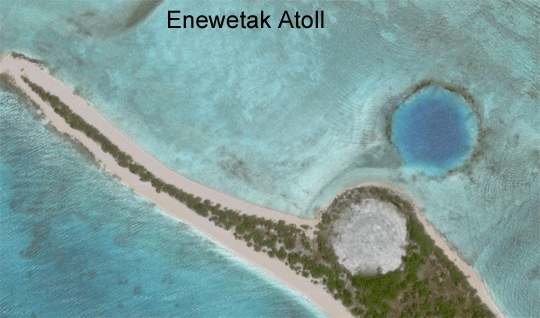
U.S. Rep. Tulsi Gabbard from Hawaii wants the U.S, government to provide unclassified report on Runit nuclear waste dome
|
Gabbard Seeks Report On Pacific Nuclear Waste Dome, Runit Dome in the Marshall Islands is reportedly leaking nuclear waste. https://www.civilbeat.org/beat/gabbard-seeks-report-on-pacific-nuclear-waste-dome/ By U.S. Rep. Tulsi Gabbard from Hawaii wants the federal government to provide more information on a dome holding radioactive nuclear waste leftover from U.S. nuclear testing in the Marshall Islands.Gabbard proposed an amendment that has been added to the 2020 National Defense Authorization Act, according to a press release from her office. It would “require the Department of Energy, the Environmental Protection Agency, and the Department of Defense to provide an unclassified public report on the current state of the Runit Dome nuclear waste facility,” the press release said. The dome was created to hold 111,000 cubic yards of nuclear waste and was supposed to be a temporary structure, the Guardian reported in 2015. Leaders of the Republic of the Marshall Islands have expressed concerns about leaks. If Gabbard’s amendment becomes law, the report would describe the condition of the dome and its potential environmental and public health impacts. “The U.S. government is responsible for this storage site and must ensure the protection of the people and our environment from the toxic waste stored there,” Gabbard said in the press release. |
|
Escalating collapse of global insect populations
- The entomologists interviewed for this Mongabay series agreed on three major causes for the ongoing and escalating collapse of global insect populations: habitat loss (especially due to agribusiness expansion), climate change and pesticide use. Some added a fourth cause: human overpopulation.
- Solutions to these problems exist, most agreed, but political commitment, major institutional funding and a large-scale vision are lacking. To combat habitat loss, researchers urge preservation of biodiversity hotspots such as primary rainforest, regeneration of damaged ecosystems, and nature-friendly agriculture.
- Combatting climate change, scientists agree, requires deep carbon emission cuts along with the establishment of secure, very large conserved areas and corridors encompassing a wide variety of temperate and tropical ecosystems, sometimes designed with preserving specific insect populations in mind.
- Pesticide use solutions include bans of some toxins and pesticide seed coatings, the education of farmers by scientists rather than by pesticide companies, and importantly, a rethinking of agribusiness practices. The Netherlands’ Delta Plan for Biodiversity Recovery includes some of these elements……….. https://news.mongabay.com/2019/06/the-great-insect-dying-how-to-save-insects-and-ourselves/
Global extinctions of plant species – going at a frightening rate
|
‘Frightening’ number of plant extinctions found in global survey https://www.theguardian.com/environment/2019/jun/10/frightening-number-of-plant-extinctions-found-in-global-survey Study shows 571 species wiped out, and scientists say figure is likely to be big underestimate, Damian Carrington Environment editor @dpcarringtonTue 11 Jun 2019 |
|
|
Scandinavian farmers still impacted by radioactive fallout from Chernobyl nuclear disaster
Chernobyl: 33 Years On, Radioactive Fallout Still Impacts Scandinavian Farmershttps://www.forbes.com/sites/davidnikel/2019/06/08/chernobyl-33-years-on-radiation-still-impacts-scandinavian-farmers/#390eeebd949f, David Nike 8 June 19
The smash-hit HBO series ‘Chernobyl’ has introduced an entire new generation to the nuclear disaster that shook the world in 1986. Initially covered up by Soviet authorities, the disaster only came to light when nuclear power stations in Sweden – hundreds of miles away – detected high levels of radiation and began to ask questions. 33 years later, radiation remains a problem in both Sweden and Norway especially for farmers.
“Who would have thought that a small northern Norwegian mountain village could be hit by a nuclear accident in Europe. Overnight we were powerless. The Chernobyl accident shows that our food production is vulnerable. It’s scary,” sheep farmer Laila Hoff from Hattfjelldal told Norwegian state broadcaster NRK. She said all meat had to be destroyed in the first year following the accident. But even now in 2019, animals in 37 Norwegian municipalities are subject to radiation testing and control before they can be slaughtered. One leading researcher says it will take “decades” for the controls to no longer be necessary.
How Chernobyl hit farming in Norway and Sweden
The radioactive substance cesium-137 takes many years to break down with an estimated half-life of 30 years. It still exists in the earth in the areas affected by the Chernobyl accident, including large parts of Norway and Sweden. The substance is taken up from the soil by plants and fungi, which in turn are eaten by sheep, reindeer and other grazing animals.
In the wake of the 1986 accident, cesium-137 spread over much of northern and central Scandinavia. The weather conditions were such that Norway and Sweden were two of the countries worst hit outside the Soviet Union. In Sweden, the areas around Uppsala, Gävle and Västerbotten were hardest hit, while in Norway the area between Trondheim and Bodø along with mountainous areas further south suffered, mainly because of rainfall.
The radiation impacted vegetation to varying degrees, but also led to radioactivity in grazing animals, primarily sheep and reindeer. In reindeer calf meat, up to 40,000 becquerels per kilogram (Bq/kg) were measured, with up to 10,000 Bq/kg in sheep meat. Norwegian authorities set the highest acceptable level in meat at just 60 Bq/kg, which led to the widespread feeding of animals with non-contaminated feed. This process of feeding livestock from contaminated pastures with non-radioactive feed for a period to reduce radioactivity in meat or milk is known as nedfôring.
Chernobyl disaster: how radiation affected the UK, and which parts of Britain are most radioactive today
Background radiation levels are much higher in some parts of the UK than in others,
The poisonous radiation that spewed into the atmosphere drifted over to Western Europe, causing a spike in radiation-related diseases and deaths in the years following the disaster.
How was the UK affected by Chernobyl?
In the immediate aftermath of the accident, the UK government banned the sale of sheep across thousands of farms on the basis that the animals had likely ingested radioactive material from fallout absorbed by plants.
In June of the same year, almost 9,000 British farms were affected by restrictions brought in on the movement and sale of sheep meat. This meant livestock had to be scanned by government officials before they were allowed to enter the food chain.
Parts of Cumbria, Scotland and Northern Ireland were impacted, and North Wales was hardest hit, with sheep in Wales still failing radioactive tests 10 years after the accident in 1996.
The last restrictions on the movement and sale of sheep in the UK were lifted in 2012, 26 years after the meltdown.
There have also been some studies linking increased incidences of infant leukaemia in Britain to the Chernobyl disaster but results are not conclusive.
Which parts of the UK are most radioactive?
Most of the background radiation present in the UK today comes from radon rather than fallout from Chernobyl.
Radon is an odourless, colourless gas formed by the radioactive decay of the small amounts of uranium that occur naturally in all rocks and soils.
Due to the variations in terrain across the UK, this means that some areas nationwide have far higher levels of background radiation than others……. https://inews.co.uk/news/science/chernobyl-disaster-radiation-uk-today-most-radioactive-areas-britain/
Plan to move Oversight Bureau at Los Alamos would weaken the monitoring of nuclear radiation releases
The Environment Department says it is conducting a proper assessment to determine where the Oversight Bureau should be located. Nevertheless, DOE provides about $1.8 million annually to the LANL Oversight Bureau under what was called an agreement in principle between the two agencies. It covered oversight of both the environmental releases from nuclear weapons work and cleanup at LANL. It is now called a memorandum of understanding and is restricted to cleanup.
facilities, personnel, and information. http://nuclearactive.org/ana-opposes-new-doe-order/, http://nuclearactive.org/doe-must-hold-hearings-in-new-mexico-about-order-140-1/, and http://nuclearactive.org/santa-fe-county-commissioners-call-for-suspension-of-doe-order-140-1/. At the same time, recent reports about the use of carbon steel valves in pipelines carrying corrosive radioactive liquid waste again demonstrates that LANL needs more oversight, not less. https://www.dnfsb.gov/sites/default/files/document/18101/Los%20Alamos%20Week%20Ending%20May%203%202019.pdf, and https://nukewatch.org/2019/05/31/faulty-radioactive-liquid-waste-valves-raise-crucial-plutonium-pit-production-and-safety-board-issues/
Joni Arends, of CCNS, urged people to get involved to keep the Oversight Bureau in Los Alamos. She said, “The new Environment Department Secretary, James Kenney, needs to understand the importance of the Oversight Bureau staying in Los Alamos for those living downwind and downstream of LANL. Please contact Secretary Kenney and tell him your story about what the Oversight Bureau means to you. Explain why it needs to remain in Los Alamos. His phone number is 505 827-2855 and his email is James.Kenney@state.nm.us. Please copy your correspondence to your congressperson and your local media. Thank you.”
Marshall Islands giant clams – a delicacy – except for the plutonium
 Giant clams are a delicacy of the Marshall Islands but illnesses fuel fears of nuclear contamination, ABC
Key points:
- The Marshallese bore the brunt of US nuclear bomb tests between 1946–58
- Tests released large amounts of radioactivity that the US was supposed to clean up
- Local leaders say that people remain fearful of eating contaminated local produce
“You see a nice-looking edible clam in the lagoon — it’s just like giving a kid a lovely lollipop,” nuclear commissioner Alson Kelen told the ABC, maintaining that eating clams will always be part of Marshall Islands life.
From 1946–1958, the US detonated 67 nuclear bombs in the Marshall Islands — some of the largest atomic weapons tests in history — and the area near the test site was evacuated, with locals receiving settlement payouts.
In the aftermath, with widespread radiation sickness being reported across the Marshall Islands, radioactive soil, debris, and wreckage was dumped into a nuclear crater on Enewetak Atoll.
The crater was capped with cement in 1980 and is officially called the Runit Dome — but locals have nicknamed it The Tomb.
The Enewatak people eventually began returning to the islands in the early 1980s following highly controversial talks between the United States and leaders of the Marshall Islands.
Amid reports of ongoing aftereffects and illness, a 2012 United Nations report found that the effects of the nuclear tests were long-lasting, which was followed by a 2013 US Department of Energy report which found radioactive materials were leeching out of the Dome, threatening the already tenuous existence of Enewetak locals. ………..https://www.abc.net.au/news/2019-06-08/illness-on-enewetak-atoll-reignites-nuclear-contamination-fears/11181940
New Hampshire citizens’ group to monitor radiation emanating from the Seabrook Power plant.
Group looks to monitor Seabrook power plant radiation, Seacoastonline.com By
Radioactive shellfish – giant clams in Marshall Islands near USA nuclear dump
High radiation levels found in giant clams near U.S. nuclear dump in Marshall Islands, By SUSANNE RUST and CAROLYN COLE,
Researchers have found high levels of radiation in giant clams near the Central Pacific site where the United States entombed waste from nuclear testing almost four decades ago, raising concerns the contamination is spreading from the dump site’s tainted groundwater into the ocean and the food chain.
The findings from the Marshall Islands suggest that radiation is either leaking from the waste site — which U.S. officials reject — or that authorities did not adequately clean up radiation left behind from past weapons testing, as some in the Marshall Islands claim.
The radioactive shellfish were found near Runit Dome — a concrete-capped waste site known by locals as “The Tomb” — according to a presentation made by a U.S. Department of Energy scientist this month in Majuro, the island nation’s capital. The clams are a popular delicacy in the Marshall Islands and in other nations, including China, which has aggressively harvested them from vast swaths of the Pacific.
According to Terry Hamilton, a veteran nuclear physicist at the Energy Department’s Lawrence Livermore National Laboratory, Runit Dome is vulnerable to leakage by storm surge and sea level rise, and its groundwater, which is leaking into the lagoon and ocean, is severely contaminated.
But the radiation in the shellfish and surrounding lagoon is not coming from the 40-year-old dome, said Hamilton in a slide he presented May 15 to an audience assembled in a hotel conference room in Majuro.
He said isotopic analyses indicated the lagoon contamination was from residue from the initial nuclear weapons testing.
The Los Angeles Times was not at Hamilton’s presentation, and the Energy Department did not make him available to comment. But the following day, residents and officials informed The Times about the findings, which were later confirmed with others.
Between 1946 and 1958, the United States tested 67 nuclear devices in the Marshall Islands, including 44 in Enewetak Atoll, one of the nation’s 29 coral atolls. Although the Marshall Islands were home to only 6% of the total number of tests conducted by the United States, it bore the brunt of more than half the total energy yield of all U.S. nuclear weapons testing.
Much of the fallout from those events is now entombed within Runit Dome. According to a photograph taken of Hamilton’s presentation slides, the 377-foot-wide crater in Enewetak Atoll contains groundwater samples with radiation levels 1,000 to 6,000 times higher than those found in the open ocean.
Some Marshallese who attended the presentation are skeptical about the agency’s conclusion that the dome is not leaking into the lagoon.
“What they’re saying is, here is the dome. And here, in the lagoon area, there is radiation. … But as far as leaking from the dome, we don’t think that’s the case?” said James Matayoshi, mayor of Rongelap Atoll, one of the atolls contaminated by fallout from the nuclear testing program. “That doesn’t make any sense.”
Extending the incredulity further, Matayoshi and others noted that Hamilton presented a short animation of the dome, showing it rise and fall with the tide — suggesting seawater
is freely flowing in and out of the containment zone.
Between 1977 and 1980, the United States enlisted roughly 4,000 U.S. soldiers and subcontractors to clean the site. Many said they were inadequately protected. They excavated soils from Enewetak and elsewhere and turned the soil into a concrete slurry, which they poured into an unlined crater on Runit Island, left behind by the Cactus bomb. They sealed it with a clean concrete top 18 inches thick, creating what is now called the Tomb.
In 1980, the people of Enewetak were told by the U.S. government it was safe to return home.
But there have been lingering worries about the atoll’s safety. The U.S. government told the Marshallese the dome was a temporary fix. It’s now been nearly 40 years. This latest news didn’t alleviate any of those concerns, said Holly Barker, a professor of anthropology at the University of Washington in Seattle. Barker is a member of the Marshall Islands’ three-person National Nuclear Commission — a government-mandated committee charged with seeking justice for nuclear-related injuries and damage.
The basic takeaway from the presentation, said Barker, is the lagoon is so contaminated, any leakage from the dome is negligible.
Which raises the question, “in what way was Runit a cleanup?” Barker said………
Lucinda Anitok, 35, from Sedro-Woolley, Wash., is a descendant of Runit landowners. She said the U.S. testing program in Enewetak had devastated her family. Her grandmother, who was raised on Enewetak, had thyroid cancer. Her mother, who was born there, had cervical cancer. And her sister had leukemia.
“What happened there was wrong,” she said. “It ruined, and is still harming, many people’s lives.”…….https://www.latimes.com/science/environment/la-me-marshall-islands-dome-is-leaking-radiation-20190528-story.htm
The long-lasting impact on North Wales agriculture, from Chernobyl nuclear disaster
following the Chernobyl disaster. The most significant way this impacted on
the region was the effect it had on livestock, primarily in north western
areas.
1986 catastrophe reached upland farms of over 53,000 hectares – with the
impact lasting for more than 20 years. Just days after the Ukrainian
disaster, the UK Government announced a ban on the sale of sheep across
parts of the region as well as in Cumbria and Scotland – as the enormity of
the problem for farmers became apparent. The protocol was motivated by
heavy rain following the explosion, which washed radioactive decay – mostly
caesium 137 – out of clouds and on to fields all across the continent.
were absorbed by plants – rather than being locked up in the soil itself.
Local sheep grazing on the land then became contaminated by eating the
radioactive grass, with restrictions affecting 180,000 sheep. The
restrictions in Snowdonia and beyond – which remained in some areas until
2012 – were imposed on more than 300 Welsh farms following concern for the
caesium in soil and vegetation in upland areas.
https://www.dailypost.co.uk/news/north-wales-news/chernobyl-disaster-how-north-wales-16340587
Fukushima radiation present in Bering Sea, researchers say — but no cause for concern (at present)
|
Fukushima radiation present in Bering Sea, researchers say — but no cause for concern KNBA KBC Tuckshop , By DAVIS HOVEY (KNOM-NOME) • MAY 23, 2019 Radioactive materials from the Fukushima incident eight years ago have arrived in the Bering Sea. State epidemiologists say the levels are extremely low and do not present a health concern…….
The idea was to determine when Bering Sea coastal communities would see evidence of Fukushima contaminants, even in very small concentrations. Based on their knowledge of ocean currents, passed from generation to generation, St. Lawrence Island residents expected it to happen at some point. …..
The idea was to determine when Bering Sea coastal communities would see evidence of Fukushima contaminants, even in very small concentrations. Based on their knowledge of ocean currents, passed from generation to generation, St. Lawrence Island residents expected it to happen at some point. ……
For several years, the nonprofit Woods Hole Oceanographic Institution has been testing the water samples provided by Sheffield and Ungott. Dr. Ken Buesseler, a senior scientist with Woods Hole, studies radioactive elements in the world’s oceans and has been focused on Fukushima contaminants since 2011. Cesium-137 is a radioactive isotope, which Buesseler says travels through ocean currents and behaves like potassium or salt. Since the initial release at Fukushima, the Cesium levels detected in the Pacific Ocean have decreased by about 15 percent, due to its half-life of 30 years. Meanwhile, Cesium-134, another radioactive isotope released from Fukushima, has a shorter half-life of two years, so Dr. Buesseler explains it is almost impossible to detect levels of that contaminant at this point in the Pacific Ocean. He says partnering with Sheffield, Ungott, and other citizen scientists through a crowdfunding model has been beneficial for this project.
Buesseler wants to reassure people that, despite the contamination, they can continue boating in the ocean, do their normal, water-based activities, and still eat the seafood without concern. “What we have to watch out for is either being too dismissive of people’s concerns — and that’s often why the government will argue, ‘why bother measuring, because the levels are so low,’ which I don’t think is the correct response, because that doesn’t address their concern — or being too alarmist, people saying, ‘stay out of the ocean because there is Cesium there,’ and I think that’s also not the right response, because the levels are quite low.” Buesseler along with other scientists reiterate that there is no reason to be concerned about the small amount of Fukushima contaminants contained in the Bering Sea, nor will be there cause for concern in the future as these radioactive levels will continue to diminish as time passes……..
There are two pathways for dilution. Danielson says one is for swiftly flowing features distributed along the continental slopes, known as eddies, to mix the waters carrying Cesium-137 and other radioactive isotopes with the ambient Bering Sea waters. The other is the materials can diffuse, like when you put a little container of perfume in the corner of a room. The perfume will volatilize, and you’ll be able to smell it all the way across the room because it is diffusing out through the air. The same thing happens in the ocean water…….
The years’ worth of data from the water samples and analysis of that information can be accessed for free at http://ourradioactiveocean.org/results.html. https://www.knba.org/post/fukushima-radiation-present-bering-sea-researchers-say-no-cause-concern
|
|
|
A devastating threat to the marine ecosystem – the Impact of Ocean Acidification
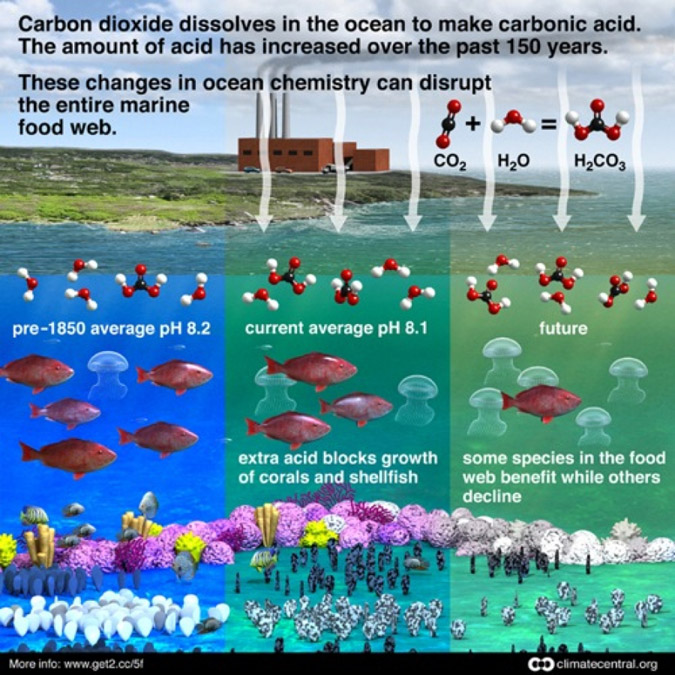
What Is the Impact of Ocean Acidification? https://www.envirotech-online.com/news/water-wastewater/9/breaking-news/what-is-the-impact-of-ocean-acidification/49250 Ocean acidification could have a massively damaging impact on millions of people all over the world in the coming years and decades, according to a new study from the University of Plymouth. By concentrating on heavily acidified hotspots in Japan and the Mediterranean, the study’s authors claim they can predict what may happen on a global scale if carbon continues to seep into the sea.The study is just latest in a growing body of work from its two authors, who have demonstrated that acidification can have a potentially devastating effect on marine ecosystems, with reefs under particular threat. This not only endangers the coral and oysters which comprise the reefs themselves, but also the myriad fish, crustaceans and other marine organisms which call them home.
What is ocean acidification?
Ocean acidification can be defined by a fall in pH levels in the water, caused primarily by carbon seeping into their vicinity. This can be caused naturally by volcanic fissures, such as at the two sites monitored by the study’s authors, but is becoming more and more commonplace through anthropomorphic activity, given that we release around a million tonnes of CO2 into the atmosphere every hour.
Roughly one quarter of that amount finds its way into the ocean and dissolves; once that happens, it reacts with the salty seawater to create a weak acidic substance. This causes surface ocean water to experience a fall in pH levels of approximately 0.002 units per year. That might not sound like much, but cumulatively it could have a sizable impact on the harmony of the water upon which so many marine creatures depend to survive and thrive.
Reefs at risk
The warming temperatures of the world’s oceans have already done significant damage to marine reefs; one only need to look at what’s happened to the Great Barrier reef for confirmation. As if that wasn’t bad enough, the acidification studied by Professor Jason Hall-Spencer and Dr Ben Harvey has been found to further jeopardise their longevity, especially for those composed of oysters or corals, which are particularly sensitive to the acidic effect.
The degradation of reefs not only spells trouble for the corals themselves, but also for the more than 25% of all marine animals which use them as a habitat. As well as being a hammer blow for biodiversity, this could also deplete stocks of many varieties of fish and shellfish which are popular for human consumption. Finally, reefs also provide an important breakwater for coastal communities; losing them would mean reduced protection against extreme weather events at sea.
What can be done?
In a world in which our seas and oceans are already suffering from myriad different problems, such as plastic pollution, dangerous blue green algae, habitat disruption from shipping, oil spills and many more, the last thing that the Earth’s waterways need right now is another threat in the form of increased oceanic temperatures and acidification. As a result, the lead author of the study Professor Hall-Spencer has called for immediate action.
“The Paris Agreement on climate change was welcome, but it does not mention ocean acidification, nor the fact that this rapid change in surface ocean chemistry undermines the social, economic and environmental pillars of sustainable development,” he remarked. “The time is ripe for a ‘Paris Agreement for the oceans’, with the specific target to minimise and address the impacts of ocean acidification, including through enhanced scientific cooperation at all levels.”
1 This Month



26 September – International Day for the Total Elimination of Nuclear Weapons


PLEASE OPPOSE HR 8255 AND S.3639 – bills would accelerate satellite deployment, with no environmental review or safeguards – https://ncstd5li.quorum.us/campaign/169331/
To see nuclear-related stories in greater depth and intensity – go to https://nuclearinformation.wordpress.com
-
Archives
- September 2026 (245)
- August 2026 (330)
- July 2026 (355)
- June 2026 (287)
- May 2026 (306)
- April 2026 (356)
- March 2026 (251)
- February 2026 (267)
- January 2026 (308)
- December 2025 (358)
- November 2025 (359)
- October 2025 (375)
-
Categories
- 1
- 1 NUCLEAR ISSUES
- business and costs
- climate change
- culture and arts
- ENERGY
- environment
- health
- history
- indigenous issues
- Legal
- marketing of nuclear
- media
- opposition to nuclear
- PERSONAL STORIES
- politics
- politics international
- Religion and ethics
- safety
- secrets,lies and civil liberties
- spinbuster
- technology
- Uranium
- wastes
- weapons and war
- Women
- 2 WORLD
- ACTION
- AFRICA
- Atrocities
- AUSTRALIA
- Christina's notes
- Christina's themes
- culture and arts
- Events
- Fuk 2022
- Fuk 2023
- Fukushima 2017
- Fukushima 2018
- fukushima 2019
- Fukushima 2020
- Fukushima 2021
- general
- global warming
- Humour (God we need it)
- Nuclear
- RARE EARTHS
- Reference
- resources – print
- Resources -audiovicual
- Weekly Newsletter
- World
- World Nuclear
- YouTube
-
RSS
Entries RSS
Comments RSS
 nuclear-news