“Get Your Endangered Species Off My Bombing Range!” Counter Punch by JOAN  ROELOFS MAY 17, 2019,
 “The Department of Defense’s ability to conduct realistic live-fire training, weapons system testing, and essential operations is vital to preparing a more lethal and resilient force for combat. . . . Starting in the late 1990s, the Department became increasingly concerned about “encroachment” pressures adversely affecting the military’s use of training and testing lands. Specifically, military installations saw
two main threats to their ability to test, train, and operate: nearby incompatible land uses and environmental restrictions to protect imperiled species and their habitats.”
Such problems are to be resolved by the DoD Readiness and Environmental Protection Integration
(REPI) Program.
The program employs “buffer partnerships” that include the DoD, private conservation groups, universities, and state and local governments. Also involved, often as additional funders, are other federal departments: Homeland Security, Energy, Interior, Agriculture, Commerce; and agencies, for example, the Agency for International Development (USAID) and the National Oceanic and Atmospheric Administration (NOAA). REPI regards these as “win-win partnerships,” as they share the cost of land or acquire easements to preserve compatible uses and natural habitats, without interfering with bombing or other essential training exercises. In addition to the helpful funding, the military can muster impressive influence over local development authorities, town councils, and adjacent landowners…….
At Fort Benning, Georgia, home of the “Maneuver School of Excellence,” (as well as the notorious School of the Americas, now renamed the Western Hemisphere Institute for Security Cooperation), live-fire and other training was threatened by threatened species and their habitats. Now the base and its partners are restoring habitat and offering contiguous land for buyers who would use the land for recreation. Among the partners are the Georgia Land Trust, The Conservation Fund, the Alabama Land Trust, and the Nature Conservancy (TNC).
Nationwide, TNC is likely the conservation organization with the greatest amount of funding from the DoD. The TNC grants for Fort Benning alone included (but were not limited to) one for $11,115,000, and another for $55,517,470. Both were described as: “Assist State and local governments to mitigate or prevent incompatible civilian land use/activity that is likely to impair the continued operational utility of a Department of Defense (DoD) military installation.”
Washington State, very receptive to military activities, despite the Hanford nuclear disaster area, has several REPI projects. One of them, at Joint Base Lewis-McChord, on Puget Sound, is to eliminate the “threat” to live-fire exercises and other missions coming from imperiled species and incompatible development. The extensive area beyond its 91,000 acres became a designated “Sentinel Landscape,” a partnership headed by Departments of Agriculture, Defense, and Interior to “align resources” to protect military testing “while benefiting ALL partners and landowners.” ……
The Defense Department has several other programs designed to prevent interference with live ammunition, bombing ranges, and other military activities. One is the Legacy Resource Management Program, which seeks civilian partners to help protect endangered species and “to promote stewardship of our nation’s. . . cultural heritage.” Already “The Department of Defense manages thousands of National Register of Historic Places-listed properties. . .” Also working with REPI is the DoD’s Office of Economic Adjustment; its Joint Land Use Studies Program helps local communities to avoid interfering with military operations by their civilian activities.
The military has a poor reputation as regards the environment—we think about the Marshall Islands, the Hanford Nuclear Reservation, poisoned aquifers, toxic waste burns, underwater sonar, and much more. It has paid attention to the criticisms. It still engages in its former ways, including the world record of oil consumption and extensive toxic emissions, but now there is a soft cop.
The DoD now emphasizes its need for natural landscapes for realistic training, its wish to avoid displacing or accidently bombing locals, and its help in protecting endangered species. However it does not want any environmental restrictions to poke into its activities. The military wants more land, airspace, and ocean clearance, and will make concessions. It uses the carrot, and the commanding influence of military power. The REPI Program supplies funds and also leverages contributions from state and local governments and conservation organizations, which are henceforth partners…..
there are serious concerns about the REPI project, and similar ones that partner with civilian governments and nongovernmental environmental organizations. First of all, by publicizing its protection of red-cockaded woodpeckers, gopher tortoises and others, their habitats, working farmlands, forests, and wetlands, the DoD emits a dust cloud over the intense environmental destruction of land, sea, and air resulting from military operations and their preparations. Militarization is worldwide and beyond, into space. In addition to the contribution of the US, other nations’ militaries are increasing in size, activities, and lethality. Many have been armed by us, or against the threat of us; some in response to other perceived threats. ……
Toxic wastes are produced (and not sequestered) at many US domestic bases; our military has granted us the bulk of superfund sites. As Joshua Frankhas stated:
US military sites, which total more than 50 million acres, are among the most insidious and dangerous Pentagon legacies. They are strewn with toxic bomb fragments, unexploded munitions, buried hazardous waste, fuel dumps, open pits filled with debris, burn piles and yes, rocket fuel…….
Another major concern about REPI and other military “partnerships” with civilian institutions and terrain is that it erodes the boundaries, however weak these days, between civil and military. Might the US be turning into a banana republic or a military dictatorship? Penetration is not new; the US Army Corps of Engineers have been developing and maintaining recreational lakes and flood control projects for a long time. However, the military is slowly expanding into every nook and cranny of civilian life. …..
https://www.counterpunch.org/2019/05/17/get-your-endangered-species-off-my-bombing-range/
May 18, 2019
Posted by Christina Macpherson |
environment, Reference, USA, weapons and war |
Leave a comment
“Anthropocene Nuclear Legacy” –Melting Glaciers Could Unleash Radioactive Fallout https://dailygalaxy.com/2019/05/anthropocene-nuclear-legacy-melting-glaciers-could-unleash-radioactive-fallout/ May 9, 2019 “These materials are a product of what we have put into the atmosphere. This is just showing that our nuclear legacy hasn’t disappeared yet. It’s still there,”said Caroline Clason, a lecturer in Physical Geography at the University of Plymouth of a study published in Nature that surveyed 19,000 of Earth’s glaciers and found their total melt amounts to a loss of 335 billion tons of ice each year, more than measurements of previous studies.“When it was built in the early 1900s, the road into Mount Rainier National Park from the west passed near the foot of the Nisqually Glacier, one of the mountain’s longest,” reports the New York Times. “Visitors could stop for ice cream at a stand built among the glacial boulders and gaze in awe at the ice. The ice cream stand (image below) is long gone.”
The glacier now ends more than a mile farther up the mountain, and they are melting elsewhere around the world too.
This scary scenario of our nuclear legacy was explored by an international team of scientists who studied the spread of radioactive contaminants in Arctic glaciers throughout Sweden, Iceland, Greenland, the Norwegian archipelago Svalbard, the European Alps, the Caucasus, British Columbia, and Antarctica. The researchers shared their results at the 2019 General Assembly of the European Geosciences Union (EGU) in Vienna.
It found man made radioactive material at all 17 survey sites, often at concentrations at least 10 times higher than levels elsewhere. “They are some of the highest levels you see in the environment outside nuclear exclusion zones,” said Caroline Clason
“Missing –14 Billion Tons of Antarctica’s Ice”
Fallout radionuclides (FRNs) were detected these sites. Radioactive material was found embedded within ice surface sediments called “cryoconite,” and at concentration levels ten times greater than the surrounding environment.“ They are some of the highest levels you see in the environment outside nuclear exclusion zones,” Clason, who led the research project, told AFP.
The Chernobyl disaster of 1986—by far the most devastating nuclear accident to date—released vast clouds of radioactive material including Caesium into the atmosphere, causing widespread contamination and acid rain across northern Europe for weeks afterwards. “Radioactive particles are very light so when they are taken up into the atmosphere they can be transported a very long way,” she told AFP. “When it falls as rain, like after Chernobyl, it washes away and it’s sort of a one-off event. But as snow, it stays in the ice for decades and as it melts in response to the climate it’s then washed downstream.”
The environmental impact of this has been shown in recent years, as wild boar meat in Sweden was found to contain more than 10 times the safe levels of Caesium.
“We’re talking about weapons testing from the 1950s and 1960s onwards, going right back in the development of the bomb,” Clason said. “If we take a sediment core you can see a clear spike where Chernobyl was, but you can also see quite a defined spike in around 1963 when there was a period of quite heavy weapons testing.”
Weapons tests can fling radioactive detritus up to 50 miles in the air. Smaller, lighter materials will travel into the upper atmosphere, and may “circulate around the world for years, or even decades, until they gradually settle out or are brought back to the surface by precipitation,” according to the Environmental Protection Agency.
Fallout is comprised of radionuclides such as Americium-241, Cesium-137, Iodine-131, and Strontium-90. Depending on a material’s half-life, it could remain in the environment minutes to years before decaying. Their levels of radiation also vary.
Particles can return to the immediate area as acid rain that’s absorbed by plants and soil, wreaking havoc on ecosystems, human health, and communities. But radionuclides that travel far and wide can settle in concentrated levels on snow and ice—large amounts of radioactive material from Fukushima was found in 2011 on four glaciers in the Tibetan Plateau, for example.
One of the most potentially hazardous residues of human nuclear activity is Americium, which is produced when Plutonium decays. Whereas Plutonium has a half-life of 14 years, Americium lasts 400.
Americium is more soluble in the environment and it is a stronger alpha (radiation) emitter. Both of those things are bad in terms of uptake into the food chain,” said Clason. While there is little data available on how these materials can be passed down the food chain—even potentially to humans—Clason said there was no doubt that Americium is “particularly dangerous”.
As geologists look for markers of the epoch when mankind directly impacted the health of the planet—known as the Anthropocene—Clason and her team believe that radioactive particles in ice, soil and sediment could be an important indicator.
The team hopes that future research will investigate how fallout could disperse into the food chain from glaciers, calling it a potential “secondary source of environmental contamination many years after the nuclear event of their origin.”
The Daily Galaxy via AFP, France24, and Nature
May 11, 2019
Posted by Christina Macpherson |
2 WORLD, climate change, environment, radiation |
Leave a comment
By Kay Vandette , 10 May 19, A new study has revealed that even the most remote and deep regions on Earth are not isolated from human activities. According to the research, radioactive carbon leftover from nuclear bomb tests in the 1950s and 1960s has made its way to the bottom of the ocean.
Researchers have discovered that crustaceans that live at the bottom of the ocean are eating radioactive carbon that has passed through the food web.
A study detailing the findings was published in the American Geophysical Union’s journal Geophysical Research Letters.
“Although the oceanic circulation takes hundreds of years to bring water containing bomb [carbon] to the deepest trench, the food chain achieves this much faster,” said Ning Wang, the lead author of the new study.
Nuclear bomb tests in the 50s and 60s released radioactive carbon-14 into the atmosphere. Once nuclear tests ended, the amount of carbon-14 or “bomb carbon” in the atmosphere dropped, and the carbon left the atmosphere to settle on the ocean’s surface. In a new study, researchers used bomb carbon to study and analyze organisms that thrive in the deepest parts of the ocean.Samples were collected from as deep as seven miles below the surface where temperatures are freezing and pressures high.
Amphipod specimens, which are crustaceans that scavenge along the deep ocean floor and eat waste and dead organisms, collected in 2017 from the Mariana, Mussau, and New Britain Trenches in the tropical West Pacific Ocean were analyzed for the study.
The amphipods had unusually high levels of carbon-14 in their stomachs and muscles, and the levels were similar to those found in surface marine organisms, suggesting that deep ocean organisms are eating carbon-14 contaminated waste and dead organisms that sink from the surface.
Over time, marine organisms incorporated this carbon into their cells and researchers observed elevated levels of carbon-14 in marine animals after nuclear bomb testing started……….. https://www.earth.com/news/radioactive-carbon-from-nuclear-bomb-tests/
|
|
|
May 11, 2019
Posted by Christina Macpherson |
2 WORLD, environment, oceans, radiation |
Leave a comment
 Radioactive carbon from nuclear bomb tests found in deep ocean trenches, Phys Org, by American Geophysical Union 8 May 19, Radioactive carbon released into the atmosphere from 20th-century nuclear bomb tests has reached the deepest parts of the ocean, new research finds. Radioactive carbon from nuclear bomb tests found in deep ocean trenches, Phys Org, by American Geophysical Union 8 May 19, Radioactive carbon released into the atmosphere from 20th-century nuclear bomb tests has reached the deepest parts of the ocean, new research finds.A new study in AGU’s journal Geophysical Research Letters finds the first evidence of radioactive carbon from nuclear bomb tests in muscle tissues of crustaceans that inhabit Earth’s ocean trenches, including the Mariana Trench, home to the deepest spot in the ocean.
Organisms at the ocean surface have incorporated this “bomb carbon” into the molecules that make up their bodies since the late 1950s. The new study finds crustaceans in deep ocean trenches are feeding on organic matter from these organisms when it falls to the ocean floor. The results show human pollution can quickly enter the food web and make its way to the deep ocean, according to the study’s authors.
“Although the oceanic circulation takes hundreds of years to bring water containing bomb [carbon] to the deepest trench, the food chain achieves this much faster,” said Ning Wang, a geochemist at the Chinese Academy of Sciences in Guangzhou, China, and lead author of the new study.
“There’s a very strong interaction between the surface and the bottom, in terms of biologic systems, and human activities can affect the biosystems even down to 11,000 meters, so we need to be careful about our future behaviors,” said Weidong Sun, a geochemist at the Chinese Academy of Sciences in Qingdao, China, and co-author of the new study. “It’s not expected, but it’s understandable, because it’s controlled by the food chain.”……
Thermonuclear weapons tests conducted during the 1950s and 1960s doubled the amount of carbon-14 in the atmosphere when neutrons released from the bombs reacted with nitrogen in the air. Levels of this “bomb carbon” peaked in the mid-1960s and then dropped when atmospheric nuclear tests stopped. By the 1990s, carbon-14 levels in the atmosphere had dropped to about 20 percent above their pre-test levels.
This bomb carbon quickly fell out of the atmosphere and mixed into the ocean surface. Marine organisms that have lived in the decades since this time have used bomb carbon to build molecules within their cells, and scientists have seen elevated levels of carbon-14 in marine organisms since shortly after the bomb tests began……..https://phys.org/news/2019-05-radioactive-carbon-nuclear-deep-ocean.html
|
|
|
May 9, 2019
Posted by Christina Macpherson |
2 WORLD, oceans, radiation |
Leave a comment
ABC , By Lexi Metherell 6 May 19,
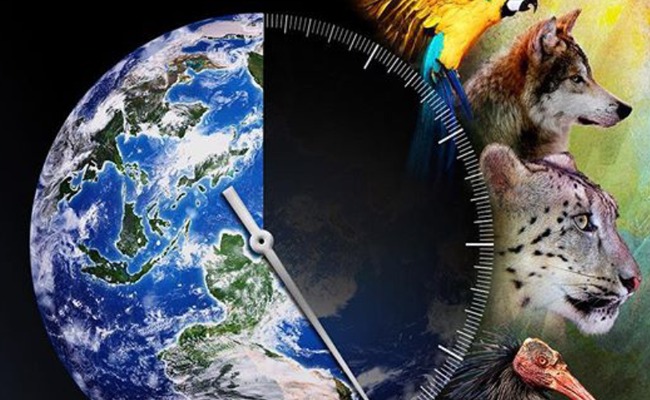
One million of the world’s species are now under threat of extinction, according to the biggest-ever review of the state of nature on Earth.
Key points:
- The report, which draws on 15,000 scientific and government sources, says human use of land and ea resources are mostly to blame
- The decline in nature is happening at rates that are unprecedented in human history, the UN report reveals
- More than 40 per cent of amphibian species, almost 33 per cent of reef-forming corals and more than a third of all marine mammals are threatened
The UN-backed report was three years in the making and was based on systematic reviews of 15,000 scientific and government sources.
Among a vast number of alarming findings is that the average population size of native species in most habitats on land has fallen by at least 20 per cent, mostly since 1900.
More than 40 per cent of amphibian species, almost 33 per cent of reef-forming corals and more than a third of all marine mammals are now under threat.
“We are eroding the very foundations of our economies, livelihoods, food security, health and quality of life worldwide,” said Sir Robert Watson, the chair of the Intergovernmental Science-Policy Platform on Biodiversity and Ecosystem Services (IPBES), which put together the report.
The IPBES has 132 nation-members and is known as the equivalent of the Intergovernmental Panel on Climate Change (IPCC), but for biodiversity.
Human expansion and exploitation of habitats to blame
The report says that human use of the land and sea resources are mostly to blame, followed by direct exploitation of animals, climate change, pollution and invasive species.
More than a third of the world’s land surface and nearly 75 per cent of freshwater resources are now devoted to crop or livestock production, while urban areas have more than doubled since 1992.
Meanwhile, 300-400 million tonnes of heavy metals, solvents, toxic sludge and other waste is dumped into the world’s waters every year.
The decline in nature is happening at rates that are unprecedented in human history.
“It’s like reading a paper that says the natural world is in catastrophic decline and there is a chance that this catastrophe will take us all down with it,” said Tim Beshara, federal policy director of Wilderness Society.
Humanity is causing a slow-motion apocalypse of the natural world and that’s getting faster and faster as time goes on.”…………
Next year is a big year for global conservation. The signatories to the Convention on Biological Diversity, which is the global treaty meant to safeguard biodiversity, are scheduled to meet and sign a new post-2020 strategic plan.
Professor Watson said it’s an opportunity to reset the clock and design a global deal for nature and biodiversity.
“The sad thing is Australia has gone missing in these negotiations, they haven’t even turned up to the last major international negotiations around this matter, and as you are seeing in the federal election, biodiversity is just not even mentioned,” he said.
“That’s a shame because Australia is one of the few mega-biodiverse countries around the world — we have more species than just about every other country.” https://www.abc.net.au/news/2019-05-06/biggest-global-assessment-of-biodiversity-sounds-dire-warnings/11082940
May 7, 2019
Posted by Christina Macpherson |
ANTARCTICA, environment |
Leave a comment

How Can Cockroaches Survive Nuclear Attacks If They Can Be Killed By Insecticide? http://mentalfloss.com/article/582458/how-can-cockroaches-survive-nuclear-attacks-killed-insecticide
Short answer: Because insecticides are powerful drugs specifically tailored to affect their neurological system when directly aimed, and many will leave long-lasting residual effect. Nuclear bombs not directly aimed at cockroaches may miss them underground for long enough to allow for radiation to dissipate enough for their survival.
Long answer:
There’s obviously considerable exaggeration on the widespread belief that cockroaches would survive a nuclear explosion.
Of course any exposed cockroach wouldn’t survive being hit by a missile, nor the massive forthcoming shock wave, not even the sky-high radiation levels. What is true is that insects are generally more resistant to radiation than vertebrates because of their smaller size and filtering exoskeleton, and that some pest cockroaches are well-known for being able to survive on limited nutrition and reproduce astoundingly quickly for their size.
This way, many researchers believe that cockroaches would likely survive for longer than vertebrates within any cities hit by a major nuclear accident or attack. Whether this is true or not, time will tell.
Now, insecticides are chemicals carefully selected to affect the nervous system of insects, causing death as soon as possible while lasting for a long time on surfaces (residual effect). They are designed to kill cockroaches—while nuclear attacks are designed to vanquish cities. The right weapon for the right enemy, that’s it.
May 7, 2019
Posted by Christina Macpherson |
2 WORLD, environment |
1 Comment
 Particles From Cold War Nuclear Bomb Tests Found in Deepest Parts of the Ocean
Crustaceans in the Mariana Trench and other underwater canyons feed on food from the surface laced with carbon-14 from Cold War bomb tests, By Christopher Crockett, smithsonian.com , May 1, 2019
Crustaceans in the Mariana Trench and other underwater canyons feed on food from the surface laced with carbon-14 from Cold War bomb tests
The first test of a thermonuclear weapon, or a hydrogen bomb, codenamed Ivy Mike and conducted by the United States in 1952 over the island of Elugelab in Enewetak Atoll in the Pacific Ocean. (Public Domain)……… Crustaceans in the Mariana Trench and other underwater canyons feed on food from the surface laced with carbon-14 from Cold War bomb tests
No place on Earth is free from human influence—not even the bottom of the deepest trenches in the ocean.
Shrimp-like critters from three West Pacific ocean trenches were found to munch on food that sinks down from the surface, leaving a unique chemical signature from decades-old nuclear bomb tests in the bodies of the deep-sea crustaceans. The findings, published recently in Geophysical Research Letters, not only help marine scientists figure out how these bottom dwellers survive, but also underscore the depths to which humanity’s influence can penetrate………
In those dark depths, one of the most common critters is the shrimp-like amphipod, a family of crustaceans that scavenge the ocean floor for food. Where that food comes from is a matter of debate. Potential sources include morsels that percolate up from Earth’s interior, nutrient-rich sediment that slides down steep trench walls, or tasty detritus that wafts down from the surface.
A recent haul of deep-sea amphipods offered Sun and colleagues a chance to solve this marine mystery. Using baited traps, two Chinese research vessels in 2017 harvested amphipods from three trenches in the West Pacific, including the famous Mariana Trench. Sun’s team chemically analyzed the amphipods’ muscle tissue and gut contents and found elevated levels of carbon-14, a heavy variant of carbon. The levels closely matched abundances found near the surface of the ocean, where the amount of carbon-14 is higher than usual thanks to nuclear bomb tests conducted more than half a century ago.
Carbon comes in a few different varieties based on how many neutrons are stuffed into its atomic nucleus. About one out of every trillion carbon atoms on Earth has two extra neutrons. This form, known as carbon-14, occurs naturally thanks to high-speed atomic particles from deep space whacking into nitrogen atoms. But in the middle of the 20th century, humans doubled the amount of carbon-14 in the atmosphere.
According to the International Atomic Energy Agency, from 1945 to 1963 the United States and the Soviet Union (with a little help from the United Kingdom and France) detonated nearly 500 nuclear bombs, 379 of which exploded in the atmosphere. These tests dramatically increased the amount of carbon-14 on our planet. The Test Ban Treaty of 1963 put a stop to most atmospheric and underwater tests, and carbon-14 levels in the atmosphere started a slow return to normal—though they are still higher than pre-nuclear levels—as ocean waters and land-based life absorbed carbon from the air.
………While the nuclear bomb signature has been recorded a couple miles down in the West Atlantic, no one has seen it as these depths before. “This is just interesting as all get out,” says Robert Key, a Princeton oceanographer who was not involved with this study. He points out that starting about a mile below the surface of the North Pacific, carbon-14 levels closely match what the atmosphere looked like before the bomb tests. “The high carbon-14 [in the amphipods] could only come from food that’s come down from the top,” he says.
The abundance of material created in nuclear bomb tests high in the sky found in the bodies of deep-dwelling amphipods underscores a very intimate connection between human activity and the most isolated reaches of the sea…………. https://www.smithsonianmag.com/science-nature/particles-cold-war-nuclear-bomb-testing-found-amphipods-mariana-trench-180972078/
May 2, 2019
Posted by Christina Macpherson |
oceans, wastes, weapons and war |
Leave a comment
 The Last Time There Was This Much CO2, Trees Grew at the South Pole, Dahr Jamail, Truthout , 29 April 19, “……… Water
As usual, there continue to be ample examples of the impacts of climate disruption in the watery realms of the planet.
In oceans, most of the sea turtles now being born are female; a crisis in sea turtle sex that is borne from climate disruption. This is due to the dramatically warmer sand temperatures where the eggs are buried. At a current ratio of 116/1 female/male, clearly this trend cannot continue indefinitely if sea turtles are to survive.
An alarming study showed recently that the number of new corals on the Great Barrier Reef has crashed by 89 percent after the mass bleaching events of 2016 and 2017. With coral bleaching events happening nearly annually now across many of the world’s reefs, such as the Great Barrier, we must remember that it takes an average of a decade for them to recover from a bleaching event. This is why some scientists in Australia believe the Great Barrier Reef to be in its “terminal stage.”
The UN recently sounded the alarm that urgent action is needed if Arab states are to avoid a water emergency. Water scarcity and desertification are afflicting the Middle East and North Africa more than any other region on Earth, hence the need for countries there to improve water management. However, the per capita share of fresh water availability there is already just 10 percent of the global average, with agriculture consuming 85 percent of it.
Another recent study has linked shrinking Arctic sea ice to less rain in Central America, adding to the water woes in that region as well.
In Alaska, warming continues apace. The Nenana Ice Classic, a competition where people guess when a tripod atop the frozen Nenana River breaks through the ice each spring, has resulted in a record this year of the earliest river ice breakup. It broke the previous record by nearly one full week.
Meanwhile, the pace of warming and the ensuing change across the Bering Sea is startling scientists there. Phenomena like floods during the winter and record low sea ice are generating great concern among scientists as well as Indigenous populations living there. “The projections were saying we would’ve hit situations similar to what we saw last year, but not for another 40 or 50 years,” Seth Danielson, a physical oceanographer at the University of Alaska Fairbanks, told The Associated Press of the diminishing sea ice.
In fact, people in the northernmost community of the Canadian Yukon, the village of Old Crow, are declaring a climate disruption State of Emergency. The chief of the Vuntut Gwitchin First Nation in the Yukon, Chief Dana Tizya-Tramm, has stated that his community’s traditional way of life is at stake, including thawing permafrost and rivers and lakes that no longer freeze deeply enough to walk across in the winter, making hunting and fishing difficult and dangerous. He said that declaring the climate emergency is his community’s responsibility to the rest of the planet.
Other signs of the dramatic warming across the Arctic abound. On Denali, North America’s highest mountain (20,310 feet), more than 66 tons of frozen feces left by climbers on the mountain are expected to begin thawing out of the glaciers there as early as this coming summer.
Another study found that tall ice cliffs around Greenland and the Antarctic are beginning to “slump,” behaving like soil and rock in sediment do before they break apart from the land and slide down a slope. Scientists believe the slumping ice cliffs may well be an ominous sign that could lead to more acceleration in global sea level rise, as far more ice is now poised to melt into the seas than previously believed.
In New Zealand, following the third hottest summer on record there, glaciers have been described by scientists as “sad and dirty,” with many of them having disappeared forever. Snow on a glacier protects the ice underneath it from melting, so this is another way scientists measure how rapidly a glacier can melt — if the snow is gone and the blue ice underneath it is directly exposed to the sun, it’s highly prone to melting. “Last year, the vast majority of glaciers had snowlines that were off the top of the mountain, and this year, we had some where we could see snowlines on, but they were very high,” NIWA Environmental Science Institute climate scientist Drew Lorrey told the New Zealand Herald. “On the first day of our survey, we observed 28 of them, and only about six of them had what I would call a snowline.”
Lastly in this section, another study warned that if emissions continue to increase at their current rate, ice will have all but vanished from European Alpine valleys by 2100. The study showed that half of the ice in the Alps’ 4,000 glaciers will be gone by 2050 with only the warming that is already baked into the system from past emissions. The study warned that even if we ceased all emissions at this moment, two-thirds of the ice will still have melted by 2100……… https://truthout.org/articles/the-last-time-there-was-this-much-co2-trees-grew-at-the-south-pole/
April 30, 2019
Posted by Christina Macpherson |
2 WORLD, climate change, water |
Leave a comment

In degrading Nature humanity harms itself, UN report warns, https://www.france24.com/en/20190425-degrading-nature-humanity-harms-itself-un-report-warns Diplomats and scientists from 130 nations gather in Paris next week to vet and validate the first UN global assessment of the state of Nature in more than a decade, and the news is not good.A quarter of 100,000 species already assessed are on a path to extinction, and the total number facing a forced exit from the world stage is closer to a million, according to an executive summary, obtained by AFP, of a 1,800-page scientific report three years in the making.
A score of 10-year targets adopted in 2010 under the UN’s biodiversity treaty — to expand protected areas, slow species and forest loss, and reduce pollution impact — will almost all fail, the draft Summary for Policy Makers reports.
But the focus of the five-day meet is not just pangolins, pandas, polar bears and the multitude of less “charismatic” lifeforms that humanity is eating, crowding or poisoning into oblivion.
Rather, the spotlight is on the one species that has so ravaged Earth’s natural systems as to imperil its own existence as well.
That, of course, would be us: homo sapiens.
The accelerating loss of clean air, drinkable water, healthy soil, pollinating insects, protein-rich fish and storm-blocking mangroves — to name but a few of the dwindling services rendered by Nature — poses no less of a threat to humanity than climate change, according to the report, set to be unveiled May 6.
“Up to now, we have talked about the importance of biodiversity mostly from an environmental perspective,” said Robert Watson, chair of the UN-mandated body that compiled the report, told AFP.
“Now we are saying that Nature is crucial for food production, for pure water, for medicines and even social cohesion.”
And to fight climate change, he added.
Forests and oceans, for example, soak up half of the planet-warming greenhouse gases we spew into the atmosphere. If they didn’t, Earth might already be locked into an unliveable future of runaway global warming.
And yet, an area of tropical forest five times the size of England has been destroyed since 2014, mainly to service the growing global demand for beef, biofuels, soy beans and palm oil.
It would be like setting fire to a lifeboat while lost at sea in order to cook the fish one just caught.
– Hidden impacts –
“We need to recognise that climate change and loss of Nature are equally important, not just for the environment, but as development and economic issues as well,” Watson said.
The way we produce our food and energy is undermining the regulating services that we get from Nature.”
Set up in 2012, the Intergovernmental Science-Policy Platform on Biodiversity and Ecosystem Services (IPBES) synthesises published science for policymakers in the same way the IPCC does for climate.
Both advisory bodies are tied to UN treaties.
But the Convention on Biological Diversity has always been a poor stepchild compared to its climate counterpart, and the IPBES — unlike the Intergovernmental Panel on Climate Change — was added two decades later as an afterthought, making its authority harder to establish.
For the public, “biodiversity” remains an abstract concept, and its impacts harder to see: species loss is invisible and remote compared to deadly heatwaves, superstorms and sea-level rise.
“There is no question that the climate convention is stronger,” Watson said.
“But our goal is to make sure that governments and the private sector really start to take biodiversity as seriously as they do climate.”
– Species disappearing –
One major finding of the report to be reviewed next week that might help do that is “an imminent rapid acceleration in the global rate of species extinction.”
The pace of loss “is already tens to hundreds of times higher than it has been, on average, over the last 10 million years,” it notes.
“Half-a-million to a million species are projected to be threatened with extinction, many within decades.”
Experts on biodiversity are also trying to engineer a “Paris moment,” something equivalent to the 2015 climate treaty that set a hard target for capping global warming at under two degrees Celsius (3.6 Fahrenheit).
That could come next year in China at the next full meeting of the Convention on Biodiversity, they say.
But the plan to save Nature — and humanity along with it — must be every bit as “transformative” as the changes proposed to avert a climate-addled future of human misery, said Watson.
“The way we produce and use energy, with way we produce and waste food — all of that has to be looked at,” he said.
“The global report will make the case that biodiversity is essential to a sustainable world and human well-being.”
April 27, 2019
Posted by Christina Macpherson |
2 WORLD, environment |
Leave a comment
Chernobyl at 33: More evidence of slow-moving ecological catastrophe, Beyond Nuclear, April 19
Following more than a decade of
research indicating
negative ecological impacts of low dose radiation, a
new study points to reduced success in breeding among a type of rodent living in contaminated areas of Chernobyl. The more radiation, the greater the impact; and what would be normal interactions with the natural ecology can make this impact even worse, which is why lab experiments can’t replicate it fully. These impacts “can lead to significant consequences for individuals, populations, and likely even entire ecosystems.”
Such revelations bode poorly for people who might resettle in areas contaminated by radiological catastrophes. Discovering what happens to people in these areas has been made more difficult because whole databases of radiation doses to humans have gone missing and research has focused mostly on catastrophic impacts rather than more subtle impacts. This is according to a
new book “Manual for Survival: A Chernobyl Guide to the Future” by Kate Brown,
interviewed on
Nuclear Hotseat. Brown also
reasons that before we think of using nuclear technology to address climate change, we need to figure out what radiation exposure from nuclear weapons and power has already done to our health.
April 27, 2019
Posted by Christina Macpherson |
environment, Ukraine |
Leave a comment
A million species face extinction due to humans, UN report finds https://www.heraldscotland.com/news/17592216.a-million-species-face-extinction-due-to-humans-un-report-finds/ By Phil Miller, Arts Correspondent, 24 Apr 19, UP to a million species face extinction due to the actions of humanity, a new UN report finds.
The Agence France-Presse agency, based in Paris, has seen the draft of a report which catalogues how “humanity has undermined the natural resources upon which its very survival depends.”
These include accelerating loss of clean air, drinkable water, carbon dioxide-absorbing forests, pollinating insects, protein-rich fish and storm-blocking mangroves.
The report, which says these issues are as important as climate change, is due to be officially published in early May.The 44-page Summary for Policy Makers distills a 1,800-page UN assessment of scientific literature on the state of nature
Robert Watson, chair of the UN-mandated body that compiled the report, said: “We need to recognise that climate change and loss of nature are equally important, not just for the environment, but as development and economic issues as well.
“The way we produce our food and energy is undermining the regulating services that we get from Nature.”
The report says deforestation and agriculture, including livestock production, account for about a quarter of greenhouse gas emissions, and have wreaked havoc on natural ecosystems as well.
The Intergovernmental Science-Policy Platform on Biodiversity and Ecosystem Services (IPBES) report warns of “an imminent rapid acceleration in the global rate of species extinction.”
The pace of loss “is already tens to hundreds of times higher than it has been, on average, over the last 10 million years.
“Half-a-million to a million species are projected to be threatened with extinction, many within decades.”
Scientists estimate that Earth is today home to some eight million distinct species, a majority of them insects.
Other findings in the report are that three-quarters of land surfaces, 40 percent of the marine environment, and 50 percent of inland waterways across the globe have been “severely altered”.
It says that many of the areas where nature’s contribution to human wellbeing will be most severely compromised are home to indigenous peoples and the world’s poorest communities that are also vulnerable to climate change.
It also says that subsidies to fisheries, industrial agriculture, livestock raising, forestry, mining and the production of biofuel or fossil fuel energy encourage “waste, inefficiency and over-consumption.”
April 25, 2019
Posted by Christina Macpherson |
2 WORLD, environment |
Leave a comment
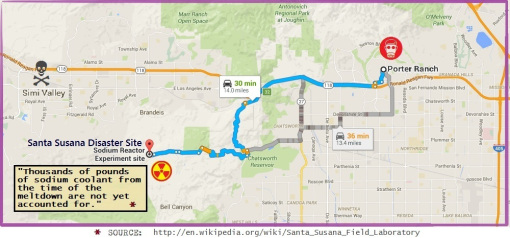 As hikers head to Santa Susana Field Lab, residents rally for a cleanup , Daily News, By OLGA GRIGORYANTS | ogrigoryants@scng.com | Los Angeles Daily News April 19, 2019 An Earth Day nature walk sponsored by Boeing Co. near the old Santa Susana Field Laboratory is drawing the scorn of local residents, who say the walk is part of an effort to gloss over the lack of a cleanup in the area after years of Cold War contamination from the rocket engine testing.
The walk includes a tour of the former field laboratory and the landscape around it in a region that includes massive sandstone rock formations, expansive views and oak trees nestled in the hills above the west edge of the San Fernando Valley……
a group of residents and activists plan to show up in the area Saturday to continue efforts calling for a long-promised clean up of contamination at the site that dates back to the Cold War, and to research and testing on the Mercury and Apollo missions. ….
The lab appeared on the map in the 1940s, and about two decades later it became the site of a partial meltdown accident that left the area polluted with radioactive and chemical contamination.
The United States Department of Energy and NASA signed an agreement in 2010, promising to remove all contamination from the site by 2017. The state’s Department of Toxic Substance Control, or DTSC, asked Boeing, which owns a portion of the area, to commit to its own cleanup. https://www.dailynews.com/2019/04/19/as-hikers-head-to-santa-susana-field-lab-residents-rally-for-a-cleanup/
April 23, 2019
Posted by Christina Macpherson |
environment, USA |
Leave a comment
 ON EVE OF EARTH DAY, ANOTHER FEDERAL JUDGE RULES THE TRUMP ADMINISTRATION ILLEGALLY ROLLED BACK CRITICAL ENVIRONMENTAL PROTECTIONS https://www.atg.wa.gov/news/news-releases/eve-earth-day-another-federal-judge-rules-trump-administration-illegally-rolled Apr 21 2019
AG Ferguson’s 20th legal victory against Trump Administration
OLYMPIA — Attorney General Bob Ferguson released the following statement today after a federal judge in Montana ruled that the Trump Administration illegally revoked an Obama-era moratorium on new coal leases on federal lands, and must comply with a federal law requiring environmental analysis before leasing coal-mining rights on public lands:
“It’s fitting that on the eve of Earth Day, another federal judge slaps down the Trump Administration’s illegal effort to roll back basic environmental protections,” said Ferguson. “The Trump Administration illegally revoked the Obama-era moratorium on leasing public lands for coal-mining even though its Interior Department admitted it did not fully understand the societal and environmental impacts of extraction. This ruling sends a clear message that the federal government cannot take an action that impacts our environment without careful review and deliberation – which, to be polite, is not a strong suit of The Trump Administration.”
Case background
In May 2017, Ferguson filed a federal lawsuit against the U.S. Department of the Interior and the Bureau of Land Management over a program to lease coal mining rights on public land, which contributes to significant coal-train traffic through the state of Washington. The lawsuit challenged then-Secretary Ryan Zinke’s decision to restart the federal coal-leasing program without supplementing or replacing its nearly 40-year-old environmental study.
The lawsuit was jointly filed by California, New Mexico, New York and Washington in the U.S. District Court for the District of Montana, Great Falls Division.
Coal from federal leases following Zinke’s order would be transported by rail across Washington. In particular, coal from the Powder River Basin is shipped to or through the state. According to the Washington Department of Transportation, the baseline number of trains in 2015 numbered 70 per day on some track segments in the state, including multiple coal trains. Diesel exhaust and coal dust from uncovered coal train cars can negatively affect air quality.
Washington has a further interest in the effects of increased coal production and consumption on climate change. Washington experiences many negative effects of climate change, including rising ambient temperatures, a diminished and unpredictable snowpack necessary for water consumption and hydropower generation, and ocean warming and acidification, which is harmful to Washington’s shellfishery.
The AGO’s Counsel for Environmental Protection is handling the case for Washington.
Attorney General Ferguson created the Counsel for Environmental Protection in 2016 to protect our environment and the safety and health of all Washingtonians.
Ferguson has filed 35 lawsuits against the Trump Administration and has not lost a case. Ferguson now has 20 legal victories against the Trump Administration. Eleven of those cases are finished and cannot be appealed. The Trump Administration has or may appeal the other nine, which include lawsuits involving Dreamers and 3D-printed guns. After more than two years of litigation, no court to rule on the merits of the Attorney General’s arguments in a lawsuit against the Trump Administration has ruled against the office.
-30-
The Office of the Attorney General is the chief legal office for the state of Washington with attorneys and staff in 27 divisions across the state providing legal services to roughly 200 state agencies, boards and commissions. Visit www.atg.wa.gov to learn more.
Contacts:
Brionna Aho, Communications Director, (360) 753-2727; Brionna.aho@atg.wa.gov
April 23, 2019
Posted by Christina Macpherson |
environment, Legal, politics, USA |
Leave a comment
Saskatoon Star Phoenix 20th April 2019 , Canada’s largest uranium producer says it’s developing a plan to clean
up groundwater contaminated with uranium and radiation four months after it was first discovered at a shuttered mill in northern Saskatchewan.
Cameco Corp. reported in December that a sampling well adjacent to its Key Lake mill “was showing an increasing trend in uranium concentration” after 50,000 litres of water were “released” over the previous year. Carey Hyndman, aspokeswoman for the Saskatoon-based company, said this week that the incident was immediately reported to the Saskatchewan Ministry of Environment and the Canadian Nuclear Safety Commission.
https://thestarphoenix.com/news/local-news/cameco-developing-plan-to-clean-up-contaminated-groundwater-at-key-lake
April 22, 2019
Posted by Christina Macpherson |
Canada, Uranium, water |
Leave a comment
ENDS 16th April 2019 The Environment Agency has flagged a series of concerns over proposals for a new nuclear power station in Suffolk, warning that a lack of detail means
that the impacts and proposed suitability of mitigations “cannot be
assessed at this time”. Energy firm EDF plans to build and operate the new
Sizewell C nuclear power station in Suffolk on land immediately to the
north of the Sizewell B power station. The application – which has yet to
be submitted – will be determined via the fast-track Planning Act 2008
regime for nationally significant infrastructure projects, with the
business secretary responsible for making a final decision.
https://www.endsreport.com/article/1582216/environment-agency-concerned-lack-detail-sizewell-c-plans
April 20, 2019
Posted by Christina Macpherson |
environment, politics, UK |
Leave a comment







 nuclear-news