New research shows a tiny island halfway between Australia and Hawaii has concentrations of nuclear material up to 1000 times higher than at two well-known meltdown locations in Ukraine and Japan.
Research carried out by Columbia University and published this week shows deadly plutonium levels are far higher than previously thought on the Marshall Islands. The group of 29 atolls was subject to 67 US nuclear tests between 1946 and 1958, with locals forced to flee as the country dropped bomb after bomb in paradise.
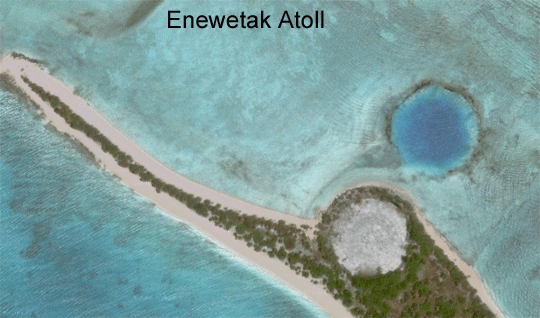
The United States entombed nuclear waste under a dome on the island of Runit that some believe is leaking into the Pacific Ocean. However the real impact of the contamination is only now being realised.
Researchers wrote that two atolls, Bikini and Enewetak, “were used as ground zero” and took the brunt of the impact.
On Enewetak, the first-ever hydrogen bomb was tested. But Bikini was the site of the world’s largest-ever hydrogen bomb test — known as Castle Bravo.
The tests, researchers say, “caused unprecedented environmental contamination and, for the indigenous peoples of the islands, long-term adverse health effects”.
Researchers tested levels of radioactive isotopes in soil and food sources and found “a real concern” on Runit where the huge dome was designed to contain radiation but is not working.
“The presence of radioactive isotopes on the Runit Island is a real concern, and residents should be warned against any use of the island,” researchers said.
“Moreover, wash-off of existing isotopes off the islands into the ocean from weathering and continued sea level rise continues to threaten, further contaminating the lagoon and the ocean at large.”
On Bikini, researchers found concentrations of particular radioactive material “were up to 15-1000 times higher than in samples from areas affected by the Chernobyl and Fukushima disasters”.
Though residents were banished from the Marshall Islands during the height of the Cold War, many have returned. The Los Angeles Times reports more than 600 people call Enewetak, Runit and Enjebi home.
Jan Beyea, a retired radiation physicist, told the newspaper: “Implicitly, I think these results might caution efforts to return because of the readings found.”
News.com.au previously reported rising sea levels were degrading the concrete dome at Runit, and the US Department of Energy concluded the “burial site” was leaking highly toxic waste.
Locals refer to it as “the poison” and have already been complaining of birth defects and high cancer rates.
After Castle Bravo, islanders more than 160km away mistook fallout for snow. It “caused skin burns, hair loss, nausea and eventually cancer” in many who were exposed, the Times reports.
The warnings from researchers clash with advice from the US Government, which signed a memorandum of understanding with the Republic of the Marshall Islands agreeing it was safe for those who wished to return home.
In the Marshall Islands, the most common cause of death is diabetes, which is related to a thyroid disorder. The second most common cause of death is cancer.
The population of the Marshall Islands is around 70,000 people, with local Marshallese people allowed to live and work in the US without a visa as part of the reparations for the nuclear testing that took place.
Over a third have already moved to the US. It is said when you leave the Marshall Islands, you buy a one-way ticket.
Activists warn that construction will release radioactive dust into the air and the Moscow River. By Evan Gershkovich, July 16, 2019
When Yelena Ageyeva moved to the Moskvorechye-Saburovo neighborhood in southeastern Moscow in 1987, she was aware that there was a radioactive site across the railroad tracks from her apartment building.
“They calmed us down by saying that it was all buried under soil and so we had nothing to worry about,” said the 59-year-old pensioner on a recent evening at the commuter rail station adjacent to the site. “We lived in peace all these years.”
The site, the Moscow Polymetals Plant’s slag heap, contains tens of thousands of tons of radioactive waste left over after the extraction of thorium and uranium from ore. The factory ceased production of metals in 1996 for “environmental reasons,” according to its website — it now produces weapons and military equipment — and the dump is now a hill half a kilometer wide sloping down to the banks of the Moscow River.
City officials had been considering a full-scale clean-up for years, but never rubber-stamped a plan due to the risky location of the site near a source of water for Moscow’s southern suburbs.
Now residents of nearby neighborhoods say new plans for an eight-lane highway across the southern band of the city that will pass next to the site have eclipsed environmental and health concerns. They warn that the construction will unleash the buried radioactive materials into the river at the bottom of the hill and the air that the city’s 12 million residents will breathe.
A legacy of a rushed Soviet effort to begin nuclear research as the race to build an atomic bomb gained steam in the 1930s, the hill is one of many contaminated sites across Russia — some of which are smack bang in the middle of the country’s capital and most populated city, where research first began at the Kurchatov Institute.
Just 13 kilometers from the Kremlin and steps from Kolomenskoye Park, a popular spot for Muscovites to ski in winter and picnic in summer, the Moskvorechye-Saburovo hill is the most contaminated of the bunch, according to Radon, a government agency tasked with locating and clearing radioactive waste.
“Operations in such an environment are a serious engineering challenge — one incautious step, and radioactive soil gets into the river,” said Alexander Barinov, Radon’s chief engineer for Moscow, when asked about the site in a 2006 interview.
“Full decontamination by removing all of the radioactive waste is simply impossible,” he added, noting that Radon every year conducts “a kind of therapy” to ensure the site’s safety — in short, dumping dirt on top of the waste to keep it buried after topsoil runoff each spring.
“The alternative is to assign this territory a special status and impose restrictions on its use, but the city authorities keep postponing this decision.”
More than a decade later, the authorities have apparently postponed that decision indefinitely. According to activists and local politicians, city officials are pretending the problem doesn’t exist at all.
“I believe the authorities know full well the risks,” said Pavel Tarasov, a Communist Party municipal deputy representing the Lefortovo neighborhood. “But it’s a lot easier to steal state budget funds allocated to construction than to clean up radioactive waste.”
Officials last fall started to push ahead with plans to build the new highway. In November, they began holding public hearings in neighborhoods through which the road will pass, including those around the radioactive site. Activists say officials didn’t mention that the hill holds radioactive waste during those hearings.
“We’ve been well aware that there was radioactive waste here for a long time,” said Andrei Ozharovsky, a specialist with the radioactive waste safety program of the country-wide Social-Ecological Union non-profit organization, during a recent tour of the site.
Ozharovsky, who in 1989 graduated from the National Research Nuclear University, located within walking distance of the plant, said he studied under a professor who used to be its former director and would mention the waste left there in lectures.
That information was not exclusive to nuclear scientists. In 2011, the popular state-run Rossia 1 television channel toured the site. “The radiation there exceeds the permissible level by tens of times,” a broadcaster said on air.
With the information out in the open, it wasn’t long until activists began to raise concerns on social media after the public hearings began last year. As anxiety swelled, local residents and municipal deputies demanded that the authorities conduct a safety test. In April, specialists from Radon and the Emergency Situations Ministry measured a rate two hundred times higher than the norm.
In the weeks since, officials have attempted to placate concerns by noting that construction won’t actually touch the radioactive parts of the site but just pass nearby — 50 meters away, to be exact. In a statement released Thursday, Radon called the reactions by local public figures “extremely emotional.”
A day earlier, Greenpeace Russia had released a statement demanding that construction be halted.
“Once trucks start driving near the site, the topsoil will slide and the radioactive dust will be released,” said Rashid Alimov, the director of the organization’s energy program, noting that the April examination didn’t dig deep enough to determine the danger level of the waste beneath.
“If radioactive dust gets into people’s lungs, it can increase the likelihood of cancer,” he added.
That worry has hit close to home for Katya Maximova, 32, who lives across the river from the site. When the Chernobyl reactor exploded in 1986, the year before she was born, her aunt lived in Ponyri, a village in Russia’s southern Kursk region about 500 kilometers away. The aunt believes the tragedy killed off almost everyone in the village over the next decade.
“Pretty much everyone got cancer within the next five to 10 years,” Maximova said.
Maximova, who has been a driving force behind the social media campaign to raise awareness about the Polymetals Plant hill, criticized the authorities for withholding information from the public and not attempting to understand the full picture in the first place.
“We’re not specialists so it’s hard to know what’s true,” she said. “We’re not against the authorities or against the construction. What we want is a full-scale examination first.”
A public hearing at the State Duma is scheduled for Wednesday morning, but Maximova said construction of the highway has already started on her side of the river.
“We have a long history of tragedies due to negligence,” she said, noting Chernobyl and last year’s fire at the Winter Cherry Mall in the Siberian city of Kemerovo that killed more than 60 people, many of them children. “These are preventable tragedies.”
Maximova has recruited others to help with the social campaign, including her friend Ruslana Lugovaya. Thinking about what could happen frightens Lugovaya, so she is allaying her fears by focusing on the work, with a dab of dark humor.
“Why go visit Chernobyl when we have our own Chernobyl right here in Moscow?” she said.
Expert says 2020 Tokyo Olympics unsafe due to Fukushima | 60 Minutes
Fukushima: an ongoing disaster, Red Flag , Jack Crawford, 15 July 2019 In March – on the eighth anniversary of the Fukushima disaster – Time magazine published an article with the headline: “Want to Stop Climate Change? Then It’s Time to Fall Back in Love with Nuclear Energy”. In it, the former head of the International Atomic Energy Agency, Hans Blix, evokes the imminent threat of climate catastrophe to argue, “There are paths out of this mess. But on March 11, 2011 [the day of the Fukushima disaster], the world’s course was diverted away from one of the most important. I am talking about nuclear energy”. He continues by criticising public fears of nuclear as irrational: “Plane crashes have not stopped us from flying, because most people know it is an effective means of travelling”. Blix speaks for the global nuclear industry, which is increasingly attempting to present itself as the solution to climate change.
But plane crashes do not kill untold numbers and spread deadly poisons over huge areas of the planet. Fukushima was and still is a horrific and ongoing human and environmental catastrophe, exposing the horrendous risks to which the powerful are willing to subject people and the planet. It should be remembered every time a pro-nuclear bureaucrat or politician exploits genuine concern about climate change to promote this deadly industry. It should never be forgotten.
………..Today, towns such as Futaba, Tomioka and Okuma are nuclear ghost towns. In them you will find a forest of metal gates, decaying buildings, shattered glass and cars wrapped in vines. The only human faces are mannequins in store windows, still dressed in the fashion of 2011. Sprawled across the highway between towns are hundreds of black bags filled with toxic dirt. They are one of the many problems of the clean-up effort. There are about 30 million one-tonne bags of radioactive topsoil, tree branches, grass and other waste. There is no safe, long-term storage place for this material.
The clean-up is undermined by cost cutting. Workers are forced to meet strict deadlines, even if it compromises safety. “There were times when we were told to leave the contaminated topsoil and just remove the leaves so we could get everything done on schedule”, explained Minoru Ikeda, a former worker. “Sometimes we would look at each other as if to say: ‘What on earth are we doing here?’”
The task is mammoth. The government and TEPCO now say that decommissioning the failed nuclear plant will take 40 years, at a cost of ¥22 trillion (or US$200 billion). But there is significant uncertainty about how to remove the hundreds of tonnes of molten fuel from the reactors. “For the removal of the debris, we don’t have accurate information or any viable methodology for that”, admitted the plant’s manager, Akira Ono, in 2015. “We need to develop many, many technologies.”
Beyond the plant itself, the total clean-up is likely to cost between ¥50 trillion and ¥70 trillion (US$460-640 billion), according to the estimates of a right wing think tank, the Japan Center for Economic Research. Thousands of workers continue to make daily trips between the contaminated zones and company accommodation. Dodgy subcontractors recruit largely from Japan’s destitute, including the homeless, migrant workers and asylum seekers. A recent Greenpeace investigation, “On the Frontline of the Fukushima Nuclear Accident: Workers and Children”, found evidence of hyper-exploitation and dangerous radiation exposure. In one case, a 55-year-old homeless man was paid the equivalent of US$10 for a month’s work. “TEPCO is God”, lamented Tanaka, another homeless Fukushima worker. “The main contractors are kings, and we are slaves.”
Scandalously, organised crime has penetrated the clean-up operations. Those with debts to the Yakuza (Japanese organised crime) have found themselves shoved into hazmat suits and set to work. The subcontracting system has allowed TEPCO to turn a blind eye to such human rights abuses.
Despite triumphant optimism from some champions of nuclear, researchers continue to uncover unexpected and unpredictable consequences of the Fukushima disaster. These include the discovery of tiny, glassy beads containing extremely high concentrations of caesium-137 (a radioactive isotope) among polluted dust and dirt particles. These bacterium-sized particles are easily inhaled and persistently insoluble. How they react with our bodies and the environment is not yet clear, but scientists increasingly believe them to be a health risk. The beads have been found as far from the disaster site as Tokyo.
The dangers faced by those returning to Fukushima prefecture have been a central controversy of recent years. Compelled by economic necessity, most have returned. But as of February 2019, 52,000 remain displaced, either unwilling to return or with homes in still-prohibited zones. In a recent press tour, the government repeatedly blamed “harmful rumours” for creating fear of returning as well as the Japanese public’s unwillingness to consume Fukushima’s fish and agricultural products.
“To me”, explained activist Riken Komatsu, “talking about ‘harmful rumours’ sounds like they are making someone else the bad guy or villain, as if they are blaming people for saying negative things because they don’t understand science and radiation. But those who have lost our trust do not have the right”.
Mistrust is justified. Prime minister Shinzo Abe, keen to move on from the crisis, intends to end evacuations by the time Japan hosts the 2020 Olympics. The international and (prior to the meltdowns) Japanese standard of acceptable exposure to radiation, one millisievert per year, has been scrapped. Across Fukushima prefecture, measurements five times that level are now deemed safe.
Some places measure as high as 20 millisieverts per year. These radiation levels are especially dangerous for children, who are far more sensitive than adults to even low levels of exposure. It will take decades before the cost of the authorities’ carelessness can be measured in increased cancer rates. The loss of happy, healthy human life of course can never be quantified………
those who “benefit” from the powerful nuclear industry are the same people who crave military dominance. The politicians and officials currently fighting to rebuild Japanese nuclear capability are thinking far more about the military tensions surrounding them than tackling climate change. We don’t need to a build a world full of deadly nuclear power plants to combat climate change. We need clean, renewable energy and a system that prioritises people and the planet over money and military might. https://redflag.org.au/node/6838
Kim and Kourtney Kardashian are flexing their social platforms for good, and they only had to go 10 miles away from their Southern California homes to do it. This weekend, they supported and advocated for the cleanup of one of America’s largest partial nuclear meltdown sites responsible for more than a thousand cancer cases.
Kim and Kourtney, along with their kids, came to the event and joined the community in painting rocks to be used for a memorial commemorating those harmed by radiation and chemicals. The Kardashians became aware of the site following the Woolsey Fire, which allegedly began at the Santa Susana Field Lab. Since then, Kim has advocated for the cleanup of the site on social media.
The Santa Susana Field Lab Meltdown Anniversary Event was set in motion to create awareness that, despite more than 50 cases of rare pediatric cancer being reported among families living in the area since the nuclear reactor and rocket-engine test facility experienced a partial meltdown in 1959, cleanup has begun but has not yet been finished. The partial meltdown contaminated the lab, leaving behind dangerous, radioactive substances and remnants from testing the limits of nuclear power that are proven to be toxic.
In 2010, the U.S. government and NASA signed administrative orders of consent promising a complete cleanup. Boeing, the only non-governmental organization responsible for the partial meltdown, submitted a cleanup plan that would leave the majority of the contamination on the site. It is up to the California Department of Toxic Substances Control (DTSC) to determine whether Boeing will be held responsible for a complete cleanup or if they will be allowed to leave the site contaminated.
When the lab was first created in 1947 for rocket, energy, and weapons testing, the surrounding area was largely rural. A small portion of it, known as Area IV, was secretly being used to test experimental nuclear reactors.
In 1959, an experiment was conducted that is estimated to have released 260 times more radiation than the Three Mile Island accident. A 2007 study found that people living within two miles of the Santa Susana Field Lab are 60% more likely to develop certain types of cancer. It’s believed that the partial meltdown that occurred as a result of this experiment is responsible for 1,800 cancer cases.
Today, more than half a million people live within 10 miles of the site. Over the years, different proposals have been made for what should be done with the land. In 2007, Gov. Arnold Schwarzenegger signed a bill that would have made restoration standards high enough for the space to be used safely for agricultural or residential property. It was struck down in federal court. The most recent proposal by the DTSC suggests a partial cleanup of the site.
“Today I went to an event for the 60th anniversary of the Santa Susana Field Lab Melt Down. It still hasn’t been cleaned up after 60 years! 60 kids all have rare cancers linked to this toxic site! It’s time to clean this up! This site is 10 miles from my home!” tweeted Kim.
“As we look back at the meltdown anniversary, we also have to look forward and get more people involved in fighting for the cleanup. We have seen some positive steps from our elected officials recently, but more — many more — people have to speak out if we are ever going to get the 100% cleaned up that we were promised,” said activist and event organizer Melissa Bumstead.
Kim has lent her voice and influence to a number of social justice issues recently, including gun safety, clemency for people of color incarcerated for lesser crimes, and criminal justice reform. She has met with President Donald Trump, funded legal teams, and asked her followers to not let injustice go overlooked. Now, she’s adding toxic nuclear site cleanup to her growing list of causes.
An analysis of soil samples, ocean sediment, and fruits from the Marshall Islands—the site of nearly 70 nuclear weapons tests during the 1940s and 1950s—has revealed alarmingly high levels of radiation, with some regions at levels exceeding areas affected by the Fukushima and Chernobyl disasters.
From 1946 to 1958, the United States conducted 67 nuclear tests in the Marshall Islands, a series of atolls located north of the equator between Hawaii and Australia. Twenty-three of these tests were conducted at Bikini Atoll and 44 near Enewetak Atoll, but fallout spread throughout the entire Marshall Islands, exposing the indigenous people there to dangerous levels of radiation.
Much of the Marshall Islands remains uninhabitable as a consequence of these nuclear tests, and it’s not immediately clear when Marshallese residents will be able to return to their ancestral homes. Three new studies published today in Proceedings of the National Academy of Sciences suggests their long-awaited return won’t happen anytime soon. A research team led by Emlyn Hughes and Malvin Ruderman from the Center for Nuclear Studies at Columbia University has detected unsafe levels of radiation in the soil, ocean sediment, and fruits in these contaminated areas.
Three years ago, the same team discovered alarming levels of gamma radiationin the Marshall Islands, and at levels that exceeded scientists’ expectations. The three new PNAS studies add to this prior work, which is being done to determine which, if any, of the Marshall Islands are safe for resettlement, and the specific risks that would be faced by returning indigenous peoples.
For the first study, the researchers measured background gamma radiation in soil samples taken from four atolls in 2017 and 2018: Bikini, Enewetak, Rongelap, and Utirik. Gamma radiation on Bikini and Naen islands were well beyond the maximum exposure limit as stipulated in agreements between the United States and the Republic of the Marshall Islands. On Bikini, the levels were as high as 648 millirems per year, and on Naen they were as high as 460 millirems per year. Safe exposure to radiation is 100 millirems per year, according to the U.S.-Republic of the Marshall Islands agreement.
These levels are “significantly higher” than “areas affected by the Chernobyl and Fukushima accidents,” wrote the study authors. The “radiation levels on Bikini Island, which served as the primary island for habitation on the atoll, before and in the aftermath of the testing, are too high for relocation to Bikini,” according to the new research. Some of the outer islands “may not [be] suitable for habitation on their own, but… islanders may visit in search of food, especially in times of harvest.”
For the second paper, the researchers explored the Castle Bravo crater—the site of the most powerful nuclear test ever conducted by the United States, which happened on March 1, 1954. This 15-megaton explosion vaporized the land beneath it, forming a crater 1.5 kilometers (0.9 miles) wide and 75 meters (246 feet) deep on Bikini Atoll. The ensuing fallout was comprised of pulverized coral, water, and radioactive particles. Traces of the radioactive debris were detected as far as Japan, India, Australia, Europe, and even the United States.
The Castle Bravo explosion also produced radioactive material that settled into the ocean sediment. From the research vessel Indies Surveyor, the researchers collected nearly 130 core samples from the Castle Bravo crater from 2017 to 2018. Analysis showed that, six decades later, the radiation levels are still “orders of magnitude” above normal levels within the top inch of sediment across the entire crater. The researchers conclude thusly:
In summary, there is still residual contamination of radionuclides throughout the Bravo bomb crater, from center to rim. We find that the radionuclide distribution is fairly uniform across the crater with some tapering off toward the crater rim….Although the lagoon is gradually filling in over time, contamination levels from residual long-lived radioactive isotopes, such as plutonium and americium, will likely last for centuries. The nuclear weapon tests caused a dramatic change in sediment composition. Additional studies to determine what the impact on life is in the lagoon craters, especially at the deeper depths, would be valuable.
The third paper is an analysis of fruits found in the Marshall Islands, namely coconuts and pandanus fruits. Cesium-137 features a half-life of around 30 years, and it’s easily absorbed by plants, presenting a potential health hazard. Sadly, 11 islands were found to have coconuts and pandanus fruits with radioactivity exceeding limits established by several countries and international organizations, including International Physicians for the Prevention of Nuclear War (IPPNW). Once again, some of the levels exceeded values found near Fukushima and Chernobyl.
“Based upon our results, we conclude that to ensure safe relocation to Bikini and Rongelap Atolls, further environmental remediation… appears to be necessary to avoid potentially harmful exposure to radiation,” wrote the authors in the study.
All-in-all, some very discouraging results, as much of the Marshall Islands remain unsafe for resettlement. It’s not immediately clear when these islands will be free of radiation, or if people will ever return to Bikini Atoll. Sadly, climate change is making a bad situation worse, as rising sea levels could render many of the safe Marshall Islands uninhabitable.
The 44-acre dump, officially known as the Shallow Land Disposal Area, was used primarily in the 1960s by the Nuclear Materials and Equipment Corp. (NUMEC), which had plants in Apollo and Parks Township. NUMEC and its successors, the Atlantic Richfield Co. and Babcock & Wilcox, produced nuclear fuels and other nuclear products for the U.S. government, commercial power plants and others.
The Army Corps of Engineers is in the process of resuming a cleanup of the dump, which is expected to cost more than $500 million.
The Corps has been monitoring the groundwater annually at the site since 2003.
The agency has found levels of radioactive contaminants in the groundwater below the federal and state drinking water quality standards. Residents who live near the dump have access to public water.
There has been no evidence of any off-site migration of radionuclides, according to the Corps.
Corps contractor Jacobs Field Services is developing a work plan for the cleanup with excavation planned to start in 2021, according to the Corps.
The grounds remain coated with plutonium, cesium, strontium and americium — radionuclides (atoms that emit radiation) that could pose potentially serious health risks to those who touch or ingest them. Some areas are more radioactive, and therefore more dangerous, than others.
“Even though the accident occurred over 33 years ago it remains one of the most radiologically contaminated places on earth.”
Chernobyl tourists should avoid plant life, and especially the depths of the forests.
Those areas were not cleaned in the aftermath of the disaster and remain highly contaminated by radiation. Research has showed that the fungus, moss and mushrooms growing there are radioactive. Eating or drinking from the area is not safe.
Those who stay on the paved pathways, which officials cleaned, are much less likely to absorb harmful toxins.
The tourists first started flocking to Chernobyl nearly 10 years ago, when fans of the video game S.T.A.L.K.E.R. wanted to see firsthand the nuclear wasteland they’d visited in virtual reality.
Next came those whose curiosity piqued when in 2016 the giant steel dome known as the New Safe Confinement was slid over the sarcophagus encasing nuclear reactor number four, which exploded in April 1986, spewed radiation across Europe and forced hundreds of thousands to flee from their homes.
Then in May, HBO’s “Chernobyl” miniseries aired, and tourism companies reported a 30 to 40 percent uptick in visitors to the Chernobyl Exclusion Zone, abandoned and eerily frozen in time.
Now the Ukrainian government — capitalizing on the macabre intrigue — has announced that Chernobyl will become an official tourist site, complete with routes, waterways, checkpoints and a “green corridor” that will place it on the map with other “dark tourism” destinations.
“We must give this territory of Ukraine a new life,” President Volodymyr Zelensky said during a visit to Chernobyl this week. “Until now, Chernobyl was a negative part of Ukraine’s brand. It’s time to change it.”
Zelensky, who was inaugurated in May, signed a decree July 10 to kickstart the Chernobyl Development Strategy, which the president hopes will bring order to the 19-mile Exclusion Zone that has become a hotbed for corruption, trespassing and theft. At the nuclear facility and in the nearby town of Pripyat, wildlife has returned and now roams freely. Flora and fauna grow up around decaying homes, playgrounds and an amusement park. Letters, dinner tables and baby dolls remain where their owners abandoned them 33 years ago.
Radioactive dust still coats it all.
“Chernobyl is a unique place on the planet where nature revives after a global man-made disaster, where there is a real ‘ghost town,’” Zelensky said during his visit. “We have to show this place to the world: scientists, ecologists, historians, tourists.”
Though exploiting a historical space like Chernobyl could infuse Ukraine’s economy with tourism dollars and motivate developers to revive the sleepy towns surrounding the “dead zone,” there are significant downsides, experts say.
[Thanks to HBO, more tourists are flocking to the eerie Chernobyl nuclear disaster site]
The grounds remain coated with plutonium, cesium, strontium and americium — radionuclides (atoms that emit radiation) that could pose potentially serious health risks to those who touch or ingest them. Some areas are more radioactive, and therefore more dangerous, than others.
“Chernobyl was the worst nuclear accident in human history,” said Jim Beasley, an associate professor at the University of Georgia who has been studying wildlife in the Exclusion Zone since 2012. “Even though the accident occurred over 33 years ago it remains one of the most radiologically contaminated places on earth.”
More than 30 people were killed in the immediate aftermath of the explosion, and officials are still debating the full extent of the longterm death toll in Ukraine and nearby countries where people grew sick with cancer and other illnesses.
The World Health Organization estimates total cancer deaths at 9,000, far less than a Belarusian study that put the death toll at 115,000, reported Reuters.
Today, radiation levels inside the Exclusion Zone vary widely from location to location, said Dr. T. Steen, who teaches microbiology and immunology at Georgetown’s School of Medicine and oversees radiation research in organisms at nuclear disaster sites. Because of that, she advises anyone visiting to be educated and cautious while inside the Exclusion Zone, and to limit time spent there.
“The longer you’re exposed, the more that future impact is,” she said.
She advises visitors to the Exclusion Zone to wear clothes and shoes they are comfortable throwing away. If they’re going to be touching or disturbing anything, she recommends a mask and gloves. Most importantly, Steen says, Chernobyl tourists should avoid plant life, and especially the depths of the forests.
Those areas were not cleaned in the aftermath of the disaster and remain highly contaminated by radiation. Research has showed that the fungus, moss and mushrooms growing there are radioactive. Eating or drinking from the area is not safe.
Those who stay on the paved pathways, which officials cleaned, are much less likely to absorb harmful toxins.
Generally speaking, Chernobyl can be safe, Steen said, “but it depends on how people behave.”
And so far, the accounts of tourists behaving badly are abundant.
Timothy Mousseau, a biologist and University of South Carolina professor, has been studying the ecological and evolutionary consequences of radioactive contaminants on wildlife and organisms at Chernobyl for 20 years. He just recently returned from his annual, month-long trip to the Exclusion Zone and said he was shocked to see 250 tourists in street clothes wandering Pripyat.
Some hopped in bumper cars at the abandoned amusement park there to take selfies.
“Part of the reason people don’t think twice about it is because there is this highly organized tourism operation,” Mousseau said. “A lot of people don’t give it a second thought.”
He is concerned that the government’s tourism campaign could only make that worse.
“The negative aspects that are being completely ignored are the health and safety issues of bringing this many people, exposing this many people to what is a small risk, albeit a significant risk, to this kind of contamination,” Mousseau said. “The more traffic there is, the most dust there is, and the dust here is contaminated.”
[We’re in the age of the overtourist. You can avoid being one of them.]
But Mousseau’s worries, and the anxieties of his colleagues, extend beyond health factors.
For decades, biologists, ecologists and medical researchers have been studying the mostly undisturbed expanse that is the Exclusion Zone. They’ve studied DNA mutations in plants and insects, birds and fish. As larger mammals, like moose, wolves and fox, have slowly re-occupied the surrounding forests, biologists have searched for clues about the ways short-term and long-term radiation exposure have altered their health.
Scientifically, there is no place on earth like Chernobyl. Beasley, who studies wolves there, calls it a “living laboratory.” An influx of humans — especially reckless ones — could destroy it.
“This is really the only accessible place on the planet where this kind of research can be conducted at a scale both spatial and temporal that allows for important scientific discovery,” Mousseau said. “Given increased use of radiation in technology and medicine, in going to Mars and space, we need to know more about radiation and its effects on biology and organisms.”
“And Chernobyl provides a unique laboratory to do this kind of research,” he said.
Tourism’s negative footprint in the Exclusion Zone is not theoretical, either.
They are leaving behind trash, rummaging through abandoned homes and buildings and, in Mousseau’s experience, stealing his research equipment. Cameras he has hidden in the depths of the most radioactive parts of the zone to capture the wildlife he studies have been vandalized or gone missing, he said.
It’s something that absolutely astounds me,” he said.
Theoretically, more government oversight at Chernobyl could help curb this kind of interference, especially if a financial investment in the zone will help preserve the ghost town there and bring in more guards and checkpoints to patrol who comes and goes.
None of that will prevent tourists from disturbing Chernobyl’s spirit.
“I think it is important to not lose sight of the fact that Chernobyl represents an area of tremendous human suffering,” Beasley said, “as hundreds of thousands of people were forever displaced from their homes or otherwise impacted by the accident.”
What is needed now is action, by Robert Dodge, 13 Jul 19,
60 years ago today the largest nuclear accident in U.S. history occurred above the Southern California community of Simi Valley when the Santa Susanna Field Laboratory (SSFL) site suffered a partial nuclear meltdown. That accident, kept secret for two decades, has resulted in ongoing local health effects that persist to this day and has pitted the community health and wellbeing against corporate financial interests and captured government agencies.
SSFL, a 2850 acre site, currently owned by the Department of Energy, NASA and the largest owner being Boeing, is aformer nuclear reactor and rocket engine testing site. It is located in the hills above the Simi and San Fernando Valleys, at the headwaters of the Los Angeles River. Located about 25 miles from downtown Los Angeles, originally far from population areas, the area now has around 500,000 people within 10 miles of the site. Over its years of operation, there were 10 non-contained nuclear reactors that operated on the site as well as plutonium and uranium fuel fabrication facilities and a “hot lab” where highly irradiated fuel from around the U.S. nuclear complex was shipped for decladding and examination. In addition there were tens of thousands of rocket engine tests conducted over the many years of operation.
The Sodium Reactor Experiment or SRE was the first reactor to provide commercial nuclear power to a U.S. city in Moorpark. Then on July 13, 1959, a partial meltdown occurred in which a third of the fuel experienced melting. Dr. Arjun Makhijani estimated the incident released 260 times the amount of radioactive iodine as was released from the 1979 Three Mile Island accident.
As a result of this partial meltdown and numerous other reactor accidents, radioactive fires, massive chemical contamination in handling of the radioactive and chemically contaminated toxic materials that were routinely burned in open pits through the years at the site, it remains one of the most highly contaminated sites in the country. It has widespread contamination with radionuclides such as cesium-137, strontium-90, plutonium-239 and toxic chemicals perchlorate, trichloroethylene (TCE), heavy metals and dioxins.
In 2012, the U.S. EPA released the results of an extensive radiological survey of Area IV and the Northern Buffer Zone at SSFL, and found 500 samples with radioactivity above background levels, in some cases, thousands of times over background.
These toxins are associated with a multitude of health risks. Many are cancer causing, others are neurotoxins causing a host of issues including learning disabilities, birth defects and many other health effects. The most vulnerable tend to be women and children. Through the years, there have been many health studies performed. In 2006, a cluster of retinoblastoma cases, a rare eye cancer affecting young children, was identified within an area downwind of the site. The retinoblastoma mothers meeting at Los Angeles’s Children’s Hospital ultimately formed a chemo carpool.
The Public Health Institute’s 2012 California Breast Cancer Mapping Project found that the rate of breast cancer is higher in Thousand Oaks, Simi Valley, Oak Park and Moorpark than in almost any other place in the state.
In addition, studies by cancer registries found elevated rates of bladder cancer associated with proximity to SSFL.
There have been numerous additional studies including one by the UCLA School of Public Health that found significantly elevated cancer death rates among both the nuclear and rocket workers at SSFL from exposures to these toxic materials. Another study by UCLA found offsite exposures to hazardous chemicals by the neighboring population at levels exceeding EPA levels of concern.
A study performed for the Federal Agency for Toxic Substances and Disease Registry found the incidence of key cancers, those types known to be associated with the contaminants on site, were 60% higher in the offsite population within 5 miles of the site compared to further away.
Unfortunately, these contaminants do not stay on site. When it rains, they wash off site to the Valleys below. When it blows, they become airborne and migrate offsite. The 2017 Woolsey fire is a most recent example. After initially denials, officials finally admitted the fire actually started on the field lab site burning across almost the entire site and potentially spreading toxic chemicals over the basin. Unfortunately, no adequate monitoring was performed and only began days after the flames had moved on.
Ultimately, the California Department of Toxic Substances Control (DTSC), has regulatory oversight of the cleanup and of the responsible parties which include NASA, the Department of Energy (DOE), and Boeing. In 2010, the Department of Energy and NASA signed historic agreements with DTSC that committed them to cleaning up all detectable contamination. The agreements, or Administrative Orders on Consent (AOC), specified that the cleanup was to be completed by 2017. Boeing, which owns most of the SSFL property, refused to sign the cleanup agreements. Nevertheless, DTSC said that its normal procedures require it to defer to local governments’ land use plans and zoning, which for SSFL allow agricultural and rural residential uses. DTSC said SSFL’s zoning would thus require Boeing to conduct a cleanup equivalent to the NASA/DOE requirements.
In response, Boeing, currently under scrutiny after the 737 MAX crashes, launched a massive “greenwashing” campaign in an attempt to convince the public that SSFL’s contamination was minimal, never hurt anyone, and that the site doesn’t need much of a cleanup because it is going to be an open space park. Boeing prefers a re-designation to recreational cleanup standards that are based on someone being on the site infrequently limited to a few hours per week . But people who live near SSFL don’t live in recreational areas, they live in residential areas and as long as the site isn’t fully cleaned up, they will still be at risk of exposure to SSFL contamination.
Recently, both the Dept. of Energy and NASA, following Boeing’s lead, have said that they too want to break out of their legal cleanup agreements and also cleanup to a weak recreational standard. So, all three responsible parties are completely disregarding the state of California’s regulatory authority. In effect they are asserting that they, the polluters, get to decide how much of their contamination gets cleaned up. That violates federal Resource Conservation and Recovery Act laws as well as the AOC cleanup agreements. Now more than ever, we need our elected representatives to stand up and demand the existing cleanup agreements be upheld.
Melissa Bumstead, an adjacent West Hills resident whose daughter has twice survived a rare leukemia and who has mapped over 50 other rare pediatric cancers near SSFL, is bringing fresh energy and new voices into the cleanup fight. Her Change.org petition has now been signed by over 650,000 people and is helping to galvanize the community to fight for the full, promised cleanup.
Thus far, almost all local and federal elected officials have voiced concern that the cleanup agreements are being broken, especially in the wake of the Woolsey Fire. What is needed now is action. People ask how to protect themselves. The best thing people can do is fight for the full cleanup of SSFL. Each of has an opportunity to help this effort. We must contact all of our local officials and demand action today for a full cleanup of SSFL.
Digging for uranium in tiger country: Nuclear drive tests India’s commitment to protecting endangered species. ‘If India’s largest tiger reserves are not sacrosanct then the future … is really bleak’, Independent Adam Withnall, Delhi@adamwithnall 14 July 19, The Amrabad Tiger Reserve, spanning more than 2,800sq km of verdant jungle in India’s southern state of Telangana, is a paradise of biodiversity.
One of the biggest nature reserves in the country, it hosts not just India’s national animal but a range of other endangered species including pangolins, panthers, sloth bears, wild dogs, jungle cats, and spotted and sambar deer.
The Chenchu, one of India’s few remaining protected hunter-gatherer tribes, also count the Amrabad reserve as their ancestral home……..
Local activists and forestry officials are now up in arms after the central government in late May gave initial clearance for an exploratory uranium mining project in Amrabad Tiger Reserve, saying the proposal was “of critical importance from a national perspective”. …….
At the annual budget presented by finance minister Nirmala Sitharaman last week, it was announced that custom duties will be waved on all imports of parts for new nuclear power plants.
There are currently 22 nuclear reactors operating across India, of which 14 rely on imported uranium. Plans are in place to expand that capacity to 32 reactors, with the additional 10 located at four sites in Rajasthan, Karnataka, Haryana and Madhya Pradesh. All are targeting completion by 2025.
At the same time, earlier this year the Indian foreign ministry announced an agreement with the US to establish six American-owned nuclear power plants in India…….
A joint statement spelled out no further detail, but showed an intent to open up India’s nuclear energy market which, since it began its nuclear arms race with neighbouring Pakistan in 1998, has been cut off from international investment and trade.
Amrabad is one of 13 sites that have now received “in-principle” approval for uranium mining projects. The national Forest Advisory Committee gave its assent on 22 May for a proposal to carry out a survey and dig boreholes in areas that include the reserve’s “core” blocks for tiger protection.
In documents supporting its proposal, the Department of Atomic Energy (DAE) noted that India’s existing discovered reserves of uranium were “either of low grade or low tonnage or both”, and that finding new sources of high-grade uranium was essential to meet the country’s growing demand…….
The department must now submit a detailed proposal that gives exact locations for digging to begin, but the granting of initial approval has alarmed local experts, many of whom submitted reports urging against the project.
Telangana’s principal chief conservator of forests, PK Jha, told the Indian Express he would not allow anyone to drill inside Amrabad unless express permission was granted by the National Tiger Conservation Authority (NTCA). “We did not allow it till now though the proposal is two or three years old,” he said.
Imran Siddiqui, co-founder of the Hyderabad Tiger Conservation Society, wrote in a blog post that he and other activists had been successfully fighting off various mining projects in Amrabad for decades.
He said the combined effects of building roads to bring in mining equipment, the digging itself and the potential for water contamination “seem poised to destroy the ecology of the entire tiger reserve”.
A team of Russian and Norwegian scientists just made a grim, timely discovery.
Just one week after a nuclear-powered Russian submarine caught fire, killing 14 sailors, researchers sent a remote submarine to collect samples around the sunken wreckage of another nuclear sub, which caught fire in 1989 leading to the deaths of 42 crew members.
The preliminary results of their investigation indicate that radiation levels in the water near the sunken Soviet sub’s ventilation duct are up to 800,000 times higherthan expected in sea water — suggesting we may be dealing with the repercussions of the recent disasterfor decades to come.
This isn’t the first time researchers have detected higher than normal radiation levels around the wreckage of K-278 Komsomolets, which sunk about 260 miles off the Norwegian coast and is now about a mile beneath the ocean’s surface.
“We took water samples from inside this particular duct because the Russians had documented leaks here both in the 1990s and more recently in 2007,” expedition leader Hilde Elise Heldal said in a press release. “So we weren’t surprised to find high levels here.”
While the current levels are higher than normal, according to Heldal, they aren’t high enough to threaten Norwegian fish or seafood — so for now, the team plans to thoroughly study its collected samples and continue to monitor to wreckage for signs that the radiation is getting worse.
Global heating is threatening supplies of water needed in large volumes to cool reactors Paul Brown, Tue 9 Jul 2019
Enthusiasts describe nuclear power as an essential tool to combat the climate emergency because, unlike renewables, it is a reliable source of base load power.
This is a spurious claim because power stations are uniquely vulnerable to global heating. They need large quantities of cooling water to function, however the increasing number of heatwaves are threatening this supply.
The French energy company EDF is curbing its output from four reactors in Bugey, on the Rhône River near the Swiss border, because the water is too warm and the flow is low.
Some reactors in the US are also frequently affected. This matters in both countries because the increasing use of air conditioning means electricity demand is high during summer heatwaves and intermittent nuclear power is not much help.
This does not affect nuclear power stations in the UK because they draw their water supplies from the sea, which stays relatively cool. However, it may affect plans to build small reactors on a lake in Trawsfynydd, Wales. And it may also reduce some of the UK’s power supplies during the summer.
As heatwaves intensify, the flow of electricity from French reactors through the growing number of cross-Channel interconnector cables cannot be relied on.
By Grant McHill Jul 8, 2019 RICHLAND, Wash. (AP)– A new report warns that a huge facility on the Hanford Nuclear Reservation in Washington state is at risk of releasing radioactive contamination into the environment the longer it remains standing.
The Plutonium Uranium Extraction Plant was built in 1956 and is heavily contaminated after being used to help produce plutonium for the nation’s nuclear weapons program.
The Tri-City Herald reports that a final decision on how to clean up and tear down the plant is not expected until about 2032.
The U.S. Department of Energy conducted a new evaluation of what to do in the meantime. It concluded the best option is to spend about $218 million to remove hazards, prepare the main processing building for demolition and demolish two attached annexes.
The nuclear fight for Sizewell on Suffolk’s coast, BBC, 7 July 2019
Joan Girling has been fighting the nuclear industry most of her adult life.
She was at school when the new Magnox reactor was begun on the Suffolk coast at Sizewell in the 1960s.
Her father told her it was a “necessary evil”.
But when she moved to Leiston, just a few miles from the nuclear power station, and work began on Sizewell B in the 1980s, she could no longer ignore it………
in 1989 the Central Electricity Generating Board (CEGB) proposed a Sizewell C and Joan decided she had to do something.
At a fractious meeting at the Leiston Film Theatre in the High Street opposite the fish and chip shop, she founded Community Against Sizewell C.
Joan and an array of other anti-nuclear groups won that fight. Sizewell C was cancelled. The plan was resurrected in 1993 and Joan helped fight and win that one as a local councillor. But she has no illusions about what swung the argument.
“It was the finances that didn’t work out for them, ” she says resignedly. “Not the environment. It’s always finance that has the final say.” ……..
In the next few weeks the plans will go to the Planning Inspectorate and then on to Secretary of State. If it is approved Joan expects ten years or more of construction, millions of tonnes of aggregate roaring in by road or rail, spoil heaps and a campus of more than 6,000 workers, on what she calls “my beloved coast.”………
Sizewell and Hinkley would be a blueprint for a nuclear future.
Joan sighs at the thought: “No, nuclear plant, never, not one, has come in on time and on budget.”
Protected areas
Sizewell is hemmed in with every kind of protected area. Philip Ridley, Head of Planning and Coastal Management at East Suffolk Council, admits: “If you were looking for a place to build a nuclear power station you could not have chosen a more environmentally sensitive spot.”
The whole coast is an Area of Outstanding Natural Beauty (AONB). The shingle beach is a Site of Special Scientific Interest (SSSI). Sizewell Marshes, just behind the plant is a Special Protected Area (SPA). The Leiston Sandlings to the south are another SPA. There’s even an ancient monument nearby, Leiston Abbey.
Minsmere
But it is hard to compromise on Minsmere, a Special Area of Conservation (SAC) and an SSSI. The thousand hectares of marsh, less than a mile to the north, is the pride of the RSPB, where in 1947 the avocet, now the emblem of the charity, started breeding again for the first time in 100 years. It is home to 5,800 plant and animal species, marsh harriers, otters, water voles and bearded tits.
Adam Rowlands, Minsmere senior site manager, says: “For the RSPB, the scale of risk is higher than anything else we have ever been faced with before.
“The proposed footprint extends into the marshes behind the site which is managed by the Suffolk Wildlife Trust, and we are concerned at the loss of habitat over the ten years of construction due to noise and light and disturbances, and also the effects on the water table.”
At the moment Minsmere’s water levels are delicately controlled by sluices. Mr Rowlands says any unexpected rise or fall of a few centimetres could flood nests and destroy habitats.
It’s not just the fresh water inland but the salt water of the North Sea that worries the RSPB.
It is an unpredictable and mobile coastline. The RSPB fears that higher sea defences and a concrete landing strip for barges could drastically alter the shoreline – and Minsmere.
Consultations
In response EDF has issued lengthy consultation papers. The local Suffolk Wildlife Trust’s response to the latest and most detailed one is littered with references to “inadequate assessment”.
What’s more, there are fears EDF will only release a full assessment immediately before the plans go before the Planning Inspectorate, giving local groups little time to respond…….https://www.bbc.com/news/business-48828820







 nuclear-news