Hinkley Mud still needs more testing for radiation
Richard Bramhall, Secretary of the Level Radiation Campaign. Tomorrow the
Senedd will debate a petition calling for an Environmental Impact
Assessment (EIA) to be undertaken ahead of any further dredged material
from Hinkley Point being disposed of at the Cardiff Grounds disposal site.
This is taking centre stage as Electricité de France (EDF) seeks a licence
to dredge huge amounts of mud from the Severn Estuary and dump it on a
shallow sandbank less than two miles from Cardiff.
The Environment (Wales) Act 2016 requires decision-makers to take great care and to consult widely
when there are uncertainties. We argue that there are large uncertainties
about how many uranium oxide fragments are in the mud, and about where they
would go if dumped on Cardiff Grounds, how much genetic damage they would
do to the population of Wales and whether the people who must make the
licensing decisions understand the relevant science.
Source: Nation Cymru 20th Oct 2020
Link:
https://nation.cymru/opinion/why-were-calling-for-more-testing-before-more-mud-from-hinkley-point-is-dumped-near-cardiff/
Sizewell C: Planning shake-up – getting rid of environmental assessment ‘runs roughshod over objectors’.
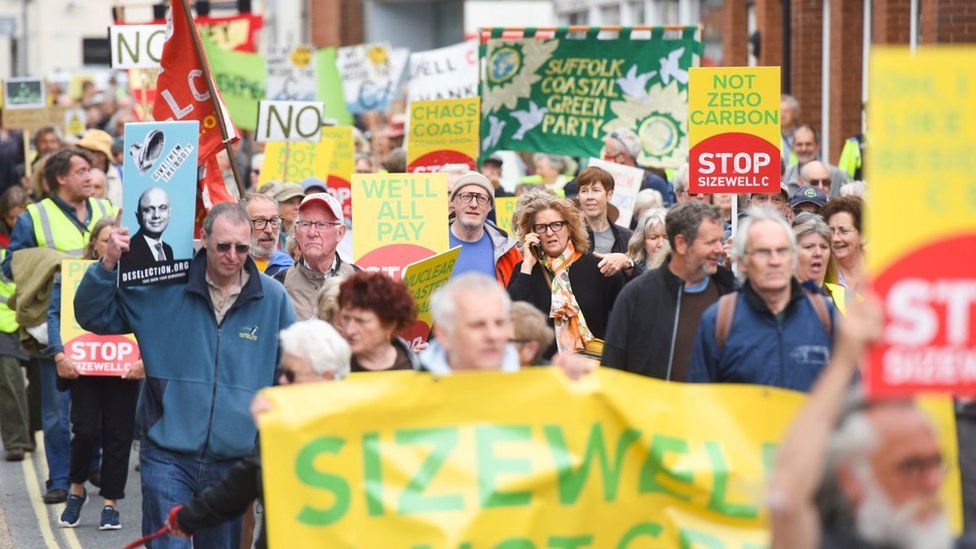
A government shake-up of planning which could bring forward the building of Sizewell C is “deeply dismaying”, campaigners said.
BBC News 24 Sept 22,
New legislation aims to cut planning rules and get rid of environmental assessments to speed up construction.
The nuclear power station in Suffolk is among projects to be “accelerated as fast as possible”, the Treasury said.
Stop Sizewell C said the plan “rode roughshod over the ability to fight damaging projects”.
The scheme, currently estimated to cost £20bn, was given government approval in July, against the advice of the Planning Inspectorate.
The new plant would be built by French-owned EDF next to the existing Sizewell B, which is still generating electricity, and Sizewell A, which has been decommissioned.
Fellow campaigners Together Against Sizewell C (TASC) has instigated a judicial review process over the planning approval, claiming it was illegal.
Chancellor of the Exchequer, Kwasi Kwarteng, who gave Sizewell the go-ahead when he was business secretary, made the latest announcement as part of his Autumn statement.
New legislation would be brought forward to “address barriers by reducing unnecessary burdens to speed-up the delivery of much-needed infrastructure”, the Treasury said………………………….. more https://www.bbc.com/news/uk-england-suffolk-6301233.
At U.N., Micronesia denounces Japan plan to release Fukushima water into Pacific
UNITED NATIONS, Sept 22 (Reuters) – The president of the Pacific island state of Micronesia denounced at the United Nations on Thursday Japan’s decision to discharge what he called nuclear-contaminated water from the Fukushima Daiichi Nuclear Power Station into the Pacific Ocean………………… (subscribers only) more https://www.reuters.com/world/asia-pacific/un-micronesia-denounces-japan-plan-release-fukushima-water-into-pacific-2022-09-22/
s
Permit problems for Sizewell C nuclear project? Cooling system could kill millions of fish.
Permit problems for Sizewell C predicted after report confirms cooling
mechanisms can kill millions of fish. The Sizewell C nuclear reactor may
face obstacles in receiving an environmental permit after a report revealed
that the cooling mechanism at a similar development could kill millions of
fish.
ENDS 12th Sept 2022
Environment Agency rejects EDF’s appeal against requirement to protect millions of fish from Hinkley C’s huge cooling system

A report threatens to undermine the government’s Sizewell C plan after it sided with opponents who claim a plughole to cool a similar nuclear reactor could kill millions of fish. Boris Johnson promised £700 million for the Sizewell C power station in Suffolk in a speech last week, saying he was “absolutely confident” the project would “get over the line”.
A day later an inspector threw out an appeal by EDF, the French energy company, against the installation of a fish deterrent device relating to Hinkley Point C in Somerset, which EDF is building. Environmentalists claim that without the device, millions of fish could be killed after being sucked into the large cooling system for the new reactor. EDF now has to install the technology or be at risk of paying compensation, which experts say could run into hundreds of millions of pounds.
Campaigners claim the saga is directly relevant to the proposed Sizewell C plant, which is also being developed by EDF and uses the same technology. The Blue Marine Foundation was one of six groups that opposed the plans from EDF. Priyal Bunwaree, the foundation’s lawyer, said: “EDF decided to build the largest engineering project in Europe in the middle of a marine protected area in the Severn estuary and then claimed it would have no adverse effect on the species within it. This was a colossal blunder and they were poorly advised. “The company must now find a technical solution to stop killing so many fish or pay compensation which we estimate could run into hundreds of millions.”
Bunwaree added that similar legal issues could be an obstacle to opening Sizewell C. “The sad
thing about Sizewell is that there has been no proper assessment of damage to the marine environment, so it is likely the same legal issue will arise there,” she said. The Hinkley C cooling system, described as a giant plughole under the sea, will suck in 130,000 litres of water per second. The twin inlet tunnels, stretching two miles out into the Severn estuary, are so big that a double-decker bus could drive through them.
Conservation groups say it will kill up to 250,000 fish a day and must be altered or scrapped. EDF appealed against the Environment Agency’s requirement that it fit an “acoustic fish deterrent” to the cooling system. It argued that it was dangerous for divers to install the fish deterrent device in
the fast waters of the Bristol Channel. An inquiry into the appeal was held last year. The inspector and George Eustice, the environment secretary who endorsed his conclusions, said that before the Hinkley plant can open EDF must fit the technology to it. Experts say it will stop the deaths of an estimated 182 million fish, which will be killed in the Bristol Channel every year for the 60 years the plant is in operation. The inspector’s report said the measures are required by law to protect cod, herring, bass and whiting and migratory species such as Atlantic salmon, allis shad and twaite shad. The report concluded that the magnitude of predicted fish deaths was more likely than EDF’s contention that there would be “no adverse effect” on species or the Bristol Channel. Some experts say the
Sizewell plant would kill 804 million fish a year.
Times 5th Sept 2022
WHAT HAPPENED AT CAMP LEJEUNE
I grew up drinking and bathing in the toxic waters around a military base in North Carolina. Thirty years later, I went back to investigate.
BY LORI LOU FRESHWATER, AUG 21, 2018
In the autumn of 1980, a contractor showed up to grade a parking lot. He had no idea he was about to start digging up the radioactive bodies of dead beagles. But the forked bucket on his bulldozer started pulling up more than soil, and it turned out he was digging in a pit of strontium-90 and dog carcasses that had been buried in an ash-gray tomb: a nest of dead dogs and laboratory waste labeled “Radioactive Poison.”
The new parking lot was on the site of the former Naval Research Laboratory dump and its associated incinerator in Camp Lejeune, North Carolina—and it was just one of many areas contaminated by an assortment of hazardous waste and chemicals on the base.
About half a mile away from the dump, soon to be known as Site 19, my friends and I were living in our neighborhood, called Paradise Point. We spent our time putting other girls’ bras into freezers at slumber parties, playing the Telephone Game, riding our bikes all over the place: to the golf course to steal a cart, to swim at the pool, to play soccer on Saturdays.
During the same autumn the dead beagles were found, I was sitting in front of a fake backdrop of rusty colored leaves, a slight 11-year-old girl with spaces between my teeth and freckles spritzed across my nose and cheeks, to take my school photo.
Under normal circumstances, this entirely unremarkable fifth-grade photo, in a plaid shirt and fragile gold necklace, would have likely ended up where most school photos do, in an old album or a drawer or simply lost to time. Instead, the photo would become a marker in the medical history of my family and my community, a reminder of the crime that was being committed on the day the photo was taken—and also for decades before, and for years after.
The place was Camp Lejeune, a United States Marine Corps base wrapped around the New River in Onslow County that served as an amphibious training base where Marines learned to be “the world’s best war fighters,” picking up skills that would allow them (for example) to make surprise landings on the shores of far away countries. From the 1950s until at least 1985, the drinking water was contaminated with toxic chemicals at levels 240 to 3400 times higher than what is permitted by safety standards.
There may never be a true accounting of the suffering caused at Lejeune. As with many other hometown environmental disasters, the Marines and family members poisoned on this military base were not born here, nor did they settle here to make a permanent life and raise their children. Instead, they were often here just for a short time, literally stationed at Lejeune for weeks, months, or, at most, a few years. From the 1950s through at least 1985, an undetermined number of of residents, including infants, children, and civilian workers and personnel, were exposed to trichloroethylene (TCE), tetrachloroethylene (PCE), vinyl chloride, and other contaminants in the drinking water at the Camp Lejeune. These exposures likely increased their risk of cancers, including renal cancer, multiple myeloma, leukemias, and more. It also likely increased their risk of adverse birth outcomes, along with other negative health effects. Now the sick and the dying are all over the world, and an untold number will never be notified about what happened. Instead, we are left to rely on scientific models and data trickling out of public-health agencies and the slow process of adding one story at a time, person-by-person, to the cold data representing an environmental and public-health disaster.
In 1989, the Environmental Protection Agency placed 236 square miles of North Carolina’s coastal soil and water on the list of toxic areas known as Superfund sites. The agency cited “contaminated groundwater, sediment, soil and surface water resulting from base operations and waste handling practices” as reasons for including it on the National Priorities List.
Camp Lejeune remains a sprawling Superfund site, and it is also the place where my mom and I spent years drinking a terrible mix of chemicals from our faucet. In the book A Trust Betrayed: The Untold Story of Camp Lejeune, author Mike Magner gives special attention to my mother’s story: “A woman with the ironic name of Mary Freshwater may have had the most ghastly experiences at Camp Lejeune.”
Of course, I share her ironic name, which can still seem like more of a curse. Nearly my entire childhood was consumed by tragedy. The chemical contamination can be linked to the deaths of my two baby brothers, Rusty and Charlie, and to my mom’s own difficult final years, when she was dying from two types of acute leukemia. My mother also suffered from mental illness, which was intensified—understandably—by our family’s brutal losses. Sometimes it seems that, behind me, there is nothing but inescapable grief. …………………..more https://psmag.com/.amp/environment/what-happened-at-camp-lejeune
As Japan builds nuclear dumping facilities, Pacific groups say ‘stop’
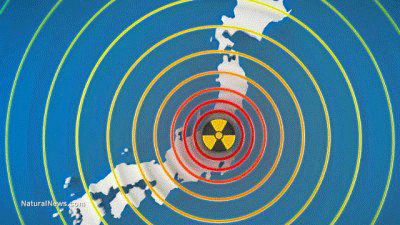
https://www.reuters.com/world/iran-seeks-stronger-us-guarantees-revival-2015-nuclear-deal-2022-08-31/ Pacific civil society groups are calling on Japan to halt its plans to dump radioactive nuclear wastewater into the Pacific Ocean.
Earlier this month the Japanese government started building facilities needed for the discharge of treated, but still radioactive, wastewater from the defunct Fukushima nuclear power plant.
In a joint statement, civil society groups, non-governmental organisations and activists described the Fumio Kishida Government’s plans as a fundamental breach of Pacific peoples’ right to a clean, healthy and sustainable environment.
Joey Tau from the pan-Pacific movement Youngsolwara Pacific said this breaches Pacific peoples’ rights to live in a clean environment.
Tau told Pacific Waves the Pacific Ocean is already endangered and Japan’s plan will have devastating impacts.
“We have a nuclear testing legacy in the Pacific. That continues to impact our people, our islands and our way of life, and it impacts the health of our people.
“Having this plan by Japan poses greater risks to the ocean which is already in a declining state.
“The health of our ocean has declined due to human endured stresses and having this could aggravate the current state of our region.
“And also, there are possible threats on the lives of our people as we clearly understand in this part of the world, the ocean is dear to us, it sustains us,” Tau said.
Tau said both the opposition in Vanuatu and the president of the Federated States of Micronesia have expressed serious concerns at Japan’s plans, and the Pacific Islands Secretariat this year has appointed an international expert panel to advise the Forum Secretary-General and national leaders.
The Northern Marianas’ House of Representatives has also condemned Japan’s plan to dump the nuclear waste.
Tau said the plans should not proceed without the Pacific people being able to voice their concerns and being better advised.
Uranium Ghost Town in the Making
, Time and again, mining company Homestake and government agencies promised to clean up waste from decades of uranium processing. It didn’t happen.
Reader supported News, Mark Olalde and Maya Miller/ProPublica, 25 Aug 22
he “death map” tells the story of decades of sickness in the small northwest New Mexico communities of Murray Acres and Broadview Acres. Turquoise arrows point to homes where residents had thyroid disease, dark blue arrows mark cases of breast cancer, and yellow arrows mean cancer claimed a life.
Neighbors built the map a decade ago after watching relatives and friends fall ill and die. Dominating the top right corner of the map, less than half a mile from the cluster of colorful arrows, sits what residents believe is the cause of their sickness: 22.2 million tons of uranium waste left over from milling ore to supply power plants and nuclear bombs.
“We were sacrificed a long time ago,” said Candace Head-Dylla, who created the death map with her mother after Head-Dylla had her thyroid removed and her mother developed breast cancer. Research has linked both types of illnesses to uranium exposure.
Beginning in 1958, a uranium mill owned by Homestake Mining Company of California processed and refined ore mined nearby. The waste it left behind leaked uranium and selenium into groundwater and released the cancer-causing gas radon into the air. State and federal regulators knew the mill was polluting groundwater almost immediately after it started operating, but years passed before they informed residents and demanded fixes.
The contamination continued to spread even after the mill closed in 1990.
The failures at Homestake are emblematic of the toxic legacy of the American uranium industry, one that has been well-documented from its boom during the Cold War until falling uranium prices and concerns over the dangers of nuclear power decimated the industry in the 1980s. Uranium mining and milling left a trail of contamination and suffering, from miners who died of lung cancer while the federal government kept the risks secret to the largest radioactive spill in the country’s history.
But for four decades, the management of more than 250 million tons of radioactive uranium mill waste has been largely overlooked, continuing to pose a public health threat.
ProPublica found that regulators have failed to hold companies to account when they missed cleanup targets and accepted incorrect forecasts that pollution wouldn’t spread. The federal government will eventually assume responsibility for the more than 50 defunct mills that generated this waste.
At Homestake, which was among the largest mills, the company is bulldozing a community in order to walk away. Interviews with dozens of residents, along with radon testing and thousands of pages of company and government records, reveal a community sacrificed to build the nation’s nuclear arsenal and atomic energy industry.
Time and again, Homestake and government agencies promised to clean up the area. Time and again, they missed their deadlines while further spreading pollution in the communities. In the 1980s, Homestake promised residents groundwater would be cleaned within a decade, locals told the Environmental Protection Agency and ProPublica. After missing that target, the company told regulators it would complete the job around 2006, then by 2013.
In 2014, an EPA report confirmed the site posed an unacceptable cancer risk and identified radon as the greatest threat to residents’ health. Still, the cleanup target date continued shifting, to 2017, then 2022.
Rather than finish the cleanup, Homestake’s current owner, the Toronto-based mining giant Barrick Gold, is now preparing to ask the Nuclear Regulatory Commission, the independent federal agency that oversees the cleanup of uranium mills, for permission to demolish its groundwater treatment systems and hand the site and remaining waste over to the U.S. Department of Energy to monitor and maintain forever.
Before it can transfer the site to the Department of Energy, Homestake must prove that the contamination, which exceeds federal safety levels, won’t pose a risk to nearby residents or taint the drinking water of communities downstream.
Part of Homestake’s strategy: buy out nearby residents and demolish their homes. Local real estate agents and residents say the company’s offers do not account for the region’s skyrocketing housing costs, pushing some who accept them back into debt in order to buy a new home. Those who do sell are required to sign agreements to refrain from disparaging Homestake and absolve the company of liability, even though illnesses caused by exposure to radioactive waste can take decades to manifest.
Property records reveal the company had, by the end of 2021, purchased 574 parcels covering 14,425 acres around the mill site. This April, Homestake staff indicated they had 123 properties left to buy. One resident said the area was quickly becoming a “ghost town.”
Even after the community is gone, more than 15,000 people who live nearby, many of them Indigenous, will continue to rely on water threatened by Homestake’s pollution.
The company said it has produced models showing that its waste won’t imperil the region’s water if it walks away. The NRC says it will only grant a groundwater cleanup exemption if that’s the case.
But while Homestake and other mining companies have polluted the region, it’s been the NRC and various other agencies that stood by as it happened. ProPublica found the NRC has issued exemptions from groundwater cleanup standards to uranium mills around the country, only to see pollution continue to spread. This has occurred as climate change hammers the West, making water ever scarcer.
“Groundwater moves. Groundwater doesn’t care about regulations,” said Earle Dixon, a hydrogeologist who reviewed the government’s oversight of uranium cleanup and pollution around Homestake for the New Mexico Environment Department and the EPA. Dixon and other researchers predict contamination at Homestake will likely spread if cleanup ends.
The company has denied that its waste caused residents’ illnesses, and judges ruled in Homestake’s favor in a case residents filed in 2004 alleging the site caused cancer. Doctors testified that the pollution was a substantial factor contributing to residents’ cancers, but tying particular cases to a single source requires communitywide blood, urine and other testing, which hadn’t been done…………………………………………………..
ProPublica found that, as with most uranium mills in the U.S., Homestake built no liner between the earth and the sandy waste left over from milling, known as tailings. This happened even though an engineer with the New Mexico Department of Health warned the company only weeks after the mill opened that it needed to at least compact the soil underneath its waste to prevent leaks. Without a liner, pollution seeped into aquifers that supplied drinking water. In 1961, the same engineer wrote that groundwater samples showed radium 226, a radioactive and cancer-causing element, at levels as much as 31 times higher than naturally occur in the area, indicating “definite pollution of the shallow ground water table by the uranium mill tailings’ ponds.”
A federal report a year later identified even higher levels of radium 226 in groundwater…………………………..
More than 500 abandoned uranium mines pockmark the Navajo Nation, and Billiman’s father, a Navajo Code Talker in World War II, died of stomach cancer, an illness associated with downwind exposure to nuclear tests. Boomer has written the story of uranium into lyrics, singing about the harm caused by the waste that was left behind…………………………………………….more https://www.rsn.org/001/a-uranium-ghost-town-in-the-making.html
China’s record-breaking heatwave, threatening water resources

The southwestern Chinese regions of Chonqging and Sichuan were battling
fires on Tuesday as they awaited a long-anticipated drop in temperatures
over the next week, but the country’s important autumn harvest remained
under serious threat. Officials warned this month that temperatures were
rising faster in China than in the rest of the world and a record-breaking
heatwave has raised concern about its ability to adapt to rapid climate
change and conserve already scarce water resources.
Reuters 23rd Aug 2022
Pacific Alliance of Municipal Councils starts Petition against dumping nuclear wastewater in Pacific

https://www.mvariety.com/news/petition-against-dumping-nuclear-wastewater-in-pacific/article_5ad4f2f2-2103-11ed-ac27-6ffcaa93ec58.html Aug 22, 2022 , The Pacific Alliance of Municipal Councils or PAMC has started a petition on change.org (https://chng.it/JLT2btJQB6) to try and stop Japan from dumping its Fukushima nuclear wastewater into the Pacific Ocean.
PAMC President and Secretary of the Rota Municipal Council, Councilman Jim Atalig, expressed his strong opposition saying, “If it’s not good for their land, it is definitely not good for our ocean where most of us get our food on a daily basis!”
Chairman Joseph E. Santos, PAMC member and chairman of the Tinian Municipal Council, says, “It is an outrage for anyone to think that it’s okay to dump their toxic wastes in our ocean when we rely on it for food, health activities, and economic sustainability.”
The other members of PAMC are Saipan and Northern Islands Municipal Council member Ana Demapan-Castro, Chairwoman, Antonia Tudela, member Daniel Aquino; Rota Municipal Council Chairman Jonovan Lizama, Vice Chairman William Taitano; Tinian Municipal Council Vice Chairwoman Thomasa P. Mendiola, and Secretary Juanita M. Mendiola, who is also the vice president of PAMC.
PAMC is urging everyone to please circulate the petition through their Facebook page so we can prevail in preventing Japan and any other countries from using our ocean as their toxic waste dumping ground!
“Nothing good will come out of this, just as the toll of human suffering as a result of all nuclear energy fallouts were never worth their well-intended, but disastrously misguided, objectives!”
California nuclear power plant extension challenged in legislative proposal
“This is too little too late, a sham process designed to circumvent citizen enforcement of the National Environmental Policy Act,”
Watchdog groups contend that regardless of the review, the NNSA will march ahead with its production plans for plutonium cores at Los Alamos
S nuclear policy | US nuclear stockpile | Environment protection
AP | Albuquerquue (US) August 20, 2022
The US government is planning to review the environmental effects of operations at one of the nation’s prominent nuclear weapons laboratories, but its notice issued Friday leaves out federal goals to ramp up production of plutonium cores used in the nation’s nuclear arsenal.
The National Nuclear Security Administration said the review being done to comply with the National Environmental Policy Act will look at the potential environmental effects of alternatives for operations at Los Alamos National Laboratory for the next 15 years.
That work includes preventing the spread and use of nuclear weapons worldwide and other projects related to national security and global stability, the notice said.
Watchdog groups contend that regardless of the review, the NNSA will march ahead with its production plans for plutonium cores at Los Alamos.
The northern New Mexico lab part of the top secret Manhattan Project during World War II and the birthplace of the atomic bomb is one of two sites tapped for the lucrative mission of manufacturing the plutonium cores. The other is the Savannah River Site in South Carolina.
The US Energy Department had set deadlines for 2026 and 2030 for ramping up production of the plutonium cores, but it’s unclear whether those will be met given the billions of dollars in infrastructure improvements still needed.
Watchdog groups that have been critical of Los Alamos accused the NNSA of going through the motions rather than taking a hard look at the escalating costs of preparing for production, the future consequences to the federal budget and the potential environmental fallout for neighbouring communities and Native American tribes.
This is too little too late, a sham process designed to circumvent citizen enforcement of the National Environmental Policy Act,” said Jay Coghlan, executive director of Nuclear Watch New Mexico.
The Los Alamos Study Group, another New Mexico-based organisation that monitors lab activities, said there is no indication that NNSA will pause any preparations for the sake of complying with National Environmental Policy Act, which mandates some scrutiny before moving ahead with major federal projects.
The group pointed to more than $19 billion in new construction and operational costs for Los Alamos’ new plutonium core production mission through fiscal year 2033. They say the price tag is expected to grow.
According to planning documents related to the sprawling Los Alamos campus, lab officials have indicated that they need more than 4 million square feet (371,612 square metres) of new construction to bolster one of its main technical areas and the area where the lab’s plutonium operations are located. Several thousand new staff members also would be needed.
This is a completely bogus process in which NNSA seeks to create a veneer of legitimacy and public acceptance for its reckless plans,” said Greg Mello, director of the Los Alamos Study Group……….. more https://www.business-standard.com/article/international/plutonium-cores-review-at-us-nuclear-lab-sham-process-watchdog-groups-122082000062_1.html
France’s government determined to expand nuclear power, oblivious to environmental, safety, and cost ill-effects

the plant’s cooling processes have increased the water’s temperature by 6 degrees C, which has triggered ripple effects throughout the food chain.
that will have a disastrous impact on the ecosystem,”
French nuclear plants break a sweat over heat wave, DW 15 Aug 22, Successive heat waves are putting French nuclear reactors under strain. But that is not pushing them into an existential crisis, as Lisa Louis reports from Paris.
Like other European countries, France has been baking in temperatures of up to 40 degrees Celsius (104 degrees Fahrenheit) for several weeks. Although that is putting French nuclear reactors under strain, this does not seem to be calling the country’s nuclear-heavy energy strategy into question.
Nuclear power plants normally generate roughly 70% of electricity in France — making nuclear’s share of the energy mix there higher than in any other country.
But more than half of the country’s 56 reactors have been closed for several months due to planned or extraordinary maintenance.
And about a fifth of them would normally need to interrupt their activity or at least reduce it to a bare minimum, as the water temperature of the rivers into which plants discharge their cooling water exceeds a certain limit.
But the government has suspended that rule until at least September 11.
‘Ripple effects throughout the food chain’
For Jean-Pierre Delfau, an environmental activist at local group FNE86, that is an exasperating decision.
“I just can’t understand how they can keep the reactors running although that will have a disastrous impact on the ecosystem,” he told DW, as he and two other environmentalists made their way through high grass on the bank of the Garonne river to take a water sample on a recent afternoon.
The Garonne supplies cooling water for the Golfech nuclear plant in southwestern France. One of the power station’s two reactors has been standing still for months, after authorities found corrosion and small cracks on pipes relevant for the plant’s safety. The second reactor is still functioning.
“Due to the heat, the Garonne’s water throughput is already down to 50 cubic meters per second, from several thousand in normal times,” Delfau said. “The Golfech plant makes that worse, as it uses 8 cubic meters for its cooling system but only discharges 6 cubic meters back, as some of the water evaporates during the process,” he pointed out.
He added that the plant’s cooling processes have increased the water’s temperature by 6 degrees C, which has triggered ripple effects throughout the food chain.
“The warmer water destroys microalgae that are food for certain small fish, which bigger fish feed on,” explained the 79-year-old, who has been an anti-nuclear protester for more than 50 years.
“Plus, warmer water contains more bacteria. In order to make it potable, we have to add a lot of chemicals, which people then drink.”
Not an existential crisis for French nuclear power
Power company EDF, which runs all of France’s nuclear power plants, declined an interview request with DW. A spokeswoman replied by email that the situation was “extraordinary” and that so far, environmental probes had not revealed any negative impact on the flora and fauna around the respective reactors.
Despite environmental concerns, current issues are not throwing French nuclear power into an existential crisis. The government is planning to soon nationalize EDF and construct additional nuclear plants.
That has Anna Creti, climate economy director at Paris University Dauphine, scratching her head.
“It’s not quite clear how this strategy is supposed to work on a technology level, especially in the short run,” she told DW.
Technology not ready

“France is banking on so-called small modular reactors (SMRs), for which there exist roughly 40 different technologies, all of them in a pilot phase,” Creti said. “Getting them ready for deployment could take up to 10 years,” she added.
“The government also plans to construct more pressurized-water, so-called EPR reactors — a model that has encountered numerous problems,” she continued.
According to current predictions, the country’s first EPR plant is to go live next year in Flamanville in the north of the country. According to developer EDF, building costs have so far at least tripled, to roughly €13 billion ($13.3 billion).
The European Court of Auditors puts that figure at €19 billion — with construction taking more than 10 years longer than planned. Other EPRs in Britain, China and Finland are reported to experience construction, conceptual or production problems.
“The government has nevertheless earmarked €150 billion for refurbishing existing nuclear plants and constructing new ones,” Creti said, adding that no such funding boon was announced for renewables, although Paris is working on new rules to cut red tape for development of renewables.
“Putting more money intorenewables would make sense, as theyhave become ever cheaper over the past few years, and their technology is sufficiently advanced for them to be deployed immediately across the country,” she emphasized.
France is the only European country not to have reached its 2020 EU renewables targets. Renewable energies make up only roughly 19% of energy production, instead of the planned 23%……………………………………..
Energy shortages expected in winter
Philippe Mante is strongly hoping for that [shift to renewables]. He’s in charge of climate affairs at EELV, France’s green party, which is opposed to constructing new nuclear plants. For the sake of energy security, the party is not in favor of immediately dismantling existing nuclear energy plants.
Neighboring countries will be watching closely. Until now, France has been Europe’s biggest net energy exporter. This year, however, the country will have to import more electricity than it’s exporting.
That’s likely to add even more pressure to energy prices, which are already skyrocketing, due among other things to Moscow’s invasion of Ukraine and reduced delivery of Russian gas. https://www.dw.com/en/french-nuclear-plants-break-a-sweat-over-heat-wave/a-
FOCUS: Respite for Japan as radioactive Fukushima water accumulation slows
https://english.kyodonews.net/news/2022/08/d10f63c6bde0-focus-respite-for-japan-as-radioactive-water-accumulation-slows-in-fukushima.html By Takaki Tominaga, KYODO NEWS – Aug 12, 2022 Tanks containing treated water at the crippled Fukushima nuclear power plant are likely to reach capacity around the fall of 2023, later than the initially predicted spring of next year, as the pace of the accumulation of radioactive water slowed in fiscal 2021
The slowdown, based on an estimate by operator Tokyo Electric Power Company Holdings Inc., gives some breathing space to Prime Minister Fumio Kishida’s government if any roadblocks are thrown up in the plan to discharge the treated water into the sea starting around spring next year.
China and South Korea as well as local fishing communities that fear reputational damage to their products remain concerned and have expressed opposition to the plan.
About 1.30 million tons of treated water has accumulated at the Fukushima Daiichi plant following the 2011 nuclear disaster, and it is inching closer to the capacity of 1.37 million tons.
The water became contaminated after being pumped in to cool melted reactor fuel at the plant and has been accumulating at the complex, also mixing with rainwater and groundwater.
According to the plan, the water — treated through an advanced liquid processing system, or ALPS, that removes radionuclides except for tritium — will be released 1-kilometer off the Pacific coast of the plant through an underwater pipe.
The International Atomic Energy Agency has been conducting safety reviews of the discharge plan and Director General Rafael Grossi says the U.N. nuclear watchdog will support Japan before, during and after the release of the water, based on science.
An IAEA task force, established last year, is made up of independent and highly regarded experts with diverse technical backgrounds from various countries including China and South Korea.
Japan’s new industry minister Yasutoshi Nishimura says the government and TEPCO will go ahead with the discharge plan around the spring of 2023 and stresses the two parties will strengthen communication with local residents and fishermen, as well as neighboring countries, to win their understanding.
Beijing and Seoul are among the 12 countries and regions that still have restrictions on food imports from Japan imposed in the wake of the massive earthquake and tsunami triggered nuclear meltdowns at the Fukushima plant in March 2011.
“We will improve our communication methods so we can convey information backed by scientific evidence to people both at home and abroad more effectively,” Nishimura said after taking up the current post in a Cabinet reshuffle Wednesday.
Kishida instructed Nishimura to focus on the planned discharge of ALPS-treated water that will be diluted with seawater to one-40th of the maximum concentration of tritium permitted under Japanese regulations, according to the chief of the Ministry of Economy, Trade and Industry.
The level is lower than the World Health Organization’s recommended maximum tritium limit for drinking water.
TEPCO will cap the total amount of tritium to be released into the sea as well.
Meanwhile, the Kishida government has decided to set up a 30 billion yen ($227 million) fund to support the fisheries industry and said it will buy seafood if demand dries up due to harmful rumors.
Fishing along the coast of Fukushima Prefecture, known for high-quality seafood, has been recovering from the reputational damage caused by the nuclear accident but the catch volume in 2021 was only about 5,000 tons, or about 20 percent of 2010 levels.
Construction of discharge facilities at the Fukushima plant started in August, while work to slow the infiltration of rain and groundwater was also conducted.
TEPCO said it was able to reduce the pace of accumulation of contaminated water by fixing the roof of a reactor building and cementing soil slopes around the facilities, among other measures, to prevent rainwater penetration.
The volume of radioactive water decreased some 20 tons a day from a year earlier to about 130 tons per day in fiscal 2021, according to the ministry.
The projected timeline to reach the tank capacity has been calculated based on the assumption that about 140 tons of contaminated water will be generated per day, according to METI.
However, storage tanks could still reach their capacity around the summer of next year if heavy precipitation or some unexpected events occur, the ministry said.
As part of preparations for the planned discharge, the Environment Ministry has started measuring tritium concentration at 30 locations on the surface of the sea and seabed around the Fukushima plant, four times a year.
Similarly, the Nuclear Regulation Authority has increased the number of locations it monitors tritium levels by eight to 20. The Fisheries Agency has started measuring tritium concentration in marine products caught along the Pacific coast stretching from Hokkaido to Chiba Prefecture.
Given that it is expected to take several decades to complete the release of treated water, NRA and METI officials urged TEPCO to further curb the generation of contaminated water at the plant.
“We want TEPCO to step up efforts so as to lower the volume of the daily generation of contaminated water to about 100 tons or lower by the end of 2025,” a METI official said.
China also discharges triated water from its nuclear power stations
 | Bob commented on Japan extremely selfish to insist on discharging nuclear wastewater into sea August 8, 2022 TOKYO, Aug. 10 (Xinhua) — Japan’s Tokyo Electric Power Company Holdings Inc. (TEPCO) has recently started …Neither you, nor China, whose official viewpoint this is, ever admits that China discharges tritiated water into the sea from its own nuclear plants and that the amount of this discharge exceeds that proposed for the ALPS treated tritiated water which has then been mixed with sea water before discharge (otherwise, the water will be so pure that its purity will poison sea life) on an annual basis. They also deliberately omit the fact that the annual discharge rate will be less than that of the Fukushima Daiichi Nuclear Power Station during its 40 year operational lifetime. A much better assessment is discussed in this other recently posted article here https://english.kyodonews.net/news/2022/08/d10f63c6bde0-focus-respite-for-japan-as-radioactive-water-accumulation-slows-in-fukushima.html |
Nuclear bomb tests at Maralinga triggered Hedley Marston to study fallout over Australia
ABC Radio Adelaide / By Daniel Keane 10 Aug 22,
Hedley Marston could be charming, genial and witty but he was not above fulmination, especially where fulminations of a different kind were concerned.
In the mid-1950s, the CSIRO biochemist emerged as arguably the most significant contemporary critic of Britain’s nuclear weapons testing program, which was launched on Australia’s Montebello Islands almost 70 years ago in October 1952.
Despite the imminent anniversary Marston remains an obscure figure, but his biographer Roger Cross believes that should change.
“He appears to be totally unknown to the Australian public and, of course, to South Australians — he was a South Australian after all,” Dr Cross said.
Marston’s reservations about the nuclear program were far from spontaneous; indeed, his strongest concerns weren’t voiced until several years after the first test, when he recorded a radioactive plume passing over Adelaide.
The source of that plume was Operation Buffalo, a series of four nuclear blasts in 1956, and Marston was especially outraged by the fact that the general population was not warned.
“Sooner or later the public will demand a commission of enquiry on the ‘fall out’ in Australia,” he wrote to nuclear physicist and weapons advocate Sir Mark Oliphant.
“When this happens some of the boys will qualify for the hangman’s noose.”
What made Marston’s fury difficult to dismiss, especially for those inclined to deride opposition to nuclear testing as the exclusive preserve of ‘commies’ and ‘conchies’, was the fact that he was no peacenik.
Detractors might have damned him as an arriviste, but never as an activist: his cordial relations with Oliphant and other scientific grandees demonstrate that Marston was, in many respects, an establishment man.
Dr Cross has described Marston’s elegant prose as “Churchillian”, and the adjective is apposite in other ways.
While the roguish Marston might not have gone as far as the British wartime leader’s assertion that, during conflict, truth is so precious “that she should always be attended by a bodyguard of lies”, he had, in a 1947 letter to the editor, publicly defended scientific secrecy:
Under present conditions of fear and mistrust among nations it is obvious that military technology must be kept secret; and to achieve this end it should be conducted in special military laboratories where strictest security measures may be observed.”
But by late 1956, Marston’s alarm at radioactive fallout across parts of Australia was such that he was privately demanding greater disclosures to the general public.
Much of his ire was aimed at the Atomic Weapons Tests Safety Committee — a body established before the Maralinga tests, but after blasts had already occurred at Emu Fields* and the Montebello Islands.
“He was the only senior Australian scientist to express concerns and, because of his character, the concerns that he expressed were very forthright,” said Dr Cross, whose biography of Marston, aptly entitled Fallout, inspired the documentary Silent Storm.
“When the safety committee after each explosion said there was absolutely no effect on Australians, he believed that they were lying.”
‘If the wind changes, we need to go’
The experiments that led Marston, whose reputation largely rested on his expertise in sheep nutrition, to reach this conclusion were two-fold.
In the more protracted one, he analysed the presence of radioactive iodine-131 — a common component of nuclear fallout — in the thyroids of sheep.
“One group he kept penned up under cover eating dried hay, which had been cut some time before. The other group, he put outside eating the grass,” Dr Cross said.
“He tested the thyroids in each group – the ones on the hay only had background amounts of iodine-131.
“But the ones in the fields had a tremendously high concentration of this radioactive isotope, both north and south of the city.”

A fallout map from the 1985 royal commission, which stated that while fallout at Maralinga Village from the October 11, 1956, test was “considered to be ‘negligible from a biological point of view’ it does suggest difficulties with the forecast prior to the test”.(Royal Commission into British Nuclear Tests in Australia)
For the other experiment, Marston conducted air monitoring in Adelaide.
He was especially alarmed by what he found for the period following the Maralinga test of October 11, 1956.
“There was a wind shear and at least part, maybe the major part, of that cloud, blew in a south-easterly direction and that took it towards Adelaide and the country towns in between,” Dr Cross said.
“The safety committee — who must have known of the wind shear — had done nothing about warning Adelaide people perhaps to stay indoors.”……………………………………………………
Despite Marston’s reservations, the nuclear program carried on regardless.
Less than a year after the Operation Buffalo tests, Maralinga was hosting Operation Antler.
In September 1957, newspapers around Australia reported on an upcoming “second test” that would, weather permitting, proceed as part of a “spring series”.
If it hadn’t been for the presence of the words “atomic” and “radioactive”, a reader might easily have inferred that what was being described was as commonplace as a game of cricket.
 |
1 This Month



Shut down the radiation-damaged Heysham nuclear reactors now
To see nuclear-related stories in greater depth and intensity – go to https://nuclearinformation.wordpress.com

Say No to NASA’s Reckless Nuclear Reactor on the Moon
Say No to NASA’s Reckless Nuclear Reactor on the Moon
-
Archives
- October 2026 (256)
- September 2026 (339)
- August 2026 (330)
- July 2026 (355)
- June 2026 (287)
- May 2026 (306)
- April 2026 (356)
- March 2026 (251)
- February 2026 (267)
- January 2026 (308)
- December 2025 (358)
- November 2025 (359)
-
Categories
- 1
- 1 NUCLEAR ISSUES
- business and costs
- climate change
- culture and arts
- ENERGY
- environment
- health
- history
- indigenous issues
- Legal
- marketing of nuclear
- media
- opposition to nuclear
- PERSONAL STORIES
- politics
- politics international
- Religion and ethics
- safety
- secrets,lies and civil liberties
- spinbuster
- technology
- Uranium
- wastes
- weapons and war
- Women
- 2 WORLD
- ACTION
- AFRICA
- Atrocities
- AUSTRALIA
- Christina's notes
- Christina's themes
- culture and arts
- Events
- Fuk 2022
- Fuk 2023
- Fukushima 2017
- Fukushima 2018
- fukushima 2019
- Fukushima 2020
- Fukushima 2021
- general
- global warming
- Humour (God we need it)
- Nuclear
- RARE EARTHS
- Reference
- resources – print
- Resources -audiovicual
- Weekly Newsletter
- World
- World Nuclear
- YouTube
-
RSS
Entries RSS
Comments RSS

