German MPs demand release of Julian Assange

Dozens of members of the German federal parliament, the Bundestag, have issued a statement demanding the release of Wikileaks founder Julian Assange, DW, 8 July 22,
More than 70 members of the German parliament from four political parties have called on US President Joe Biden and the British government to stop the impending deportation of Wikileaks founder Julian Assange from the UK to the US to face espionage charges.
“Journalists must not be persecuted or punished for their work anywhere in the world,” the Bundestag deputies wrote in an open letter. “In the interest of press freedom as well as for humanitarian reasons in view of his poor state of health, Julian Assange must be released without delay.”
Assange has been imprisoned in the UK since April 2019, when the government of Ecuador, which had hosted him in its London embassy for seven years, withdrew his political asylum.
A subsequent legal process and court trial ended on June 17, when British Home Secretary Priti Patel granted the US’s extradition request. Assange’s lawyers are currently appealing the minister’s decision.
“A free press is one of the fundamental components of each and every democracy,” the Bundestag members wrote. “We are very concerned about the deterrent effect that Assange’s extradition and conviction could have on press freedom and investigative journalism around the world.”……………..
Christian Mihr, head of the German branch of Reporters Without Borders, said he hoped the German government would take the parliamentarians’ message on board. “I hope the government recognizes it … when elected representatives send such a strong signal, and that they take it seriously and position themselves clearly to Joe Biden,” he told DW……………………..
In 2019, the UN special rapporteur on torture, Nils Melzer, visited Assange in Belmarsh prison in London and concluded that his treatment by the UK, US, and Ecuadoran governments amounted to psychological torture.
DW has reached out to the German Foreign Ministry for a reaction. So far, the German government has held the position that it has no reason to doubt the integrity of the British extradition process.
A petition opposing the “psychological torture” of Assange has been approved by the Bundestag’s petitions committee, the Left Party parliamentary group announced in Berlin on Wednesday. Left-wing politicians see the committee’s vote as a demand that the German government take action to secure Assange’s release.
Green MP Corinna Rueffer welcomed the German lawmakers’ action on Twitter as an act to strengthen press freedom. https://www.dw.com/en/german-mps-demand-release-of-julian-assange/a-62398140?fbclid=IwAR1IPR7JHWnWfz90wM2pQKnt3RavVFCUAH8eV8f-yUl6sXZmjl4qTgfc91Q
NO TO NATO IN MADRID

The statement states that “NATO propaganda paints a false picture of NATO representing the so-called democratic countries versus an authoritarian world to legitimize its militaristic course. In reality, NATO is stepping up its confrontation with rival and emerging superpowers in pursuit of geopolitical hegemony, control over transport routes, markets and natural resources. Although NATO’s strategic concept claims to be working toward disarmament and arms control, it is doing just the opposite.”
- By Ann Wright, Popular Resistance., July 6, 2022
NATO’S Summit In Madrid And Lessons Of War At The City’s Museums.
I was one of hundreds who attended the NO to NATO peace summit June 26-27, 2022 and one of tens of thousands who marched for NO to NATO in Madrid, Spain a few days before the leaders of the 30 NATO countries arrived in the city for their latest NATO Summit to map out NATO’s future military actions.
Two conferences, the Peace Summit and the Counter-Summit, provided opportunities for Spaniards and international delegations to hear the impact of ever-increasing military budgets on NATO countries that give weaponry and personnel to the war mongering capabilities of NATO at the expense of health, education, housing and other true human security needs.
In Europe, the disastrous decision by the Russian Federation to invade Ukraine and the tragic loss of life and destruction of large parts of the industrial base of the country and in the Dombass region is seen as a situation precipitated by a US sponsored coup in Ukraine in 2014. Not to defend or justify the Russian attack on Ukraine, however, NATO, the US and the European Union’s endless rhetoric of Ukraine joining their organizations is acknowledged as is the often-cited Russian Federation’s “redlines” of its national security. The continuing large-scale US and NATO military war maneuvers, creation of US/NATO bases and deployment of missiles on the border with Russia are identified as provocative, aggressive actions by the US and NATO. Ever more powerful weapons are being injected into the Ukrainian battlefields by NATO countries which could inadvertently, or purposefully, quickly escalate to the disastrous use of nuclear weapons.
In the peace summits, we heard from people directly affected by NATO’s military action. The Finnish delegation is strongly opposed to Finland joining NATO and spoke of the relentless media campaign by the government of Finland that has influenced traditional No to NATO Finns to acquiese to the government’s decision to join NATO. We also heard by zoom from speakers from Ukraine and Russia who both want peace for their countries not wars and who urged their governments to begin negotiations to end the horrific war.
The summits had a wide-range of panel and workshop topics:………………………………
The Madrid Peace Summit ended with a final declaration………………….
”………………………..NATO’s new security concept called NATO 360º radius, calls for military intervention by NATO anywhere, anytime, all around the planet. The Russian Federation and the People’s Republic of China are singled out as military adversaries and, for the first time, the Global South appears within the scope of the Alliance’s intervention capabilities,
NATO 360 is prepared to intervene outside the imperative mandates of the UN Charter, as it did in Yugoslavia, Afghanistan, Iraq and Libya. This violation of international law, as we have also seen in Russia’s invasion of Ukraine, has sped up the pace at which the world becomes insecure and militarized.
This southward focus shift will bring about an extension in the capabilities of US military bases deployed in the Mediterranean; in the case of Spain, the bases in Rota and Morón.
NATO 360º strategy is a threat to peace, an obstacle to progress towards shared demilitarized security.………………..”
NO TO NATO international coalition statement
The NO to NATO international coalition issued a strong and extensive statement on July 4, 2022 contesting NATO’s Madrid summit strategy and its continuing aggressive actions. The coalition expressed “outrage” at the decision of NATO’s heads of government to further increase confrontation, militarization and globalization instead of opting for dialogue, disarmament and peaceful co-existence.
The statement states that “NATO propaganda paints a false picture of NATO representing the so-called democratic countries versus an authoritarian world to legitimize its militaristic course. In reality, NATO is stepping up its confrontation with rival and emerging superpowers in pursuit of geopolitical hegemony, control over transport routes, markets and natural resources. Although NATO’s strategic concept claims to be working toward disarmament and arms control, it is doing just the opposite.”
The coalition statement reminds that NATO member states combined “account for two-thirds of the global arms trade that destabilizes entire regions and that warring countries like Saudi Arabia are among NATO’s best customers. NATO maintains privileged relationships with gross human rights violators like Colombia and apartheid state Israel… The military alliance is abusing the Russia-Ukraine war to dramatically increase the armament of its member states by many tens of billions and by expanding it’s Rapid Reaction Force on a massive scale…Under the leadership of the US, NATO applies a military strategy aimed at weakening Russia rather than bringing a swift end to the war. This is a dangerous policy that can only contribute to increase the suffering in Ukraine and can bring the war into dangerous levels of (nuclear) escalation.”………………………………………………………………………………………………….. more https://popularresistance.org/no-to-nato-in-madrid/
Ann Wright served 29 years in the U.S. Army and Army Reserves and retired as a Colonel. She was also a U.S. diplomat and served in U.S. embassies in Nicaragua, Grenada, Somalia, Uzbekistan, Kyrgyzstan, Micronesia, Afghanistan and Mongolia. She resigned in 2003 in opposition to the U.S. war on Iraq. She is the co-author of “Dissent: Voices of Conscience.”
America’s $1.4 Trillion So-Called “National Security” Budget Makes Us Less Safe—Not More
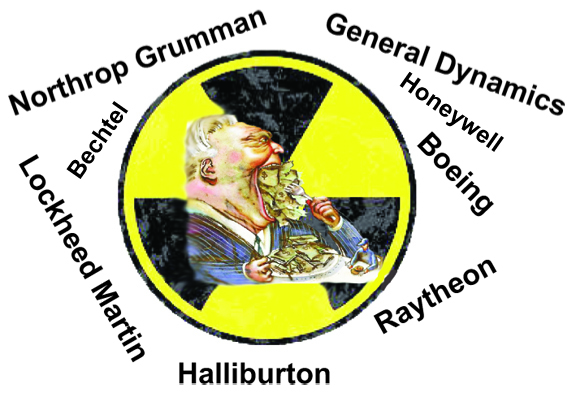
America and the world would be far safer places if this outrageous spending was drastically cut and those funds redirected to “moral” investments in people, society, and planetary health—not war and weapons.
Common Dreams WILLIAM HARTUNG, July 7, 2022 by TomDispatch
This March, when the Biden administration presented a staggering $813 billion proposal for “national defense,” it was hard to imagine a budget that could go significantly higher or be more generous to the denizens of the military-industrial complex. After all, that request represented far more than peak spending in the Korean or Vietnam War years, and well over $100 billion more than at the height of the Cold War.
It was, in fact, an astonishing figure by any measure — more than two-and-a-half times what China spends; more, in fact, than (and hold your hats for this one!) the national security budgets of the next nine countries, including China and Russia, combined. And yet the weapons industry and hawks in Congress are now demanding that even more be spent.
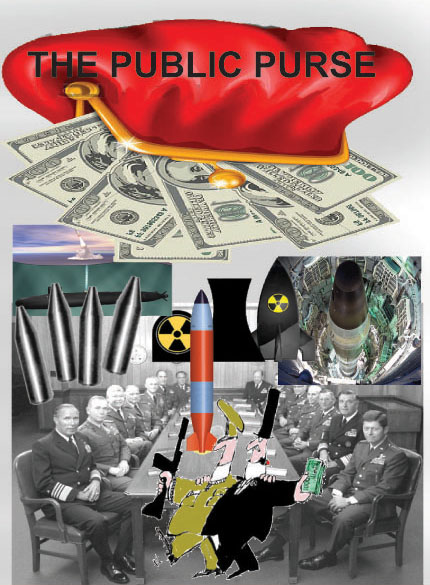
In recent National Defense Authorization Act proposals, which always set a marker for what Congress is willing to fork over to the Pentagon, the Senate and House Armed Services Committees both voted to increase the 2023 budget yet again — by $45 billion in the case of the Senate and $37 billion for the House. The final figure won’t be determined until later this year, but Congress is likely to add tens of billions of dollars more than even the Biden administration wanted to what will most likely be a record for the Pentagon’s already bloated budget.
This lust for yet more weapons spending is especially misguided at a time when a never-ending pandemic, growing heat waves and other depredations of climate change, and racial and economic injustice are devastating the lives of millions of Americans. Make no mistake about it: the greatest risks to our safety and our future are non-military in nature, with the exception, of course, of the threat of nuclear war, which could increase if the current budget goes through as planned.
But as TomDispatch readers know, the Pentagon is just one element in an ever more costly American national security state. Adding other military, intelligence, and internal-security expenditures to the Pentagon’s budget brings the total upcoming “national security” budget to a mind-boggling $1.4 trillion. And note that, in June 2021, the last time my colleague Mandy Smithberger and I added up such costs to the taxpayer, that figure was almost $1.3 trillion, so the trend is obvious.
To understand how these vast sums are spent year after year, let’s take a quick tour of America’s national security budget, top to bottom.
The Pentagon’s proposed “base” budget, which includes all of its routine expenses from personnel to weapons to the costs of operating and maintaining a 1.3 million member military force, came in at $773 billion for 2023, more than $30 billion above that of 2022. Such an increase alone is three times the discretionary budget of the Centers for Disease Control and Prevention and more than three times the total allocation for the Environmental Protection Agency.
In all, the Pentagon consumes nearly half of the discretionary budget of the whole federal government, a figure that’s come down slightly in recent years thanks to the Biden administration’s increased investment in civilian activities. That still means, however, that almost anything the government wants to do other than preparing for or waging war involves a scramble for funding, while the Department of Defense gets virtually unlimited financial support.

And keep in mind that the proposed Biden increase in Pentagon spending comes despite the ending of 20 years of U.S. military involvement in Afghanistan, a move that should have meant significant reductions in the department’s budget. Perhaps you won’t be surprised to learn, however, that, in the wake of the Afghan disaster, the military establishment and hawks in Congress quickly shifted gears to touting — and exaggerating — challenges posed by China, Russia, and inflation as reasons for absorbing the potential savings from the Afghan War and pressing the Pentagon budget ever higher.
It’s worth looking at what America stands to receive for its $773 billion — or about $2,000 per taxpayer, according to an analysis by the National Priorities Project at the Institute for Policy Studies. More than half of that amount goes to giant weapons contractors like Raytheon and Lockheed Martin, along with thousands of smaller arms-making firms.
The most concerning part of the new budget proposal, however, may be the administration’s support for a three-decades long, $1.7-trillion plan to build a new generation of nuclear-armed missiles (as well, of course, as new warheads to go with them), bombers, and submarines. As the organization Global Zero has pointed out, the United States could dissuade any country from launching an atomic attack against it with far fewer weapons than are contained in its current nuclear arsenal. There’s simply no need for a costly — and risky — nuclear weapons “modernization” plan. Sadly, it’s guaranteed to help fuel a continuing global nuclear arms race, while entrenching nuclear weapons as a mainstay of national security policy for decades to come. (Wouldn’t those decades be so much better spent working to eliminate nuclear weapons altogether?)
The riskiest weapon in that nuclear plan is a new land-based, intercontinental ballistic missile (ICBM). As former Secretary of Defense William Perry once explained, ICBMs are among “the most dangerous weapons in the world” because a president warned of a nuclear attack would have only a matter of minutes to decide whether to launch them, increasing the risk of an accidental nuclear war based on a false alarm. Not only is a new ICBM unnecessary, but the existing ones should be retired as well, as a way of reducing the potential for a world-ending nuclear conflagration……………………..
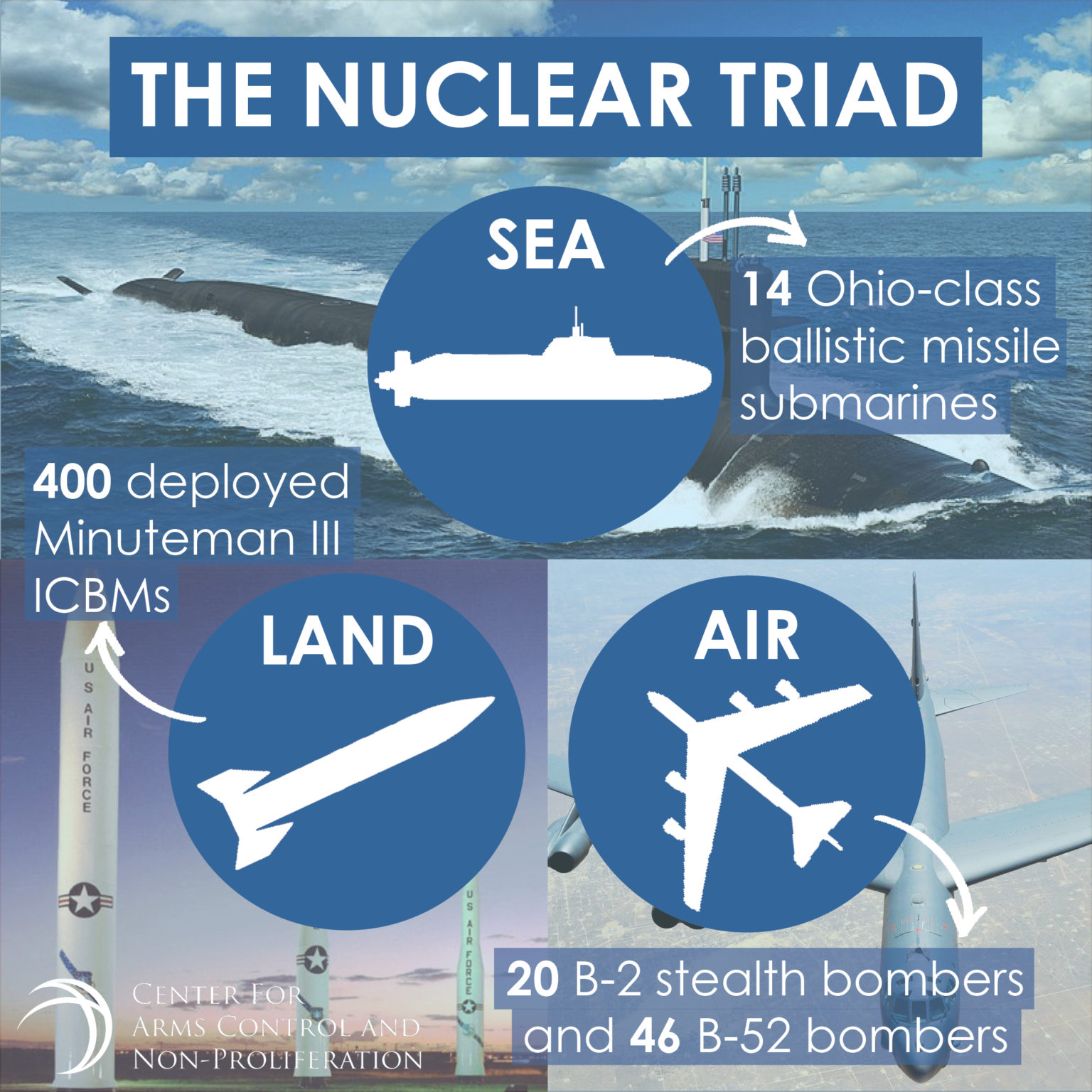
The Nuclear Budget
The average taxpayer no doubt assumes that a government agency called the Department of Energy (DOE) would be primarily concerned with developing new sources of energy, including ones that would reduce America’s dependence on fossil fuels to help rein in the ravages of climate change. Unfortunately, that assumption couldn’t be less true.
Instead of spending the bulk of its time and money on energy research and development, more than 40% of the Department of Energy’s budget for 2023 is slated to support the National Nuclear Security Administration (NNSA), which manages the country’s nuclear weapons program, principally by maintaining and developing nuclear warheads. Work on other military activities like reactors for nuclear submarines pushes the defense share of the DOE budget even higher. The NNSA spreads its work across the country, with major locations in California, Missouri, Nevada, New Mexico, South Carolina, Tennessee, and Texas. Its proposed 2023 budget for nuclear-weapons activities is $16.5 billion, part of a budget for defense-related projects of $29.8 billion……………………………
Our Misguided Security Budget
Spending $1.4 trillion to address a narrowly defined concept of national security should be considered budgetary malpractice on a scale so grand as to be almost unimaginable — especially at a time when the greatest risks to the safety of Americans and the rest of the world are not military in nature. After all, the Covid pandemic has already taken the lives of more than one million Americans, while the fires, floods, and heat waves caused by climate change have impacted tens of millions more.
Yet the administration’s proposed allocation of $45 billion to address climate change in the 2023 budget would be less than 6% of the Pentagon’s proposed budget of $773 billion……………………………….. https://www.commondreams.org/views/2022/07/07/americas-14-trillion-so-called-national-security-budget-makes-us-less-safe-not-more
Ukraine Reform Conference – name changed to Ukraine Recovery Conference – to hide the reality of Ukraine’s endemic corruption.

Ukraine’s endemic corruption problems are suddenly forgotten as hungry Western investors smell ‘reconstruction’ profits,
The flagship “Ukraine Reform Conference” is suddenly rebranded to suit current needs. Rt. rachelmarsden.com 6 July 22,
Rachel Marsden is a columnist, political strategist, and host of independently produced talk-shows in French and English.
The annual Ukraine Reform Conference has, since 2017, brought together Western officials and their local ‘civil society’ foot soldiers to discuss ways that Ukraine can reduce its rampant corruption. But this year, before getting underway this week in Lugano, Switzerland, it underwent a name change to the Ukraine Recovery Conference.
Perhaps drawing attention to the existence of the country’s endemic corruption isn’t convenient for those looking to avoid heavy criminal penalties set up to explicitly prevent investment that fuels corruption?
Simply changing the marketing of the conference does nothing to alter the reality. If anything, it’s counterproductive for Ukraine itself and serves to enable and perpetuate serious systemic problems that prevent the country from progressing.
“The authorities are delaying the fulfillment of many important anti-corruption promises,” according to Andrey Borovik, executive director of the Ukraine office of Transparency International, an organization funded by Western governments and multinationals. As for Ukrainian President Volodymyr Zelensky, “corruption just doesn’t seem to worry Mr. Zelensky much – at least when those implicated are close to him,” claimed Kyiv Independent (another Western funded outfit) editor Olga Rudenko in a guest piece for the New York Times in February, right before the Russian military operation started.
Not exactly the kind of guy you’d want overseeing massive investment projects, one would think.
These days, tackling corruption is taking a rhetorical backseat to the Western push to frame Ukraine as just your typical European country. “For the last two years, we have been discussing large European values, mostly a theoretical debate,” Slovenian Prime Minister Janez Jansa has said. “Then, suddenly, we realised that those fundamental European values actually exist. And that they are threatened. And that Europeans are defending them. With their lives. In Ukraine.”
Despite acknowledging that Ukraine would have to enact “a number of important reforms,” EU Commission President Ursula von der Leyen said that “Ukraine has clearly shown commitment to live up to European values and standards. And embarked, before the war, on its way towards the EU.” In reality, the only thing that has actually changed is that Western officials saw an opening to exploit current public sympathy, if not ignorance, to gain acceptance for an idea that normally would be a much tougher sell to the average EU citizen. That is, the notion that Ukraine would be a net benefit to the bloc rather than an Achilles heel rife with problems that has no business being included in a zone that allows for free movement of people and goods among member states.
…………….. the head of Interpol, Jurgen Stock, has warned EU nations in particular that “the wide availability of weapons during the current conflict will lead to the proliferation of illicit weapons in the post-conflict phase.”
Neglecting to place Ukraine’s corruption problem uncompromisingly front and center in order to better peddle the premature public narrative of the need for investment under the guise of ‘reconstruction’ represents a threat to the EU – and one that Western officials are only too happy to facilitate, apparently. One has to wonder why that is.
It’s hardly a secret that Western nations have historically leveraged foreign aid to gain economic and political footholds within other countries, either through state-backed programs, civil society funding, or corporate opportunities. But there’s also another catch. Current Western laws such as the Foreign Corrupt Practices Act (FCPA) in the US, the UK Bribery Act, or the Loi Sapin II in France all create an obligation for any entity or individual investing in foreign countries to ensure a corruption-free transaction. If Western investment in Ukrainian reconstruction ends up in the wrong hands, then board members, employees, and managers could all end up facing criminal charges with penalties of prison.
………………………. Western entities have an economic interest in portraying Ukraine as a safe place to invest. Otherwise, they’re easy pickings for the authorities of other foreign countries who might choose to use corrupt investment dealings in Ukraine as a means of taking a competitor off the playing field.
…………………… to get the green light, and to convince the average taxpayer to accept funding the risk, everyone has to make the venture sound benevolent – hence the Marshall Plan comparisons – and reduce any references to corruption to a minor detail. https://www.rt.com/russia/558414-anti-corruption-ukraine-reform-conference
—
Is nuclear sustainable? Read the label

[Ed. For a while they tried calling nuclear ”amber”, but that didn’t work – they’ve settle for ”sort of green”]
By DEBRA KAHN , 07/08/2022, https://www.politico.com/newsletters/the-long-game/2022/07/08/is-nuclear-sustainable-read-the-label-00044684
SHADES OF GREEN — The European Union broadened its definition of sustainable energy this week to include things not everyone agrees on — and triggered a fight.
The vote to include natural gas and nuclear power in the list of activities the EU is trying to encourage private investors to support was billed as a “pragmatic approach.” It’s also backed by Ukrainian officials, who say it should help reduce reliance on Russian gas.
But it’s getting major pushback — from scientists, sustainable investor groups and the European Commission’s own finance advisers, who argue the rules will divert money from truly green projects to prop up legacy industries and allow emissions to rise further, as POLITICO’s America Hernandez reports.
Under the new rules, countries heavily reliant on coal and oil for electricity will be able to replace them with less-polluting gas-fired power through 2030 and advertise the switch as sustainable to investors, as long as the plants switch to a clean-burning fuel like hydrogen by 2035 and respect a 20-year cap on greenhouse gas emissions.
Existing nuclear plants, which produce CO2-free electricity, will also get to be called climate-friendly if operators draw up safety plans showing where their radioactive waste will be permanently stored by 2050 and switch to so-called accident-tolerant fuels by 2025.
Activist investor groups are warning that watering down the sustainable designation will backfire.
“Calling gas sustainable, even as a ‘transition’ fuel, will not convince climate-change conscious investors, and it will make the taxonomy lose its usefulness as a tool to orient capital flows towards sustainable economic activities,” said Thierry Philipponnat, chief economist at watchdog group Finance Watch.
The United Nations’ Principles for Responsible Investment, which represents more than 5,000 investors managing €167 trillion ($169 trillion right now — great time to go to Europe) in sustainable assets, warned that blindly trusting the EU’s green labels “could prompt fragmentation across the market and lead to potential greenwashing.”
NUCLEAR RENAISSANCE PT. II — U.S. environmentalists were similarly dismayed this week by Pacific Gas & Electric’s announcement that it will try to keep California’s remaining nuclear plant open past its planned retirement.
A PG&E spokesperson told the San Diego Union-Tribune that the utility plans to apply for an Energy Department grant aimed at helping keep nuclear plants open. Diablo Canyon accounts for almost 9 percent of the state’s electricity generation, and officials are worried about reliability this summer and in years to come.
The move follows support from Gov. Gavin Newsom and lawmakers in last week’s state budget to fund agency power purchases from Diablo Canyon and natural gas plants when supplies run low. It’s an about-face from 2016, when environmentalists and labor unions representing plant workers came to a state-approved agreement to shut down the plant starting in 2024.
(NB: Diablo would have stayed open had California decided to let nuclear count toward its green electricity requirements in 2015.)
“Instead of propping up outmoded nuclear plants, Newsom should instead be providing more resources and funding to deploy renewable energy infrastructure across California,” Sierra Club California director Brandon Dawson said in a statement.
Austria, Luxembourg and green groups have already said they’ll sue the European Commission over its new rules. California environmentalists may also try suing to enforce the closure agreement, the SDUT reports.
Nationalising EDF is no cure-all for France’s nuclear industry troubles

The French state has said it will fully nationalise EDF, the debt-laden utility that runs the nation’s nuclear power plants and which the government has so far struggled to restructure. It has not said whether it
will buy out minority shareholders on the market or take control by law.
But however it is nationalised, it doesn’t guarantee a fix for EDF’s mountain of debt or its corroding reactors and it won’t reduce the cost of shielding consumers from sky-high energy prices.
Analysts say the government’s main goal may be to secure a freehand in running a business that has a roughly 80% share of the French electricity market, once it is delisted and the state no longer has to answer to any other shareholders.
About half of EDF’s 56 nuclear reactors in France are now offline, in part due to corrosion issues. EDF has repeatedly cut its planned nuclear output for 2022, just as Europe scrambles to find alternative energy sources as Russian gas supplies dwindle.
As well as problems with old reactors, it is also running years late and billions of euros above budget in building a new-generation of reactors in France and Britain, raising questions about whether it has to fix fundamental design faults. Furthermore, EDF has been hobbled by a regulated tariff system, known as Arenh, forcing it to sell 100 terawatt/hours (TWh) of nuclear generation to power retailers and large
consumers at 42 euros/MWh, which is well below market levels.
Reuters 7th Aug 2022
Test rocket carrying component for future nuclear armed ICBM explodes after takeoff

By Barbara Starr, CNN Pentagon Correspondent, July 8, 2022, (CNN)A test rocket carrying a component for a future US nuclear armed intercontinental ballistic missile blew up 11 seconds after takeoff Wednesday night from Vandenberg Space Force Base in California, according to a statement from the base…………
This was the first test of the Mk21A Reentry Vehicle (RV) the part of the weapon that would hold a nuclear warhead if the system was operational. There was no nuclear element or armed component to this test
The Mk21A is planned to be the reentry vehicle for the future LGM-35A Sentinel intercontinental ballistic missiles, a new ground-based nuclear intercontinental ballistic missile planned to replace the current Minuteman III intercontinental ballistic missile as a key element of the US nuclear deterrent capability.
The explosion comes a week after the latest test of a US hypersonic weapon failed after an “anomaly” occurred during the first test of the full system.
The test, carried out June 30 at the Pacific Missile Range Facility in Hawaii, was supposed to launch the Common Hypersonic Glide Body atop a two-stage missile booster. The booster is designed to launch the system and accelerate it to hypersonic speeds in excess of Mach 5, at which point the glide body detaches and uses its speed to reach the target. It was the first time the entire system was tested, called an All Up Round test……. https://edition.cnn.com/2022/07/08/politics/test-rocket-explodes/index.html
Evidence is the foundation of the TPNW — IPPNW peace and health blog

IPPNW statement to the First Meeting of States Parties on the importance of establishing a scientific advisory panel Carlos Umaña: “These warnings about the humanitarian impact of nuclear weapons are the most compelling reason for eliminating nuclear weapons and the most powerful argument we have for the need to universalize the TPNW.” Delivered by Co-President […]
Evidence is the foundation of the TPNW — IPPNW peace and health blog
Sizewell C – just the latest nuclear scam
Whatever chaos unfolds between today (Thursday) and tomorrow, Boris
Johnson is apparently still planning to confirm his Government’s
commitment to a new nuclear power station at Sizewell tomorrow.
As we all know, Johnson’s default political tactic is to lie, regardless of which
particular issue or crisis he’s having to address. For those who’ve
made something of a labour of love tracking Johnsonian mendacity, watch out
for this latest nuclear nonsense tomorrow – it’s absolutely guaranteed
to be brimful of outright lies, half-truths, omissions and rhetorical
boosterism of the kind that has made him (probably!) the least trustworthy
politician in the world apart from Vladimir Putin.
On this occasion, that’s simply because this whole ‘nuclear renaissance’ story is one
great big scam from start to finish. If I could count the ways,
anticipating the lying drivel that will be emerging from the BEIS press
release.
Jonathon Porritt 7th July 2022
http://www.jonathonporritt.com/sizewell-c-just-the-latest-nuclear-scam/
Nuclear war would turn oceans upside down, crash food web
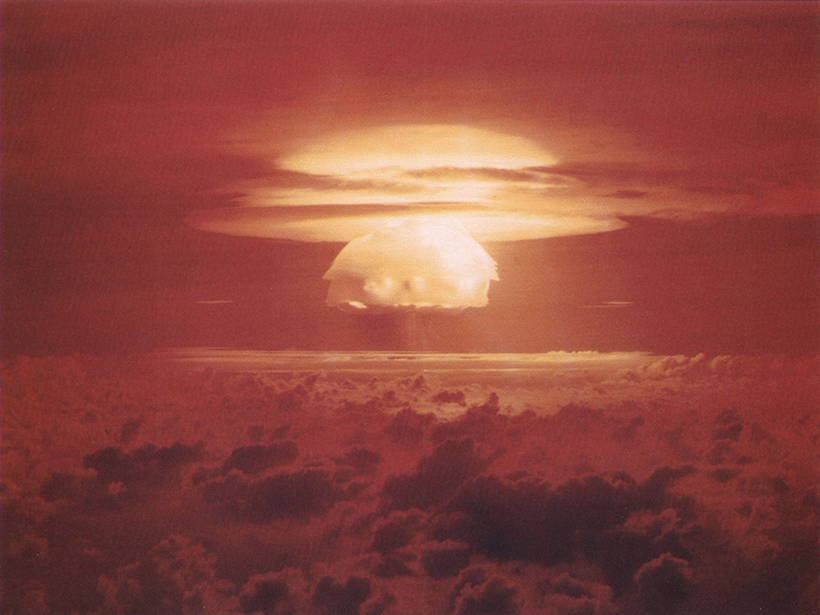
https://news.wisc.edu/nuclear-war-would-turn-oceans-upside-down-crash-food-web/ July 8, 2022 By Chris Barncard , Russia’s invasion of Ukraine has given the specter of nuclear war renewed weight as a global threat, and a new study of the environmental impact of a nuclear conflict describes dire consequences for the world’s oceans.
“If there were a nuclear war, these huge explosions and the firestorms they cause could throw so much soot — teragrams, or millions of tons — into the atmosphere, it would block out enough sunlight to cool the atmosphere significantly,” says Elizabeth Maroon, a professor of atmospheric and oceanic sciences at the University of Wisconsin–Madison.
In just one month after a nuclear exchange between Russia and the United States or India and Pakistan, average global temperatures would drop by 13 degrees Fahrenheit — a larger temperature change than in the last ice age — according to climate modeling by Maroon and collaborators from around the world. The research team, led by Louisiana State University professor of oceanography and coast sciences Cheryl Harrison, published their findings July 7 in the journal AGU Advances.
Even setting aside radioactive fallout, the consequences on land would be dire, including widespread crop failures. But in just a year, the planet’s interconnected oceans would enter a state unfamiliar to scientists like Maroon who study the way oceans have changed on much longer time scales. And, unlike effects on the atmosphere and on land, oceans would not fully recover within the 30-year time period covered by the researchers’ simulations of nuclear conflicts.
“Changes in the ocean take longer than in the atmosphere or on land, but our modeling shows that even in the first year after a nuclear war the ocean circulation would have started changing drastically,” says Maroon, an expert on the interplay between the Atlantic Ocean’s complex circulation patterns and Earth’s climate.
The Atlantic’s major circulation turn-around in the northern latitudes — in which warm surface water streaming north to Greenland, Iceland and Norway cools and sinks into middle depths to be drawn south again — comes unhinged.
“Within the first year or two, water in the North Atlantic sinks all the way to the bottom of the ocean, which we think has not happened even in the ice ages,” says Maroon. “In today’s ocean, only near Antarctica does water sink all the way to the seafloor.”
That unprecedented mixing and ocean circulation speed-up — which would last for about two decades — would move nutrients in the ocean vital for supporting the smallest and most numerous marine organisms, like plankton, into entirely unfamiliar conditions around the world.
It would also result in cooling so strong it would extend sea ice and render impassable major seaports that are now open year-round, and would likely cause significant damage to much of the ocean food web.
“It’s no secret that nuclear winter would be terrible,” Maroon says. “What this study shows are the lasting extent of effects we hadn’t really addressed before on ocean circulation and ecosystems and the very base of the food web.”
To read more about the study and its findings, visit: https://www.lsu.edu/mediacenter/news/2022/07/07docs_harrison_aguadvances.php
The Corporatization of Space.

The Corporatization of Just About Everything,
Consortium News, Tom Valovic, July 6, 2022………………………………………… let’s draw on the self-declared wisdom of Time magazine for guidance. (This is a publication that’s now in the Big Tech/Big Media” camp as it’s now owned by the CEO of Salesforce.com). In the same issue, another article gushed over the fact that corporations are poised to dominate the exploration and use of space:“….NASA made it clear that when that clock does toll, the U.S. will be getting out of the space station game, likely for good. Instead, the space agency signed a $415.6 million seed money deal with three companies — Blue Origin, Nanoracks, and Northrop Grumman — to develop their own private space stations, on which NASA and other customers could lease space for professional crews and tourists. The article goes on to point out that, in a press statement, a NASA spokesperson boasted that….
” NASA is once again leading the way to commercialize space activities” and that “we are partnering with U.S. companies to develop the space destinations where people can visit, live, and work.”
It seems abundantly clear that the top-down corporate model of governance is fundamentally anti-democratic by its very nature and the waning power and direction of our democratic institutions worldwide has much to do with this fact.
…. uncontrolled and uncontrollable market forces are no substitute for thoughtful and enlightened public policy and democratic norms. Granted, this is in short supply these days but allowing corporations to fill that void is hardly a solution.
As our glorious planet continues to experience crisis after crisis, it’s sad and troubling that there seems to be no shortage of profiteers looking to make an easy buck off the spoils. It seems abundantly clear that the top-down corporate model of governance is fundamentally anti-democratic by its very nature and the waning power and direction of our democratic institutions worldwide has much to do with this fact……. https://consortiumnews.com/2022/07/06/the-corporatization-of-just-about-everything/
Tom Valovic is a journalist and the author of Digital Mythologies (Rutgers University Press), a series of essays that explored emerging social and political issues raised by the advent of the Internet. He has served as a consultant to the former Congressional Office of Technology Assessment. Tom has written about the effects of technology on society for a variety of publications including Columbia University’s Media Studies Journal, the Boston Globe, and the San Francisco Examiner, among others.
Church stands against nuclear power in the Philippines
JUCA News, July 04, 2022
Renewable generation must double in the next few years if we are to save the nation from an economic meltdown
Bishop Ruperto Santos of Balanga has spoken out against the revival of the Bataan nuclear power plant saying it would be a great danger to the people and the environment. The Philippine bishops’ conference stands against nuclear power also.
“The voice of our people is strongly, openly no,” he said. Bishop Santos claimed the danger would be greater than any possible benefit. The danger “heavily outweighs its benefits,” he told Radyo Veritas on June 3.
The bishop was reacting to news reports that the Philippines’ new president Ferdinand Marcos Jr. plans to revive the nuclear power plant built by his father — the late dictator Ferdinand Marcos Sr.
When former president Rodrigo Duterte signed an executive order that allowed nuclear power plants to be considered as a source of electricity generation, a wave of concern swept through the minds and hearts of the security, environmental, medical, and renewable energy thinking community……………………
“The Diocese of Balanga has decided… [we] are against this [move] and this stand will not change.”
The gray-haired veterans of the anti-Bataan Nuclear Power Plant campaigns, such as famous campaigner Professor Roland Simbulan of Nuclear Free Philippines, will recall the hundreds of millions of dollars that were siphoned off the deal into the private accounts of Marcos cronies.
Had the nuclear plant been operational, the Mount Pinatubo volcanic eruption and the many earthquakes would have likely caused a nuclear disaster. The real possibility of a nuclear accident is what rightly scares millions of people away from nuclear power as a source of electricity when there are many alternatives of renewable energy available.
Solar and wind farms, hydro dams, geothermal, and biomass are all available and at much lower cost in comparison to nuclear energy, coal, oil and gas imports.
According to a report by the Philippine Electricity Market Corporation (PEMC), the few existing renewable energy (RE) projects, especially solar and wind power have already saved the Philippines 4.04 billion pesos (about US$73 million).
Besides, renewable energy sources of electricity are free, thanks to nature. The wind blows, the sun shines and volcanic heat is always present for geothermal plants and delivered by nature without cost. They just need more investment and harnessing and they pose no danger………………………………………………………
The greatest challenge is the safe disposal of the deadly contaminated nuclear waste, which will last for thousands of years. The Philippine Department of Energy consultant proposes burying it on a remote island. For sure, the contamination will leech into the ocean and poison sea life and those who eat fish.
Pope Francis has encouraged everyone to use alternative ways to protect the environment and nuclear power is not one of them.
The future of the planet and humans is to stop burning fossil fuels, such as coal, oil and gas, and stop global warming and accelerate the building of renewable energy projects…………… https://www.ucanews.com/news/church-stands-against-nuclear-power-in-the-philippines/97889
Ukraine has sold two French-donated 155mm Caesar howitzers to Russia
PANAGYURISHTE ($1=1.88 Bulgarian Levs) — French and Ukrainian [from Donbas] sources claim that in the hands of the Russian army, and more precisely in the production workshops of the Russian manufacturer Uralvagonzavod, there are two 155mm self-propelled howitzers Caesar, donated by France to Ukraine, as military aid against the Russian invasion on February 24 this year.
On June 20, French lawyer Régis de Castelnau wrote on his official Twitter account: “Another success of Macron: 2 French Caesar guns were intercepted intact by the Russians. They are currently in the Uralvagonzavod factory in the Urals for study and possible reverse engineering. Thank you Macron, we are paying”.
A few days later, on June 23rd, the Russian company [Uralvagonzavod] responded to the French lawyer, through its official Telegram profile and citing Régis de Castelnau’s tweet, writing: “Hello, Mr. Regis. Please convey our thanks to President Macron for the donation of the self-propelled guns. This material is of course not tip-top… not like our MSTA-S! But nevertheless, it will be useful. Send more – we’ll take them down.”
Ukrainian sources from Donbas claim that they are also aware of this case, but not from the French lawyer or the Russian plant, but from French military sources, emphasizing that the online publication Donbas Insider does not cite who exactly the French military sources are.
France’s General Staff has denied reports of a French Caesar self-propelled howitzer being captured by Russian forces in Ukraine. “This information is false,” said the General Staff of France. “We categorically deny it. We’ve discussed this with our Ukrainian partners.” According to the Armed Forces of Ukraine, no evidence was provided to support the claim.
The news of captured weapons would not surprise anyone in wartime. We have witnessed the Ukrainian and Russian military capturing various enemy weapon systems. But the same “unidentified” French sources claim, according to a Donbas Insider, that the two Caesar self-propelled howitzers were sold, through an intermediary, by Ukrainians to Russians. The price, which is being discussed in tight circles, is $120,000 each. BulgarianMilitary.com recalls that the unit value of a Caesar self-propelled howitzer varies around the amount of 7 million euros.
A political analyst at BulgarianMilitary.com says that the possibility that the two howitzers were sold to Moscow is evident in the tone and ending of French lawyer and politician Régis de Castelnau’s words. “It is very clear to him [the French lawyer] that during the war, in addition to prisoners of war, the adversaries acquire different foreign equipment. This is war, some die, others abandon their positions out of fear, and others profit from the war. The end of the comment “Thank you Macron, we are paying’ suggests that Régis de Castelnau believes that the two howitzers were not abandoned and therefore captured, but sold. The irony is too strong in this particular case to ignore this fact”, says Dr. Sebastian Levi, correspondent, and analyst of BulgarianMilitary.com for the Middle East region.
Levy also says that he believes the two self-propelled howitzers were resold with the help of an intermediary, a military dealer. Levy, however, has no evidence for his claims but refers to his league reasoning.
However, sales are a fact
The feeling that corrupt Ukrainian servicemen are involved in the illegal arms trade to extract maximum profit is not from now, and it is not only about this case.
On June 2, BulgarianMilitary.com revealed the sale of at least one FGM-148 Javelin anti-tank guided missile system on the dark web for $30,000. The seller is unclear, but according to the information posted on the darknet, the location [where the system will be shipped or picked up from] is Kyiv, the capital of Ukraine.
“Ukrops are selling Javelins on the darknet. The command of the Armed Forces of Ukraine resells equipment and weapons supplied by NATO to the Middle East and North Africa. Anyone with a TOR browser can buy this ATGM in the online store,” writes the pro-Russian Telegram channel ABS News.
Interpol knows
Interpol knows the illegal sale of arms by Ukrainians to Russians. The German online edition Overton-Magazin writes that concerns can be seen in the statements of Jürgen Stock, Secretary-General of Interpol, “who fears that the weapons will be handed over to criminal organizations. However, this is happening with the complicity of Western governments, which are not willing to put in place safeguards and vetting mechanisms for the use of these weapons. In fact, even the US intelligence services do not know where the weapons delivered to Ukraine are going.”
According to the German publication, a part of the weapons delivered to Ukraine were actually seized, but another part was resold by Ukrainian holdings, which are in the hands of Russian businessmen. Overton-Magazin even points to a specific case that should be investigated for illegal trade, and that is the downed Ukrainian helicopters that tried to evacuate Ukrainian soldiers from Mariupol. The investigation so far indicates that the helicopters were shot down by American Stinger anti-aircraft missiles donated by the Americans.
Here’s what the German publication Overton-Magazin wrote: “The Western narrative of the prophesied defeat of Russia and the victorious resistance of Ukraine is the main argument for promoting the deployment of weapons. It gives the impression that all that is needed is the ‘last little push’, to achieve victory. The reality, however, is not so romantic.”
………………………. And finally, let’s mention the most important fact that is known, but no one dares to talk about it: in order for such a sale to be carried out, the presence of strong corruption is necessary, especially among the military command and the lower officer ranks of the Ukrainian army. https://bulgarianmilitary.com/2022/07/05/ukraine-has-sold-two-french-donated-155mm-caesar-howitzers-to-russia/
Why would anybody invest in Sizewell C nuclear plant? – An unlikely proposition?
Why would anybody invest in Sizewell C nuclear plant? – An unlikely
proposition? The Government has tasked Barclays Bank with finding investors
for the proposed Sizewell C (SZC) plant.
Reports surfaced in the Mail on
Sunday that Centrica is planning on taking a stake in the company. Perhaps
the fact that the report emerged in the Mail on Sunday rather than the
Financial Times is a sign that the decision is still subject to vagaries.
This report has me scratching my head so hard it hurts!
Why would Centrica,
which in 2016 abandoned plans to invest in Hinkley C partly because of
‘the lengthening time frame for a return on the capital invested in a
project of this scale‘ now opt for an investment in SZC? After all the
doubt about return on investments in SZC may be viewed as, if anything,
even more threadbare, to that of Hinkley C.
100% Renewables 7th July 2022
With EDF’s parlous finances and France nationalising EDF – decision on Britain’s planned Sizewell C nuclear station has been delayed

A decision on a new nuclear power station at Sizewell in Suffolk has been
delayed again by the government. French energy company EDF wants to build
Sizewell C, a £20 billion two-reactor nuclear plant, next to Sizewell B. A
decision on Sizewell C was expected today (7 July), but it has been pushed
back to 20 July at the latest. Paul Scully MP said: “I have decided to set
a new deadline of no later than 20 July 2022 for deciding this application.
This is to ensure there is sufficient time to allow the Secretary of State
to consider the proposal.”
On Wednesday, the French government announced
the state was taking full control of EDF, in a drive to boost its domestic
nuclear expansion.
Reacting to the delay, Alison Downes, of campaign group
Stop Sizewell C, said it would have been farcical if a decision on Sizewell
C had been made today, following the news from Paris. She added: “We also
hope that announcements of EDF’s re-nationalisation have given ministers
pause, especially when EDF’s parlous finances are at least in part down to
their disastrous track record at building the type of reactors proposed for
Sizewell C.”
ITV 7th July 2022
-
Archives
- October 2026 (104)
- September 2026 (339)
- August 2026 (330)
- July 2026 (355)
- June 2026 (287)
- May 2026 (306)
- April 2026 (356)
- March 2026 (251)
- February 2026 (267)
- January 2026 (308)
- December 2025 (358)
- November 2025 (359)
-
Categories
- 1
- 1 NUCLEAR ISSUES
- business and costs
- climate change
- culture and arts
- ENERGY
- environment
- health
- history
- indigenous issues
- Legal
- marketing of nuclear
- media
- opposition to nuclear
- PERSONAL STORIES
- politics
- politics international
- Religion and ethics
- safety
- secrets,lies and civil liberties
- spinbuster
- technology
- Uranium
- wastes
- weapons and war
- Women
- 2 WORLD
- ACTION
- AFRICA
- Atrocities
- AUSTRALIA
- Christina's notes
- Christina's themes
- culture and arts
- Events
- Fuk 2022
- Fuk 2023
- Fukushima 2017
- Fukushima 2018
- fukushima 2019
- Fukushima 2020
- Fukushima 2021
- general
- global warming
- Humour (God we need it)
- Nuclear
- RARE EARTHS
- Reference
- resources – print
- Resources -audiovicual
- Weekly Newsletter
- World
- World Nuclear
- YouTube
-
RSS
Entries RSS
Comments RSS

