Nuclear power reactor forced to shut down due to extreme 28C heat

We will see more heatwaves in a warmer world,” said Samantha Burgess, strategic climate lead at the European Centre for Medium-Range Weather Forecasts (ECMWF), which operates Copernicus.
French energy officials have shut down another reactor at the Golfech nuclear power plant as a scorching heatwave continues to grip Europe
Lauran O’Toole and Eliana Nunes News Reporter, 10 Jul 2026
Reactor 2 at the Golfech nuclear power plant in south-west France’s Tarn-et-Garonne department was taken offline on Thursday, state-owned electricity company EDF said. The temperature of the River Garonne, from which the plant draws water to cool its reactors, was approaching the regulatory limit of 28C.
EDF said the temperature of the Garonne is expected to reach 28C on Friday, when France’s national weather service has placed nine departments under the highest-level red heatwave alert.
A 2006 EU directive on freshwater quality stipulates that cooling water discharged from power plants must not cause river temperatures to exceed 28C.
Reactor 2 was the only unit operating at the site as Reactor 1 has been offline for maintenance since May. EDF had already suspended operations at Golfech on June 23 for the same reason before restarting Reactor 2 on July 3, the Express reports.
A spokesperson for the company said: “Weather conditions over the last few days have led to a significant rise in the temperature of the Garonne (river), which is expected to reach 28C this Friday July 10.
“As a precautionary measure, production unit No. 2 at EDF’s Golfech nuclear power station was shut down on Thursday July 9 at 11:30 a.m.”
During the previous heatwave at the end of June, EDF also shut down two other nuclear reactors – at the Bugey nuclear power station on the River Rhône and the Nogent-sur-Seine plant on the River Seine – to comply with environmental limits on river temperatures, Le Parisien reports.
The EU’s Copernicus Climate Change Service said on Thursday that western Europe experienced its hottest June on record this year. The average temperature reached 20.74C – more than 3C above the average between 1991 and 2020, the climate monitor said.
“We will see more heatwaves in a warmer world,” said Samantha Burgess, strategic climate lead at the European Centre for Medium-Range Weather Forecasts (ECMWF), which operates Copernicus.
“They will be more intense and they will last longer, and they will impact more geographical areas.”
Heatwave: EDF will once again shut down nuclear reactors.
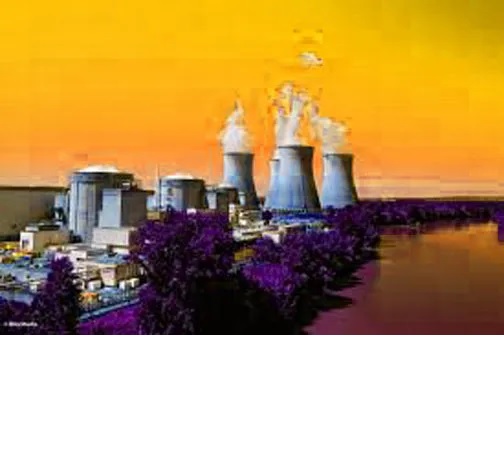
Two weeks after the latest heatwave, EDF has had to halt production at several reactors to prevent further warming of the rivers. The electricity company is planning new upgrades at Golfech on the Garonne and at Chooz on the Meuse in response to climate change.
By Amélie Laurin, July 9, 2026
The respite was short-lived for EDF’s nuclear power plants. After the exceptional heatwave at the end of June which had put three reactors out of service, the public electricity company will again stop two of them on Thursday evening, due to the high temperatures: Bugey 3, on the Rhône, from 9 p.m., then Golfech 2, on the Garonne, at 11:45 pm.
Their reconnection to the grid is scheduled for July 17, after the Bastille Day holiday weekend, which is expected to reduce national electricity consumption by several GW per day, according to forecasts from RTE, the high-voltage transmission network operator. A power reduction is also planned for this Thursday for environmental reasons at Saint-Alban 2, on the Rhône River, according to regulatory announcements from EDF., the operator of high-voltage lines. A power
reduction is also planned this Thursday for environmental reasons at
Saint-Alban 2, on the Rhône, according to EDF’s regulatory messages………. (Subscribers only)
Les Echos 9th July 2026 https://www.lesechos.fr/industrie-services/energie-environnement/canicule-edf-va-de-nouveau-arreter-des-reacteurs-nucleaires-2241469
Europe’s Nuclear Plants Can’t Beat the Heat
By Haley Zaremba – Jul 10, 2026, https://oilprice.com/Alternative-Energy/Nuclear-Power/Europes-Nuclear-Plants-Cant-Beat-the-Heat.html
- France is cutting output at up to five nuclear plants this week as record heat pushes river temperatures too high to cool reactors safely.
- Last month’s heat wave already knocked out power to 70,000 households on France’s hottest day ever, 44°C, and Germany and the UK both rely on French nuclear exports.
- More than 1,000 heat-related deaths in France and stalled EU adaptation funding show the grid crisis is outpacing the response.
Europe’s blistering heat wave is threatening energy security across the continent as power plants shut down and the risk of rolling blackouts rises. Electric grids are overstressed, and ecosystems are too. Rivers are greatly affected by soaring temperatures, which in turn impacts the energy industry and power plants that rely on that water supply for their cooling systems. Just this week, France announced that it will reduce production at as many as five nuclear power plants, with two already curbing output this week.
France is expected to receive the worst of a coming high-pressure heat dome over the next few weeks, with temperatures soaring to as high as 42 Celsius (107.6 Fahrenheit) in some parts of the country on Wednesday. When Europe experienced a similar heat wave last month, a transformer failed, leaving nearly 70,000 households without power as temperatures reached deadly levels. The country recorded its hottest day ever on record, with temperatures reaching a blistering 44 °C (111 °F).
These temperatures are not only deadly to humans, they are also a huge threat to the ecosystem. Rivers are growing hotter under these conditions, and one of the impacts of that change is that their waters are no longer as effective for cooling down nuclear power plants, which serve as the backbone of France’s energy mix. As a result, the country anticipates needing to curb production at plants around the country at the very same time that demand is surging.
It’s a sad irony that just as electricity is needed more than ever to keep indoor temperatures at survivable levels, the power grid is most likely to fail. “As it gets hotter, things stop working quite so well,” Iain Staffell, associate professor of sustainable energy at Imperial College London, was recently quoted by DW. “I think we do need to adapt the power system to cope with the changing weather,” he went on to add.
The reduction of nuclear power output in France could greatly affect energy availability and affordability within France and in neighboring countries such as Germany and the United Kingdom, which import electricity generated by the nation’s sizable nuclear power sector. And nuclear is only part of the story. The heat wave is also impacting the output of hydropower and limiting the cooling abilities of coal and gas plants.
Europe can expect this kind of strain to be the new normal as global warming alters climatic patterns around the world and increases the frequency and intensity of extreme weather. Policies will need to be put into place, and enacted quickly, in order to prepare European grids to withstand these kinds of temperatures at regular intervals going forward.
“Utilities can adapt by planning for summer peaks, making cooling demand more flexible, reinforcing grids for high temperatures, deploying batteries and demand response, and climate-proofing power plants’ cooling systems,” Simone Tagliapietra, senior fellow at Bruegel, an economic and policy think tank, recently told MIT Technology Review via email.
However, all of these imperatives are massively costly and difficult to implement, leading to inaction on the part of European leadership and widespread vulnerabilities of the continent’s energy infrastructure. Last year, the European Environment Agency reported that all 27 countries in the European Union have climate adaptation plans, but noted that “insufficient long-term funding” has stifled implementation.
This has led to frustration and resentment amongst the public, not to mention over 1,000 unnecessary deaths. “Everyone is asking, why are we not ready?” Francois Gemenne, an environmental politics professor at French business school HEC Paris, recently told the New York Times. “We are becoming aware of our own vulnerability.”
UK has ‘no future’ if it fails to act on ecosystem collapse threatening national security

Members of parliament have demanded full publication of an explosive
report by the UK’s spy leaders that found the collapse of ecosystems
overseas would have catastrophic consequences for the UK’s national
security, warning that the UK has “no future” if the findings are not
urgently acted on.
Despite growing concerns for the UK’s food security,
likely to be worsened by the third heatwave this summer currently
afflicting the UK and swathes of the northern hemisphere, the government
has refused to publish the full report, which has circulated among defence
officials for more than a year.
The report paints a devastating picture of
severe food shortages, price rises, migration, political destabilisation
and possible war, resulting from the collapse of ecosystems, fuelled by the
human-induced climate crisis and over-exploitation, as the Guardian has
previously revealed. Food shortages could result within five years.
Guardian 8th July 2026, https://www.theguardian.com/global-development/2026/jul/08/uk-report-ecosystem-collapse-national-threat-food-security
The cities most at risk from extreme heat, ranked
Almost all cities facing the greatest danger from extreme heat are in Asia
and Africa, where searing temperatures collide with poverty and little
means to cope, according to a new Oxford study. The study assesses 205
cities with populations of over one million on three fronts: how hot they
get, how vulnerable their people are, and how well they can cope. It shows
that Al Basrah in Iraq is the city most at risk. The assessment further
reveals that some 95 per cent of the cities at the highest risk are in
South Asia, Southeast Asia and Sub-Saharan Africa. India, Pakistan,
Nigeria, and Ghana host the largest number of cities with high risk scores,
according to the study published in the journal Sustainable Cities and
Society. Major tourist destinations and business hubs feature in the top
50, such as Cairo in Egypt, Bangkok in Thailand, Hanoi in Vietnam, and
Jaipur in India.
Independent 7th July 2026Africa, https://www.independent.co.uk/climate-change/news/extreme-heat-warning-cities-bangkok-ho-chi-minh-cairo-b3010260.html
Wildfire in southern France forces evacuation of 10,000 people
Neil Murphy
A wildfire has forced the evacuation of thousands of people in southern
France as the country grapples with the impacts of an early summer heatwave
that scorched much of Europe. More than 10,000 people have been ordered to
leave more than a dozen small towns and villages in the foothills of the
French Pyrenees, near the border with Spain. The fire, located in
Trévillach near Perpignan, has burned at least 4,600 hectares (11,366
acres), local prefect Pierre Regnault de la Mothe said in a post on X.
BBC 6th July 2026, https://www.bbc.co.uk/news/articles/crlwweye9glo
The Heat Is the Story—Climate Change Is the Cause

As extreme heat forces Fourth of July and America 250 celebrations to cancel or scale back across the country, the real story isn’t the weather—it’s the accelerating climate crisis reshaping American life.
Joshua Scheer,July 4, 2026, https://scheerpost.com/2026/07/04/the-heat-is-the-story-climate-change-is-the-cause/
The climate crisis has become so normalized that much of the corporate media now reports its consequences while refusing to name their cause.
We recently highlighted this failure through FAIR’s incisive analysis, “Covering the Impact of Climate Change—Without Mentioning Climate Change.” This latest reporting from USA Today does exactly what FAIR warned about.
Across the United States, Fourth of July and America 250 celebrations are being canceled, postponed, or scaled back because temperatures have become simply too dangerous. More than 120 million Americans are under extreme heat warnings. Another 62 million are under heat advisories. Parades have been canceled after floats were already lined up. Historic celebrations in Philadelphia have been abandoned. Fireworks have been delayed, festivals shut down, and even events on the National Mall now require cooling tents, misting stations, hydration centers, and emergency precautions just to proceed.
And yet the story is framed as though this were simply an unfortunate spell of bad weather, It isn’t this is what climate change looks like in real time.
According to the Center for Climate and Energy Solutions, extreme heat is becoming both more frequent and more intense as the planet warms. What was once considered unusual is increasingly becoming routine. The organization notes that U.S. cities experienced an average of just two extreme heat events per year in the 1960s. Between 2010 and 2020, that number had risen to ten. At the same time, the nation’s heat-wave season has expanded by 46 days.
The trend is accelerating. The year 2024 was the hottest ever recorded globally, and the last decade has been the warmest on record. Looking ahead, the Fifth National Climate Assessment projects that much of the United States will experience 15 to 30 additional days above 95 degrees each year if global temperatures rise by 2 degrees Celsius. In some states, including Florida, that increase could reach 50 additional days annually.
Extreme heat is already the deadliest weather-related hazard in the United States, killing more Americans each year than hurricanes, floods, or tornadoes. Heat-related deaths have risen by more than 50 percent since 2000, while prolonged high temperatures increase the risk of cardiovascular disease, respiratory illness, kidney damage, and heat stroke. Older adults, children, outdoor workers, and low-income communities without reliable access to cooling face the greatest risks.
The consequences extend far beyond public health. Extreme heat strains the electric grid as air-conditioning demand surges while reducing the efficiency of power lines and power plants. It damages crops, stresses livestock, worsens drought, fuels larger wildfires, and intensifies the urban heat island effect, making many cities several degrees hotter than surrounding areas.
Against that backdrop, the cancellation of parades, fireworks, festivals, and outdoor gatherings across the country is not simply a holiday inconvenience. It is another visible reminder that climate change is reshaping everyday American life.
Yet too much media coverage still treats these events as if they were disconnected episodes of bad weather. When hundreds of Independence Day celebrations are canceled because it is unsafe to be outside, the story is not simply that it is hot. The story is why it is hot—and why these dangerous heat waves are becoming America’s new normal.
The economic costs of climate change are no longer theoretical—they are arriving in real time.
As seen by a recent July 1st Wall Street Journal analysis argues that extreme heat has become a chronic drag on the global economy, disrupting everything from construction and transportation to agriculture, public events, and energy systems. As temperatures soar across the United States ahead of the Fourth of July holiday, more than 150 million Americans have been placed under heat alerts, while Europe continues to experience deadly temperatures that the World Health Organization estimates contributed to roughly 1,300 excess deaths in a single week.
Read more: The Heat Is the Story—Climate Change Is the CauseThe article notes that economists are increasingly treating climate change not as a distant environmental concern but as a central economic force. George Buckley, chief European economist at Nomura, told the Journal that climate change is becoming impossible for economists to ignore, comparing it to other long-term structural challenges such as aging populations. What once appeared to be an issue for future generations is now affecting quarterly growth, inflation, productivity, and government budgets.
Extreme heat carries immediate economic consequences. Outdoor construction slows or stops altogether. Transportation systems are disrupted as rail lines, roads, and infrastructure strain under prolonged high temperatures. Schools close, public events are canceled, and businesses lose productivity as workers are forced indoors or face dangerous working conditions. While some sectors—such as movie theaters and air-conditioning manufacturers—may temporarily benefit, economists emphasize that these isolated gains are dwarfed by the broader losses.
The financial toll is already measurable. Research cited by the Journal estimates that last year’s European heat waves and floods caused approximately $43 billion in economic damage. Allianz modeling suggests that if years of record-breaking heat become the norm, some countries could lose between 5 and 7 percent of their gross domestic product over a five-year period. Those losses come not only from reduced economic output but also from mounting public expenditures to repair damaged infrastructure, strengthen emergency services, and retrofit schools and public buildings with cooling systems.
The article also highlights another consequence often overlooked in public debate: inflation. Extreme heat damages crops, reduces agricultural yields, and pushes food prices higher. One study found that Europe’s 2022 heat wave added roughly two-thirds of a percentage point to food-price inflation. As these events become more frequent, economists warn that climate-related inflation will become harder for central banks to dismiss as temporary, complicating efforts to stabilize prices and manage economic growth.
Perhaps the most significant conclusion is that climate disasters no longer arrive as isolated emergencies. Repeated heat waves compound one another. Construction projects delayed by one event are interrupted again weeks later. Infrastructure weakens under repeated stress. Emergency services remain stretched. Businesses and governments find themselves spending more simply to maintain existing systems rather than investing in future growth.
For years, climate change was framed primarily as an environmental issue. Increasingly, even the financial press is recognizing that it is also an economic one. Every canceled festival, delayed construction project, damaged harvest, overloaded power grid, and record-breaking electric bill represents another reminder that the costs of a warming planet are no longer hypothetical. They are already being paid.
When Americans can no longer safely celebrate Independence Day outdoors because of relentless, life-threatening heat, that is not merely a weather story—it is one of the defining climate stories of our time. Every article that catalogs canceled events without confronting the underlying cause helps normalize what should instead shock us.
Journalists rightly ask who is responsible after floods, hurricanes, or wildfires devastate communities. Why should record-breaking heat be treated any differently? Reporting the consequences while refusing to name the crisis leaves readers informed about the symptoms but blind to the disease.
The cancellations themselves are news. The real story is why they are becoming the new normal.
The climate crisis is no longer something our children will inherit. It is something we are living through right now. It is changing how we work, where we live, what we grow, how much we pay for food and energy, and now even how we celebrate.
The tragedy is not only that the planet is warming. It is that too many of our institutions—including much of the corporate media—continue to describe the symptoms while refusing to confront the disease. By treating record-breaking heat as another unfortunate weather event instead of what it is—a predictable consequence of decades of fossil fuel dependence and political inaction—they normalize a catastrophe that should be demanding urgent action.
Perhaps the most patriotic act today is not waving a flag while pretending everything is normal. It is refusing to accept that this is normal at all. The greatest threat to America’s future is not acknowledging the climate crisis—it is continuing to look away from it. Until we are willing to name the problem honestly, we will never summon the courage to solve it.
May we never forget this moment. And to those of us in the older generations: we cannot pretend this crisis belongs only to the young. People are already dying from extreme heat and the accelerating impacts of climate change—that is a documented fact. The greatest burden, however, will fall on those who must live with the consequences long after today’s leaders are gone.
If we continue down this path, future generations may well look back and ask why we accepted a slow-moving catastrophe that unfolded in plain sight. Nuclear war remains one of humanity’s greatest fears because of its speed and devastation. Climate change is different. It kills more slowly, more unevenly, and often out of the headlines—but it is no less real for those already suffering its consequences.
The question is no longer whether the crisis has arrived. It has. The only question that remains is whether we will finally find the courage to act before today’s warning becomes tomorrow’s irreversible tragedy.
May we never forget Zach from the DNC and the Hilary post election meeting in which he said
“Why should we trust you as chair to lead us through this?” two people in the room told The Huffington Post. “You backed a flawed candidate, and your friend [former DNC chair Debbie Wasserman Schultz] plotted through this to support your own gain and yourself.”
“You and your friends will die of old age and I’m going to die from climate change. You and your friends let this happen, which is going to cut 40 years off my life expectancy,” he said, according to the report.
While Zach was booed and repeatedly told to sit down, he refused to back down, continuing to call Brazile “part of the problem.”
It all leads back to the same moral failure we have witnessed with Gaza, the drive toward war with Iran, and now the climate crisis. On genocide, too many Democratic leaders have not merely been silent—they have been complicit. They have armed it, funded it, defended it, excused it, and attacked those who dared to call it by its name.
That same cowardice runs through their response to war and climate catastrophe. Again and again, Democratic leaders offer speeches about democracy and humanity while backing policies that destroy both. They condemn cruelty when it is politically convenient, but when real power demands a choice, too many choose donors, weapons manufacturers, fossil fuel interests, and empire over human life.
As we honor Ron Kovic, Mike Prysner, and now Zach, we are reminded that conscience rarely comes from the people sitting comfortably in power. It comes from those willing to speak the truth even when party leaders, pundits, and careerists tell them to sit down.
We need more people in positions of power with that courage. Because when leaders fund genocide, march us toward war, and ignore a climate crisis already killing people, they are not simply failing us. They are helping lead us toward death.
History will not remember their carefully worded statements. It will remember whether they stood against genocide, war, and climate collapse when it mattered.
Can provocative climate messaging on OnlyFans cut through social media’s noise?

by Jessica Riches, July 2, 2026, https://www.positive.news/environment/can-provocative-climate-messaging-on-only-fans-cut-through-social-medias-noise/
A climate narrator is using OnlyFans to reach new audiences in unlikely places. It turns out, people listen
As part of a climate communications project, I joined OnlyFans. It wasn’t a publicity stunt, it was an attempt to answer a question that sits at the heart of my work: if the climate crisis is one of the defining issues of our time, why do so many people still tune out?
My job is to help ordinary people understand existential risks to humanity in a way that does not make them want to switch off. Some people wonder why that job needs to exist at all. If terrible things are coming, surely humanity should respond at the level of the risk?
Sadly, humans are not rational, and fossil fuel companies have preyed on that knowledge for decades. Since the industry first learned of its own polluting powers, it has spent tens of billions of dollars trying to influence public opinion, lobby governments and spread climate doubt among ordinary people.
If that bored you, there’s a reason for that. I just shared alarming facts with no emotional experience, no solution, no way through. And you do not know me, so why should you listen?
The human brain is not built to absorb warnings about slow-moving, existential threats when they come with no clear route out, so turning away is not irrational, it is protective. What a lot of people never hear is that there is a lot we can do, both to stop the climate crisis getting worse and to adapt to what has already happened. Part of my work is finding new ways to share that information, and to cut through the confusion created by fossil fuel billionaires.
That is where Headline Newds came from. Some of the most intimate parasocial relationships that exist right now, especially among people climate communications often fail to reach, are on OnlyFans, the online subscription platform favoured by adult content creators. So what would happen if we worked with comedy and OnlyFans stars to communicate urgent climate science, political context and solutions to people who usually scroll past this stuff?
It turns out, people listen. We’ve had millions of views on our videos, and in my DMs I hear from men who are dismayed by our governments’ response to the climate crisis, scared for the future of ocean life and angry about the lies they have been fed by corporations for years. Many are lonely, or grew up in a generation where expressing emotion was punished, and most have never had climate messaging reach them in a way they connected with.
That is the impact of meeting people where they are, rather than where the climate sector wishes they were. Story and entertainment can help complex messages land because our brains lower their defences when they are immersed in rich worlds, humour and emotional character journeys. But we are also living in a different information economy, where influencers shape what people believe every day. A 30-second political aside in a gaming stream can be far more persuasive than a political ad, while right-wing political content now dominates the influencer ecosystem.
We would have reached even more people if the accounts of all our creators had not been shadowbanned by Instagram, which means the algorithm will not recommend their content to non-followers because it may be deemed “offensive”. Content moderation has an important role to play, particularly on platforms used by children, but it is striking what is deemed dangerous.
Most have never had climate messaging reach them in a way they connected with
The policing of women’s bodies has stopped us reaching wider audiences, yet there is still more stigma attached to showing human flesh, and celebrating the most natural instincts of desire and connection, than there is to destroying the earth for profit. As a white middle-class woman with a ‘real’ job that nobody understands, I am largely protected from that stigma, and I joined OnlyFans myself as a message to the climate communications industry that we have to try everything and be everywhere if we want to cut through a media ecosystem designed to suppress us.
I might not be providing the type of comfort people are used to finding on OnlyFans, but I can tell them that the apocalypse they are used to seeing is not inevitable. We know how to survive the impacts that we are too late to reverse and, more importantly, we know how to stop it getting worse. What we have to do now is dismantle the systems that politicians, fossil fuel billionaires and the media they own have built to protect the status quo and prevent meaningful climate action.
If this is Climate Change, then bring it on!’ (NOT!)

Blackwater Against New Nuclear Group (BANNG) 15 June 2026, https://www.banng.info/news/regional-life/climate-change-bring-it-on-not/
Professor Andrew Blowers, Chair of BANNG considers this statement in the Blackwater Against New Nuclear Group (BANNG) for Energy and Environment June 2026 Column for Regional Life
The long spell of hot weather we endured/enjoyed (?) towards the end of May may well have been a turning point in our attitude towards Climate Change.
There are still those who deny or refuse to accept the glaring truth that heatwaves and persistently dry weather during summer and intense rainfall and flooding, but rarely frost and snowfall during winter, is becoming the new normal.
For them ‘Bring it on!’ is the response to Climate Change and warmer weather.
But for others the recent heatwave confirmed the growing anxiety that Climate Change is real, happening now, long-lasting and perilous. And it is caused by human misuse, overuse and abuse of the resources of our living space.
The basic facts are well known and now widely accepted. Global warming has already reached an average of 1.4°C above preindustrial levels close to what is regarded as the limit deemed by climate scientists necessary to avoid catastrophic impacts. If present trends continue we are on course for 2.0°C by mid-century and 3.0°C – and possibly even 4.0°C – by the end of the century, at which point, in the words of the UK’s Climate Change Committee, the UK’s climate will be ‘unrecognisable, with potentially catastrophic impacts’.
So, what are we doing by way of mitigation to keep the warming within tolerable limits. Not enough, it seems. All but fools, knaves and naysayers realise global warming is real, pressing and urgent. But, they remain powerful enough to undermine efforts to achieve net zero carbon by 2050.
The transition to electrification of the whole economy is slow and uneven. It requires decarbonisation and long-term commitment. In the current political climate calls to ‘drill, baby, drill’ try to drown out the commitment to sustainable development and net zero.
If the effort to maintain a safe level of global warming is failing we have little choice but to adapt to its consequences as best we can. For the UK this means focusing on three areas.
Cooling our homes and workplaces. Heatwaves with temperatures reaching 40°C would make 92% of homes overheat, threatening health and wellbeing.
Flooding. It is estimated that 1 in 4 properties in England will be at risk of flooding from rivers, sea and surface water by mid-century.
Water management. It will be vital to conserve water to ensure adequate supplies and avoid drought and wildfires.
Land management. We must halt the predicted drop by 2050 of our high quality farmland to 10% from the present 40% and ensure that 30% of land is protected for nature.
Yet, we remain blissfully unprepared in terms of insulating our homes, building flood defences, constructing reservoirs and managing our land. It is estimated that investing in adaptation at the rate of £11Bn each year will generate returns in the tens of billions.
If this is the price to avoid the worst impacts of Climate Change, then……. ‘Bring it on!’.
When the right denies the true danger of heatwaves, ask yourself this: whose children’s lives is it willing to risk?

The Guardian, George Monbiot, 1 July 26
The class politics of extreme heat are very real and very dangerous – but that doesn’t stop the billionaire press from peddling its agenda
Every time you think the idiocy has hit rock bottom, it discovers a new level. It turns out there’s an even deeper hole you can dig for yourself than climate-science denial: heat-stress denial. Across the billionaire press last week, columnists and leader writers minimised the health impacts of the heatwave, particularly in schools. Expect more of this next week, when temperatures are forecast to soar again.
An editorial in the Telegraph (which represents the newspaper’s view) titled “Hot weather alarmism treats the public like children” maintained that “unlike in the seventies, when people were largely trusted to look after themselves, officialdom now feels the need to lecture the public about the risks of hot weather at every opportunity”. Extreme heat warnings are issued and weather maps are “painted in an alarming red”. Outrageous! Instead of issuing warnings, the government should just trust people to “take the appropriate precautions”. We should all “learn to live” with it. Quite right too: whatever happened to the bulldog spirit of ignorance and needless death? Cricket, warm beer, excess mortality: these are the markers of national character.
Also in the Telegraph, under the headline “Heatwave hysterics wouldn’t have lasted a day in 1976”, the columnist Ysenda Maxtone Graham insisted that during the heatwave that year – which she remembers as “two months of blissful messing about” – “common sense was applied by most without the need for nannying intervention”. Now, however, “health messages range from the patronising – tube announcements imploring travellers to carry a bottle of water – to the preposterous, as if a healthy adult is liable to drop dead from a little bit of sun exposure”. Never mind the unhealthy adults. Or disabled people, or elderly people, or children, all of whom are likely to be more vulnerable. She claimed that in 1976, “schools didn’t close because of the heat”, and that children and teachers heroically “sweltered in 30-degree classrooms”.
Maxtone Graham’s column was remarkably similar to Jane Moore’s in the Sun, titled: “Why on earth do schools need to CLOSE in hot weather? Forget today’s nannying, alarmist state – let’s go back to ’76.” Moore remembers 1976 as “the best summer of my life”. Apparently there was a “gung-ho spirit” that “should be used as a standard benchmark for common sense”………………………
There is a powerful body of evidence showing that warnings and advice save lives. The Red Cross discovered in 2023 that there’s a strikingly poor understanding of the health risks of heatwaves in the UK, where they used to be rare. A survey reported in the journal Energy Research & Social Science last year found that 49% of participants had “little to no knowledge on how to cope with extreme heat”. Nevertheless, government warnings, doubtless to the delight of the Telegraph, remain vague, hard to interpret and unsupported by effective action. Let the bodies pile high.
……………..There’s nothing new about feather-bedded columnists in nice homes in leafy streets or air-conditioned offices instructing other people to tough it out. But the class disparity in heat shielding is especially acute in Britain, where homes and public buildings are woefully unsuited to extremes.
The paper I mentioned above also found that 82% of households reported difficulty in keeping at least one room cool during the summer. The rate of overheating for the poorest half “was twice that of householders in the top half of higher-income earners”. Many other studies have produced similar findings. Steady temperatures are the preserve of the rich.
Extreme heat hits children – who have higher metabolisms and lower sweating rates – harder than most adults. Their thermal comfort levels are, on average, 1.9-2.8C lower. There are many reports of children vomiting and losing consciousness in class during heatwaves. Temperatures above 25C limit their cognitive performance. The government’s Climate Change Committee finds that “taking an exam on a 32C day leads to around a 10% lower likelihood of passing compared to a 22C day”. Yet another advantage for private schools, which can generally afford better buildings and air-conditioned exam rooms.
But, as the government confirms to me, it sets no maximum temperature limit for schools. Otherwise it might have to do something. Instead, it advises schools to open and close doors and windows and minimise heat from equipment: advice that leaves teachers with sealed windows and impossible heat loads in despair. https://www.theguardian.com/commentisfree/2026/jul/01/right-danger-heatwaves-children-class-politics-extreme-heat-billionaire-press
World Bank drops climate financing targets following pressure from US

The World Bank’s Climate Change Action Plan (CCAP) was established in 2021 with an overarching aim of integrating climate adaptation and mitigation into development financing and programming.
In an update to stakeholders, the World Bank has confirmed that a goal of funnelling 45% of its annual lending resources to projects that feature “climate co-benefits” will be retired. A target of devoting 35% of lending resources to climate projects has also been dropped.
The CCAP will remain in place. The World Bank states it will continue to track and report on scorecard indicators such as net greenhouse gas emissions and beneficiaries with enhanced resilience to climate risks.
European nations had pushed for the World Bank to keep its climate targets in place, but the organisation buckled to pressure from the US – which holds the largest controlling vote in the World Bank – and pushed for it to retire its climate targets.
Last year, the FT reported that the US was pressuring the World Bank as part of a wider push to get multilateral development banks to finance more oil and gas projects……………………………………..
Edie 30th June 2026,
https://www.edie.net/world-bank-drops-climate-financing-targets-following-pressure-from-us/
Record heatwave cripples Europe’s energy supply as nuclear reactors are taken offline.
Europe’s brutal heatwave is closing schools and factories and claiming lives. Now, its nuclear power plants are shutting down.
Jamie Seidel, News.au 28th June 2026
Record heatwave cripples Europe’s energy supply as nuclear reactors are
taken offline. Europe’s brutal heatwave is closing schools and factories
and claiming lives. Now, its nuclear power plants are shutting down. France
has already shut down three of its nuclear reactors.
“The main pressure
comes from a triple squeeze: Cooling demand rises sharply, while power
plants and grids become less efficient, and some thermal and nuclear plants
must cut output because cooling water is too warm or scarce,” Simone
Tagliapietra, a researcher for the Bruegel think-tank, told the
Massachusetts Institute of Technology (MIT). Nuclear reactors require water
to keep their radioactive cores cool and contained. But the river water
feeding this process has become hot.
That reduces its cooling effect.
And the wastewater comes out even hotter. Which threatens to breach environmental safety limits.
Other French reactors are operating at reduced power. And more are being wound down as the heatwave lingers.
Blackouts are now a thing. The supply problem, explains MIT climate analyst Casey Crownhart, is being exacerbated by other nuclear reactors being offline.
Peak European electricity demand is traditionally during winter. That’s when everyone turns their electric heaters on. Summer is supposed to experience far less demand. So maintenance cycles and repairs are scheduled for the warmer months. Those months are now unexpectedly hot. Switzerland is experiencing the same problem. It says the output of its Beznau nuclear reactors have been reduced. They will be shut down if the extreme heat continues.
Heat isn’t only a problem for nuclear power plants………………………………………………………………………………………………………………………………………………………………………………………………..
The French government is scrambling to respond to the reactor shutdown crisis. Emergency meetings are being held in stuffy offices. Similar meetings are happening across Europe.
Meanwhile, El Nino’s fallout is beginning to reach across Africa and Australia and into the Indian Ocean. https://www.news.com.au/technology/environment/record-heatwave-cripples-europes-energy-supply-as-nuclear-reactors-are-taken-offline/news-story/5962d04f0b8268a57217dc7ab12f213e
Swiss nuclear power station shut down as river warms
The two Beznau nuclear reactors in Switzerland which are cooled by water from the river Aare, have been taken off grid due to the water overheating.
Swiss Info 26th June 2026, https://www.swissinfo.ch/eng/energy-transition/the-river-cooled-beznau-nuclear-power-station-is-being-shut-down-the-aare-is-too-warm/91657359
The energy company Axpo announced the decision on Friday.
Axpo stated that the two reactors are currently in a shut-down state. The temperature of the river Aare reached 25 degrees Celcius, which does not allow sufficient cooling.
The output of the two reactors had already been reduced on Tuesday – most recently to 50%. According to Axpo, the temperature of the River Aare reached 25 degrees for the first time on Wednesday after the cooling water had been fully mixed.
Axpo indicated that if there was no prospect of the Aare cooling down, the reactors would be shut down completely on Friday. The two reactor units on the Aare island in Döttingen had already temporarily suspended electricity production in July 2025.
Will the heatwave spark action, or further inflame the culture wars?
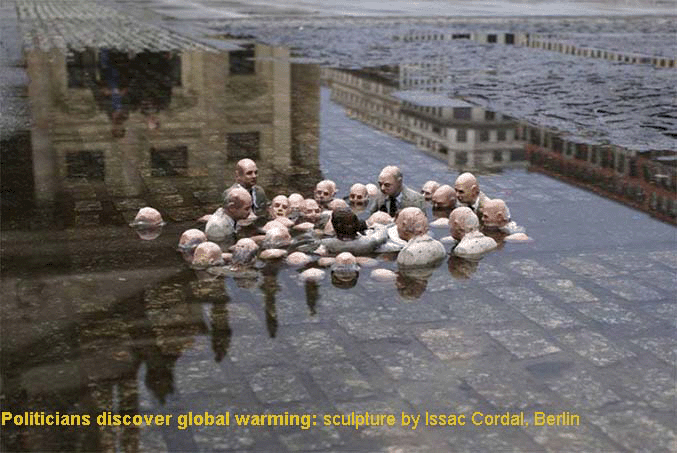
Patrick Greenfield, Guardian, 29 June 26
Last week’s extreme weather should galvanise the political response to global heating. But the sad paradox is that it could bolster support for climate-sceptical parties
You could be forgiven for thinking that last week’s heatwave in Europe would be a galvanising moment for action on the climate crisis. At one point, more than 150 million Europeans sweltered in temperatures above 35C (95F) – with several parts of the continent soaring past 40C. A heatwave of this magnitude has never been recorded this early in the year.
When scientists finish their calculations, the death toll will probably number in the thousands. Spain, one of the few countries that produces real-time statistics on excess deaths linked to heat, has recorded more than 100 per day since Wednesday. French authorities said that at least 1,000 additional deaths had been recorded between 24 and 27 June, a figure that is likely to rise. They include four toddlers who died in incidents linked to the heat. A three-year-old boy in a Paris suburb was found dead last week after climbing into a car and becoming trapped.
There is a miserable inevitability surrounding these events: scientists have long warned they were coming. Yet countries have not done enough to cut the emissions from fossil fuels that are causing the extreme weather – or adapt to the realities of managing the toll on their transport and healthcare systems.
For today’s First Edition, I spoke with Ajit Niranjan, the Guardian’s Europe environment correspondent, about whether this week’s heatwave in Europe could prompt a fresh drive for action on global heating or whether it may, counterintuitively, boost support for political parties that are sceptical about the climate crisis. But first, the headlines.
…………..Europe heatwave | Germany, Czechia, Poland and Hungary reached record temperatures of more than 40C on Sunday as a heatwave linked to hundreds of deaths in western Europe spread east.
…………..The arrival of extreme weather in Europe has been quick. It is the world’s fastest-warming continent, heating up at twice the rate of the rest of the planet. In the 1950s, 60s and 80s, there was not a single “tropical night” recorded at the London Heathrow weather station – defined as when the night-time temperature does not fall below 20C. Now, they are common: four in a row were recorded last week, according to the popular weather blogger London & Southeast.
The UK and other European countries are unprepared for these conditions and the immense strain they put on health and travel networks. In the UK, hundreds of schools closed early, workplaces overheated, and train operators asked people not to travel. On Wednesday, the London ambulance service recorded its busiest ever day for the most serious category of callouts, with 642 responses to reports of cardiac arrests, patients who have stopped breathing and life-threatening injuries. Just two days later, the record was broken again, with more 999 calls made than ever before, more even than during the Covid-19 pandemic.
By yesterday, the heatwave had moved east. Poland, Czechia and Slovakia were all expecting record temperatures of more than 40C. Bautzen in in eastern Saxony broke the German re
A boost for the far right
Sometimes, climate-driven weather events can temporarily cut through, says Ajit, pointing to the 2021 floods in the Ahr valley in Germany, which killed 188 people and washed away entire villages. But increasingly, the opposite happens.
“One trend that’s possibly the most counterintuitive about these kinds of moments is that far-right parties who are denying the science of climate change can get a bit of a boost from extreme weather events,” says Ajit. “They spin the extreme weather as a failure of government policy, arguing that focusing on climate change was part of the initial problem, and it is more about mismanagement.”
In many cases, such as the 2024 floods in Valencia, when more than 230 people were killed after a year’s worth of rain fell in eight hours to parts of eastern Spain, both things are true: the climate drove the extreme weather, but poor governance contributed to the deadly outcome. This is likely to become an increasingly common dynamic as extreme weather events grow in frequency.
“Both sides of this issue need to be addressed,” says Ajit. “There is this weird tendency where political parties completely deny one of the causes by either focusing just on climate or just on adaptation, without having a good plan for the other. This is certainly a part of the strategy used by far-right parties to bash climate policy,.”
‘Extreme’ weather having ‘significant impact’ on Kent’s nuclear power stations

Mary Harris Senior Reporter, Kent Live, 26 Jun 2026
“Extreme” weather is hitting Kent’s two nuclear power stations, but the Government said it was “not an issue for nuclear safety”. Dungeness has two power stations, next to the coast on Romney Marsh, and the committee on radioactive waste management spent a day there.
The visit was part of the committee’s scrutiny of such facilities across the UK. After its visit, the committee has said today (June 26): “Both reactor facilities are highly exposed to weather conditions, and it is an area where these conditions can be extreme.”
Dungeness, Romney Marsh and Rye Bay have the designation of a special protection area, and the area is of international importance, for its topography, i.e. the area’s physical features, along with its plant and invertebrates, the latter being animals without a backbone or skeleton, such as spiders, worms, snails, lobsters, crabs and insects like butterflies.
The power stations here are rather unimaginatively called Dungeness A and Dungeness B, with A connected to the grid in 1965. It had two reactors which stopped operation on December 31, 2006.
The reactors were designed to operate for 25 years but lasted far beyond this. For those after more detail, it was a “legacy Magnox” power station.
And B also had two reactors which started operating in 1983 and 1985. They were closed for maintenance in 2018, with an announcement three years later they would be moved to their “defueling phase”.
This one was an Advanced Gas-cooled Reactor (AGR), operated by EDF Energy. But their coastal location is having an effect on the structures, said the committee following its tour.
In feedback just published today, it said: “Both reactor facilities are highly exposed to weather conditions, and it is an area where these conditions can be extreme. Whilst it is not an issue for nuclear safety and security, during the tour, it was clear that the combination of high winds and its coastal location meant that salt-water was a particular challenge, with corrosion having a significant impact on infrastructure.”…………………………………..https://www.kentlive.news/news/kent-news/extreme-weather-having-significant-impact-11032284
1 This Month
23-25 October – on Zoom – World BEYOND War’s annual global conferenc


Shut down the radiation-damaged Heysham nuclear reactors now
To see nuclear-related stories in greater depth and intensity – go to https://nuclearinformation.wordpress.com

Say No to NASA’s Reckless Nuclear Reactor on the Moon
Say No to NASA’s Reckless Nuclear Reactor on the Moon

-
Archives
- October 2026 (247)
- September 2026 (339)
- August 2026 (330)
- July 2026 (355)
- June 2026 (287)
- May 2026 (306)
- April 2026 (356)
- March 2026 (251)
- February 2026 (267)
- January 2026 (308)
- December 2025 (358)
- November 2025 (359)
-
Categories
- 1
- 1 NUCLEAR ISSUES
- business and costs
- climate change
- culture and arts
- ENERGY
- environment
- health
- history
- indigenous issues
- Legal
- marketing of nuclear
- media
- opposition to nuclear
- PERSONAL STORIES
- politics
- politics international
- Religion and ethics
- safety
- secrets,lies and civil liberties
- spinbuster
- technology
- Uranium
- wastes
- weapons and war
- Women
- 2 WORLD
- ACTION
- AFRICA
- Atrocities
- AUSTRALIA
- Christina's notes
- Christina's themes
- culture and arts
- Events
- Fuk 2022
- Fuk 2023
- Fukushima 2017
- Fukushima 2018
- fukushima 2019
- Fukushima 2020
- Fukushima 2021
- general
- global warming
- Humour (God we need it)
- Nuclear
- RARE EARTHS
- Reference
- resources – print
- Resources -audiovicual
- Weekly Newsletter
- World
- World Nuclear
- YouTube
-
RSS
Entries RSS
Comments RSS

