Three nuclear reactors are shut down in France due to the heatwave
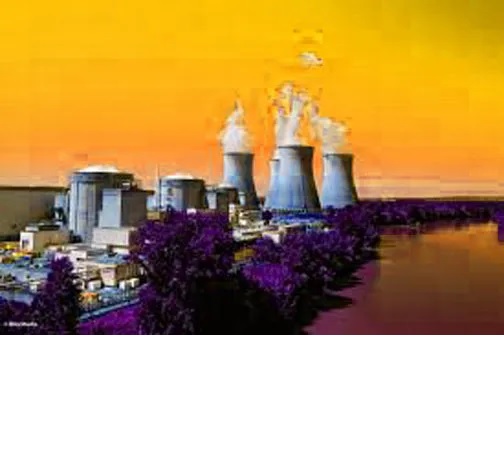
After the Golfech power plant (Tarn-et-Garonne), two other nuclear reactors were shut down, in Bugey (Ain) and in Nogent-sur-Seine (Aube).
25/06/2026 franceinfo with AFP, https://www.franceinfo.fr/environnement/evenements-meteorologiques-extremes/vagues-de-chaleur-canicules/trois-reacteurs-nucleaires-sont-a-l-arret-en-france-en-raison-des-fortes-chaleurs_8079206.html
The heatwave is impacting energy production. EDF shut down two
nuclear reactors on Thursday, June 25th.
(New window), at Bugey (Ain) and Nogent-sur-Seine (Aube), bringing to three the number of reactors shut down in France due to the high temperatures, after that of Golfech (Tarn-et-Garonne), while a unit at Saint-Alban must also reduce its production, according to a situation report sent to AFP.
Reactor number 3 at the Bugey nuclear power plant, located on the banks of the Rhône River, has been shut down since 9:00 AM, as has unit number 1 at Nogent-sur-Seine since 9:15 AM, due to
“external environmental factors” and in order to comply with the temperature limits for the Rhône and Seine rivers, EDF explains on its regulatory information website. The shutdowns or production reductions decided by EDF aim to meet environmental obligations to protect the flora and fauna of the rivers and streams that are used to cool the nuclear facilities.
Do not further warm the waterways
In the event of extreme heat, the rising temperature of these waterways can force EDF to reduce or even halt its production to avoid further heating them with its discharges of cooling water that is a few tenths of a degree to a few degrees warmer, depending on the site. The operation of France’s 57 reactors is subject to strict limits on the temperature increase of these waterways.
In the case of Golfech, which has been shut down since Monday, the river temperature must not exceed 28°C after discharges from the power plant. In Nogent-sur-Seine, “regulations stipulate that the temperature rise of the Seine must not exceed 3°C between upstream and downstream of the site, and that the average temperature must not exceed 28°C downstream.”
Covering the Impact of Climate Change—Without Mentioning Climate Change

despite leading their shows with severe weather headlines, nightly news shows on NBC, ABC and CBS failed to mention climate even in passing.
June 26, 2026, Olivia Riggio, https://fair.org/home/covering-the-impact-of-climate-change-without-mentioning-climate-change/
Severe weather has gripped the globe this week, with record-shattering, deadly heat in Western Europe. In the US, heat, wind and drought conditions fueled wildfires in the Southwest, while heavy thunderstorms, wind and floods caused destruction in eastern and central states.
Scientists attribute these extremes to fossil fuel–driven climate change. Europe’s heatwave would have been “virtually impossible to occur at this time of year” 50 years ago, scientists from the World Weather Attribution group reported. The project’s Theodore Keeping of Imperial College London told reporters (EuroNews, 6/26/26):
The science of how climate change is worsening heatwaves is settled…. Continued fossil-fuel emissions are directly responsible for the disruption people are experiencing this week in their homes, schools and workplaces.
With extreme weather events worsening each year, and the world on track to surpass by 2030 the Paris Agreement’s attempt to limit global heating to 1.5°C above pre-industrial levels, connecting these disruptive and deadly events to climate change is a key part of the story.
Yet on the evening of Tuesday, June 23, despite leading their shows with severe weather headlines, nightly news shows on NBC, ABC and CBS failed to mention climate even in passing.
Cropping out climate
Substitute anchor Hallie Jackson began the NBC Nightly News (6/23/26) by describing apocalyptic scenes around the globe:
Tonight, the dangerous triple weather threat with fires, floods and deadly heat affecting millions. The flash flood emergency here at home: Fast-moving waters trapping drivers and washing out roads. Wildfires exploding out West. Plus, overseas, a record-shattering heatwave in Europe leaving dozens dead.
The broadcast covered heavy rains in Oklahoma, wildfires in Utah and Nevada, and heat and fire in Miami disrupting World Cup events. In France, it was so hot, Paris shut down the Eiffel Tower Tuesday, and Wednesday was expected to reach a 102°F record. More than 40 people were believed to have drowned in France’s rivers and beaches while trying to escape the heatwave that began last week.
In London, NBC’s Danielle Hamamdjian reported record highs in the city on Tuesday, with even higher temperatures anticipated to come.
The broadcast then cut to a clip of UN Secretary General Antonio Guterres saying, “And today this city—and far beyond—are experiencing the hottest day of the year—with higher temperatures to come.”
The event that he was speaking at—London Climate Action Week—was not identified. In fact, a banner with the London Climate Action Week logo that was behind Guterres was cropped out of the shot. The soundbite NBC featured was excised from Guterres’ longer remarks about the severity of climate change and the critical necessity of quickly and justly transitioning from fossil fuels:
We have just lived through the 11 hottest years ever recorded. And today this city—and far beyond—are experiencing the hottest day of the year—with higher temperatures to come. London isn’t just calling—it’s cooking. Around the world, climate disasters are becoming more frequent, more destructive and more costly. And the World Meteorological Organization has warned we ain’t seen nothing yet. El Niño is not just knocking on the door. It risks blowing the house down. Turning up the heat. Disrupting food and water systems. And hitting the vulnerable the hardest. Ten years ago, world leaders agreed in Paris to limit global temperature rise to 1.5 degrees Celsius. Now scientists say average annual temperatures will exceed that threshold in the coming years.
Later in the speech, Guterres demanded that AI companies publicly disclose their energy usage and commit to powering data centers with renewables by 2030.
From a speech entirely about climate change and its tangible impacts, NBC Nightly News managed to cherrypick a soundbite of Guterres essentially saying nothing more than “it’s hot.” While the segment linked together these extreme weather events in Europe and the US as a global phenomenon, climate change didn’t even get a passing mention.
Records broken by unknown force
ABC World News Tonight (6/23/26) with David Muir followed suit. Raising the alarm about tornadoes and flood watches in the east, severe storm threats in Texas, Oklahoma, Colorado and Wyoming, extreme heat in the southwest and heatwaves in France, England, Italy and Spain, the broadcast didn’t mention the word “climate” once.
“We’ve lived here for 20 years and I’ve never seen anything like this,” a Fairfax County, Virginia, man said of the winds and storms that sent trees into cars and homes in the area.
CBS Evening News (6/23/26) led with fires, droughts, floods and storms across the US, spotlighting Utah, where one wildfire was the size of San Francisco. “The outbreak follows the state’s warmest winter on record and one of the driest, with just a fifth of normal snowpack,” said host Tony Dokoupil.
In the next segment, correspondent Leigh Kiniry reported from London about record temperatures across Europe. Uniquely among the corporate networks’ evening newscasts, this report alluded vaguely to climate change, noting that “the continent is warming faster than any other.” But viewers were given no clue as to how or why: Direct mentions of climate change were nonexistent throughout the entire broadcast.
‘Not one government is making progress’
The lone exception to the erasure of climate change on the nightly news broadcasts was PBS NewsHour (6/23/26). While the show didn’t lead headlines with extreme weather, its segment about the European heatwave included a soundbite from a Paris resident expressing dissatisfaction with how governments have ignored climate change. “Paris when temperatures go high is just hell on earth,” she said:
It’s catastrophic. I’m worried for the coming years. We have known about climate change for a while, and not one government is making progress on this issue.
Later in the broadcast, PBS dedicated a segment to droughts in the Southern US affecting farmers in Georgia. The report was part of an ongoing PBS series called Tipping Point, which focuses on the impacts of climate change and communities’ efforts to adapt.
Rachel Cleetus of the Union of Concerned Scientists explained:
Climate change is making these more frequent, both the short-duration kinds of droughts that we’re seeing in some places, but also the longer megadroughts like the Southwest is experiencing. The unpredictability of it, the extremes, both the droughts and then the whiplash with extreme rainfall events, that makes it very difficult to plan for these kinds of conditions.
The report went on to describe precision irrigation systems as a possible mitigation—though noting that their cost is often prohibitive. The segment points to “policy steps worth considering,” like helping farmers obtain these technologies through grants and low-cost loans.
PBS deserves credit as the only nightly broadcast that mentioned climate change at all. But while it addressed the issue of adaptation, it avoided the more fundamental question of causation; the burning of fossil fuels, and its connection to the segment’s weather horror stories, wasn’t mentioned at all.
FAIR (7/18/23) has previously documented that even when TV news connects extreme weather events to climate change, it seldom connects climate change to fossil fuels—but the industry seems to have taken a step backward.
The lack of climate coverage in legacy media follows a trend media analysts have been tracking since President Donald Trump’s second term began. A Media Matters study (3/4/26) found that ABC, CBS and NBC aired 35% less climate coverage in 2025 than in 2024. A FAIR study (4/14/26) found that trend mirrored in online news. But as coverage decreases, climate change’s effects only increase in frequency and severity.
Bonn climate talks: Key outcomes from the June 2026 UN climate conference
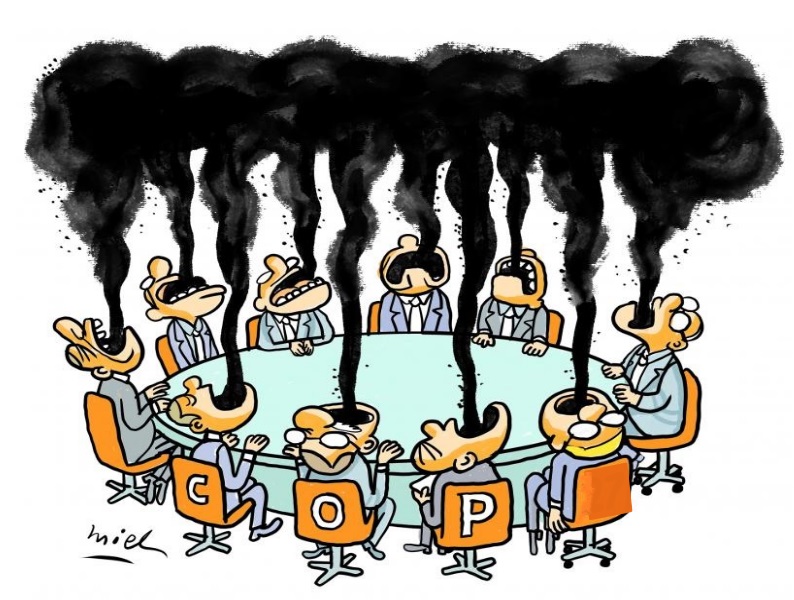
Carbon Breif, 19 June 2026
Two weeks of tense UN climate talks in Bonn, Germany, have produced few tangible outcomes as diplomats faced “gridlock”.
Negotiators failed to find agreement in numerous areas, such as scaling up global emissions cuts and funding for climate adaptation.
In the closing plenary, many diplomats lamented weakened trust in the UN climate process, as it struggled to find its footing in a new geopolitical landscape.
As ever, climate finance was one of the greatest sources of tension between developed and developing countries, influencing the debate around adaptation and trade in the Bonn talks.
Many countries criticised “coordinated attacks” on science by those with “fossil-fuel interests”.
Some delegates saw progress on a “just transition mechanism” to support communities through decarbonisation as a positive outcome, with a package of texts agreed for the COP31 climate summit in Antalya, Turkey.
Reporting from the talks in Bonn, Carbon Brief covers the key outcomes and disputes at the 64th biannual sessions of the UN Framework Convention on Climate Change (UNFCCC) subsidiary bodies (SB64).
- Adaptation
- Just transition
- Climate finance
- Global stocktake
- Mitigation work programme
- Action agenda and new initiatives
- Climate science
- Fossil fuels
- Trade dialogues
- COP reform
- Ocean dialogue
- Road to COP31
………………………………………………………………………………………………………………………………………………………………………………………………………………………. Road to COP31
Attention now turns to COP31, which will be held in the resort city of Antalya, Turkey.
…… COP31 is being promoted as an “implementation COP”, helping to “close the gap between multilateral commitments and real-world delivery”, according to its website.
However, the fraught negotiations in Bonn, including the lack of progress on key elements, mean the future effectiveness of climate summits is increasingly under question. …….
…………“In some negotiating rooms, we’ve heard a familiar tendency towards you-first-ism: Groups refusing to deliver commitments or allow the process to move forward unless others go first. This is a recipe for gridlock when we need all negotiating tracks to be moving in the fast lane.” – UN Climate Change executive secretary Simon Stiell ………..https://www.carbonbrief.org/bonn-climate-talks-key-outcomes-from-the-june-2026-un-climate-conference/
Climate change matters

by beyondnuclearinternational, https://beyondnuclearinternational.org/2026/06/21/climate-change-matters/
Environmental laws should be adhered to not abolished, says Diane Curran
For 45 years, I have represented environmental organizations and state and local governments in US Nuclear Regulatory Commission (NRC) licensing and enforcement proceedings, as well as in federal court. Today, more than ever, we need to talk about climate change.
I currently represent Beyond Nuclear and the Sierra Club in a case challenging the NRC’s refusal to consider how climate change may affect the safety and environmental integrity of nuclear reactors in initial licensing and license-renewal proceedings. The case has been briefed and argued in the D.C. Circuit, and we are awaiting a decision.
Climate change must be accounted for in reactor licensing because it challenges the NRC’s ability to ensure safe operation over the decades of a reactor’s operating license term. Weather-related hazards—including floods, hurricanes, tornadoes, derechos, wildfires, drought, and extreme heat and cold—are becoming more severe and more frequent. Assessing how those risks are likely to evolve over the operating life of a reactor is difficult, but it is essential to protecting public safety and environmental integrity. It is also essential to ensure reliability of the electricity supply.
Unfortunately, even before the Trump administration took office, the NRC has consistently declined to take a systematic approach to how climate change could affect the future safety of new and existing reactors undergoing licensing review. Instead, the agency has generally looked backward—preparing for the worst weather events in the historical record rather than assessing how climate-related risks may change over time. With respect to those prospectively changing risks, the NRC simply says that its safety oversight includes “large margins of error” and “defense-in-depth.”
We need look no farther than Hurricane Helene to see how quickly the lessons of the past and generalizations about safety margins can evaporate in the face of the unique and severe challenges posed by extreme weather events. No hurricane with such record-breaking rainfall had passed through the Appalachian Mountains before Helene. Flooding and landslides resulted in 250 deaths and between $80 and $250 billion in damages. Two years later, the region is still recovering.
Consider how much worse the effects of Hurricane Helene might have been had it passed about 25 miles west over of the three-reactor Oconee nuclear plant in the mountains of South Carolina. Oconee is a pump-storage plant, built into the side of an earthen dam beneath two lakes totaling about 2 million acre-feet of water. At the time the plant was built, dam failure was not viewed as a credible event warranting design features to protect safety equipment from inundation and failure. What if the effects of Hurricane Helene had included a radiological accident caused by failure of the dams above the Oconee nuclear plant? The devastation to human health and the environment would be almost unimaginable. But the NRC recently re-licensed Oconee to operate for a second license renewal term, refusing demands to consider climate change in its decision.
What can be done to close this dangerous and expensive gap in the NRC’s regulatory process? If the Atomic Energy Act were the NRC’s only governing statute, the public would have little chance of challenging the NRC’s refusal to consider climate-related risks on the ground that it posed an unacceptable risk to public health and safety. Because the NRC is the principal agency charged with carrying out the Act’s requirements, courts generally afford it broad discretion in how and when it does so.
But the NRC is also governed by the National Environmental Policy Act (NEPA). Although NEPA and its implementing regulations have been narrowed in recent years by Congress and the NRC, its core requirement remains intact: when an NRC licensing decision could significantly affect the human environment, the NRC must evaluate the risk and consider alternatives to avoid or mitigate it. NEPA does not dictate a particular outcome, but it does require the NRC to disclose and assess relevant information. And while courts still give the NRC some discretion in identifying and evaluating significant impacts, that discretion is more constrained than under the Atomic Energy Act.
We are hopeful that the D.C. Circuit will compel the NRC to address the safety and environmental implications of climate change in reactor licensing and license-renewal proceedings. But given the Trump administration’s public position on climate change and its policy of minimizing costs to the nuclear industry, we should not assume the NRC will produce a strong environmental analysis if we prevail.
Even so, a court victory would be significant in three important respects:
- It would establish the principle that climate change is real and must be addressed in reactor licensing. Members of the public could then invoke that principle with legislators, state regulators, and potential investors on specific nuclear projects.
- A favorable ruling would push future NRC leadership to incorporate climate change into licensing decisions.
- Even if the NRC’s analysis of climate-related accident risk were weak or flawed, state and local governments would be able to independently evaluate the NRC’s claims and decide for themselves whether to support a new reactor or a license-renewal project.
The Trump administration’s tenure is a discouraging time for anyone concerned about nuclear reactor safety and climate change. But Mother Nature does not read executive orders, and she will have the last word. In the meantime, NEPA remains a meaningful tool for forcing the NRC to reckon with the reality of climate change before great harm occurs.
Diane Curran is an attorney who litigates against the US Nuclear Regulatory Commission. This article is drawn from a presentation Curran made duriong a June 2nd briefing on Capitol Hill.
Australia’s coal and gas exports violate our human rights, group says in new UN case

Lana LamSydney, 23 June 26, https://www.bbc.com/news/articles/cn8q5nx6jw6o
A group of Australians have accused the government of violating their human rights by continuing to export coal and gas and are asking the UN to take action.
The group say their lives have been harmed due to extreme weather in Australia – bushfires, floods, heatwaves, rising sea levels and toxic algal blooms – and the government’s support of fossil fuel companies is to blame.
It is the first legal claim taken to an international body or court since 2025’s ruling by the International Court of Justice (ICJ) that countries can be sued over climate change.
Any decision by the UN is not legally binding but Australia – one of the world’s largest coal and gas exporters – would be expected to respond.
The BBC has contacted Environment Minister Murray Watt for comment.
Dr Barry Traill, a wildlife ecologist and volunteer firefighter, is one of the ten litigants.
In 2009, several of his friends died during the devastating Black Saturday bushfires in Victoria, despite being prepared and experienced, he said.
“That deeply changed me,” Traill said, and “it became clear that the old rules around fires and survival no longer applied”.
In 2019, he was on the frontlines battling severe blazes in Queensland during the so-called Black Summer fires where he saw that climate change was not a future problem.
“It is already killing people and hurting lives, landscapes and communities across Australia,” he said.
“Continuing to allow coal and gas companies to increase pollution, while people face worsening disasters, is a profound failure of responsibility.”
Brendon Donohue has also joined the legal claim, describing how he was trapped in his home for 10 days in 2022 when floods in Brisbane damaged the power supply of his apartment block, meaning the lifts, intercom and exits were not accessible.
“Because I live with blindness and mobility challenges, climate impacts affect me differently and can make everyday life much harder to navigate safely,” he said.
Another case is that of Prof Anne Poelina, an Indigenous woman from the Kimberley region in Western Australia, who describes being displaced from the area around the Fitzroy River, one of the state’s most important waterways, because of catastrophic flooding.
“When the river is healthy, our people are healthy,” she said, and “when the river suffers, our people suffer.”
“What concerns me most is the intergenerational loss of cultural knowledge,” she added as “so much of our knowledge is not written down”, but passed on by being physically present on the land.
“They are asking the United Nations Human Rights Committee to declare that it’s unlawful for Australia to continue approving and subsidising coal and gas for export without a plan to protect people from dangerous climate change,” said Hannah White, senior lawyer with Environmental Justice Australia.
Last July, the ICJ – considered the world’s highest court with global jurisdiction – ruled that countries can sue each other for climate change, including over historic emissions of planet-warming gases.One of the lawyers helping the group with their claim said that “climate harm caused by Australia’s coal and gas doesn’t stop at a border, and neither does Australia’s responsibility for it”.
France tries to cope with second premature heatwave in less than a month

19/06/2026 – https://www.france24.com/en/france-tries-to-cope-with-second-premature-heatwave-in-less-than-a-month
France is in the grip of a heatwave, which Météo France expects to be “wisdespread, prolonged and intense”. The thermometer is set to climb even higher in the coming days, reaching or exceeding 40°C on June 21, leading to several municipalities to cancel Fete de la Musique celebrations. The state-owned utility EDF has also warned that three nuclear plants face production curbs next week because of high temperatures on the Rhone and Garonne rivers.
High French river temperatures expected to limit nuclear power output next week
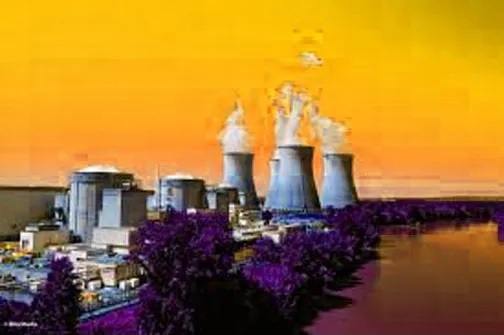
By Forrest Crellin and Tristan Veyet,
French state-owned utility EDF warned on Thursday that three nuclear
plants face production curbs next week because of high temperatures on the
Rhone and Garonne rivers as France grapples with its second heatwave this
spring. Nuclear output in France has been relatively consistent this year
as production has continued to recover from lows hit several years ago, but
exceptional heatwaves at the end of the northern hemisphere spring have
raised water temperatures to levels that put reactors at risk of output
curtailment.
Reuters 18th June 2026
Science ‘under attack’ from fossil fuel interests at UN climate talks
A coalition of some rich nations and the world’s most vulnerable have vowed to protect climate science in UN negotiations
Matteo Civillini, Joe Lo, 17 June 26. https://www.climatechangenews.com/2026/06/17/science-under-attack-from-fossil-fuel-interests-at-un-climate-talks/
Dozens of countries have called out growing “coordinated attacks” by fossil fuel interests aimed at undermining the role of climate science in the UN negotiations at the mid-year talks in Bonn.
Under the banner of ‘Friends of Science’, in an overflowing press conference room lined with negotiators and civil society supporters, diplomats from Fiji, Nepal, the European Union, Switzerland, Sierra Leone and Panama vowed to ensure that decision-making in the UN climate process remains based on the “best available science”. That includes reports from the Intergovernmental Panel on Climate Change (IPCC), the UN’s climate science body, they said.
While steering clear of singling out any specific country, they said efforts to cast doubt on established scientific concepts, such as the 1.5 global warming limit, are led by “the usual suspects” and those who think “science threatens their economic prospects”.
Saudi Arabia and India have opposed calls in draft texts to encourage scientific work on scenarios that would minimise the magnitude and duration of any overshoot of 1.5C, according to one negotiator in the room and summaries of closed-door discussions published by a reporting service.
UN chief António Guterres conceded last year that a temporary breach of the key warming limit is inevitable, while urging countries to redouble efforts to bring temperatures back down.
‘Polluted narrative’
Share:
- X (Twitter)
Dozens of countries have called out growing “coordinated attacks” by fossil fuel interests aimed at undermining the role of climate science in the UN negotiations at the mid-year talks in Bonn.
Under the banner of ‘Friends of Science’, in an overflowing press conference room lined with negotiators and civil society supporters, diplomats from Fiji, Nepal, the European Union, Switzerland, Sierra Leone and Panama vowed to ensure that decision-making in the UN climate process remains based on the “best available science”. That includes reports from the Intergovernmental Panel on Climate Change (IPCC), the UN’s climate science body, they said.
While steering clear of singling out any specific country, they said efforts to cast doubt on established scientific concepts, such as the 1.5 global warming limit, are led by “the usual suspects” and those who think “science threatens their economic prospects”.
Saudi Arabia and India have opposed calls in draft texts to encourage scientific work on scenarios that would minimise the magnitude and duration of any overshoot of 1.5C, according to one negotiator in the room and summaries of closed-door discussions published by a reporting service.
UN chief António Guterres conceded last year that a temporary breach of the key warming limit is inevitable, while urging countries to redouble efforts to bring temperatures back down.
‘Polluted narrative’
Scientists have long established that burning fossil fuels is the primary cause of man-made climate change and a rapid shift away from oil, coal and gas is essential to curb global warming.
Saudi Arabia is dependent on oil and gas exports, while India largely relies on coal to power its economic development.
One negotiator said that research on how climate action can be equitable for developing countries, produced by Indian universities, had been published too late to be incorporated into the last IPCC assessment report in 2023. This incident led the Indian government to try and discredit the IPCC, they said. Some Indian scientists have argued that the IPCC’s scenarios are unfair on developing countries.
Saudi Arabia and India have played down the importance of making sure that the latest IPCC assessments – regarded as the gold standard of climate science – are available for the next global stocktake, the UN scorecard of climate action around the world.
“Anyone that is blocking references to science – they are not our friends,” Sivendra Michael, lead negotiator for Fiji, told a press conference, highlighting the rise of a “polluted narrative” both inside and outside the negotiating rooms.
1.5C is a ‘hard limit’
Speaking for the AILAC coalition of Latin American countries, Panama’s Ana Aguilar said they went to Bonn to negotiate positions, not to negotiate the facts laid out by science.
“We see coordinated efforts to cast doubt on the best available science driven by a narrow set of interests, not by the needs of our people,” she added. “We have seen this playbook before… manufacture doubt, delay the response and let the vulnerable people pay this bill.”
The ‘Friends of Science’ coalition stressed that the 1.5C goal of the Paris Agreement cannot be negotiated, as the survival of the most climate vulnerable communities is at stake if it is permanently breached.
“Science tells us that 1.5C is a hard limit for many countries, including the small island developing states and least developed countries,” said Manjeet Dhakal, a negotiator for Nepal. “We still have a chance to keep 1.5 degrees in reach and minimise the overshoot if we act fast and drastically.”
Long-running IPCC standoff
While diplomats claimed attacks on science are broadening, one long-standing issue of contention is whether the latest assessment reports of the IPCC will be ready in time for the next UN global stocktake due to start this November and end in 2028.
This matters because, as some experts have pointed out, previous IPCC findings played a key role in the first such exercise, which culminated at COP28 in Dubai in the landmark agreement on transitioning away from fossil fuels in energy systems
The IPCC, which works with academics worldwide, publishes its comprehensive scientific assessment reports every five to seven years. The process for the last one, AR6, lasted around seven and a half years. The seventh assessment cycle, AR7, began in July 2023, but a political battle over the timing has dragged on for over two years at successive IPCC meetings, with governments repeatedly failing to find a solution.
A large majority of nations have been pushing for an accelerated timeline that would ensure the AR7 reports can be fed into the UN’s global stocktake. But a group of countries, including Saudi Arabia, India, China, Russia and Kenya, have said at previous IPCC meetings they want a longer process, arguing a fast-tracked assessment would put a burden on developing countries with limited resources.
Science and the stocktake
That fight has now bled into the Bonn talks where governments began discussing the arrangements for the next stocktake. At a session earlier this week, most developed countries, Latin American and small island states, and the world’s poorest nations emphasised the assessment of collective climate action must be guided by the “best available science” – code for the findings of the IPCC reports.
The Maldives, speaking for small island states, said IPCC science remains “essential to the integrity, credibility and usefulness” of the stocktake. AILAC said that starting the process “on the right footing” requires a political decision on the timeline to deliver the AR7 reports in time. Switzerland said IPCC reports “ask more than is politically comfortable, but that is precisely why they must guide every decision we make”.
Saudi Arabia, however, said no particular scientific input – and in particular what comes out of the IPCC – should be prioritised. Similarly, India warned against creating “some kind of preferred hierarchy” in the role that any specific source of information should play in the process.
Ghana’s Antwi-Boasiako Amoah, who chairs the African Group, told a press conference on Tuesday that some countries think rushing to get IPCC inputs into the global stocktake could “undermine or compromise the IPCC process”. “Africa is for science,” he said, without saying where the continent stands on the IPCC timeline.
Crunch talks in October
At the “Friends of Science” press conference, Dhakal pushed back on the idea that science would have to be rushed to be incorporated. He said the IPCC leadership has “perfectly made it clear” that they can deliver the report before the global stocktake. “It is the scientists who are saying they can deliver it on time,” he said.
The discussion will be picked up again at the next IPCC session in October, where its boss Jim Skea is hoping to reach an agreement. “As a scientist myself, I cannot overstate the importance of this decision,” he told governments in Bonn last week.
Andreas Sieber, head of political strategy at campaigning group 350.org, told Climate Home News that the debate may sound procedural, “but it is anything but”. “Science is the backbone of the Paris Agreement ambition cycle, and the evidence assessed through AR7 will help determine not only the emissions pathways countries pursue, but also how the world responds to mounting climate losses and who receives support,” he said in Bonn.
Amoc collapse could change Europe’s climate 10x faster than expected. We aren’t ready
Penny Holliday, Femke de Jong and Sjoerd Groeskamp, Sun 14 Jun 2026
The system of ocean current that moves heat in the Atlantic Ocean plays a key role in regulating climate. Today’s monitoring of it may be discontinued.
Imagine we detect a large asteroid heading straight for Earth. We are able to intervene and prevent disaster, but instead we cut the funding needed to track it. A few million dollars, it was argued, was too expensive to have a chance to save society.
While this scenario isn’t real, the metaphor is alarmingly accurate. In Europe, we spend €1bn to monitor space for asteroids, even if the actual risk of a civilisation-ending asteroid strike is close to zero.
But governments don’t commit to spend a fraction of that amount to adequately monitor a threat that is more imminent, more likely, and located here on Earth: a major change in the Atlantic Meridional Overturning Circulation (Amoc).
The Amoc is a vast system of ocean currents that moves heat from the south to north in the Atlantic Ocean, thereby playing a crucial role in regulating global climate upon which modern civilisation is built – from agriculture, through infrastructure to health, prosperity and culture. Changes in Amoc can affect food security, coastal flooding, storms, energy demand, migration, infrastructure planning, etc.
Under current climate change, the Amoc is projected to weaken enough to radically change the weather and cause sea level rise in Europe. However, there is little consensus on when and how fast this will occur. Projections of the future Amoc vary between climate models, and while scientists continue to improve the ability of models to represent the real ocean, progress is hampered by insufficient understanding of the physics of the Amoc.
Consequently, this complicates matters for policymakers to implement adaptive strategies to reduce financial loss and impact on human lives. It is even more astonishing, then, that today’s minimal monitoring of the Amoc, our best hope of understanding what lies ahead, is now under acute threat of being discontinued. This will leave us unaware, unprotected and unprepared.
Worse, there is potential for Amoc weakening to become a collapse. In that specific scenario, Europe would experience climate change up to 10 times faster than today. Considering that current climate change is already hard to keep up with as a society, we can’t begin to imagine what impact an Amoc collapse could have on our daily lives.
Further confusion is sown by an avalanche of new studies that bring a different interpretation of whether the Amoc has already weakened. This is because many new studies are based on approximations of Amoc strength that attempt to fill a gap caused by the lack of past direct measurements, for example by using historical sea surface temperature data.
The subsequent scientific debate may appear like disagreement, but it is really reflecting high levels of uncertainty because of the scarcity of data.
Underlying these high levels of uncertainty is the absence of long-term Amoc observations that allow us to describe past changes and understand how the Amoc works. We are in a situation where are trying to understand a planetary-scale system with very little direct observation.
Systematic monitoring of the Amoc began only two decades ago when a handful of visionary researchers in different countries patched together individual nationally funded research projects within the competitive science domain.
Yet, these measurements are now a benchmark for climate models and have critically improved our understanding of the Amoc. The extreme vulnerability of funding for Amoc observing has been confirmed by a recent assessment that showed how funding issues have already reduced Amoc observing capabilities.
Several Amoc monitoring initiatives are at a risk of being defunded and could be discontinued at any moment. While we can’t go back in time to do more observations, we can improve our observation strategy for the future.
Instead, the Trump administration has proposed budget cuts to Nasa, Noaa and NSF – agencies that together provide about 50% of the total Amoc monitoring budget. Last week the US announced the descoping of the Ocean Observing Initiative which was part of a programme observing the Amoc.
The recently launched European OceanEye initiative has allocated €50m for ocean observations and is a great incentive to continue Amoc observations. However, before OceanEye is up and running, the research vessels that service the present-day observing systems will already have to be financed, planned and packed.
In short: monitoring, understanding and forecasting the Amoc is at risk. Without sustained Amoc observations, we cannot know what lies ahead. An Amoc collapse may be imminent, a century away, or, if we act boldly to limit climate change, it might be averted altogether.
For too long, understanding and monitoring the Amoc was viewed as an academic pursuit. Instead, it should now be treated as what it truly is: an urgent, global priority. There is an acute and essential need to construct an alternative international funding strategy to secure long-term Amoc monitoring that realises a robust, continuous and open-access Amoc monitoring program to provide the knowledge to build a safer and more resilient world.
The cost of all Amoc monitoring adds up to about €25m a year. Meaning that for five cents per person per year, the EU can maintain one of the world’s most important climate monitoring systems that affects our everyday lives and improves resilience to the climate crisis.
We therefore urge the EU, the UK and other international partners to step up, make haste, get organised and collaborate to assure long-term continuation of Amoc monitoring before it is lost.
Penny Holliday is chief scientific officer of the National Oceanography Centre and has been researching ocean circulation for 30 years- Dr M Femke de Jong is senior scientist at the Royal Netherlands Institute for Sea Research (NIOZ) and has been researching the Atlantic circulation for 23 years
- Dr Sjoerd Groeskamp is senior scientist at the Royal Netherlands Institute for Sea Research (NIOZ) studying ocean physics and thermodynamics
Record winter temperatures in Antarctic raise fears over speed of climate breakdown

Temperatures above 15C ‘very strange’ say scientists, as snow melts and rain falls on glaciers in usually frozen region
Jonathan Watts , 11 June 26, https://www.theguardian.com/environment/2026/jun/10/record-winter-temperatures-in-antarctic-raise-fears-over-speed-of-climate-breakdown
Temperatures in the Antarctic climbed above 15C this month, shattering the previous winter heat record for the usually frozen region and raising concerns about the speed of climate breakdown.
The new winter peak temperature was logged by the Argentinian Esperanza base on the Trinity peninsula on 6 June amid a protracted heatwave, when the maximum daily temperature exceeded zero degrees for three consecutive weeks.
Scientists said the high of 15.4C broke the previous record set at the same station in 1998 by 2C. “This is absolutely crazy,” said Raúl Cordero, an Ecuadorian climate professor at the University of Groningen. “It is also about 20C above normal for this time of the year. That is a huge anomaly.”
Unusually strong warm winds from the north blew across much of the Antarctic peninsula. One Chilean weather station, Boonen Rivera, registered temperatures of close to 13C, Cordero said.
On King George Island, 100 miles (160km) from Esperanza, researchers said the landscape had changed from mostly white to brown, grey and green after temperatures hit 4.6C on 6 June.
“Last weekend was very strange. The temperatures here went very high so everything outside melted,” said Luis Muñoz, a Chilean glaciologist. “Usually there is 20cm of snow and a lot of ice on the ground at this time.”
Muñoz said he and a colleague, Natalia Mestre, climbed to the 500-metre peak of the nearby Collins glacier last Wednesday and were surprised to find rain melting the ice. “There was a direct impact on the glacier, which should be receiving snow now. It should not be suffering ablation at this time of the year. This is obviously not good for the glacier.”
The Antarctic region is coming under increasing human pressure, directly in the form of resource exploration and tourism and indirectly through the burning of fossil fuels, which is heating the planet.
Scientists warn that some of the region’s biggest glaciers, such as Thwaites and Pine Island, are approaching or may even have passed a tipping point that could push up global sea levels by four metres. Antarctic ice melt has also been found to slow global ocean circulation.
Cordero said a single winter of heatwaves, no matter how amazing, would not by itself make a huge difference to sea levels, but it signified more alarming long-term trends. “This heatwave happened because of extremely strong westerlies,” he said. “This has been happening with increasing frequency since the 1980s, and that is known to be related to climate change.”
A nuclear war between India and Pakistan could destroy the ozone layer
Climate models suggest a small nuclear war in the tropics would do even more damage to the ozone layer than a larger nuclear war in more northerly latitudes, increasing exposure to dangerous ultraviolet radiation all over the world
By Michael Le Page, 10 June 2026,
https://www.newscientist.com/article/2529589-a-nuclear-war-between-india-and-pakistan-could-destroy-the-ozone-layer/
A nuclear war would not only trigger a nuclear winter, but also severely damage the ozone layer, making recovery even harder. Now, a study has shown that a relatively small nuclear war between India and Pakistan could do just as much damage to the ozone layer as a larger nuclear war between the US and Russia.
“We want to emphasise that even a small-scale nuclear war can produce far-reaching global side effects beyond the conflict regions,” says Zhihong Zhuo at the University of Quebec in Montreal.
A nuclear war would devastate the areas where bombs or warheads explode, with the explosions, heat and radiation potentially killing many millions directly. The explosions and fires would be so large that huge quantities of smoke would be pumped into the atmosphere, blocking sunlight and causing global temperatures to plummet – a nuclear winter.
“There’s strong surface cooling in the first several years,” says Zhuo, who presented her team’s results at a meeting of the European Geosciences Union in Vienna last month.
For instance, a 2007 study estimated that a billion people could die of starvation as a result of a nuclear winter caused by a war between India and Pakistan.
Recovery from a nuclear winter would be delayed by damage to the ozone layer in the stratosphere that blocks harmful ultraviolet light – volcanic eruptions and even large wildfires can also damage the ozone layer. High UV levels can harm plants as well as animals, meaning lower yields from farming even as temperatures recover.
Recent studies with advanced climate models suggest the extent of ozone damage after a nuclear war has been underestimated. So, concerned by the many conflicts around the world, Kuo and her colleagues decided to look at the possible consequences if one went nuclear. Drawing on estimates from previous studies, they modelled an India-Pakistan nuclear war that would release 5 million tonnes of soot into the atmosphere and a US-Russia war releasing 16 million tonnes. Unlike previous studies, they also took into account other pollutants such as organic carbon.
Their climate model suggests that air circulation patterns in the tropics would allow the pollutants from an India-Pakistan war to rise higher into the atmosphere, stay there longer and spread more widely around the world.
“The upward transport is stronger for the tropical cases,” Kuo says. So although the quantities of pollutants are smaller than from a US-Russia war, the effects on the ozone layer are actually greater.
The damage to the ozone layer would be greatest over the poles, similar to the situation caused by ozone-damaging pollutants known as CFCs. But there could be an increase in UV levels of up to 30 per cent even in tropical areas, the model suggests, with serious impacts on the health of people and wildlife.
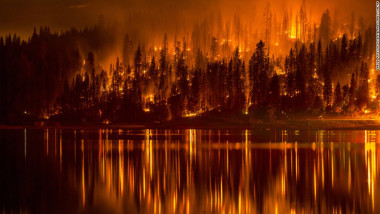
Wildfires devastating richer areas but fewer hectares burned globally – study
Ajit Niranjan, June 26, https://www.theguardian.com/world/2026/jun/01/wildfires-devastating-richer-areas-but-fewer-hectares-burned-globally-study
‘Megafires’ in California, Canada, South Korea and Europe in 2025, but changes to farming slowed spread in parts of Africa.
“Devastating” wildfires ripped across the wealthier parts of the world in 2025, a study has found, even as globally, the area ravaged by flames fell.
Catastrophic blazes claimed lives, homes and jobs last year in California, Canada, Europe and South Korea. But the 335m hectares burned was the second-lowest since 2002, the review found, largely owing to the expansion of African farms that have fragmented landscapes and hampered the spread of large savannah fires.
The disasters in 2025 included a Scottish “megafire” that torched more than 100,000 hectares – contributing to the UK breaking its record for burned area – and the Palisades and Eaton fires in Los Angeles, which were among the most destructive in US history.
Record-breaking blazes in Spain and Portugal burned more than half a million hectares, while South Korea had its biggest and deadliest wildfire season on record.
Fires accounted for more than 38% of insured losses from weather disasters in 2025, the study found.
“2025 shows that a ‘quiet’ fire year globally can still be devastating,” said Matthew Jones, a climate scientist at the University of East Anglia and lead author of the study. “We are seeing a growing disconnect between total area burned and real-world impacts.”
Changes in land use mean wildfires burn less of the planet than they have historically done, but global heating is creating conditions allowing them to spread, increasing the danger at what researchers call the wildland-urban interface, where people are most at risk.
Adverse weather, inflamed by carbon pollution, turned some of last year’s fires into explosive infernos.
In southern California and South Korea, the researchers found, high winds and dry vegetation pushed fires through densely populated areas, causing “exceptional mortality, mass evacuations, and major infrastructure losses”. In the Mediterranean, meanwhile, drought and extreme heat drove severe blazes, from Portugal to Turkey.
“These conditions do not cause the fires, but in the event of a fire, we have material that is more flammable than usual – because it is drier – and wind conditions that fan the flames,” said David Garcia, an applied mathematician at the University of Alicante, who was not involved in the study. “This makes large fires more likely to occur.”
An attribution study Garcia co-authored last year found the extreme weather fuelling the flames in Portugal and Spain last year was made 39 times more likely by climate breakdown. “If we continue to warm the planet, large-scale fires will continue to increase,” he said.
The overall reduction in global burned area led to a drop in carbon dioxide emissions to their third-lowest level on record.
In Canada, though, extreme wildfire emissions were recorded for the third year in a row. Since 2023, boreal forests in North America have emitted close to 4bn tonnes of CO2, exceeding the total emissions of the preceding 15-year period.
As well as heating the planet, the pollutants in wildfire smoke lead to huge numbers of people dying from breathing dirty air. The toxic particles spewed by Canadian wildfires in 2023 killed 82,000 people, according to a study published in September, with smoke even choking cities in the US, Europe and Africa.
Adrián Regos, a landscape ecologist at the Biological Mission of Galicia, Spain, who was not involved in the study, said last year’s events illustrated how a relatively small number of extreme fires could dominate the ecological, social and economic consequences of an entire fire season.
“The broader pattern highlighted by this study is consistent with what we are observing across southern Europe: while total burned area may fluctuate from year to year, climate change is increasing the likelihood of extreme fire-weather conditions, and fuel accumulation associated with rural abandonment is making many landscapes more vulnerable to large, fast-moving fires,” he said.
“The challenge is therefore not only reducing the number of fires, but increasing the resilience of landscapes and communities to extreme events.”
Extreme Heat Headlines Obscure The Scale Of The Crisis
Nate Bear, May 29, 2026, https://www.donotpanic.news/p/extreme-heat-headlines-obscure-the
It’s been record hot in parts of Europe and Asia over the last week and this has provoked an outburst of three things that have become de rigeur whenever this happens:
- Climate change scepticism
- Exclusive focus on heat by legacy media
- Divorced context
The first one is baked in to the conversation, you might say, if you were reaching for an appropriate metaphor. And normally I’d not be that bothered. But I’ve been seeing more of it across my social media, especially on Twitter/X, and the explanation I think is two-fold.
Firstly, and most obviously, Musk and Nikita Bier, the guy in control of the algorithm, boost right-wing accounts by policy, which means scepticism and denial at moments of climate extremes become more visible, given these positions tend to be rightist in nature. Secondly, despite my leftist politics, my anti-Zionism and pro-Palestine writings have attracted people who approach anti-Zionism from a more right-wing, pro-sovereignty, pro-nationalist perspective. These people, my intuition tells me, put climate change and Zionism in the same bracket – as a mainstream, elite-led “narrative” to be rejected. As such I’ve been seeing some of these accounts, who I agree with on Israel, Palestine, imperialism and Zionism, in my feed posting content and takes sceptical of climate change.
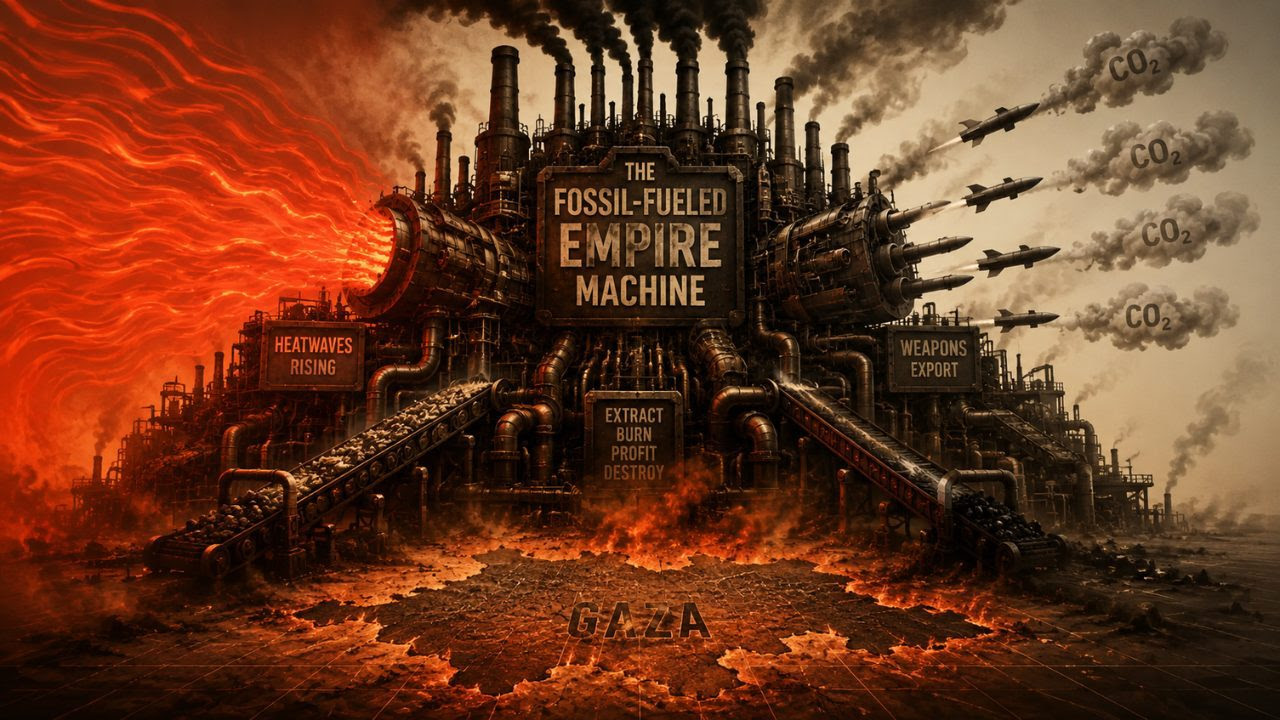
To me, this is not a coherent politics. Zionism and a heating planet grow from the same root. Imperialism is a fuel source for climate change, and anti-imperialism cannot be separated from ecological destruction. The Pentagon is the single biggest institutional emitter of greenhouse gases, burning more fossil fuels annually than entire countries like Portugal, Sweden and Denmark. An empire which projects global power and launches missiles thousands of miles from its shores to impose its violent will on the world could not survive without fossil fuels. Which is why, among many other reasons, Trump, and US empire historically, have loved oil so much.
In the first 15 months of the genocide in Gaza, Israel burnt more fossil fuels than Estonia and Costa Rica burn in a year combined.
Now it’s been more than two and a half years, the ecological cost to the atmosphere of genociding Gaza and mass murdering Palestinians will be equivalent to the pollution necessary to power the lives of tens of millions of people. But instead of using fossil fuels to provide the necessities of life, Zionism uses fossil fuels on a massive scale to end lives. Zionism kills Palestinians as a first order effect, and then boosts the heatwaves that cause death and suffering years later.
That brings me to number two.
A heating planet is just one outgrowth of the current global system, yet far too often legacy media ignores the vast scale of the ecological crisis to focus narrowly on climate change. And this is where an argument for climate as a narrative can be made, but it’s not the argument made by those who scorn it as a tool to provoke fear and impose control. If climate change is pushed as a narrative, it’s because an easy solution can be sold within the existing confines of globalised neoliberal capital. A transition to solar and wind, fuelled by mega-mining companies blasting the holes and digging up the minerals which are transported by the mega-shippers, the market lubricated by metals traders, with the profits captured by the energy giants.
Crucially, in this telling of the crisis, nothing really has to change. On the contrary in fact. In this telling, capitalist growth policies become essential to combating climate change.
The root of climate change as a mainstream narrative is better understood then as seeded in and growing out of imperialist-capitalist relations, not conspiracist adjacent globalist plots.
Which brings me to complaint number three.
If the crisis is understood not just as a climate crisis but as a whole-system ecological crisis underpinned by the existing system of globalised neoliberal capital, no easy, sellable solutions can be proffered. If our ecological predicament is understood as encompassing greenhouses gases, plastic pollution, ocean acidification, nitrogen pollution, tropical forest destruction, ozone depletion and species extinction, the story of the crisis becomes far harder to tell as a soundbite. If ecological damage is assessed not just in terms of extreme heat but in terms of an integrated system under a multi-faceted assault, the breadth and scale of the problem quite obviously defies any singular, energy source-focused solution.
Taking the crisis as a whole would require a discussion which slays sacred capitalist cows, confronts elite power structures and concludes with the necessity to completely reshape not just energy systems, but many of the systems which drive our civilisation. It would require serious policies that reject global capital and move us towards sustainable, local systems that benefit communities not oligarchic structures and corporate entities, whether that be in energy, farming, tourism or trade.
Here’s the unifying kicker: a politics of true global sustainability would require the same kind of revolutionary thinking and action that would also end imperialism and Zionism.
In conclusion, yes, the world is heating up, and that’s because of the extraordinary increase in the rate at which carbon dioxide is being released from burning fossil fuels. And yes, this heating will have to stop or lots of people will die and the system will collapse. But fossil fuels can be used usefully or badly, and the externalities of their burning (the heat trapping pollution) can be more, or less, worth the cost of burning them.
Genocide, conquest and imperialism are vile and depraved ways to use any energy resource, let alone a non-renewable one that has planetary effects long into the future.
To be honest, I may have written this article for an audience that doesn’t exist. But I have been frustrated for a long time now with how ecological collapse has been so divorced from the majority of anti-imperial thought. I think that is also partly to do with a belief that imperialists weaponise climate change to demonise, for example, China’s use of coal or Venezuela’s use of its oil revenues (now of course captured by empire).
I understand this perspective, and imperialist media definitely does this.
But that isn’t a reason to pretend basic physics is wrong or to write off climate change as a conspiracy or a globalist plot.
It’s a reason to think more deeply about how and why climate change is presented to us as a problem in the way that it is, not a reason to doubt whether it is a problem at all.
Global heating is making hajj ever more dangerous, report finds

Global heating has “fundamentally altered” the climate of Mecca and is
exposing millions of hajj pilgrims to extreme and dangerous heat even in
months outside summer, new analysis has found.
Carbon dioxide emissions
from fossil fuels means scorching temperatures of 40C (104F) are now
regularly experienced in May, the study showed. In past decades, such peaks
would only have occurred in summer. The researchers said that hajj, the
annual Islamic pilgrimage to Mecca, would take place amid dangerous heat
almost all year round by the end of the century without a rapid transition
away from fossil fuels.
Saudi Arabia, which hosts hajj, is the world’s
second biggest oil producer and a long-term obstructer of climate action.
Guardian 29th May 2026, https://www.theguardian.com/environment/2026/may/29/global-heating-hajj-muslim-pilgrimage-saudi-arabia-dangerous
Global temperatures to reach near-record highs in next five years, report finds
By Olivia Le Poidevin and Cecile Mantovani,May 28, 2026
Average global temperatures are forecast to reach near-record levels in
the next five years, with Arctic temperatures expected to warm faster
than other regions, a report by the U.N. weather agency and the UK’s Met
Office said on Thursday. The annual report, opens new tab which gives
regional predictions for temperatures and rain predicts that annual global
mean near-surface temperatures will range between 1.3°C and 1.9°C above
the 1850-1900 pre-industrial period.
Reuters 28th May 2026, https://www.reuters.com/sustainability/cop/global-temperatures-reach-near-record-highs-next-five-years-report-finds-2026-05-28/
1 This Month
23-25 October – on Zoom – World BEYOND War’s annual global conferenc


Shut down the radiation-damaged Heysham nuclear reactors now
To see nuclear-related stories in greater depth and intensity – go to https://nuclearinformation.wordpress.com

Say No to NASA’s Reckless Nuclear Reactor on the Moon
Say No to NASA’s Reckless Nuclear Reactor on the Moon
-
Archives
- October 2026 (190)
- September 2026 (339)
- August 2026 (330)
- July 2026 (355)
- June 2026 (287)
- May 2026 (306)
- April 2026 (356)
- March 2026 (251)
- February 2026 (267)
- January 2026 (308)
- December 2025 (358)
- November 2025 (359)
-
Categories
- 1
- 1 NUCLEAR ISSUES
- business and costs
- climate change
- culture and arts
- ENERGY
- environment
- health
- history
- indigenous issues
- Legal
- marketing of nuclear
- media
- opposition to nuclear
- PERSONAL STORIES
- politics
- politics international
- Religion and ethics
- safety
- secrets,lies and civil liberties
- spinbuster
- technology
- Uranium
- wastes
- weapons and war
- Women
- 2 WORLD
- ACTION
- AFRICA
- Atrocities
- AUSTRALIA
- Christina's notes
- Christina's themes
- culture and arts
- Events
- Fuk 2022
- Fuk 2023
- Fukushima 2017
- Fukushima 2018
- fukushima 2019
- Fukushima 2020
- Fukushima 2021
- general
- global warming
- Humour (God we need it)
- Nuclear
- RARE EARTHS
- Reference
- resources – print
- Resources -audiovicual
- Weekly Newsletter
- World
- World Nuclear
- YouTube
-
RSS
Entries RSS
Comments RSS

