Will the heatwave spark action, or further inflame the culture wars?
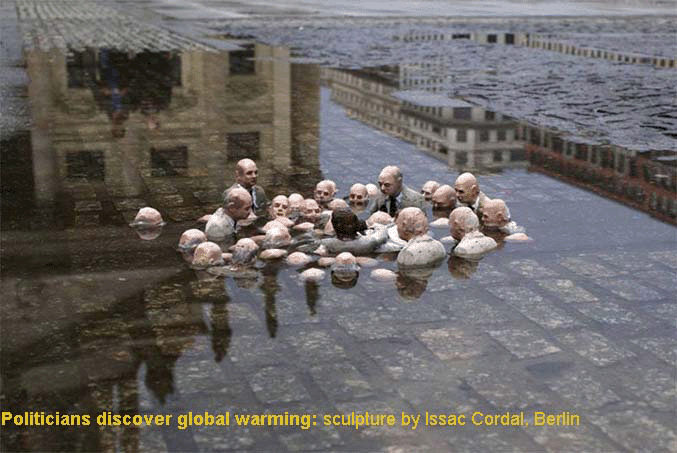
Patrick Greenfield, Guardian, 29 June 26
Last week’s extreme weather should galvanise the political response to global heating. But the sad paradox is that it could bolster support for climate-sceptical parties
You could be forgiven for thinking that last week’s heatwave in Europe would be a galvanising moment for action on the climate crisis. At one point, more than 150 million Europeans sweltered in temperatures above 35C (95F) – with several parts of the continent soaring past 40C. A heatwave of this magnitude has never been recorded this early in the year.
When scientists finish their calculations, the death toll will probably number in the thousands. Spain, one of the few countries that produces real-time statistics on excess deaths linked to heat, has recorded more than 100 per day since Wednesday. French authorities said that at least 1,000 additional deaths had been recorded between 24 and 27 June, a figure that is likely to rise. They include four toddlers who died in incidents linked to the heat. A three-year-old boy in a Paris suburb was found dead last week after climbing into a car and becoming trapped.
There is a miserable inevitability surrounding these events: scientists have long warned they were coming. Yet countries have not done enough to cut the emissions from fossil fuels that are causing the extreme weather – or adapt to the realities of managing the toll on their transport and healthcare systems.
For today’s First Edition, I spoke with Ajit Niranjan, the Guardian’s Europe environment correspondent, about whether this week’s heatwave in Europe could prompt a fresh drive for action on global heating or whether it may, counterintuitively, boost support for political parties that are sceptical about the climate crisis. But first, the headlines.
…………..Europe heatwave | Germany, Czechia, Poland and Hungary reached record temperatures of more than 40C on Sunday as a heatwave linked to hundreds of deaths in western Europe spread east.
…………..The arrival of extreme weather in Europe has been quick. It is the world’s fastest-warming continent, heating up at twice the rate of the rest of the planet. In the 1950s, 60s and 80s, there was not a single “tropical night” recorded at the London Heathrow weather station – defined as when the night-time temperature does not fall below 20C. Now, they are common: four in a row were recorded last week, according to the popular weather blogger London & Southeast.
The UK and other European countries are unprepared for these conditions and the immense strain they put on health and travel networks. In the UK, hundreds of schools closed early, workplaces overheated, and train operators asked people not to travel. On Wednesday, the London ambulance service recorded its busiest ever day for the most serious category of callouts, with 642 responses to reports of cardiac arrests, patients who have stopped breathing and life-threatening injuries. Just two days later, the record was broken again, with more 999 calls made than ever before, more even than during the Covid-19 pandemic.
By yesterday, the heatwave had moved east. Poland, Czechia and Slovakia were all expecting record temperatures of more than 40C. Bautzen in in eastern Saxony broke the German re
A boost for the far right
Sometimes, climate-driven weather events can temporarily cut through, says Ajit, pointing to the 2021 floods in the Ahr valley in Germany, which killed 188 people and washed away entire villages. But increasingly, the opposite happens.
“One trend that’s possibly the most counterintuitive about these kinds of moments is that far-right parties who are denying the science of climate change can get a bit of a boost from extreme weather events,” says Ajit. “They spin the extreme weather as a failure of government policy, arguing that focusing on climate change was part of the initial problem, and it is more about mismanagement.”
In many cases, such as the 2024 floods in Valencia, when more than 230 people were killed after a year’s worth of rain fell in eight hours to parts of eastern Spain, both things are true: the climate drove the extreme weather, but poor governance contributed to the deadly outcome. This is likely to become an increasingly common dynamic as extreme weather events grow in frequency.
“Both sides of this issue need to be addressed,” says Ajit. “There is this weird tendency where political parties completely deny one of the causes by either focusing just on climate or just on adaptation, without having a good plan for the other. This is certainly a part of the strategy used by far-right parties to bash climate policy,.”
No comments yet.
-
Archives
- October 2026 (129)
- September 2026 (339)
- August 2026 (330)
- July 2026 (355)
- June 2026 (287)
- May 2026 (306)
- April 2026 (356)
- March 2026 (251)
- February 2026 (267)
- January 2026 (308)
- December 2025 (358)
- November 2025 (359)
-
Categories
- 1
- 1 NUCLEAR ISSUES
- business and costs
- climate change
- culture and arts
- ENERGY
- environment
- health
- history
- indigenous issues
- Legal
- marketing of nuclear
- media
- opposition to nuclear
- PERSONAL STORIES
- politics
- politics international
- Religion and ethics
- safety
- secrets,lies and civil liberties
- spinbuster
- technology
- Uranium
- wastes
- weapons and war
- Women
- 2 WORLD
- ACTION
- AFRICA
- Atrocities
- AUSTRALIA
- Christina's notes
- Christina's themes
- culture and arts
- Events
- Fuk 2022
- Fuk 2023
- Fukushima 2017
- Fukushima 2018
- fukushima 2019
- Fukushima 2020
- Fukushima 2021
- general
- global warming
- Humour (God we need it)
- Nuclear
- RARE EARTHS
- Reference
- resources – print
- Resources -audiovicual
- Weekly Newsletter
- World
- World Nuclear
- YouTube
-
RSS
Entries RSS
Comments RSS


Leave a Reply