What is actually to happen at Paris climate talks?

 A Massive Climate Summit Is About to Happen in Paris. Here’s What You Need to Know. http://climatedesk.org/2015/11/a-massive-climate-summit-is-about-to-happen-in-paris-heres-what-you-need-to-know/ Tim McDonnell on Friday, November 27, 2015
 Diplomats and scientists are descending on the French capital Monday. They’ll try to save the world. On Monday, roughly 40,000 heads of state, diplomats, scientists, activists, policy experts, and journalists will descend on an airport in the northern Paris suburbs for the biggest meeting on climate change since at least 2009—or maybe ever. The summit is organized by the United Nations and is primarily aimed at producing an agreement that will serve as the world’s blueprint for reducing greenhouse gas emissions and adapting to the impacts of global warming. This is a major milestone in the climate change saga, and it has been in the works for years. Here’s what you need to know:
What’s going on at this summit, exactly? At the heart of the summit are the core negotiations, which are off-limits to the public and journalists. Like any high-stakes diplomatic summit, representatives of national governments will sit in a big room and parse through pages of text, word by word. The final document will actually be a jigsaw puzzle of two separate pieces. The most important part is the Intended Nationally Determined Contributions (INDCs). These are commitments made individually by each country about how they plan to reduce their carbon footprints. The United States, for example, has committed to cut its greenhouse gas emissions 26 to 28 percent below 2005 levels by 2025, mostly by going after carbon dioxide emissions from coal-fired power plants. Nearly every country on Earth has submitted an INDC, together covering about 95 percent of global greenhouse gas emissions. (You can explore them in detail here.)
The INDCs will be plugged in to a core agreement, the final text of which will be hammered out during the negotiations. It will likely include language about how wealthy nations should help pay for poor nations’ efforts to adapt to climate change; how countries should revise and strengthen their commitments over time; and how countries can critically evaluate each other’s commitments. While the INDCs are unlikely to be legally binding (that is, a country could change its commitment without international repercussions), certain elements of the core agreement may be binding. There’s some disagreement between the United States and Europe over what the exact legal status of this document will be. A formal treaty would need the approval of the Republican-controlled US Senate, which is almost certainly impossible. It’s more likely that President Barack Obama will sign off on the document as an “executive agreement,” which doesn’t need to go through Congress.
Meanwhile, outside the negotiating room, thousands of business leaders, state and local officials, activists, scientists, and others will carry out a dizzying array of side events, press conferences, workshops, etc. It’s basically going to be a giant party for the world’s climate nerds. Continue reading
Climate change’s biggest toll will be on children – UNICEF report
Children will bear the brunt of climate change –  http://www.un.org/apps/news/story.asp?NewsID=52637#.VljDrtIrLGg 24 November 2015 – More than half a billion children live in areas with extremely high flood occurrence and 160 million in high drought severity zones, leaving them highly exposed to the impacts of climate change, the United Nations Children’s Fund (UNICEF) said in a report released ahead of the 21st United Nations climate change conference, known as COP21.
According to the agency, of the 530 million children in the flood-prone zones, some 300 million live in countries where more than half the population lives in poverty – on less than $3.10 a day. Of those living in high drought severity areas, 50 million are in countries where more than half the population lives in poverty.
“The sheer numbers underline the urgency of acting now,” said UNICEF Executive Director Anthony Lake, in a press release. “Today’s children are the least responsible for climate change, but they, and their children, are the ones who will live with its consequences. And, as is so often the case, disadvantaged communities face the gravest threat,” he continued.
Climate change means more droughts, floods, heatwaves and other severe weather conditions. UNICEF is underlining that these events can cause death and devastation, and can also contribute to the increased spread of major killers of children, such as malnutrition, malaria and diarrhoea. This can reportedly create a vicious circle according to the agency – a child deprived of adequate water and sanitation before a crisis will be more affected by a flood, drought, or severe storm, less likely to recover quickly, and at even greater risk when faced with a subsequent crisis.
The report, Unless we act now: The impact of climate change on children, finds that the vast majority of the children living in areas at extremely high risk of floods are in Asia, and the majority of those in areas at risk of drought are in Africa.
Meanwhile, world leaders gathering in Paris for COP21 – held from November 30 to December 11 – will seek to reach agreement on cutting greenhouse gas emissions, which most experts say is critical to limiting potentially catastrophic rises in temperature.
“We know what has to be done to prevent the devastation climate change can inflict. Failing to act would be unconscionable,” said Mr. Lake. “We owe it to our children – and to the planet – to make the right decisions at COP21.”
Corporations determined to control Paris climate agreement
 several platforms to ensure business-friendly proposals are at the heart of climate policy-making, rather than vice versa. New markets, experimental technologies, all endorsed so polluters don’t have to change their business models.
In the real world, “net-zero” gives polluters an excuse to continue with business as usual, claiming that future inventions will fix the problem.
Hundreds of thousands have already added their name to campaigns urging governments to recognise the damaging influence “big polluters” have over climate policy, and to kick them out of COP21 and all levels of government.
If enough people get behind it, Paris could mark a watershed moment: the beginning of the end for the cosy affair between politicians and polluters.
Paris climate talks: powerful business lobbies seek to undermine deal http://www.theguardian.com/sustainable-business/2015/nov/27/paris-climate-talks-un-business-lobbying-deal-governments by Pascoe Sabido
Tackling climate change means drastically transforming our economies. Our political leaders, not business, are best placed to do that.
As the UN’s climate talks in Paris begin, the lobbying and public relations push from some of the biggest corporations responsible for climate change has gone into overdrive. What are the messages they’re so keen to spread, and what will they mean for the COP21 conference – and for the climate?
A recent report from the NGO Corporate Europe Observatory reveals that what’s on offer at COP21 is nothing short of a climate catastrophe, a guaranteed recipe to cook the planet. But rather than sending the dish back, political leaders have asked for seconds, bringing the very companies responsible for the problem ever closer into the UN fold.
James Bacchus, a trade expert at the International Chamber of Commerce, says: “This issue is important for governments to address but it is far too important to leave to governments alone.”
Fortunately for Bacchus, the UN agrees. Continue reading
Paris the beginning of climate action – not the end
Paris offers a chance at a different story. Ambitions are more modest, and more realistic. No one is expecting the agreement to comprehensively achieve the 2-degree target. In fact, documents already released suggest it would allow temperatures to rise at least 2.7 degrees.
Success at Paris will be more subtle. It will be measured by whether incremental steps to reduce greenhouse gas emissions continue to be seen as a priority for the world, long after the excitement of the conference has passed away.
It will be the intangible measure of how the world’s attitude on climate change has shifted.
Don’t rely on grand treaties from the Paris climate summit http://www.abc.net.au/news/2015-11-27/phillips-don’t-rely-on-grand-treaties-from-paris/6979176OPINION
Calm your farm, Greenies. Paris is an amazing city, but the United Nations conference on climate change to be held next week is not going to save the world. Continue reading
Nuclear power to fix climate change? It’s just not going to happen
Future Prospects…….. Can nuclear power grow as rapidly as desired by those advocating it to mitigate climate change? For that to happen, nuclear power would have to increase its share of global generation relative to sources that are proving more economically competitive, such as natural gas and renewables — and that in turn would require vastly accelerated and expanded reactor construction at prices that make sense relative to these other sources.
 All of this is quite apart from the other well-known and widespread concerns about nuclear power: the potential for severe accidents, the linkage to nuclear weapons and the production of long-lived radioactive waste. These challenges will not disappear and indeed may only grow worse, which is why nuclear’s prospects as a significant climate change mitigator are feeble to nonexistent.
Nuclear Power Is No Fix for Climate, Energy Intelligence, M.V. Ramana27 November 2015
| As we approach this year’s climate talks in Paris, several policymakers and organizations dealing with energy have stated publicly that an expansion of nuclear power is needed to combat global warming. The Nuclear Energy Agency and the International Atomic Energy Agency (IAEA) have argued on their websites that “to limit the rise in global mean temperatures to 2°C” nuclear energy has to increase its share of global electricity production from “11% in 2014 to 17% in 2050.”What are the prospects of an expansion of nuclear power such that it increases its electricity market share by over 50% in about 35 years? The short answer is that they are slim at best.
Several technical and economic challenges confront such a large and relatively rapid expansion of nuclear reactor construction; these challenges suggest that although nuclear power will remain part of electricity generation in several countries, its prospects for significant growth are limited. In addition, there are social problems; in particular, sustained public opposition in most countries around the world, a sentiment that was clearly apparent in 2011 after the multiple meltdowns at the Fukushima Daiichi nuclear power plant…….. As of November 2015, the IAEA reported a total of 441 “operational reactors” in 31 countries and Taiwan, with a combined generating capacity of nearly 382 gigawatts of electricity. However, not all of these “operational reactors” are necessarily operating. Apart from reactors that are shut down for routine maintenance or refueling, this count includes 43 reactors in Japan, only two of which are operating and generating electricity. Most of these reactors are concentrated in just a few countries — over half are in just four countries, if one counts the ones in Japan. The IAEA also lists 65 reactors under construction with a total capacity of over 64 GW. Some of these will likely never be completed (e.g. two reactors in Japan), and some have been under construction for lengthy periods of time — most notably the US Tennessee Valley Authority’s Watts Bar-2 which may see commercial operation next year after a 43-year on-again, off-again construction period……… As with the reactor fleet, construction is also concentrated in a few countries: China alone accounts for nearly a third of the reactors under construction, and, with Russia and India, comprises over half the total number. This growth, in particular China’s rapid pace of building nuclear plants, has led some to expect an increase in nuclear power’s market share. But this is not a valid conclusion for two reasons. First, China’s targets for nuclear power have declined significantly after Fukushima. In 2010, the official target for nuclear capacity in 2020 was 70 GW, and there were reports that it was or had been as high as 114 GW. The current target is 58 GW by 2020, and even meeting that lower target is a challenge. Second, China is not constructing only nuclear reactors, but also coal power plants, hydroelectric dams, wind turbines and solar plants at a tremendous rate. Hence, it is easy to see that nuclear power’s share of the electricity production in China — only 2.39% in 2014 — is unlikely to increase significantly for decades even if current Chinese nuclear plans go through without any further hitches. India’s nuclear share has also remained in the 2% to 4% rangefor a couple of decades. Its nuclear program, which dates back to the 1950s, is notable for ambitious expansion plans that have never been met and there are good reasons to expect the same in the future. For example, in 2010, the head of India’s Atomic Energy Commission projected a capacity of 35 GW by 2020. The current expectation is for a little over 10 GW of installed capacity by that time. In fact, even the IAEA, which historically has always been very optimistic about nuclear energy’s prospects, and which has as one of its objectives “to accelerate and enlarge the contribution of atomic energy,” has lowered its sights: : The latest of its projections for nuclear power’s share in 2030 ranges from 11.3% to 8.6%, with even lower projections for 2050. This is much lower than foreseen by the agency a decade ago, when it projected the nuclear share declining only to 15%-17% by 2020 and 13%-14% by 2030, and far lower than the 17% by 2050 target it claims is necessary for climate mitigation. This decline in future projections is a function of both anticipated reactor shutdowns due to aging and a reduced rate of construction of new reactors. Is Nuclear Power Competitive?…… Future Prospects…….. Can nuclear power grow as rapidly as desired by those advocating it to mitigate climate change? For that to happen, nuclear power would have to increase its share of global generation relative to sources that are proving more economically competitive, such as natural gas and renewables — and that in turn would require vastly accelerated and expanded reactor construction at prices that make sense relative to these other sources. All of this is quite apart from the other well-known and widespread concerns about nuclear power: the potential for severe accidents, the linkage to nuclear weapons and the production of long-lived radioactive waste. These challenges will not disappear and indeed may only grow worse, which is why nuclear’s prospects as a significant climate change mitigator are feeble to nonexistent…..http://www.energyintel.com/pages/worldopinionarticle.aspx?DocID=906841 |
Natural greenhouse gases increase with higher temperatures: will ,accelerate global warming
Global warming will be faster than expected http://www.sciencedaily.com/releases/ 2015/11/151126104037.htm November 26, 2015
- Source:
- Linköping Universitet
- Global warming will progress faster than what was previously believed. The reason is that greenhouse gas emissions that arise naturally are also affected by increased temperatures. This has been confirmed in a new study that measures natural methane emissions.
- “Everything indicates that global warming caused by humans leads to increased natural greenhouse gas emissions. Our detailed measurements reveal a clear pattern of greater methane emissions from lakes at higher temperatures,” says Sivakiruthika Natchimuthu, doctoral student at Tema Environmental Change, Linköping University, Sweden, and lead author of the latest publication on this topic from her group.
Over the past two years the research team at Linköping University has contributed to numerous studies that all point in the same direction: natural greenhouse gas emissions will increase when the climate gets warmer. In the latest study the researchers examined the emissions of the greenhouse gas methane from three lakes. The effects were clear and the methane emissions increased exponentially with temperature. Their measurements show that a temperature increase from 15 to 20 degrees Celsius almost doubled the methane level. The findings was recently published in Limnology and Oceanography.
While increased anthropogenic emissions of greenhouse gases are expected and included in climate predictions, the future development of the natural emissions has been less clear.
Now knowledge of a vicious circle emerge: greenhouse gas emissions from the burning of fossil fuels lead to higher temperatures, which in turn lead to increased natural emissions and further warming.
“We’re not talking about hypotheses anymore. The evidence is growing and the results of the detailed studies are surprisingly clear. [DB1] The question is no longer if the natural emissions will increase but rather how much they will increase with warming,” says David Bastviken, professor at Tema Environmental Change, Linköping University.
- This means that warming will be faster than expected from anthropogenic greenhouse gas emissions alone. According to Professor Bastviken this also means that any reductions in anthropogenic greenhouse emissions is a double victory, by both reducing the direct effect on warming, but also by preventing the feedback with increased natural emissions.
Pope and Muslim leaders in call for climate action
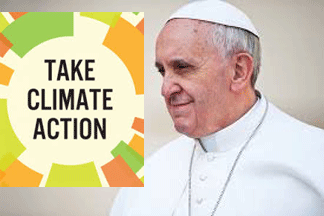 Pope Francis says failure of climate summit would be catastrophic, Guardian 26 Nov 15
Pope meets Muslim and other religious leaders in Nairobi to call for success at the Paris summit and for greater environmental protections in Africa. World leaders must reach a historic agreement to fight climate change and poverty at coming talks in Paris, facing the stark choice to either “improve or destroy the environment”, Pope Francis said in Africa on Thursday.
Francis chose his first visit to the world’s poorest continent to issue a clarion call for the success of the two-week summit, known as COP21, that starts on Monday in the French capital still reeling from attacks that killed 130 people and were claimed by Islamic State.
In a long address in Spanish at the United Nations regional office, Francis said it would be “catastrophic” if particular interests prevailed over the common good of people and the planet or if the conference were manipulated by business interests.
In Kenya, at the start of his three-nation Africa trip, the pope also said dialogue between religions was essential to teach young people that violence in God’s name was unjustified.
Bridging the Muslim-Christian divide and climate issues are major themes of the trip that also takes him to Uganda, which like Kenya has been a victim of extremist attacks, and the Central African Republic, a nation riven by sectarian conflict.
“We are confronted with a choice which cannot be ignored: either to improve or destroy the environment,” the pope said in Nairobi, home to the UN Environment Programme headquarters.
He noted that some scientists consider protection of the Congo basin tropical forest, which spreads over six countries and is the world’s second-largest after the Amazon, essential for the future of the planet because of its biodiversity.
Francis, who took his name from St Francis of Assisi, the patron saint of nature, has made protecting “God’s creation” a plank of his pontificate. In June, he issued a landmark encyclical calling for urgent action to save the planet……. http://www.theguardian.com/environment/2015/nov/26/pope-francis-says-failure-of-climate-summit-would-be-catastrophic
Indonesia’s fires – enormous output of greenhouse emissions
 Indonesia: fires threaten to send even modest climate ambitions up in smoke The Conversation, Sonny Mumbunan Economist and research scientist at the Research Centre for Climate Change, University of Indonesia , 26 Nov 15 At the Paris climate negotiations, Indonesia will bring to the table a target of an unconditional 29% emissions reduction by 2030, increasing to 41% on condition of international assistance.
Indonesia’s emission reduction plan (or Intended Nationally Determined Contribution) is therefore slightly higher than its 2009 commitment to reduce emissions by 26% by 2020.
There are three problems with Indonesia’s INDC. The target is not ambitious; the plan is incoherent; and with the recent massive forest fires in Indonesia that have yet to be accounted for in the INDC it does not accurately reflect emissions for Indonesia.
Such a problematic INDC would affect the global efforts to adequately tackle climate change, since Indonesia is one of the biggest carbon emitters in the world. The forest fires have pushed the country into the top ranks of global greenhouse gas emitters……https://theconversation.com/indonesia-fires-threaten-to-send-even-modest-climate-ambitions-up-in-smoke-49155
Corporate greenwashing at Solutions COP21
Paris: closed to civil society, open to greenwashers, New Internationalist , 24 Nov 15 By Pascoe Sabido |”…….Solutions COP21 is a platform for some of the world’s most socially and environmentally destructive corporations, whose business models constantly attack life, youth, friendliness, solidarity and any notion of an equitable approach.
Sponsored by the likes of dirty energy giant Engie (formerly GDF Suez, also an official sponsor of COP21) alongside fracking enthusiast Suez Environment and agrofuels giant Avril-Sofiproteol, the event at the Grand Palais will also welcome Vinci, the company behind the proposed airport at Notre-Dame-des-Landes, coal financiers HSBC and BNP Paribas, and Coca-Cola, among many others.
As the organizers are proud to admit, corporate climate criminals will be joined inside the event by small and medium enterprises, NGOs (some of whom have pulled out after public pressure) and international artists (some of whom have refused to pull out on discovering the true nature of the event).
Such an ensemble lends a veneer of respectability that money can’t buy. But what it can buy is political access. Corporate packages ranging up to $266,000 ensure you don’t have to settle for mere exhibition space but can have VIP access to networking areas with negotiators and politicians, as well as guaranteed TV coverage.
In short, the French government has put its weight behind a corporate greenwashing event for the biggest polluters to push their false solutions – such as fracking, nuclear energy, GMOs and market-based solutions – at the same time as silencing those very communities coming to Paris to denounce such destructive business practices and the fatal impacts they have on the ground.
Before the attacks took place, there was already a public call for mass civil disobedience against (false) Solutions COP21, coming from a diverse range of organizations including ATTAC France, Via Campesina, the trade union Solidaires, the grassroots activist networks Climate Justice Action and the JEDIs, Sortir du Nucleaire and Corporate Europe Observatory. Huge uncertainty followed, but hearing the response from both the organizers of Solutions COP21 and the French government, it now feels more important than ever for the mobilization to take place.
The fight for climate justice is intertwined with the fight for peace, not just in Europe but in communities around the world facing violence and terror as a result of our extractivist economic model.
If the French government thinks that events in the Grand Palais are more important than the voices of those on the frontline fighting climate change and its causes, then that’s where their message needs to be delivered.
If you are in Paris on Friday 4 December, make your way to the venue from 10.00am, where guides will take you on a ‘toxic tour’ around the expo with representatives of frontline communities as they call out the false solutions on offer. Meanwhile, creative acts of civil disobedience are planned to stop the event from staying open.
As others in the climate movement have said already, now is not the time to stay silent. No-one intends to.
Pascoe Sabido is a researcher and campaigner with Corporate Europe Observatory.
http://newint.org/blog/2015/11/24/paris-cop21-civil-society-vs-greenwashers/#sthash.i2AYXtTS.dpuf
Is everyone forgetting the greenhouse gas emissions from military sources?
These issues will be explored at a series of launch events for the book Secure and Dispossessed – Challenging the militarization of climate change (Pluto Press/TNI) published this month. The London launch will be held at 6.30pm on 25 November at Free Word Centre, London, the Amsterdam launch at 7.30pm Tuesday 1 December at Pakhuis de Zwijger and the Paris launch during the climate forum meetings on the 5 and 6 December. An earlier version of this article was published by Global Justice Now. The elephant in Paris – the military and greenhouse gas emissions http://newint.org/blog/2015/11/19/the-military-and-greenhouse-gas-emissions/
There is no shortage of words in the latest negotiating document for the UN climate negotiations taking place in Paris at the end of November – 32,731 words to be precise, and counting. Yet strangely there is one word you won’t find: military. It is a strange omission, given that the US military alone is the single largest user of petroleum in the world and has been the main enforcer of the global oil economy for decades.
The history of how the military disappeared from any carbon accounting ledgers goes back to the UN climate talks in 1997 in Kyoto. Under pressure from military generals and foreign policy hawks opposed to any potential restrictions on US military power, the US negotiating team succeeded in securing exemptions for the military from any required reductions in greenhouse gas emissions. Even though the US then proceeded not to ratify the Kyoto Protocol, the exemptions for the military stuck for every other signatory nation. Even today, the reporting each country is required to make to the UN on their emissions excludes any fuels purchased and used overseas by the military.
As a result it is still difficult to calculate the exact responsibility of the world’s military forces for greenhouse gas emissions. A US Congressional report in 2012 said that the Department of Defense consumed about 117 million barrels of oil in 2011, only a little less than all the petrol and diesel use of all cars in Britain the same year. Deploying that oil across the globe to the fuel-greedy hummers, jets and drones has become a growing preoccupation of NATO military strategists.
But the responsibility of the military for the climate crisis goes much further than their own use of fossil fuels. As we witnessed in Iraq, the military, the arms corporations and their many powerful political supporters have consistently relied on (and aggressively pushed for) armed intervention to secure oil and energy supplies. The military is not just a prolific user of oil, it is one of the central pillars of the global fossil-fuel economy. Today whether it is in the Middle East, the Gulf, or the Pacific, modern-day military deployment is about controlling oil-rich regions and defending the key shipping supply routes that carry half the world’s oil and sustain our consumer economy.
The resulting expansion of conflict across the globe has consumed ever-increasing levels of military expenditure: in 2014, global military expenditure reached $1.8 trillion dollars. This money is a huge diversion of public resources that could be invested instead in renewable energy as well as providing support for those most affected by climate change. When the British government in 2014 allocates £25 billion to the Ministry of Defence but only £1.5 billion to the Department of Energy & Climate Change, it is clear where its priorities lie.
Ironically despite their role in the climate crisis, one of the loudest voices calling for action on climate change is coming from the military. British Rear Admiral Morisetti is typical of a growing chorus of military generals identifying climate change as the major security challenge of this century. He argues for action on climate change because it will be a ‘threat multiplier’ with the potential to exacerbate the ‘development-terrorism’ nexus. The argument has been readily picked up by politicians who increasingly talk about the security implications of climate change.
This could seem a welcome development. After all who would not want one of the most powerful forces on your side in tackling humanity’s greatest ever challenge? But there is a good reason also to be cautious of who we jump into bed with. A close look at military climate change strategies reveals that their focus is on securing borders, protecting trade supply-routes for corporations, controlling conflicts around resources and instability caused by extreme weather, and repressing social unrest. They turn the victims of climate change into ‘threats’ to be controlled or combated. There is no critical examination of the military’s own role in enforcing a corporate-dominated fossil-fuel economy that has caused the climate crisis.
In fact, there is evidence that many players in this corporate-military-security industrial nexus are already seeing climate change not just as a threat but an opportunity. Arms and security industries thrive on conflict and insecurity and climate change promises another financial boon to add to the ongoing War on Terror. British arms giant BAE Systems was surprisingly open about this in one of their annual reports explaining ‘New threats and conflict arenas are placing unprecedented demands on military forces and presenting BAE Systems with new challenges and opportunities.’ An Energy Environmental Defence and Security (E2DS) conference in 2011 jubilantly proclaimed that ‘the aerospace, defence and security sector is gearing up to address what looks set to become its most significant adjacent market since the strong emergence of the civil/homeland security business almost a decade ago.’
In the aftermath of the terrible killings in Paris, military responses are again taking central stage. It seems that the lack of evidence of any success from 14 years of bombings, drone killings, armed invasions is no obstacle to the military-security juggernaut. Do we really want the same forces to now dominate our response to climate change which will affect millions of people over the coming decades? A growing number of social movements are saying that climate change demands breaking the cycle of violence in order to build a collective caring response to a crisis that will affect us all. The Paris climate talks are an opportunity to draw attention to the military elephant in the room and demand that adaptation to climate change is led by principles of human rights and solidarity, rather than militarism and corporate profits.
1.5 degrees C is the global warming level limit required to save islands and coastal cities
 “We definitely think that staying below 2 degrees is still very possible,” Christiana Figueres, executive secretary of the U.N. Framework Convention on Climate Change, told reporters as the report was released. “Getting down to the range of 1.5 should not be taken off the table either.”
Jumeau of the Seychelles pointed out that a 1.5°C goal would be achievable, and that adopting and meeting it would benefit rich coastal nations as well as those whose existences may be threatened by rising seas.
“It’s not just about the islands, it’s about New York, it’s about New Orleans, it’s about London, it’s about Venice,” Jumeau said. “There is no way we can compromise on 1.5.”
 The Forgotten U.N. Climate Goal: 1.5°C, Climate Central November 19th, 2015 While much of the attention on a historic Paris climate meeting in the coming weeks will focus on the confounding task of trying to keep global warming below 2°C, or 3.6°F, a battle over another goal — one that has been forgotten by many — will be playing out in the negotiating halls.Delegates representing island states and others whose homelands are most threatened by rising seas will be pushing for the formal adoption of a long-overlooked goal, one that limits warming to less than 1.5°C, or 2.7°F.
Corporations and climate change
 http://www.abc.net.au/radionational/programs/ockhamsrazor/corporations-and-climate-change/6947120ABC Radio National, Ockhams Razor 22 Nov 15 In the lead-up to the Paris Climate Talks, Christopher Wright, examines how environmental destruction became a business opportunity. He explores the complex relationship between the corporate world and climate change, and the central role of corporations in shaping political and social responses to the climate crisis………
These proclamations need to be viewed in the broader context of business opposition to the fundamental economic change necessary to avoid dangerous climate change. A good example of the duality of this corporate engagement has been the recent revelation that oil-giant Exxon, for decades a leading opponent of carbon regulation and funder of climate change denial, has since the mid-1980s been well aware of the disastrous implications of fossil fuel use for the Earth’s climate. This self-serving logic parallels other well-known examples of business obfuscation such as BP’s infamous ‘Beyond Petroleum’ greenwashing in the early 2000s, and more recently Peabody Energy’s marketing of coal as a response to “energy poverty” in the developing world.
How then to make sense of the mixed messages from corporations on climate change?

In our new book, Climate Change, Capitalism and Corporations: Processes of Creative Self-Destruction, Daniel Nyberg and I explore the role of corporations and corporate capitalism within the climate crisis. We argue that while many global businesses promote a message of “action” and “leadership”, this ignores the deeper problem 0f how corporate capitalism is locked into a cycle of promoting ever more creative ways of exploiting nature and destroying a habitable climate……..
In our book we argue that global capitalism is now locked into a process of what we term “creative self-destruction”…….
sparkling image of corporate environmentalism and business sustainability falsely promises no conflicts and no trade-offs. Here, it is seen as possible to address climate change while continuing the current global expansion of consumption. In contrast to the blinding evidence of ever-escalating greenhouse gas emissions, this comforting political myth promises no contradiction between material affluence and environmental well-being. We can have it all and, according to the myth of corporate environmentalism, avoid climate catastrophe!……..
Ultimately the “success” or otherwise of the Paris climate talks are unlikely to threaten the fundamental dynamics underlying the climate crisis. Dramatic decarbonisation based around mandatory limits upon consumption, economic growth, and corporate influence are not on the agenda nor open for discussion. Rather, global elites have framed the response to climate change around an accentuation of the very causes of the crisis.
In essence, the prevailing corporate view is that capitalism should be seen not as a cause of climate change but as an answer to it. Thus a problem brought about by overconsumption, the logic goes, should be addressed through more consumption………http://www.abc.net.au/radionational/programs/ockhamsrazor/corporations-and-climate-change/6947120#transcript
Divest from fossil fuels before climate summit- urges economist Thomas Piketty
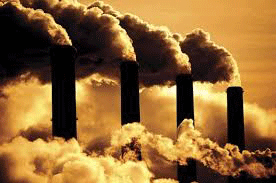 Thomas Piketty calls for investors to divest from fossil fuels ahead of climate talks http://www.theguardian.com/environment/2015/nov/14/thomas-piketty-economist-investors-divest-fossil-fuels-ahead-climate-talks, Emma Howard, 14 Nov 15
Economist says Paris summit offers a decisive moment in history for investors to move out of the dirty fuels that put the ‘public’s wellbeing at risk’ Thomas Piketty has called for investors to move their money out of fossil fuels ahead of landmark UN climate change talks.
The French economist, along with ‘ecological economist’ Tim Jackson, authors of the respective bestselling books Capital in the Twenty-First Century and Prosperity Without Growth: economics for a finite planet, said that investors should divest from a sector with a business model “at odds with physical realities”.
In a letter to the Guardian, they wrote: “This is a rare and decisive moment in history. Science, ethics, and economics are intersecting to form a clear market signal: in the lead up to the COP21 climate talks, responsible investors should divest from fossil fuels.”
COP21 is a landmark UN summit in Paris opening at the end of November, where nearly 200 countries will attempt to reach a deal on limiting greenhouse gas emissions post-2020.
The economists warned that public wellbeing was at risk from continued investment in oil, coal and gas companies whose products are driving global warming.
“Set against a backdrop of record-breaking climatic extremes and weather events, capital continues to flow into the exploration and future extraction of dirty energy. Those investments are wagers on a future in which vast potentials of carbon reserves are available to be processed – a bet against the public’s wellbeing.”
In the letter Piketty and Jackson cite the growth of a global divestment movementwhich has now persuaded more than 2,000 institutions and 400 individuals worth $2.6tn to divest from oil, coal and gas companies.
They add: “At a time when the fossil fuel industry should be shifting their businesses to focus on renewable energy they are doing the opposite, doubling down on coal, oil and gas … Meanwhile, clean, carbon-free energy is rapidly becoming cost-competitive with dirty energy. These recent political and market shifts are all being driven forward by a dramatic shift in the social zeitgeist.Climate change is now a primary social concern.”
The letter comes one week after Piketty, professor at the Paris School of Economics and the London School of Economics, published a proposal calling for the introduction of a tax on business flights to raise funds for countries suffering the impacts of climate change such as drought, sea level rise and flooding.
Fossil fuel divestment campaigners have previously won vocal support from the Nobel prizewinning economist Joseph Stiglitz and the UN, although other investors such as Bill Gates have criticised the movement as propounding an ineffective “false solution”.
Big Corporations need not worry about Climate Agreements: the Trans Pacific Partnership will fix that!
Trans-Pacific Partnership deal “an act of climate
denial” http://www.nationalobserver.com/2015/11/10/news/trans-pacific-partnership-deal-act- climate-denial By Charles Mandel If a climate change policy interferes with a corporation’s business, under the terms of the recently signed, secretive TPP deal, the corporation could sue a state government.
“The TPP is an act of climate denial,” said Jason Kowalski, the U.S. policy director at 350.org.
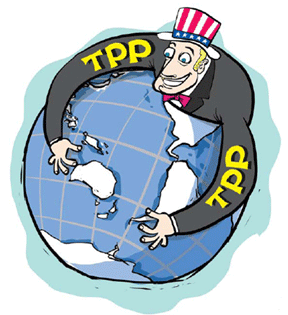
“It denies the scientific imperative to leave fossil fuels in the ground by granting corporations incredible powers over the sovereign right of countries to fight climate change on their own.”
At issue is the investor state dispute settlement (ISDS) mechanism included in the trade deal. ISDS’s allow foreign investors to use a secret tribunal to launch a lawsuit if they believe government actions might affect their future profits.
The TPP could limit a country’s ability to put in place any agreement it reaches at the Paris climate change summit because of concerns over lawsuits, according to Pierre-Yves Serinet, coordinator of the Quebec Network on Continental Integration.
“It creates a chill effect on the state to even create those policies,” he told National Observer, noting that 70 per cent of all the cases in trade deals involve ISDS attacks on environmental policies.
ISDS mechanisms are found in other trade deals such as the North American Free Trade Agreement and the Canada-European Union Comprehensive Economic and Trade Agreement.
Corporations have used the trade mechanism over 600 times to challenge governments, Maude Barlow, the national chairperson of the Council of Canadians said in her forward to the recent report,An ISDS Carve-out to Support Action on Climate Change.
Canada faces $2.6-billion in challenges from American corporations under NAFTA alone.
Friends of the Earth International noted that in 2009, Vattenfall — a Swedish energy company — launched a US$1.9-billion ISDS case against Germany for its decision to delay a coal-fired power station in order to impose stricter environmental standards.
To avoid the suit, the government reached a settlement that involved removing additional environmental requirements, enabling the coal plant to begin operations in 2014.
A number of environmental groups are also outraged that the 12-country trade deal fails to mention climate change policy, which is something they feel agreements must now consider.
“The words ‘climate change’ don’t even appear in the text, a dead give-away that this isn’t a 21st-century trade deal,” Michael Brune, executive director of the U.S. Sierra Club, said in a statement.
“It sets us back further, empowering fossil fuel corporations to challenge our public health and climate safeguards in unaccountable trade tribunals while increasing dirty fossil fuel exports and fracking.”
“We think it’s a very bad agreement on many fronts, and obviously in Canada it’s been negotiated by a government that’s not there anymore, that was very secretive and non-transparent,” Serinet said.
Both Prime Minister Justin Trudeau and International Trade Minister Chrystia Freeland have previously said the deal would be open to a full debate in Parliament.
Christiana Figueres: a climate action force to be reckoned with
That market-driven shift to cleaner energy is making Figueres’ job easier. When she talks to business, she’s already pushing at an open door. Some investors — such as Norway’s $900 billion sovereign wealth fund generated by oil and gas exports — are getting out of coal, in the belief that its days are numbered.
The message that tackling climate change makes economic sense is one that Figueres has been taking around the world.
The climate revolutionary Christiana Figueres blends tact, emotion and a bit of bullying to get deep emissions cuts in Paris next month. Politico By JANOSCH DELCKER
11/10/15, “…….. blend of tact, emotion and a bit of bullying is what the rest of the world can expect from the executive secretary of the U.N. Framework Convention on Climate Change (UNFCCC) at next month’s COP21 climate talks in Paris.

The petite Costa Rican anthropologist-turned-diplomat with short brown-hair and striking eyes — one blue and one hazel — is the public face of the effort to strike a deal that seeks to address global warming. She travels the world, occasionally becoming so moved while giving speeches that she wells up, in her campaign to bring home the seriousness of the threat facing the world.
As the Norwegians discovered in Svalbard, the world shouldn’t expect only praise for steps taken so far to combat climate change. Figueres will be demanding it do still more because to her, what’s on offer isn’t enough.
“I am the daughter of a revolutionary and I feel very comfortable with revolutions,” Figueres said at a climate conference last month in Oslo…….
This time, countries are putting forward their own pledges of how much they plan to cut their carbon dioxide output ahead of the summit. In the jargon of climate diplomacy, these promises are called Intended Nationally Determined Contributions, or INDCs. The idea is that this will be something countries are actually committed to doing, unlike with Kyoto.
So far 156 of the 195 countries attending the COP21 have submitted INDCs covering more than 90 percent of global emissions. The catch? Even if implemented, the U.N. says those reductions won’t stop the world from warming by more than 2 degrees Celsius by 2100, the level the world body considers the threshold beyond which climate change could have devastating consequences.
That’s something Figueres recognizes. One of her tasks is to manage expectations……..
Any agreement in Paris, Figueres said, will have many weaknesses. Her goal is more realistic: to realize that the 2-degree target won’t be hit right away, but to get the world’s countries to agree to revisit their commitments every five years, steadily ramping up their greenhouse gas reductions over time.
As Paris gets closer, her tone is becoming more cautious. In September she said there will be a legally binding deal, it just won’t punish countries that fail to meet the mark. By October she played down the legally binding aspect and said the voluntary emissions pledges are, in fact, a more effective way of dealing with climate change……..
The business case for green
As advanced economies move away from industry to services and information, and cars and factories get cleaner, the world is seeing a “decoupling GDP from GHG,” or global greenhouse gas emissions, as she put it. In 2014, carbon emissions were flat while the world economy grew. The trend is most evident in rich nations. Since 1991, for example, Sweden’s economy has grown by 58 percent while emissions have fallen by 23 percent.
That market-driven shift to cleaner energy is making Figueres’ job easier. When she talks to business, she’s already pushing at an open door. Some investors — such as Norway’s $900 billion sovereign wealth fund generated by oil and gas exports — are getting out of coal, in the belief that its days are numbered.
The message that tackling climate change makes economic sense is one that Figueres has been taking around the world……. http://www.politico.eu/article/the-climate-revolutionary-un-christina-figueres-climate-chief-cop21/
1 This Month





PLEASE OPPOSE HR 8255 AND S.3639 – bills would accelerate satellite deployment, with no environmental review or safeguards – https://ncstd5li.quorum.us/campaign/169331/
To see nuclear-related stories in greater depth and intensity – go to https://nuclearinformation.wordpress.com
-
Archives
- October 2026 (19)
- September 2026 (339)
- August 2026 (330)
- July 2026 (355)
- June 2026 (287)
- May 2026 (306)
- April 2026 (356)
- March 2026 (251)
- February 2026 (267)
- January 2026 (308)
- December 2025 (358)
- November 2025 (359)
-
Categories
- 1
- 1 NUCLEAR ISSUES
- business and costs
- climate change
- culture and arts
- ENERGY
- environment
- health
- history
- indigenous issues
- Legal
- marketing of nuclear
- media
- opposition to nuclear
- PERSONAL STORIES
- politics
- politics international
- Religion and ethics
- safety
- secrets,lies and civil liberties
- spinbuster
- technology
- Uranium
- wastes
- weapons and war
- Women
- 2 WORLD
- ACTION
- AFRICA
- Atrocities
- AUSTRALIA
- Christina's notes
- Christina's themes
- culture and arts
- Events
- Fuk 2022
- Fuk 2023
- Fukushima 2017
- Fukushima 2018
- fukushima 2019
- Fukushima 2020
- Fukushima 2021
- general
- global warming
- Humour (God we need it)
- Nuclear
- RARE EARTHS
- Reference
- resources – print
- Resources -audiovicual
- Weekly Newsletter
- World
- World Nuclear
- YouTube
-
RSS
Entries RSS
Comments RSS

