Trans Pacific Partnership will make Paris Climate Agreements irrelevant
The TPP, because of fast track, bypasses the normal legislative process of public discussion and consideration by congressional committees
The “deal is rife with polluter giveaways that would undermine decades of environmental progress, threaten our climate, and fail to adequately protect wildlife because big polluters helped write the deal.”
 The agreement, in essence, becomes global law. Any agreements over carbon emissions by countries
  made through the United Nations are effectively rendered null and void by the TPP.
“Trade agreements are binding,” Flowers said. “They supersede any of the nonbinding agreements made by the United Nations Climate Change Conference that might come out of Paris.”


 The Most Brazen Corporate Power Grab in American History http://www.globalresearch.ca/tpp-wto-nafta-the-most-brazen-corporate-power-grab-in-american-history/5487363 Nov 6, 2015 By Chris Hedges The release Thursday of the 5,544-page text of the Trans-Pacific Partnership—a trade and investment agreement involving 12 countries comprising nearly 40 percent of global output—confirms what even its most apocalyptic critics feared.
“The TPP, along with the WTO [World Trade Organization] and NAFTA [North American Free Trade Agreement], is the most brazen corporate power grab in American history,” Ralph Nader told me when I reached him by phone in Washington, D.C. “It allows corporations to bypass our three branches of government to impose enforceable sanctions by secret tribunals. These tribunals can declare our labor, consumer and environmental protections [to be] unlawful, non-tariff barriers subject to fines for noncompliance. The TPP establishes a transnational, autocratic system of enforceable governance in defiance of our domestic laws.” Continue reading
Climate risks of krypton-85 from nuclear fission
Paul Langley, 9 Nov 15, Climate risks by radioactive krypton-85 from nuclear fission. Atmospheric-electrical and air-chemical effects of ionizing radiation in the atmosphere
” The study shows that krypton-85 from nuclear fission enhances air ionization and, thus, interferes with the atmospheric-electrical system and the water balance of the earth atmosphere. This is reason for concern: There are unforeseeable effects for weather and climate if the krypton-85 content of the earth atmosphere continues to rise. There may be a krypton-specific greenhouse effect and a collapse of the natural atmospheric-electrical field. In addition, human well-being may be expected to be impaired as a result of the diminished atmospheric-electrical field. There is also the risk of radiochemical actions and effects caused-by krypton-85-containing plumes in other air-borne pollutants like the latters’ transformation to aggressive oxidants. This implies radiation smog and more acid rain in the countries exposed. This study summarizes findings gained in these issues by various sciences, analyses them and elaborates hypotheses on the actions and effects of krypton-85 on the air, the atmosphere and the climate. ” https://inis.iaea.org/search/Images/product-name.gifhttps://inis.iaea.org/search/searchsinglerecord.aspx…#
Nuclear lobby trying to stop renewables and real solutions to climate chnage
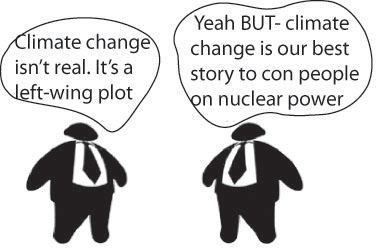 Nuclear power plants warn of closure crisis The Hill By Timothy
 Cama – 11/05/15 The nuclear power industry is sounding the alarm over the latest in a series of plant closures, warning that an energy source central to meeting President Obama’s climate change goals is deteriorating……
“This president has been largely very supportive,” said Richard Myers, vice president of policy development at the Nuclear Energy Institute (NEI)…..
But while Obama has made it clear that he supports nuclear power, there’s little he can do to stop the economic forces that make power plants expensive to operate — or the state and regional electricity policies the industry complains are hurting them.
Entergy Corp. announced this week its plans to close the FitzPatrick Nuclear Power Plant near Syracuse, N.Y., the seventh nuclear power plant to announce impending closure in recent years, out of the 60 plants currently operating throughout the country. A few weeks earlier, Entergy said it would close the Pilgrim Nuclear Generating Station in Massachusetts……..
Obama gave nuclear a big win in August with his climate rule for power plants. The Environmental Protection Agency (EPA) will count newly built nuclear plants toward states’ compliance with the rule, as the industry requested. But it won’t count existing plants, which the NEI also wanted.
The administration has put significant Energy Department funding into research and development projects for nuclear power, including efforts to develop small modular reactors, largely seen as the industry’s future.
Nuclear power has not been a major part of the 2016 presidential election, with the Republican field giving it only fleeting mentions as part of their “all of the above” energy plans and Democrats focusing on goals to increase renewable electricity. Instead, Myers said, the fights are focused elsewhere, especially in states and regional electricity markets.
About half of the country’s nuclear reactors are in markets that primarily favor the cheapest power source, putting nuclear at a disadvantage. Instead, the industry wants credit for its low emissions and high reliability………
As part of its efforts to stop plant closures, the industry launched a project dubbed Nuclear Matters. Its board includes big names and former policymakers, including former Sens. Judd Gregg (R-N.H.) and Evan Bayh (D-Ind.), former EPA Administrator Carol Browner and former Obama chief of staff Bill Daley…….
Others are critical of the nuclear industry’s efforts to save existing reactors. “The only thing that can stop it is if the nuclear industry repeals the laws of economics,” said Mark Cooper, a research fellow at the Vermont Law School.
“They’re stuck,” he said. “They can’t repeal the laws of economics. Or they can, if they can convince policymakers and regulators to abandon the market, to screw around with the market.” The industry has often done just that, Cooper said. But the efforts frequently fail.
Nearly all of the recent closures have been both premature — before the expected life of the reactors — and due to a major expected cost, such as a repair. John Coequyt, international climate program director at the Sierra Club, said the nuclear industry’s tactics to save plants are often at odds with efforts to increase renewable energy and reduce demand at peak times.
“The reason these plants are uneconomic is because renewable energy and demand response companies are driving down the value of nuclear power plants,” he said. “The consequences of those policies are much broader than just the nuclear industry.”
In that way, Coequyt said nuclear is aligned with coal-fired power plants, which also lose out when demand is reduced. The Sierra Club also objects generally to nuclear power, citing its environmental risks. It would rather see more renewables to fill the carbon-free void.
“They’re trying to restructure things so that other climate solutions don’t happen, so that they can continue to operate their nuclear power plants,” Coequyt said. “And that is a huge problem for us.” http://thehill.com/policy/energy-environment/259199-nuclear-power-plants-warn-of-closure-crisis
Southern Ocean fast becoming acidic, with abrupt effects on the marine food chain
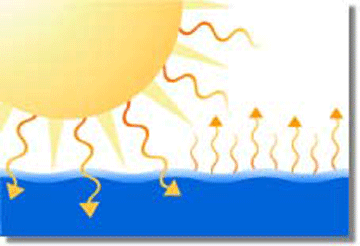 Abrupt changes in food chains predicted as Southern Ocean acidifies fast: study [excellent pictures] http://www.smh.com.au/environment/climate-change/abrupt-changes-in-food-chains-predicted-as-southern-ocean-acidifies-fast-study-20151030-gknd2g.html November 3, 2015 Peter Hannam Environment Editor, The Sydney Morning Herald The Southern Ocean is acidifying at such a rate because of rising carbon dioxide emissions that large regions may be inhospitable for key organisms in the food chain to survive as soon as 2030, new US research has found.
Tiny pteropods, snail-like creatures that play an important role in the food web, will lose their ability to form shells as oceans absorb more of the CO2 from the atmosphere, a process already observed over short periods in areas close to the Antarctic coast.
Ocean acidification is often dubbed the “evil twin” of climate change. As CO2 levels rise, more of it is absorbed by seawater, resulting in a lower pH level and reduced carbonate ion concentration. Marine organisms with skeletons and shells then struggle to develop and maintain their structures.
Using 10 Earth system models and applying a high-emissions scenario, the researchers found the relatively acidic Southern Ocean quickly becomes unsuited for shell-forming creatures such as pteropods, according to a paper published Tuesday in Nature Climate Change.
“What surprised us was really the abruptness at which this under-saturation [of calcium carbonate-based aragonite] occurs in large areas of the Southern Ocean,” Axel Timmermann, a co-author of the study and oceanography professor at the University of Hawaii told Fairfax Media. “It’s actually quite scary.”
Since the Southern Ocean is already close to the threshold for shell-formation, relatively small changes in acidity levels will likely show up there first, Professor Timmermann said: “The background state is already very close to corrosiveness.”
Below a certain pH level, shells of such creatures become more brittle, with implications for fisheries that feed off them since pteropods appear unable to evolve fast enough to cope with the rapidly changing conditions.
“For pteropods it may be very difficult because they can’t run around without a shell,” Professor Timmermann said. “It’s not they dissolve immediately but there’s a much higher energy requirement for them to form the shells.”
Given the sheer scale of the marine creatures involved, “take away this biomass, [and] you have avalanche effects for the rest of the food web”, he said.
As carbon dioxide levels rise, the impacts seen in the Southern Ocean – and its counterpart regions in the northern hemisphere – can be expected to spread closer to the equator.
Scientists anticipate that a halt in the increase in greenhouse gases will take time to have an impact on slowing the warming of the planet. However, a faster response can be expected in the oceans to any slowing in the pace of acidification.
“The corrosiveness of the water is a very strong function of the atmospheric C02 and there is not much of a delay [to any changes]”, Professor Timmermann said.
The paper’s release comes about four weeks before delegates from almost 200 nations are expected to gather in Paris, France to negotiate a new global treaty to curb carbon emissions.
Near record expansion of ozone hole over Antarctica
Ozone hole over Antarctica expands to near-record levels, now four times size of Australia, ABC News The World Today , 3 Nov 15 By Lucy Carter The hole in the ozone layer over Antarctica has expanded to near-record levels this year, covering an area almost four times the size of Australia.
Scientists from the UN said the increase was due to colder-than-usual temperatures, rather than any extra damage being done to the Earth’s protective layer.

But that could still mean extra UV radiation and the risk of more people getting sunburnt in Australia’s southern states this summer.
The hole in the ozone layer above Antarctica has been carefully monitored for over 30 years.
According to atmospheric scientist Professor David Karoly from the University of Melbourne, its size fluctuates greatly when it emerges each spring. “Each springtime over the last now nearly 35 years, there’s been a depletion of stratospheric ozone over Antarctica primarily due to two really important factors,” he said.
“It’s the increase in ozone-depleting chemicals in the atmosphere and a very special cold conditions that occur in winter and spring over Antarctica which provide a special, if you like, catalytic ozone destruction vessel that allows the ozone to be rapidly deployed by the higher concentrations of chlorofluorocarbons — ozone-depleting chemicals that have occurred in the stratosphere due to human activity.”
The UN’s weather and climate agency said this year’s seasonal ozone hole peaked on October 2, covering an area over Antarctica of 28.2 million square kilometres — close to four times the size of Australia or the size of Russia and Canada combined…….
“We do know that the substances that cause the ozone hole, the chlorines and bromines up there are decreasing … have decreased by about 18 per cent since their peak in the late 1990s, early 2000s,” he said.
Since 1987, gases known to cause ozone depletion have been banned and last year the World Meteorological Organisation reported the first positive signs of “ozone recovery”.
Professor David Karoly from the University of Melbourne said this fluctuation in size was not a long-term concern.
“It makes it harder to then see the long-term improvement, the declining trend in the size of the ozone hole but that is still expected to continue,” he said.
“We expect in the southern hemisphere that the ozone hole will not completely recover for another 40 to 60 years, when it recovers back to pre-1980 levels when the ozone hole was first discovered.”
However, this year’s ozone hole size does have the potential to affect Australians.
“Once the ozone hole does start to break up, air that’s depleted in ozone may be transported over to the southern parts of Australia which can, of course, during those periods increase the amount of UV radiation which in the Earth’s surface,” Mr Krummel said.
“So there could be a tendency for a bit more sunburn. “I would say mostly the southern states is where it is likely to impact……..http://www.abc.net.au/news/2015-10-30/ozone-hole-over-antarctica-expands-to-near-record-levels/6898824
Is the world ignoring the climate catastrophe of Indonesia’s fires?
 Governments ignore issues when the media ignores them.
one reason is the complete failure of perspective in a de-skilled industry dominated by corporate press releases, photo ops and fashion shoots, where everyone seems to be waiting for everyone else to take a lead. The media makes a collective non-decision to treat this catastrophe as a non-issue, and we all carry on as if it’s not happening.
Indonesia is burning. So why is the world looking away?, Guardian George Monbiot, 30 Oct 15 A great tract of Earth is on fire and threatened species are being driven out of their habitats. This is a crime against humanity and nature “……A great tract of Earth is on fire. It looks as you might imagine hell to be. The air has turned ochre: visibility in some cities has been reduced to 30 metres. Children are being prepared for evacuation in warships; already some have choked to death. Species are going up in smoke at an untold rate. It is almost certainly the greatest environmental disaster of the 21st century – so far.

And the media? It’s talking about the dress the Duchess of Cambridge wore to the James Bond premiere, Donald Trump’s idiocy du jour and who got eliminated from the Halloween episode of Dancing with the Stars. The great debate of the week, dominating the news across much of the world? Sausages: are they really so bad for your health?
What I’m discussing is a barbecue on a different scale. Fire is raging across the 5,000km length of Indonesia. It is surely, on any objective assessment, more important than anything else taking place today. And it shouldn’t require a columnist, writing in the middle of a newspaper, to say so. It should be on everyone’s front page. It is hard to convey the scale of this inferno, but here’s a comparison that might help: it is currently producing more carbon dioxide than the US economy. And in three weeks the fires have released more CO2 than the annual emissions of Germany.
But that doesn’t really capture it. This catastrophe cannot be measured only in parts per million. The fires are destroying treasures as precious and irreplaceable as the archaeological remains being levelled by Isis. Orangutans, clouded leopards, sun bears, gibbons, the Sumatran rhinoceros and Sumatran tiger, these are among the threatened species being driven from much of their range by the flames. But there are thousands, perhaps millions, more.
One of the burning provinces is West Papua, a nation that has been illegally occupied by Indonesia since 1963. I spent six months there when I was 24,investigating some of the factors that have led to this disaster. At the time it was a wonderland, rich with endemic species in every swamp and valley. Who knows how many of those have vanished in the past few weeks? This week I have pored and wept over photos of places I loved that have now been reduced to ash.
Nor do the greenhouse gas emissions capture the impact on the people of these lands. After the last great conflagration, in 1997, there was a missing cohort in Indonesia of 15,000 children under the age of three, attributed to air pollution. This, it seems, is worse. The surgical masks being distributed across the nation will do almost nothing to protect those living in a sunless smog. Members of parliament in Kalimantan (Indonesian Borneo) have had to wear face masksduring debates. The chamber is so foggy that they must have difficulty recognising one another.
It’s not just the trees that are burning. It is the land itself. Much of the forest sits on great domes of peat. When the fires penetrate the earth, they smoulder for weeks, sometimes months, releasing clouds of methane, carbon monoxide, ozone and exotic gases such as ammonium cyanide. The plumes extend for hundreds of miles, causing diplomatic conflicts with neighbouring countries.
Why is this happening? Indonesia’s forests have been fragmented for decades by timber and farming companies. Canals have been cut through the peat to drain and dry it. Plantation companies move in to destroy what remains of the forest to plant monocultures of pulpwood, timber and palm oil. The easiest way to clear the land is to torch it. Every year, this causes disasters. But in an extreme El Niño year like this one, we have a perfect formula for environmental catastrophe……..
Governments ignore issues when the media ignores them. And the media ignores them because … well, there’s a question with a thousand answers, many of which involve power. But one reason is the complete failure of perspective in a de-skilled industry dominated by corporate press releases, photo ops and fashion shoots, where everyone seems to be waiting for everyone else to take a lead. The media makes a collective non-decision to treat this catastrophe as a non-issue, and we all carry on as if it’s not happening.
At the climate summit in Paris in December the media, trapped within the intergovernmental bubble of abstract diplomacy and manufactured drama, will cover the negotiations almost without reference to what is happening elsewhere. The talks will be removed to a realm with which we have no moral contact. And, when the circus moves on, the silence will resume. Is there any other industry that serves its customers so badly?
A fully linked version of this article can be found at monbiot.com http://www.theguardian.com/commentisfree/2015/oct/30/indonesia-fires-disaster-21st-century-world-media
Bikini Islanders – first expelled by nuclear tests. now by climate change
Exiled by nuclear tests, now threatened by climate change, Bikini islanders seek refuge in U.S. http://www.washingtonpost.com/news/morning-mix/wp/2015/10/28/exiled-by-nuclear-tests-now-threatened-by-climate-change-bikini-islanders-seek-refuge-in-u-s/ By Sarah Kaplan On the morning of July 1, 1946, a second sun rose over the remote Pacific island chain of Bikini Atoll.

The world’s fourth atomic bomb had just been detonated over the area with an “unearthly brilliance that petrified observers,” wrote the Washington Post reporter at the scene.A hundred miles away, from a ship just off the shore of tiny Rongerik Atoll, Bikini’s former residents watched a mushroom cloud form over the place that had been their home. Now it was a bomb site, shrouded in toxic nuclear fallout that would render it uninhabitable. The Bikini islanders didn’t know that yet; they had agreed to a series of nuclear tests on their islands believing they would be able to return as soon as the experiments ended.
Instead, they began a decades-long nomadic existence that would see Bikini islanders starve on atolls too small and sparse to sustain them and sicken from lingering radiation on others. The tiny community would be relocated five times in as many decades before settling elsewhere in the Marshall Islands. Some islanders watch warily as scientists re-evaluate their old home. Others have tried to move on, settle down.
But their bad luck just won’t let them. Now, they say, the rising seas and brutal storms brought on by climate change have rendered their new homes uninhabitable. On Wednesday, Marshallese Foreign Minister Tony de Brumwill meet with members of Congress and ask for a change in the terms of the fund that was set up to help Bikini islanders resettle. Currently, the fund can only be used to help them buy property in the Marshall Islands, but they’re giving up on the Pacific entirely. They want to come to the U.S. instead.
“Kili [is] uninhabitable because of climate change,” de Brum told the BBCTuesday, referring to the tiny island where about 700 people now live. Continue reading
Exxon’s campaign to spread doubt on the science of climate change
Exxon Sowed Doubt About Climate Science for Decades by Stressing Uncertainty
 Collaborating with the Bush-Cheney White House, Exxon turned ordinary scientific uncertainties into weapons of mass confusion. Inside Climate News, David Hasemyer and John H. Cushman Jr. 23 Oct 15 As he wrapped up nine years as the federal government’s chief scientist for global warming research, Michael MacCracken lashed out at ExxonMobil for opposing the advance of climate science.
His own great-grandfather, he told the Exxon board, had been John D. Rockefeller’s legal counsel a century earlier. “What I rather imagine he would say is that you are on the wrong side of history, and you need to find a way to change your position,” he wrote.
Addressed to chairman Lee Raymond on the letterhead of the United States Global Change Research Program, his September 2002 letter was not just forceful, but unusually personal.
No wonder: in the opening days of the oil-friendly Bush-Cheney administration, Exxon’s chief lobbyist had written the new head of the White House environmental council demanding that MacCracken be fired for “political and scientific bias.”
Exxon was also attacking other officials in the U.S. government and at the UN’s Intergovernmental Panel on Climate Change (IPCC), MacCracken wrote, interfering with their work behind the scenes and distorting it in public.
Exxon wanted scientists who disputed the mainstream science on climate change to oversee Washington’s work with the IPCC, the authoritative body that defines the scientific consensus on global warming, documents written by an Exxon lobbyist and one of its scientists show. The company persuaded the White House to block the reappointment of the IPCC chairman, a World Bank scientist. Exxon’s top climate researcher, Brian Flannery, was pushing the White House for a wholesale revision of federal climate science. The company wanted a new strategy to focus on the uncertainties.
“To call ExxonMobil’s position out of the mainstream is thus a gross understatement,” MacCracken wrote. “To be in opposition to the key scientific findings is rather appalling for such an established and scientific organization.”
MacCracken had a long history of collaboration with Exxon researchers. He knew that during the 1970s and 1980s, well before the general public understood the risks of global warming, the company’s researchers had worked at the cutting edge of climate change science. He had edited and even co-authored some of their reports. So he found it galling that Exxon was now leading a concerted effort to sow confusion about fossil fuels, carbon dioxide and the greenhouse effect.
Exxon had turned a colleague into its enemy.
It was a vivid example of Exxon’s undermining of mainstream science and embrace of denial and misinformation, which became most pronounced after President George W. Bush took office. The campaign climaxed when Bush pulled out of the Kyoto Protocol in 2001. Taking the U.S. out of the international climate change treaty was Exxon’s key goal, and the reason for its persistent emphasis on the uncertainty of climate science.
This in-depth series by InsideClimate News has explored Exxon’s early engagement with climate research more than 35 years ago – and its subsequent use of scientific uncertainty as a shield against forceful action on global warming. The series is based on Exxon documents, interviews, and other evidence from an eight-month investigation………. http://insideclimatenews.org/news/22102015/Exxon-Sowed-Doubt-about-Climate-Science-for-Decades-by-Stressing-Uncertainty
Climate change is going to cost even more than was predicted
A cliché repeated in some scientific circles suggests that there are three possible responses to climate change: mitigation (the word wonks like to use instead of prevention), adaptation, and suffering.
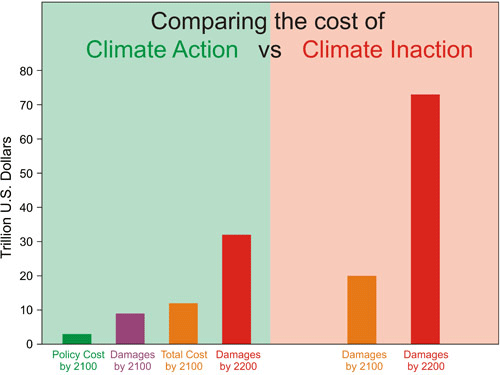
Climate change slams global economy, study from Stanford and Berkeley shows, SMH October 22, 2015 Eric Roston Climate change could cause 10 times as much damage to the global economy as previously estimated, slashing output by as much as 23 per cent by the end of the century, a new research paper from US universities Stanford and Berkeley finds.
Looking at 166 countries between 1960 and 2010, the researchers identified an optimal average annual temperature that coincides with peak productivity. It’s 13 degrees celsius, or approximately the climate of San Francisco’s bay area (Sydney’s mean temperature last year was 19.3 degrees).
Countries in the tropics, already hotter than this optimal temperature, are likely to face the most dramatic economic pain from warming, found the study, published in the latest issue of Nature. Countries at or just past the 13-degree annual average, like the US, China, and Japan, may be increasingly vulnerable to losses as the temperature warms. Northern countries well below the ideal average may see benefits as opportunities open up for agriculture and industry.
But this was the least robust finding. And even if the warming improves the lot of Scandinavia and Canada, such nations may not have many healthy trading partners left as others suffer. Also, higher temperatures in northern countries don’t take into account changes in precipitation, more extreme weather, and the many other risks in a warming world.
The authors made a clever end run around the biggest problem at the core of climate science: There’s only one Earth. Scientists usually like to run “controls,” situations that have identical conditions to the experiment except for the one thing being studied. Unfortunately for climate scientists, there’s no second Earth, filled with identical people doing identical things, where greenhouse gas emissions aren’t a problem.
So the study looks at national temperature records through time. Instead of studying a warming Nigeria and a control Nigeria, the scientists compared Nigerian economic output in average years with that in warming years………..
A dramatically higher damage function changes the cost/benefit analysis and makes potential policies that looked expensive yesterday much cheaper by comparison.
Another takeaway from the study is that over the last six decades, economies haven’t adapted well to hotter temperatures. “We’re optimistic on adaptation and its long-run potential,” Burke said. “Looking historically, we don’t see a lot of evidence that we’re good at that.”
A cliché repeated in some scientific circles suggests that there are three possible responses to climate change: mitigation (the word wonks like to use instead of prevention), adaptation, and suffering.
If the new study means our mitigation efforts are even weaker than previously thought, and we don’t have a proven track record of adaptation, are we setting ourselves up for suffering?
“That’s exactly right,” Burke said. “That’s exactly right.” http://www.smh.com.au/business/the-economy/climate-change-slams-global-economy-study-from-stanford-and-berkeley-shows-20151022-gkfl07.html#ixzz3pcaEBLtj
Rich countries put planet on course for irreversible climate change
 Unfair deal under discussion at last UN meeting before Paris negotiations http://www.foei.org/news/unfair-deal-discussion-last-un-meeting-paris-negotiations
Rich countries put planet on course for irreversible climate change
19 October, 2015 Rich countries – those most responsible for climate change – are putting us on course for irreversible and more devastating climate change instead of taking the urgently needed radical action to reduce their carbon emissions, Friends of the Earth International has warned.
The warning was issued as governments from around the world start a week-long gathering at the UN climate talks in Bonn to negotiate the text of a new global climate treaty to be agreed in Paris in December.
“Emission cut pledges made by rich countries so far are less than half of what we need to avoid runaway climate change. The draft Paris agreement being negotiated this week shows that many seem ready to accept irreversible and devastating consequences for people and the planet,” said Susann Scherbarth, climate justice and energy campaigner at Friends of the Earth Europe.
“This draft would even dismantle several key principles of the UN climate convention, such as equity. This is simply unacceptable. Richer countries must do their fair share. The new treaty must protect poorer countries and people, not let richer countries off the hook,” she added.
“Politicians are on track to fail us at their summit in Paris. Many politicians, under pressure from transnational corporate polluters profiting from fossil fuels and dirty energy, are promoting coal, fracking and nuclear energy at the UN and at national level. Instead, they should commit to drastic emission cuts and a transformation of our energy system,” said Dipti Bhatnagar, Friends of the Earth International’s climate justice coordinator.
Hundreds of thousands of people are paying with their lives for our governments’ continued inaction. But the real leaders, the people, are taking action, and showing the way with real solutions, such as community controlled renewable energy. Thousands of people from all over the world, including Friends of the Earth supporters, plan to go to Paris to make their voices heard during the United Nations climate summit and to mobilize further in 2016 and beyond.
“Our governments must stop dirty energy and urgently follow the real leaders – the people, not the polluters. More and more people are supporting the real solutions, resisting fossil fuel extraction and leading us towards climate-safe societies,” said Dipti Bhatnagar, Friends of the Earth International’s climate justice coordinator.
Climate justice organisations, social movements, faith groups, trade unions, environmental and development organisations released a new report today: ‘Fair Shares: A Civil Society Equity Review of Intended Nationally Determined Contributions (INDCs)‘.
The report shows that many developing countries are pledging to do more than their ‘fair share’ to cut emissions while rich countries are dangerously failing to pull their weight.
Based on the information governments have submitted to the UN about their INDCs, the report outlines by how much they pledge to cut their emissions.
The report argues that while ‘equity’ is a core principle in the UN process to find a global deal, countries have so far been allowed to determine their own targets on a purely national basis without reference to the scale of the global effort needed.
In the report, the fair share that each country should have in tackling climate change is measured based on their level of responsibility in causing the crisis as well as their capacity to tackle climate change at this moment in time.
Canada’s new PM Trudeau pledges action on climate change
 Incoming Canadian PM Justin Trudeau pledges new action on climate change ahead of Paris meeting, ABC News 22 Oct 15 The newly-elected Canadian leader Justin Trudeau will arrive in office with a pledge to improve the country’s battered environmental image, promising a new strategy for global climate negotiations in Paris this December.
The 43-year-old son of former prime minister Pierre Trudeau swept to victory with 39.5 percent of the popular vote, in an election that saw the highest voter turnout since 1993.
Although he has yet to say how he will achieve his goals, the Liberal Party leader faces a tough task meeting expectations.
He has less than 40 days before the Paris climate conference begins, hardly time for yet-unnamed energy and environment ministers to get up to speed, let alone to forge a common position with Canada’s 10 provinces on carbon emissions cuts.
Yet he has pledged a break from the policies of defeated prime minister Stephen Harper — a politician from Alberta’s oil patch who pulled Canada out of the Kyoto treaty and fought to shield the energy industry from global commitments to cut carbon emissions.
During the election campaign, Mr Trudeau criticised Mr Harper relentlessly for turning Canada into a “pariah” on climate change issues.
He pledged to attend the Paris conference, and then convene the country’s provincial premiers within 90 days to create national emissions targets under a framework that would allow provinces to set a price on carbon.
That party platform had almost no specifics but it raised expectations both domestically and abroad that Mr Trudeau would change Canada’s course on climate…………. http://www.abc.net.au/news/2015-10-21/canadian-leader-justin-trudeau-faces-climate-change-challenges/6872344
Global warming could cause disappearance of vast Alpine glacier
Vast Alpine glacier could almost vanish by 2100 due to warming, Reuters, Reporting by Alister Doyle; Editing by Frances Kerry GREAT ALETSCH GLACIER, SWITZERLAND | BY DENIS BALIBOUSE One of Europe’s biggest glaciers, the Great Aletsch, coils 23 km (14 miles) through the Swiss Alps – and yet this mighty river of ice could almost vanish in the lifetimes of people born today because of climate change.
The glacier, 900 meters (2,950 feet) thick at one point, has retreated about 3 km (1.9 miles) since 1870 and that pace is quickening, as with many other glaciers around the globe.
That is feeding more water into the oceans and raising world sea levels…….
even the Great Aletsch glacier, the biggest in the Alps and visible from space, is under threat from the build-up of greenhouse gases in the atmosphere from factories, power plants and cars that are blamed for global warming.

Andreas Vieli, a professor who heads the University of Zurich’s group of glaciology experts, said the Aletsch may lose 90 percent of its ice volume by 2100, with the lower reaches melting away.
“My kids are going to see a very different scenery in the Alps,” he said.
And on the ice, Aletsch guide Richard Bortis said, “if I stay on the glacier for several days … I can even see the changes myself.”
The glacier is a vast water reserve, important for irrigation and hydroelectric power……For glaciers around the globe, from the Andes to Alaska, rising temperatures mean that the volume lost from the summer melt exceeds snows that replenish the glaciers’ ice in winter. The Aletsch flows downhill at about 180 meters (590 feet) a year.
The World Glacier Monitoring Service says “the rates of early 21st-century mass loss are without precedent on a global scale” at least since measurements began around 1850.
Representatives from almost 200 governments will meet in Paris from Nov. 30-Dec. 11 to try to agree ways to curb greenhouse gas emissions.
The United Nations’ panel of climate scientists says sea levels are set to rise by between 26 and 82 cm (10 and 31 inches) by the late 21st century, after a gain of about 20 cm (8 inches) since 1900, partly fed by water from melting glaciers. Rising oceans are a threat to places from San Francisco to Shanghai, to low-lying Pacific atolls and large parts of Bangladesh…… http://www.reuters.com/article/2015/10/15/us-climatechange-summit-earthprints-swit-idUSKCN0S914A20151015
Climate change already impacting Bangladesh coastal communities
Rising salinity threatens Bangladesh’s coastal communities – experts Source: Thomson Reuters Foundation – Tue, 13 Oct 2015 Author: Pantho Rahaman Reporting by Pantho Rahaman; editing by Jumana Farouky and Laurie Goering -the Thomson Reuters Foundation, the charitable arm of Thomson Reuters, that covers humanitarian news, climate change, women’s rights, trafficking and corruption. Visitwww.trust.org/climate
“……..Climate change-induced alterations to sea level, temperature and rainfall are affecting freshwater supplies in low-lying coastal areas around the world, scientists and environmentalists say.
With more than a quarter of its population living in 19 districts facing or near the Bay of Bengal, Bangladesh is especially vulnerable, they say.
If access to fresh water continues to decrease at current rates in Bangladesh, experts warn, the country faces worsening drinking and irrigation water scarcity in the next few decades.
“Left unattended, 2.9 million to 5.2 million poor (people) in southwest coastal Bangladesh will face serious river salinity problems by 2050,” said Susmita Dasgupta, the lead environmental economist of the World Bank’s research department, in an email interview.
A DIRE PICTURE
A study by the World Bank and Bangladesh’s Institute of Water Modelling (IWM) published last year paints a dire picture of the future of freshwater supplies for the country’s coastal communities.
In a worst case scenario, the study predicts that the area served by freshwater rivers – those whose salt levels measure less than 1 part per thousand – in the country’s 19 coastal districts will drop from 41 percent to 17 percent by 2050.
Researchers believe sea-level rise, rising temperatures, changing rainfall patterns and a reduction of water flow in the country’s rivers could add to river salinity.
Losing freshwater could mean “significant shortages of drinking water” and a lack of irrigation water for dry-season agriculture, the study said.
“The impact of the increase in salinity is already being felt by the local communities, as they now have to purchase water from water treatment plants run by commercial operators,” said Ainun Nishat, a noted Bangladeshi environmentalist and one of the researchers on the World Bank study.
A dramatic decrease in the area served by freshwater rivers would also do damage to the region’s fishing industry, which supports approximately a half million families, researchers said…..
Of Bangladesh’s 19 southwestern coastal districts, the study pinpointed nine already in danger of being unable to protect their freshwater resources.
Even in the best case, by 2050 four districts – Barguna, Jhalokoti, Khulna, and Patuakhali – may no longer have regular access to fresh water from rivers. And in a worst-case scenario, Pirojpur district could lose 100 percent of its fresh river water, while Bagerhat and Barisal could lose over 90 percent, the study said.
In addition, the study said, five districts will suffer a serious shortage of water for dry-season agriculture.
“This worrying change might lead to a migration of people from southwestern Bangladesh,” Nishat said……http://www.trust.org/item/20151013101601-r0cyw/?source=jtDontmiss
Narrow window of opportunity to prevent rapid drastic fall in Antarctic ice sheets
the results leave a narrow opening through which humanity can slip. If temperatures remain within 2C (3.6F), the collapse of the shelves will stabilise and the sheets will remain mostly intact. Sea-level rise from Antarctica would remain within 23cm (9 inches) by 2300.
To achieve this, the authors said the world will have to follow the Intergovernmental Panel on Climate Change’s (IPCC) lowest emissions scenario.This requires global emissions to peak around 2020 and decline to below zero by 2100.
The new study “ultimately confirm[s] the suspicions of earlier glaciologists that the fate of ice shelves largely determines whether Antarctica contributes less than 1 metre or up to 9 metres to long-term sea-level rise”
 Antarctic ice sheets face catastrophic collapse without deep emissionscuts, http://www.theguardian.com/environment/2015/oct/14/antarctic-ice-sheets-face-catastrophic-collapse-without-deep-emissions-cuts Guardian, Karl Mathiesen, 15 Oct 15
Study finds that a global temperature increase of 3C would cause ice shelves to disappear, triggering sea-level rise that would continue for thousands of years. A team of researchers has found that steep cuts to emissions during the next decade are the only way to avoid a catastrophic collapse of Antarctic ice sheets and associated sea-level rise that will continue for thousands of years.

The study, published in the journal Nature on Wednesday, found that should the global temperature increase to around 3C (5.4F) above the pre-industrial era then the ice shelves that hold back the giant continental ice sheets would be lost over the next few centuries. Continue reading
Climate action can slow down the disastrous melting of Antarctic ice shelves
New study projects that melting of Antarctic ice shelves will intensify http://www.eurekalert.org/pub_releases/2015-10/whoi-nsp100915.phpWOODS HOLE OCEANOGRAPHIC INSTITUTION New research published today projects a doubling of surface melting of Antarctic ice shelves by 2050 and that by 2100 melting may surpass intensities associated with ice shelf collapse, if greenhouse gas emissions from fossil fuel consumption continue at the present rate.
Ice shelves are the floating extensions of the continent’s massive land-based ice sheets. While the melting or breakup of floating ice shelves does not directly raise sea level, ice shelves do have a “door stop” effect: They slow the flow of ice from glaciers and ice sheets into the ocean, where it melts and raises sea levels.
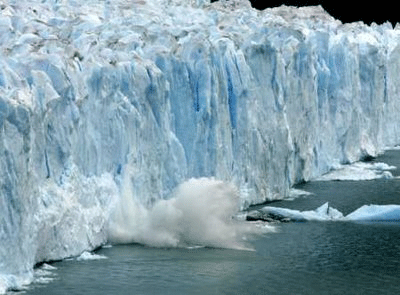
“Our results illustrate just how rapidly melting in Antarctica can intensify in a warming climate,” said Luke Trusel, lead author and postdoctoral scholar at Woods Hole Oceanographic Institution (WHOI). “This has already occurred in places like the Antarctic Peninsula where we’ve observed warming and abrupt ice shelf collapses in the last few decades. Our model projections show that similar levels of melt may occur across coastal Antarctica near the end of this century, raising concerns about future ice shelf stability.”
The study, published Oct. 12, 2015, in Nature Geoscience, was conducted by Trusel, Clark University Associate Professor of Geography Karen Frey, WHOI scientists Sarah Das and Kristopher Karnauskas, Peter Kuipers Munneke and Michiel R. van den Broeke of the Institute for Marine and Atmospheric Research Utrecht University, and Erik van Meijgaard of the Royal Netherlands Meteorological Institute.
To study how melting evolves over time and to predict future ice sheet melting along the entire Antarctic coastline, the scientists combined satellite observations of ice surface melting with climate model simulations under scenarios of intermediate and high levels of greenhouse gas emissions until the year 2100.
The results indicate a strong potential for the doubling of Antarctica-wide ice sheet surface melting by 2050, under either emissions scenario. However, between 2050 and 2100, the models reveal a significant divergence between the two scenarios. Under the high-emissions climate scenario, by 2100 ice sheet surface melting approaches or exceeds intensities associated with ice shelf collapse in the past. Under the reduced-emissions scenario, there is relatively little increase in ice sheet melting after the doubling in 2050.
“The data presented in this study clearly show that climate policy, and therefore the trajectory of greenhouse gas emissions over the coming century, have an enormous control over the future fate of surface melting of Antarctic ice shelves, which we must consider when assessing their long-term stability and potential indirect contributions to sea level rise,” said Frey.
Funding for the research was provided by NASA, the Doherty Postdoctoral Scholarship Program at WHOI, the Netherlands Earth System Science Centre, the Polar Program of the Netherlands Organization of Scientific Research, and the Dutch Ministry of Infrastructure and the Environment.
The Woods Hole Oceanographic Institution is a private, non-profit organization on Cape Cod, Mass., dedicated to marine research, engineering, and higher education. Established in 1930 on a recommendation from the National Academy of Sciences, its primary mission is to understand the ocean and its interaction with the Earth as a whole, and to communicate a basic understanding of the ocean’s role in the changing global environment. For more information, please visitwww.whoi.edu.
1 This Month





PLEASE OPPOSE HR 8255 AND S.3639 – bills would accelerate satellite deployment, with no environmental review or safeguards – https://ncstd5li.quorum.us/campaign/169331/
To see nuclear-related stories in greater depth and intensity – go to https://nuclearinformation.wordpress.com
-
Archives
- October 2026 (19)
- September 2026 (339)
- August 2026 (330)
- July 2026 (355)
- June 2026 (287)
- May 2026 (306)
- April 2026 (356)
- March 2026 (251)
- February 2026 (267)
- January 2026 (308)
- December 2025 (358)
- November 2025 (359)
-
Categories
- 1
- 1 NUCLEAR ISSUES
- business and costs
- climate change
- culture and arts
- ENERGY
- environment
- health
- history
- indigenous issues
- Legal
- marketing of nuclear
- media
- opposition to nuclear
- PERSONAL STORIES
- politics
- politics international
- Religion and ethics
- safety
- secrets,lies and civil liberties
- spinbuster
- technology
- Uranium
- wastes
- weapons and war
- Women
- 2 WORLD
- ACTION
- AFRICA
- Atrocities
- AUSTRALIA
- Christina's notes
- Christina's themes
- culture and arts
- Events
- Fuk 2022
- Fuk 2023
- Fukushima 2017
- Fukushima 2018
- fukushima 2019
- Fukushima 2020
- Fukushima 2021
- general
- global warming
- Humour (God we need it)
- Nuclear
- RARE EARTHS
- Reference
- resources – print
- Resources -audiovicual
- Weekly Newsletter
- World
- World Nuclear
- YouTube
-
RSS
Entries RSS
Comments RSS


