It’s hard to do, but global warming must be kept below 1.5 degrees
 Paris UN climate conference 2015: Is it possible to keep global warming below 1.5 degrees?, SMH, December 11, 2015 Tom Arup Environment editor, The Age In a significant shift, more than 100 countries – including Australia, the US, Germany and France – have agreed to support recognition of a goal to keep global warming below 1.5 degrees.

Until now, the common goal has been to keep warming to less than two degrees above pre-industrial levels.
So why is there sudden momentum for this more ambitious target? And what is the real world difference between 1.5 and 2 degrees?
The 1.5 degree goal has been the focus of a long-term push by small island states and least-developed African nations – the most vulnerable countries to climate change due to their geography and economic position.
A recent review by the UN climate body found that when temperatures do rise above 1.5 degrees, polar regions, high mountains, tropics and low-lying coastal regions will be most in the gun. In Africa, the ability to grow food will be hit, particularly for the sub-Sahara..
What needs to be done to get there?
This is the problem: the 2 degree goal is hard enough. The scientific models show 1.5 degrees is almost impossible.
Global emissions remainhigh, and the world has already warmed by one degree since industrial times. Glen Peters, a senior researcher with Oslo-based organisation CEIRCO, says at current rate of emissions the world will have produced enough carbon dioxide by 2020 to lock in 1.5 degrees warming.
And even if sharp cuts to emissions are made, there is a kicker. Temperatures would almost certainly first go over the threshold, meaning technology to draw carbon from the atmosphere will be needed to help cool the planet and bring it under 1.5 degrees……
If there are two targets in any Paris agreement, would having 1.5 degrees mean anything?
Its inclusion in the text would ensure the more ambitious target is considered alongside two degrees in any official reviews or assessments by the UN. And coupled with strong measures to encourage countries to cut emissions faster, those in favour say it could drive greater climate ambition.
For vulnerable countries, it could help them set a legal threshold to trigger a form of compensation – called loss and damage – to help them recover from climate change driven natural disasters. Loss and damage is another of the moving elements at the Paris talks.
Ultimately is 1.5 degrees scientifically realistic?
Let’s give the final word to Peters, who suggests: “Take a cold shower”. http://www.smh.com.au/environment/un-climate-conference/paris-un-climate-conference-2015-is-it-possible-to-keep-global-warming-below-15-degrees-20151209-gljtzu.html#ixzz3u4Qn6qB6
Nuclear lobby in frantic mode at Paris Climate Summit
Nuclear Champions go into Overdrive http://www.no2nuclearpower.org.uk/recent-additions/nuclear-champions-go-into-overdrive/ 11 Dec 15
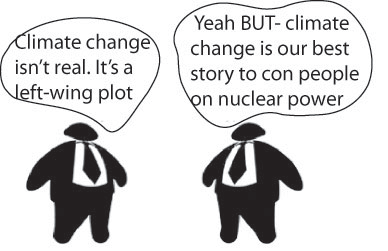 Pro-nuclear lobbyists and nuclear industry champions have been in overdrive during the Paris Climate Conference.
They seem to be making a desperate last-ditch effort to convince us all that nuclear power is an important part of the answer to the climate crisis with blatant attacks on those who envisage a future based on renewable energy without nuclear. (1) But the truth is that nuclear power is a dangerous distraction from what we really need to be doing. Because every pound spent on nuclear power could have been spent more effectively, making greater reductions in carbon emissions, nuclear is actually damaging efforts to tackle climate change.
NASA scientist James Hansen was in Paris to berate climate campaigners for failing to support nuclear power. But Hansen ignores renewables and energy efficiency, setting up a false choice between fossil fuels and nuclear. (2) Hansen doesn’t just want more nuclear power, but he wants next-generation nuclear power stations fuelled with weapons-useable plutonium, extracted from spent fuel in reprocessing plants like Sellafield, which runs the risk of more weapons proliferation problems in future. (3)
A big part of the pro-nuclear argument seems to be based on the idea that renewable energy currently provides only a tiny part of global electricity supply and cannot scale up rapidly enough to replace fossil fuels. Nuclear power, on the other hand, the argument goes, could do so. Hansen wants 115 new reactors to be built every year – yet the world has never built more than 40 a year. (4) Fortunately the concept of a world powered by 100% renewable energy is no longer seen as a pipedream but as a necessary and, more importantly, achievable goal at every level–from individuals to large corporations, and from small communities to large cities. (5)
Meanwhile the UK Government seems intent on demonstrating to the rest of the world that nuclear power is too expensive to play a part in tackling climate change and leads to the slashing of budgets for faster and much more effective ways of reducing carbon emissions. References …..
Carbon tax is best method to tackle global warming, say influential USA leaders
From Paris with love: US policy leaders see elegance in a carbon tax http://www.theage.com.au/comment/from-paris-with-love-us-policy-leaders-see-elegance-in-a-carbon-tax-20151211-gll7ye.html#ixzz3u4Og6BLZ Scot Lehigh
A group of influential academics say a carbon tax offers greater potential to combat
global warming than any other policy As negotiators labour away in Paris on climate change solutions, some United States policy luminaries are urging a simple, elegant remedy: a carbon tax.
“This single policy change … offers greater potential to combat global warming than any other policy, with minimal regulatory and enforcement costs,” they say in a public letter to the Paris participants.
So far, that idea has been embraced more by the left than the right, but signatories include George Shultz, who held four cabinet-level posts under Republicans presidents, culminating in his more than six years as secretary of state under Ronald Reagan; and Greg Mankiw, chairman of the Council of Economic Advisers under George W. Bush.
Three Nobel prize winners in economics have signed on: Columbia’s Joseph Stiglitz, former chief economist at the World Bank; University of Maryland economist Thomas Schelling; and Kenneth Arrow, professor emeritus at Stanford. And add a Nobel winner in physics to that list: Stanford’s Steven Chu, President Obama’s first secretary of energy.
So why a carbon tax? Because it’s comparatively easy to administer and would help get prices right. Although carbon dioxide emissions are the primary contributor to man-made global warming, the price of carbon-based energy doesn’t reflect the environmental harm it causes.
“This is pollution just like water pollution and other forms of air pollution,” notes Chu. “There are long-term costs … that should be incorporated in the cost of the fuel.” If a tax were assessed based on an energy source’s carbon content, the price of fossil fuels would rise significantly, rendering it less attractive compared with cleaner energy. Then markets could work their wonders.
The letter, sent under the auspices of the nonprofit Carbon Tax Center, lists these guiding principles: The tax should be calibrated to an energy source’s carbon content (the heaviest impact, obviously, would be on coal) and assessed at the industry level, which means on extractors or importers of coal, oil, and natural gas. The levy should start low but rise relatively quickly, on a predictable trajectory, to a substantial level. At least some of the resulting revenue should be used to offset the effect on lower-income households.
Chu, who wants all the carbon-tax revenue to be returned to citizens, says that could be done by giving seniors a bump in government-funded retirement pensions, employees a tax break, and the self-employed an income tax cut.
A common-across-multiple-countries carbon tax would be much easier to agree on and administer than a cap-and-trade system for carbon emissions, because there are far fewer points of potential disagreement, notes Harvard economist Martin Weitzman.
Further, there’s an easy solution to the free-rider effect: If several large countries implemented such a tax, they could then assess tariffs on products from countries that failed to do so. A desire to recoup that revenue for themselves “could be enough to induce countries to participate,” says Weitzman.
There’s one big problem, however: political resistance in the US, where, unlike in other countries, the conservative approach to global warming has been to wish it away.
But that’s changing. And as it does, the logic of a revenue-neutral carbon tax that complements markets may become more apparent.
“One scenario is that one, and then three, and then a dozen, and then a few dozen Republicans will peel away from the monolith, enough to allow for a congressional majority,” says Charles Komanoff, executive director of the Carbon Tax Center.
After all, it’s an idea with real appeal. Once you resign yourself to living in the real world, that is.
Mass Paris Protest Concluding Climate Summit
MASS PARIS PROTEST ON 12-12 TO CONCLUDE HISTORIC CLIMATE SUMMIT See more at: http://www.occupy.com/article/mass-paris-protest-12-12-conclude-historic-climate-summit#sthash.ZyIzAQ5c.dpuf , – BY NADIA PRUPIS THIS ARTICLE ORIGINALLY APPEARED ON COMMON DREAMS N PARIS EARLIER THIS WEEK, A PANEL OF ACTIVISTS, INCLUDING AUTHOR NAOMI KLEIN AND U.K. LABOUR PARTY LEADER JEREMY CORBYN, SPOKE TO A PACKED CROWD ON THE ROLE OF THE GLOBAL LABOR SECTOR IN THE CLIMATE JUSTICE MOVEMENT AND CALLED FOR MASS CIVIL DISOBEDIENCE TO BREAK FRENCH PRESIDENT FRANÇOIS HOLLANDE’S BAN ON DEMONSTRATIONS DURING THE COP21 SUMMIT.
Klein spoke candidly about the global climate agreement being hammered out by world leaders this month, stating, “The deal that will be unveiled in less than a week will not be enough to keep us safe. In fact, it will be extraordinarily dangerous.”
Wealthy nations have set up inadequate climate targets that could allow average global temperatures to rise by 3 or 4 degrees Celsius, Klein said – far higher than the agreed-on threshold of 2°C, which scientists say would cause catastrophic extreme weather events. The deal is going to “steamroll over crucial scientific red lines… it is going to steamroll over equity red lines… it is going to steamroll over legal red lines.”
“Which is why on December the 12 at 12 o’clock – that’s 12-12-12 – many activists will be peacefully demonstrating against the violation of these red lines,” Klein said, prompting a round of applause from the audience of roughly 800 trade unionists and other workers and activists.
The march will protest the French government’s crackdown on activism following the November 13 attacks that killed 130 people – and sparked a cross-border manhunt that many said flouted Europeans’ civil liberties. Klein has been an outspoken critic of the ban.
“We will be mourning the lives already lost to climate disruption, in solidarity with the lives lost to the tragic attacks here in Paris and enlarging that circle of mourning,” Klein said. “By taking to the streets, we will be clearly and unequivocally rejecting the Hollande government’s draconian and opportunistic bans on marches, protests, and demonstrations.”
“We will be rejecting the shameful preemptive arrests of climate activists… the restrictions on free speech and movement,” she continued. “Liberté is not just a word, and it doesn’t just apply to Christmas markets and football matches.”
Corbyn added, “We’ve taken the responsibility on ourselves to do something here and now. To stop the destruction of the world’s environment, to bring people together to prevent that happening, and above all, to bring people together not through fear, but through hope, through imagination, through optimism. Unleash the optimism, unleash the imagination, unleash the hope. That is the way forward.”
The panel also discussed the importance of a “just transition” to a clean future, particularly by converting to a system of community-owned renewable resource infrastructures—a process also known as energy democratization.
“When communities have control over the production and distribution of clean energy, that’s environmental justice,” said Judy Gonzalez, president of the New York State Nurses Union, who also spoke on the panel.
Corbyn also hit back at criticisms that a focus on sustainable energy, in tandem with a fossil fuel phase-out, is financially nonviable. “A more sustainable energy policy… one that would help the issues we face on a global level, would actually be an economic generator, rather than a problem,” he said.
Clara Paillard, president of the Public & Commercial Services Union culture sector, added, “If we want a just transition, we will need jobs – many, many jobs. Climate is a trade union issue.”
“In 2008, the U.K. found 800 billion pounds to save the bank. And in the U.K., tax avoidance and evasion represent over 100 billion pounds every year,” Paillard continued. “Let’s be clear, if the planet was a bank they would have already saved it.”
Climate Change Denialism – money buys opinion
Follow the money to climate science denial https://independentaustralia.net/environment/environment-display/follow-the-money-to-climate-science-denial,8472 Graham Readfearn 10 December 2015, A Greenpeace investigation uncovers a complex climate science denial machine involving cash from big business in exchange for “peer review” studies.Graham Readfearn from DeSmogBlogreports.
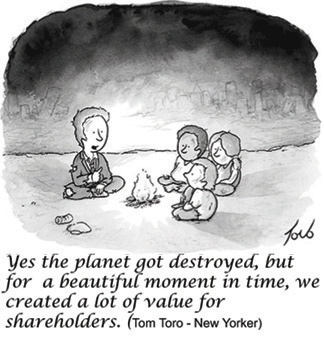
AN UNDERCOVER INVESTIGATION by environment group Greenpeace has found some of the world’s most vocal climate science denial groups were willing to accept cash from fossil fuel interests in return for writing articles and reports that reject the impacts of greenhouses gases. Continue reading
More articles on climate change
10 facts that show why cities are the key to climate change and global health
To mark cities day at the UN Climate Conference in Paris, here’s why urbanisation should be at the heart of any conversation about the planet’s future http://www.theguardian.com/cities/gallery/2015/dec/08/statistics-show-cities-key-future-planet-un-climate-change
Feted by Hollywood, city mayors take starring role in Paris climate talksWhen Leonardo di Caprio and Robert Redford arrived at the UN Climate Conference, their first priority was to talk to city leaders. It’s one indication of where the power to reduce climate emissions now lies, writes John Vidalhttp://www.theguardian.com/cities/2015/dec/07/hollywood-city-mayors-paris-climate-talks-di-caprio-redford
ExxonMobil is OK with a carbon tax Even Big Oil is ahead of the Republican Party when it comes to climate changeDecember 8, 2015. Even ExxonMobil says climate change is real. So why won’t the GOP?To understand how dangerously extreme the Republican Party has become on climate change, compare its stance to that of ExxonMobil.http://www.post-gazette.com/opinion/2015/12/08/ExxonMobil-is-OK-with-a-carbon-tax/stories/201512080009
The double and entwined dangers – nuclear and climate change
 increased reliance on nuclear energy to reduce carbon emissions will contribute to the risks of nuclear proliferation
a series of incidents in recent years, extreme weather events, environmental degradation and major seismic events can directly impact the safety and security of nuclear installations.
The Climate-Nuclear Nexus: Two Key Threats Endangering Future Generations, Huffington Post Jakob von Uexkull 5 Dec 15 Over the next two weeks, Heads of States are meeting in Paris to finally agree on a plan to curb climate change. Considering that climate change can exacerbate a range of interconnected transnational threats and crises that our generation faces today, such as extreme poverty, hunger, violent conflicts and pandemic disease, meaningful action is urgently needed.
Despite this, the proposed measures are again nowhere near proportional to the problem. In fact, the climate negotiations have so far been subjected to lack of information and misguidance on so-called solutions that should enable us to limit the rise in temperatures to 2°C. One particular problem is that too many of the intended nationally determined contributions (INDCs) still build on nuclear energy as a way for low-carbon development.
This is extremely problematic given that increased reliance on nuclear energy to reduce carbon emissions will contribute to the risks of nuclear proliferation. In these crucial times, current instabilities and geopolitical tensions are an important dynamic to consider. The increasingly aggressive nuclear threat postures between Russia and NATO in Europe, the rising nuclear tensions between China and US allies in the South China sea, and the excessive expenditures (over US$100 billion annually) on nuclear weapons consume resources required and undermine conditions conducive for tackling climate change in a cooperative manner. Further proliferation of nuclear weapons would make this even worse……
Nuclear energy is neither required for nor capable of solving the climate crisis. Nuclear energy lacks the capacity potential to significantly replace the huge amounts of fossil energy. In addition, the nuclear ‘fuel chain’ contains a variety of problems and risks, including the release of radioactive materials at every stage of the cycle and trans-generational safety problems from nuclear waste disposal. A very serious problem is the possibility, at various stages of the nuclear fuel chain, to divert nuclear technologies and know-how towards nuclear weapons development.
As the Word Future Council has highlighted in a recent report, climate change and nuclear weapons interact with each other in additional ways. Conflicts induced or exacerbated by climate change could contribute to global insecurity, which, in turn, could enhance the chance of a nuclear weapon being used, could create more fertile breeding grounds for terrorism, including nuclear terrorism, and could feed the ambitions among some states to acquire nuclear arms.
Furthermore, as evidenced by a series of incidents in recent years, extreme weather events, environmental degradation and major seismic events can directly impact the safety and security of nuclear installations. Moreover, a nuclear war could lead to a rapid and prolonged drop in average global temperatures and significantly disrupt the global climate for years to come, which would have disastrous implications for agriculture, threatening the food supply for most of the world. Finally, climate change, nuclear weapons and nuclear energy pose threats of intergenerational harm, as evidenced by the transgenerational effects of nuclear testing and nuclear power accidents and the lasting impacts on the climate, environment and public health from carbon emissions……
The World Future Council has been highlighting how climate change and nuclear weapons interact with each other through its ‘Climate-Nuclear Nexus’ project. Foreign Minister of the Republic of the Marshall Islands, Tony deBrum, received together with the People of the Marshall Islands the Honorary Right Livelihood Award on 30 November for initiating litigation in the International Court of Justice to ensure the nuclear-armed states uphold their disarmament obligations. http://www.huffingtonpost.com/jakob-von-uexkull/the-climate-nuclear-nexus_b_8707016.html?ir=Australia
Climate refugees will be needing help, whether or not COP21 talks produce a result
Even If Paris Climate Talks Succeed, Pacific Islanders Will Be Looking For New Homes, New Matilda, By Thom Mitchell on December 4, 2015 Australia’s Pacific Island neighbours already face poverty, and soon they’ll be facing even worse. Thom Mitchell reports from Paris.
More than 70 per cent of households in the Pacific Islands of Tuvalu and Kiribati to Australia’s north east say they’re likely to migrate if the impacts of climate change become any worse than they already are, according to research presented in Paris at a global summit on climate change yesterday.

Climate change already exists as a key driver of migration in the region, according to the study presented by the United Nations University’s Dr Koko Warner, which found it motivating 23 per cent of Kiribati’s migration and eight per cent of Tuvalu’s.
In Nauru – an island nation Australia uses to arbitrarily and indefinitely detain many of its asylum seekers – more than 40 per cent of households said they feel migration would be their likely response if sea level rise or flooding worsened.
All three islands are extremely vulnerable to the climate change impacts like sea level rise, saltwater intrusion, and storm surges, and the survey of more than 7,000 people across the three countries found that climate change was already affecting agriculture and fish stocks, and reclaiming or spoiling land.
Pacific Island leaders have been pushing the issue of climate-induced migration in the opening days of the Paris talks, arguing for a more ambitious target than the two degrees of average global warming the negotiations are aiming for. Tuvaluan Prime Minister Enele Sopoaga said the two degree target was about “saving economies,” and that for Pacific Islanders their preferred target of a 1.5 degree rise in temperatures is about “saving our people”……..
The President of Kiribati, Anote Tong, has repeated his calls for Australia to stop approving new fossil fuel developments at the talks, arguing that to be serious about cutting emissions you’ve got to be serious about not approving new coal mines.
“They use the excuse of the poor. But we are the poor, and we are speaking on our own behalf and we will be affected,” Tong said in November. Yesterday, Australia’s Environment Minister Greg Hunt argued that the reason he approved the massive Carmichael coal mine in Queensland is that, as a government minister, he makes assessments of projects against the existing law, that greenhouse gasses do not form part of that law, and that it would be “neo-colonial” to make decisions about another countries’ “energy future”…….
Greens Deputy Leader Larissa Waters is also at the Paris climate talks, and she said it is “dishonest and deceptive for Minister Hunt to say he hopes there are no climate refugees at the same time as he approves mega coal mines that he knows full well drive dangerous global warming and threaten our Pacific Island neighbours”.
“President Tong yesterday said that politicians have no compassion, only election cycles; and looking at the Turnbull Government’s dangerous climate policies it’s hard not to agree,” she said………
Phil Glendenning is the Director of the Pacific-focused Edmund Rice Centre and the Refugee Council of Australia, and he said a two degree rise in temperatures would be devastating for Tuvalu and Kiribati.
“Where will these people go? And more importantly, if there was some sort of arrangement where they had some sort of certainty of their future, that would give them a choice and ease the burden they feel at the moment, where they feel it’s all inevitable,” he said.
“I think Australia could play a creative role to become part of the solution rather than a fence or a barrier, but having said that most people want to stay in their homes,” he said. “If they do choose to move, though, Australia should make it easier rather than harder.”
Glendenning said it would be good to see “some sort of freedom of association that would be different but similar to the arrangements that New Zealand has with the Cook Islands and Niue; different but similar to what the Marshall Islands have with the United States”.
“Kiribati and Tuvalu do not have that access,” he said, “and yet both of those countries use Australian currency, and look to Australia as their largest neighbour”.
“Why not have a look at that, because if we look at it Tuvalu has a population the size of Lithgow (to Sydney’s north west) and Kiribati is the same size as Toowoomba (in Queensland’s Darling Downs).”
The study found that while the majority of respondents would prefer to migrate if climate impacts worsen, the average monthly per capita income is just US$12 across the three countries studied, and only a quarter of the population felt their households will have the financial means to relocate. https://newmatilda.com/2015/12/04/even-if-paris-climate-talks-succeed-pacific-islanders-will-be-looking-for-new-homes/
Global warming is increasing wildfires (and increasing the danger from nuclear facilities)

 New research finds that global warming is intensifying wildfires, Guardian, John Abraham, 3 Dec 15 A new study finds a human fingerprint in growing California wildfire risks A new paper was just published which provides a glimpse into the future of wildfires. The paper is titled “Extreme fire season in California: A glimpse into the future?” It was published as the second chapter of “Explaining Extreme Events of 2014” which is from by the American Meteorological Society and it is available here. The lead-in summary to the article is very much to the point. It states,
The fire season in northern California during 2014 was the second longest in terms of burned areas since 1996. An increase in fire risk in California is attributable to human-induced climate change.
The authors, Jin-Ho Yoon and colleagues make the point that California has been under drought conditions since 2012 and that the drought worsened recently. As is obvious, drought exacerbates the threat from wildfires. Last year, the California Department of Forestry and Fire Protection saw many more fires than have occurred in the prior five-year averages……
The authors then project into the future and ask what the current trends portend over the next few centuries. The predicted results are striking. We can expect to see increases in the drought index, the area under extreme threat of fires, and the days of fire danger. The following statement from the report provides a great summary.
The increase in extreme fire risk is expected within the coming decade to exceed that of natural variability and this serves as an indication that anthropogenic climate warming will likely play a significant role in influence California’s fire season…..http://www.theguardian.com/environment/climate-consensus-97-per-cent/2015/dec/03/new-research-finds-that-global-warming-is-intensifying-wildfires
$3.4 Trillion Fossil Fuel Divestment Globally
 Fossil Fuel Divestment Reaches $3.4 Trillion Globally New Matilda, By Thom Mitchell on December 3, 2015
The President of the Rockefella Brothers Fund sees fossil fuel investments as increasingly risky, and the former Development Minister of France is heralding a “cultural shift” in financial markets. Thom Mitchell reports.
Over 500 funds managing nearly three and half trillion dollars have joined the global fossil fuel divestment movement, a panel of environmentalists and financial heavyweights announced at the United Nations climate change summit in Paris today.
Campaigners spearheading the fast-growing movement at climate advocacy groups 350.org and Divest-Invest said that in the past 10 weeks alone more than 100 institutions had promised to ‘divest for Paris’, including the city of Melbourne and the insurance company Allianz.
The $3.4 trillion figure represents funds ‘under management’, not funds invested directly in fossil fuels, and many of the commitments represent only a partial pull-out from polluting energy of at least one form of fossil fuel (coal, oil, or gas).
“Because of their varying degrees of disclosure with these commitments, we don’t have the exact total of the amount divested, but we do know that standard portfolios contain around 3.7 per cent of fossil fuels,” said May Boeve, Executive Director of 350.org. “But the point here has never been exactly how much is pulled out in that way… and that’s for a simple reason: A growing number of investors, representing a growing amount of capital, do not want to be associated with this industry any longer,” she said.
“It is a rogue industry, and that is what these commitments represent. It demonstrates that investors are taking climate risk extremely seriously.”
The $860 million Rockefella Brothers Fund was one of the first big institutions to divest from fossil fuels, in September last year, and the philanthropic organisations’ President Stephen Heintz told media that since that time the divestment movement had grown from around $50 billion in assets under management, to $3.4 trillion.
“You can see that this movement is rapidly growing, and it’s because of two things: There is a moral imperative to save the planet, and to do so we need to end the fossil fuel era now, and it also makes economic sense,” he said.
“As governments from around the world come together to set the framework in place for moving us quickly into the fossil fuel-free era, those assets are going to become less and less valuable.”…….https://newmatilda.com/2015/12/03/fossil-fuel-divestment-reaches-3-4-trillion-globally/
France to spend billions on African renewable energy projects
COP21: France to spend billions on African renewable energy projects Guardian, 1 Dec 15
François Hollande tells Paris climate summit that his government will double investments in wind, solar and hydropower to €2bn France plans to spend billions of euros in renewable energy and other environmental projects in its former west African colonies and across Africa over the next five years, President François Hollande said on Tuesday.
Africa produces little of the greenhouse gases such as carbon dioxide, produced by burning fossil fuels, linked by scientists to rapid climate change. But it is particularly vulnerable to a changing climate, as much of its population is poor, rural and dependent on rain-fed agriculture.
Hollande told a conference on Africa, held as part of climate change talks in Paris, that his government would double investments in renewable energy generation, ranging from wind farms to solar power and hydroelectric projects, across the continent to €2bn between 2016 and 2020……..
African leaders want the biggest polluting nations to commit to financing as part of contributions to an internationally administered Green Climate Fund, that hopes to dispense $100bn a year after 2020 as a way to finance the developing world’s shift towards renewables. http://www.theguardian.com/environment/2015/dec/01/cop21-france-to-spend-billions-on-african-renewable-energy-projects
Call for religious role in combatting global warming
Why battling climate change requires a spiritual rebirth, The Gazette By: Matthew Fox November 30, 2015 On Monday (Nov. 30) representatives from 195 nations will gather in Paris to grapple with the greatest moral issue of our time — the war against Mother Earth. French Foreign Minister Laurent Fabius warns that “It is life on our planet itself which is at stake,” and there is an “absolute urgency” to turn things around.
This is not political rhetoric or religious apocalypticism — it is science that is drawing (finally) nations together around our real foe: the environmental danger to our planet. If our forays into space the past 40 years have demonstrated anything they have instructed us that Earth is very special in the universe. Yes, we have discovered exoplanets we hope might some day reveal other forms of life — and hopefully of intelligent life — but for now, and in our neighborhood, Earth stands alone.
We are being urged as a species to wake up and get out of our narcissistic anthropocentrism, that is to say our preoccupation with all things human, at the expense of all our relations with whales and dolphins, elephants and tigers, birds and redwoods, rain forests and rivers, oceans and lakes.
Will we take this opportunity to wake up from denial? Whole political parties in America as well as giant industries supporting such head-in-the-sand candidates seem to prefer denial to truth. Yet only the truth will set us free and get us working…….
I define spirituality as “waking up” and I am not alone in this — the great Indian mystic of the 15th century, Kabir, said: “You have been sleeping for hundreds of millions of years. Why not wake up this morning?” Both St. Paul and Jesus talk about “waking up.” We humans have been in a deep sleep, especially in the West, mesmerized by our own doings and gadgets and projections, but the crisis at hand is a wake-up call.
Our religions must change and be part of the solution and not the problem. ……Each religion must act swiftly and work with, not against, science. Pope Francis’ encyclical “Laudato Si’” is a good example of this effort. Science too must work out of wisdom paradigms of justice and compassion. Education must be similarly reborn. The wisdom of indigenous tribes is indispensable for this change of consciousness for they have been in communion with Mother Earth and her creatures for thousands of years. They are leaders in a more-than-human awareness…….http://gazette.com/why-battling-climate-change-requires-a-spiritual-rebirth-commentary/article/1564615
Marshall Islands – first nuclear destruction, now climate destruction as well
A ground zero forgotten, WP, Dan Zak, 29 Nov 15 The Marshall Islands, once a U.S. nuclear test site, face oblivion again A boy and his grandfather are fishing in the shallows off their tiny island, a dot of green in the sapphire eternity between Hawaii and Australia. The flash comes first, silent and brighter than the sun, from a four-mile-wide fireball beyond the horizon. The sky turns blood red. Wind and thunder follow.
Even 61 years after, Tony deBrum gets “chicken skin” when sharing his memories of the largest American nuclear-weapons test — the biblical, 15-megaton detonation on Bikini Atoll, 280 miles northwest of his island. Its flash was also seen from Okinawa, 2,600 miles away. Its radioactive fallout was later detected in cattle in Tennessee.
About this story: This article was made possible by a grant from the Pulitzer Center on Crisis Reporting.
“We pause today to remember the victims of the nuclear-weapons testing program,” deBrum says to a couple hundred people seated in a convention hall in Majuro, the capital of the Marshall Islands, a little-known nation that was entrusted to the United States as a primitive society 68 years ago.
It’s March 2 at an event marking Nuclear Victims Remembrance Day, and the boy in the shallows is now the foreign minister of the Marshall Islands, which has entered the 21st century as part trust-fund baby, part welfare state. Its elders have endured burns that reached to the bone, forced relocation, nightmarish birth defects, cancers in the short and long term. Its young people have inherited a world unmade, remade and then virtually forgotten by Washington, D.C.
The victims of the tests “have been taken from us before their time,” deBrum says, so that Americans could learn more about the “effects of such evil and unnecessary devices.”
From 1946 to 1958, the United States conducted 67 tests in the Marshall Islands. If their combined explosive power was parceled evenly over that 12-year period, it would equal 1.6 Hiroshima-size explosions per day.
This is not something one gets over quickly.
Payday at Bikini Jack’s“Washington — and this is just my personal opinion — I think they’re going out of their way to wash their hands of the Marshalls,” says Jack Niedenthal, a Pennsylvanian who arrived in the islands with the Peace Corps in 1981 and eventually became one of their unofficial representatives to the United States. “You look at what they spend on Iraq and Afghanistan, and it’s billions upon billions. For four bullets into a tree in Iraq, they could fix this entire place.”……
The RMI, as the republic is called, is both vast and slight. There are 1,200 islands — spread out over a chunk of ocean the size of Mexico — whose combined land area is roughly equivalent to D.C.’s. American arrogance and American generosity collide here, and paradox reigns. It was once called the most contaminated place on Earth, yet it has the dizzy beauty of a mirage. Wealthy foreigners spirit themselves to surfer paradise, past islanders living with sky-high rates of diabetes and thyroid abnormalities. In a place where the United States has sunk billions, children play in landfills. The Marshallese couldn’t exist without the ocean, but now sea-level rise attributed to global warming imperils their homes and lives.
Seven thousand miles away is Washington, its tough-love parent, delivering an annual allowance for the RMI’s operations while trying to close the book on a history of destruction and sadness. The United States has been an epic force here for 70 years, and decisions made over the next decade could save the islands or seal their fate……
A chosen people
On a Sunday after church in 1946, a Navy commodore met with the people of Bikini Atoll and told them they were like the Israelites, a chosen people, and that perfecting the atomic bomb would deliver mankind from future wars. Within one month of that conversation, the Bikinians had boarded U.S. ships for relocation. Within five, the first two tests had been conducted.
“We located the one spot on Earth that hadn’t been touched by the war and blew it to hell,” Bob Hope reportedly once said.
“Paradise Lost” with Lijon Eknilang – Marshall Islands
The Marshallese culture is rooted in a history of resource sharing, ecological balance, of an intimate knowledge of how the winds blow, how the waves break, how the stars slip across the sky. Over the past 70 years, though, victimhood, corruption and dependency have produced a different kind of fallout.
“We have basically destroyed a culture,” says Glenn Alcalay, an anthropology professor at New Jersey’s Montclair State University who took part in Greenpeace’s second evacuation of Rongelap in 1985. “We’ve stolen their future. When you take the future from a people, you’ve destroyed them.”…….
cancer and birth defects are the modern connections to the past. There are still radiation-related cancers that have yet to develop or be diagnosed in the population of Marshallese who were on the islands between 1948 and 1970, according to a 2004 report by the U.S. National Cancer Institute. Everyone seems to have a relative whose cancer falls on the Energy Department’s list of ailments traceable to radiation…..http://www.washingtonpost.com/sf/national/2015/11/27/a-ground-zero-forgotten/
Republic of Marshall Islands seeks refuge in USA for its climate (and nuclear) victims
A ground zero forgotten, WP, Dan Zak, 29 Nov 15 “……Last year the RMI filed lawsuits against the United States and the eight other nuclear-armed nations, alleging noncompliance with the Non-Proliferation Treaty. The news caught most Marshallese, including RMI officials, by surprise. The Nuclear Age Peace Foundation in California engineered the lawsuits in collaboration with deBrum, who has been their cheerleader. The suits were filed in U.S. District Court in San Franciscoand to the International Court of Justice.
The U.S. Justice Department, in its motion to dismiss, implied that the lawsuit is a stunt that has no business in the court system. A federal judge in San Francisco dismissed the suit in February (the RMI appealed), and it’s a nonissue in the international court, since the U.S. government does not recognize that court’s jurisdiction.
No matter, deBrum says. It’s the principle of the thing, particularly in this year of the 70th anniversaries of Hiroshima and Nagasaki, and with next year’s 70th anniversary of the first atomic test in the Marshalls.
He comes to the country he’s suing a couple of times a year, to preach about the connection he sees between a nuclear past and a climate-change future. Just 45 minutes away from Majuro by air, 500 Bikinians are struggling on Kili, a rocky island without a lagoon where their elders were exiled. A ship bearing food and diesel arrives every three months, if the weather behaves. In February, the yearly king tide washed completely over the island, fouling freshwater reservoirs.
DeBrum is lobbying Congress to amend U.S. law to definitively allow Bikinians to use their resettlement funds to relocate to the United States.
“How can you separate nuclear from climate with Bikini and Kili?” deBrum says during a reception last month in the Rayburn House Office Building, where anti-nuclear nonprofit groups gave him an award for his work. “It’s the classic case of one meeting the other. You have nuclear refugees on an island affected by climate change.”…….
The U.S. Embassy considers the Marshall Islands to be on the front line of climate change, which manifests most dramatically during late-winter king tides. In March of last year, 1,000 people evacuated Majuro as the surge pulled homes into the ocean.
“Climate change is my nuclear experience,” says Mark Stege, 37, who grew up in Majuro, studied at Columbia University and is now director of the Marshall Islands Conservation Society. “I can see a lot of connections at the emotional level, and the community level, at the individual family level. The same questions are relevant in both situations. There’s this really deep sense of loss.”….http://www.washingtonpost.com/sf/national/2015/11/27/a-ground-zero-forgotten/
Melbourne, Australia, starts the wave of global climate marches
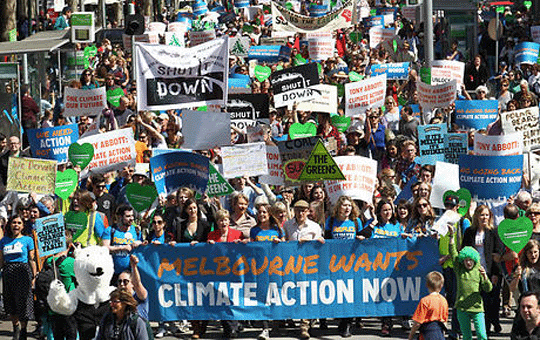 Thousands gather at Melbourne CBD rally ahead of Paris climate summit, The Age, [excellent photos and video] November 27, 2015 -Chloe Booker, Timna Jacks, With Tom Cowie and AAP
Tens of thousands of people have gathered in Melbourne’s CBD to demand world leaders take strong action to protect the planet at the Paris climate change conference.
The so-called People’s Climate March was one of hundreds of rallies being held around the world in the lead up to the crucial meeting. Members of The Cat Empire performed for the crowd, which included Opposition Leader Bill Shorten and Greens Senator Richard Di Natale.
A sea of placards stretched down Bourke Street from Spring Street to Swanston Street and along Swanston Street from Bourke Street to La Trobe Street. There was a stand-off between banked-up traffic and protesters at Exhibition Street as frustrated drivers honked their horns and the crowd erupted in cheers and shouts.
Stunned diners observed the march from outside Bourke Street cafes, and some heckled the demonstrators. Sections of the crowd were more like a party, with some dancing and clapping to a marching band dressed in green-glittered uniforms, while others swayed to the strumming of a guitar. ……..
Andy Parsons, an Environment Victoria volunteer who attended both rallies, said environmentalists supported the right of Aboriginal people to live independently.”The Aboriginal people lived sustainably for thousands of years. Us white people could learn a lot from them,” he said.
Aboriginal man Robbie Thorpe said he saw a parallel between the “genocide” of his people and what he called the “ecocide” of Australia’s natural environment. “We are the custodians of the land and the language. Only we know how to talk to our land. Without the Aboriginal people the land can’t survive and without the land, we can’t survive.” http://www.theage.com.au/victoria/thousands-expected-at-melbourne-cbd-rally-ahead-of-paris-climate-summit-20151127-gl9lz8.html
1 This Month





PLEASE OPPOSE HR 8255 AND S.3639 – bills would accelerate satellite deployment, with no environmental review or safeguards – https://ncstd5li.quorum.us/campaign/169331/
To see nuclear-related stories in greater depth and intensity – go to https://nuclearinformation.wordpress.com
-
Archives
- October 2026 (19)
- September 2026 (339)
- August 2026 (330)
- July 2026 (355)
- June 2026 (287)
- May 2026 (306)
- April 2026 (356)
- March 2026 (251)
- February 2026 (267)
- January 2026 (308)
- December 2025 (358)
- November 2025 (359)
-
Categories
- 1
- 1 NUCLEAR ISSUES
- business and costs
- climate change
- culture and arts
- ENERGY
- environment
- health
- history
- indigenous issues
- Legal
- marketing of nuclear
- media
- opposition to nuclear
- PERSONAL STORIES
- politics
- politics international
- Religion and ethics
- safety
- secrets,lies and civil liberties
- spinbuster
- technology
- Uranium
- wastes
- weapons and war
- Women
- 2 WORLD
- ACTION
- AFRICA
- Atrocities
- AUSTRALIA
- Christina's notes
- Christina's themes
- culture and arts
- Events
- Fuk 2022
- Fuk 2023
- Fukushima 2017
- Fukushima 2018
- fukushima 2019
- Fukushima 2020
- Fukushima 2021
- general
- global warming
- Humour (God we need it)
- Nuclear
- RARE EARTHS
- Reference
- resources – print
- Resources -audiovicual
- Weekly Newsletter
- World
- World Nuclear
- YouTube
-
RSS
Entries RSS
Comments RSS

