Trump will put all USA climate action into Limbo
Trump said he will rescind any regulations that unduly burden energy development, including the Clean Power Plan, which, if it survives legal challenges, was to have been the cornerstone of Obama’s climate action legacy and the main policy for realizing the nation’s Paris goals. He also said he would abolish the Waters of the U.S. rule, which the fracking industry in North Dakota has opposed. Trump said he would urge TransCanada to renew its permit application for the Keystone XL pipeline. Within his first 100 days, Trump said he would lift moratoriums on fossil fuel production in federal areas, which could clear the way to new coal leasing in the West as well as coastal oil drilling, not only in the Arctic but also the Atlantic and potentially, the Pacific………
For his energy and environmental policy team, Trump has selected one of the nation’s most prominent climate contrarians, Myron Ebell of the Competitive Enterprise Institute, to head his EPA transition. Ebell worked on policy for the tobacco industry before his years of work opposing environmental regulations and sowing doubt on climate science. Trump is also reported to be considering Harold Hamm, chief executive of fracking industry leader Continental Resources, for energy secretary, and Forrest Lucas, co-founder of oil products company Lucas Oil, for interior secretary……..
the early battle lines will be Trump’s regulatory proposals.

 In Trump, U.S. Puts a Climate Denier in Its Highest Office and All Climate Change Action in Limbo
His anti-regulatory stances, support of unfettered fossil fuel production, and his threat to pull the U.S. out of the Paris agreement, send ripple effects worldwide.BY MARIANNE LAVELLE, INSIDECLIMATE NEWSNOV 9, 2016 Donald Trump’s astonishing victory has turned the world of climate action upside down, setting back U.S. environmental policy and threatening the international drive to cut carbon pollution and slow global warming. Continue reading
Even under Trump, there will still be reason for climate action hope
There’s no way around it: Donald Trump looks like a disaster for the planet Vox by Nov 9, 2016 “…….So is there any hope things won’t actually be this bad? Okay, now time for a deep breath.
 Even under Trump, there will still be reason for hope. Political change unfolds in unexpected ways, and not everything on Earth revolves around the machinations of the US federal government. So here are a few reasons to think the fight against climate change is not yet lost:
- States like California and New York are still pursuing their own ambitious climate policies, and it’s possible those efforts could be so successful that other states decide to follow suit.
- Likewise, wind power, solar power, and electric cars will keep getting cheaper — it’s possible they’ll acquire a self-sustaining momentum, even without support from the US government. Or maybe some other new low-carbon technologies will emerge to shake up climate politics. (Small modular reactors, anyone?)
- Climate activists will continue to push for action at local levels — much as they did during the George W. Bush years, when the Sierra Club began blocking a major planned expansion of coal power. It’s possible that opposition to Trump will galvanize a new generation of climate activists who find creative ways to address global warming.
- Other countries still have their own reasons for tackling climate change, even China and India (which, note, is choking on deadly levels of air pollution in Delhi right now). It’s possible that Trump’s recalcitrance on climate change could motivate the rest of the world to redouble their efforts at curtailing emissions without us.
- Heck, it’s even possible that Trump and the GOP could have a change of heart and decide that global warming is a real issue that needs to be taken seriously. It’s possible that Republicans could balk at repealing all these pollution regulations, realizing that they’re actually quite popular. Stranger things have happened.
So lots of stuff is possible. Climate change will continue to be a defining issue for generations, long after Donald Trump is gone — and there’s never reason to give up. But the landscape has undeniably shifted. The prospect of staying below 2°C looks increasingly bleak. Right now Trump has given every indication that he wants to gamble with the future of the only planet around that’s known to support life. And it’s a wildly irresponsible bet.
Further reading
— The 6 most important parts of Donald Trump’s energy policy
— From my colleague Ezra Klein: It’s now on America’s institutions — and the Republican Party — to check Donald Trump
— Andy Revkin offers a somewhat more optimistic take on environmentalism under Trump here. I disagree with his assessment of global politics, but obviously I could be wrong! His take is worth reading. http://www.vox.com/2016/11/9/13571318/donald-trump-disaster-climate
Donald Trump wants to blow up the global climate effort
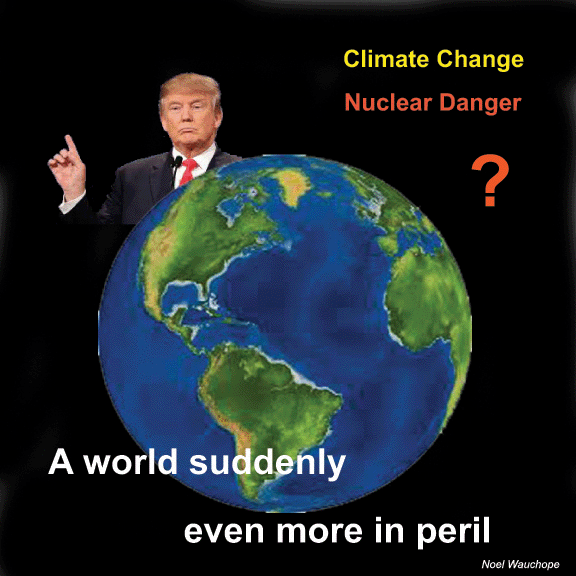 There’s no way around it: Donald Trump looks like a disaster for the planet Vox by Nov 9, 2016 This is happening. Donald Trump is going to be president of the United States.
And there’s no way around it: What he’s planning to do looks like an absolute disaster for the planet (and the people on it). Specifically, all the fragile but important progress the world has made on global warming over the past eight years is now in danger of being blown up.
Trump has been crystal clear about his environmental plans. Much of the media never wanted to bring it up, never wanted to ask about it in debates, never wanted to turn their addled attention away from Hillary Clinton’s email servers to discuss what a Trump presidency might mean for climate change. But the warning signs were there:
- Trump called global warming a Chinese hoax. He couldn’t have been blunter about this. He also tapped Myron Ebell, an avowed climate denier, to head his EPA transition team.
- Trump has said, straight up, he wants to scrap all the major regulations that President Obama painstakingly put in place to reduce US carbon dioxide emissions, including the Clean Power Plan. If Trump wants to rewrite these rules through executive action, he can. Or Republicans in Congress could try to pass a law forbidding the EPA from ever regulating CO2 again.
- Trump has also hinted he wants to downsize the EPA. “What they do is a disgrace,” he has said. He now has the power to rewrite or scale back other regulations on mercury pollution, on ground-level ozone, on coal ash, and more.
- Trump has said he wants to repeal all federal spending on clean energy, including R&D for wind, solar, nuclear power, and electric vehicles. This would require Congress, but it’s not impossible.
- Trump has said he wants to pull the United States out of the Paris climate deal. There’s nothing stopping him here. Technically, the US can’t officially withdraw for four years, but for all practical purposes, the Trump administration could ignore it.
So what happens if Trump gets his way? More air pollution, more carbon emissions. Exactly how much more remains to be seen. There are, after all, plenty of other factors pushing down US emissions that Trump has no control over. Natural gas from fracking would continue to kill coal power. Wind and solar would continue to grow. But it’s nearly impossible to imagine emissions under Trump dropping at the sharp pace necessary to slow global warming. And emissions could even rise, as this analysis from Lux Research suggests.
The world is making cautious progress on global warming. Trump wants to blow that all up.
For the last eight years, the Obama administration has been using every regulatory lever at its disposal to push down US greenhouse gases — aiming for a 28 percent cut below 2005 levels by 2025. Obama has also been trying to coax countries like China to participate in a global climate deal, in which every country would voluntarily pledge to restrain its emissions and meet regularly at the UN to ratchet up ambitions over time.
That plan finally came to fruition last December, when the world agreed to a sweeping climate agreement in Paris. The Paris deal was always delicate, and the current pledges weren’t nearly enough to avoid dangerous global warming, defined as 2°C or more. But the deal was a start. And the hope was that by cooperating and exerting diplomatic pressure on each other, all countries would steadily increase action over time.
Now it’s in peril. If Trump yanks the United States out of the Paris agreement, the deal won’t die, but momentum could wane. One can imagine China and India deciding they don’t need to push nearly as hard on clean energy if the world’s richest and most powerful country doesn’t care. At best, progress would slow. At worst, the entire arrangement could falter, and we set out on a path for 4°C warming or more.
These are decisions that will reverberate for thousands of years and affect hundreds of millions of people. We can’t easily undo the effects of all that extra carbon dioxide we keep putting into the air. Without drastic reductions in emissions (or possibly risky geoengineering), global temperatures will keep rising. The ice caps in Greenland and Antarctica will keep melting. Once that process gets underway, we can’t reverse it. The seas will rise. South Florida will eventually vanish beneath the oceans. Megadroughts will become more likely in the Southwest. For generations and generations.
This is the future of humanity at stake. We’re at risk of departing from the stable climatic conditions that sustained civilization for thousands of years and lurching into the unknown. The world’s poorest countries, in particular, are ill-equipped to handle this disruption. http://www.vox.com/2016/11/9/13571318/donald-trump-disaster-climate
The world is already experiencing dramatic impacts of human-induced climate change
Climate change already dramatically disrupting all elements of nature https://www.sciencedaily.com/releases/2016/11/161110115540.htm Source: Wildlife Conservation Society
- Summary:
- Global changes in temperature due to human-induced climate change have already impacted every aspect of life on Earth from genes to entire ecosystems, with increasingly unpredictable consequences for humans, according to a new study.

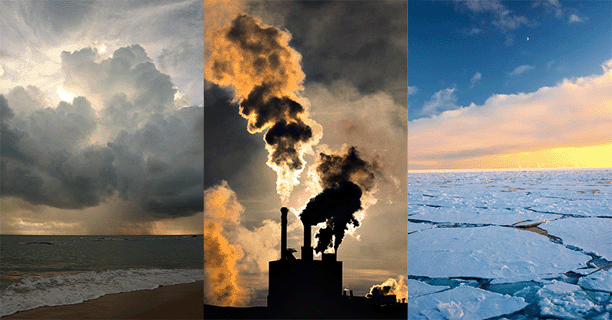
Global changes in temperature due to human-induced climate change have already impacted every aspect of life on Earth from genes to entire ecosystems, with increasingly unpredictable consequences for humans — according to a new study published in the journal Science.
The study found a staggering 80 percent of 94 ecological processes that form the foundation for healthy marine, freshwater and terrestrial ecosystems already show signs of distress and response to climate change.
Impacts to humans include increased pests and disease outbreaks, reduced productivity in fisheries, and decreasing agriculture yields.
“There is now clear evidence that, with only a ~1 degree C of warming globally, very major impacts are already being felt,” said study lead author Dr Brett Scheffers of the University of Florida. “Genes are changing, species’ physiology and physical features such as body size are changing, species are rapidly moving to keep track of suitable climate space, and there are now signs of entire ecosystems under stress.”
Said the study’s senior author, Dr. James Watson from the Wildlife Conservation Society and University of Queensland: “The level of change we have observed is quite astonishing considering we have only experienced a relatively small amount of climate change to date. It is no longer sensible to consider this a concern for the future. Policy makers and politicians must accept that if we don’t curb greenhouse gas emissions, an environmental catastrophe is likely.”
But the study also points to hope as many of the responses observed in nature could be applied by people to address the mounting issues faced under changing climate conditions. For example, improved understanding of the adaptive capacity in wildlife can be applied to our crops, livestock and fisheries. This can be seen in crops such as wheat and barley, where domesticated crops are crossed with wild varieties to maintain the evolutionary potential of varieties under climate change.
Paris climate change agreement will not be derailed by Donald Trump
 Donald Trump: Paris climate change delegates hopeful presidency will not derail agreement http://www.abc.net.au/news/2016-11-10/trump-will-not-derail-paris-climate-agreement-delegates-say/8013386 The World Today By Katherine Gregory Delegates at annual climate change talks in Morocco are hopeful Donald Trump’s presidency will not derail progress made on action.
Representatives from 200 countries are at the Marrakech summit finalising the details of the Paris Agreement on climate change, which commits governments to keeping a global temperature rise to well below 2 degrees Celsius.
Tina Johnson from the US Climate Network said the movement had its work cut out for it now. “I think if we have a scenario where the action that he takes is contrary to where we feel it needs to be going, it will impact us, of course, because it means we have to do more work to make sure that he actually is moving in the direction that we need him to move in,” she said.
Mr Trump is a well-known climate change sceptic and has threatened to remove America from the treaty.
But Australia’s Climate Council CEO Amanda McKenzie said it was going to be difficult for him to do that. “It’s also important to note that the US climate action has come from the states,” Ms McKenzie said. “California has been driving much of the climate action and support for renewable energy in the US.
“As well as [US President Barack] Obama’s work has through regulations — which are very hard to unwind once they’re changed and in place and have impacts on the community.
“So it’s very hard for Trump to wind back international or domestic action on climate change.
“That said, of course it is a blow if he does want to take the US out of the Accord, but we need to remember this agreement is more than just one country.”
Trump says climate change a Chinese hoax
Mr Trump has previously labelled climate change a hoax and conspiracy by the Chinese.
He gave similar comments in July this year when interviewed by Bill O’Reilly from Fox News.
“If you look at what’s going on in China and all these other countries, they talk and laugh behind out back at what we’re doing,” Mr Trump said.
“We want clean air, clean water. I’ve got many environmental awards.” Mr O’Reilly asked him: “OK, but did you ever call climate change a hoax?”
Mr Trump responded: “Well I might have, because when I look at things that are going on.”
“In fact, when you look at Europe, where they had their big summit a couple of years ago, where people were sending out emails, scientists practically calling it a hoax.”
At the Marrakech summit, Greenpeace china policy advisor Li Shuo said Mr Trump’s presidency meant climate change was now a geopolitical battle between the US and China.
“We urge the next US president to take that into consideration and to be mindful of the very delicate agreement it has reached with China, in terms of US and China doing bilateral agreements, and to honour the commitments and the targets it has made with China and also in the Paris Agreement.”
‘It may mean other countries do more’Ms McKenzie said it was now up to other countries to step up to the plate. “Because so many other countries have made a substantial commitments to this, and countries like China, Brazil, the EU, Germany have all been pushing ahead on this, and I think it’s unlikely they will go backwards in their climate action,” she said.
“So it may mean other countries do more and take more leadership.”
Mr Trump has flagged he will stop all US Government funding of clean energy projects and climate change initiatives.
Experts are concerned that may also include dumping Mr Obama’s $US3 billion pledge to the Green Climate Fund, which is supposed to help vulnerable countries like those in the Pacific adapt to climate change.
International climate organisation 350.org‘s Cambell Klose said Australia’s ratifying of the Paris Agreement, albeit late, provided hope on a dark day for the climate change movement.
But he said Mr Trump’s election and the republican control of the US Senate and Congress meant there will be little resistance to any changes he might make.
“We know that he will rescind or get rid of Obama’s executive orders of climate change, which puts caps on emissions on coal stations and saw a lot of coal stations close over the last five years,” Mr Klose said. “He’s flagged he wants to see the coal industry flourish again. “The most disappointing thing is he’s looking to strip as many subsidies from renewable energy as possible and focus on drilling and it seems as though he wants to drill for oil on a lot of federal land and this could include national parks.”
Trump election victory – risk of America becoming rogue nation on climate change
Trump Victory Deals Blow to Global Fight Against Climate Change http://www.bloomberg.com/news/articles/2016-11-09/trump-victory-seen-undermining-u-s-lead-on-pollution-fight
-
Next U.S. president has said climate change is a hoax
-
Focus on talks in Morocco aimed at implementing Paris deal
The global fight against climate change will suffer a blow from Donald Trump’s victory in the U.S. presidential election, threatening the industries working to clean up pollution from fossil fuel.
The next president has questioned the science of climate change, vowed to withdraw from the Paris agreement on global warming and pledged to stimulate production of coal, the dirtiest fossil fuel. Green campaigners and policymakers, some of whom are gathered this week in Morocco for talks on implementing the Paris deal, sounded the alarm over the upheaval they expect when Trump takes office in January.
“The presidency of Donald Trump relegates the West as we knew it to the realm of the past,” Reinhard Butikofer and Monica Frassoni, co-chairs of the European Green Party, said in a statement. “If Donald Trump pursues the foreign policies that he announced during his campaign, this will severely undermine trans-Atlantic relations, the international rule of law and world peace.”
Under President Barack Obama, the U.S. rescued a two-decade-old process the United Nations promoted to rein in pollution damaging the climate, forging the Paris deal last year. Along with China and more than 190 other countries, the accord set out a framework for all nations to cut emissions. Trump has said he will cancel that work.“This is a very bad outcome,” Tom Steyer, founder of San Francisco-based advocacy group NextGen Climate Action, said in a phone interview Wednesday. “The Paris accord was a historic attempt to move forward as a globe to deal with a global problem, with American leadership. If he follows through on his campaign statements, that would be a devastating mistake.”
Delegates at COP22 react to Trump win
May Boeve, executive director of the anti-fossil-fuel campaign group 350.org, said in a statement that “Trump will try and slam the brakes on climate action. Our work becomes much harder now, but it’s not impossible, and we refuse to give up.”
It would be difficult for Trump to pull out of the Paris accord, which is part of the 1992 UN Framework Convention on Climate Change, which the U.S. ratified under Republican President George H.W. Bush. Trump would have to renounce the 1992 treaty or risk bringing down the entire UN process to scrap Paris. He’d have to give three years of notice to withdraw legally.
“If the U.S. pulls out of this process and is seen as going as a rogue nation on climate change, that will have implications for everything else on President Trump’s agenda when he wants to deal with foreign leaders,” Alden Meyer, who has been following the UN talks for more than two decades, said at the organization’s annual gathering in Marrakech on Wednesday. “I think he will soon come to understand that.”Doubts about U.S. support for the accord may stall progress in talks in Morocco this week and next, since other nations wouldn’t trust that any commitments the U.S. made will stick after Trump takes office. The U.S. is the richest among the top six polluting nations, and its support for the deal is essential to keep China and other developing economies working for cleaner industry.French Environment Minister Segolene Royal expressed concern about Trump’s stance in a posting on Twitter, noting that Obama “ratified and committed” the U.S. to the Paris agreement and there should be “no withdrawal,” adding, “Let’s stay vigilant for climate.”
In Trump administration, climate denier Sarah Palin tipped to be in charge of climate policy
 Trump Campaign Leaks MAJOR Sarah Palin Announcement, Sit Down For This (DETAILS), http://bipartisanreport.com/2016/11/09/breaking-trump-campaign-leaks-major-sarah-palin-announcement-sit-down-for-this-details/ Nov Palin A By Pearson McKinney –
The only climate-denying world leader – Donald Trump
Donald Trump will be the only climate-denying world leader Mashable, BY ANDREW FREEDMAN, 10 Nov 16 If a Donald J. Trump administration acts on the president-elect’s view that global warming’s a “hoax,” the consequences of the presidential election may echo for generations. When he’s sworn into office in January, Trump becomes the only leader of a major industrialized country to deny the existence of human-caused global warming.
In the lead-up to the election, environmental leaders and climate scientists issued apocalyptic warnings of what a Trump presidency would do to efforts to rein in global warming, given that the Paris Climate Agreement only just went into effect on Nov. 4, and is still fragile. Now, some of these same people are shellshocked, but remain resolved to opposing attempts to slow the pace of emissions cuts, which climate science says is a crucial factor in determining how much the world will warm in the next several decades.
The U.S. and the world can’t afford to stall or slide backwards on climate progress, according to scientific research. Studies show climate change proceeding faster than anticipated, with a narrowing window to act in order to forestall the worst impacts of global warming, such as a catastrophic increase in sea levels.
In fact, a recent U.N. report showed that if we are to have any hope of meeting the Paris Agreement’s goal of limiting global warming to under 2 degrees Celsius, or 3.6 degrees Fahrenheit, below preindustrial levels, emissions cuts need to become more ambitious.
The Obama administration committed to reducing U.S. greenhouse gas emissions by 25 to 28 percent below 2005 levels by 2025, and it’s expected to lay out a decarbonization plan by midcentury during the ongoing U.N. climate talks in Marrakech, Morocco.
During the campaign, Trump made clear he would dismantle those regulations and others.
A Trump White House will have few checks on its power given that Republicans hold both houses of Congress, meaning that there could be significant rollbacks of EPA regulations and climate-related executive orders that could have ramifications beyond a single presidential term.
A slowdown or halt in U.S. emissions cuts would shift the climate math in favor of more severe global warming impacts. Leading environmental activist and journalist Bill McKibben emphasized that issue when reached on Wednesday, telling Mashable that “… The results of this election may eventually be measured in inches or feet of sea level rise.”
He went on to say that the U.S. is “one of the world’s biggest economies, and even just four years of unbridled emission staying in the atmosphere for many hundreds years would make a substantial difference. The climate system doesn’t forget, and it doesn’t forgive.”
Environmental groups unite
Trump’s election may help unify the environmental movement in opposition to the White House, making opposition to new fossil fuel projects, anti-regulatory moves and other potential actions more intense and effective.
“This is an undeniable tragedy, but of course as organizers, our job is try and forge some sort of way ahead,” said Jamie Henn, a spokesman for 350.org, in an email on Wednesday morning.
Henn says the group will push the Obama administration to take fossil fuel projects currently undergoing review off the table, and then focus on flexing its muscles to oppose Trump’s moves…….http://mashable.com/2016/11/09/trump-climate-denier-president/#M.xO4eMvMkqu
Megadroughts, Extinctions, Water, Air, Fire – the results of climate change
Climate Disruption’s Legacy: Megadroughts, Extinctions, Obituaries for Reefs Sunday, 06 November 2016 00:00By Dahr Jamail, Truthout | Report “…..September of this year saw Earth pass a dramatic threshold — one that signifies our entrance into a new era of anthropogenic climate disruption (ACD). September 2016 will now be remembered as the month that Earth passed the threshold of 400 ppm of CO2 in the atmosphere permanently, according to scientists.
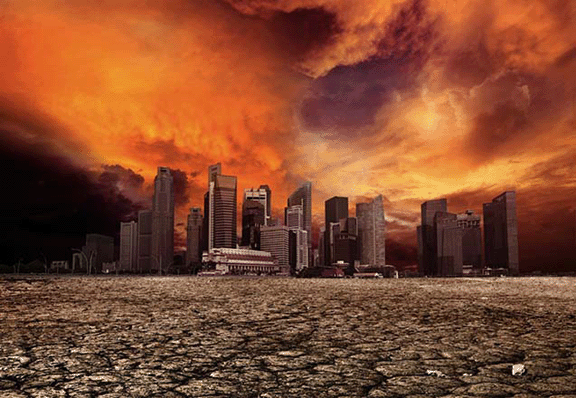
That means that no one currently alive on the planet will ever again see an atmosphere with less than 400 ppm CO2……
We are watching giant pieces of our planet’s biosphere die before our eyes…….
The Great Barrier Reef obituary is a sign of our times, and we must brace ourselves for more tragedies like it — for coral reefs, glaciers, ice fields, forests, lakes, rivers, and of course, species……
Even in late October, Arctic sea ice hit a new record daily low extent, underscoring the fact that this year’s record low readings are three million square kilometers below the same day readings (October 23) of that day in 1981.
Earth
A recently published report on Earth’s biodiversity revealed that global wildlife numbers have fallen by 58 percent since just 1970. The report — called The Living Planet assessment — produced by the Zoological Society of London and the World Wildlife Fund also said that if trends continue, this decline will likely reach two-thirds among vertebrates in only four more years. The report lists ACD as one of the driving factors of the great dying.
The report confirms what many of us have been watching for a number of years now — that we are bearing witness to the collapse of wildlife. We are so obviously living in the Anthropocene: the era in which humans exert the dominant influence over Earth and its destiny……..
Water
This month, as usual, ACD-fueled dramatic changes in water-related phenomena abound.
A recently published study found that multi-decade megadroughts due to ACD are “virtually certain” across the US Southwest.
Perhaps this has already begun as by late October, over 120 million people (28 percent of the population of the lower 48 states) were experiencing drought. California entered the sixth year of its drought.
Things are looking grim for the Mediterranean region as well, as another study warned that even if the Earth only warmed 2C (which is a laughably low estimate at this point) widespread desertification will overtake huge swaths of this lush region and render the ecosystem there “unrecognizable.”
At the other end of the extreme water event spectrum, Louisiana is struggling to figure out what to do about rising seas.
Air
Evidence that conditions in the atmosphere are worsening continues to unfold.
A study recently published in Nature shows that, thanks to leaks from oil and gas activities around the world being far more persistent and larger than previously believed, methane emissions from that industry are likely 60 percent higher than estimated. Methane is 22 times more potent a greenhouse gas than CO2…….
Fire
Given that this year saw the hottest summer ever recorded, it comes as no surprise that there has been a preponderance of fires, many of which persisted well into the fall season.
Massive fires covering millions of acres across Russia prompted many residents to sign a petition to Vladimir Putin, in which they complained of suffocating from the smoke. According to independent satellite analysis from experts, huge fires across Siberia have burned millions of acres year after year, and have caused a dramatic uptick in the number of fires facing that region.
In Australia, the Bureau of Meteorology recently released a report stating that that country is experiencing more extreme fire weather and hotter days as ACD progresses. Fire season there has been extended by several weeks, according to the agency, and that trend is expected to continue to increase.
In the US, a study recently published in the Proceedings of the National Academy of Sciences shows that ACD is what is behind the recent surge in wildfires across the west, as the research ties them directly to escalating temperatures…..http://www.truth-out.org/news/item/38236-climate-disruption-s-legacy-megadroughts-extinctions-obituaries-for-reefs
Cost of global warming ‘is worse than I feared’ – Nicholas Stern
Nicholas Stern: cost of global warming ‘is worse than I feared’, Guardian, Robin McKie, 6 Nov 16,
Ten years ago the leading economist warned about climate change in a landmark report – he says while there is cause for optimism, the picture is still grim. lot has happened since Nicholas Stern, then a permanent secretary at the Treasury, produced his landmark review of the impact of climate change 10 years ago. His work was quickly recognised as the definitive account of the economic dangers posed to the planet by global warming.
Since then, global temperatures have risen to record levels. Arctic summer sea ice has continued to shrink, as have many major land-based ice sheets. Carbon dioxide is being pumped into the atmosphere in ever-increasing amounts. At the same time, low-lying coastal areas, such as south Florida and parts of Bangladesh, are experiencing more and more flooding as sea levels have risen. Scientists have begun to link extreme weather events to the planet’s changing climate, while animal and plant species are gradualling moving towards the poles. So, a decade on, is Stern plunged in despair over our prospects? Not quite. While the picture is certainly grim, the world’s top climate economist still believes there are grounds for modest optimism.
“We have been too slow in acting on climate change,” he told the Observer. “In particular, we have delayed the curbing of greenhouse gas emissions for far too long. When we published our review, emissions were equivalent to the pumping of 40-41bn tonnes of carbon dioxide into the atmosphere a year. Today there are around 50bn tonnes of carbon dioxide equivalent. At the same time, science is telling us that impacts of global warming – like ice sheet and glacier melting – are now happening much more quickly than we anticipated.”
In his report, published in October 2006, Stern warned that the cost of inaction would be far greater for future generations than the costs of actions taken today. “With hindsight, I now realise that I underestimated the risks. I should have been much stronger in what I said in the report about the costs of inaction. I underplayed the dangers.”
These are stark remarks. Yet the dramatic success of the Paris climate talks last year, and their subsequent rapid ratification by more than 90 countries, has provided the 70-year-old economist with a sense of hope: “It has taken only 11 months to get the Paris agreement ratified. It took eight years to get its predecessor, the Kyoto protocol, into force. So in a sense, the last 12 months have been encouraging.”
In his review, Stern made a cogent case for the need to make drastic reductions in fossil fuel burning to curb emissions of carbon dioxide, which are heating our atmosphere dangerously. The costs involved – in investing in the development of alternative energy sources, for example – would be far outweighed by the costs of coping with an overheated world afflicted by flooding, soaring temperatures, ruined crops and farmland, lack of food and displaced people, he argued. Most experts responded positively to the review…….
As a counterbalance, Stern points to the fact that in recent years there has been an encouraging increase in the use of sustainable technologies that should help us to wean us of our fossil fuel dependency. Cities like Barcelona and Bogotá have made themselves cleaner and healthier. Coal burning has peaked in China. Hybrid cars and electric vehicles are being sold in increasing numbers and the cost of making solar panels has been reduced by a factor of 20. “We have reached the point where we can now see that the alternative route is not really something that should be regarded as a cost. It is actually a much better way of doing things, even if you had never heard of climate change,” says Stern.
But the message has taken too long to sink in, and as result we are approaching a crunch point, he argues. In the next 20 years, as economies across the globe expand, the planet is likely to build infrastructure – roads, buildings, ports and airports – that will more than double what already exists.
The crucial issue is the nature of that infrastructure. “If it is dirty and high carbon, it will lock us into that technology for a long time. We will be sentenced to live in cities where we cannot breath or move or be productive. If we do it using sustainable technology, however, we could have an extremely attractive future where you have strong growth, poverty is reduced, cities are cleaner and forests are saved. People have not sufficiently understood the importance of the next 20 years. They are going to be the most decisive two decades in human history.”
Last year’s Paris climate deal suggests there is a will to avoid the worst and there is a prospect of further strong agreements being reached at this month’s talks in Marrakech. India, China and the US have all made positive noises. Hillary Clinton is a firm supporter of climate change initiatives ……..
The Paris agreement remains central to Stern’s sense of cautious optimism. “It was the honesty of the delegates’ awareness of the nature of the problem and the speed of the agreement’s ratification that has given me most hope. We have a lot to do to limit carbon emissions to an effective level. I am confident that it is possible to achieve that, though I cannot say that I am confident it will happen.” https://www.theguardian.com/environment/2016/nov/06/nicholas-stern-climate-change-review-10-years-on-interview-decisive-years-humanity
Despite Paris agreement, world is set for a 3.5 degree temperature rise
Paris Agreement comes into force but sets us on course for a 3.5 degree world, says Friends of the Earth International http://reliefweb.int/report/world/paris-agreement-comes-force-sets-us-course-35-degree-world-says-friends-earth REPORT from Friends of the Earth 03 Nov 2016 On Friday 4 November, just days before the UN climate talks open in Marrakech, the Paris Agreement comes into force. Friends of the Earth International reiterates its concern that without greater ambition and more urgency the Paris Agreement will fail to deliver the scale of fair and drastic action needed to prevent dangerous climate change.
1971 countries have agreed to reduce greenhouse gas emissions to hold the global temperature increase to “well below 2°C above pre-industrial levels” and to “pursue efforts to limit the temperature increase to 1.5 °C above pre-industrial levels.’’ However, even if countries stick to commitments made so far, we can expect at least 3.5°C of warming2.
“After 24 years of negotiations we are hurtling towards a 3.5 degree world, which will be catastrophic for millions across the world,” said Dipti Bhatnagar, Climate Justice and Energy Coordinator for Friends of the Earth International. “Despite all the science-based evidence, rich countries are failing to do their fair share of emissions reductions as well as provide much-needed finance to drive energy transformation in developing countries. The clock is ticking, we have almost no time left to ensure the peoples of Africa are not sacrificed to increasing temperatures.”
“There are 1.2 billion people living with no access to electricity and over half of those people are in Africa,” said Geoffrey Kamese, Senior Programme Officer, Friends of the Earth Uganda / NAPE “Africa-led and people-centred initiatives – such as the Africa Renewable Energy Initiative – must be given support to work for people. However, we’re only seeing more of the same – old and indeed new dirty energy projects – oil, coal, gas and big dams, fracking, even tar sands – continue to devastate communities.
The Paris Agreement’s goal of preventing catastrophic climate change and protecting the world’s poor will be worthless if governments use it to open the door to untested, dangerous geo-engineering (that will also trigger a global land grab for agrofuels), and to focus on discredited solutions such as carbon markets and nuclear energy.
Friends of the Earth International champions the real solutions to the climate crisis: steep and urgent reductions in carbon emissions, in line with each country’s fair share; an end to deforestation; new, public finance and support for clean, sustainable, people-centred power solutions, and a transformation in our food systems. These solutions have long been underway, initiated by people and their communities. Decision-makers must listen to the people, listen to the science, and stop wasting precious time and money on false solutions.
Global nuclear lobby gets ready to influence climate talks
 Nuclear community gets ready for Paris Agreement WNN 04 November 2016 Countries planning to use nuclear power to meet their climate change goals will pool experience as part of a forthcoming research effort by the International Atomic Energy Agency (IAEA).
The Paris Agreement entered into force today, committing governments to limiting global warming to 2 deg C and, if possible, 1.5 deg C.
The IAEA told journalists today that it is starting to “Coordinate research efforts of member states on the assessment of the potential role of nuclear in their climate change mitigation strategies.” It will cover various analytical methods, frameworks and strategies.
Loreta Stankeviciute of the IAEA’s Planning and Economic Studies Section will oversee the work. She said research “would include aspects such as energy planning but also focus on the assessment and effectiveness of support mechanisms that were mentioned under the Paris Agreement such as domestic policies and carbon prices in order to identify key barriers and develop approaches to address those investments in low carbon technologies.”
The head of the Planning and Economic Studies Section, David Shropshire, said IAEA tools were generalised enough to be used for any kind of energy development, not just nuclear power. To make best use of the tools, it has recently signed a practical arrangement with the International Renewable Energy Agency (Irena). The focus of cooperation between the two UN agencies has been Africa, but could be expanded anywhere, said Shropshire…..
the World Nuclear Association made clear the industry’s readiness to work for the Paris goals…… It said that industry has endorsed a goal of supplying 25% of the world’s electricity with nuclear generation by 2050, a target that will require the construction of 1000 GWe of new nuclear capacity.
Shropshire said, “It’s up to each member state to decide for themselves how much [the role of nuclear] is going to be. http://www.world-nuclear-news.org/EE-Nuclear-community-gets-ready-for-Paris-Agreement-0411161.html
Bigger battles beyond the climate agreement – climate crises for vulnerable countries
The ‘flexible’ carbon mitigation mechanism of National Determined Contributions that makes contribution to emission cuts voluntary allows for the watering down of the historic and current responsibility of big polluter countries like the United States and China. Pressure is unjustly put on low carbon economies of developing countries when there should be none in the first place.
There are no concrete commitments and mechanisms that will ensure adequate and unconditional support for climate vulnerable countries. Even more marginalized was the proposed mechanism for ‘Loss and Damage’ that sought to facilitate compensation from industrialized nations to vulnerable nations that are already suffering climate impacts.
Transnational corporations and financial institutions, meanwhile, are given free rein to promote multi-billion dollar false climate solutions such as mega hydro, clean coal, and nuclear power plants, timber plantations, carbon credits, and other projects that displace communities and degrade the environment.
These are just the tip of the iceberg.
There are bigger battles outside the Paris Agreement http://opinion.inquirer.net/98960/there-are-bigger-battles-outside-the-paris-agreement INQUIRER.net November 04, 2016 LEON DULCE
Campaign Coordinator Kalikasan People’s Network for the EnvironmentWe write with regard to the resurgence of debate on President Rodrigo Duterte’s ambivalence over the Paris Agreement on Climate Change, as it comes in a time when deeper public discourse and action on the climate crisis is urgently needed.
World leaders will gather at the United Nations “COP22″ climate talks once again to attempt to concretize the Paris Agreement’s agreed common actions on mitigating carbon emissions that induce climate change, adapting communities to worsening climate impacts, and ensuring financing, technology transfer, capacity building, and loss and damage mechanisms.
COP22’s commencement fittingly coincides with the Philippines’ commemoration of the third anniversary of Super Typhoon Yolanda (international name Haiyan). World leaders should be reminded that some 16 million people were severely affected by Yolanda’s powerful winds, floods and storm surges across the Philippines, and that these impacted communities are still struggling to recover three years later—a preview of what future climate norms are in store for us if climate disruption is left unfettered.
An alarming evidence of this was the findings of current Social Welfare Secretary Judy Taguiwalo that at least 200,000 Yolanda survivors have yet to receive emergency shelter assistance from the state because of discrimination by local politics during the Aquino administration.
Meanwhile, the specter of ‘disaster capitalism’ continues to haunt Yolanda survivors. Initial findings of an environmental investigation mission held by the Center for Environmental Concerns and scientist group AGHAM regarding the proposed P7.9-billion Leyte Tide Embankment Project revealed how the biggest post-Yolanda mega-infrastructure solution actually threatens the livelihood and environment of some 10,000 residents across the east coast of Leyte.
Unfortunately, there is still a yawning gap between the abject plight of Yolanda survivors and other frontline communities and the reality of the Paris Agreement.
The ‘flexible’ carbon mitigation mechanism of National Determined Contributions that makes contribution to emission cuts voluntary allows for the watering down of the historic and current responsibility of big polluter countries like the United States and China. Pressure is unjustly put on low carbon economies of developing countries when there should be none in the first place.
There are no concrete commitments and mechanisms that will ensure adequate and unconditional support for climate vulnerable countries. Even more marginalized was the proposed mechanism for ‘Loss and Damage’ that sought to facilitate compensation from industrialized nations to vulnerable nations that are already suffering climate impacts.
Transnational corporations and financial institutions, meanwhile, are given free rein to promote multi-billion dollar false climate solutions such as mega hydro, clean coal, and nuclear power plants, timber plantations, carbon credits, and other projects that displace communities and degrade the environment.
These are just the tip of the iceberg. It is hard not to cast a shadow of doubt over the Paris Agreement and the uphill battle to step up the pact’s ambition in the upcoming COP22. It is actually commendable how President Duterte asserts our people’s right to develop as the foundation of his argument, a right of vulnerable and poor nations that is given only tokenisms in the agreement.
The climate talks, however, are still a legitimate venue to advance the concrete needs and aspirations of our people.
President Duterte can take a leaf from the book of Bolivian President Evo Morales, who called out global capitalism as the root of the climate and environmental crises in his plenary speech at COP21 last year, or from Pope Francis who also called for system change with his encyclical “Laudato Sii.”
At COP22, Duterte can take up the cudgels for the Filipino people struggling for climate justice, from the Lumad, Igorot, and other indigenous peoples resisting big coal and metallic mines to the Yolanda survivors that will march once again on ‘ground zero’ come November 8 to assert their demands for resilient homes and livelihoods.
These are the bigger battles outside the Paris Agreement that need to be fought, as these are the ones winning the struggle against the global system that perpetuates climate injustice. Let these stories of struggles in the frontlines be at the core of the climate talks.
—
U.N.: Paris Climate Agreement Takes Effect
https://www.stratfor.com/situation-report/un-paris-climate-agreement-takes-effect NOVEMBER 4, 2016The Paris agreement under the U.N. Framework Convention on Climate Change entered into force Nov. 4, U.N. Dispatch reported. The deal was formulated in December 2015 and would put a cap on greenhouse gas emissions. In order to take effect, it had required that 55 parties whose emissions totaled to 55 percent of the world total ratify the pact. To date, 97 parties have signed on. The pact’s objective is to maintain global warming at below 2 degrees Celsius (3.6 degrees Fahrenheit) since the start of the Industrial Revolution, with 1.5 degrees Celsius as the goal. World leaders and activists will gather in Marrakech, Morocco, from Nov. 7-18 for a follow-up on the Paris meeting.
In spite of the fanfare, the Paris agreement on its own will not significantly alter countries’ behavior with regard to climate change. Instead, a variety of political, economic and technological factors will determine how different regions change their energy consumption to mitigate the threat of global warming. The transition beyond oil is already underway, as the world’s energy systems shift toward nuclear power, natural gas, renewables or some combination of the three.
On 4 November, Paris Climate deal came into legal force
The Paris climate deal has come into force – what next for Australia?, The Conversation, The Paris climate agreement comes into legal force today, just 11 months after it was concluded and 30 days after it met its ratification threshold of 55 parties accounting for at least 55% of global greenhouse gas emissions.
By contrast, the Kyoto Protocol, which this treaty now replaces, took more than 8 years to come into force, slowed by the United States’ persistent and erosive opposition.
At the time of writing, the Agreement has been ratified by 94 parties, including the world’s four largest emitters: China, the United States, the European Union and India. As Climate Analytics reports, these nations account for 66% of greenhouse emissions. Even if the United States were to withdraw its support under a Trump presidency, the Paris Agreement will remain in force……..
a legal hybrid that obliges parties to abide by processes, mechanisms and timetables for setting and reviewing their national climate targets, and providing climate finance to developing countries.
But the treaty doesn’t compel those national efforts collectively to meet its core aims: to keep global warming well below 2℃ and as close as possible to 1.5℃ above pre-industrial levels; to peak global emissions as soon as possible; and to reach zero net global emissions in the second half of this century. Worse still, the currently pledged targets would deliver some 3℃ of overall warming by the end of this century.
Because the treaty relies on “intended” national climate targets rather than binding ones, much hinges on the success of the requirement for nations to review and toughen them every five years. The theory is that these global stocktakes of collective progress (beginning with a facilitative dialogue among parties in 2018) will generate enough pressure for individual nations to be encouraged to ratchet up their efforts as they go.
For these reasons – because of its emphasis on process and its lack of compliance mechanisms – the Agreement has been described as a promissory note, or prematurely criticised as inadequate…….
while there will be more celebrations at this year’s UN climate summit, which begins in Marrakech on Monday, negotiators and UN bureaucrats have been caught out. In some senses, the Paris Agreement is a framework agreement within a Framework Agreement (the UN Framework Convention on Climate Change, of which this is a subsidiary part). It’s a work in progress with lots of details yet to be filled in.
The newly formed Ad Hoc Working Group on the Paris Agreement will be scrambling to define key elements governing the new treaty’s implementation. Many of these elements are critical to the treaty’s long-term effectiveness. They include measures to ensure transparent and effective accounting of countries’ emissions reductions; to work out exactly how the ambition of “zero net emissions” will be met; and to transfer crucial economic measures used under the Kyoto Protocol over to the new framework.
The Agreement requests that this be done by the first session of the Conference of the Parties to the new treaty. As this now will occur in Marrakech, time is too short and such labour is likely to continue through 2017 and perhaps beyond……… https://theconversation.com/the-paris-climate-deal-has-come-into-force-what-next-for-australia-68140
1 This Month





PLEASE OPPOSE HR 8255 AND S.3639 – bills would accelerate satellite deployment, with no environmental review or safeguards – https://ncstd5li.quorum.us/campaign/169331/
To see nuclear-related stories in greater depth and intensity – go to https://nuclearinformation.wordpress.com
-
Archives
- October 2026 (10)
- September 2026 (339)
- August 2026 (330)
- July 2026 (355)
- June 2026 (287)
- May 2026 (306)
- April 2026 (356)
- March 2026 (251)
- February 2026 (267)
- January 2026 (308)
- December 2025 (358)
- November 2025 (359)
-
Categories
- 1
- 1 NUCLEAR ISSUES
- business and costs
- climate change
- culture and arts
- ENERGY
- environment
- health
- history
- indigenous issues
- Legal
- marketing of nuclear
- media
- opposition to nuclear
- PERSONAL STORIES
- politics
- politics international
- Religion and ethics
- safety
- secrets,lies and civil liberties
- spinbuster
- technology
- Uranium
- wastes
- weapons and war
- Women
- 2 WORLD
- ACTION
- AFRICA
- Atrocities
- AUSTRALIA
- Christina's notes
- Christina's themes
- culture and arts
- Events
- Fuk 2022
- Fuk 2023
- Fukushima 2017
- Fukushima 2018
- fukushima 2019
- Fukushima 2020
- Fukushima 2021
- general
- global warming
- Humour (God we need it)
- Nuclear
- RARE EARTHS
- Reference
- resources – print
- Resources -audiovicual
- Weekly Newsletter
- World
- World Nuclear
- YouTube
-
RSS
Entries RSS
Comments RSS

