Climate Change – a critical issue for the Marshall Islands
Climate Change Is A ‘Matter Of Life And Death’ For The Marshall Islands, Honolulu Civil Beat, The first female head of state of a Pacific island nation talks about the biggest threat her country faces. 4 Nov 16 By t takes a combination of guts, grit and gray matter to face off against what is arguably the world’s biggest threat — a planet in the throes of environmental and climate upheaval.
Famine, war and disease, as climate apocalypse threatens the world
UN paints apocalyptic picture of famine, war and disease unless world wakes up to dangers of climate change, Independent UK
‘We will grieve over the avoidable human tragedy; the growing numbers of climate refugees hit by hunger, poverty, illness and conflict will be a constant reminder of our failure to deliver’
Ian Johnston Environment Correspondent, 3 Nov 16 The world will “grieve over the avoidable human tragedy” of climate change, as refugees flee “hunger, poverty, illness and conflict” unless urgent action is taken to reduce emissions from fossil fuels, the United Nations has warned.Despite the Paris climate agreement being hailed as a the “moment we decided to save our planet” by US President Barack Obama among others, the UN Environment Programme (UNEP) said the commitments made by countries so far were “not nearly enough” to prevent disastrous global warming.
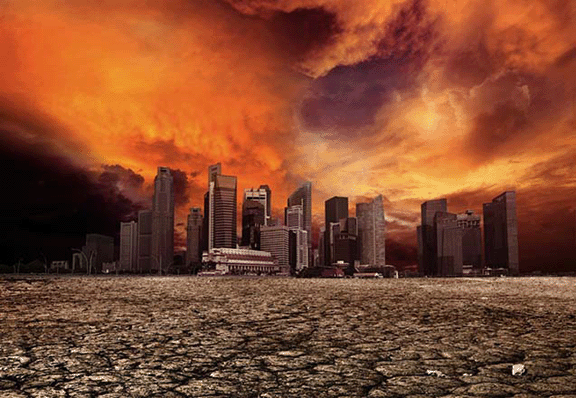
In a report, which UNEP said it hoped would be a “wake-up call to the world”, the world body estimated the Earth’s average temperature was set to increase by up to 3.4 degrees Celsius above pre-industrial levels by 2100 – the kind of change that would take at least tens of thousands of years to occur naturally, accomplished by humans in little over two centuries. It called for further measures to reduce greenhouse gases by a quarter by 2030.
Despite an overwhelming scientific consensus that climate change is real, the total amount of greenhouse gases produced by humans has continued to rise as countries have focused on short-term economic growth.Next week world leaders will meet in Morocco for the first major climate summit after Paris, which organisers have pledged will be a “conference of concrete action”.The UNEP report was unequivocal about the need for the countries to co-operate with that aim in mind.
“Everybody willing to look can see the impact of our changing climate. People already face rising seas, expanding desertification and coastal erosion. They take little comfort from agreements to adopt mitigation measures and finance adaptation in the future. They need action today,” wrote Erik Solheim, head of UNEP, and Jacqueline McGlade, UNEP’s chief scientist, in the report’s foreword.
But the reductions in greenhouse gases promised at Paris were “not nearly enough”.
“This report estimates we are actually on track for global warming of up to 3.4 degrees Celsius,” the foreword said. “Current commitments will reduce emissions by no more than a third of the levels required by 2030 to avert disaster. We must take urgent action. If we don’t, we will mourn the loss of biodiversity and natural resources. We will regret the economic fallout.
“Most of all, we will grieve over the avoidable human tragedy; the growing numbers of climate refugees hit by hunger, poverty, illness and conflict will be a constant reminder of our failure to deliver. None of this will be the result of bad weather. It will be the result of bad choices by governments, private sector and individual citizens.”
Under the Paris treaty, the world committed to trying to restrict global warming to as close to 1.5C as possible, a target that looks increasingly unlikely to be met given it is already at 1C.A leading climate researcher, Professor Niklas Höhne, of the NewClimate Institute in Cologne, previously told The Independent that three degrees of warming would be “completely catastrophic”, resulting in a world that was “not very pleasant” for its human population with increasingly severe droughts, floods and storms.It is also could trigger a number of ‘tipping points’ such as the melting of permafrost in the northern tundra, releasing vast amounts of methane, a potent greenhouse gas, that would send the temperature spiralling upwards………
Speaking last month, Professor Lord Nicholas Stern – who published a landmark report by the financial dangers of climate change 10 years ago – warned the world’s economy could “self-destruct” if fossil fuels continued to be burned. http://www.independent.co.uk/environment/climate-change-global-warming-united-nations-famine-war-disease-a7394926.html
Urgent and dramatic need for world to act on climate change
 World is set to warm 3.4°C by 2100 even with Paris climate deal https://www.newscientist.com/article/2111263-world-is-set-to-
warm-3-4c-by-2100-even-with-paris-climate-deal/ By
The world must “urgently and dramatically” step up its efforts to cut greenhouse gas emissions if it is to have any chance of limiting dangerous climate change, according to a new report.
Released in London a day before the Paris Agreement comes into force, the report by the United Nations Environment Programme (UNEP) found that 2030 emissions are set to exceed by more than a quarter the levels needed to keep global warming below the crucial 2 °C level.
Without swift reductions in emissions, the world is on track for a temperature rise of 2.9 °C to 3.4 °C this century, even if the pledges agreed in Paris last year are fully implemented, the report warned.
The Paris Agreement committed signatories — including the UK — to holding the increase in global average temperatures well below 2 °C above pre-industrial levels and to pursue efforts to limit it to 1.5 °C, which it said would “significantly reduce the risks and impacts of climate change”.
Emissions still too high
But the UNEP report finds that, on current trends, emissions are set to reach the equivalent of 54-56 gigatonnes (billion tonnes) of carbon dioxide by the end of the next decade – well above the 42 gigatonne maximum if warming is to be kept below 2 °C .
The demand for urgent action is reinforced by the fact that 2015 was the hottest year on record and the first six months of 2016 were each the warmest recorded, said the report.
The report found that members of the G20 group of industrialised nations, including the UK, were collectively “on a likely track” to meet greenhouse gas reduction pledges made in Cancun, Mexico, in 2010.
But it warned that the Cancun promises “do not deliver the necessary early emission reductions” to avoid breaching the 2 °C threshold.
Not good enough
Though the Paris Agreement will slow climate change, it’s still not quite good enough if we are to stand a chance of avoiding serious climate change, said Erik Solheim, head of UNEP.
“If we don’t start taking additional action now, beginning with the upcoming climate meeting in Marrakesh, we will grieve over the avoidable human tragedy,” said Solheim.
“The growing numbers of climate refugees hit by hunger, poverty, illness and conflict will be a constant reminder of our failure to deliver,” he said. “The science shows that we need to move much faster.”
UNEP identified a range of actions which could deliver large reductions in emissions by 2030.
Investment in energy efficiency measures totalling between $20 and $100 US per tonne of carbon dioxide could deliver global reductions of 5.9 gigatonnes for buildings, 4.1 gigatonnes for industry and 2.1 gigatonnes for transport, the report said.
Experts doubt that geo-engineering will succeed in halting climate change
 Geo-engineering unlikely to work, conservation group says http://climatenewsnetwork.net/19791-2/ November 1, 2016, by Alex Kirby Attempts to limit climate change by using the novel technologies known as geo-engineering are very unlikely to work, leading biologists say.
LONDON, 1 November, 2016 – The global watchdog responsible for protecting the world’s wealth of species, the UN’s Convention on Biological Diversity (CBD), has looked at the hopes for reining in climate change through geo-engineering. Its bleak conclusion, echoing that reached by many independent scientists, is that the chances are “highly uncertain”.
“Novel means”, in this context, describes trying to reduce greenhouse gas (GHG) emissions by removing them from the atmosphere, and altering the amount of heat from the Sun that reaches the Earth.
Some scientists and policymakers say geo-engineering, as these strategies are collectively known, is essential if the world is to meet the goals of the Paris Agreement. This is because current attempts to reduce emissions cannot make big enough cuts fast enough to keep global average temperatures from rising more than 2°C above their pre-industrial levels, the Agreement’s basic goal.
But the CBD says in a report that geo-engineering, while it could possibly help to prevent the world overheating, might endanger global biodiversity and have other unpredictable effects.
Many independent analysts have raised similar concerns.Attempts to increase the amount of carbon in the oceans, in order to remove GHGs, have so far shown disappointing results. One report doubted that geo-engineering could slow sea-level rise. Another said it could not arrest the melting of Arctic ice. A third study found that geo-engineering would make things little better and might even make global warming worse.
Transboundary impacts
The lead author of the CBD geo-engineering report is a British scientist, Dr Phillip Williamson, of the UK’s Natural Environment Research Council. He is an associate fellow in the School of Environmental Sciences at the University of East Anglia, UK.
The CBD originally became involved in climate geo-engineering in 2008, because member governments were concerned that experiments to fertilise the oceans could pose unknown risks to the environment (they were then unregulated when carried out in international waters).
The CBD’s concern expanded to include other geo-engineering techniques, especially atmospheric methods which could have uncertain transboundary impacts. Some scientists argue that “geo-engineering” is a hazily-defined term and prefer to speak instead simply of “greenhouse gas removal”.
Dr Williamson and his colleagues say assessment of the impacts of geo-engineering on biodiversity “is not straightforward and is subject to many uncertainties”.
On greenhouse gas removal they warn that removing a given quantity of a greenhouse gas would not fully compensate for an earlier ‘overshoot’ of emissions.
New risks
In some cases, they say, the cure may be worse than the disease: “The large-scale deployment of bioenergy with carbon capture and storage (BECCS) seems likely to have significant negative impacts on biodiversity through land use change.”
President Obama’s important legacy on climate change
Barack Obama is the first climate president http://www.skepticalscience.com/obama-first-climate-president.html 2 November 2016 by John Abraham
My how far we’ve come in less than eight years. We have seen happen what those of us in the climate and energy fields knew could happen. The US has become a world leader on climate change, dramatically increased our production of clean and renewable fuels, reduced our emissions of greenhouse gases, signed major international agreements to continue progress into the future, and have done so without cost increases or power disruptions that the denial community proclaimed would occur.
As we in the United States get ready to elect a new president, it is helpful to think about the impact a president can have. Particularly since we transitioned from the worst climate president ever (Bush) to the best (Obama). I am going to detail what I think are Obama’s signature accomplishments.

In my mind, the most important part of President Obama’s legacy on climate is that he changed the conversation. He showed that not only should the US play a role in reducing emissions, but we can do just that. He showed that this problem isn’t too big to solve. In fact, most of the solutions are subtle enough that we don’t even notice them. He showed that we can change our future for the better.
With respect to specific actions, the Clean Power Plan is one of his biggest accomplishments. By working with the EPA, he created the first ever carbon pollution standards for the largest source of pollution – power plants. He did this in the midst of a do-nothing congress that fought him every step of the way.
Under his presidency, we made huge investments in clean energy, which are paying off already. Jump starts to the wind and solar industry have led to enormous cost decreases – dirty energy isn’t cheaper anymore. It is really astonishing – wind power has tripled and solar power has increased by 30 times since he took office.
Under his presidency, we improved standards for fuel economy of our vehicles, which not only reduces pollution but also saves money. Furthermore, Obama set targets to reduce the federal government’s emissions by nearly 20% by 2025. He has worked to reduce other types of greenhouse gases such as methane and hydrofluorocarbons, not only within the US but through international agreements.
And those aren’t the only international efforts. Obama made a joint plan with China that is almost unbelievably ambitious. It will reduce our emissions by approximately 27% by 2025 and puts major limits on Chinese emissions as well. He also forged an agreement with India to help low-income countries transition to modern economies that are not as polluting as current developed nations.
There are many more items which would be too numerous to mention but I wanted to know how his presidency is viewed within Washington DC. I mean, among climatescientists, he is the president we’ve been waiting for, but what do legislators think? I asked representative Betty McCollum from Minnesota for her view. Ms. McCollum has a long history of focusing on the environment in general and climate change in particular – long before it was popular. She told me: Click here to read the rest
The trouble with negative emissions
 http://science.sciencemag.org/content/354/6309/182 Kevin Anderson Glen Peters kevin.anderson@manchester.ac.uk; glen.peters@cicero.oslo.no
Summary
In December 2015, member states of the United Nations Framework Convention on Climate Change (UNFCCC) adopted the Paris Agreement, which aims to hold the increase in the global average temperature to below 2°C and to pursue efforts to limit the temperature increase to 1.5°C. The Paris Agreement requires that anthropogenic greenhouse gas emission sources and sinks are balanced by the second half of this century. Because some nonzero sources are unavoidable, this leads to the abstract concept of “negative emissions,” the removal of carbon dioxide (CO2) from the atmosphere through technical means. The Integrated Assessment Models (IAMs) informing policy-makers assume the large-scale use of negative-emission technologies. If we rely on these and they are not deployed or are unsuccessful at removing CO2 from the atmosphere at the levels assumed, society will be locked into a high-temperature pathway.
Retreating will be necessary – to adapt to climate change
 To Adapt to Climate Change, Retreat Is Necessary Four years after Hurricane Sandy, many coastal communities recognize that rising oceans mean relocating their residents. But there is no consensus on how to do so. The Nation By Alexandra Tempus OCTOBER 31, 2016 “……After Sandy made landfall in 2012, it destroyed or damaged roughly 305,000 homes in New York, killing 53 people and leaving the state with $42 billion in damages. Since then, more than 700 home-owning New York families alone have relocated as a result of the storm. Renters or public-housing tenants who have relocated are harder to track, but at least 2,000 were displaced to hotel rooms after Sandy and almost as many registered for affordable housing within six months of Sandy. Across the globe, growing numbers of people are being permanently displaced by climate-change impacts—the 1,000-year floods and megadroughts and superstorms generated by rising temperatures. By now experts have established that the damage Sandy wrought was made worse by rising sea levels, linking it indisputably to climate change.
Decline of coal mining brings lowered global carbon intensity
Global carbon intensity falls as coal use declines
China leads the charge for emissions efficiency, but faster progress is needed to meet the Paris climate goals, reports Climate Home, Guardian, Karl Mathiesen , 1 Nov 16, The amount of carbon needed to power the global economy fell to record lows in 2015, as coal consumption in major economies plummeted.
PricewaterhouseCoopers’ (PwC) annual Low Carbon Economy Index report has found that the global carbon intensity (emissions per unit of GDP) fell by 2.8%.
This was more than double the average fall of 1.3% between 2000 and 2014, but far below the 6.5% required to stay within the 2C warming limit set by last year’s Paris agreement.
“What we’ve seen in 2014-15 is a real step change in decarbonisation,” said Jonathan Grant, PwC director of sustainability and climate change.
The result was just 0.1% lower than the previous year, but it occurred against the background of healthy growth, which usually spurs carbon emissions growth.
“There was fairly reasonable economic growth in 2015, which is why we think this result is quite significant,” said Grant.
The biggest driver was a decline in China’s coal consumption, which resulted a 6.4% drop the carbon intensity of the world’s second biggest economy……. https://www.theguardian.com/environment/2016/nov/01/global-carbon-intensity-falls-as-coal-use-declines
Examining health impacts of climate change on Pacific Island Countries
Pacific Island Countries and Climate Change: Examining Associated Human Health Vulnerabilities, Environmental Health Perspectives, 1 Nov 16 Nancy Averett writes about science and the environment from Cincinnati, OH. Her work has been published in Pacific Standard, Audubon, Discover, E/The Environmental Magazine, and a variety of other publications.
Climate change presents a significant and growing threat to human health, with diverse impacts projected for different regions.1Investigators now report that Pacific island countries including Fiji, Tonga, and the Marshall Islands are among the nations most vulnerable to climate-related health problems due to their particular geographic, demographic, and socioeconomic characteristics.2 Their new paper is a synthesis of the key technical findings and policy implications of the 2015 World Health Organization report Human Health and Climate Change in Pacific Island Countries, written by the same group.3
First author Lachlan McIver, an associate professor in the College of Public Health, Medical, and Veterinary Sciences at Australia’s James Cook University, says that when teams of climate change and health consultants began their assessment in 2011, not many regions or countries had undertaken vulnerability and adaptation assessments or been able to derive results and act upon them, “so we were really on a bit of a crest of the wave in that sense.” He says the teams found that not all “best practices” described in the literature for assessing climate change health vulnerabilities actually worked in practice in the Pacific island countries due, in part, to a lack of data in some countries. Thus, he says, the consultants found they had to be flexible and use both quantitative and qualitative methods in their research and analysis.
The authors examined 13 Pacific island countries in terms of 3 categories of climate-related health concerns that they termed “direct,” “indirect,” and “diffuse.” Direct effects included physical and psychological trauma related to an extreme weather event such as a hurricane or a heat wave. Indirect effects included increased burdens of disease resulting from climate-related disruption—for instance, a rise in vector-borne diseases if ecological disruption were to create conditions favorable to the spread of pathogen-carrying pests. Finally, diffuse effects included increased mental health problems, injuries, and violent deaths that could result as societal dysfunction unfolds; this unfolding would be due to such phenomena as loss of livelihood or a lack of basic resources including water, food, and housing.2
The teams worked with stakeholders in each country to develop lists of their highest-priority climate-sensitive health risks then decide which ones to address in their adaptation plans. Some countries chose to include all relevant risks; others picked just those deemed to be the greatest threat. Because of that variation, the report contains this caveat: “The climate-sensitive health risks presented … should be considered a synthesis of each country’s priorities rather than a true cross-country comparison of risks.”2
Most countries placed water security, food security, vector-borne diseases, and direct health impacts of extreme weather events among their top priorities. Pacific island populations also face a unique climate-related health risk in terms of their extremely high levels of noncommunicable diseases, including obesity, diabetes, and hypertension. Noncommunicable diseases are already leading causes of death in these populations,4 partly because of a high dependence on energy-dense, high-calorie imported foods rather than locally grown products.5 In an example of a diffuse effect, climate change could exacerbate these trends because higher temperatures, altered rainfall patterns, and sea level rise will make it even more difficult to grow local food; increased reliance on imported foods could, in turn, lead to food insecurity.2
Kathryn Bowen, a senior research fellow at the Australian National University, says the work was an important first step. …….
For coauthor Kristie Ebi, a professor of environmental and occupational health science at the University of Washington, the concern is whether there will be enough outside funding to help these nations implement their plans. “These islands are suffering the consequences of climate change, and they’re not responsible for it,” she says. “Their total greenhouse gas emissions are tiny … so to ask them to take on [the health burdens associated with climate change] without additional funding really isn’t fair.” http://ehp.niehs.nih.gov/124-A208/
Geoengineering is being investigated to alter climate
Geoengineering to Alter Climate Moves Closer to Reality http://www.bloomberg.com/news/articles/2016-10-31/geoengineering-to-alter-climate-change-moves-closer-to-reality Anna Hirtenstein ahirtens
-
Researchers say greenhouse-gas removal needed to avert warming
-
Large-scale greenhouse gas removal among methods considered
-
A United Nations body is investigating controversial methods to avert runaway climate change by giving humans the go-ahead to re-engineer the Earth’s oceans and atmosphere.
So-called geoengineering is seen as necessary to achieve the COP21 Paris agreement clinched in December, when 197 countries pledged to keep global temperatures rises below 2 degrees Celsius (3.6 degrees Fahrenheit), according to researchers who produced a report for the UN Convention on Biological Diversity.
- “Within the Paris agreement there’s an implicit assumption that there will need to be greenhouse gases removed,” said Phil Williamson, a scientist at the U.K.’s University of East Anglia, who worked on the report. “Climate geoengineering is what countries have agreed to do, although they haven’t really realized that they’ve agreed to do it.”
Large-scale geoengineering may include pouring nutrients into oceans to save coral habitats or spraying tiny particles into the Earth’s atmosphere to reflect sun rays back into space. Geoengineering proposals have been shunned because of their unpredictable consequences on global ecosystems.
Hazardous, Costly
The University of East Anglia released a study in February that concluded geoengineering ideas were hazardous, costly or unrealistic. The Convention on Biodiversity has approached geoengineering with caution, seeking to constrain the development unless there is effective global governance, Williamson said.
- “Risks of having local imbalances of climate are quite high, we’re not quite sure how it would turn out,” Williamson said. “If you have a climate catastrophe, a flood or storm, the accusation will be that it resulted from your action in the atmosphere.”Some minds have nevertheless been changing when confronted with the scale of the climate change problems to be solved. Monday’s report makes clear that while geoengineering still entails environmental, political and economic risks, it’s worth considering as long as potentially unintended consequences can be pinpointed and minimized.
- Carbon capture and storage is one of the more viable options going forward, Williamson said. Costs for machines that suck carbon dioxide out of the air, known as the direct air capture method, are falling as the technology becomes more efficient. The government of Norway recently committed $160 million to fund projects that will collect pollution from three industrial sites and extend its research program.World leaders will be meeting in Marrakesh from Nov. 7 to 20 for the COP22 conference to bang out more details on the implementation of climate deal and discuss concrete plans. To date, 87 countries have ratified the Paris agreement, including China, the U.S. and the European Union. It will enter into force Nov. 4.
The geoengineering report will be presented at a UN Convention on Biodiversity Conference in Cancun, Mexico in December.
US nukes were imperilled by Hurricane Matthew
Nuclear Shutdown News – October 2016: Hurricane Matthew Imperiled US Nukes http://obrag.org/?p=113497 by on NOVEMBER 1, 2016 Black Rain Press
Nuclear Shutdown News chronicles the decline and fall of the nuclear industry in the US and beyond, and highlights the efforts of those who are working for a nuclear free world. What follows is our October edition, which is dedicated to Judy Friedman of Connecticut’s Peoples Action for Clean Energy (PACE)!
Hurricane Matthew Imperils US Nukes As It Threatens Millions
Hurricane Matthew, which brought death and destruction from Haiti to the Carolinas in October, also had an impact on a number of aged nuclear facilities in the US. There are no nuclear plants in Haiti, Cuba or the Bahamas, which suffered the worst of the hurricane’s wrath.
On October 4, as Matthew approached Florida, Florida Power & Light, the electrical utility that runs the St. Lucie nuke plant in the southeast part of the state, declared an “unusual event” at the plant.
On a scale of 1 to 5, an Unusual Event is a 1, with the worst such nuclear plant emergency being mandatory evacuation.
All US nuclear plants producing electricity also depend on outside electrical power sources to operate. In the case of St. Lucie, the storm caused loss of its outside power. When this happens, backup diesel powered generators are supposed to kick in.
This is critical, because a reactor’s nuclear fuel must constantly be covered with water. If it isn’t, it will begin to heat up, and, in the worst case, melt down, causing a nuclear catastrophe.
This is what happened at Fukushima in 2011. The earthquake destroyed the outside electrical system, and then the tsunami overwhelmed the backup diesel system, leading to multiple meltdowns at the plant that are still ongoing.
Fortunately the emergency at St. Lucie was short-lived. But it demonstrates the vulnerability of the aging US nuclear industry. The two reactors at St. Lucie began operating in 1976 and 1983. They were designed to operate for only 40 years. On October 6 the US Nuclear Regulatory Commission (NRC) declared it “had dispatched additional inspectors to St. Lucie,” as well as to Turkey Point, another nuke in southeast Florida operated by FP&L, and to the Brunswick plant in North Carolina.
Like St. Lucie, Turkey Point ‘s two reactors are ancient, only more so. They started up in 1973 and 1974. They are located on Biscayne Bay, adjacent to Biscayne National Park.
According to the Southern Alliance for Clean Energy (SACE), “no other place” besides Turkey Point “uses an unlined porous industrial sewer to cool water” for a nuclear plant, resulting in “polluting ground water and the waters of Biscayne Bay.”
SACE also states that “the Biscayne acquifer provides drinking water for more than three million people” and that Turkey Point’s polluted waters “contain a slew of pollutants including arsenic, phosphorus. total nitrogen, high salinity levels, and tritium (radioactive hydrogen, all migrating in all directions.”
Unfortunately, the hurricane’s storm surge accelerated this toxic pollution.
Other nuke plants that had to close temporarily because of Hurricane Matthew were the 43 year old Robinson reactor 2 in South Carolina. and the Harris nuke on central North Carolina.
In addition, World Nuclear News reported on October 14 that –
“Storm Preparations were also put in place at Global Nuclear Fuel near Wilmington, North Carolina, a nuclear fuel fabrication plant that also designs nuclear reactors.”
That corporation, operated by General Electric (which built the Fukushima nuke plant), Toshiba and Hitachi, also operates in Europe, Mexico, Taiwan and Japan.
Before Hurricane Mathew turned east out into the Atlantic, it was projected to head up the East Coast towards New York City and Boston, meaning it might have threatened coastal nuke plants in Maryland, New Jersey, Connecticut and New Hampshire.
Sources: Florida Power and Light, fpl.com; Nuclear Regulatory Commission; nrc.gov; World Nuclear News; world-nuclear-news.org, Southern Alliance for Clean Energy.
Leonardo Di Caprio’s new film “Before The Flood” debunks climate myths
Debunking climate myths with Leonardo DiCaprio’s Before The Flood http://www.skepticalscience.com/debunking-climate-myths-with-Leonardo-DiCaprio-Before-The-Flood.html 29 October 2016 by John Cook
On Sunday October 30, 9 PM EST, Leonardo DiCaprio’s film Before The Flood will screen free online as well as on National Geographic. The film explores the causes and impacts of climate change, arguing for urgent action and a rapid transition off fossil fuels.
It will be streamed all week on Facebook, Youtube, Hulu, Playstation, and can be viewed on demand on Apple iTunes, Amazon, and GooglePlay. Here’s more details on how to see the film and here’s the trailer: https://www.youtube.com/watch?v=D9xFFyUOpXo
I was invited to contribute to Beforetheflood.com, debunking some of the most common myths about climate change. Here are my pages on Leonardo DiCaprio’s site:
- 97% of climate scientists agree that humans are causing global warming (debunking the myth that “scientists don’t agree”).
- Our planet is warming at a rate of 4 atomic bombs per second (debunking the myth that “we’re in a period of cooling”).
- Climate patterns confirm humans are causing global warming (debunking the myth that “solar flares are to blame”).
- Climate change is having negative impacts on all parts of society (debunking the myth that “climate change is no big deal”).
- We have all the technology we need to solve climate change (debunking the myth that “there’s nothing we can do”)
We also embedded some key Denial101x videos in the debunkings, such as Consensus of Scientists and Daily & Yearly Cycle.
Beforetheflood.com is a rich website definitely worth exploring, with great info such as Brendan DeMelle’s The Climate Denial Industry. I’m looking forward to watching the film on Monday…
By 2100 Southern Spain headed to become a desert, with climate change
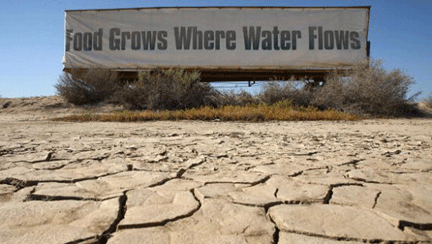 Climate change rate to turn southern Spain to desert by 2100, report warns, Guardian, Adam Vaughan, 28 Oct 16
Mediterranean ecosystems will change to a state unprecedented in the past 10,000 years unless temperature rises are held to within 1.5C, say scientists. Southern Spain will be reduced to desert by the end of the century if the current rate of greenhouse gas emissions continue unchecked, researchers have warned.
Anything less than extremely ambitious and politically unlikely carbon emissions cuts will see ecosystems in the Mediterranean change to a state unprecedented in the past 10 millennia, they said.
The study, published in the journal Science, modelled what would happen to vegetation in the Mediterranean basin under four different paths of future carbon emissions, from a business-as-usual scenario at the worst end to keeping temperature rises below the Paris climate deal target of 1.5C at the other.
Temperatures would rise nearly 5C globally under the worst case scenario by 2100, causing deserts to expand northwards across southern Spain and Sicily, and Mediterranean vegetation to replace deciduous forests.
Even if emissions are held to the level of pledges put forward ahead of the Paris deal, southern Europe would experience a “substantial” expansion of deserts. The level of change would be beyond anything the region’s ecosystems had experienced during the holocene, the geological epoch that started more than 10,000 years ago.
“The Med is very sensitive to climatic change, maybe much more than any other region in the world,” said lead author Joel Guiot of Aix-Marseille University. “A lot of people are living at the level of the sea, it also has a lot of troubles coming from migration. If we add additional problems due to climate change, it will be worse in the future.”
He said that while his study did not simulate what would happen to production of Mediterranean food staples such as olives, other research showed it was clear the changes would harm their production. Climate change has already warmed the region by more than the global average – 1.3C compared to 1C – since the industrial revolution.
The real impact on Mediterranean ecosystems, which are considered a hotspot of biodiversity, could be worse because the study did not look at other human impacts, such as forests being turned over to grow food……. https://www.theguardian.com/environment/2016/oct/27/climate-change-rate-to-turn-southern-spain-to-desert-by-2100-report-warns
Climate change brings skin diseases to new regions
Climate change is shifting areas of skin disease concern http://news.trust.org/item/20161022111027-42ao8 by Reuters, 21 October 2016 As the planet warms, many bacteria, viruses, fungi and parasites can survive in areas where they haven’t been found before
By Kathryn Doyle Oct 21 (Reuters) – Climate change is bringing certain skin diseases and other illnesses to regions where they were rarely seen before, according to a recent research review.
Dermatologists should keep these changing patterns of skin diseases in mind when making diagnoses, say the authors, who analyzed specific disease shifts in North America.
As the planet warms, many bacteria, viruses, fungi and parasites can survive in areas where they haven’t been found before, the review team writes.
In the U.S., for example, the incidence of the tick-borne Lyme disease increased from an estimated 10,000 cases in 1995 to 30,000 in 2013, and the area where it occurs keeps expanding from New England north into Canada as the ticks find their preferred habitat expanding.
“In places like Canada, now there are ticks that carry Lyme disease farther north than doctors would ever expect to see that,” Dr. Misha Rosenbach of the University of Pennsylvania in Philadelphia told Reuters Health said in a phone interview.
The range of Valley Fever in the southwest U.S. is spreading in a similar way, he said.
Viruses like dengue, chikungunya and Zika are transmitted by mosquitoes originally from Africa and Asia, which have now spread widely throughout North America as the mosquitoes can survive further and further north.
“We are seeing a much wider spread northward for some of these formerly tropical diseases that are now in Texas and Florida,” Rosenbach said.
Seventeen of the warmest years on record occurred within the last 18 years, largely due to combustion of fossil fuels and destruction of rainforests, the authors write in the Journal of the American Academy of Dermatology.
Water warming and flooding can also give rise to skin threats not previously typical of certain areas, the authors note. Ocean warming increases jellyfish populations, and Portuguese man-of-war now swim along the southeast U.S. coastline where they once did not, for example.
Parts of North America, particularly the Great Lakes, should expect substantially greater rainfall and therefore more outbreaks of waterborne disease as well.
Increasing temperatures in the Gulf of Mexico contribute to the increased cases of illness from consuming raw oysters.
Another skin-related consequence of climate change is skin cancer: as ozone is depleted, the risk of skin cancer goes up. A two-degree temperature increase could raise skin cancer incidences by 10 percent each year, the authors write.
The dermatologic consequences of climate change may not all be negative – you could argue that if temperatures keep rising, some mosquito habitat will be dried out due to drought and some disease ranges may shrink, Rosenbach said.
When doctors see patients with a fever and a rash, he added, “what you suspect” as the diagnosis “depends on where you are.”
“It’s important to remember that what people learned 20 years ago or 10 years ago in medical school can be subject to rapid change,” he said. “The bottom line is it’s important to keep an open mind about possible diagnoses.”
SOURCE: bit.ly/2enGiMA Journal of the American Academy of Dermatology
Carbon dioxide at record levels, UN warns
‘New era of climate change’: carbon dioxide at record levels, UN warns, SBS, 25 Oct 16 The concentration of carbon dioxide (CO2) in the atmosphere has passed an ominous milestone, ushering the planet into ‘a new era’ of climate change, the UN said Monday. For the first time on record, the amount of CO2 in the atmosphere averaged 400 parts per million (ppm) in 2015, the World Meteorological Organization (WMO) said in its latest Greenhouse Gas Bulletin.
CO2, the main greenhouse gas driving climate change, has previously passed the 400 ppm threshold on certain months in specific locations but never on a globally averaged basis, WMO said.
The UN agency also reported that CO2 concentration rates had “surged again to new records in 2016” and predicted the annual average would “not dip below (400 ppm) for many generations.”
WMO chief Petteri Taalas said “the year 2015 ushered in a new era of optimism and climate action with the Paris climate change agreement.
“But it will also make history as marking a new era of climate change reality with record high greenhouse gas concentrations,” he added in a statement.
The CO2 concentration rate for 2014 was 397.2 ppm, just short of the 400 ppm mark that some climate activists once deemed unthinkable……..http://www.sbs.com.au/news/article/2016/10/25/new-era-climate-change-carbon-dioxide-record-levels-un-warns
1 This Month





PLEASE OPPOSE HR 8255 AND S.3639 – bills would accelerate satellite deployment, with no environmental review or safeguards – https://ncstd5li.quorum.us/campaign/169331/
To see nuclear-related stories in greater depth and intensity – go to https://nuclearinformation.wordpress.com
-
Archives
- October 2026 (10)
- September 2026 (339)
- August 2026 (330)
- July 2026 (355)
- June 2026 (287)
- May 2026 (306)
- April 2026 (356)
- March 2026 (251)
- February 2026 (267)
- January 2026 (308)
- December 2025 (358)
- November 2025 (359)
-
Categories
- 1
- 1 NUCLEAR ISSUES
- business and costs
- climate change
- culture and arts
- ENERGY
- environment
- health
- history
- indigenous issues
- Legal
- marketing of nuclear
- media
- opposition to nuclear
- PERSONAL STORIES
- politics
- politics international
- Religion and ethics
- safety
- secrets,lies and civil liberties
- spinbuster
- technology
- Uranium
- wastes
- weapons and war
- Women
- 2 WORLD
- ACTION
- AFRICA
- Atrocities
- AUSTRALIA
- Christina's notes
- Christina's themes
- culture and arts
- Events
- Fuk 2022
- Fuk 2023
- Fukushima 2017
- Fukushima 2018
- fukushima 2019
- Fukushima 2020
- Fukushima 2021
- general
- global warming
- Humour (God we need it)
- Nuclear
- RARE EARTHS
- Reference
- resources – print
- Resources -audiovicual
- Weekly Newsletter
- World
- World Nuclear
- YouTube
-
RSS
Entries RSS
Comments RSS

