The world is already experiencing dramatic impacts of human-induced climate change
Climate change already dramatically disrupting all elements of nature https://www.sciencedaily.com/releases/2016/11/161110115540.htm Source: Wildlife Conservation Society
- Summary:
- Global changes in temperature due to human-induced climate change have already impacted every aspect of life on Earth from genes to entire ecosystems, with increasingly unpredictable consequences for humans, according to a new study.

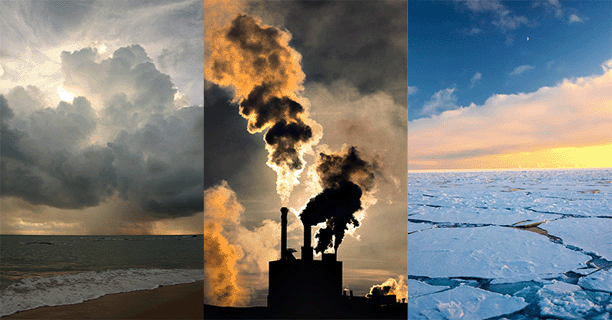
Global changes in temperature due to human-induced climate change have already impacted every aspect of life on Earth from genes to entire ecosystems, with increasingly unpredictable consequences for humans — according to a new study published in the journal Science.
The study found a staggering 80 percent of 94 ecological processes that form the foundation for healthy marine, freshwater and terrestrial ecosystems already show signs of distress and response to climate change.
Impacts to humans include increased pests and disease outbreaks, reduced productivity in fisheries, and decreasing agriculture yields.
“There is now clear evidence that, with only a ~1 degree C of warming globally, very major impacts are already being felt,” said study lead author Dr Brett Scheffers of the University of Florida. “Genes are changing, species’ physiology and physical features such as body size are changing, species are rapidly moving to keep track of suitable climate space, and there are now signs of entire ecosystems under stress.”
Said the study’s senior author, Dr. James Watson from the Wildlife Conservation Society and University of Queensland: “The level of change we have observed is quite astonishing considering we have only experienced a relatively small amount of climate change to date. It is no longer sensible to consider this a concern for the future. Policy makers and politicians must accept that if we don’t curb greenhouse gas emissions, an environmental catastrophe is likely.”
But the study also points to hope as many of the responses observed in nature could be applied by people to address the mounting issues faced under changing climate conditions. For example, improved understanding of the adaptive capacity in wildlife can be applied to our crops, livestock and fisheries. This can be seen in crops such as wheat and barley, where domesticated crops are crossed with wild varieties to maintain the evolutionary potential of varieties under climate change.
No comments yet.
1 This Month
23-25 October – on Zoom – World BEYOND War’s annual global conferenc


Shut down the radiation-damaged Heysham nuclear reactors now
To see nuclear-related stories in greater depth and intensity – go to https://nuclearinformation.wordpress.com

Say No to NASA’s Reckless Nuclear Reactor on the Moon
Say No to NASA’s Reckless Nuclear Reactor on the Moon

-
Archives
- October 2026 (199)
- September 2026 (339)
- August 2026 (330)
- July 2026 (355)
- June 2026 (287)
- May 2026 (306)
- April 2026 (356)
- March 2026 (251)
- February 2026 (267)
- January 2026 (308)
- December 2025 (358)
- November 2025 (359)
-
Categories
- 1
- 1 NUCLEAR ISSUES
- business and costs
- climate change
- culture and arts
- ENERGY
- environment
- health
- history
- indigenous issues
- Legal
- marketing of nuclear
- media
- opposition to nuclear
- PERSONAL STORIES
- politics
- politics international
- Religion and ethics
- safety
- secrets,lies and civil liberties
- spinbuster
- technology
- Uranium
- wastes
- weapons and war
- Women
- 2 WORLD
- ACTION
- AFRICA
- Atrocities
- AUSTRALIA
- Christina's notes
- Christina's themes
- culture and arts
- Events
- Fuk 2022
- Fuk 2023
- Fukushima 2017
- Fukushima 2018
- fukushima 2019
- Fukushima 2020
- Fukushima 2021
- general
- global warming
- Humour (God we need it)
- Nuclear
- RARE EARTHS
- Reference
- resources – print
- Resources -audiovicual
- Weekly Newsletter
- World
- World Nuclear
- YouTube
-
RSS
Entries RSS
Comments RSS


Leave a Reply