World environment movement ready to fight Trump on climate change
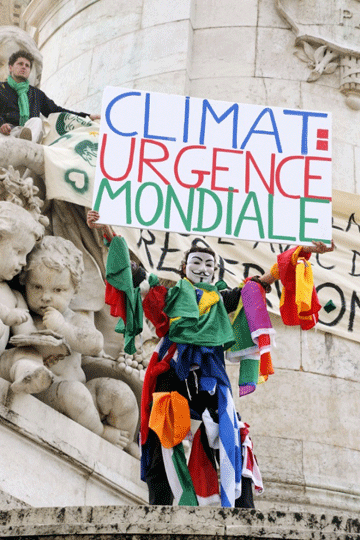 Global green movement prepares to fight Trump on climate change
Election of a climate sceptic as US president sparks outpouring of donations and a surge in planned protests and court challenges, Guardian, Oliver Milman, 19 Nov 16, The global green movement is preparing for the fight of its life against efforts by Donald Trump to rollback action on climate change, with a surge in fundraising, planned court challenges and a succession of protests.
Environmental activists said the election of a climate change denier as US president, along with the prospect of former vice-presidential nominee Sarah Palin and various oil billionaires holding senior posts, has prompted an “outpouring” of donations.
This week, comedian, John Oliver, used his show to urge viewers to give to the Natural Resources Defense Council, while EarthJustice, a specialist in environmental law, reported a “substantial increase” in donations to wage the expected legal battles ahead. The Sierra Club said it has had 9,000 new monthly donors since election day, more than they had in the year to date.
After spending eight years cheering and occasionally scolding Barack Obama, environmentalists are now moving on to a war footing. Campaigns will be pitched around climate action and protecting national parks, with green groups claiming that public support for these things means that Trump has no mandate to tear them apart.
With Congress and the White House in Republican hands, the message will have to resonate in conservative ears rather than just energise the base…….
Environmentalists said that, while Trump’s hand in the courts and Congress might be stronger than it was when they fought against George W Bush, one key difference was that businesses were now convinced of the need for curbing emissions. At the UN climate talks this week in Marrakech, a coalition of businesses including Kellogg’s and Mars, urged leaders to commit to long-term carbon plans.
“Ten years ago, US business wasn’t on board about tackling climate change,” said Craig Bennett, CEO of Friends of the Earth in the UK. “This time round you have a situation where US businesses and businesses more globally [support action], so this time around the environmental movement does not feel like it is on its own. We’re much better placed to fight this.”
In the UK, a cross-party group of MPs and environment groups has already begun meeting to discuss how to respond to anti-environmental rhetoric from the Trump administration, and how to deal with the consequences of the president elect delivering on his promise to withdraw from the Paris climate agreement……..
In Australia, the Trump victory is driving an intensified focus from environmentalists to put a stop to a proposed coalmine there, which would be the biggest in the already coal-rich nation, and one of the biggest in the world…… https://www.theguardian.com/environment/2016/nov/18/global-green-movement-prepares-to-fight-trump-on-climate-change
USA Judge refuses to dismiss Youth Climate Lawsuit

 Judge Won’t Dismiss Youth Climate Lawsuit; Stage Set for Historic Trial ,17 November 2016 By Dana Drugmand, Truthout | Report As global temperature continues to rise — with 2016 slated to set a new high for the third consecutive year — young climate activists are rising to the occasion and breaking new legal ground. Finally, a landmark youth-led climate change lawsuit may move forward to trial.
On November 10, 2016, US District Court Judge Ann Aiken ruled in favor of 21 youth plaintiffs suing the federal government over its inadequate action to prevent anthropogenic climate disruption (ACD).
“It’s clear Judge Aiken gets what’s at stake for us,” said 17-year-old plaintiff Victoria Barrett, from White Plains, New York. “Our planet and our generation don’t have time to waste. If we continue on our current path, my school in Manhattan will be underwater in 50 years.”
Judge Aiken rejected defendants’ motion to dismiss the case, following the recommendation made by magistrate judge Thomas Coffin last April. Judge Coffin determined that the youths had standing and had potential constitutional and public trust claims.
The youth plaintiffs (who range from nine to 20 years old) and the nonprofit Our Children’s Trust claim violation of the public trust doctrine, and most prominently, violation of their constitutional rights to life, liberty and property due to climate instability. Federal agencies like the Environmental Protection Agency (EPA) are the main defendants, supported by the fossil fuel industry as interveners in the case. The plaintiffs allege that the government has known about the dangers of climate change for decades, yet deliberately pursued policies that enabled a fossil-fuel-based energy system and locked in dangerous levels of warming that may be irreversible.
Plaintiffs seek relief in the form of a court mandate that the US develop a climate recovery plan based on the current science……
Although this was not a decision on the merits, Judge Aiken acknowledged the substantive argument that the conventional policy response to the climate crisis has failed to prevent harm.
“This action is of a different order than the typical environmental case,” she wrote in her decision. “It alleges that defendants’ actions and inactions — whether or not they violate any specific statutory duty — have so profoundly damaged our home planet that they threaten plaintiffs’ fundamental constitutional rights to life and liberty.”
In seeking appeal, the government will ask the judge for certification that raises a jurisdictional question, but Vermont Law School professor Patrick Parenteau said she will likely deny this request, thus sending the case to trial.
“I think the case has a lot of moral force and a lot of rhetorical force, regardless of what its ultimate fate may be,” Parenteau told Truthout, adding that it will hopefully capture public attention and remind people that elections have consequences, particularly for younger generations……..http://www.truth-out.org/news/item/38405-judge-won-t-dismiss-youth-climate-lawsuit-stage-set-for-historic-trial
Commitment to divest from fossil fuels – Islamic Society of North America
 Islamic Society of North America Announces Divest-Invest Commitment http://www.greenfaith.org/programs/divest-and-reinvest/islamic-society-of-north-america-announces-fossil-fuel-divestment Statement of Dr. Azhar Azeez
President of the Islamic Society of North America 9 Safar 1438 AH/10 November 2016
ISNA was proud to have been an important part of the organizing of the Marrakech Conference back in April of this year at which scholars and Muslim leaders from around the globe affirmed the message of the Prophet Muhammed (AS) Suluh Medina (Charter) as a model and basis for interfaith cooperation common action as we strive for a better and more fair and just world.
ISNA also has a proud tradition of partnering with other national faith communities on issues and causes of justice including the Shoulder-To-Shoulder Campaign and most recently signing along with other national and world faith leaders the COP 22 Interfaith Climate Statement to be presented in Marrakech today.
“According to Islam’s most basic and fundamental teachings, human beings have been uniquely charged with the great responsibility of being Guardians and Caretakers of the Earth. It goes against the overall service based mission ISNA, to invest in fossil fuel companies whose operations and products cause such grave harm to humanity and to Creation and ISNA commits herself to this cause.”
The Islamic Society of North America is the largest US Muslim umbrella organization. Established in 1963 as the Muslim Students Association of the US and Canada, ISNA’s affiliate and constituent organizations include the North American Islamic Trust (NAIT), Islamic Medical Association of North America (IMANA), Association of Muslim Scientists and Engineers (ASME), Association of Muslim Social Scientists (AMSS), Council of Islamic Schools of North America (CISNA), Muslim Students Association (MSA) and Muslim Youth of North America (MYNA). For information about ISNA, see www.isna.net.
Contact: Imam Saffet Abid Catovic, Board Member, ISNA Green Mosque Task Force; saffetac@aol.com
Religious leaders from 44 countries present the the COP22 Interfaith Climate Statement
 World religious leaders present joint statement to UN climate talks http://www.indcatholicnews.com/news.php?viewStory=31359 World religious leaders present joint statement to UN climate talks http://www.indcatholicnews.com/news.php?viewStory=31359 |
| November 16, 2016 At the UN climate talks on Wednesday, a senior member of the UN Secretary General’s Climate Change Support Team received the COP22 Interfaith Climate Statement, signed by more than 230 eminent religious leaders from 44 countries. The Statement called on nations to justly manage the transition to a low carbon economy and urged for governments to shift trillions of investments in fossil fuels into renewable energy, in line with the Paris Agreement and the Sustainable Development goals (SDGs).The Statement is consistent with the Secretary General’s continued strong call for redirecting investments into clean energy, including clean energy access. “As a means to speed up the transition to a low carbon economy,” the Secretary General told 500 global investors at the 2016 Investor Summit on Climate Risk, “Markets now have the clear signal they need to unleash the full force of human ingenuity and scale up investments that can generate low-emissions resilient growth.”The Statement was drafted and distributed in collaboration with more than thirty faith groups globally. Signatories of the Statement include His Holiness the Dalai Lama; Msgr. Marcelo Sánchez Sorondo, Chancellor of the Pontifical Academy of Sciences; Rev Dr Olav Fykse Tveit, General Secretary, World Council of Churches; Sayyid M. Syeed, Islamic Society of North America; Archbishop Desmond Tutu; and over 230 other faith leaders from around the globe. Other signatories include senior Buddhist, Muslim, Hindu, Jain, Sikh, , Eastern Orthodox, Roman Catholic, Anglican, Episcopal, Baptist, Pentecostal, Lutheran, Quaker, Unitarian Universalist, Indigenous and other Spiritual leaders.
At the Summit of Religious and Secular Leaders on Climate Change, Ban Ki-Moon said the potential impact of the faith sector was enormous, describing them as the “third largest category of investor, that can establish green religious buildings. Invest ethically in sustainable products. And set an example for the lifestyles of billions of people, whose actions can encourage political leaders to act more boldly in protecting people and the planet.” He went on to say that the world’s faith and religious communities owned up to eight percent of the world’s habitable land and five percent of commercial forests. The faith sector also contributes to more than half of the world’s schools, and according to the Pew Research Center offers moral and spiritual guidance to approximately 84 percent of all people. The interfaith delegation that handed over the Statement included ISNA representative Imam Saffet Catovic; Sister Jayanti, European Director of Brahma Read the COP22 Interfaith Climate Statement here: http://www.interfaithstatement2016.org/ In support of the Statement and marking the world’s first public divestment announcement from a Muslim institution, the Islamic Society of North America (ISNA) in a major announcement on 10 November committed to divest from fossil fuels and encouraged its two constituent organizations and five national affiliated institutions to do so as well. See: http://www.greenfaith.org/programs/divest-and-reinvest/islamic-society-of-north-america-announces-fossil-fuel-divestment |
John Kerry – USA is not giving up on Paris climate deal
 John Kerry: We will fight to keep US in the Paris climate deal
Secretary of state says the outgoing Obama administration is determined to prevent Trump withdrawing the US from the landmark deal, Guardian, Arthur Neslen in Marrakech and Fiona Harvey, 17 Nov 16, John Kerry has signalled that the outgoing Obama administration is preparing a fight to ensure that Donald Trump does not withdraw the US from the landmark Paris agreement, to prevent catastrophic climate change.
Petition accepted by USA, calling for fossil fuel lobbyists to be excluded from Marrakech climate talks
Marrakech climate talks: US accepts petition calling for fossil fuel lobbyists to be excluded
Petition supports nations such as Ecuador and Venezuela that tried to initiate a conflict of interests policy, Guardian, Michael Slezak, 16 Nov 16, A petition calling for fossil fuel lobbyists to be excluded from the UN climate change negotiations has been forced into the hands of the US delegation in Morocco, where almost 200 nations are meeting to work out ways to implement the 2015 Paris agreement to limit greenhouse gas emissions.
The US delegation initially said it could not formally receive the petition signed by more than 500,000 people but later contacted Corporate Accountability International, agreeing to receive it on Wednesday.
The development followed a side event on Monday at the meeting in Marrakech, headed by the Ecuadorian delegation, where parties to the Paris agreement and non-government organisations met to discuss why a conflict of interests policy was needed and what it might look like.
The petition, spearheaded by Corporate Accountability International, calls for the UN Framework Convention on Climate Change to create a policy that would screen non-state participants of meetings for conflicts of interests.
It was written in support of moves by Ecuador, Venezuela and other developing nations representing the majority of the world’s population, who tried to initiate a conflict of interests policy in May.
They argued that groups representing fossil fuel companies, whose net worth can be larger than the GDPs of developing nations, and who have funded climate change denial, should not be allowed in policy negotiations without being screened for conflicts of interest.
That move was blocked by delegations representing rich nations including the EU, the US, UK and Australia, which argued that the negotiations should be “open” and that there was no clear definition of a “conflict of interest”.
“I stand with the governments calling for an end to big polluter conflicts of interest at the United Nations Framework Convention on Climate Change,” the petition reads. “In order for the UNFCCC to create strong climate policy that protects people and the planet from climate catastrophe, we need to remove big polluters from the policymaking table.”
In a statement, the lead negotiator for the Ecuadorian delegation said: “Too much is at stake to continue allowing the world’s biggest polluters and their agents to undermine this process.”
He said the responsibility of saving the planet could not be left up to “the industries and their corporate powers that got us here”…..
In May, the Like Minded Group of Developing Countries – a collection of more than 20 countries representing most of the world’s population – pushed for a report to be prepared examining how “the United Nations system and other intergovernmental forums … identify and minimise the risk of conflicts of interest”.
The call was blocked by rich countries but several developing nations rose to speak passionately about the issue, including Venezuela, Ecuador and China.
Besides handing the petition to the US delegation, Corporate Accountability International is planning a protest action on the issue later this week, Bragg said. https://www.theguardian.com/environment/2016/nov/16/marrakech-climate-talks-us-accepts-petition-calling-for-fossil-fuel-lobbyists-to-be-excluded
The $trillion costs of not acting on climate change
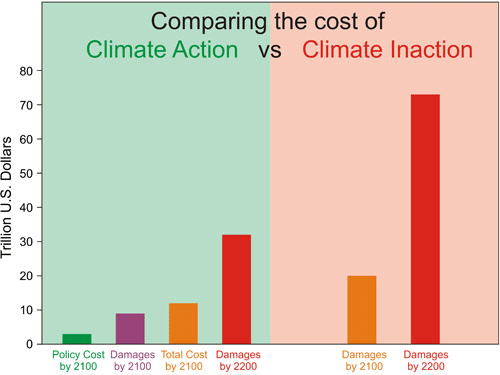 The cost of climate change: World’s economy will lose $12tn unless greenhouse gases are tackled Damage caused by rising seas, increased storms and other climate-related problems pose ‘a very serious challenge to poverty eradication efforts in the developing world’ The Independent, Ian Johnston Environment Correspondent Thursday 17 November 2016 Preventing global warming from rising above 1.5 degrees Celsius will mean the world’s economy is at least 10 per cent bigger by 2050 than it would be if action is not taken to reduce greenhouse gases, according to a new report.
The planet’s average temperature has already risen about 1C in about 130 years, with scientists admitting that restricting this to just 0.5C more will be difficult.
However the report – released by the United Nations Development Programme and a group of 43 developing countries which are highly vulnerable to climate change – argued doing so would be worth it.
As a result, the world’s gross domestic product would fall by $21 trillion by 2050, compared to $33 trillion under a ‘business-as-usual’ approach that allows global warming of 2.5 degrees. This saving of $12 trillion (about £9.6 trillion) represents about 10 per cent of global GDP.
It would also “substantially” reduce the risk of the flooding of large parts of the world’s lowest lying land, “with the Greenland ice sheet facing irreversible decline most likely around 1.6C of warming”.All the ice on Greenland would take some time to melt but would raise sea levels by seven metres once completely gone.
Keeping global warming to 1.5 per cent would mean at least 10 per cent of the coral reefs on the planet would survive; any higher and the “virtual disappearance” of this key marine ecosystem would begin.
The report, called Pursuing the 1.5C Limit, said such changes would dramatically affect the world’s economy…..http://www.independent.co.uk/environment/global-warming-climate-change-world-economy-gdp-smaller-12-trillion-a7421106.html
Global action on climate change is unstoppable, despite Mr Trump – says Ban Ki-moon
Donald Trump’s stance on climate change will not halt ‘unstoppable’ global action, Ban Ki-moon says, ABC News, UN secretary-general Ban Ki-moon says action on climate change has become “unstoppable”, as he expressed hopes US President-elect Donald Trump would drop plans to quit a global accord aimed at weaning the world off fossil fuels.
Key points:
- Mr Ban says he hopes Mr Trump will “evaluate” his position on climate change
- Mr Trump has previously said he will withdraw US from Paris Agreement
- Mr Ban says market forces are already pushing the world economy towards cleaner energies
At a meeting of almost 200 nations in Morocco to work out ways to implement the 2015 Paris agreement to limit greenhouse gas emissions, Mr Ban said US companies, states and cities were all pushing to limit global warming.
“What was once unthinkable has become unstoppable,” he told a news conference of the Paris Agreement, agreed by governments last year, ratified in record time and formally adopted by more than 100 nations including the United States……Mr Ban, who will step down at the end of the year after a decade in charge of the United Nations, has made action on climate change a core issue of his time in office. http://www.abc.net.au/news/2016-11-15/trump-wont-stop-climate-change-action-un-ban-ki-moon-hopes/8028300
US Republicans now seek a quick way to get out of Paris climate agreement
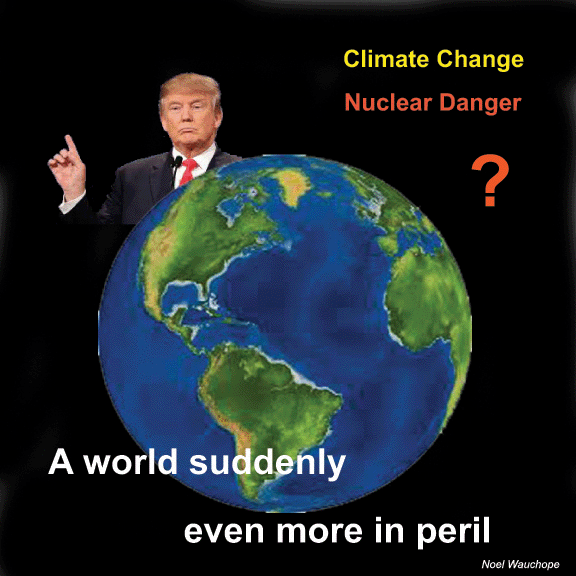 Trump seeking quickest way to quit Paris climate agreement, says report, Guardian, 13 Nov 16
The president-elect wants to bypass the theoretical four-year procedure to exit the accord, according to a Reuters source, Donald Trump is looking at quick ways of withdrawing from the Paris climate agreement in defiance of widening international backing for the plan to cut greenhouse gas emissions, Reuters has reported.
But, according to Reuters, a source in the Trump transition team said the victorious Republican, who has called global warming a hoax, was considering ways to bypass a theoretical four-year procedure for leaving the accord.
“It was reckless for the Paris agreement to enter into force before the election,” said the source, who works on Trump’s transition team for international energy and climate policy, speaking on condition of anonymity. The Paris agreement went into force on 4 November, four days before last Tuesday’s election.
Alternatives were to send a letter withdrawing from a 1992 convention that is the parent treaty of the Paris agreement, voiding US involvement in both in a year’s time, or to issue a presidential order simply deleting the US signature from the Paris accord, the source told Reuters.
Many nations have expressed hopes the United States will stay. Morocco, the host for the talks, said the agreement that seeks to phase out greenhouse gases in the second half of the century was strong enough to survive a pullout.
“If one party decides to withdraw that it doesn’t call the agreement into question,” foreign minister Salaheddine Mezouar told a news conference.
Despite the threat of a US withdrawal, US secretary of state John Kerry said on Sunday that he would continue his efforts to implement the Paris agreement until Barack Obama leaves office on 20 January.
Speaking in New Zealand following a trip to Antarctica, Kerry appeared to take a swipe at Trump when he listed some of the ways in which global warming could already be seen. He said that there were more fires, floods and damaging storms around the world, and sea levels were rising.
“The evidence is mounting in ways that people in public life should not dare to avoid accepting as a mandate for action,” Kerry said…..https://www.theguardian.com/us-news/2016/nov/13/trump-looking-at-quickest-way-to-quit-paris-climate-agreement-says-report
Despite Trump, the shift to a low-carbon economy already has its own momentum
Donald Trump presidency a ‘disaster for the planet’, warn climate scientists, Guardian, Oliver Milman, 13 Nov 16 “………The shift to a low-carbon economy already has its own momentum, however, with the cost of solar and wind power tumbling in recent years. Nearly 100 coal power plants were retired in 2015, with renewables accounting for two-thirds of all new electricity generation.
New York and California both have their own ambitious emission reduction plans, conservative states such as Iowa are embracing wind energy, and innovations from companies such as Tesla, in solar panels and battery storage, are being snapped up by homeowners.
Trumpian interference can only do so much to slow this trend, although plodding progress isn’t enough to stave off climate catastrophe. The UN has warned that global emissions must peak by 2020 and then be sharply reduced in order to avoid the worst. This shrinking window risks being clouded entirely if the US is to choke itself, and the rest of the world, on its fumes.
Stunned environment groups, faced with triumphant climate denialism in all branches of government, are trying to muster defiance. “This could be devastating for our climate and our future,” admitted Michael Brune, executive director of the Sierra Club. “But Trump must choose wisely or we guarantee him the hardest fight of his political life. We won’t be in a defensive crouch for the next four years, licking our wounds.
“If he tries to go backwards on climate change he’ll run headlong into an organized mass of people who will fight him in the courts, in Congress and on the streets.”
Others are more conciliatory, with former vice president Al Gore proffering an olive branch along with an enormous dollop of optimism. “Last night President-elect Trump said he wanted to be a president for all Americans,” Gore said on Wednesday. “In that spirit, I hope that he will work with the overwhelming majority of us who believe that the climate crisis is the greatest threat we face as a nation.”
Whether or not Trump becomes a belated convert to the reality of climate change, the physics of global warming remain unchanged.
2016 will be the warmest year on record, beating a mark set only last year. These extremes, where India experiences a temperature of 51C (123F) and the Arctic is robbed of almost all of its winter snowfall, are set to become the norm within a decade. American citizens, from Alaska to Louisiana, are already being uprooted due to the rising seas, a situation that will become commonplace.
Trump knows enough of the gargantuan shifts underway to build a seawall for his golf course in County Clare, Ireland. His Mar-a-Lago club in Florida may have to be next. Whether he extends his concern from beyond his own business interests to the rest of the world remains to be seen. https://www.theguardian.com/environment/2016/nov/11/trump-presidency-a-disaster-for-the-planet-climate-change
Keep it in the ground: What President Trump means for climate change

Donald Trump’s win could be catastrophic for the world’s climate, as well as international diplomacy, as American leadership is transformed This November is likely to have profound implications for climate change – but not in the way that was anticipated just a week ago. The Paris climate deal came into force on 4 November but Tuesday’s election of Donald Trump as US president casts an ominous shadow over the agreement and the chances of avoiding dangerous global warming.
Trump is a highly erratic figure, so predicting his actions can be problematic. But we do know that he wants to withdraw the US from the Paris accord, which aims to keep the global temperature increase below a 2C threshold, that he believes climate change to be a “hoax” and that Barack Obama’s warning that global warming is a threat on a par with terrorism was “one of the dumbest statements I’ve ever heard in politics.”
Obama’s climate legacy, and the tools he used to force down emissions, are set to be torn apart by Trump once he enters the White House. Contentious oil pipelines such as Keystone and Dakota Access will likely be approved. Clean energy funding will be slashed. The world’s second largest greenhouse gas emitter will look to prop up coal, rather than renewables, to power its future. Read my report today for the full story.
This could prove catastrophic for the world’s climate, as well as international diplomacy, as American leadership is transformed into an excuse to slack off in cutting emissions. Already, the 2C threshold looks in severe peril. 8 November could be the day when tens of millions of people were condemned to an unlivable environment. A Trump u-turn on this matter, at least, would be welcomed by those most at risk.
Oliver Milman, US environment correspondent
Drought is destabilising Africa
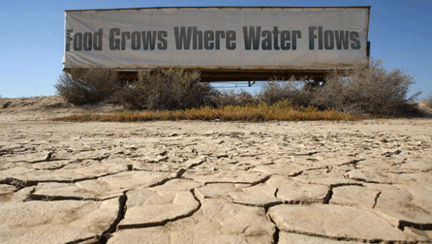 HotSpots H2O: Africa’s Water Challenges http://www.circleofblue.org/2016/world/hotspots-h2o-africas-water-challenges/ Global HotSpots H2O, 13 Nov 16
From the Syrian conflict, to protests in Zimbabwe, Tunisia and India, to a deep drought destabilizing South Africa, water is playing a significant role in global civil unrest.
HotSpots H2O from Circle of Blue’s award-winning team of journalists examines regions, populations, and countries that are most at risk from water-related unrest and conflict. It reveals the challenges individuals confront — and the solutions they discover — as they strive to build resilient communities.
Africa’s Water Challenges The worst drought in 35 years continues to grip southern Africa, even as the El Nino season that caused it comes to an end. The drought, which began in 2015, has left 21.3 million people in need of food assistance,according the American aid agency USAID. Officials say the food crisis will continue to get worse.
“The crisis has yet to peak,” United Nation’s Special Envoy Macharia Kamau told journalists in Mozambique after a four day tour of that nation where he witnessed the desperation of the hungry. “For many children, women and the elderly, the next few months will be about looking at survival straight in the face,” he continued.
The fifteen-nation Southern African Development Community (SADC) has been scrabbling to find aid for the food crisis and has recently launched a call for $US 2.9 billion in food aid from the international community. The call for assistance comes as the wet season returns to southern Africa with the onset of La Nina.
Despite the upcoming rains, Lesotho, Madagascar, Malawi, Mozambique, Swaziland, and Zimbabwe have all declared a state of emergency, due to the upcoming “lean season.” From January to March famers will wait for their crops to grow before they can begin to harvest.
The severity of the effects of the drought in the region stem in part from the fragile nature of the water systems and the economic structures prevalent in the region, according to visiting Oxford Professor David Grey.
“Unsustainable livelihoods as a consequence of the hydrological complexity and variability are fairly widespread across the continent,” Grey told Circle of Blue. “And the consequences of this is that as populations grow, people find it harder and harder to feed themselves.”
Water Security: Freedom from Intolerable Water-Related Risks | PODCAST |
Large-scale drought in southern Africa. Floods in North Korea and Haiti. Rumblings of water-related conflicts in Pakistan and India. In Circle of Blue’s latest HotSpots H2O podcast, Dr. David Grey, a visiting professor of Water Policy from Oxford University, argues that water security is closely linked to migration, climate change risk, and economic development. In an interview with J. Carl Ganter, Circle of Blue’s director, Dr. Grey also offers solutions to alleviating the world’s water-related risks.
Dr. Grey also is a former member of the World Economic Forum Global Agenda Council on Water Security. J. Carl Ganter reports from Washington D.C. at the International Dialogue on the Global Commons.
Madagascar in Focus: Food Shortages Affects 1.4 Million People
“These are people living on the very brink – many have nothing but wild fruits to eat,” United Nations World Food Programme (WFP) regional Director Chris Nikoi told reporters in late October.
The drought forced many subsistence farmers to begin eating their own seed stocks and selling their land to get by, meaning they will have nothing to plant and nowhere to plant it when the rain returns. Next year, according to the UN Food and Agriculture Organization, at least 840,000 people risk severe malnutrition, and nearly 1.4 million will be food insecure.
Children have been the hardest hit. According to UNICEF, some 10,500 kids have been treated for a hunger-related illness known as severe acute malnutrition or SAM since January of this year. Children suffering from SAM typically have a mortality rate of around 30 to 50 percent.
The return of La Nina this winter may bring some relief. But strong rain could cause flash flooding, washing away fragile topsoil and newly planted crops.
Climate scientists warn that Trump’s election is a disaster for the planet
Donald Trump presidency a ‘disaster for the planet’, warn climate scientists
Leading scientists say the climate denier’s victory could mean ‘game over for the climate’ and any hope of warding off dangerous global warming, Guardian, Oliver Milman, 13 Nov 16 The ripples from a new American president are far-reaching, but never before has the arrival of a White House administration placed the livability of Earth at stake. Beyond his bluster and crude taunts, Donald Trump’s climate denialism could prove to be the lasting imprint of his unexpected presidency.
“A Trump presidency might be game over for the climate,” said Michael Mann, a prominent climate researcher. “It might make it impossible to stabilize planetary warming below dangerous levels.”
Kevin Trenberth, senior scientist at the US National Center for Atmospheric Research, added: “This is an unmitigated disaster for the planet.”
Trump has vowed to sweep away the climate framework painstakingly built over Barack Obama’s two terms. At risk is the Paris climate accord, which only came into force last week, and Obama’s linchpin emissions reduction policy, the Clean Power Plan.
At a pivotal moment when the planet’s nations have belatedly banded together to confront an existential threat, a political novice who calls global warming a “bullshit” Chinese-invented hoax is taking the helm at the world’s foremost superpower.
“Millions of Americans voted for a coal-loving climate denier willing to condemn people around the globe to poverty, famine and death from climate change,” said Benjamin Schreiber, climate director at Friends of the Earth US. “It seems undeniable that the United States will become a rogue state on climate change.”
US conservatives are already rubbing their hands in glee at the prospect of a bonfire of regulation. Trump wants the US to exit the Paris deal, which commits nations to keeping the global temperature rise below a 2C threshold, potentially setting off a cataclysmic domino effect where other countries also drop out or ease off efforts to decarbonize. The 2C limit, which was already a stern challenge, now appears perilous.
The Clean Power Plan, the main tool to cut American emissions, is also targeted for elimination, along with billions of dollars in clean energy funding. Republicans will also turn off the tap of aid flowing to developing nations already struggling with climate change-driven sea level rise, heatwaves and drought.
Bitterly contested fossil fuel projects such as the Keystone development and the Dakota Access pipeline, which has caused unprecedented uproar among native American tribes, would likely be waved through, with Trump promising to “lift the Obama-Clinton roadblocks to allow these vital energy infrastructure projects to go ahead”.
Environmentalists are already aghast at Trump’s presidential preparations. He has appointed Myron Ebell, director at a conservative thinktank, to oversee transition plans for the Environmental Protection Agency, which Trump has casually earmarked for abolition. Ebell has said global warming is “nothing to worry about” and that the Clean Power Plan is “illegal”.
Shortlists drawn up for key Trump administration posts have also raised alarm. Oil billionaire Harold Hamm is being touted as energy secretary, while former vice presidential candidate Sarah Palin could make a stunning comeback as interior secretary, putting her in charge of US public lands, including treasures such as Yellowstone and Yosemite national parks. Palin is an enthusiastic proponent of oil and gas drilling, describing the fossil fuels as “things that God has dumped on this part of the Earth for mankind’s use”.
Republicans have already used Congressional committees to hound climate scientists and green groups and this badgering may escalate once climate denial is official White House doctrine. It’s understood that scientists at Nasa are already bracing themselves for cuts to climate research programs.
Predicting Trump’s plans, however, largely relies upon reading the runes from his discursive policy speeches, which regularly dissolved into vituperative diatribes while on the campaign trail.
At the heart of his energy and climate thinking is an “America first” policy where “draconian climate rules” are repealed and the US escalates its production of coal, oil and natural gas. In May, Trump sported a coal miner’s helmet at a rally in West Virginia, a state with a long history of mining, to underscore his message that the “war on coal” is over and that jobs will flow back to the stricken industry.
“Under my administration,” Trump said, “we’ll accomplish complete American energy independence. Complete. Imagine a world in which our foes, and the oil cartels, can no longer use energy as a weapon. It will happen. We’re going to win.”
These bromides to American industrial strength helped propel Trump to the White House but aren’t tethered to reality. US coal production slumped 10% last year, with mining jobs shrinking by 12%. Over the same 12-month period, the US oil industry lost $67bn. These woes have been caused by market forces, rather than onerous regulation, and even Trump’s authoritarianism doesn’t extend far enough to change that.
“As president, Donald Trump will pretend climate change does not exist,” said Prof Tom Lyon of the University of Michigan’s business school. “This is an increasingly untenable position, even for committed climate skeptics.
“His energy policy will encourage investment in high-carbon energy sources that will look foolish in retrospect. And he will anger much of the rest of the world by reneging on policies designed to address global challenges.”
US greenhouse gas emissions have started to taper off in recent years but a Trump presidency would see a resurgence, with an analysis by Lux Research finding that carbon dioxide output would be 16% higherthan the current trajectory should the real estate magnate complete a second term.
This would give the world a hefty shove towards climate disaster and fatally wound the US’s reputation as a global leader. Should other major emitters such as China, India and the European Union fail to make compensatory emissions cuts the planet will likely spiral into runaway climate change where tens of millions of people are displaced by rising seas, food insecurity and conflict, leading to an unprecedented international humanitarian disaster.
Major US cities including New York, Miami and Boston would face inundation. California, already suffering its worst dry spell in 1,200 years, may stage ‘megadroughts’ that last 20 or even 30 years. The Pentagon has warned climate change poses a “threat multiplier” to US national security, to hoots of derision from Republicans……… https://www.theguardian.com/environment/2016/nov/11/trump-presidency-a-disaster-for-the-planet-climate-change
Marrakech talks pressing on with climate action, despite Mr Trump
The Paris Agreement is now in force after a speedy ratification, the US share of global emissions has declined, and renewable energy is now much cheaper. Many US states, cities and businesses will continue to work towards reducing emissions, and many Republican politicians have let go of their aversion to renewable energy in response to public and business pressure.
In short, much of America and the rest of the world will continue to build momentum under the Paris Agreement, despite the changing of the guard in Washington DC.
Meanwhile, after the initial pause to digest the shock of Trump’s victory, the negotiators at Marrakech have got back down to their business, which is to fill in the implementation details of the Paris Agreement.
The view from Marrakech: climate talks are battling through a Trump tsunami, https://theconversation.com/the-view-from-marrakech-climate-talks-are-battling-through-a-trump-tsunami-68597 The Conversation, November 11, 2016 Stunned. Shocked. Speechless. Devastated. Political tsunami. These were the key words rising to the surface of the babble of conversations that took place in the corridors of the climate negotiations in Marrakech on Wednesday 9 November – the day Donald Trump won the US presidency. Continue reading
Under President Trump there’ll be a fossil fuel fan administration

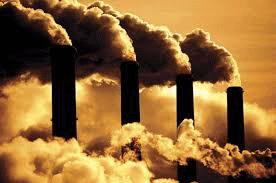 Meet the Fossil Fuel Superfans Tipped to Run Energy and Climate Under Trump Truthout, Friday, 11 November 2016 By Zachary Davies Boren, Joe Sandler Clarke and Emma Howard, Energydesk | Report “…….Trump, an avowed climate change denier and fossil fuel champion, looks set to stack his key energy and environment positions with oil and gas men and free market zealots.
Using documents leaked to Buzzfeed, sources at Politico and beyond, we’ve done a rundown of who’s in line for a top energy and climate job in the US government.
Harold Hamm (Possible Energy Secretary)
Tipped for energy secretary in a Trump administration, oil and gas billionaire Hamm has been showered with praise by the new President-elect, who said with classic hyperbole that Hamm understands energy “better than anybody else”.
As chief exec of Oklahoma-based fracking firm Continental Resources, Hamm would represent the first cabinet appointee directly plucked from the fossil fuel industry since 1977.
For years Trump has been dismissive of man-made climate change, but the particular brand of anti-regulation and anti-renewables stance he deployed in the election was vintage Hamm, who was often referred to as Trump’s ‘energy adviser.’
Hamm, whose firm runs the bulk of the Bakken shale formation in North Dakota, has already called for Trump to scrap “overreaching regulations” in order to ramp up oil production — despite record-breaking output under Obama.
During the campaign, Hamm said Trump didn’t actually “understand” oil issues after the then-candidate suggested local communities should have a say in whether there’s fracking in their area.
Myron Ebell (possible EPA)
Myron Ebell is a highly active climate change denier.
Reports emerged in September that Trump would appoint him to lead the transition at the Environmental Protection Agency.
Ebell is currently head of libertarian think-tank the Competitive Enterprise Institute (CEI), which says of itself: “The CEI’s largest program takes on all the hard energy and climate issues.
“CEI questions global warming alarmism, makes the case for access to affordable energy, and opposes energy-rationing policies, including the Kyoto Protocol, cap-and-trade legislation, and EPA regulation of greenhouse gas emissions. CEI also opposes all government mandates and subsidies for conventional and alternative energy technologies.”
The CEI also leads SafeChemicalPolicy.org, a coalition that lobbies against regulation of the chemicals industry. It promotes the “life enhancing value of chemicals” — even those that scientists claim “significantly increase our risks of cancer, developmental defects, and even obesity”.
If that wasn’t enough, Ebell also runs the Cooler Heads Coalition, a grassroots group that works to “dispel the myths of global warming.” It names the neoconservative American Legislative Exchange Council (ALEC) and the Heartland Institute among its members.
The Heartland Institute has used the words of mass murderers to justify its opposition to climate action and attempted to block climate change teaching in schools.
ALEC, which has repeatedly blocked legislation to tackle climate change, has become so divisive that even oil giants Shell and BP have quit the group.
Sarah Palin (Possible Secretary of Interior) “I would love to have the strength of Sarah Palin in my administration.” That’s what Trump said back in September 2015.
The former Vice Presidential candidate and Alaska Governor is on the shortlist for the next Secretary of the Interior, running the government department responsible for the management of federal land and, crucially, the country’s natural resources.
On announcing her support for the then-candidate Trump, Palin told CNN she would love to run the Department of Energy, seemingly without knowing what the department actually did.
“Energy is my baby,” she said. “Oil, gas, minerals, those things God has dumped on this part of the earth for mankind’s use instead of us relying on unfriendly foreign nations for us to import their resources. If I were head of that, I’d get rid of it.”
The Interior Department has broad ranging responsibilities, from managing America’s national parks to dealing with the land rights of Native Americans, to making decisions about fracking and offshore drilling
The thought of the woman responsible for the “drill baby drill” campaign overseeing who can drill off the coast of Alaska certainly is something.
Forrest Lucas (Possible Secretary of Interior) One of Palin’s rivals for the Interior job is oil industry executive Forrest Lucas.
Lucas, 74, is the co-founder of Lucas Oil and is wealthy enough to have given new Vice President Mike Pence $50,000 while he was running to be Indiana’s governor and spend more than $100million putting his name on an American Football stadium 10 years ago. The Indianapolis Colts now play their home games at the Lucas Oil Stadium.
The oil and gas industry has been fighting furiously against the Obama administration for eight years, on everything from Arctic drilling to the Keystone XL pipeline, so having one of their own heading up the department of interior would be a boon.
As Khalid Pitts, from the Sierra Club, told Politico it would be “open season” on America’s environment if someone like Lucas was given a job.
That said, current secretary Sally Jewell is a former Mobil Oil executive, but she is also known for her conservation work.
Mike McKenna (Energy Department)
Energy lobbyist Mike McKenna is in line to to lead the transition at the Energy Department.
McKenna is the President – and according what is presumably his LinkedIn page also the “Czar” — at lobby firm MWR Strategies, while also working as a specialist for the energy department in the past.
According to the Washington Post, he has lobbied on behalf of the firm owned by the billionaire Koch Brothers, which was listed by Forbes as one of the largest private companies in the US. They are a major funder of climate sceptic think-tanks and scientists as well as efforts to water down environmental regulation at the EU level.
Also among the companies to have been represented by McKenna, named by the Washington Post, are multinational Dow Chemical and energy firm EDF Suez, which owns fracking licences in the UK. http://www.truth-out.org/news/item/38348-meet-the-fossil-fuel-superfans-tipped-to-run-energy-and-climate-under-trump
1 This Month





PLEASE OPPOSE HR 8255 AND S.3639 – bills would accelerate satellite deployment, with no environmental review or safeguards – https://ncstd5li.quorum.us/campaign/169331/
To see nuclear-related stories in greater depth and intensity – go to https://nuclearinformation.wordpress.com
-
Archives
- October 2026 (10)
- September 2026 (339)
- August 2026 (330)
- July 2026 (355)
- June 2026 (287)
- May 2026 (306)
- April 2026 (356)
- March 2026 (251)
- February 2026 (267)
- January 2026 (308)
- December 2025 (358)
- November 2025 (359)
-
Categories
- 1
- 1 NUCLEAR ISSUES
- business and costs
- climate change
- culture and arts
- ENERGY
- environment
- health
- history
- indigenous issues
- Legal
- marketing of nuclear
- media
- opposition to nuclear
- PERSONAL STORIES
- politics
- politics international
- Religion and ethics
- safety
- secrets,lies and civil liberties
- spinbuster
- technology
- Uranium
- wastes
- weapons and war
- Women
- 2 WORLD
- ACTION
- AFRICA
- Atrocities
- AUSTRALIA
- Christina's notes
- Christina's themes
- culture and arts
- Events
- Fuk 2022
- Fuk 2023
- Fukushima 2017
- Fukushima 2018
- fukushima 2019
- Fukushima 2020
- Fukushima 2021
- general
- global warming
- Humour (God we need it)
- Nuclear
- RARE EARTHS
- Reference
- resources – print
- Resources -audiovicual
- Weekly Newsletter
- World
- World Nuclear
- YouTube
-
RSS
Entries RSS
Comments RSS

