Uranium industry in Australia – not looking good
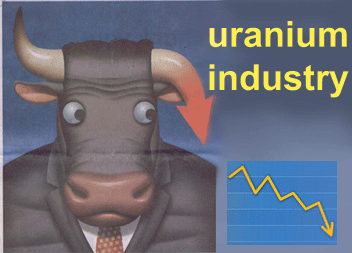 recent steps by BHP to cuts of its uranium program — from the delay of the uranium production expansion plan at the Olympic Dam project to the selling of a large Yeelirrie deposit located in Western Australia.
Recent Ranger and Olympic Dam issues along with various problems related to notable Australian uranium projects like Angela/Pamela, Kintyre, Oban, Wiluna and Koongarra, amongst others, have also caused concerns about the future development dynamics of the local uranium industry.
Australia’s uranium industry hits turbulence Mining.com, Vladimir Basov | February 8, 2013 Recent news from Australia raises serious concerns about the future development of its domestic uranium industry. While established players are exiting the market, others are lining up to explore new areas and have made some positive moves.
Open-pit mining operations at Ranger mine were terminated at the end of November 2012. Continue reading
Cloudy future for nuclear power in USA
 The Nuclear Power and Natural Gas Equation
NYT, By JON HURDLE, 7 Feb 13, Duke Energy is weighing the issue of how to replace the power generated by its troubled Crystal River nuclear plant in Florida, which the company has announced that it will permanently shut down.
One option is the construction of a new plant fired by natural gas, given the low price and abundant supply of that fuel source. Such a plant could come online as early as 2018, Duke said on Tuesday……
In a post-Fukushima world in which regulators are tasked with rigorously policing nuclear safety, ailing plants like Crystal River are less likely to survive than they once were, one analyst suggested on Wednesday. …. even if it had restarted, it would have faced the same regulatory rigor and some local opposition. Similar concerns have arisen about plants like Vermont Yankee, which the Vermont Senate voted to have shut down, a move blocked by the Nuclear Regulatory Commission, and Indian Point in New York, which Gov. Andrew Cuomo has said he wants closed…..
Concern about the age of many American nuclear plants is exacerbated by the fact that 72 of them have had their original 40-year operating licenses extended for another 20 years, Mr. McIntyre of the Nuclear Regulatory Commission noted. The oldest plant is Oyster Creek in New Jersey, which began operating in 1969; the newest is Watts Bar in Tennessee, which went online in 1996……
the future of nuclear plants is clouded by the abundance of domestic natural gas, which has led many utilities to embrace that fuel for power generators.
Oh dear! a major nuclear accident would damage France’s image!
 The bulk of financial losses would come from damage to France’s image
Major nuclear accident would cost France $580 billion: study By Michel
Rose SAINT-PAUL-LES-DURANCE, France Feb 6, 2013 (Reuters) – A
nuclear accident similar to the one at Japan’s Fukushima reactor would
cost France about 430 billion euros ($580 billion), or 20 percent of
its economic output, French nuclear safety institute IRSN said in a
study on the possible financial impact of a nuclear crisis.
A major disaster damaging one of France’s 58 nuclear reactors and
contaminating the environment with radioactive material would displace
an estimated 100,000 people, destroy crops and create massive power
outages, the study said….. Continue reading
France’s nuclear power edge fades, while Germany goes ahead phasing nuclear out
Since the start of the year, France has embarked on a national debate
on energy expected to culminate in a law in October to outline the
country’s future energy mix. Environment Minister Delphine Batho has
said the outcome will reflect Hollande’s promises on nuclear
power.
Forecasts that Germany’s power imports would rise and new power plants
would be built as a result didn’t materialize, according to
Hans-Joachim Ziesing, a member of the independent commission
monitoring the energy transformation in Germany…
Hollande Draws French Industry Ire as Nuclear Edge Fades Bloomberg
News, By Tara Patel February 07, 2013 French industrial groups are
up in arms as their once-celebrated nuclear-energy edge evaporates.
After decades when their factories churned out everything from steel,
glass and chemicals with one of the cheapest power prices in Europe
thanks to the country’s 58 nuclear reactors, French companies’
competitive advantage is being whittled away as the U.S. embrace of
shale gas cuts energy prices there and as Germany gives businesses
fiscal breaks on electricity costs.
Electricite de France SA’s nuclear
reactors, which make France the most reliant on atomic power in the
world, will need billions of euros of upgrades Continue reading
Another nuclear power plant bites the dust in USA
 “I believe this is going to be further fuel on the fire for the Legislature, hopefully, to begin to question the wisdom of these high-risk investments in energy,” said Stephen Smith, executive director of the Southern Alliance for Clean Energy.”
Florida Progress’ nuclear plant in Crystal River to close By MICHAEL SASSO | The Tampa Tribune February 06, 2013 TAMPA — Progress Energy Florida will permanently shut its damaged nuclear reactor in Crystal River, capping a very public and costly embarrassment that played out over the past three years.
Progress Energy, a subsidiary of Charlotte, N.C.-based Duke Energy, said Tuesday that it will begin decommissioning the Crystal River reactor instead of making repairs, which could have cost billions. Continue reading
Greenland now up for uranium grabbing?
Thanks To Global Warming, Everyone Wants To Mine Greenland’s Uranium Deposit
Business Insider, Rob Wile | Feb. 6, 2013 “……Denmark’s Politiken via Presseurop reports that thanks to global warming, Greenland’s icy surface is melting away, and many believe it’s too poor to refuse the opportunity. The country sits on top of the fifth-largest uranium deposit in the world….. The plan has Irked some environmentalists. And technically, the Danish parliament would still have to approve a final decision.
But a majority in the Danish parliament is prepared for the first time to repeal Denmark’s nominal zero-tolerance policy on the radioactive metal, according to Euractiv.
…… http://www.businessinsider.com/race-for-greenland-uranium-deposits-2013-2#ixzz2KFWg91ok
Centrica gets out of UK’s uneconomic new nuclear power project
 Centrica pulls out of project to build new UK nuclear plants and launches £500m share buy-back Centrica has scrapped plans to take part in the building of new UK nuclear reactors, blaming spiralling costs and delays, and has launched a £500m share buy-back.Telegraph UK, By Emily Gosden 04 Feb 2013
 to build nuclear reactors at Hinkley Point in Somerset and Sizewell in Suffolk. It capped months of speculation to announce its withdrawal on Monday morning. “Since our initial investment, the anticipated project costs in new nuclear have increased and the construction timetable has extended by a number of years,” Centrica chief executive Sam Laidlaw said.
Uranium industry is being killed off by cold, hard, economics
 For now, at least, uranium is dead. Its killer was cold, hard economics.
Virginia Uranium’s Strangely Short Half-Life, Bacon’s Rebellion, February 1, 2013 by Peter Galuszka “…….Back in 2007, uranium prices were about $140 a pound. That touched off a renewed effort to mine the Coles Hill Farm tract in Pittsylvania County, one of the country’s largest uranium deposits.
As both sides of the argument poured money into lobbyists’ pockets, something happened that was beyond their control. Uranium prices set by global demand started dropping. By 2010, they had plummeted to about $70 a pound because of the global economic slowdown. After the Fukushima nuclear disaster in Japan in March 2011, they fell to the mid-$40-a-pound level, where they are now.
What that means for uranium mining in Virginia can be explained with simple arithmetic. According to Brett Arends of the Wall Street Journal, “The industry needs prices to be at $75 to $80 a pound for future mine production to be profitable.” In other words, for Virginia Uranium’s project to work, prices would likely need to rebound by about $30 a pound. I have noted this in a previous blog.
The bad news for uranium continues. Continue reading
The rise and fall of Virginia Uranium
Virginia Uranium’s Strangely Short Half-Life, Bacon’s Rebellion, February 1, 2013 by Peter Galuszka After years building up to a critical mass, Virginia’s uranium controversy never quite reached fission. State Sen. John Watkins, a Republican and uranium backer from Powhatan, pulled the plug on his pro-mining bill Thursday as it faced certain death at a Senate committee. There are a couple of other legislative efforts out there, but it probably safe to say that the state’s now 31-year-old ban on mining uranium stays….
 Virginia Uranium, which wants to develop the 119 million pound deposit near Chatham, had given thousands of dollars in donations, trips and gifts to many legislators. Anti-mining advocates, including the cities of Norfolk and Virginia Beach who feared for their drinking water sources, hired their own advocacy muscle. Ordinary folks down in the gently rolling hills of Pittsylvania County organized a strikingly tightly-disciplined and effective anti-mining campaign.
At the end of the day, however, the real reason uranium failed lurks behind the scenes far from the polished floors of the State Capitol.
The fact is that the dynamics of energy pricing are undergoing a huge change in this country. A flood of natural gas, some from controversial “fracking” drilling methods, is making other forms of electricity generation, notably nuclear, financially less attractive. http://www.baconsrebellion.com/2013/02/the-unusually-short-half-life-of-virginia-uranium.html
Uranium miners’ hope – African fighting might lift price of uranium
Uranium Price May Spike On Geopolitical Tensions In Africa Daily Markets By Jeb Handwerger updated January 31, 2013 Keep a close eye on Al Qaeda in Africa. France is sending in Special Forces into Niger to protect their uranium sources controlled by state owned Areva. France is concerned that the fight in neighboring Mali may threaten neighboring Niger which has been a huge producer of uranium for 50 years.
Australian uranium company ERA closed its only mine, made big loss
Australia uranium miner ERA books steep 2012 loss http://www.marketwatch.com/story/australia-uranium-miner-era-books-steep-2012-loss-2013-01-31 By Ross Kelly SYDNEY–-Energy Resource of Australia Ltd. said Thursday annual losses deepened to 218.8 million Australian dollars (US$227.4 million) due to weak uranium prices, a high Australian dollar and the cost of rehabilitating a recently-depleted mine bordering Kakadu National Park.
The company, which counts Rio Tinto Ltd. as its largest shareholder, said the net loss for the year to Dec.31 compared to a A$153.6 hole in 2011.
ERA stopped mining at its only producing pit, Ranger, in November and will process stockpiled ore while it decides whether to build a new underground mine there. The company produced 3,710 metric tons of uranium oxide in 2012 and forecast production sourced from stockpiles in 2013 of between 2,700 and 3,300 tons.
ERA also announced that its chairman, David Klinger, would retire next month and be replaced by current non-executive director Peter McMahon.
In USA 40 nuclear reactors might be closed down
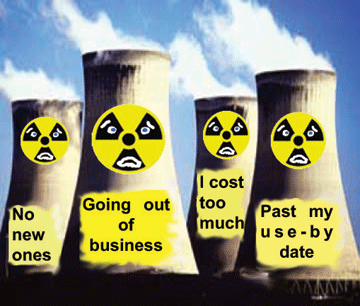 Analyst: “The Slow Demise of U.S. Nuclear Power” — 40 reactors could be closed http://enenews.com/analyst-slow-demise-of-u-s-nuclear-power-40-reactors-at-risk-of-closing
Title: Are U.S. Nuclear Power Plants Going the Way of Coal Plants?
Source: Investment U
Author: David Fessler, Senior Analyst
Date: January 29, 2013: Issue #1958
Last October, Dominion Resources, Inc. (NYSE: D) announced it would be closing its Kewaunee nuclear power plant. Located in Wisconsin, this small, 566-megawatt (MW) unit is the first nuclear plant to succumb to cheap natural gas. […]
[…] According to data from the International Atomic Energy Agency (IAEA), 40 [U.S. nuclear reactors] are smaller than one GW in size. They all could ultimately suffer the same fate as Dominion’s Kewaunee reactor.
Is There a Way to Play the Slow Demise of U.S. Nuclear Power?
[…] Regardless of how many plants are closed, or how quickly it happens, the pipeline companies will be the beneficiaries.
Vogtle nuclear plant a financial debacle for USA’s loan guarantee program
Georgia nuclear power plant could be Solyndra redux, report says
A report by two energy-consulting firms says the US government has not protected US taxpayers well enough against the risks of federal loan guarantees to a new nuclear power project. Christian Science Monitor, By Mark Clayton, Staff writer / January 30, 2013 Construction of the first newly licensed US nuclear power plant in decades could become a “Solyndra-like” debacle thanks to billions in federal loan guarantees whose terms appear too weak to protect taxpayers, according to one group’s analysis of internal documents released by the US Department of Energy.
The two-reactor $14 billion Vogtle plant being built in Georgia is seen as a test of the US nuclear industry’s planned “renaissance” with a new nuclear reactor design and updated construction processes all aimed at cutting time and costs.
But two Massachusetts-based energy-consulting firms, Earth Track and Synapse Energy Economics, say the $8.3 billion in federal loan guarantees backing the project were crafted with excessively favorable financial terms for the recipient companies, weak federal oversight, and possible political interference in the loan-guarantee process. The two firms analyzed hundreds of Energy Department e-mails and financial documents released earlier this month to the Southern Alliance for Clean Energy (SACE), a green-energy watchdog group that won access to them in a Freedom of Information Act lawsuit. …..
In their report, Earth Track and Synapse say the documents reveal: Continue reading
Running nuclear power plant – 45 times more costly than coal, and gas is even cheaper
while fuel costs [for nuclear power] are low, maintenance costs for enhanced
safeguards are rising.
UBS UBSN.VX -0.98% analyst Julien Dumoulin-Smith estimates fixed costs
per kilowatt of capacity at a nuclear plant are perhaps five times
those for a comparably sized coal plant.
Smaller nuclear plants, with less output over which to spread fixed
costs, suffer most.
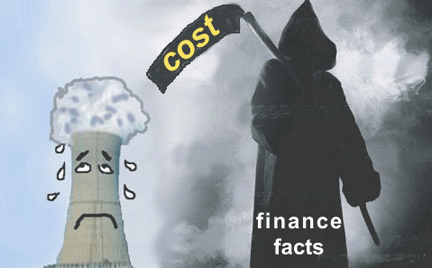
Gas Suffocates Nuclear Power
http://online.wsj.com/article/SB10001424127887323854904578263952157252768.html
Natural gas is poison for coal. But its toxicity also extends to
nuclear power. 25 Jan 13, Low gas prices have made it cheaper to run
gas-fired power plants more often and, because these plants often set
the wholesale electricity price, reduced power prices overall. Add on
tightening emissions standards, and coal plants have suffered, with
many expected to close.
But nuclear power stations haven’t escaped. Cheap electricity due to
weak gas prices hurts their profits, too. Continue reading
Corporations circle around for lucrative nuclear waste cleanup
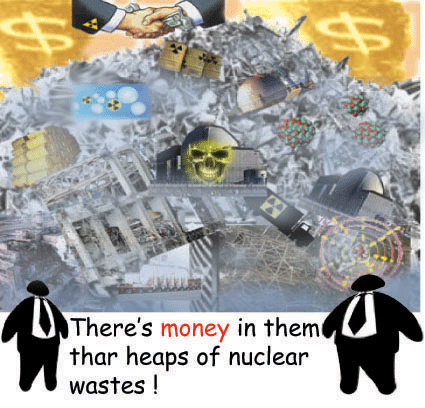 UK firms to bid for Japan’s nuclear clean-up
http://www.independent.co.uk/news/business/news/uk-firms-to-bid-for-japans-nuclear-cleanup-8458524.html
MARK LEFTLY, 20 JANUARY 2013 British engineers Amec, Babcock
International, and Atkins are believed to be circling nuclear
decommissioning work estimated to be worth at least $5bn (£3.2bn) in
Japan as a result of the Fukushima disaster.
The new Japanese government is thought to be preparing decommissioning
contracts that will include Fukushima’s Daiichi plant, which was
overwhelmed by a tsunami in 2011, and other reactors in seismically
endangered areas.
A nuclear source said bids could be invited for the clean-up work
before the end of the year, with British groups in a strong position
due to all the decommissioning work that has been undertaken in the
UK.
US-owned Energy Solutions will also be interested.
“This is a huge opportunity,” claimed the source. “Japan should start
making some real progress on decommissioning now.”
1 This Month





PLEASE OPPOSE HR 8255 AND S.3639 – bills would accelerate satellite deployment, with no environmental review or safeguards – https://ncstd5li.quorum.us/campaign/169331/
To see nuclear-related stories in greater depth and intensity – go to https://nuclearinformation.wordpress.com
-
Archives
- October 2026 (19)
- September 2026 (339)
- August 2026 (330)
- July 2026 (355)
- June 2026 (287)
- May 2026 (306)
- April 2026 (356)
- March 2026 (251)
- February 2026 (267)
- January 2026 (308)
- December 2025 (358)
- November 2025 (359)
-
Categories
- 1
- 1 NUCLEAR ISSUES
- business and costs
- climate change
- culture and arts
- ENERGY
- environment
- health
- history
- indigenous issues
- Legal
- marketing of nuclear
- media
- opposition to nuclear
- PERSONAL STORIES
- politics
- politics international
- Religion and ethics
- safety
- secrets,lies and civil liberties
- spinbuster
- technology
- Uranium
- wastes
- weapons and war
- Women
- 2 WORLD
- ACTION
- AFRICA
- Atrocities
- AUSTRALIA
- Christina's notes
- Christina's themes
- culture and arts
- Events
- Fuk 2022
- Fuk 2023
- Fukushima 2017
- Fukushima 2018
- fukushima 2019
- Fukushima 2020
- Fukushima 2021
- general
- global warming
- Humour (God we need it)
- Nuclear
- RARE EARTHS
- Reference
- resources – print
- Resources -audiovicual
- Weekly Newsletter
- World
- World Nuclear
- YouTube
-
RSS
Entries RSS
Comments RSS

