Radiation risk causes doctors to go on strike – Wuhan, China
 Wuhan doctors on strike over X-ray radiation Shanghai Daily, February 22, 2013 Some hospital workers in Wuhan, capital of Hubei Province reportedly went on strike after three gynecologists developed thyroid cancer, which they believed was caused by their frequent exposure to X-rays.
The three women doctors at the Wuhan Union Hospital were diagnosed with cancer last month, today’s Beijing News reported. They blamed the hospital in a statement made to the public on Monday.
The statement said they performed surgeries on a floor directly underneath two X-ray machines in two bone surgery rooms overhead. The two rooms were not insulated with radiation-proof materials. The hospital did not inform or warn them of the risks…… http://www.china.org.cn/china/2013-02/22/content_28035886.htm
Huge financial risk for South Dakota with uranium mining
We are being asked to take a huge risk with our water and environment with a company of very dubious financial stability
This market has fallen to about $40 per pound and may go lower
We should not take this risk.
Uranium mine too great a risk for South Dakotahttp://www.mitchellrepublic.com/event/article/id/76549/group/homepage/Powertech (USA), Inc., a Canadian company with just 10 employees owned by a stock market hedge fund, is planning a massive uranium mining operation near Edgemont. Continue reading
Cash strapped Japanese nuclear power companies selling uranium back to original sellers at a lower price!
 A senior official of a major utility said the move was exceptional because it likely meant selling the uranium for less than the import price.
Japan Atomic Power takes rare step of selling uranium to pay off loans http://www.japantimes.co.jp/news/2013/02/21/national/japan-atomic-power-takes-rare-step-of-selling-uranium-to-pay-off-loans/#.USfWWB1wpLt
KYODO
 A Japanese nuclear power company has taken the rare step of selling some of its uranium, apparently to help repay loans amid its faltering business conditions, according to sources.
Japan Atomic Power Co. apparently needs to secure money to repay loans due in April amid uncertainty over when it can resume operating its three idled reactors.
Tokyo Electric Power Co. is considering taking similar action as it continues to face funding difficulties following the crisis at the Fukushima No. 1 complex, the sources said. Continue reading
Nuclear power on the wane, and cheap gas is hastening that decline
 Another casualty of the shale gas boom: Nuclear power WP by Brad Plumer February 21, 2013 The last few years have seen all sorts of drastic upheavals in the U.S. energy sector. Cheap natural gas is dominating. Wind and solar are growing. Coal is dwindling.
Now we can add another trend to the list: Nuclear power is on the decline. Since 2010, the amount of electricity generated from America’s nuclear reactors has fallen about 3 percent, or 29 billion kilowatt-hours. That’s a sizable drop.
So why is nuclear on the wane? Part of the story here is that America’s fleet of reactors is aging, which means they need to be taken offline more frequently for repairs. The San Onofre plant near San Diego, for instance, has been out since January 2012.
But a huge part of the story here is competition from cheap shale gas. This month, Duke Energy decided to close its Crystal River nuclear plant in Tampa rather than pay $1.5 billion to repair a cracked dome. The reason? It was easier to build new natural-gas turbines to replace the lost electricity. Last fall, Dominion Power announced that it would close its Kewaunee reactor in Wisconsin for similar reasons.
And that’s just the start: One energy analyst told Bloomberg that at least four other U.S. reactors are now at risk of early retirement “due to new power market economics.” Not only that, but the gas boom is killing off future reactors, too: Back in 2011, NRG scrapped plans for two new nuclear units in Texas. The reason? Other sources were cheaper and easier, including gas and wind.
No costs for nuclear firms that built Fukushima reactors, but residents must pay back compensation
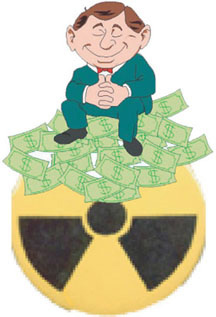 the firms that helped design and build the Fukushima reactors, such as General Electric, Toshiba and Hitachi, are not required to pay a cent in compensation.
Aslihan Tumer, Greenpeace’s international nuclear project leader, says some of the companies are continuing to profit from the reactor.
“Nuclear suppliers are completely protected from accepting any liability or being held accountable in case of an accident,” he said.
Residents paying back Fukushima compensation ABC News, By North Asia correspondent Mark Willacy Feb 19, 2013 Nearly two years on from the meltdowns at the Fukushima nuclear plant, there are accusations the nuclear industry is evading its responsibilities.
The disaster has mostly dropped out of the news in Japan and its victims remain largely hidden after being placed in tiny, so-called temporary apartments across the country.
The ABC has learned that TEPCO, the operator of the Fukushima plant, is handing out what are called “temporary compensation” payments – money handed out to victims of the meltdowns, but which must be repaid….. Continue reading
Vogtle new nuclear plant is not signalling a nuclear power revival
Vogtle is progressing but nuclear revival is not ajc By Kristi Swartz, 17 Feb 13, When major construction started at Georgia Power’s Plant Vogtle nuclear expansion project near Augusta a year ago, all eyes were on what was supposed to be the rebirth of the nuclear industry after more than a generation without new plants.
The stakes were high for Georgia Power and its parent, Atlanta-based Southern Co., which became responsible for showing the nation that the nuclear industry could build two reactors without major technical problems, delays or cost overruns. Consumers already were on the hook, paying for Georgia Power’s $6.1 billion portion of the project through a fee on their monthly utility bills.
The $14 billion Vogtle expansion in Waynesboro — one of the largest economic development initiatives in state history — is behind schedule, and the nuclear revival hasn’t worked out the way the industry had hoped. Continue reading
France – to phase out nuclear at home, but keen to sell it to India
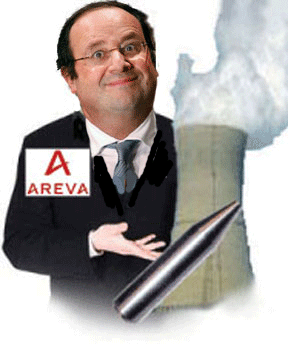 Trust our nuclear technology: French president to India Deccan Herald, Mumbai, Feb 15, 2013, (IANS) French President Francois Hollande Friday urged India “to trust” his country’s nuclear technology and extended France’s support to the Indian nuclear power generation programme……
France is helping India construct two nuclear power reactors at the proposed 9,900 MW Jaitapur Nuclear Power Project in Ratnagiri, 400 km south of Mumbai. The project has been facing stiff resistance from locals, NGOs, anti-nuclear groups and some political parties..… Earlier Friday, Hollande met Maharashtra Governor K. Sankaranarayanan, Industry Minister Narayan Rane, Tourism Minister Chhagan Bhujbal and Protocol Minister Suresh Shetty and stressed the importance of nuclear energy.
UK govt twists and writhes – trying to give the nuclear industry a subsidy that doesn’t look like a subsidy
 The government, which has ruled out any public subsidy for nuclear power, is determined to avoid the perception that it will support new nuclear at any price, even at the risk of the talks collapsing.
 hangs in the balance amid increasingly fraught talks between EDF Energy and the Treasury over the price of electricity from EDF’s planned nuclear power station in Somerset.
The two sides are negotiating over what price EDF should be awarded for the power it generates at Hinkley Point C, set to become the first new UK atomic plant built in a generation. But the gap between them is much wider than many in the industry were expecting. Continue reading
Czech Republic the latest in nuclear industry death agonies across Europe
 Nuclear Revival Dying in Europe as Power Prices Slump: Energy Bloomberg, By Ladka Bauerova – Feb 13, 2013 A Czech atomic-plant expansion planned near the German border had been one of the few prizes left for Europe’s nuclear-power industry after the Fukushima disaster stopped projects from Switzerland to Romania.
Russian and U.S. contractors have prepared to bid for the $10 billion contract to build two new reactors, Europe’s largest competitive tender for a nuclear project. Now a combination of cheaper European power prices and carbon credits, falling demand for electricity and concern government support may falter leaves CEZ AS’s project in doubt, analysts and investors said.
“The future of nuclear energy in Europe looks very dim indeed,” said Mycle Schneider, an independent consultant on energy and nuclear power based in Paris. “Nuclear is too capital intensive, too time-consuming and simply too risky.”Abandoning the Temelin project would deal another blow to the foundering nuclear industry in Europe, and to contractors such as Russia’s Rosatom Corp. and Westinghouse Electric Corp., after the 2011 accident at the Fukushima plant in Japan. Continue reading
Many Fukushima labourers cheated out of correct pay
 Ministry: Many Fukushima laborers deprived of danger pay
http://ajw.asahi.com/article/0311disaster/fukushima/AJ201302090067 By
TOSHIO TADA February 09, 2013 The Environment Ministry has admitted
danger pay has not been reaching some laborers entitled to a hefty
bonus for their work on decontamination projects near the Fukushima
No. 1 nuclear plant.
Unscrupulous employers likely pocketed the missing cash, but the
ministry says it will neither penalize them nor name and shame them
because that “would have a big adverse effect,” an official in charge
of the matter said. Continue reading
Stories and pictures of abandoned nuclear power plants
 iPctures: Gone Fission: 11 Unfinished Nuclear Power Plants http://weburbanist.com/2013/02/10/gone-fission-11-unfinished-nuclear-power-plants/ These 11 unfinished, abandoned, canceled, mothballed and/or suspended nuclear power plants will, for better or worse, never know the warmth of split atoms.
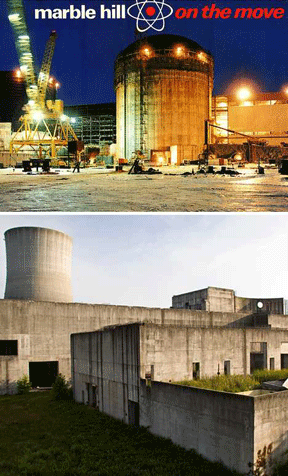 Lemoniz Nuclear Power Plant, Spain Construction of the Lemóniz Nuclear Power Plant, located on the Bay of Biscay on Spain’s northern coast, began in the mid-1970s but was dogged from its inception by violent opposition from ETA, the terrorist organization dedicated to the independence of Spain’s Basque country. The group managed to smuggle bombs into the facility on several occasions in 1978 and 1979 resulting in a number of fatalities and delaying the plant’s construction……
Marble Hill Nuclear Power Station, Indiana, USA (at left) From 1977 to 1984, Public Service Company of Indiana (PSI) spent approximately $2.5 billion to build the Marble Hill Nuclear Power Station near Hanover, Indiana, and by the time the financial tap ran dry it was only half-finished! The political and environmental landscape had changed quite a bit over those 7 years with the biggest speed bump being the Three Mile Island crisis in 1979. With costs spiraling out of control and the state government reluctant to provide funding, PSI abandoned the project and auctioned off most of the salvageable material for a mere pittance.
Equipment and parts from the Marble Hill Nuclear Power Station continued to be sold off in the early to mid-1990s but by the year 2000 everything of value had been sold. Since 2008, slow and steady demolition under the auspices of MCM Management Corp. has seen first the fuel-handling building and then the twin reactor containment buildings gradually reduced to mounds of scrap. The bright side, if any, is that none of the demolished material is radioactive.
Bataan Nuclear Power Plant, Philippines Continue reading
Florida nuclear companies got $1 billion from customers, for non existent power plants
Time to repeal nuclear recovery lawhttp://www.sun-sentinel.com/news/opinion/fl-sccol-oped0210-20130210,0,5173814.story, By Susan Clary February 10, 2013 With the help of the Florida Legislature, two energy companies have been able to collect more than $1 billion from utility customers for the construction of nuclear power plants with no guarantee they would ever be built. Continue reading
UK’s new nuclear fleet may be simply unaffordable
UK nuclear plans flicker over cost By: Tracey Boles Express UK, February 10, 2013 ENERGY secretary Ed Davey warned yesterday that he will not do a deal to fund new reactors “at any price” as fears mount that interested utilities cannot afford to build them.French state-owned utility EDF Energy and the Government are negotiating a “strike price” for the new reactors, the unit cost of electricity which would underpin investment plans for EDF’s two reactors at Hinkley Point in Somerset.
Keeping the price from being set high would involve taxpayer subsidy. Davey said yesterday he was seeking a “fair price for the consumer”.
Earlier this month, EDF’s partner Centrica withdrew from the UK’s planned nuclear programme because of increasing costs and delays. EDF has also been seeking Chinese state investment to little avail so far…… EDF have always argued that the price must be fair to both sides or it will not be sustainable. “It has to be high enough to encourage investors,” said a source close to negotiations.
Another senior industry source said: “EDF has a huge debt pile in France, and Paris will want to be sure the UK is a good place to put money more than their own market.” …
Japan hoping to sell nuclear technology to Saudi Arabia
Trade Minister Toshimitsu Motegi‘s visit at the weekend was aimed at securing extra oil from the world’s biggest exporter in case of instability in world supply, Japanese officials had said…….. Saudi Arabia’s plan to build up to 17 gigawatts of nuclear power capacity over the next two decades has offered a possible lifeline to plant builders hit by a lack of demand since the Fukushima disaster….. http://news.yahoo.com/japan-offers-nuclear-help-saudi-free-oil-154800170.html
Exelon nuclear company blaming wind energy for decline in electricity prices
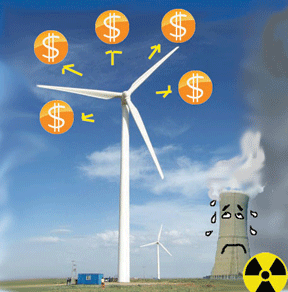 Exelon is merely “looking for a scapegoat” after power prices plummeted following the utility’s “bet on the electricity spot market” with nuclear.
Exelon chief: Wind subsidies could shut down nuclear plants,THE HILL By Zack Colman – 02/08/13
A major utility that was ousted from a wind energy trade group last fall said continued government support of wind power could shutter nuclear plants.
Exelon Corp. CEO Christopher Crane told the Chicago Tribune in comments published Friday that his company might eventually have to close nuclear facilities “if we continue to build an excessive amount of wind and subsidize wind.”
Exelon vocally opposed the extension of the wind production tax credit last year. That led the American Wind Energy Association (AWEA) to kick the Chicago-based utility out of the organization.
Exelon will likely try to quash AWEA’s push this year for a phase-out of the 2.2 cent per kilowatt-hour credit for wind power production. Exelon has ties to the White House, as one of its directors is a top fundraiser for and friend of President Obama. Former strategist David Axelrod also consulted for the utility, and Chicago Mayor Rahm Emanuel, who served as Obama’s first chief of staff, helped create the firm through a merger in 2000 while working as an investment banker. Continue reading
1 This Month





PLEASE OPPOSE HR 8255 AND S.3639 – bills would accelerate satellite deployment, with no environmental review or safeguards – https://ncstd5li.quorum.us/campaign/169331/
To see nuclear-related stories in greater depth and intensity – go to https://nuclearinformation.wordpress.com
-
Archives
- October 2026 (19)
- September 2026 (339)
- August 2026 (330)
- July 2026 (355)
- June 2026 (287)
- May 2026 (306)
- April 2026 (356)
- March 2026 (251)
- February 2026 (267)
- January 2026 (308)
- December 2025 (358)
- November 2025 (359)
-
Categories
- 1
- 1 NUCLEAR ISSUES
- business and costs
- climate change
- culture and arts
- ENERGY
- environment
- health
- history
- indigenous issues
- Legal
- marketing of nuclear
- media
- opposition to nuclear
- PERSONAL STORIES
- politics
- politics international
- Religion and ethics
- safety
- secrets,lies and civil liberties
- spinbuster
- technology
- Uranium
- wastes
- weapons and war
- Women
- 2 WORLD
- ACTION
- AFRICA
- Atrocities
- AUSTRALIA
- Christina's notes
- Christina's themes
- culture and arts
- Events
- Fuk 2022
- Fuk 2023
- Fukushima 2017
- Fukushima 2018
- fukushima 2019
- Fukushima 2020
- Fukushima 2021
- general
- global warming
- Humour (God we need it)
- Nuclear
- RARE EARTHS
- Reference
- resources – print
- Resources -audiovicual
- Weekly Newsletter
- World
- World Nuclear
- YouTube
-
RSS
Entries RSS
Comments RSS

