Virginia uranium might well not be profitable, after all
 “The industry needs prices at $75 or $80 a pound for future mine production to be profitable.” Thus, the uranium market has a long way to go before the 119 million pound tract around Coles Hill Farm east of Chatham, said to be the largest in the U.S., can actually be profitable to mine.
This is a fact that Virginia Uranium hasn’t really advertised..
The Wobbly World of Global Uranium Prices, Bacon’s Rebellion,
January 19, 2013 by Peter Galuszka
Highly controversial plans to mine and mill a rich tract of uranium in Pittsylvania County are before the General Assembly. Plenty of studies, lobbyists and scads of money are being thrown about on both sides of the argument.
Yet a brief story on page B7 in today’s Wall Street Journal deals with a topic that may be the truly decisive factor in the project…… Continue reading
France’s drive to sell nuclear abroad, while getting out of it at home
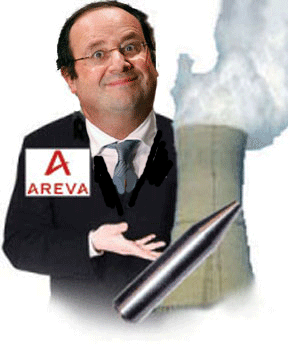 France on nuclear charm offensive in Saudi Arabia, By Geert De Clercq PARIS, Jan 18 (Reuters) – A top French minister and the chief executives of French utility EDF and reactor builder Areva are visiting Saudi Arabiathis weekend to build a case for selling French nuclear reactors to the oil-rich country.
Industry Minister Arnaud Montebourg will meet with Saudi officials and with representatives of EDF and Areva, who opened a joint office in Riyadh six months ago to lay the groundwork for a French nuclear offer.
Montebourg will build on a Nov. 4 visit by French President Francois Hollande to Saudi Arabia’s King Abdullah and a 2011 agreement betweenFrance and Saudi Arabia that offered the Saudis atomic know-how and training for local staff….
France plays a strong hand in Saudi Arabia, which has no nuclear capabilities of its own but has deep pockets and wants to acquire the most modern technology…..
Unlike other suppliers, Areva also sells uranium, offering utilities long-term supply contracts…….
he French will face formidable competition from U.S., Japanese and South Korean consortia. Westinghouse-Toshiba has deep ties with the Middle East, and a Korean-led consortium dealt the French a humiliating blow with its surprise win of a $40 billion contract in Abu Dhabi three years ago…….
Hollande’s government, despite having decided to cut the share of nuclear in French electricity generation to 50 percent in 2025 from the current 75 percent, is keen to export reactors….. http://www.reuters.com/article/2013/01/18/france-saudi-nuclear-idUSL6N0ANEA120130118
Nuclear reactors in operation – drop in numbers, as IAEA reclassifies 47 Japanese reactors as “Long-term Shutdown” (LTS)
IAEA Shifts 47 Japanese Reactors Into “Long-Term Shutdown” Category 16 January 2013 In an unprecedented move, the International Atomic Energy Agency (IAEA) has shifted 47 Japanese nuclear reactors from the category “In Operation” to the category “Long-term Shutdown” (LTS) in its web-based Power Reactor Information System (PRIS). The number of nuclear reactors listed as “In Operation” in the world thus drops from 437 yesterday to 390 today, a level last seen in Chernobyl-year 1986 and a dramatic step of the IAEA’s official statistics in recognizing industrial reality in Japan.
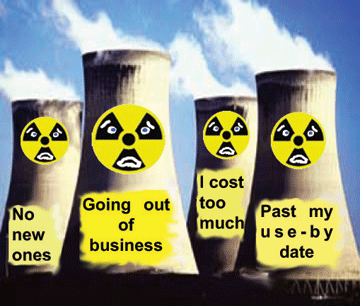
This is without doubt a unique revision of world operational nuclear data. However, numerous questions remain. The definitions of the IAEA’s reactor status categories remain unclear. Units can remain in the LTS category for many years, without any apparent limit. Japan has now 48 units listed as LTS, one of which is the fast breeder reactor Monju that has not been generating electricity since a sodium fire severely damaged the plant in 1995, while three further units at Kashiwazaki-kariwa have not been generating power since an earthquake hit the site in 2007.
New nuclear power- not a good investment
the nuclear renaissance may be largely over before it started.
New Centralized Nuclear Plants: Still an Investment Worth Making? Forbes, Peter Kelly-Detwiler,15 Jan 2013,
“…….Even without Fukushima, the verdict on large centralized US nukes is probably in, for the following reasons:
1) They take too long: In the ten years it can take to build a nuclear plant, the world can change considerably (look at what has happened with natural gas prices and the costs of solar since some of these investments were first proposed). The energy world is changing very quickly, which poses a significant risk for thirty to forty year investments.
2) They are among the most expensive and capital-intensive investments in the world; they cost many billions of dollars, and they are too frequently prone to crippling multi-billion dollar cost overruns and delays. In May 2008, the US Congressional Budget Office found that the actual cost of building 75 of America’s earlier nuclear plants involved an average 207% overrun, soaring from $938 to $2,959 per kilowatt.
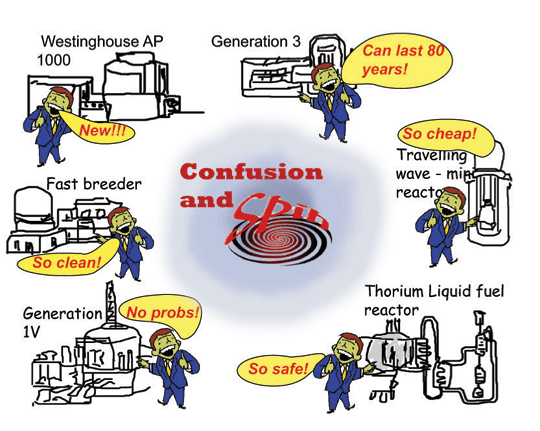
3) And once the investments commence, they are all-or-nothing. You can’t pull out without losing your entire investment. For those with longer memories, WPPS and Shoreham represent $2.25 bn (1983) and $6 bn (1989) wasted investments in which nothing was gained and ratepayers and bondholders lost a good deal. Continue reading
San Onofre leads the way for USA rust bucket nuclear reactors to go
The fiasco at San Onfre is being replayed at rust bucket reactors throughout the US.
Meanwhile, the conversion to green power in Germany is booming. When 8 reactors were shut and the conversion to wind, solar and biomass became official policy, “experts” predicated energy shortages and soaring prices. But the opposite has happened as supply has boomed and prices have dropped.
The same things will happen in California and elsewhere as these radioactive jalopies begin to shut. The effectiveness of citizen activism in California is now vastly multiplied as these two decrepit reactors become increasingly obsolete, inoperable and economically insupportable.
 Showdown at San Onofre: Why the Nuclear Industry May Be Dealt a Big Blowhttp://www.alternet.org/environment/showdown-san-onofre-why-nuclear-industry-may-be-dealt-big-blow?akid=9919.1085969.01RI09&rd=1&src=newsletter775567&t=19 Two stricken California reactors may soon redefine a global movement aimed at eradicating nuclear power.January 7, 2013
Two stricken California reactors may soon redefine a global movement aimed at eradicating nuclear power.
They sit in a seismic zone vulnerable to tsunamis. Faulty steam generators have forced them shut for nearly a year.
A powerful “No Nukes” movement wants them to stay that way. If they win, the shutdown of America’s 104 licensed reactors will seriously accelerate.
The story of San Onofre Units 2 & 3 is one of atomic idiocy. Continue reading
Virginia would be gambling its future, with uranium mining
Uranium mining: A fiscal conservative might say, ‘no’, http://www.wpcva.com/altavista/opinion/article_7de6346e-5ff6-11e2-9db4-001a4bcf887a.html ALTAVISTA Journal, Katie Whitehead/Special to the Journal. January 16, 2013
Traditional conservative values support continuing the moratorium on uranium mining in Virginia. Moving forward with legalization of uranium mining in Virginia would be expensive for taxpayers, with no guarantee the costs would ever be recovered.
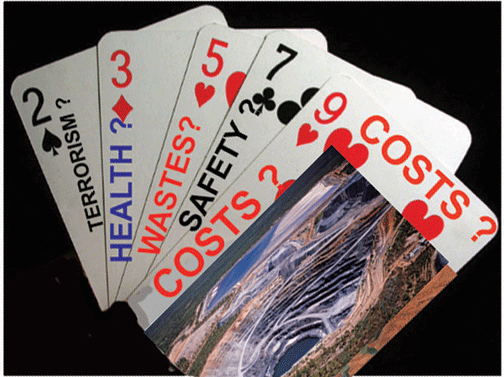
The governor’s Uranium Working Group (UWG) report lists the many protective actions Virginia would need to take to regulate and monitor uranium mining and milling. Following through on all the suggested safety measures would require establishing a comprehensive uranium mining and milling regulatory program. The only proposal worth considering — other than maintaining the moratorium — is a fully funded, fully staffed, comprehensive, state-level, statewide program that incorporates all the measures outlined by the UWG. Even then, it might be impossible to guarantee a degree of safety in operation that would be acceptable to a majority of citizens.
Dr. Paul Locke, chairman of the National Academy of Sciences (NAS) study committee, recently told reporters, “Putting protective regulations into place would be a very, very, very difficult task. Continue reading
Chrystal River, Vermont nuclear plants likely to follow Kewaunee into closure
Analyst: Florida nuclear plant will likely be closed — Gundersen: “The dominoes are starting to fall” (AUDIO)
Source: Fairewinds Energy Education
Date: January 13, 2013
Nuclear Expert Arnie Gundersen, Fairewinds Energy Education: Duke is seriously considering pulling the plug on the [Crystal River nuclear] plant […]
Last week we had a financial analyst at UBS suggest that Vermont Yankee didn’t make economic sense.
This week, we’ve got a financial analyst at another firm called Fitch and he says that the Crystal River plant will likely be closed because Duke can’t make economic sense out of it.
So the dominoes are starting to fall.
We’ve have Kewaunee, which is shutting down in the Midwest because of financial reasons. And now we’ve got UBS analysts and Fitch analysts also claiming it makes no economic sense to keep other nuclear plants running.
There’s money in them thar nuclear wastes
Veolia Draws Upon Fukushima to Move Into Nuclear Dismantling, Bloomberg, By Tara Patel – Jan 15, 2013 Veolia Environnement SA (VIE), which treated radioactive water from Japan’s nuclear meltdown at Fukushima, plans to use the experience to move into decontamination and power plant dismantling.
The water utility and the nuclear research group known as CEA plan to earn as much as 400 million euros ($534 million) in revenue within about four years by cleaning radioactive sites and taking apart installations, they said today.
“The market is developing very quickly,” Veolia Chief Executive Officer Antoine Frerot told a press conference today in Paris. About 300 nuclear reactors will have to be halted worldwide within two decades including in France, Germany, Japan and the U.S., he said.
The shift into the atomic market comes after President Francois Hollande pledged to lower France’s dependence on the energy and shut the country’s oldest plant at Fessenheim. It’s also the first new market Veolia has publicly announced it will enter into since Frerot pledged to pull out of some countries and businesses in a bid to boost profit…… http://www.bloomberg.com/news/2013-01-15/veolia-draws-upon-fukushima-to-move-into-nuclear-dismantling-1-.html
Shortage of workers at Fukushima nuclear plant resulted in high radiation exposure
Worker shortages revealed at nuclear plant after disaster
http://www.yomiuri.co.jp/dy/national/T130113003104.htm 14 Jan
A manager’s calls for reinforcements to help contain a series of
crises at Tokyo Electric Power Co.’s Fukushima No. 1 nuclear power
plant were ignored, newly released TEPCO teleconference footage has
revealed.
Although Masao Yoshida, then manager of the plant damaged by the March
11, 2011, earthquake and tsunami, repeatedly asked TEPCO headquarters
in Tokyo to send more workers, the request was not met in a timely
manner. As a result, the plant’s workers suffered extreme fatigue and
heightened radiation exposure, the footage showed. Continue reading
Cheaper for Duke Energy to close Crystal River nuclear plant
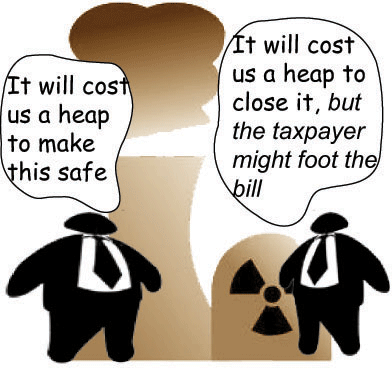 Rating agency thinks nuclear plant will be closed, Tampa Bay Times, By
Ivan Penn, Times Staff Writer, Jan 11, 2013 In its latest evaluation
of Duke Energy, the Fitch rating agency concludes this week that the
utility probably will permanently close the crippled Crystal River
nuclear plant.
In giving Duke a “stable” outlook, Fitch noted that a repair of the
Crystal River plant would pose too much of burden on Duke but shutting
it down would guarantee some protections provided by a settlement
agreement with the state.
“Fitch believes it is unlikely management will elect to repair Crystal
River 3 given the rising cost estimates, construction risks and low
gas-price environment, and instead will pursue the retirement option
and recovery of invested capital,” the rating agency stated…..
http://www.tampabay.com/news/business/energy/rating-agency-thinks-nuclear-plant-will-be-closed/1270052
UK govt will have to fix a consumer price, to get a deal to construct nuclear reactors
 a deal is
unlikely to be clinched before the French utility and the U.K.
government agree on a guaranteed price that consumers will pay for
power generated from Hinkley Point
Centrica is likely to withdraw from the construction of new reactors
because it fears that there will be cost overruns and that indirect
subsidies being negotiated with the British government will be
insufficient to justify the investment
EDF and French nuclear-reactor vendor Areva SA AREVA.FR 0.00%
are struggling with rising costs and delays in the construction of
next-generation European pressurized reactors. Costs at Areva’s
project in Finland have more than doubled to €8 billion ($10.5
billion), and the plant is five years behind schedule.
 EDF and Chinese Firm Enter Talks to Build U.K. Nuclear Plants, WSJ, 10
Jan 13, By SELINA WILLIAMS in London and GÉRALDINE AMIEL in Paris
Electricité de France SA EDF.FR -1.84% is in talks with state-owned
China Guangdong Nuclear Power Holding Co. on forming a partnership to
build nuclear-power plants in the U.K., people familiar with the
matter said.
The deal could replace EDF’s partnership with British utility Centrica
CNA.LN -0.39% PLC for new plants in Britain and dispel some doubts
about whether the French company has sufficient funds for its nuclear
ambitions in the U.K., the people said…..
A new U.K. partnership with China Guangdong would provide EDF with
much-needed financing as it struggles with difficult market conditions
in France and prepares to unveil a cost-cutting plan that it has said
could threaten the company’s British investments.
A deal would give the Chinese utility, which already collaborates with
EDF on new reactors in China, a foothold in a new market Continue reading
Thieves fall out – The rest of the nuclear lobby accused of blocking the thorium lobby!
China blazes trail for ‘clean’ nuclear power, TODAY online by Ambrose
Evans-Pritchard Jan 09, 2013“……Major players in the nuclear
industry have had a vested interest in blocking thorium. They have
sunk huge costs in the old technology, and they have bent the ear of
cash-strapped ministers. The hesitance of governments is
understandable, but the costs are going to hit whatever they do.
China’s dash for thorium is now changing the game…..”
Chrystal River nuclear plant’s financial mess
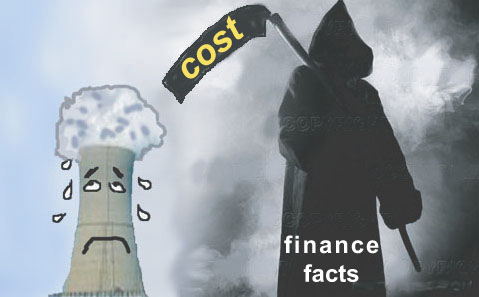 No decision yet on Crystal River nuclear plant
http://www2.tbo.com/news/business/2013/jan/07/no-decision-yet-on-crystal-river-nuclear-plant-ar-600253/
By The Associated Press January 07, 2013 TALLAHASSEE —
Progress Energy is still undecided on whether to repair or shut down
its crippled nuclear power plant in Crystal River.
That means that the state’s second-largest power company could have to
refund customers $100 million under a prior settlement between the
utility and consumer advocates. That settlement calls for the refund
if repairs had not begun by the end of 2012.
A lawyer for the utility company told state regulators Monday that
Progress expects to have a decision about the plant by this summer –
although he didn’t rule out an announcement before then.
The reactor has been down since late 2009, when its concrete
containment building cracked during a maintenance and upgrade project.
Officials say fixing the plant would likely take several years and
cost billions.
Company terminates USA spent nuclear fuel license due to costs
Costs drove PFS move to terminate US spent fuel storage license: exec Washington (Platts)–2 Jan2013
Private Fuel Storage’s December request that the US Nuclear Regulatory Commission terminate its license for an away-from-reactor spent fuel storage facility in Utah that might never be built centered on economics, according to Robert Palmberg, chairman of the PFS board.
It was costing the utility consortium hundreds of thousands of dollars a year to maintain a license for a project that has remained dormant since NRC licensed the facility in 2006, he said in an interview Wednesday. …. http://www.platts.com/RSSFeedDetailedNews/RSSFeed/ElectricPower/6977321
Financial advice to Entergy – sell Vermont Yankee nuclear plant
Vermont, New York regulators urge review of storage of spent nuclear fuel, VT Digger, by Andrew Stein | January 3, 2013 “……..The Swiss financial services company UBS issued a report this week that forecasts a grim cash flow outlook for Entergy Corporation’s nuclear power plants, and recommended that Entergy sell Vermont Yankee to shore up its finances.
The U.S. Appellate Court ruling put a halt to license renewal applications for nine plants, including Indian Point in New York and Seabrook in New Hampshire.
Under the order, the commission, for the first time, will require environmental assessments of nuclear waste now held at the nation’s 104 reactor sites amid growing public pressure to evaluate the potential hazards of spent fuel pools and dry cask storage at nuclear reactor sites in the United States after the Fukushima nuclear disaster in Japan. There are 104 nuclear reactors at 64 operating plants in the United States, according to a report from CNN. Half are more than 30 years old.
The Commission gave Vermont Yankee, which was built in 1972, a 20-year license extension in 2011.
WASTE STORAGE DOCUMENTS: ….. http://vtdigger.org/2013/01/03/vermont-new-york-regulators-urge-review-of-spent-nuclear-fuel-storage/
1 This Month





PLEASE OPPOSE HR 8255 AND S.3639 – bills would accelerate satellite deployment, with no environmental review or safeguards – https://ncstd5li.quorum.us/campaign/169331/
To see nuclear-related stories in greater depth and intensity – go to https://nuclearinformation.wordpress.com
-
Archives
- October 2026 (19)
- September 2026 (339)
- August 2026 (330)
- July 2026 (355)
- June 2026 (287)
- May 2026 (306)
- April 2026 (356)
- March 2026 (251)
- February 2026 (267)
- January 2026 (308)
- December 2025 (358)
- November 2025 (359)
-
Categories
- 1
- 1 NUCLEAR ISSUES
- business and costs
- climate change
- culture and arts
- ENERGY
- environment
- health
- history
- indigenous issues
- Legal
- marketing of nuclear
- media
- opposition to nuclear
- PERSONAL STORIES
- politics
- politics international
- Religion and ethics
- safety
- secrets,lies and civil liberties
- spinbuster
- technology
- Uranium
- wastes
- weapons and war
- Women
- 2 WORLD
- ACTION
- AFRICA
- Atrocities
- AUSTRALIA
- Christina's notes
- Christina's themes
- culture and arts
- Events
- Fuk 2022
- Fuk 2023
- Fukushima 2017
- Fukushima 2018
- fukushima 2019
- Fukushima 2020
- Fukushima 2021
- general
- global warming
- Humour (God we need it)
- Nuclear
- RARE EARTHS
- Reference
- resources – print
- Resources -audiovicual
- Weekly Newsletter
- World
- World Nuclear
- YouTube
-
RSS
Entries RSS
Comments RSS

