IAEA promotes nuclear power to Vietnam
 AEA pledges to help Vietnam in developing nuclear energy, Shanghai Daily, Jan 09,2014 HANOI, Jan. 9 (Xinhua) — General director of the International Atomic Energy Agency (IAEA) said the agency would provide supports for Vietnam in construction of the country’s nuclear power plants.The IAEA chief Yukiya Amano made the commitment while talking with press agencies in Vietnam’s capital Hanoi on Thursday during his working visit to the country.

IAEA will send delegations of leading experts to Vietnam to discuss issues of infrastructure construction, safety and other nuclear-related issues. The agency also planned to send a delegation to the country annually to help with applications of atomic energy, said Amano. In addition, the IAEA will support Vietnam through technical projects. During the 2012-2013 period, IAEA funded 1 million euro for Vietnam to develop these projects, including nuclear energy infrastructure and laboratory upgrading……During the 2014-2015 period, IAEA has approved funding for five Vietnamese projects, focusing on infrastructure construction, nuclear power legislation, and nuclear technology applications in industry, agriculture, health care and the building of the country ‘s two nuclear power plants. http://www.shanghaidaily.com/article/article_xinhua.aspx?id=192639
Could USA go broke, due to its $1 trillion nuclear weapons arsenal?
 U.S. Nuclear-Weapons Plan Is So Expensive, It Can’t Be Implemented,National Journal by Douglas P. Guarino January 8, 2014 A new study says the strategy to update the U.S. triad of nuclear-armed aircraft, submarines and missiles would cost $1 trillion over the next 30 years, even under conservative assumptions
U.S. plan for modernizing the nation’s nuclear arsenal is so expensive that it cannot be implemented, the authors of a new study contend.
“It’s just not real,” Jeffrey Lewis, one of the report’s co-authors, said in reference to the current U.S. modernization blueprint. “It’s inconceivable to me that we will execute anything like the plan that they say they’re going to do.” The analysis, released on Tuesday by the James Martin Center for Nonproliferation Studies, says the strategy to update the U.S. triad of nuclear-armed bomber aircraft, submarines and ground-based missiles would cost $1 trillion over the next 30 years, even under conservative assumptions.
The estimate relies largely on official government figures, the authors say, and does not include costs associated missile defense, nonproliferation efforts and related intelligence programs Continue reading
Turkey gets its demand to enrich uranium into its nuclear agreement with Japan
 Ankara ‘adds’ uranium clause in nuclear deal with Tokyo, Hurriyet Daily News, 9 Jan 14 ISTANBUL/TOKYO Ankara demanded allowance for uranium enrichment and plutonium extraction in a nuclear export deal inked with Tokyo, a Japanese daily quoted as a Japanese Foreign Ministry official as saying.
A clause, which was added in the nuclear agreement signed by the two nations, upon Turkey’s demand prompted concerns over a possible proliferation of nuclear weapons.
The clause at issue allows Turkey to enrich uranium and extract plutonium, potentially creating nuclear material for weapons, Japanese daily Asahi Shimbun reported on Jan. 8…..http://www.hurriyetdailynews.com/nuclear-deal-with-turkey-stirs-concerns-in-japan.aspx?pageID=238&nID=60729&NewsCatID=34
Britain’s nuclear project means opposition to EU renewables targets, and potential job losses
UK opposition to new EU green eenergy targets could risk ‘half a million jobs’ theguardian.com, Thursday 2 January 2014 Britain’s demand to keep nuclear option open to reduce emissions will mean potential job losses, leaked report shows Adam Vaughan Over half a million new jobs over the next two decades could be at risk from the UK’s opposition to new EU targets for green energy, according to a leaked official report from the European commission.
Since last spring, European countries have been battling over what new climate change targets should be set to follow the existing ones for greenhouse gas emissions, renewable energy and energy efficiency, which run out in 2020. The UK, along with the Czech Republic, is strongly opposed to setting a new renewable energy goal for 2030, favouring an overall target for greenhouse gas emissions instead – which would entail an ambitious cut of 50% on 1990 levels. They want countries to be allowed the freedom to reach the target as they choose to, for example by relying heavily on nuclear power.
Energy and climate secretary, Ed Davey, has said: “We need a technology neutral approach to how individual countries meet their emissions targets … we will therefore oppose a renewable energy target at an EU level as inflexible and unnecessary.”
But a draft report, commissioned by the European commission on the impact of setting different targets and seen by the Guardian, says that including renewable energy and energy efficiency targets in addition to a greenhouse gas emissions target would create around 568,000 more jobs across Europe by 2030 than an emissions one alone. However, the cost of having renewable energy and efficiency targets would be 2.6% higher than with just an emissions target alone, the report notes.Germany, Denmark, Austria and Finland back a renewable energy target. A new energy efficiency target is considered unlikely.The wind industry said that not setting a renewable energy target would make it harder for developers to attract investment. ……
The new German government has already set a target of 40-45% of its electricity supply coming from renewable sources by 2025, higher than the 30-35% EU-wide target being discussed. By contrast, the UK has been one of the worst performers for share of energy generated by renewable sources, near the bottom of the European league table along with Malta and Luxembourg. http://www.theguardian.com/environment/2014/jan/02/uk-eu-renewables-targets
Japan to join in UK’s economically insane nuclear power project
Toshiba to buy majority stake in UK nuclear consortium,Dan Milmo, The Guardian UK 27 Dec 13, Japanese company keen to kickstart ambitious reactor building programme that stalled after 2011 disaster at Fukushima Japanese group Toshiba has confirmed that it is in the final stages of securing a majority stake in a British nuclear power consortium, bringing a further boost to the UK’s ambitious nuclear programme.
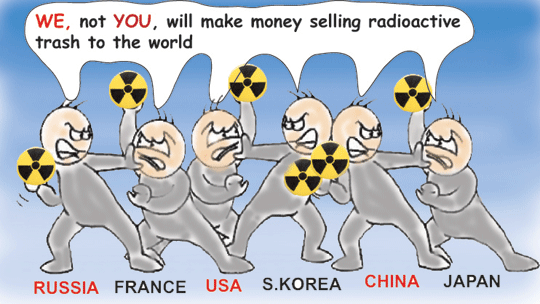
Toshiba’s chief executive, Hisao Tanaka, said an agreement to take a controlling shareholding in the NuGen consortium could be in place as early as January. NuGen is a joint venture between Spanish power company Iberdrola and French utility firm GDF Suez that is developing a plant at Sellafield in Cumbria, where the owners plan to build 3.6 gigawatts of nuclear capacity on a disused reactor site…….
Toshiba is keen to kickstart an ambitious reactor building programme that stalled after countries around the world – led by Germany – froze nuclear expansion plans and tightened regulations in the wake of Japan’s 2011 disaster at Fukushima.
Its domestic rival, Hitachi, has bought the Horizon project which intends to build two nuclear power stations, in Anglesey and Gloucestershire.
Britain is one of the few countries pressing ahead with nuclear plans in spite of the safety fears raised by Fukushima. The government’s determination to make nuclear a central part of its energy strategy was confirmed two months ago when ministers approved a deal with France’s EDF Energy to build the £16bn Hinkley Point nuclear power plant in Somerset. Analysts at Liberum Capital said state guarantees on electricity prices offered to EDF in order to secure the deal could prove to be “economically insane”. The European Union has also weighed into the nuclear subsidy debate by launching an investigation into whether the Hinkley deal broke state aid rules……..
Tanaka said a majority stake was necessary to make progress on the project, where delays have frustrated the UK government, sources say, as it pushes through its own ambitious nuclear programme to replace new reactors. A controlling stake would allow Westinghouse, 87%-owned by Toshiba, to supply three of its AP1000 reactors for the site……http://www.theguardian.com/business/2013/dec/26/toshiba-stake-uk-nuclear-consortium
India’s nuclear power program could be called off, may be unaffordable
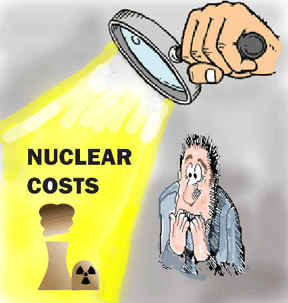 Cost of nuclear power proving high, DAE in a fix http://timesofindia.indiatimes.com/india/Cost-of-nuclear-power-proving-high-DAE-in-a-fix/articleshow/27920490.cms PTI | Dec 25, 2013, NEW DELHI: As the cost of electricity generation by nuclear power plants, to be set up with the help of French and American companies, is turning out to be on the higher side, the department of atomic energy is in a fix over how to bring down the cost.
 On one hand, it is involved in hard negotiations with the companies and on the other hand, sources said, if the cost per unit turns out to be too expensive, then it may not even pursue the project with collaborators
Currently, the DAE is in negotiations with French company Areva to build six EPR reactors of 1650 MW each at Jaitapur. Sources pointed out that initial estimates state the cost of the project to be around Rs 27-30 crore per megawatt and the cost per unit to be around Rs 9 per unit in 2021. Speaking to reporters in Mumbai last month, RK Sinha, DAE secretary, had said a competitive per unit tariff of Rs 6.50 has been estimated in the year of completion of Jaitapur project in 2020-21.
In the case of Mithi Virdhi project where American company Westinghouse Electric is providing AP-1000 reactors, the cost per megawatt is coming to around Rs 40 crores while the cost per unit is around Rs 12.
Although this project is yet to reach the advanced negotiations stage, the DAE has already signed an early works agreement with Westinghouse Electric. The DAE is skeptical about the proposal due to its high cost. It states that the cost per unit from the Kudankulam Nuclear Power Plant (KKNPP) unit 1 and 2 is around Rs 3.50 to Rs 4 per unit.
“If we take inflation into consideration, even then the cost is very high. We are also answerable to people. Plus, there is a lot of opposition to nuclear projects where we have foreign collaborators. If nothing works out, then we will, perhaps, have to back out because of the high electricity generation cost from the project,” a senior DAE official said.
Nuclear industry pronounced dead
he nuclear renaissance is dead … stone cold dead. And the prospects for nuclear power in Australia are dead. If nuclear power is economically prohibitive (or nearly so) in nuclear nations such as the UK and the US, it is far more so in Australia given that we have little relevant infrastructure or expertise. The major parties seem to be well aware that nuclear power is a non-starter, so the nuclear debate in Australia is reduced to the slow, repetitive drum-beat of a small but vocal nuclear lobby.
 The nuclear renaissance is stone cold dead http://www.onlineopinion.com.au/view.asp?article=15860&page=1 23 Dec 13 This year has been the nuclear power industry’s annus horribilis and the nuclear renaissance can now be pronounced stone cold dead.
Nuclear power suffered its biggest ever one-year fall in 2012 − nuclear generation fell 7% from the 2011 figure. Nuclear generation fell in no less than 17 countries, including all of the top five nuclear-generating countries. Nuclear power accounted for 17% of global electricity generation in 1993 and it has steadily declined to 10% now.
The International Atomic Energy Agency (IAEA) has downwardly revised its nuclear power projections, and now anticipates growth of 23% to 100% percent by 2030. Historically, the IAEA’s upper projections have been fanciful, and its lower projections are usually much closer to the mark. So annual growth of a little over 1% is about as much as the industry can realistically hope for.
And the IAEA will further reduce its projections when it factors in this year’s annus horribilis.Perhaps the most shocking developments have been in the United States, Continue reading
Columbia Nuclear Generating Station – cheaper to just shut it down?
Numbers Debate Rages Over Northwest Nuclear Plant KUOW.ORG, By ANNA KING, 20 Dec 13, There’s a new debate raging over the Northwest’s only commercial nuclear power plant. But it’s not about safety or how to dispose of nuclear waste.
This debate about the Columbia Generating Station in southeast Washington focuses on dollars and cents. A new report raises questions about whether the plant pencils out for the region…….
The heart of the debate: Would it be more expensive to continue running the nearly 30-year-old nuclear power plant or to shut it down in the next few years? Continue reading
UK nuclear subsidies may be unnecessary, and could cost £17bn
 Subsidies for UK nuclear plant could reach £17bn and ‘may be unnecessary’ http://www.telegraph.co.uk/finance/newsbysector/energy/10525538/Subsidies-for-UK-nuclear-plant-could-reach-17bn-and-may-be-unnecessary.html
European Commission probes whether subsidies are needed for EDF’s Hinkley Point plant in Somerset and warns they could cost £17bn – more than the plant itself By Emily Gosden, Energy Editor
18 Dec 2013 British consumers could pay £17bn in potentially unnecessary subsidies to fund construction of the country’s first new nuclear plant in a generation, the European Commission has said.
The EC said it was assessing whether the planned subsidies for Hinkley Point in Somerset – which could exceed the £16bn cost of the plant itself – were needed at all, or whether energy companies would build the plant anyway without a penny of public support.
Ministers in October signed a landmark deal with energy giant EDF to fund the construction of the plant, which would see consumers pay billions of pounds in subsidies to the French company for decades to come.
On Wednesday the Commission opened a formal investigation into “whether the construction of a nuclear power station could not be achieved by market forces alone, without state intervention”. The Commission said its investigation, which threatens to delay or derail the plant altogether, will assess whether UK plans “to subsidise the construction and operation” of the plant are in line with EU state aid rules.
Tepco resigned to permanent closure of the undamaged nuclear reactors at Fukushima
Fukushima nuclear operator Tepco to shut two more reactors BBC News, 18 Dec 13, The operators of the crippled Fukushima nuclear power plant in Japan are to decommission two reactors that were not badly damaged by the earthquake and tsunami in 2011.
They have bowed to public pressure that the plant be shut permanently……Four reactors were severely damaged by the disaster that struck in March 2011.
Tokyo Electric Power (Tepco) had delayed making a final announcement on the fate of reactors number 5 and 6 at Fukushima while negotiations continued about the financing of the decommissioning process.
The executive board has now accepted the inevitable and acknowledged there will be no attempt to generate electricity from the plant again…….http://www.bbc.co.uk/news/world-asia-25434996
Virginia Uranium dumps its Coles Hill project
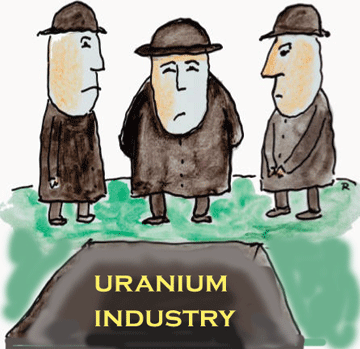 Amid fierce political opposition, US uranium miner suspends mine plans Mining.com, Ana Komnenic | December 15, 2013 A uranium miner has given up on mining one of the world’s largest known uranium deposits in Virginia – for now.
Virginia Uranium has plans to develop the Coles Hill deposit in Pittsylvania County.According to the Associated Press, the site contains an estimated 119-million-pounds of uranium.
But Virginia has a decades-long ban on uranium mining and the Gov.-elect Terry McAuliffe has fiercely opposed attempts to change this legislation and said he would veto any pro-uranium bills.Faced with this major political hurdle, Virginia Uranium told the Associated Press on Saturday that it would “not back the introduction of uranium mining legislation in the 2014 session of the General Assembly.”
The company cited the Governor-Elect’s opposition as a “significant challenge” to the project……
Environmental group Sierra Club has applauded McAuliffe for his opposition, publishing an article this week thanking the Governor.
Earlier this year McAuliffe stated that he was “not comfortable” enough with the science to say that he believed his community would be safe.
“I’m afraid it would get into the drinking water,” he said……http://www.mining.com/amid-fierce-political-opposition-us-uranium-miner-gives-up-on-one-of-the-worlds-largest-uranium-deposits-66417/
Bankruptcy looms for uranium company USEC
Uranium company USEC says expects to file for bankruptcy Dec 16, 2013 Dec 16 (Reuters) – USEC Inc, a supplier of enriched uranium for commercialnuclear power plants, said it expected to file for bankruptcyprotection as part of a deal with its bondholders, sending the company’s shares down as much as 52 percent.
USEC, which has been struggling to fund projects and has posted losses for the past four quarters, said it expected to file a prearranged Chapter 11 petition in the first quarter…….
The company said in November that government funding for its $350 million American Centrifuge Project in Ohio would end in January.
The project, which is 80 percent funded by the U.S. Department of Energy (DOE), is designed to produce low-enriched uranium used to make nuclear fuel. It was scheduled to be completed this month.
USEC wound down operations at another uranium enrichment plant earlier this year. The company is in the process of handing over the plant in Paducah, Kentucky to owner DOE.
Although power companies are building five reactors in southeastern United States, nuclear power generation is expected to decline. This will lower demand for uranium…
Moreover, uranium prices are yet to recover after they plummeted following the March 2011 meltdown at Japan‘s Fukushima Daiichi atomic power plant…..http://uk.reuters.com/article/2013/12/16/usec-bankruptcy-idUKL3N0JV2CI20131216
Closing Hanford Nuclear Plan would save money
Big Bucks Saved If Aging Hanford Nuclear Plant Closes TriplePundit By Bill DiBenedetto | December 16th, 2013 Ratepayers in Washington State could save a cool $1.7 billion over 17 years if the Columbia Generating Station (CGS) nuclear power plant at Hanford is closed.
A 212-page economic analysis released last week by McCullough Research of Portland, OR notes that the CGS on the Hanford Nuclear Reservation is the only nuclear facility that was actually completed out of the five plants begun there during the long and tangled history of Hanford. In addition, it contains a General Electric boiling water reactor that’s similar to those that were destroyed during the Fukushima Daiichi nuclear disaster in Japan….http://www.triplepundit.com/2013/12/big-bucks-saved-aging-hanford-nuclear-plant-closes/
Warning that UK’s Hinkley nuclear power will be unaffordable
 Ineos boss says Hinkley nuclear power too expensive, BBC News 15 Dec 13, Power from the new Hinkley C nuclear generator will be too expensive, the boss of one of the UK’s biggest energy consumers has warned.
Jim Ratcliffe, whose company Ineos owns the Grangemouth plant in Scotland, told the BBC that UK manufacturers would find the price unaffordable.
The government has guaranteed a price of £92.50 per megawatt hour (Mwh). Mr Ratcliffe said Ineos recently agreed a deal for nuclear power in France at 45 euros (£37.94) Mwh.
The government has guaranteed that the new Hinkley station, being development by France’s EdF and backed by Chinese investors, can charge the £92.50 minimum price for 35 years.
“Forget it,” Mr Ratcliffe said in an interview with the BBC’s business editor Robert Peston.
The existing Hinkley station currently produces about 1% of the UK’s total energy, but this is expected to rise to 7% once expansion of the Somerset plant is complete in 2023.
Ministers and EdF were in talks for more than a year about the minimum price the company will be paid for electricity produced at the site, which the government estimates will cost £16bn to build.
In the end, the government guaranteed the group a price for electricity in 2023 at twice the current level of wholesale prices……..http://www.bbc.co.uk/news/business-25390456
Japan joins the frenzy to sell uneconomic nuclear power to UK
Westinghouse to buy 50 per cent stake in NuGen By Guy Chazan, Jim Pickard and George Parker 15 Dec 2013, Westinghouse, the Japanese-owned engineering group, will announce within days that it is buying a big stake in one of the UK’s three nuclear-building consortiums .

Westinghouse, which is owned by Toshiba, is expected to announce it is acquiring a 50 per cent share in NuGen, which owns the right to build a nuclear plant near Sellafield in Cumbria…. Continue reading
1 This Month





PLEASE OPPOSE HR 8255 AND S.3639 – bills would accelerate satellite deployment, with no environmental review or safeguards – https://ncstd5li.quorum.us/campaign/169331/
To see nuclear-related stories in greater depth and intensity – go to https://nuclearinformation.wordpress.com
-
Archives
- October 2026 (10)
- September 2026 (339)
- August 2026 (330)
- July 2026 (355)
- June 2026 (287)
- May 2026 (306)
- April 2026 (356)
- March 2026 (251)
- February 2026 (267)
- January 2026 (308)
- December 2025 (358)
- November 2025 (359)
-
Categories
- 1
- 1 NUCLEAR ISSUES
- business and costs
- climate change
- culture and arts
- ENERGY
- environment
- health
- history
- indigenous issues
- Legal
- marketing of nuclear
- media
- opposition to nuclear
- PERSONAL STORIES
- politics
- politics international
- Religion and ethics
- safety
- secrets,lies and civil liberties
- spinbuster
- technology
- Uranium
- wastes
- weapons and war
- Women
- 2 WORLD
- ACTION
- AFRICA
- Atrocities
- AUSTRALIA
- Christina's notes
- Christina's themes
- culture and arts
- Events
- Fuk 2022
- Fuk 2023
- Fukushima 2017
- Fukushima 2018
- fukushima 2019
- Fukushima 2020
- Fukushima 2021
- general
- global warming
- Humour (God we need it)
- Nuclear
- RARE EARTHS
- Reference
- resources – print
- Resources -audiovicual
- Weekly Newsletter
- World
- World Nuclear
- YouTube
-
RSS
Entries RSS
Comments RSS

