Canada joins the scramble to sell uneconomic nuclear power to India
India, Canada aim for closer ties , THE HINDU, SANDEEP DIKSHIT , 15 DEC 13 After 40 years, the countries are entering into partnership in civil nuclear energy
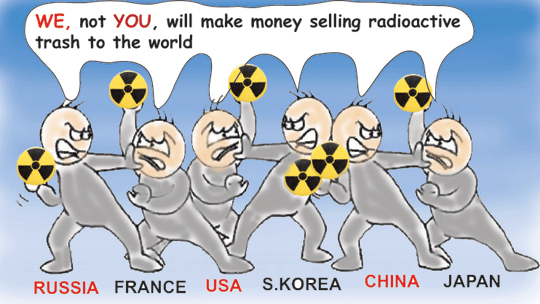
India and Canada are aiming for closer partnerships in civil nuclear energy and hydrocarbons with the dissipation of distrust that had kept them estranged for 40 years after India conducted a nuclear test in 1974……relationship would be supplemented by a “collaborative approach” in the civil nuclear sector, decks for which have been cleared with the signing of a civil nuclear accord and finalising of the administrative arrangements, High Commissioner for Canada to India Stewart Beck told The Hindu…….
“We are now putting in force a civil nuclear partnership. India has several reactors derived from Canadian technology but since then it has gone on its own path of development. We are now in a situation where the two can talk to each other. There is a huge need in India of Uranium which we can sell,” said Mr. Beck……http://www.thehindu.com/news/national/india-canada-aim-for-close-partnership-in-civil-nuclear-deal/article5462847.ece
Aging nuclear power plants very costly to ratepayers
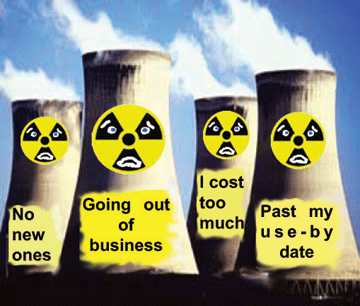 Report: Ratepayers Could Save $1.7 Billion If Aging Nuclear Plant at Hanford, Washington Is Closed By: Washington and Oregon Physicians for Social Responsibility Yuba Net.com SEATTLE/ PORTLAND – December 11, 2013 – Ratepayers could save at least $1.7 billion over the next 17 years if the Columbia Generating Station nuclear power plant on the Hanford Nuclear Reservation in Washington State is closed according to a new report by McCullough Research of Portland, Oregon.
The report can be found online at http://www.psr.org/chapters/oregon/news/new-report-ratepayers-could.html.
The Columbia Generating Station, the only nuclear plant completed of the five plants begun by the Washington Public Power Supply System (WPPSS), contains a General Electric boiling water reactor similar to those destroyed during Japan’s Fukushima Daiichi nuclear disaster.
“We believe this report demonstrates clearly that aging nuclear reactors, in addition to having safety problems, are having trouble competing in the electric power market,” says Dr. Catherine Thomasson, PSR national executive director. The report was commissioned by the Washington and Oregon Physicians for Social Responsibility local affiliate chapter.
The report makes four recommendations: the plant should be displaced by less expensive market solutions; Bonneville Power Administration should ask suppliers for firm bids to displace the plant; the displacement power should be purchased by plant owner Energy Northwest and supplied to BPA under an existing contract; and Energy Northwest should use a combination of training and employing current workers in plant decommissioning…….http://yubanet.com/usa/Report-Ratepayers-Could-Save-1-7-Billion-If-Aging-Nuclear-Plant-at-Hanford-Washington-Is-Closed.php#.UqtFG9JDt9U
Russia keen to sell nuclear reactors to USA
 Megatons to Megawatts 2.0: Russia eyes new nuclear project with US energy industry Rt.com December 11, 2013 “……..Rosatom enters US nuclear energy market Marking the end of the HEU-LEU agreement signed in 1993, the head of Russia’s Rosatom
  nuclear energy corporation, Sergey Kiriyenko, has met with his American counterpart in Washington, the US Secretary of Energy Ernest Moniz and his deputy Daniel Poneman.
The parties “compiled a list of mutually interesting projects” Kiriyenko told journalists on Tuesday. The head of the Russian nuclear energy industry named one such project: an international fast-neutron reactor, but refrained from specifying the others.
Kiriyenko said that the HEU-LEU agreement has become “unique experience” which paved the way for future Russia-US cooperation in the nuclear energy sphere.
Rosatom has already signed more than $5.5 billion worth of direct contracts, with US nuclear power generators outside the framework of the HEU-LEU agreement, Kiriyenko acknowledged.
“It is the basis that allows our companies to discuss further cooperation options after the completion of this project,” Kiriyenko said…….. http://rt.com/news/heu-leu-agreement-over-037/
BHP pessimistic about future of uranium market?
Where Olympic Dam is concerned, it’s the outlook for the main commodity—uranium—rather than potential investors that it mostly dislikes.
BHP Warms to Partnerships, But Olympic Dam Remains in the Cold WSJ 10 Dec 13, BHP Billiton Ltd. wants to share the love to get its $10 billion Jansen potash project in Canada off the ground. But the world’s biggest mining company is being a determined single when it comes to another costly development: Australia’s Olympic Dam…….
BHP’s reluctance to seek a partner for an expanded Olympic Dam project in South Australia may surprise as it’s stuck on the back burner, squeezed by low commodity prices and high development costs estimated by analysts at around $30 billion. In August last year, BHP said it would look for a less costly design for the Olympic Dam mine, which had been expected to bring in billions in tax dollars and create thousands of jobs. Up to now, it hasn’t announced any new plans for the site.
At first glance, finding a competitor to share development costs and risks with BHP makes sense. If they also bring in new technology then so much the better.
The problem for BHP is that a partner might actually want to get the project moving, even at a much-reduced scale. That would test BHP’s desire to keep annual spending below $15 billion in future, down by a third from last year’s bill totaling $21.7 billion. With uranium prices continuing to hover near eight-year lows, and several countries debating nuclear power in their energy mix, BHP can avoid such tough decisions by keeping full control of the asset.
“We like partnerships,” Mr Mackenzie told U.S. investors. Where Olympic Dam is concerned, it’s the outlook for the main commodity—uranium—rather than potential investors that it mostly dislikes. http://blogs.wsj.com/moneybeat/2013/12/10/bhp-warms-to-partnerships-but-olympic-dam-remains-in-the-cold/
Distrust growing over secret Trans Pacific Partnership deal
 One of the most controversial provisions in the talks includes new corporate empowerment language insisted upon by the U.S. government, which would allow foreign companies to challenge laws or regulations in a privately run international court.
Previously leaked TPP documents have sparked alarm among global health experts, Internet freedom activists, environmentalists and organized labor, but are adamantly supported by American corporations and the U.S. Chamber of Commerce. The Obama administration has deemed negotiations to be classified information — banning members of Congress from discussing the American negotiating position with the press or the public. Congressional staffers have been restricted from viewing the documents
Obama Faces Backlash Over New Corporate Powers In Secret Trade Deal HUFFINGTON POST 12/09/2013 WASHINGTON –– The Obama administration appears to have almost no international support for controversial new trade standards that would grant radical new political powers to corporations, increase the cost of prescription medications and restrict bank regulation, according to two internal memos obtained by The Huffington Post. Continue reading
Right after the Fukushima disaster, Japan set about to market nuclear power
Japan “will resuscitate nuclear energy, and rebuild the basis for promoting exports of infrastructure facilities,” indicating that the ministry would continue to advance nuclear power generation and further expand nuclear facilities exports.
Because the pro-nuclear Abe administration has said, “We will share our experience of the accident and lessons learned from the disaster with countries of the world,” the ministry’s report can be regarded as a prototype for Prime Minister Shinzo Abe’s nuclear policy.
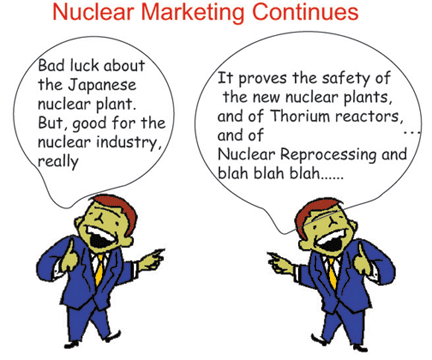
Ministry continued promoting nuclear power right after Fukushima accident December 02, 2013 THE ASAHI SHIMBUN The industry ministry began working to continue promoting nuclear power even immediately following the disastrous meltdowns at the Fukushima No. 1 nuclear power plant in March 2011, sources said.
The Asahi Shimbun has obtained a copy of the ministry’s confidential internal document titled, “Toward the Renaissance of Nuclear Energy,” which was compiled in late March 2011.
The report was written by a senior ministry official familiar with nuclear power facilities and distributed to its executives involved in designing the country’s energy policy, according to the sources.
The in-house document was used as a basis to determine the nation’s future nuclear policy in the aftermath of the disaster triggered by the Great East Japan Earthquake and tsunami on March 11, 2011, the sources said. Continue reading
Japan marketing nuclear technology to India
 Nuclear deal with Japan on the anvil THE HNDU, SANDEEP DIKSHIT , 2 Dec 13 At meeting with Emperor, Manmohan prefers to focus on economic aspects of relationship
Japan has said the main purpose of Emperor Akihito’s ongoing visit to India was to add more ballast to the bilateral relationship.
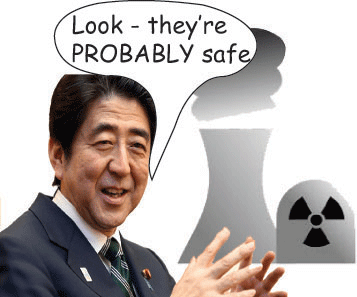 One of the elements that would add greater depth to the ties would be a civil nuclear agreement. “We are close to a bilateral deal on the peaceful use of nuclear energy,’’ said senior Japanese diplomats accompanying the Emperor, who is on a six-day visit to India……http://www.thehindu.com/news/national/nuclear-deal-with-japan-on-the-anvil/article5415157.ece
China marketing nuclear technology to Pakistan
How Pakistan and China Are Strengthening Nuclear Ties http://world.time.com/2013/12/02/how-pakistan-and-china-are-strengthening-nuclear-ties/?iid=gs-main-lead
The reactors are expected to start supplying 2,200 megawatts to the grid by 2019. The complex is not the first energy investment or nuclear project in Pakistan that China has been involved with, but it will be by far the largest.
 The nuclear power relationship between Pakistan and China is widely seen as a continuing effort to respond to the India-U.S. civilian nuclear deal, which, among other things, ended a decades-long moratorium on U.S. companies selling nuclear technology to India, despite India not being a signatory to the Nuclear Non-Proliferation Treaty. The move rankled Pakistan, which has also not signed the treaty and worries about a nuclear buildup by a country it considers its archenemy. China, too, criticized the deal for, it asserted, undermining nonproliferation. That the U.S. was building ties with India to counterbalance China’s growing power in Asia was probably not lost on Beijing either.
Russia aggressively marketing nuclear power to South Africa
the draft Russian agreement, which Business Day has seen, had a veto clause, which would allow the parties to block the involvement of a third country
Russia turns up heat on ambitions for nuclear build in SA  BUSINES DAY LIVE, BY CAROL PATON, 29 NOVEMBER 2013 THE RUSSIAN GOVERNMENT IS PUMPING UP THE PROPAGANDA SURROUNDING THE COUNTRY’S NUCLEAR AMBITIONS IN SOUTH AFRICA WITH A SERIES OF REPORTS ON THE OFFICIAL INTERNATIONAL BROADCASTER VOICE OF RUSSIA THAT A DEAL HAS BEEN STRUCK TO BUILD SOUTH AFRICA’S PLANNED NUCLEAR POWER PLANTS.
Several countries are jockeying for position in South Africa’s nuclear build programme, which envisages the construction of three nuclear power plants to supply 9,600MW at the cost of at least R1-trillion. The government has said the procurement process is close to finalised and there is high expectation among bidders that it will go ahead next year.
This week, the temperature over the nuclear build was further heightened when state-owned Russian corporation Rosatom hosted a nuclear suppliers’ forum in Johannesburg “with the aim of establishing and developing lasting partnerships in South Africa”.
At the forum on Monday, a memorandum of understanding was signed between the Nuclear Energy Corporation of South Africa (Necsa) and a Rosatom subsidiary. Continue reading
Marketing nuclear power to Egypt – what a lovely, safe, idea!
Egypt moves ahead with nuclear plant to address electricity crisis ALMONITOR, Egypt Pulse Ayah Aman 29 Nov 13, CAIRO — The Egyptian government is taking new steps to implement its ambitious program to use nuclear energy for the generation of electricity. This comes after the project had been halted due to security, political and economic reasons as well as popular opposition…….
A source at the EAEA told Al-Monitor that the government expected to receive offers from 30 international companies for the execution of the project. The actual competition has been limited to 10 companies from six countries: Russia, China, Japan, South Korea, the United States and France…….
“The government will meet the $4 billion financing through grants from companies that it will pay back in installments,” the same source clarified. “However, the Egyptian government has yet to receive any offers for financing or assistance.” He brushed off criticism that external financing constituted a violation of sovereignty, “as it is the only option available to expedite the completion of the project.”
A delegation from the international consulting firm WorleyParsons visited Cairo in early November and met with experts on nuclear safety……… The Supreme Council of Energy is scheduled to hold a meeting next week, chaired by Mansour, to discuss the nuclear dossier and review the steps being considered to hold the tender to build nuclear power plants. Continue reading
India’s Jaitapur nuclear power plans hit financial problems
 Plans for Western India Nuclear Project Hit Hurdle -Official By Saurabh Chaturvedi MUMBAI--India’s plans for setting up one of the country’s biggest nuclear power projects in its western region have been hampered due to a rise in the cost of equipment to be secured from French supplier Areva S.A. (AREVA.FR), a senior Indian government official said Thursday.
India’s state-owned monopoly Nuclear Power Corp. had signed an initial pact  with Areva in 2010 for the supply and installation of equipment needed for building two nuclear power reactors of 1,650 megawatts each at Jaitapur in the western state of Maharashtra. The plan is to eventually build a total of six reactors with a combined capacity of 9.9 gigawatts, which would be the biggest nuclear power complex in India at a single location.
But the cost of the equipment has risen due to the higher cost of borrowing as well as a slide in the rupee’s value against the U.S. dollar this year, which would more than double the cost of electricity generation from an initial estimate of about 4 rupees (6.4 U.S. cents) per unit.
“The price of electricity from the project once it becomes operational can not be more than 6.50 rupees,” said R.K. Sinha, chairman of India’s Atomic Energy Commission, the country’s top nuclear policy making body. “Negotiations are still on.”
An Areva India executive, who declined to be named, said negotiations on the sale of the equipment are still under way, while Areva India chairman and managing director Erwan Hinault didn’t immediately respond to emailed queries.
Nuclear Power Corp. had earlier expected to sign an agreement with Areva for the supply of equipment for the first two reactors by end-2012, but negotiations remained inconclusive. Global nuclear equipment companies such as Areva, GE Hitachi Nuclear Energy and Westinghouse Electric Co. have been keen to capitalize on India’s plans to spend billions of dollars to boost its nuclear power capacity. More than half of India’s 228 gigawatts of total power generation capacity is based on coal, which is in short supply…. http://online.wsj.com/article/DN-CO-20131128-003020.html?dsk=
We don’t do nuclear investment – says World Bank
 World Bank says no nuclear investment http://www.skynews.com.au/businessnews/article.aspx?
 id=928794 November 28, 2013 The World Bank and United Nations have appealed for billions of dollars to provide electricity for the poorest nations but say there will be no investment in nuclear power.
‘We don’t do nuclear energy,’ said World Bank president Jim Yong Kim on Wednesday, as he and UN leader Ban Ki-moon outlined efforts to make sure all people have access to electricity by 2030. Kim said $US600-800 ($A659-878) billion a year will be needed to meet the campaign target of universal access to electricity, doubling energy efficiency and doubling the share of renewable energy by 2030. In some countries, only 10 per cent of the population has electricity.
So far, the campaign has a pledge of one billion US dollars from the OPEC Fund for International Development, Bank of America has raised $US500 million through the world’s first ‘green bond’ and Norway has committed to spend two billion krone (US$325 million) on renewable energy efforts in 2014.
Kim said the World Bank is preparing energy plans for 42 countries that would be ready in June, but said any money raised would only go to new power sources. ’Nuclear power from country to country is an extremely political issue,’ Kim told reporters.
‘The World Bank Group does not engage in providing support for nuclear power. We think that this is an extremely difficult conversation that every country is continuing to have. ’And because we are really not in that business our focus is on finding ways of working in hydro electric power in geo-thermal, in solar, in wind,’ he said.
‘We are really focusing on increasing investment in those modalities and we don’t do nuclear energy.’
Kim highlighted private financing for power expansion in Nigeria and Ivory Coast and said efforts were being made to launch a similar deal for Myanmar, where the government has launched major reform efforts. ’We are working and moving very quickly to try to ensure that Myanmar experiences a clear democracy dividend,’ Kim said. The World Bank chief said it had been difficult to find long term capital for poorer countries but insisted: ‘We will show investors that sustainable energy is an opportunity they cannot afford to miss.’
The future of the uranium market melting away
 Of course, the nuclear lobby is well-heeled and has its silver-tongued apologists who will do their best to discredit such stories. Beyond the despicable aspects of this, you should consider, from an investment point of view, the risk that the industry loses control of the public relations battle as more stories emerge – and legal consequences ensue……uranium stocks are a no-go as a long-term investment.
Meltdown Coming? The Uranium Story You Haven’t Heard Money  Morning 27 November 2013 by Chris Mayer “……You remember the nuclear disaster at Fukushima? It was a horrible human tragedy that is still playing out – and in ways I am sure you will be surprised to learn.
The disaster also set back the so-called nuclear renaissance that was then in swing. Uranium prices fell like a piano tumbling down a flight of stairs, only recently crashing down to five-year lows and laying waste to uranium stocks.
But it’s been over two years since the meltdown at Fukushima, and memory is short. Here is Barron’s over the weekend, on its optimistic appraisal of Cameco, the world’s largest publicly traded producer of uranium:
‘Cameco shares recently rallied after stronger-than-expected third-quarter earnings, but are still flat for the year. They fetch just 15.2 times what the company has earned, well below its decade median of 24 times, and the low-cost producer generated net profit margins near 22% even when uranium prices slumped. Improving prices can only energize the stock.‘
Among the ‘reasons for optimism‘, Barron’s included ‘gradual progress toward the cleanup in Japan‘.
Barron’s piece inspired me to write to you today. As a long-term investor, I am not tempted – at all – by the apparent bargain in uranium stocks. Continue reading
Warren Buffett is going for Renewable Energy
 Here’s What Warren Buffett Thinks About Renewable Energy The Motley Fool By Jason Hall | November 27, 2013 |
“Rule No. 1: Never Lose Money. Rule No. 2: Never Forget Rule No. 1.”
–Warren Buffett
Warren Buffett is famous for both his legendary investing acumen, and his simple, straightforward investing advice. For years, alternative energy has been viewed as non-competitive with traditional energy production from coal and other fossil fuels, making them money-losers for most investors.
Buffett’s own Berkshire Hathaway (NYSE: BRK-B ) subsidiary MidAmerican Energy is heavily investing in alternative energy sources, including both wind and solar. And considering that MidAmerican produces more than $1.2 billion in annual “ammo” for Buffett’s “elephant gun,” the story on renewables is clearly changing.
Should investors follow t… (registered readers only) http://www.fool.com/investing/general/2013/11/27/when-it-comes-to-renewable-energy-buffetts-not-blo.aspx
GE Hitachi Nuclear Energy wants to build a laser uranium enrichment facility in Kentucky
GE Hitachi, Energy Dept. in talks over Ky. uranium Chron, By DYLAN LOVAN and ROGER ALFORD, Associated Press | November 27, 2013 LOUISVILLE, Ky. (AP) — The U.S. Department of Energy said Wednesday that it is entering negotiations with General Electric’s nuclear division on a proposal to replace an aging uranium enrichment plant in Kentucky with a new facility.
GE Hitachi Nuclear Energy wants to build a laser enrichment facility that would make use of the depleted uranium kept at the Paducah Gaseous Diffusion Plant. The Energy Department announced that it has selected GE Hitachi to begin exclusive negotiations for the sale of the uranium inventory.
GE Hitachi spokesman Chris White said Global Laser Enrichment that uses a unique laser technology would extract natural uranium from Paducah’s stores of depleted tails. The uranium would be used to fuel commercial nuclear reactors in the U.S., he said.
The negotiations are just beginning and there is no timetable on building a new plant, White said…….http://www.chron.com/business/energy/article/GE-Hitachi-Energy-Dept-in-talks-over-Ky-uranium-5017015.php
1 This Month





PLEASE OPPOSE HR 8255 AND S.3639 – bills would accelerate satellite deployment, with no environmental review or safeguards – https://ncstd5li.quorum.us/campaign/169331/
To see nuclear-related stories in greater depth and intensity – go to https://nuclearinformation.wordpress.com
-
Archives
- October 2026 (10)
- September 2026 (339)
- August 2026 (330)
- July 2026 (355)
- June 2026 (287)
- May 2026 (306)
- April 2026 (356)
- March 2026 (251)
- February 2026 (267)
- January 2026 (308)
- December 2025 (358)
- November 2025 (359)
-
Categories
- 1
- 1 NUCLEAR ISSUES
- business and costs
- climate change
- culture and arts
- ENERGY
- environment
- health
- history
- indigenous issues
- Legal
- marketing of nuclear
- media
- opposition to nuclear
- PERSONAL STORIES
- politics
- politics international
- Religion and ethics
- safety
- secrets,lies and civil liberties
- spinbuster
- technology
- Uranium
- wastes
- weapons and war
- Women
- 2 WORLD
- ACTION
- AFRICA
- Atrocities
- AUSTRALIA
- Christina's notes
- Christina's themes
- culture and arts
- Events
- Fuk 2022
- Fuk 2023
- Fukushima 2017
- Fukushima 2018
- fukushima 2019
- Fukushima 2020
- Fukushima 2021
- general
- global warming
- Humour (God we need it)
- Nuclear
- RARE EARTHS
- Reference
- resources – print
- Resources -audiovicual
- Weekly Newsletter
- World
- World Nuclear
- YouTube
-
RSS
Entries RSS
Comments RSS

