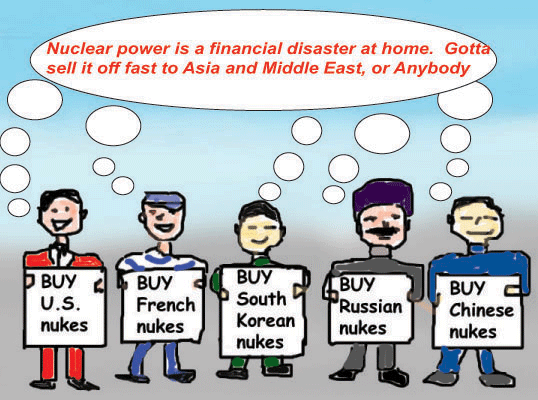
India joins the panic to sell costly, impractical, nuclear power to Africa and Middle East
|
Indian Envoy To Russia Says Countries Could Build Nuclear Power Plants In Africa & Middle East Caspian Newa By Vusala Abbasova January 26, 2020 Russia and India may team up to construct nuclear power plants in Africa and the Middle East, according to India’s ambassador to Russia, building on their current experiences in Bangladesh.
“We are already working under the scheme in Bangladesh,” Varna added, referring to the current construction of the country’s first nuclear power plant, called Rooppur. “Now Russia is also pretty active in the construction of nuclear power plants in the Middle East and Africa. That opens a new pathway of cooperation for us.” Varma believes the two sides could also launch projects in Africa using the experience they gained from joint work on Rooppur, which is being built by Russia’s Rosatom State Atomic Energy Corporation and costing over $13 billion. “Russia already has agreements in this field with a number of African countries,” Varma said. “Ethiopia is one of them, and there are some countries in the Middle East.”
|
|
In UK “big” nuclear power versus “small” (both unaffordable) at Wylfa
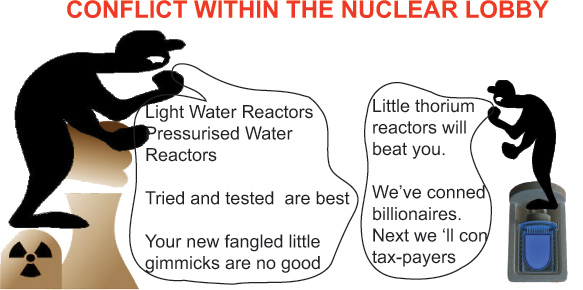
 The global nuclear lobby might look like a unified force – it’s anything but!. The nuclear nations fight each other in desperately trying to flog off their unaffordable white elephant nuclear reactors to ‘developing’ countries, or to any sucker, really. .
The nuclear industry itself is divided – the ‘conventional’ big nuclear reactors versus the (not yet existing) Small and Medium Nuclear Reactors (SMRs)
‘No plans’ for Wylfa mini nuclear power station according to developer, https://www.dailypost.co.uk/news/north-wales-news/no-plans-wylfa-mini-nuclear-17599188, Owen Hughes, Business correspondent, 20 JAN 2020
Horizon Nuclear Power said its full focus is on delivering a full scale nuke plant.
Wylfa Newydd developer Horizon Nuclear Power says there are “no plans” to build mini reactors at its Anglesey site.
Rolls Royce is currently leading a consortium developing the technology for Small Modular Reactors (SMRs) – supported by the UK Government. Trawsfynydd in Gwynedd has been tipped at a prime spot for one of the reactors and over the weekend Wylfa was also reported as a target location.
But Horizon has released a statement making clear the Wylfa site is not being put forward for this technology as they press on with the current plan for a full scale nuclear site.
A spokesman said: “There are no plans to deploy a Rolls Royce Small Modular Reactor at the Wylfa Newydd site.”
He added: “Activity on the Horizon project is currently suspended, but we’re working hard to establish the conditions for a restart using our tried and tested reactor design, which has already cleared the UK regulators’ assessment process.
Energy Secretary Andrea Leadsom wants additional information before deciding whether to give planning permission for Wylfa Newydd.
She deferred the decision on the site in October.
If permission is granted then the next step will be securing funding to make the project happen.
When it comes to SMRs, Alan Woods, strategy and business development director for Rolls-Royce, said they were focusing on sites in Wales and the north of England. Modular reactors are smaller and, once the first is approved and built, manufacturers hope mass-production will lead to shorter construction times and lower costs for each unit.
The consortium will need to establish factories to produce the small modular reactors with the pre-fabricated modules transported to sites for construction.
$123 billion the cost of safety measures for Japan’s nuclear stations
 Costs for managing Japan’s nuclear plants to total 13 trillion yen, https://english.kyodonews.net/news/2020/01/8722fafaff9b-costs-for-managing-japans-nuclear-plants-to-total-13-trillion-yen.html
KYODO NEWS – Jan 15, 2020 The total costs to implement government-mandated safety measures, maintain facilities and decommission commercially operated nuclear power plants in Japan will reach around 13.46 trillion yen ($123 billion), a Kyodo News tally showed Wednesday.
The amount, which could balloon further and eventually lead to higher electricity fees, was calculated based on financial documents from 11 power companies that own 57 nuclear reactors at 19 plants, as well as interviews with the utilities.
Two years after the 2011 Fukushima nuclear crisis, the Japanese government introduced new safety standards which made measures against natural disasters and major accidents mandatory for restarting reactors.
The power companies have been given the option of either maintaining their idled nuclear power plants and restarting them once they had implemented the required safety measures, or decommissioning their plants. But it has become clear either choice required massive costs.
Of the total costs, 5.4 trillion yen was for safety measures implemented as of last month at 15 power plants they are trying to restart.
Decommissioning costs for 17 reactors belonging to nine nuclear power plants, which were deemed too expensive to implement safety measures for, totaled around 849.2 billion yen.
As the estimated costs for decommissioning the No. 1 to No. 4 reactors at the Fukushima Daiichi nuclear power plant run by Tokyo Electric Power Company Holdings Inc. differ, they were not included in the figure.
Maintenance costs, which will not only apply to restarted plants in operation but also to idled ones and those in the process of being decommissioned, are required for 54 reactors at 17 plants.
Those under construction were excluded. In the six years from fiscal 2013, when the new regulations were introduced, they totaled around 7.2 trillion yen.
The costs include labor, repairs and others considered nuclear power plant expenses as shown in each company’s annual securities report. But plant depreciation costs and a reserve for dismantling facilities were subtracted as they overlapped with some expenses for safety measures and decommissioning.
Maintenance fees will be required every year moving forward and are expected to continue to grow from the annual costs of around 1 trillion yen across the 11 utilities.
The total costs could further rise by several hundred billion yen as money needed to construct anti-terrorist facilities, also required under the new safety standards, was not included in the figures of some of the companies.
The majority of the 17 reactors at nine power plants slated for decommissioning are aging and they also include four at the Fukushima Daini complex, which local officials requested to be scrapped.
Romania quits deal with China for new nuclear reactors
|
Romania to exit deal with Chinese company for new nuclear reactors https://www.romania-insider.com/ro-exit-deal-cgn-nuclear-jan-2020 Romania’s Government will exit the deal with the Chinese partner for the construction of reactors 3 and 4 at the Cernavoda nuclear power plant, prime minister Ludovic Orban announced in an interview with Hotnews.ro.“It is clear to me that the partnership with the Chinese company is not going to work,” Orban said, adding that the Government has already started to look for a new partner and financing for this project.
In 2015, Romanian state-owned electricity producer Nuclearelectrica, the company that operates the Cernavoda nuclear power plant, signed a memorandum of understanding with China General Nuclear Power Corporation (CGN) for the construction of two new reactors (3 and 4). On May 8 last year, the two sides officially signed the preliminary agreement on the construction and operation of two new reactors. However, the cooperation between Nuclearelectrica and CGN became uncertain after Romania’s president Klaus Iohannis and U.S. president Donald Trump signed a joint declaration in Washington, on August 21, that mentioned, among others, a closer cooperation between U.S. and Romania in the field of nuclear energy. In September, former PM Viorica Dancila also signed a memorandum in this regard with U.S. Energy Secretary Rick Perry. Moreover, China General Nuclear Power Corporation was accused of nuclear espionage by the U.S. Government back in 2016. |
|
In Turkey, renewable energy rising, as nuclear partnership with Japan is scrapped
|
Turkey, Japan scrap partnership in Sinop nuclear plant in Turkey’s north, Hurriyet Daily News, 20 Jan 2020, Turkey is reassessing its major partner for the country’s second nuclear plant in the Black Sea province of Sinop, Energy Minister Fatih Dönmez said on Jan. 19.In an interview with state-run Anadolu Agency, Dönmez said that the time schedule and pricing of the nuclear power plant in Sinop fell short of the ministry’s expectations after the results of feasibility studies, carried out by Japanese Mitsubishi Heavy Industries, Ltd., came out.
“We agreed with the Japanese side to not continue our cooperation regarding this matter,” Dönmez said…….. An intergovernmental agreement was signed between Turkey and Russia in May 2010 for Akkuyu NPP, the first nuclear plant of Turkey that will have four VVER-1200 power reactors with a total installed capacity of 4,800 megawatts. …… Share of local and renewable energy increases to 62 pct Dönmez also said Turkey saw an increase in the share of local and renewable resources for the country’s electricity production. Electricity production from local and renewables sources in 2019 amounted to 62 percent compared to 49 percent in 2018, a 13 percent increase, he further elaborated……… http://www.hurriyetdailynews.com/turkey-japan-scrap-partnership-in-sinop-nuclear-plant-in-turkeys-north-151212 |
|
The highly controversial question of how to fund UK’s nuclear build
|
Momentum Builds for UK Government to Self-Fund New Nuclear Plants https://www.greentechmedia.com/articles/read/momentum-builds-for-uk-government-to-fund-new-nuclear-itself
The U.K. government wants new nuclear capacity. How it will be funded remains a highly contentious question. JOHN PARNELL JANUARY 15, 2020 When the U.K. government unveiled its contract for difference with EDF’s 3.2-gigawatt Hinkley Point C nuclear power station in 2012, it proudly proclaimed that the arrangement proved new nuclear did not need direct subsidy.
Since then, three other U.K. projects have been put on an indefinite pause after Hitachi and Toshiba said their respective ventures had failed to attract investors. While the 35-year contract for difference (CFD) awarded to EDF is considered generous at £92.50 ($120) per megawatt-hour, the French energy giant is on the hook for overrun costs — no small concession. A 2014 study found that of a global sample of 180 nuclear power plants, 97 percent ended up over budget. There is an acceptance in the nuclear industry and at the government level that the CFD approach won’t be used for nuclear again in the U.K. Yet all but one of the country’s 15 working reactors are going offline by 2030, and the process of replacing them is behind schedule. A new approach is needed — and quickly. Sizewell C is the next active nuclear project in the U.K. pipeline. It will be a carbon copy of EDF’s Hinkley C, offering project savings and a readymade supply chain. The plan is to switch the workforce from one site to the other. How Sizewell C will be funded, however, remains an open question. The government launched a consultation in July 2019 on a new method that could be used for Sizewell C. That process closed in October, but between Brexit and an election, there has been no response from the government since. EDF has reportedly become twitchy about the timeline, telling the government it needs to know how Sizewell C will be funded by the end of the year if it’s to have any chance of starting construction in 2022. The Department for Business, Energy & Industrial Strategy told GTM it would follow up on the consultation’s responses “in due course.” RAB: Nuclear’s next top model?The government is seeking feedback on one possible new approach for Sizewell C known as regulated asset base (RAB), which is already in use for other big infrastructure projects. The RAB model basically gives the project developer a means to recover its investment through consumer bills under the watchful gaze of a regulator — including payments during the construction phase. It’s the model used by the country’s water monopolies to pay for their infrastructure. But pipes and pumps are generally simpler and cheaper than new nuclear. The biggest RAB deal in the U.K. so far is the £13.5 billion extension of Heathrow Airport. The most conservative estimate for Sizewell C is £20 billion ($26 billion). (Its forerunner Hinkley Point C is sitting at £22 billion and counting.) Taking this approach would be a first for the energy sector and a first for RABs. An entirely new entity, within or outside current regulator Ofgem, would have to step up to monitor how funds were being recouped from bills. EDF and other nuclear developers wouldn’t be paid if projects never make it to financial close, potentially leaving them exposed to the predevelopment costs. But clarity is still needed on which entities would be exposed to various other risks, and there is danger that in the event of project costs rising, billpayers would be stuck with the tab. Another option: State-backed nuclear funding?Meanwhile, a number of respondents to the government’s consultation say the government should take another, more controversial route: stepping in to build new nuclear itself, then quickly selling completed plants to the private sector. The U.K. government celebrated the fact that it wasn’t sinking state money into Hinkley Point C when the CFD was awarded. But after all, that project is being developed by two other state-run companies, albeit ones from France and China. In its response to the government’s consultation on funding options, the independent Nuclear Energy Consulting Group called for a new nuclear Crown Corporation, a state-backed investment vehicle, to step in to build nuclear projects. “This new entity would act as an owner or funder of new [nuclear power] projects from inception to commercial operation, with project risks and benefits during development and construction remaining with [HM government],” write authors Edward Kee, Ruediger Koenig, Paul Murphy and Xavier Rollat. In an email to GTM, Edward Kee, the CEO of Nuclear Energy Consulting Group, shared the group’s reservations about the RAB model. “We have doubts that developing and implementing a nuclear power RAB framework would happen fast enough. It is also unclear that the RAB approach would deliver the needed nuclear power investment, even when put into place,” said Kee. The International Project Finance Association, whose members include the World Bank, the U.S. Treasury and many major investors, agreed that the U.K. government should consider funding nuclear projects. “An alternative structure would be for government to procure construction on the balance sheet (so that the government would own the project and pay for construction as the costs are incurred), and then look to sell the project to the private sector once operational,” the IPFA suggested in its response. Energy Systems Catapult, a not-for-profit innovation center established by the government itself, also backs using the national balance sheet to build new nuclear at the lowest cost. The potential funding pool for new nuclear in Europe shrank in December when the EU published a definitive list of what can be considered for “sustainable finance.” Nuclear power did not make the grade, and nuclear won’t be financed as part of the EU’s recently announced Green Deal. Whether financial institutions follow the EU’s lead remains to be seen. The government declined to comment on its position toward directly funding and owning new nuclear power assets. “New nuclear has an important role to play in providing reliable, low-carbon power as part of our future energy mix as we aim to eliminate our contribution to climate change by 2050,” a spokesperson said. “However, we are clear that any energy project must offer value for money for consumers.” Does the U.K. need new nuclear at all?Other influential groups remain open or even supportive of the RAB model for funding new nuclear. The union Unite is receptive to a RAB framework but began its own response by saying it “favors a policy of state ownership of the energy sector.” The union also warned against letting what it views as inevitable cost overruns be passed on to energy-intensive consumers, which might then take their operations and jobs elsewhere. Trade body EnergyUK said it supports the development of an RAB model but added that it views a levy on consumer bills as a more regressive approach to funding than using general taxation. At the same time, other groups are questioning the government’s commitment to new nuclear. Citizens Advice, the powerful consumer watchdog, said it does not believe RAB would deliver good value. The union Unite is receptive to a RAB framework but began its own response by saying it “favors a policy of state ownership of the energy sector.” The union also warned against letting what it views as inevitable cost overruns be passed on to energy-intensive consumers, which might then take their operations and jobs elsewhere. Trade body EnergyUK said it supports the development of an RAB model but added that it views a levy on consumer bills as a more regressive approach to funding than using general taxation. At the same time, other groups are questioning the government’s commitment to new nuclear. Citizens Advice, the powerful consumer watchdog, said it does not believe RAB would deliver good value. “Several of the government’s own advisors, including both the Committee on Climate Change and the National Infrastructure Commission, are less definitive on the case for new nuclear than it is,” the group states in its response to the consultation. “If new nuclear is an option rather than a necessity, its economics come more sharply into play, and they are challenging when compared to a range of other low-carbon options.” Citizens Advice said it wants to see a detailed business case for new nuclear prior to any contracts being signed. It claims the value-for-money assessment on Hinkley C was published after the deal was legally binding and was only three pages long. The group also pointed out the elephant in the room: Brexit. To date, the investor pool for new U.K. nuclear has been largely populated by firms backed by foreign governments, including those that we may need to strike trade deals with in the coming years, meaning that there are political as well as economic considerations at play,” it wrote. “These factors would make it extremely hard for any regulator to take any steps that might result in the abandonment of a new nuclear project, even if costs were to escalate significantly. This would dilute their ability to act in consumers’ best interests.” |
|
Significant drop in France’s nuclear energy production
 Reuters 10th Jan 2020, EDF’s French nuclear power generation fell by a more than expected 3.5 percent last year, the state-owned utility said on Friday. The French company’s domestic nuclear output power dropped to 379.5 terawatt hours (TWh), missing a revised production target of between 384 TWh and 388 TWh.
power output tumbling in the final month of 2019 by 15.2% to 33 TWh. The
operator of France’s 58 nuclear reactors, covering about 75% of the
country’s electricity needs, had revised its 2019 nuclear production
target from 390 TWh to between 384 TWh and 388 TWh in November because of reactor maintenance and safety checks after an earthquake.
Britain’s Sizewell nuclear project in jeopardy, as EDF struggles to get funding
 Sizewell, Times 13th Jan 2020, EDF is in a race against time to secure a funding deal for its proposed nuclear power station in Suffolk as delays risk making the project prohibitively expensive. The French energy giant has hired Rothschild as financial adviser for the Sizewell C project and says it wants a “definitive way forward” from the government this year so it can start construction in 2022. The company building the £22 billion Hinkley Point C plant in Somerset has promised it can significantly reduce the cost of the sister plant in Suffolk, including by transferring workers and equipment Sizewell, Times 13th Jan 2020, EDF is in a race against time to secure a funding deal for its proposed nuclear power station in Suffolk as delays risk making the project prohibitively expensive. The French energy giant has hired Rothschild as financial adviser for the Sizewell C project and says it wants a “definitive way forward” from the government this year so it can start construction in 2022. The company building the £22 billion Hinkley Point C plant in Somerset has promised it can significantly reduce the cost of the sister plant in Suffolk, including by transferring workers and equipmentbetween the two. Delays to funding that result in a hiatus between the
projects would erode such savings and jeopardise Sizewell, which the government has said must be cheaper than Hinkley. A senior executive at Sizewell recently admitted that if funding proposals ended up “outside an acceptable price range for the government, then the project probably won’t go ahead — it’s as simple as that”.
EDF has proposed an alternative, funding model for Sizewell C, under which consumers would pay for the project while it is still under construction. This would cut borrowing costs but also put consumers on the hook for cost overruns.
The government ran a consultation last year on adopting the model but is yet to give its verdict. An EDF spokeswoman said: “We hope to see a way forward on nuclear financing in 2020 ahead of COP26 [the Glasgow climate change summit]. This would ensure we can maximise the benefits of replicating the design of Hinkley Point C at Sizewell C.”
|
UK’s competition watchdog to investigate Jacobs’ acquisition of Wood Nuclear Limited
Times and Star 9th Jan 2020, The proposed £250 million acquisition of a major player in the clean-up of the Sellafield site in West Cumbria could be blocked. The Competition and Markets Authority (CMA) has launched an investigation into global engineering firm Jacobs’ acquisition of Wood Nuclear Limited – the nuclear arm of the Wood Group.
The proposal deal – announced in August last year – would see Wood Nuclear Limited along with “subsidiary and certain affiliated companies” come under control of Jacobs’ UK division. Jacobs would also take on existing contracts held by the business – which include managing the Design and Engineering lot for the Programme and Project Partners (PPP) framework.
20-year contract awarded last year by Sellafield Limited as part of its push to “revolutionise” the decommissioning of the site, could be worth up to £769 million. Wood’s nuclear division is already a long-standing big tier company at Sellafield and, in December was awarded a £50m contract to provide programmable digital control technologies to the plant.
UK’s Sizewell C nuclear project not viable, due to escalating costs?

Could escalating costs mean ‘game over’ for nuclear power and Sizewell C? East Anglian Daily Times, January 2020, Andrew Hirst
The growing cost of nuclear power could mean ‘game over’ for Sizewell C, experts claim. While much of the debate in Suffolk around EDF Energy’s proposals have focussed on the local impacts, recent reports from energy forums have started to question how viable the industry is for the UK – and globally.
At a recent debate, Paul Dorfman of the University College London’s Energy Institute went head to head with Paul Spence, director of strategy and corporate affairs at EDF to discuss the future of the sector.
Dr Dorfman, who also founded the Nuclear Consulting Forum, said the “massive cost escalations” of nuclear power together with the increasing competiveness of renewables meant there was “little rationale for new nuclear builds”.
Costs for offshore wind have plummeted to around £40 per MWh – making it now one of the cheapest forms of power available.
Meanwhile, the costs government agreed to pay EDF for Hinkley Point C, is more than twice as expensive at £92.50 per MWh.
The latest World Nuclear Industry Status Report warned of “substantial challenges” and a decline in usage, with fewer reactors in operation today than 30 years ago.
Globally, while investment in renewables has increased to around $350bn per year, nuclear fell to just $17bn. Dr Dorfman said: “In this context, nuclear power at the expense of more flexible, safe, productive, cost-effective and affordable technologies really does seem to be rather foolish.”
He said it could mean “game over” for nuclear projects, including Sizewell…….
The government consulted earlier this year on the “Regulated Asset Base model”, which is intended to incentivise private investment in public projects by guaranteeing a return for developers. It would mean developers can raise revenue, potentially though customer bills, and reduces their risk. ……
although EDF claims RAB could save money for consumers – critics say it merely leaves the public with all the risk.
“Under RAB, the plan is for the burden of risk to pass to hard-pressed UK consumers and/or taxpayers labouring under post-Brexit conditions,” said Dr Dorfman.
“Not only that, but the revenue stream will include a variable strike price – with taxpayers and/or electricity consumers forced to write, what is essentially, a ‘blank cheque’.
Earlier this year it was reported a “Sizewell surcharge” could add £6 to annual energy bills under the RAB model. A petition opposing the surcharge was signed by more than 36,000 people.
Concerns were further compounded by EDF’s precarious financial position. The company is €37.4billion net debt and its stock lost 34% of its value this year.
Professor Steve Thomas, a researcher in energy policy at the University of Greenwich, questioned the company’s credentials ahead of a seminar organised by the Nuclear Free Local Authorities in Colchester last month.
“EDF is in deep financial crisis and will only be able to survive with heavy French government support and radical restructuring,” he said. “It is unclear how EDF will be able to finance Hinkley Point C, much less Sizewell C, and the UK government must resist pressures to throw more public money at these ill-conceived projects and abandon them now.”
The European Pressurised Water Reactor (EPR) is dragging nuclear company EDF into $billions of debt

Climate News Network 31st Dec 2019, The edifice already heading for the status of the largest and most expensive construction project in the world, the Hinkley C nuclear power station (above) in the UK, is dragging its builder, the French giant EDF, into ever-deeper debt: the company’s flagship reactor is facing still more delay.
Although EDF is a vast company, owning 58 reactors in France alone,
and is 85% owned by the French state, it owes around €60 billion ($67bn),
a debt expected to increase by €3 billion ($3.35bn) a year.
This has led some city analysts, notably S&P Global, to downgrade the company’s prospects to “negative” − which is essentially a recommendation to
shareholders to sell.
Apart from the problem that EDF’s fleet of reactors in France is operating well beyond their original design life and are in constant need of safety and maintenance upgrades, the company’s main problem is its flagship, the European Pressurised Water Reactor (EPR), which is getting into ever-greater difficulties.

In Europe there are four EPRs under construction: the two barely begun at Hinkley Point in Somerset in the west of England; one in northern France at Flamanville (below) in Normandy; and the original prototype in Finland, known as Olkiluoto 3 (OL3) (above) . The extraordinary fact is that, although OL3 was due to start up in 2009, it is still incomplete, and its start date has just been put back again – until 2021.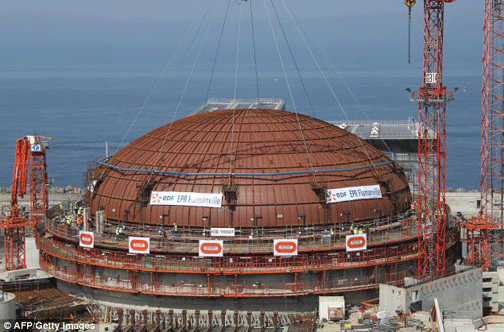
https://climatenewsnetwork.net/flagship-reactor-launch-postponed-again/
Germany To Close All Nuclear Plants By 2022
In the wake of the Fukushima disaster in Japan in 2011, Germany ordered the immediate shutdown of eight of its 17 reactors, and plans to phase out nuclear power plants entirely by 2022.
The Philippsburg 2 reactor near the city of Karlsruhe in southwestern Germany has provided energy for 35 years. The Philippsburg 1 reactor—opened in 1979—was taken offline in 2011.
Over the past few years, nuclear power generation in Germany has been declining with the shutdown of its nuclear plants, while electricity production from renewable sources has been rising.
A government-appointed special commission at Europe’s largest economy announced the conclusions of its months-long review and proposed that Germany shut all its 84 coal-fired power plants by 2038.
Germany, where coal, hard coal, and lignite combined currently provide around 35 percent of power generation, has a longer timetable for phasing out coal than the UK and Italy, for example—who plan their coal exit by 2025—not only because of its vast coal industry, but also because Germany will shut down all its nuclear power plants within the next three years.
The closure of all nuclear reactors in Germany by 2022 means that Germany might need to retain half of its coal-fired power generation until 2030 to offset the nuclear phase-out, German Economy and Energy Minister Peter Altmaier said earlier this year.
Missouri lawmaker pushes for helping nuclear companies to charge customers in advance
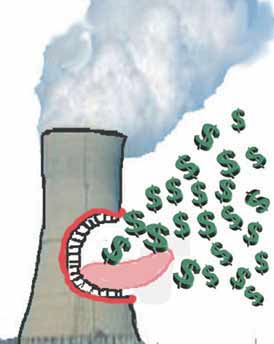 Local rep looks to boost nuclear by letting companies charge customers for plants up front, Austin Huguelet, Springfield News-Leader Dec. 29, 2019 Missouri hasn’t seen a new nuclear plant in more than 30 years.A local lawmaker and state air conservation officials say that needs to change to meet the demands of the future. Local rep looks to boost nuclear by letting companies charge customers for plants up front, Austin Huguelet, Springfield News-Leader Dec. 29, 2019 Missouri hasn’t seen a new nuclear plant in more than 30 years.A local lawmaker and state air conservation officials say that needs to change to meet the demands of the future.
Their first step: letting power companies bill customers up front for the cost. Rep. John Black, R-Marshfield, filed a bill earlier this month that would allow companies to add the cost of a new nuclear plant or renewable energy generator to customers’ rates while they’re under construction. Missouri voters banned the practice via initiative petition in 1976, shortly after St. Louis-based Ameren’s corporate predecessor won approval to collect costs while it built the state’s first nuclear power plant in Callaway County. Consumer advocates railed against the idea of paying for something not yet in service. Environmentalists raised the specter of potential disasters. At the ballot box, 63 percent of voters agreed, delivering a durable mandate that has withstood efforts to repeal the law. …….. John Coffman, who led the state’s utility watchdog from 2003-2005 and now does advocacy work around the country, said Black’s idea is simply about shifting risk from Wall Street to utility customers. “Sometimes Wall Street doesn’t want to invest in it unless they’re using the ratepayers’ money to do it,” Coffman said. “But then people should be asking, ‘Why is that?’” ……..Ed Smith, the policy director for the Missouri Coalition for the Environment he said the lack of easy taxpayer or ratepayer money for nuclear has led Ameren to make better decisions for the public. “Missouri was spared of having its customers spend billions of dollars on a nuclear plant,” he said. “And Ameren has acquired wind farms, built pipelines and done other things that are prudent for its customers rather than chasing this shiny nuclear idea that would generate a chunk of money for investors but was not in the best interest of their customers.”…….. John Coffman, who now represents the Consumers Council of Missouri, said all Black’s bill does is shift the risk taken on by investors and shareholders to customers. That may not be a problem if a project is completed on time and on budget, but Coffman said other recent projects suggest there’s no guarantee and plenty of downside. He represented AARP of South Carolina in the aftermath of that state passing a law allowing cost recovery during construction, which led to utility companies spending $9 billion on a reactor and then abandoning it amid cost overruns, delays, falling energy demand and the bankruptcy of its lead contractor. Ratepayers have already paid more than $2 billion for the project, according to the (Charleston) Post and Courier, and are on the hook to pay a new owner roughly the same amount over 20 years. “The public should not be their insurance,” Coffman said……… The legislation is House Bill 1784. https://www.news-leader.com/story/news/politics/2019/12/29/john-black-nuclear-power-charging-customers-up-front/2752198001/ |
|
Nuclear cost and water consumption – The elephants in the control room
Nuclear cost and water consumption – The elephants in the control room, Open Forum.com.au.  Peter Farley | December 20, 2019
 These are Plant Vogtle in the US (US$27.5bn, 2.2GW), Framanville France (€12.4bn+, 1.6 GW), Olkiluoto in Finland (around €10 bn+, 1.6 GW) and Hinckley Point in the UK (₤22 bn+, 3.2 GW).
There are two further plants whose power costs have been published, Akkuyu in Turkey US$127/MWh and Barakah in the Emirates US$110/MWh.
It should be emphasised that none of these costs are the full cost recovery. For example in the British case it is estimated that some $10 bn has been spent by others on upgrading the grid and backup power supplies. In Turkey the cost of the plant is just that, and doesn’t include civil works, grid connections, cooling water supply.
In the US plant Vogtle has benefited from some US$8bn of federal government loan guarantees and an unusual form of financing where customers have paid about 8% premium on their bills for 10-12 years before the plant is to be commissioned.
All of the plants get catastrophe insurance and some security from their government and most have inadequate bond structures for long term waste storage. They also rarely pay for cooling water. Many have preferential supply agreements which will require other cheaper sources of power to turn off to allow the nuclear plants to keep running.
However, even on the published information, nuclear power plants in democracies are running at about A$13m/MW………
“…..Cooling Water
A key issue with nuclear plants is cooling. Because of the cost of shutdowns and the degradation of materials by irradiation, the plants are designed to run at lower peak temperatures (260-320 C) than coal (500-670 C), gas turbines (1,300-1430C) or internal combustion plants (2,000 C).
The thermal efficiency of a plant is directly related to the difference between the peak temperature and the cooling medium – what is termed Carnot efficiency.
Lower temperature means lower efficiency, as less of the heat energy is converted into work and more is removed by the cooling system. So for a given amount of electrical energy delivered, more cooling is required in a nuclear plant. Furthermore the warmer the cooling water or air the more coolant is required.
Thus the Barrakah plants require 100 tonnes of Gulf seawater per second for each generator. In higher latitudes with seawater temperatures in the range of 2-12C, water requirements can still be 40-60 tonnes per second per GW…….
It is enough to change the local environment for all sea life, so finding a suitabable site is very difficult. There are currently no nuclear plants operating using warm seawater for cooling although Barrakah is soon to be commissioned.
The problem there is not just the temperature but the accelerated rates of corrosion and biofouling which will mean the heat exchangers need to be larger, pumping losses will be higher and maintenance bills higher still…..
On land in very cold climates, a small number of air cooled plants have been built but the offset is that about 5% of the output of the power plant is used to run the fans. However in warm climates it is virtually impossible to run an air cooled nuclear power plant……
A closer look at Barrakah
There are a range of risks with all nuclear designs, but the business risks assoctiated with the Barrakah style APR 1400 seem even larger than most.
The Barrakah plants were supposed to progressively come on line in early 2017 but they have yet to generate power. This delay is adding US$1.2-2 bn per year to the eventual liabilities that have to be paid off.
They are designed for an 18 month refueling cycle – unlike the AP1000 at plant Vogtle which has a 3 year refueling cycle. This means lower lifetime capacity factors and higher backup requirements with gas or pumped hydro. The design goal is 90% availability.
They have largely been built with very low finance costs from both Korea and the Emirates together with cheap expat Indian and Pakistani labour which significantly understates their real cost of construction.
The Barrakah plant is a 4 unit plant, which allows useful economies of scale, and there is nowhere in Australia where a 4 unit plant can safely be intergrated into the grid.
Recent problems with the single unit 750MW Kogan Creek generator in Queensland have shown that the grid can be destabilised with the failure of a single unit. As demand is gradually falling, a single unit of that magnitude is even harder to manage. The APR 1400 units are 1,350-1,400 MW so would be even more difficult to integrate into the grid.
These reactors have not yet been shown to work in a hot environment so their reliability is unknown, in fact there is only one other reactor of this type operating in the world with two more under construction.
The Moorside project in the UK which was to use KEPCO designs has been abandoned and plans for two more units in Korea have been frozen. KEPCO was offered all the development work already done on the Oldbury and Wyfla plants in the UK and did not take them up.
These plants came with billions of pounds worth of development work already done, project teams and permits in place and an offer from the UK government of a guaranteed ₤75/MWh + inflation for 25+ years.
There is a reasonably held belief that the price was artificially supported by the previous Korean government which viewed nuclear technology as a new export industry and this project as a flagship demonstrator. In contrast the current Korean government was elected on an anti-nuclear program and has pledged to build no more plants after the current two units under construction are completed.
There are some doubts about the level of safety in the design and a new design, APR1400+ was developed to reduce the possibility of a melt down. However no plants of this design have been ordered. So which one would you choose? https://www.openforum.com.au/nuclear-cost-and-water-consumption-the-elephants-in-the-control-room/?fbclid=IwAR2M3NxMjfrDJNWTG9tatKSARHGUKWVcG_CE-bSW5wtnAbwhGnYxd1ElugU
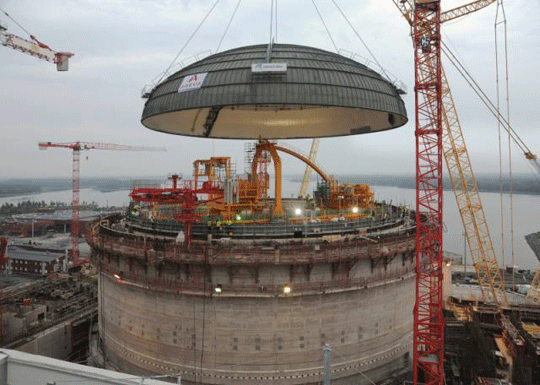
Yet more delay – Finland’s Olkiluoto 3 nuclear reactor already 12 years behind schedule
|
Olkiluoto 3 nuke delayed yet again, now 12 years behind schedule https://yle.fi/uutiset/osasto/news/olkiluoto_3_nuke_delayed_yet_again_now_12_years_behind_schedule/11128489
– 20 Dec 19, Finland’s fifth nuclear reactor will not begin regular operations before 2021, rather than 2009 as originally planned. The startup date for the Olkiluoto 3 (OL3) nuclear reactor on Finland’s southwest coast has been pushed back again. Plant owner Teollisuuden Voima (TVO) said on Thursday that it had been informed of the new schedule by the main supplier, the Areva-Siemens Consortium.The supplier now says that fuel will be loaded into the reactor next summer ahead of grid connection in November 2020. Regular electricity production would start in March 2021, instead of September 2020 as most recently announced. Faulty components foundTVO says the latest delays are due to slow progress in system testing and shortcomings in spare part deliveries. For instance auxiliary diesel generators were found to have faulty components. “Because of numerous delays we have to do maintenance to equipment and components already installed to ensure fluent start-up and continuous operation. The manufacturing and deliveries of the spare parts take time,” OL3 Project Director Jouni Silvennoinen said in a TVO statement. Construction work on OL3 started nearly 15 years ago. According to the original timetable, it was to have gone online in 2009. Since then there have been many delays, lawsuits and massive cost overruns. With a total cost estimate of at least 8.5 billion euros, it has been described as the second-most expensive building in human history, behind a hotel complex in Mecca. Construction of the original atomic power station began in 1973. The first unit began commercial operations six years later, becoming the country’s second reactor after one in Loviisa. The Fennovoima consortium hopes to build Finland’s first entirely new nuclear plant since the 1970s in Pyhäjoki, near Raahe. That project too has been beset by delays and is yet to receive a construction permit.
|
|

1 This Month
26 September – International Day for the Total Elimination of Nuclear Weapons





PLEASE OPPOSE HR 8255 AND S.3639 – bills would accelerate satellite deployment, with no environmental review or safeguards – https://ncstd5li.quorum.us/campaign/169331/
To see nuclear-related stories in greater depth and intensity – go to https://nuclearinformation.wordpress.com
-
Archives
- September 2026 (281)
- August 2026 (330)
- July 2026 (355)
- June 2026 (287)
- May 2026 (306)
- April 2026 (356)
- March 2026 (251)
- February 2026 (267)
- January 2026 (308)
- December 2025 (358)
- November 2025 (359)
- October 2025 (375)
-
Categories
- 1
- 1 NUCLEAR ISSUES
- business and costs
- climate change
- culture and arts
- ENERGY
- environment
- health
- history
- indigenous issues
- Legal
- marketing of nuclear
- media
- opposition to nuclear
- PERSONAL STORIES
- politics
- politics international
- Religion and ethics
- safety
- secrets,lies and civil liberties
- spinbuster
- technology
- Uranium
- wastes
- weapons and war
- Women
- 2 WORLD
- ACTION
- AFRICA
- Atrocities
- AUSTRALIA
- Christina's notes
- Christina's themes
- culture and arts
- Events
- Fuk 2022
- Fuk 2023
- Fukushima 2017
- Fukushima 2018
- fukushima 2019
- Fukushima 2020
- Fukushima 2021
- general
- global warming
- Humour (God we need it)
- Nuclear
- RARE EARTHS
- Reference
- resources – print
- Resources -audiovicual
- Weekly Newsletter
- World
- World Nuclear
- YouTube
-
RSS
Entries RSS
Comments RSS

