PG and E face bankruptcy- transparency needed on decrepit Diablo Canyons nuclear reactors

|
December 18, 2019, by Common Dreams
The same pattern of lethal neglect and deferred maintenance that made PG&E the proven culprit in murderous wildfires is being repeated at Diablo Canyon. by Mimi Kennedy, Harvey Wasserman But in the interim, it must be brought to light that no squaring of PG&E’s accounts—with the people of California, the utility’s fire victims, the governor, the Public Utilities Commission, the banks, or the planet – will be complete unless there is a transparent public inspection of, and credible mechanical and fiscal accounting for, Diablo Canyon’s two aging reactors (see our petition at www.solartopia.org). The two central coast nukes are scheduled to shut by 2025, a fact that gives some policymakers a false sense of safety and a convenient cover to avoid thinking about the devastating possibility of an earthquake that would render a major population center uninhabitable and its agricultural economy barren. Why kick up a fuss if the problem’s going away in five years? Here’s why: The same pattern of lethal neglect and deferred maintenance that made PG&E the proven culprit in murderous wildfires is being repeated at Diablo Canyon. But the nuclear reactor units are more than thirty years old. Diablo Unit One was long ago found to be seriously embrittled, which means its piping is almost certainly cracked due to age. Its list of deferred maintenance procedures is a by-now notorious PG&E trademark. Its waste management procedures are suspect. The site is surrounded by more than a dozen interlinked earthquake faults. Can we really trust the operation of these immensely complex machines over the coming sixty months to a company we don’t trust to safely deliver electricity in a light breeze? We don’t need to: the power Diablo generates can be made up for by truly renewable energy sources. Now is the time—before PG&E’s bankruptcy is resolved—for the governor, the California Public Utilities Commission, and other public authorities to conduct a transparent inspection of PG&E’s nuclear facility at Diablo. A truthful appraisal of the reactors—what PG&E might claim as its biggest single asset—is impossible without a thorough inventory of the reactors’ structural liabilities Technically, such inspections are the bailiwick of the Nuclear Regulatory Commission. The NRC is currently a captive agency, with three of its five commissioners appointed by Trump. They have advocated a drastic scale-back of on-site safety inspections, allowing the nation’s 96 aging reactors to become progressively more dangerous to our population. But PG&E’s bankruptcy creates a condition outside the NRC’s purview: the court must ensure that the aggrieved parties are given a full understanding of the financial value and risks of the assets at stake. All US reactors, Diablo among them, lack private insurance. A federal fund to which providers contribute to cover their liability for catastrophic accidents contains less than $13 billion, a drop in the bucket compared to what even one such accident would cost. And who will run these two hotly contested nukes after the bankruptcy settlement? Public ownership is being hailed as a possible, progressive solution. Does that mean We the People unwittingly assume liability for the incalculable health, ecological, and property damages if the San Andreas fault (or any other) reduces Diablo to radioactive rubble and sends an apocalyptic Chernobyl cloud through the central valley, down to Los Angeles, up to the Bay Area, and into Northern California, so recently reduced to ash by PG&E? The high-stakes debate over what to do with what was once the world’s largest electric utility has been suspiciously silent on Diablo’s two 800-pound gorillas. So hear this scream: The question of ownership – private or public – cannot be answered without accounting for the structural safety and potential liabilities of the two decrepit megaliths at San Luis Obispo. The governor, the CPUC, the courts, and the company must provide the public with a detailed, independent, and credible look at the innards of these two immense machines before any bankruptcy proceedings can conclude or any future for California’s electric supply can be mapped out. Call them all now!!! |
|
|
Safety costs increase for Tokai No. 2 nuclear plant
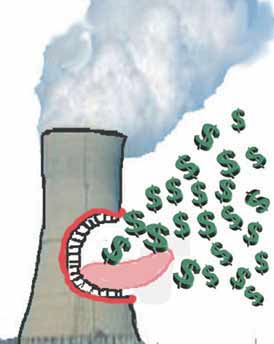 Contractors want 70 billion yen more for safety at nuclear plant http://www.asahi.com/ajw/articles/AJ201912170067.html By TAKASHI ICHIDA/ Senior Staff Writer, December 17, 2019 TOKAI, Ibaraki Prefecture–-Costs to safeguard the Tokai No. 2 nuclear plant here will run at least 70 billion yen ($642 million) more than the plant operator’s estimate, raising the likelihood that consumers will get stuck covering the difference through their power bills.
Japan Atomic Power Co. (JAPC) is seeking to restart the plant, idled since the 2011 Fukushima nuclear disaster, as soon as possible to secure much-needed revenue by selling power from it to electric utilities.
The plant operator has been negotiating with leading general contractors over the cost of work to increase safety at the single-reactor plant along the coast of Ibaraki Prefecture. It aims to ink contracts for the work by March 2020. But the difference over the cost between the two sides has rarely narrowed.
Construction of a 20-meter-tall seawall and an emergency facility to protect the plant from possible tsunami and other natural disasters are among the protective measures scheduled.
In October 2018, the Nuclear Regulation Authority approved the plan to implement the measures under more stringent regulations that went into force in July 2013 after the triple meltdown at the Fukushima No. 1 nuclear plant.
JAPC estimated that the project would cost 174 billion yen, according to officials at some construction companies.
Six major general contractors–Kajima Corp., Taisei Corp., Obayashi Corp., Shimizu Corp., Hazama Ando Corp. and Penta-Ocean Construction Co.–were asked to give quotes for each portion of the project. Only one company will be chosen for each portion.
Their quotes, all submitted by around November 2018, pegged the overall cost at least 250 billion yen more than JAPC envisaged.
The plant operator is also required to build a facility to respond to a possible terror attack, estimated at costing 61 billion yen, bringing the overall cost to protect the plant to more than 300 billion yen.
The ballooning price tag is blamed on a spike in the cost of civil engineering materials, machine tools and workers, according to officials familiar with the matter.
The plant operator urged contractors to rethink their estimates, but they refused, maintaining that the higher price was inevitable in order to complete the project on time.
With JAPC’s self-imposed March deadline to conclude contracts fast approaching, industry analysts say the operator will likely give in to the contractors’ demands.
In October, five regional electric utilities, including Tokyo Electric Power Co. and Tohoku Electric Power Co., which used to purchase electricity from JAPC, announced they would increase financial support to the company to 350 billion yen from the 300 billion yen they pledged in March.
The rise is attributed to a surge in the costs for the seawall and emergency facility.
JAPC and the six contractors declined to comment when asked by The Asahi Shimbun to provide more details of specific cost overruns.
Japan’s major electric power companies usually directly select individual contractors for projects and do not open contracts for bidding.
Under such contracts, disparities between estimates and final costs rarely emerge.
An official at one of the power companies who is familiar with the matter called the 70 billion yen cost overrun “extremely unusual.”
JAPC maintains that its initial 174 billion yen estimate is more than adequate for contractors to complete the work.
But an official at one of the construction companies accused the power company of low-balling the amount needed for the project.
An official close to a utility financially supporting JAPC said the operator should have contractors compete for each project segment and require them to submit estimates.
The Tokai No. 2 nuclear plant started operations in 1978. The Nuclear Regulation Authority authorized a 20-year extension on the reactor’s life in November 2018.
Switzerland to shut down uneconomic Mühleberg nuclear reactor
|
Switzerland to shut down first nuclear reactor le News18/12/2019 BY LE NEWS
On 20 December 2019, Switzerland will shut down the Mühleberg nuclear reactor in the canton of Bern. The plant went into operation in 1972, making it the nation’s second oldest nuclear power station after Beznau, which started its first reactor in 1969. The Mühleberg power station, which takes its cooling water from the Aare river, was originally scheduled for shutdown in 2012. This date was later extended to 2019. Fissures in the mantle surrounding the reactor and rising operating costs mean the plant is no longer economically viable. Groups concerned about the safety of the reactor are celebrating. The safety justification for the nation and it neighbours for shutting down this reactor has existed for a long time, according to Philippe de Rougemont, a spokesperson for the group Sortir du nucléaire, a group that organised an unsuccessful referendum in 2016 to precipitate the phaseout of Switzerland’s nuclear power industry. The Mühleberg reactor, which is the closest Swiss reactor to Lausanne and Geneva, must now be decommissioned. Radioactive material must be cooled, processed and disposed of safely. The organisation Sortir du nucléaire said it will keep a close eye on this process, which it considers a major risk. Switzerland has five nuclear reactors on four sites. After the 2011 nuclear accident at Fukushima in Japan, the Federal Council, Switzerland’s executive, said it would build no new nuclear reactors and decommission existing nuclear power plants at the end of their safe operational lifespans. It estimated the safe operational lifespan to be about 50 years, which means Beznau I would be taken offline in 2019, Beznau II and Mühleberg in 2022, Gösgen in 2029 and Leibstadt in 2034. However, the government made no commitment to close any nuclear reactor by a specific date. The Federal Council was supported by parliamentary and upper house majorities……. https://lenews.ch/2019/12/18/switzerland-to-shut-down-first-nuclear-reactor/ |
|
Hazards of Russia’s nuclear colonialism- example South Africa
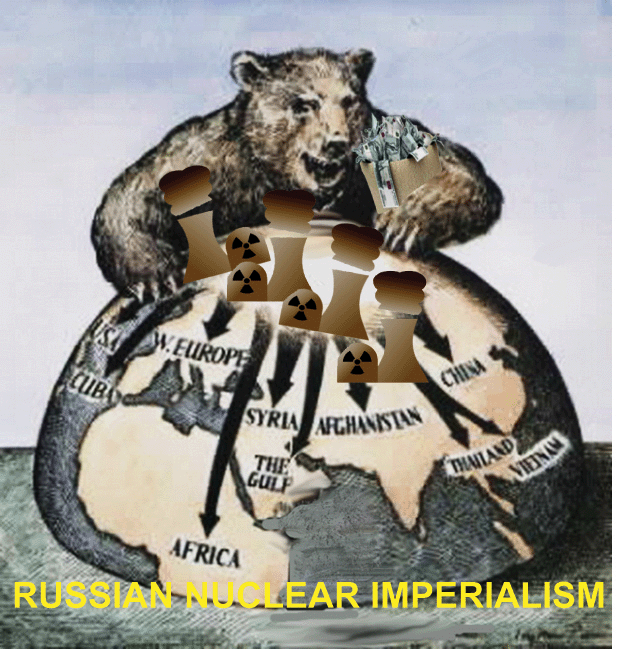
 Africa, Russia squandered close ties with the South African government by overplaying its hand and getting caught up in a corrupt nuclear energy pact. Carnegie Endowment For International Peace (thoroughly researched and referenced) 16 Dec 19,
 SUMMARY
 Amid the widespread attention the Kremlin’s recent inroads in Africa have attracted, there has been surprisingly little discussion of South Africa, a country which, for nearly a decade, unquestionably represented Russia’s biggest foreign policy success story on the continent. As relations soared during the ill-starred presidency of Jacob Zuma (2009–2018), the Kremlin sought to wrest a geopolitically significant state out of the West’s orbit and to create a partnership that could serve as a springboard for expanded influence elsewhere in Africa. Continue reading
 Idaho nuclear waste processing project to close – not commercially viable
Federal officials will shut down an Idaho nuclear waste treatment project after determining it would not be economically feasible to bring in radioactive waste from other states.
The U.S. Department of Energy in documents made public this week said the Advanced Mixed Waste Treatment Project that employs 650 workers will end next year.
A $500 million treatment plant handles transuranic waste that includes work clothing, rags, machine parts and tools that have been contaminated with plutonium and other radioactive elements. The U.S. Nuclear Regulatory Commission says transuranic wastes take much longer to decay and are the most radioactive hazard in high-level waste after 1,000 years.
The Energy Department said that before the cleanup began, Idaho had the largest stockpile of transuranic waste of any of the agency‘s facilities. Court battles between Idaho and the federal government culminated with a 1995 agreement requiring the Energy Department to clean up the Idaho site.
The Idaho treatment plant compacts the transuranic waste, making it easier to ship and put into long-term storage at the Waste Isolation Pilot Plant in New Mexico.
Federal officials earlier this year floated the idea of keeping the $500 million treatment plant running in Idaho with waste from other states. The bulk of that would have been 8,000 cubic meters (6,100 cubic meters) of radioactive waste from a former nuclear weapons production area in Hanford in eastern Washington.
Local officials and politicians generally supported the idea because of the good-paying jobs. The Snake River Alliance, an Idaho-based nuclear watchdog group, said it had concerns the nuclear waste brought to Idaho would never leave.
A 38-page economic analysis the Department of Energy completed in August and released this week found “it does not appear to be cost effective due to packaging and transportation challenges in shipping waste” to Idaho.
“As work at the facility will continue into 2019, no immediate workforce impacts are anticipated,” the agency said in an email to The Associated Press on Friday. The Energy Department “recognizes the contribution of this facility and its employees to DOE‘s cleanup mission and looks forward to applying the knowledge gained and experience of the workforce to other key activities at the Idaho site.”
The agency said it would also consider voluntary separation incentives for workers.
With the Idaho treatment plant scheduled to shut down, it‘s not clear how the transuranic waste at Hanford and other sites will be dealt with.
The Energy Department “will continue to work to ensure a path forward for packaging and certification of TRU (transuranic) waste at Hanford and other sites,” the agency said in the email to the AP.
The Post Register first reported the closure.
2 nuclear reactors in Fukui Prefecture to be shut down
Kansai Electric Power Co. will spend ¥118.7 billion to dismantle the Nos. 1 and 2 units at the Oi nuclear power plant, with work expected to wrap up in the fiscal year ending March 2049.
The units, which each have an output capacity of more than 1 million kilowatts, are the most powerful reactors to be approved for decommissioning by the Nuclear Regulation Authority since a magnitude 9.0 earthquake and subsequent tsunami caused a meltdown at the Fukushima No. 1 plant in March 2011.
Following the disaster, the government placed a 40-year limit on the lifespan of reactors in the country, with a possible 20-year extension if strict safety standards are met.
As both units came online in 1979 and were approaching the 40-year limit, Kansai Electric had a choice of applying for the extension or scrapping them.
In December 2017, the utility announced it would scrap the aging reactors, citing the high cost of implementing additional safety measures. Kansai Electric submitted the decommissioning plan to the authority in November 2018.
The plant’s Nos. 3 and 4 units came online in 1991 and 1993, respectively, and are currently active.
Around 23,000 tons of low-level radioactive waste will be remain following the dismantling process, according to the plan, along with another 13,200 tons of nonradioactive waste.
The plan does not state where the waste will be stored.
France’s nuclear industry in dire straits
 The French nuclear revolution is rusting away, December 6, 2019, THE AUSTRALIAN, Henry Ergas “……..France’s nuclear power industry faces a future that is more uncertain than ever. The problems gripping the industry were highlighted late last month in an official report prepared by the former president and chief executive of PSA Peugeot Citroen, Jean Martin Folz.
While the report’s focus is on the difficulties that have plagued the construction of a new reactor at Flamanville in northwestern France, its implications reach much further.
With nuclear power plants accounting for more than 70 per cent of its overall electricity generation, no country is as dependent on nuclear energy as is France.
The decision to rely so massively on nuclear energy was taken in 1974, after the oil shock of the previous year had underlined France’s vulnerability to Middle Eastern oil. Prime minister Pierre Messmer launched a crash program that led to the construction of 56 reactors in just 15 years.
…….. however, most of France’s generators are approaching the final decade of their useful life. Planning for their replacement has been a stop-start affair, with the Greens’ increasingly strident opposition to nuclear power deterring successive governments from taking action.
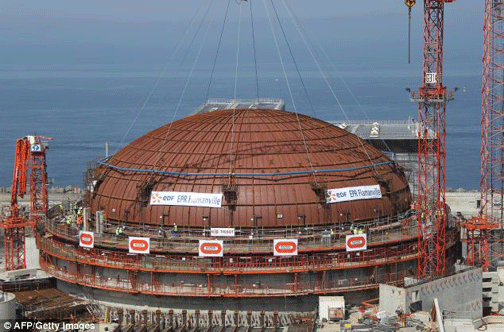 As a result, only the Flamanville plant received the go-ahead, with construction beginning in 2007 for an expected entry into service in 2012. Virtually from the outset, the project was beset by woes. At this stage, the total costs of construction are four times greater than initially estimated, while the plant will not enter service before the end of 2022.
The problems stem partly from the sheer complexity of the new reactor, which is the first of its kind to be built in France.
Additionally, the catastrophe at Fukushima in 2011 led to regulatory changes that necessitated costly redesigns. And the project has suffered more than its fair share of mismanagement, aggravated by a byzantine allocation of responsibilities between EDF, the main French electricity utility, which oversaw the project, and many layers of subcontractors.
However, as the Folz report shows, the primary cause of the difficulties lies in the erosion of the industry’s skill base during the long hiatus from the end of the crash program in 1990 to the initiation of Flamanville………
There is, at this point, no prospect of France scaling up its nuclear program  ………The cost blowout at Olkiluoto drove Areva, the “national champion” of France’s nuclear industry, into bankruptcy.
Even with an injection of $7.3bn in public funds EDF, which acquired Areva, lacks the balance sheet strength to underwrite new projects, while the French government’s borrowing ability is hampered by its already too high levels of debt.
To make matters worse, the regulated prices at which EDF has to sell the power it generates mean that it cannot charge its European clients the full value of the baseload it supplies.
 As for global investors, who might provide the debt financing EDF would require, they are wary of projects that are risky in themselves ….
Given those constraints, the government has announced a modest plan to eventually build six additional reactors. So far, however, there are no actionable decisions beyond the completion of Flamanville. And work on the next generation of reactors….. has been quietly downgraded, making it likely that there will no fourth generation reactor of French design.
The consequences for France itself are far-reaching. Beginning in the late 1950s, French firms succeeded in one high-technology market after the other by developing or acquiring a rather basic design (including the Westinghouse Pressurised Water Reactor, the Mirage jet fighter and the TGV high-speed train) that they upgraded while producing it on a large scale.
That era is over, and there is every sign France is struggling with almost all the major projects it has in train.
The Folz report should therefore come as an ominous warning for Australia’s submarine project, as it identifies French industry’s serious managerial and technological weaknesses in a range of areas, such as precision welding, that are crucial to that project’s success……. https://www.theaustralian.com.au/commentary/the-french-nuclear-revolution-is-rusting-away/news-story/afe4546ed799939cf117d71f05035c5e
Coal power becoming ‘uninsurable’ as firms refuse cover
Coal power becoming ‘uninsurable’ as firms refuse cover, US insurers join retreat from European insurers meaning coal projects cannot be built or operated, Guardian, Julia Kollewe, Mon 2 Dec 2019 The number of insurers withdrawing cover for coal projects more than doubled this year and for the first time US companies have taken action, leaving Lloyd’s of London and Asian insurers as the “last resort” for fossil fuels, according to a new report.The report, which rates the world’s 35 biggest insurers on their actions on fossil fuels, declares that coal – the biggest single contributor to climate change – “is on the way to becoming uninsurable” as most coal projects cannot be financed, built or operated without insurance.
Ten firms moved to restrict the insurance cover they offer to companies that build or operate coal power plants in 2019, taking the global total to 17, said the Unfriend Coal campaign, which includes 13 environmental groups such as Greenpeace, Client Earth and Urgewald, a German NGO. The report will be launched at an insurance and climate risk conference in London on Monday, as the UN climate summit gets underway in Madrid.
The first insurers to exit coal policies were all European, but since March, two US insurers – Chubb and Axis Capital – and the Australian firms QBE and Suncorp have pledged to stop or restrict insurance for coal projects.
At least 35 insurers with combined assets of $8.9tn, equivalent to 37% of the insurance industry’s global assets, have begun pulling out of coal investments. A year ago, 19 insurers holding more than $6tn in assets were divesting from fossil fuels…… https://www.theguardian.com/environment/2019/dec/02/coal-power-becoming-uninsurable-as-firms-refuse-cover
Russia’s nuclear company Rosatom in financial trouble trying to fund nuclear project in Turkey
 Turkey’s first nuclear plant delayed by funding problems – energy expert https://ahvalnews.com/turkey-energy/turkeys-first-nuclear-plant-delayed-funding-problems-energy-expert, Nov 30 2019 Turkey’s first nuclear plant delayed by funding problems – energy expert https://ahvalnews.com/turkey-energy/turkeys-first-nuclear-plant-delayed-funding-problems-energy-expert, Nov 30 2019
Completion of Turkey’s first nuclear power station is likely to be delayed as the Russian company building it is struggling to secure funding, former diplomat and Bosphorus Energy Club head Mehmet Öğütçü told Turkish daily Sözcü. A small part of the plant in Akkuyu, southern Turkey, may be opened for political reasons in 2023, the centenary of the founding of the Turkish Republic, Öğütçü said. But Russian state-owned Rosatom is having difficulties financing the project, which is expected to cost between $20 billion and $25 billion, he said, adding that Western companies were avoiding Akkuyu over concerns about nuclear armament. A Turkish consortium pulled out of the project last year, citing a failure to reach commercial terms with Rosatom, which owns a 51 percent stake in the project. A report by the main opposition Republican People’s Party this month criticised the terms of the government’s deal with Rosatom, which has been guaranteed a price of 12.35 U.S. cents per kilowatt hour in a 15-year power purchase agreement. |
|
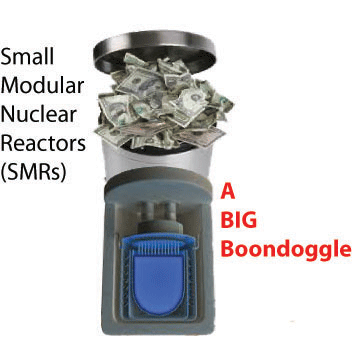
Russia’s Rosatom planning to market Small Modular Nuclear Reactors to Europe
|
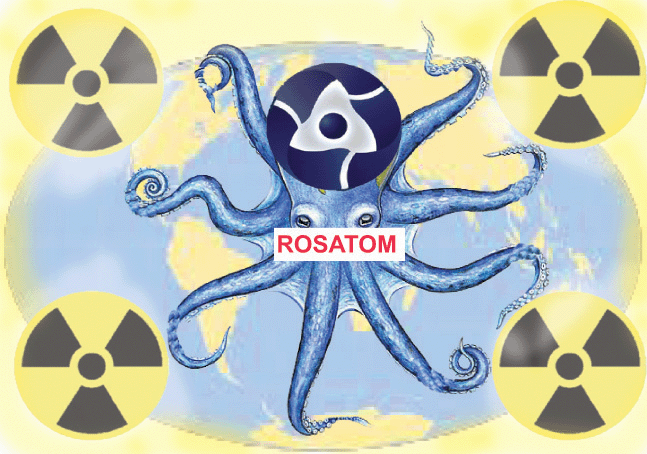
Russian company’s plan for nuclear power expansion revealedVLADIMIR PUTIN has made nuclear energy one of Russia’s key priorities, and now the Russian nuclear power company Rosatom has revealed to Express.co.uk their plans to ramp up expansion into Europe with small modular reactors. Express UK By CHARLIE BRADLEY, Fri, Nov 29, 2019
Rosatom is completely under state control, and while its emphasis with some projects has been geared towards powering hard to reach Russian territories, it has also undertaken numerous international projects. This includes the development of nuclear power plants in China, Turkey and Iran, highlighting the growing presence of Russian energy throughout the world. And now, with some projects already under way in countries like Hungary and Finland, its Vice President of Marketing and Business Development Overseas, Anton Moskvin, has told Express.co.uk that Europe is a future target for the company.He said: “I must say Europe is very interesting for us with prospective small modular reactors market development, we know that several countries are interested. The UK has great interest in the small modular reactors.” …… However, some in the EU have expressed concern over any plans for the Russian nuclear giant, fearing that the country could use its business to wield political influence.
In 2014, President Putin agreed a deal worth £8.5billion with Hungary President Viktor Orban, a deal which has seen the two leaders meet regularly since. Hungary is both a NATO and EU member, and the latter has sought legislation to ensure countries embarking on nuclear deals with Moscow do not become dependent on the Kremlin. RFI (Radio France International) reported last month that Jan Haverkamp, vice-chairman of Nuclear Transparency Watch, has serious reservations about the projects. He said: “Our assessment is that the Kremlin tries to use nuclear power now to regain some of that lost influence. “We see Rosatom being very eager to buy up nuclear companies in Europe, where they try to get a participation in order to get a solid nuclear foothold inside the EU.” Mr Moskvin said he could not comment on political issues……… https://www.express.co.uk/news/world/1211103/putin-news-russia-europe-nuclear-power-eu-rosatom-spt |
|
Persistent outages plaguing Grand Gulf nuclear plant are adding millions to the bills of New Orleans customers
Grand Gulf is supposed to run almost every single day at full capacity, acting as a foundational “base load” plant in the region’s energy system. It represents roughly one-fifth of all the generation that Entergy New Orleans owns or has purchase agreements for.
But over the last few years, Grand Gulf has been beset by a series of planned and unplanned outages that have made it the least reliable nuclear generator in the US, according to the Nuclear Energy Institute, an industry trade group. In fact, the plant was in the middle of an outage this week.
These outages cost New Orleans residents millions of dollars, according to figures Entergy has provided the City Council…. …..https://thelensnola.org/2019/11/27/persistent-outages-plaguing-grand-gulf-nuclear-plant-are-adding-millions-to-the-bills-of-new-orleans-customers/
The global uranium industry is really on the skids

Uranium bulls ‘as rare as white unicorns’ Jim Green, Online Opinion, 26 November 2019, https://onlineopinion.com.au/view.asp?article=20623&page=0
Uranium bulls are “as rare as white unicorns” according to a commentary in FNArena in September 2019, and the market is “sick and dying” with uranium “quickly becoming a dinosaur of a commodity”.
Canadian company Cameco recently said it cannot see any case for construction of new uranium mines for some years to come. Chief financial officer Grant Isaac said that new mines will not win financial backing without a far stronger recovery in demand for uranium than is currently on the horizon.
“It’s pretty hard to say you’re going to take the risk on an asset … that isn’t licensed, isn’t permitted, probably doesn’t have a proven mining method, when you have idle tier one capacity that’s licensed, permitted, sitting there,” Isaac said.
Moreover, Cameco has no plans to restart mines put into care-and-maintenance in 2016 and 2017: McArthur River (and the Key Lake mill) and Rabbit Lake in Canada, and the Crow Butte and Smith Ranch-Highland in-situ leach mines in the US. Plans to expand Crow Butte were abandoned in March 2019.
Instead, Cameco will continue to meet its contracts by purchasing uranium on the spot market. Delivering the company’s third-quarter results (a small loss), chief executive Tim Gitzel said that only 9 million pounds of uranium oxide will be produced from its mines next year, with the remainder of its requirement of 30‒32 million pounds supplied from spot market purchases.
Cameco’s workforce in Canada has halved. Before the Fukushima disaster, the company employed more than 2,100 people in Saskatchewan. Since then, 810 mine and mill workers have been sacked, along with 219 head office employees in Saskatoon. Continue reading
France’s Flamanville nuclear financial catastrophe gets worse
Le Monde 22nd Nov 2019, Jean-Martin Folz’s report on the construction of the Flamanville EPR, handed out on October 28 , is without appeal for the French nuclear power industry. The financial catastrophe continues to worsen. The project is currently 10 years late and 9 billion euros over budget. He helped engulf Areva, flagship of the French nuclear industry, declared bankrupt in 2016, which owed its salvation to a bailout on public funds of 4.5 billion euros.
It now weighs on the accounts of EDF, a new prime contractor since the
wreck of Areva, which no longer hopes to connect the reactor to the network
before 2022.
Georgia’s Nuclear Plant Vogtle behind schedule, with costs escalating

State staff: Georgia Power nuclear timeline ‘significantly challenged’ AJC CONTINUING COVERAGE Nov 23, 2019, By Matt Kempner
Georgia Power’s nuclear expansion of Plant Vogtle is falling further behind schedule, according to a filing Friday by Georgia Public Service Commission staff and consultants.
Unless performance improves considerably, the latest deadlines for commercial operation of two new reactors by November 2021 and November 2022 are “significantly challenged,” according to the filing. It also flagged safety risks for workers.
The project is already years behind its original schedule and billions of dollars over budget. More delays could add costs. And if the price tag rises, electric consumers in much of Georgia could be at risk of increases in their monthly bills. Ultimately, elected members of the PSC will decide how much of the costs get passed along to Georgia Power customers. Many electric membership corporations and city utilities in Georgia are also connected to the project and will have to make decisions about how to recoup costs.…….
Georgia Power already has spent 10 years and incurred billions of dollars in costs to get as far as it has. That includes $2 billion in financing costs already recovered from customers through a special fee in monthly bills, years before the new reactors produce power. https://www.ajc.com/news/state-staff-georgia-power-nuclear-timeline-significantly-challenged/i1Ff7BnBp6grU5ht1WBHeO/
A call for John Hopkins University to stop helping nuclear weapons industry

Hopkins must take a stand against its nuclear weapons production, https://www.jhunewsletter.com/article/2019/11/hopkins-must-take-a-stand-against-its-nuclear-weapons-production
By THE EDITORIAL BOARD | November 21, 2019 After years of protests from students, the University continues to invest in fossil fuel companies. It has an exclusivity contract with PepsiCo, a company that uses suppliers who violate child labor laws, going against ethical and sustainable business practices. Most recently, the University was slow to end contracts with Immigration and Customs Enforcement, the government agency that is responsible for separating families at the U.S.-Mexico border.
The University’s involvement in these contracts has been well publicized and heavily criticized by students and professors alike. Adding to this list of questionable practices is a partnership that is less well-known, but just as problematic: a contract with the U.S. government to take part in nuclear weapons research.
On Nov. 13, the International Campaign to Abolish Nuclear Weapons (ICAN) published a report stating that 49 U.S. universities are complicit in the production of nuclear weapons. The group calls on students and faculty to “demand their universities stop helping to build weapons of mass destruction.”
The report is scathing. It repeatedly mentions Hopkins, highlighting its involvement in creating nuclear weapons for the U.S. ICAN notes that Hopkins receives twice as much funding as any other university from the Department of Defense (DOD) largely because of the work of its renowned Applied Physics Laboratory (APL). Created in 1942 for weapons development in World War II, the APL has since served as a technical resource for the U.S. government, developing numerous technologies for air and missile defense, naval warfare, computer security and space science.
In 2017, the APL received a seven year contract with the DOD for $93 million to continue the Air Force Nuclear Weapons Center’s strategic partnership. This contributes to the multi-year contract with the agency that is now worth more than $7 billion.
The research involved in this deal is largely classified. On the surface, this seems to contradict the University’s policy against classified research. However, the APL is exempt from this policy, as it is the only part of the University listed as a “non-academic division.”
The University continues to brand itself as an ethical research institution. However, its direct involvement with the development of weapons of mass destruction is contradictory to these actions.
We believe that Hopkins should remove itself from all contracts associated with nuclear weapons. Instead, the APL should focus on research that does not have the same devastating and inhumane implications that nuclear weapons do.
Those who support the University’s work with nuclear weapons may argue that Hopkins receives a high monetary benefit from their partnership with the Department of Defense. They may also claim that Hopkins, which is just one of nearly 50 universities conducting research, can’t make any difference on its own. Even if Hopkins ends the contracts, why would other schools do the same?
These arguments are valid, and we understand the concerns that are associated with terminating the contracts. It is true that Hopkins receives a hefty sum for its involvement with the DOD. According to ICAN, “the funding ceiling for its ongoing contract was extended beyond $7 billion” in 2019.
There is also a turning tide against nuclear weapons development across the world. The Treaty on the Prohibition of Nuclear Weapons, introduced to the United Nations in 2017, bans the development and use of nuclear weapons by signatories. So far, 122 countries have signed on, though the U.S. and most western countries have not. If Hopkins and other reputable institutions take a stand against nuclear weapons development, it will send a sign to the world at large that we want to move on from using these weapons of mass destruction.
Large scale change starts small, and it starts with us. We encourage students to take a stand for what they believe in. As with any other issue, there are multiple ways to tell Hopkins that it’s time for a change. On their website, ICAN outlines three ways that students can speak out. They recommend publicizing the issue, demanding transparency from universities and calling on them to end their work with nuclear weapons.
We know that there’s no guarantee that Hopkins will end its contracts and stop working on nuclear weapons development. But by speaking out, we can initiate the change. Activists who are part of sustainability and pro-peace groups can protest against nuclear weapons production. Students who are majoring in STEM fields can take a stand against working at the associated departments at the APL, and should be aware of the larger implications of any research they are involved in. All students can tell Hopkins that we demand an explanation and that we take issue with the greater mission behind the research.
The University’s mission statement, in part, mentions that its goal is “To educate its students and cultivate their capacity for lifelong learning, to foster independent and original research, and to bring the benefits of discovery to the world.” We hope that the University will refocus its attention on these goals. If Hopkins turns away from nuclear weapons research, other institutions may follow in our path. Making the world a safer place is the best way to bring the benefits of our discovery to everyone.
1 This Month
26 September – International Day for the Total Elimination of Nuclear Weapons





PLEASE OPPOSE HR 8255 AND S.3639 – bills would accelerate satellite deployment, with no environmental review or safeguards – https://ncstd5li.quorum.us/campaign/169331/
To see nuclear-related stories in greater depth and intensity – go to https://nuclearinformation.wordpress.com
-
Archives
- September 2026 (281)
- August 2026 (330)
- July 2026 (355)
- June 2026 (287)
- May 2026 (306)
- April 2026 (356)
- March 2026 (251)
- February 2026 (267)
- January 2026 (308)
- December 2025 (358)
- November 2025 (359)
- October 2025 (375)
-
Categories
- 1
- 1 NUCLEAR ISSUES
- business and costs
- climate change
- culture and arts
- ENERGY
- environment
- health
- history
- indigenous issues
- Legal
- marketing of nuclear
- media
- opposition to nuclear
- PERSONAL STORIES
- politics
- politics international
- Religion and ethics
- safety
- secrets,lies and civil liberties
- spinbuster
- technology
- Uranium
- wastes
- weapons and war
- Women
- 2 WORLD
- ACTION
- AFRICA
- Atrocities
- AUSTRALIA
- Christina's notes
- Christina's themes
- culture and arts
- Events
- Fuk 2022
- Fuk 2023
- Fukushima 2017
- Fukushima 2018
- fukushima 2019
- Fukushima 2020
- Fukushima 2021
- general
- global warming
- Humour (God we need it)
- Nuclear
- RARE EARTHS
- Reference
- resources – print
- Resources -audiovicual
- Weekly Newsletter
- World
- World Nuclear
- YouTube
-
RSS
Entries RSS
Comments RSS

