Russia Spreads Influence in Africa Using Nuclear Power
Russia Spreads Influence in Africa Using Nuclear Power – Reports, Moscow Times, 30 Aug 19, Russia is working to win influence in at least 10 African states with high-cost nuclear technology that for the most part does not suit their needs, researchers and NGOs have told The Guardian newspaper.
With booming exports, nuclear energy is one example of Russia’s increasing presence in Africa in recent years. Elsewhere, a businessman known as “Putin’s chef,” Yevgeny Prigozhin, is widely reported to be spearheading Russia’s push to exchange security and electioneering services for mining rights in Africa.
Russia’s state nuclear agency Rosatom has approached the leaders of “dozens” of African countries with various nuclear energy projects in the past two years, The Guardian reported Wednesday. Rosatom has existing deals with Egypt and Nigeria and other various agreements with other countries on the continent.
Few African countries have the capacity to distribute the amount of nuclear energy generated by the type of reactors that Rosatom is exporting, experts told the outlet. Observers also noted that the costly projects favored by Rosatom likely wouldn’t benefit Africa’s poorest populations…….. https://www.themoscowtimes.com/2019/08/29/russia-spreads-influence-in-africa-using-nuclear-power-reports-a67077
Japan to decommission reactors at world’s biggest nuclear plant?

Japan may decommission reactors at world’s biggest nuclear plant, https://www.aljazeera.com/ajimpact/japan-decommission-reactors-world-biggest-nuclear-plant-190826074851152.html
Plant operator Tepco says it may start decommissioning at least one reactor five years after restarting two others. Japan‘s Tokyo Electric Power Company (Tepco) said on Monday it may start to decommission at least one nuclear reactor at its Kashiwazaki-Kariwa power plant, the world’s biggest nuclear plant by capacity, within five years of restarting two of the reactors at the site.Tepco President Tomoaki Kobayakawa made the comments in a statement outlining its response to a request for plans on the station’s future by the government of the city of Kashiwazaki in Niigata prefecture, where the plant is located.
In 2017, Tepco received initial regulatory approval from the Japanese government to restart reactors 6 and 7 at Kashiwazaki-Kariwa, each with a capacity of 1,356 megawatts (MW). The plant site has seven reactors with a total capacity of 8,212MW, equal to 20 percent of Japan’s nuclear capacity.
The facility is Tepco’s last remaining nuclear plant after it announced plans to shut its Fukushima Daini station, near the Fukushima Daichi plant where a massive earthquake and tsunami caused the meltdown of three of the site’s reactors in 2011.
Kashiwazaki’s Mayor Masahiro Sakurai demanded in 2017 that Tepco submit plans to shut at least one of reactors 1 to 5 in return for approval of the restart of reactors 6 and 7, a city official told the Reuters news agency by phone on Monday. The Kashiwazaki mayor will take about a month to evaluate Tepco’s plan, the official said.
Tepco said on Friday that Kobayakawa would brief local officials on Monday about its answers to the city’s request.
Tepco may take steps to decommission more than one of reactors 1 to 5 within five years after the restart of reactors 6 and 7 if it is confident it can secure enough non-fossil fuel energy sources, according to the statement.
A Tepco official said on Monday the company is aiming to have renewable and nuclear power produce 44 percent of total output by 2030.
Tepco has been trying to convince local authorities near Kashiwazaki-Kariwa, who have sign-off rights on nuclear restarts, that it has overcome operational failings revealed at Fukushima.
Eight years ago, nearly 20,000 people died in an earthquake and tsunami that precipitated what became Japan’s worst nuclear disaster. At least 160,000 people were forced to leave their contaminated homes.
In April, Japan partially lifted an evacuation order in one of the two towns, Okuma, for the first time since the disaster, but many former residents are still reluctant to return.
The other town, Futaba, remains off-limits, as are several other towns nearby.
Santee Cooper officially cancels contract to end dispute over nuclear parts
Safety concerns about floating nuclear reactors, and Rosatom admits that electricity from small floating nuclear reactors is more expensive.

|
Russia to launch floating nuclear reactor, Rosatom insists 2-reactor unit is safe as tests are planned in the Arctic, Ft.com, Nastassia Astrasheuskaya in Murmansk 21 Aug 19, On Friday, three tugs will tow the Akademik Lomonosov barge out of Murmansk to begin a 5,000km voyage to a remote port on the other side of Russia’s Arctic coast, and in the process send waves through the nuclear energy sector.
The vessel is a floating nuclear reactor, a portable power plant designed to supply electricity to areas disconnected from the grid, and envisaged by Russia’s state nuclear corporation Rosatom as the future of small-scale nuclear power with an eye on export opportunities in developing countries.
But the two-reactor Lomonosov, which took a decade to design and build, has sparked safety fears and concerns over the environmental impact of any mishap, amid concern over a botched nuclear missile test this month at a military site close to Murmansk that released a radiation spike in a nearby city.
Rosatom insists the unit is safe, and “virtually unsinkable” in case of natural disasters. The plant will also be guarded by the Russian guard, Moscow’s internal military force. “Our unit has other tasks, other requirements in terms of security. It has to correspond with double standards — for a nuclear plant and a vessel,” said Dmitry Alexeenko, deputy head of Rosatom’s department overseeing its construction.
The unit is the first in a programme designed to provide power to remote communities where building a conventional nuclear power plant would be excessive. The Akademik Lomonosov will sail to the Chukotka region, deep in Russia’s far east, where miners are seeking to exploit gold and copper reserves. …
However, environmental groups have raised concerns over the possible repeat of the 1986 Soviet nuclear power plant explosion in Chernobyl, modern-day Ukraine. In 2017, Greenpeace led a protest at St Petersburg’s Baltic shipyard, where the unit was being tested, demanding “No to floating Chernobyl”. The reactor tests were then moved to Murmansk. “A floating nuclear power plant is far more vulnerable to outside threats, such as those from pirates, should they be sold to equatorial countries, and natural disasters, which Fukushima proved even onshore plants are prone to,” said Konstantin Fomin of Greenpeace Russia. The launch comes as energy companies around the world, including in the US and South Korea, have been exploring building smaller scale reactors.
Rosatom says it has been in talks with potential buyers from Latin America, Africa and Asia. It has also held discussions with Sudan to use the plant for power generation and Argentina for water desalination. But the project’s total cost, and confirmation of any foreign contracts, will only be made after the technology is fully tested, the company added. Nuclear energy experts said given the construction timeframe, it is unlikely to be cheap.
Anton Khlopkov, head of Russia’s independent Center for Energy and Security Studies, expects the unit to be significantly cheaper than a conventional land-based nuclear power plant, which normally costs about $5bn-$6bn. But the cost per megawatt would be higher, he said.
“The project economics remain an open question, even taking into account that it is aimed at distant locations where the power costs can be higher for obvious reasons. Even then the project has to prove economic viability,” he said. Rosatom, however, sees the reactor as a strategic project where economic costs are secondary. …….https://www.ft.com/content/2edadf02-b538-11e9-8cb2-799a3a8cf37b
|
|
|
FirstEnergy Solutions moves to ditch union contracts for bailed out nuclear plants, drawing Democrats’ ire
FirstEnergy Solutions moves to ditch union contracts for bailed out plants, drawing Democrats’ ire
FirstEnergy Solutions’ veteran nuclear plant workers would lose traditional pensions if a bankruptcy court agrees with the latest FES restructuring plan, Utility Dive, John Funk Aug. 15 2019, “…….
In a reference to the FES reorganization plan filed July 23 — less than 12 hours after House Bill 6 had been approved by the legislature and signed by Republican Gov. Mike DeWine — the unions argue that the company intends to use the court to emerge from bankruptcy without its union contracts. And that contradicts the testimony of David Griffing, the company’s vice president of governmental affairs, the union filing to the court charges.
Griffing assured lawmakers in April before an Ohio House subcommittee that “that new [collective bargaining agreements] were in essence agreed upon … Both parties … believe the negotiations were acceptable.” But Friday’s filing on behalf of the union locals indicates that the company has neither agreed to assume the existing contracts nor reached new ones with the unions at two of the three FES nuclear plants, Perry, east of Cleveland and Beaver Valley, near Pittsburgh.
The union is basing its position in the bankruptcy struggle to remain viable at the power plants on the argument that “successorship clauses” in the contracts obligate FES to require any new company — including a reorganized FirstEnergy Solutions — to assume the contracts as they were agreed to. The unions point out that FES abided by that contract language when it sold other power plants to outside companies.
FES: Can’t assume the contract
The company position, as laid out in its July 23 reorganization plan, is that the reorganized FES cannot assume the contract because “the collective bargaining agreements require the Debtors to provide benefits to their employees under health care, severance, welfare, incentive compensation, and retirement plans sponsored by FirstEnergy Corp.”
The unions are countering that under the bankruptcy code and existing case law, the company must declare before reorganization whether it is rejecting the contract. “They simply want the benefit of plan confirmation, without deciding whether to assume or reject,” the union attorneys wrote. “However this is not what the law provides.”
The union filing reveals that in bargaining talks over the past few months the company has contended that the benefits in the existing union contracts, particularly the pension benefits, “are non-replicable.”
Unions play key role in HB 6
“HB 6 was problematic because I thought it was a bad idea to direct rate payer money to a corporation who refused to unequivocally agree to protect and support union contracts and the men and women who rely on those contracts to put food on their table,” Sykes wrote.
Rolls-Royce in talks to sell French nuclear business to Framatome
Aero-engine group’s restructuring under chief Warren East continues, Ft.com Sylvia Pfeifer
Rolls-Royce is in talks to sell its French civil nuclear business to Framatome, a company controlled by France’s EDF, in the latest move by the FTSE 100 engineer to reshape its operations. Two people close to the sales process said on Tuesday night that talks with the French company were continuing. The aero-engine group confirmed in March it had hired consultants from KPMG to review options for its international civil nuclear business, estimated by analysts to be worth up to £200m.
 |
ReplyForward
|
Brexit proving a problem for the nuclear industry – shortage of welders for Hinkley Point C project,
likely to take a hit if Brexit jeopardizes a crucial supply of welders. The
skilled workers have been in short supply for years, a strain that will
likely worsen as new nuclear projects are built.
to the Migration Advisory Committee, which keeps a list of occupations with
a shortage of workers.
become more difficult and costly to build and operate multi-billion-dollar
atomic plants, which are crucial to the U.K.’s target to produce net-zero
carbon emissions by 2050.
France SA’s 19.6 billion-pound ($24 billion) Hinkley Point C project, the
only nuclear plant now under construction in Britain. “Hinkley requires a
large number of welders,” said Peter Haslam, who retired on Friday as
head of policy at the Nuclear Industry Association. “They come from
Europe. We need these people to have easy access to the U.K.”
Revealed: mental health crisis at Hinkley Point C nuclear construction site
Guardian 13th Aug 2019 Several workers on nuclear plant have killed themselves or attempted to,
says union. Hinkley is grappling with a mental illness crisis, with several
attempted suicides since work began in 2016, a Guardian investigation can
reveal.
building project, a central plank in Britain’s future energy strategy. But
according to union officials, there has been a surge in suicide attempts
this year, a rise in the number of people off sick with stress, anxiety and
depression, and an increase in workers suffering from mental distress.
attempts in the first four months of 2019. The Guardian understands at
least two workers connected to the project have taken their lives since
construction started in earnest in 2016.
appear to be loneliness, relationship breakdown and the struggle of being
sometimes hundreds of miles away from family. At Hinkley, workers live on
special campuses in nearby Bridgwater, or else in converted digs in the
town. They work a variety of shift patterns and are shuttled to and from
the site on scores of buses. Some contractors work as much as 11 days on
with three days off, including an extra weekend day for travelling home.
But the Guardian understands that most people can cope with the stress and
pressure of the work. The problems start once they clock off.
Guardian 13th Aug 2019 Angie Young, the health and wellbeing manger at the Hinkley Point C (HPC)
site, does not hesitate when asked what the main cause of mental health
issues there is. “It’s loneliness. You’re living away from home,
living without your family. Loneliness is the big thing.” But a major
complicating factor is that tough men who build stuff are not always great
at talking about feelings. “Our guys are construction guys – they are
macho. The average age is 45-55. They haven’t got someone nagging them to
go and see someone. We’re trying to address that.”
https://www.theguardian.com/uk-news/2019/aug/13/no-more-man-up-better-mental-health-hinkley-point-c
Tepco, Chubu Electric Power Co., Hitachi Ltd. and Toshiba Corp to join up to build nuclear power plant in Aomori?
Tepco and three other companies considering joint firm to build nuclear power plant in Aomori, Japan Times, 9 Aug 19,
JIJI Tokyo Electric Power Company Holdings Inc. and three other companies are considering jointly setting up a new firm to construct and manage a planned nuclear power plant in Aomori Prefecture, informed sources said Thursday.
The three partners are Chubu Electric Power Co., Hitachi Ltd. and Toshiba Corp., the sources said.
Under the plan, the new company will build and run a new nuclear plant next to Tohoku Electric Power Co.’s Higashidori nuclear facility, which has been idle since the triple core meltdown at Tepco’s Fukushima No. 1 plant…….
Hitachi has frozen its nuclear plant construction program in Britain, while Toshiba withdrew from nuclear plant construction overseas. https://www.japantimes.co.jp/news/2019/08/09/business/corporate-business/tepco-three-companies-considering-joint-firm-build-nuclear-power-plant-aomori/#.XU3f0egzbIU
Fukushima governor accepts Tepco plan to scrap No. 2 nuclear plant and store spent fuel on site
Fukushima governor accepts Tepco plan to scrap No. 2 nuclear plant and store spent fuel on site, Japan Times, 31 July 19
KYODO FUKUSHIMA – Fukushima Gov. Masao Uchibori said Tuesday his prefecture will accept a decision by Tokyo Electric Power Company Holdings Inc., or Tepco, to scrap the Fukushima No. 2 nuclear complex, which is located near the No. 1 plant that was crippled in the March 2011 disaster.
In a meeting with Tomoaki Kobayakawa, the president of the utility, the governor also accepted its plan to build an on-site storage facility to store spent nuclear fuel.
The decision means that all 10 nuclear reactors in the northeastern prefecture, including the six at the Fukushima No. 1 complex 12 kilometers from the No. 2 plant, will be scrapped, though the decommissioning work will take decades.
Tepco’s decision to scrap the No. 2 complex, expected to cost around ¥280 billion ($2.6 billion), was formally approved at the company’s board meeting held on Wednesday.
While three of the reactors at the No. 1 complex experienced meltdowns in March 2011, the earthquake and tsunami disaster did not cause serious structural damage to the No. 2 plant…….
Tepco has not picked a final disposal site for the spent fuel from the No. 2 complex, raising concern among local residents that the radioactive nuclear waste may remain stored on-site for a long time.
“The premise is that the nuclear fuel will be transported out of the prefecture. Temporary storage for the time being is unavoidable,” Uchibori said.
He later told reporters Tepco had assured him that the storage facility would not be permanent.
The No. 2 plant currently has around 10,000 assemblies of spent fuel cooling in pools.
The scrapping of the No. 2 plant also means that the central government’s annual subsidies of around ¥1 billion for each of the towns of Naraha and Tomioka that host the facility will eventually be terminated.
Revenue linked to the nuclear plant, from property taxes and in other forms, accounted for 25 percent of Naraha’s total revenue and 40 percent of Tomioka’s.
Uchibori said he will ask the government to take into account “the financial situation of the two towns in view of the special circumstances relating to the decommissioning.”https://www.japantimes.co.jp/news/2019/07/31/national/fukushima-governor-accepts-tepco-plan-scrap-no-2-nuclear-plant-store-spent-fuel-site/#.XUIPkm8zbIU
UK union unhappy with financing plan for new nuclear power plants
Times 30th July 2019 New nuclear power plants should be funded through general taxation instead of piling the costs on to consumers, a leading union has said. The GMB said
that the government’s proposed regulated asset base funding model for
further reactors was “acceptable”, but that the costs should be paid “from
a progressive general taxation system”. Last week The Times reported leaked
government analysis that up to 40 gigawatts of either nuclear power or
carbon capture and storage plants was needed by 2050 to meet “net zero”
emissions targets. That equates to 12 Hinkley Point plants. Under the
regulated asset base model, developers would receive a regulated return
while the plant was under construction, cutting their financing costs. It
would still be funded on bills, exposing consumers to cost overruns.
https://www.thetimes.co.uk/article/a80b0ffa-b23b-11e9-9df9-ac98825b867a
New report: Nuclear Power ‘seven decades of economic ruin’

Nuclear power ‘seven decades of economic ruin’, says new report https://www.pressenza.com/2019/07/nuclear-power-seven-decades-of-economic-ruin-says-new-report/ 29.07.2019 – London, United Kingdom – Campaign for Nuclear Disarmament New research has found that almost all nuclear power plants built since the nuclear industry’s inception have generated large financial losses.
The report by the German Institute for Economic Research examines 674 nuclear power plants built since 1951. Its authors found that typical nuclear power plants averaged 4.8 billion euros in losses.
The report authors argue that new technology for nuclear plants won’t solve the underlying economic difficulties: “Those in favor of nuclear energy like to point out the ongoing technological developments that could lead to it growing more efficient in the future.
“They include ‘fourth generation’ nuclear power plants and mini-nuclear power plants (small modular reactors, SMRs). Anything but new, both concepts have their roots in the early phase of nuclear power in the 1950s. Then as now, there was no hope that the technologies would become economical and established.”
Kate Hudson, CND general secretary, said:
“The history of nuclear power is seven decades of economic ruin and environmental catastrophe. Toshiba’s decision last year to abandon plans to build a reactor at Moorside in Cumbria and Hitachi’s suspension of work this year on the Wylfa Newydd plant in Anglesey simply reflect the economic reality that this report sets out.
“Nuclear power isn’t only expensive, it creates an unsolvable waste problem, and as the TV drama Chernobyl so graphically reveals, nuclear accidents create human misery and environmental destruction.
“Our new Prime Minister should learn these lessons and adopt a fresh approach to energy that centres on clean and economically viable renewable technology.”
India’s Govt prohibits mining of thorium and other atomic minerals by private entities
Govt prohibits mining of atomic minerals by private entities https://www.thehindubusinessline.com/economy/govt-prohibits-mining-of-atomic-minerals-by-private-entities/article28732945.ece July 27, 2019
Atomic minerals zirconium, monazite and thorium are found in abundance along several beaches of the country
The government has prohibited mining of atomic minerals by private entities and will grant operating rights to only state-run companies to “safeguard” strategic interest of the country, according to a gazette notification issued on Saturday.
Atomic minerals zirconium, monazite and thorium are found in abundance along several beaches of the country.
Zircon have potential applications in the strategic, defence and hi-tech sectors as it contains an important strategic element, called hafnium, which is used in the field of atomic energy.
Monazite is a mineral of thorium, uranium and rare earths and it has a high percentage of neodymium which has several hi-tech applications.
Zirconium, hafnium and thorium are very important strategic elements used in different stages of the country’s nuclear power programme, and since monazite and zircon occur in beach sand minerals, any loss or pilferage of these minerals at any stage of mineral handling or processing “shall affect the larger national interest”, the notification said.
“In offshore areas and their strategic importance, it is imperative that the mineral concessions in offshore areas be brought at par with the onshore areas in their treatment and therefore, in order to safeguard the strategic interest of the nation, it is expedient in larger national interest to prohibit the grant of operating rights in terms of any reconnaissance permit, exploration license or production lease of atomic minerals” in any offshore areas to anyone, except a government owned or controlled company, it stated.
“The central government hereby prohibits grant of operating rights in respect of atomic minerals in any offshore areas in the country…to any person, except the government or a government company or a corporation owned or controlled by the government, under the Offshore Areas Mineral (Development and Regulation) Act, 2002,” it said.
The government also “rescinded” any action taken by it earlier in this regard.
A layman’s guide to the ‘Regulated Asset Base’ that will fund Sizewell C nuclear power plant.
 Dave Toke’s green energy blog, https://realfeed-intariffs.blogspot.com/2019/07/a-laymans-guide-to-regulated-asset-base.html, 23 July 2019 Dave Toke’s green energy blog, https://realfeed-intariffs.blogspot.com/2019/07/a-laymans-guide-to-regulated-asset-base.html, 23 July 2019
The Government’s proposed new ‘Regulated Asset Base’ (RAB) means of funding nuclear has just been published, and it is living as far down to its expectations as could be expected. I’ve ploughed through the sometimes (deliberately?) convoluted description of the scheme and translated a few key passages to help you understand it all.
The Government failed to learn from the days when nuclear power were constructed from the 1950s to the 1990s. In those days nuclear power was very expensive, but the Government was able to con the public into believing that it was cheap. They did this by making sure the public could not understand the vaguaries of nuclear power funding and by putting all of the cost overruns that building the power stations involved onto consumer bills without them noticing. Basically, we are reurning to these days when the public was kept in the dark about the cost of building nuclear power plant and the same public will be paying for the cost overruns resulting from the project. The Government made the mistake of giving a contract price for Hinkley C. Although it featherbedded the developers EDF by giving an ultra long premium price contract (35 years) and the promise of Government lending to cover the bulk of the costs, the contract (CfD) allowed some sort of comparison to be made with competitior sources. Solar and wind power’s costs have fallen well below the price given to Hinkley C (£92.50 in 2012 prices). So now the Government, having learned this mistake, has produced the RAB. This will allow the Government, though an appointed ‘Regulator’ to launder electricity consumer’s money to pay for the inevitable cost overruns, whilst the Regulator assures the public that this all represents ‘value for money’. The project that is earmarked for RAB funding is Sizewll C, involving the same reactor type (EPR) as is being constructed at Hinkley C. What some key passages mean:1. ‘Despite the progress at HPC, the challenges facing the global nuclear industry have meant that replicating a CfD model for further new nuclear projects has proved very challenging. Few project developers have a balance sheet that can accommodate the £15-20bn cost of delivering a new nuclear project, and financial investors have been unwilling to invest during the construction phase given the long construction period and risk of cost increases and delays. We are therefore looking to work with the sector to develop an alternative funding model for new nuclear projects that can attract private finance at a cost that represents value for money to consumers and are considering its wider applicability to other firm low carbon technologies’ (page 9) 2. ‘A large-scale new nuclear project bears some similarities with the Thames Tideway Tunnel (TTT) project, in that it is a complex single asset construction project with a significant upfront capital expenditure requirement, long construction period and a long asset life. In developing a potential nuclear RAB model, we have taken the model used for TTT, which was also developed under a RAB, as a starting point, whilst recognising that new nuclear projects are greater in scale and face specific challenges that were not relevant to TTT’ (page 11) 3. ‘A target total construction cost would be set for the project company which would be used as the Baseline for incentivisation and risk sharing. If construction costs increased above the Baseline, a portion of the additional costs would be added to the RAB, such that the impact would be shared between investors and suppliers (and through them, their consumers) (page 14)…(this approach will) ‘provide clarity and certainty to investors, suppliers and consumers, which is particularly important for a large single-asset project with a complex and relatively long construction period’ (page 15)
Translation: The Regulator will produce lots of impenetrable accountancy jargon based on hilariously optimistic projections about construction times and costs which the regulator will swallow whole. When the inevitable happens and costs overrun the investors will still get a reasonable rate of return on their investments and the electricity consumers will pay for most of the cost overruns. 4. ‘Role of the Regulator ‘The EPR technology has now started commercial operations in China’ (pages 8-9) You can read the Government’s RAB consultation and make a response at https://www.gov.uk/government/consultations/regulated-asset-base-rab-model-for-nuclear
|
|
UK’s love-in with “an innovative funding model” does not hide the hideous expense of nuclear power
 Guardian 23rd July 2019 Let’s face it: nuclear power is hideously dear and far from ideal. The
government should be backing renewables, not tying itself to an expensive
nuclear future. That bill-payers got stuffed in the deal that brought the
Hinkley Point C project into existence is beyond dispute these days.
Even government ministers barely quibble with the National Audit Office’s
assessment that consumers will be paying through the nose for 35 years.
Instead, the defence has tended to run along these lines: don’t worry,
we’ve triggered a “resurgence” in the nuclear industry in the UK and
the next reactors will be relative bargains.
Now here’s the government’s latest effort to resurrect the show – “an innovative
funding model”. Of course, it’s not really innovative. The “regulated
asset base” (RAB) approach, which could be used at Sizewell B in Suffolk,
and is intended to copy the design of Hinkley, is common in other parts of
the utility world.
Aside from exposing consumers to the cost of overruns,
RAB in effect also requires them to provide financing at zero interest, a
point made by the National Infrastructure Commission last year. Little
wonder, then, that the juice should be cheaper than Hinkley’s – some of
the costs will be hidden from view.
The same NIC report said: “There is limited experience of using the RAB model for anything as complex and risky as nuclear.” Second, no financing model can disguise the core truth about
nuclear – the technology is hideously expensive. Even after recognising
the need to have secure “baseload” supplies, it recommended
commissioning only one more nuclear plant, on top of Hinkley, before 2025.
That remains a commonsense analysis. Renewables are winning the price race.
Let us pray, then, that a love-in with RAB does not reignite ministerial
fantasies about a “resurgence” in nuclear. We don’t want a
resurgence. We want to build as few new reactors as possible.
1 This Month
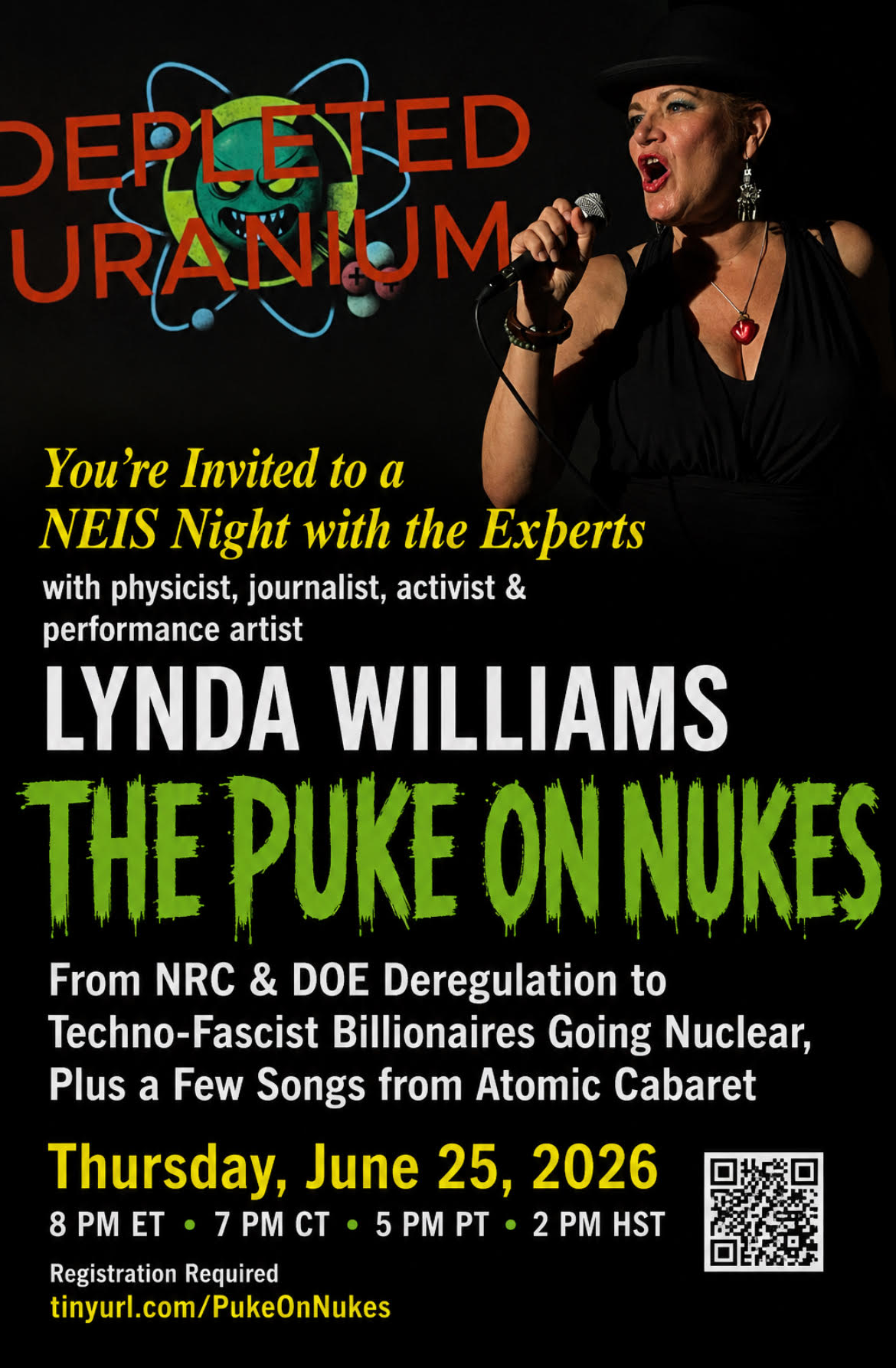
25 June- THE PUKE ON NUKES
Thursday, June 25, 2026
7pm Central Time (8pm ET, 6pm MT, 5pm PT) UTC – 5
From NRC & DOE Deregulation to Techno-Fascist Billionaires Going Nuclear, Plus a Few Songs from Atomic Cabaret REGISTER
26 June – Radiation Trainwreck at the NRC / Join the Protect Better Campaign – https://us02web.zoom.us/meeting/register/4ZlZ5_qLSHGiLSCg8FF6Bg#/registration

1st July – Webinar Waste of Space: The Environmental Harm of Military and Civil Space Activity st July, 7 pm

Report Launch Online: We are seeing an increasing exploitation of space for military and commercial purposes. This must change.

Protect Sazan Island from the Trump family! https://secure.avaaz.org/campaign/en/protect_sazan_island_from_the_trump_family_loc/?bqFCVab&v=174511&cl=22707147157&_checksum=5e9dde668860e8231c33699735e16a1fbf22ab2cb01da50c999fe8732b9775ef&utm_source=email&utm_medium=blast_email&utm_campaign=174511


Cuba Is Not a Failed State – It Is a Besieged State
PETITION: “Global Appeal to Endorse Palestinian Right of Return of Refugees”
To see nuclear-related stories in greater depth and intensity – go to https://nuclearinformation.wordpress.com
-
Archives
- June 2026 (230)
- May 2026 (306)
- April 2026 (356)
- March 2026 (251)
- February 2026 (268)
- January 2026 (308)
- December 2025 (358)
- November 2025 (359)
- October 2025 (376)
- September 2025 (257)
- August 2025 (319)
- July 2025 (230)
-
Categories
- 1
- 1 NUCLEAR ISSUES
- business and costs
- climate change
- culture and arts
- ENERGY
- environment
- health
- history
- indigenous issues
- Legal
- marketing of nuclear
- media
- opposition to nuclear
- PERSONAL STORIES
- politics
- politics international
- Religion and ethics
- safety
- secrets,lies and civil liberties
- spinbuster
- technology
- Uranium
- wastes
- weapons and war
- Women
- 2 WORLD
- ACTION
- AFRICA
- Atrocities
- AUSTRALIA
- Christina's notes
- Christina's themes
- culture and arts
- Events
- Fuk 2022
- Fuk 2023
- Fukushima 2017
- Fukushima 2018
- fukushima 2019
- Fukushima 2020
- Fukushima 2021
- general
- global warming
- Humour (God we need it)
- Nuclear
- RARE EARTHS
- Reference
- resources – print
- Resources -audiovicual
- Weekly Newsletter
- World
- World Nuclear
- YouTube
-
RSS
Entries RSS
Comments RSS
 nuclear-news