
October 30, 2019
Would Russia hold the 1994 Olympics at Chernobyl, the site of the 1986 meltdown? Only 8-years later, do we really think it’s safe to hold the Olympics on Fukushima soil? What would common sense tell us?
But these are very dark times.
The International Olympic Committee (IOC), the Japanese government, and most news media have ignored the risks one of the worst nuclear disasters in world history: the 2011 Fukushima power plant meltdown.
For years afterward, the Japanese government struggled what to do with millions of gallons of contaminated water and tens of thousands of Japanese refugees. Instead of safer measures, they chose the cheapest solution, spinning the truth in favor of profit and national image over human life.
Scientists warned that almost everything on land is contaminated, and this may include Tokyo which sits 100 kilometers from Fukushima.
Radiation levels may beyond what is safe for humans
According to 60 Minutes Australia, many experts are asking for the Fukushima Olympics to be canceled due to radioactive contamination. Yet, when The Washington Post ran an article on the struggles Fukushima and the residents are facing, there is no mention of what dangers Olympians and spectators may face in an area that has radiation levels way beyond what is safe for humans. Such high levels are likely to continue for decades to come.
In fact, in that same article, Simon Denyer wrote that when it rains, the water itself is radioactive. Residents feel forced by the Japanese government to return, as the government cuts pensions if residents refuse, essentially forcing them and their children for increased risk of cancer and other health problems. Childhood cancer is increasing in the affected zones, Denyer reports.
Why the silence? Where is the IOC? Is it okay for athletes and spectators to spend two weeks in a radioactive zone so that the Japanese government can make everyone forget that radiation exposure is no big deal? Such wouldn’t have to do with money over human life would it? Where is the U.S. news media that often looks for just a big story like this to crack? Why the silence?
As for Japan, what choice does it have but to move forward and accept that almost its entire population is inevitably exposed to radiation.
This is not something they can fix, so the government must reinvent Fukushima as a safe and wonderful place, a place where one can eat the vegetables and fruits from Fukushima, and they can live there healthy and happy. What better way than to repackage horrible facts with a new Fukushima, a safer, healthier one? However, they will have to force their residents to come back in order to seal such a wonderful myth.
Smelling a Nuclear Rat?
Dahr Jamail interviewed Arnie Gunderson that oversaw dozens of nuclear power plant projects in the United States. He faults the Japanese government and the nuclear power plant industry in pushing residents to go back to Fukushima before the 2020 Games. Even more surprising is that the IOC is also, according to Jamail, making very light over the known toxicity of Fukushima where the softball and baseball events will be played. Denyer, however, verified that six total events will take place in Fukushima. Gunderson, with 45 years’ experience with nuclear energy companies says that the goal is profit and that public health is not being considered.
Thyroid cancer, Jamail writes, already is increasing within the 310-mile radius of the disaster, and instances of cancer among children is increasing as well. In fact, the radiation is not decreasing but increasing at the power plants. Dr. Tadahiro Katsuta of Meiji University in Japan makes the Japanese motive clear: the Japanese government is putting its public image and money over the lives of its citizens. The Japanese government is also putting international athletes and citizens at risk with little regard for their health and safety.
Reporters Dave Zirin and Jules Boykoff went through Fukushima with a radioactive tester. They noted that a reading over 0.23 is seen as unsafe for humans. As they neared the Fukushima Daiichi Unit 1 reactor, the needle read 3.77. The Olympic torch is scheduled to pass near this area.
Who Works in Radioactive Zones without Protection? Athletes and Migrant Workers
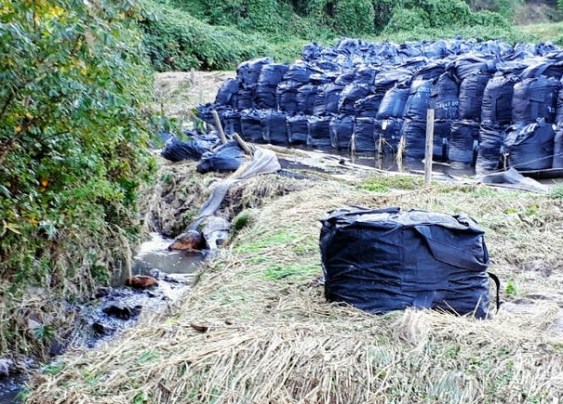
They witnessed in Fukushima workers without protective suits putting contaminated soil in black plastic bags and piling them in “pyramids.” While some agencies dispute how dangerous Fukushima is, what is clear is that the Japanese government raised the exposure benchmark for radiation from 1mSV a year to 20 MSV per year, the reporters noted. As an international journalist based in Japan stated, the Japanese government is pushing “propaganda over truth.” The IOC seems happy to play along.
Tens of thousands of Japanese refugees are still displaced and not willing to go back. The question is why wouldn’t people back to their homes, many of which whose families lived there for generations, if it were safe? Why would the IOC be so willing to host the games at a questionable site, even if such posed the slightest risks to athletes?
It does not take a nuclear engineer or scientist to understand that radiation contamination lasts for many years. Why build Olympic venues eight years after that very place had a nuclear disaster? Isn’t such a push egregious, irresponsible, and shameful? Common sense would tell any organizer of any event that such an event should not be placed in areas that could potentially put people at risk.
It’s time to hold the Japanese government and the IOC responsible for their hasty and reckless push to ignore the risks facing displaced citizens, spectators, and athletes and demand that the games be postponed and moved from Fukushima.
These are indeed dark times, where governments and their ties to corporate interests spin truths and make fictions that all of us would like to be real, but sadly money is always at the end of this contaminated rainbow. In the years to come, when the cancer cases mount, these same organizations and governments will pretend they knew nothing. Let’s all remember that.
https://baltimorepostexaminer.com/fukushima-is-not-safe-for-2020-olympics-nuclear-scientists-warn/2019/10/30
November 4, 2019
Posted by dunrenard |
fukushima 2019 | 2020 Olympics, Contamination, Fukushima Radiation |
Leave a comment
A worker at a hotel in the Fukushima Prefecture city of Iwaki releases water from a tap on Oct. 24, 2019, after water supplies were resumed on that day following cutoffs caused by Typhoon Hagibis.
TOKYO — No watertight doors were installed at nine water purification plants for tap water that were submerged by floods triggered by Typhoon Hagibis in mid-October, although they are situated in areas that local governments assumed could be inundated, the Mainichi Shimbun has learned.
There are at least 578 water purification plants across the country where no flood countermeasures have been taken even though they are situated in areas prone to immersion when flooding occurs. About two weeks after Typhoon Hagibis, a water purification plant in the Chiba Prefecture city of Kamogawa, eastern Japan, was submerged at the time of torrential rain on Oct. 25. It is therefore an urgent task to take countermeasures.
The typhoon, this year’s 19th, cut off water supplies to 163,243 households in 14 prefectures including Tokyo. Of those, some 40% — 63,698 in six cities and towns in the northeastern Japan prefecture of Fukushima and the eastern Japan prefectures of Ibaraki and Tochigi — were left without tap water because a total of 10 local water purification plants were submerged. The 10 facilities include one each in the Fukushima Prefecture cities of Iwaki and Tamura, one in the Ibaraki Prefecture city of Hitachiota, two in the Ibaraki Prefecture town of Daigo, three in the Tochigi Prefecture city of Nasukarasuyama and two in the city of Tochigi.
Nine of the 10 plants, excluding the one in Tamura, are located in areas that prefectural governments have designated as zones that could be inundated under the Flood Control Act, but no watertight doors were installed at any of the facilities.
In Iwaki, where a levee of the Natsui River burst during the typhoon, water supplies were cut off to some 45,000 households at one point. An official of the municipal government’s waterworks bureau admitted that it had not assumed that the city’s water purification plant would be flooded as a result of the river dike bursting.
“We had believed we should prioritize the renovation of our aging water purification equipment and make the facility quake-resistant, and didn’t take any particular measures against typhoons,” said the official. “We thought if muddy water flowed into the facility, we would need to adjust the amount of disinfectant, but never assumed that it would end up under water as a result of the dike bursting.”
When torrential rains hit western Japan in July 2018, some 264,000 households in 80 municipalities in 18 prefectures were left without water because local waterworks facilities including purification plants sustained damage.
This prompted the Health, Labor and Welfare Ministry to examine 3,521 major water purification plants across the country. The ministry then found that 758 of such facilities, or 22% of the total, are situated in areas designated as zones prone to floods, and that no anti-flooding measures, such as the installation of watertight doors and floodgates, had been taken at 578, or over 70%, of the 758 facilities. The huge cost of installing watertight doors poses a challenge.
In fiscal 2018, the ministry deemed 147 of these facilities, which could trigger particularly large-scale water supply cuts, in need of emergency countermeasures and began to subsidize one-third the cost of anti-flooding measures to waterworks bodies that lack financial resources.
However, the 10 water purification plants that were inundated in mid-October are not covered by the project.
Masakatsu Miyajima, professor of construction engineering at Kanazawa University, says, “Water purification plants are prone to flooding because they are situated near rivers, and need countermeasures. However, as the finances of waterworks operators are worsening due to the aging of society and depopulation, the national government needs to expand budgets for such programs. Residents should also stockpile water and local bodies should make arrangements for cooperation between themselves over water supplies in emergency cases,” he said.
(Japanese original by Haruna Okuyama and Mei Nanmo, City News Department)
A worker at a hotel in the Fukushima Prefecture city of Iwaki releases water from a tap on Oct. 24, 2019, after water supplies were resumed on that day following cutoffs caused by Typhoon Hagibis. (Mainichi/Mei Nanmo)
November 4, 2019
Posted by dunrenard |
fukushima 2019 | Drinking water, Flooding, Fukushima Prefecture, Typhoon Hagibis |
Leave a comment
Tokyo continues its behind the cloak diplomatic negotiations to export its contaminated food products to unknowing populations…
The European Union says it will partially ease import restrictions from mid-November on some Japanese food products. The EU has been requiring radiation tests for certain goods since the 2011 nuclear accident at the Fukushima Daiichi power plant.
The European Commission says from November 14, it will remove all restrictions on agricultural and fisheries products from Iwate, Tochigi, and Chiba prefectures.
It will also end testing requirements on some products from several other regions.
But regulations will continue to affect certain items from nine prefectures. They include some marine products and wild plants from Fukushima.
Japanese government officials say they will call on the EU to remove the remaining restrictions.
November 4, 2019
Posted by dunrenard |
fukushima 2019 | Contaminated Food, EUROPE, Japan Exports |
Leave a comment
International Campaign to Abolish Nuclear Weapons co-founder Tilman Ruff.
The Australian Olympic Committee has been urged to inform its athletes and team members about the ongoing health effects of the 2011 Fukushima nuclear reactor disaster for those attending the 2020 Tokyo Games.
Tilman Ruff, a public health expert who co-founded the Nobel Peace Prize-winning International Campaign to Abolish Nuclear Weapons (ICAN) in Melbourne, said he had written to the AOC to warn that levels of radioactivity in certain areas could be above the recommended maximum permissible exposure level. He said the Japanese Olympic Committee planned to host baseball and softball competitions and part of the torch relay in Fukushima City, 50km away from the ruins of the Fukushima Dai-ichi nuclear power plant.
In 2011, multiple nuclear meltdowns at the damaged facility caused radioactivity to leak out across Japan and the Pacific.
“It was a catastrophe comparable only to the nuclear meltdown of Chernobyl,” he said. While contamination was not as severe as at Chernobyl, “it was widespread and persists”.
At least 50,000 residents have not yet been able to return to the most affected areas in Fukushima prefecture. “The Japanese government is making a concerted effort to present the Fukushima nuclear disaster as over and effectively dealt with in the lead-up to the Olympics. Some of these efforts are misleading and should not be accepted at face value,” Dr Ruff said.
He said thyroid cancers had notably increased among young people in Fukushima, with a total of about 200 cases.
He has made several visits to Fukushima since 2011, the latest in May when he provided radiation health advice to the Fukushima prefectural government.
Dr Ruff said he then wrote to the AOC urging it to “properly inform and safeguard the best interests of the Australian staff and team, and their accompanying families, especially women who may be pregnant and young children”.
He said short-term visits to areas contaminated by radioactive fallout “now involve low to minimal risk”.
“However, if any (AOC) members or athletes plan to be based in Fukushima or neighbouring contaminated prefectures for weeks or months, they should be informed about the health risks of radiation exposure,” Dr Ruff said.
International physician groups have criticised the Japanese government’s decision shortly after the 2011 disaster to increase the maximum permissible radiation dose for Japanese citizens from one to 20 millisieverts. “Eight years later, it has not reversed that decision,” Dr Ruff said. “No other government in the world has ever accepted such a high level of radiation beyond the immediate emergency phase of a nuclear disaster for its citizens.”
An AOC spokesman said Tokyo 2020 provided regular updates to the IOC regarding the situation. “We have been given assurances that radiation levels in Fukushima City are safe, noting that the IOC Co-ordination Team has made several visits to the region and that ongoing monitoring is conducted independently of the Japanese government,” the spokesman said.
November 4, 2019
Posted by dunrenard |
fukushima 2019 | 2020 Olympics, Contamination, Fukushima Radiation |
Leave a comment
The area of the Fukushima Daiichi nuclear power station is being impacted by high waves, flooding and landslides. Who knows how many more bags of nuclear waste, and more tons of radioactive water will now be at sea, i.e. in the Pacific Ocean.
November 4, 2019
Posted by dunrenard |
fukushima 2019 | Flooding, Fukushima Prefecture, Typhoon Hagibis |
Leave a comment
Search and rescue operations continued in eastern Japan on Saturday after torrential rains spurred landslides and flooding in areas still reeling from damage caused by typhoons, authorities said.
At least 10 people were confirmed dead and several others were missing in Chiba and Fukushima prefectures, police and other sources said.
In the city of Chiba, mudslides crushed three houses, killing three people who were buried underneath them. Another mudslide hit a house in the nearby city of Ichihara, killing a woman. Some other bodies were found in submerged cars.
In Soma, Fukushima Prefecture, the body of a woman was found near a beach.
Rescue workers using helicopters continued to search for survivors and winched people to safety after rivers overflowed and submerged vast swaths of land, including roads and railway tracks.
Ichihara saw more than 280 millimeters of rain over a 12-hour period Friday — more than the average monthly total for October — according to the Meteorological Agency.
While rains passed and floodwater subsided, parts of Chiba were still inundated. About 4,700 homes were out of running water and some train services were delayed or suspended. Power was restored Saturday at most of the 6,000 Chiba households that had lost electricity.
Prime Minister Shinzo Abe held an emergency task force meeting Saturday morning and called for “the utmost effort in rescue and relief operations.” He also urged quick repairs of electricity, water and other essential services to help restore the lives of the disaster-hit residents.
Some flights to Narita Airport were canceled Friday due to the rain, affecting travelers using one of the country’s largest international airports. Around 3,000 people spent the night at the airport as the downpours also disrupted train and bus connections to nearby cities.
A total of 15 rivers have flooded in Chiba Prefecture due to the rains, forcing more than 1,800 people to evacuate, the prefectural government said.
About 1,200 children were stranded at schools and other facilities and stayed overnight there. No children were injured or fell ill, and parents were able to pick them up Saturday, the prefecture said.
The downpour came as a result of a low-pressure system above the main island of Honshu that moved northward later Friday.
Two weeks ago, Typhoon Hagibis caused widespread flooding and left more than 80 people dead across Japan.
Yoshiki Takeuchi, an office worker who lives in a riverside house in the city of Sodegaura, Chiba Prefecture, said he had just finished temporary repairs to his roof after tiles were blown off by Typhoon Faxai in September when Friday’s rain hit.
“I wasn’t ready for another disaster like this. I’ve had enough of this, and I need a break,” he said.
November 4, 2019
Posted by dunrenard |
fukushima 2019 | Flooding, Fukushima Prefecture, Typhoon Hagibis |
Leave a comment
A most essential interview of Mari Inoue by Libbe Halevy,
 Citizens’ Radiation Data Map of Japan – created by moms, parents, grandparents to supply the information that the Japanese government would not. See what radiation levels have been and will be for the next 100 years.
This Week’s Featured Interview:
Citizens’ Radiation Data Map of Japan by the Minna-no Data Site reveals the deadly impact of the radioactivity released by the Fukushima Daiichi triple nuclear meltdown of March, 2011. 4,000 citizens took soil samples to capther the data that created the full 200-page book, written in Japanese, which won a major mainstream journalism award and is a “hot” seller in Japan.
Now the English-language digest has been published, and non-Japanese speakers can see for ourselves the radiation contamination that resulted from that disaster.
Mari Inoue of the Manhattan Project for a Nuclear-Free World is part of the team who worked on the English translation. Here, she explains how the data was collected, what it shows, and provides instruction for any community to duplicate this process to compile accurate radiation data in communities where contamination is suspected.
More information about Minna-no Data Site (Everyone’s Data Site) and the English digest booklet of “Citizens’ Radiation Data Map of Japan Digest Edition – Grassroots Movement Reveals Soil Contamination in Eastern Japan in the Wake of Fukushima” is available here: https://en.minnanods.net/
If you have any questions about the English booklet, or interested in obtaining a copy of the English booklet, please contact: mdsbookorder@mp-nuclear-free.com.
November 4, 2019
Posted by dunrenard |
fukushima 2019 | Fukushima Contamination, Mari Inoue, Nuclear Hotseat Podcast |
Leave a comment
- We report chemical durability of Cs-rich microparticle from Fukushima Daiichi.
- The dissolution rate was estimated for various solution composition.
- Cs-rich microparticles can remain in lung and environments for several decades.

October, 2019
Abstract
To understand the chemical durability of highly radioactive cesium-rich microparticles (CsMPs) released from the Fukushima Daiichi Nuclear Power Plant in March 2011, we have, for the first time, performed systematic dissolution experiments with CsMPs isolated from Fukushima soils (one sample with 108 Bq and one sample with 57.8 Bq of 137Cs) using three types of solutions: simulated lung fluid, ultrapure water, and artificial sea water, at 25 and 37 °C for 1–63 days.
The 137Cs was released rapidly within three days and then steady-state dissolution was achieved for each solution type. The steady-state 137Cs release rate at 25 °C was determined to be 4.7 × 10³, 1.3 × 10³, and 1. 3 × 10³ Bq·m−2 s−1 for simulated lung fluid, ultrapure water, and artificial sea water, respectively.
This indicates that the simulated lung fluid promotes the dissolution of CsMPs. The dissolution of CsMPs is similar to that of Si-based glass and is affected by the surface moisture conditions.
In addition, the Cs release from the CsMPs is constrained by the rate-limiting dissolution of silicate matrix.
Based on our results, CsMPs with ∼2 Bq, which can be potentially inhaled and deposited in the alveolar region, are completely dissolved after >35 years. Further, CsMPs could remain in the environment for several decades; as such, CsMPs are important factors contributing to the long-term impacts of radioactive Cs in the environment.
https://www.sciencedirect.com/science/article/pii/S0045653519311701?via%3Dihub&sfns=mo&fbclid=IwAR0tbULuzIFwPg-RLoasHtJGKV10yokXY4Nt0YPhuff6PE3lD-_XCCqgRn0
November 4, 2019
Posted by dunrenard |
fukushima 2019 | Fukushima Daiichi, Microparticles, Research Study |
Leave a comment

5th October 2019
On October 3, the Citizens’ Committee on Nuclear Energy, whose members include academics, technical experts, and NGOs, made a new proposal to deal with contaminated water from the damaged Fukushima Daiichi Nuclear Plant after the water has been treated. The proposal, submitted to Ministry of Economy, Trade and Industry (METI), the Ministry of the Environment (MOE), and the Nuclear Regulation Authority, is to convert the treated water to solid form by mixing with mortar, and storing it on land. Citizens’Comittee on Nuclear Energy (CCNE)
 Figure 1 (Prepared by Yasuro Kawai, Citizens’ Committee on Nuclear Energy, for October 3, 2019 press conference)
However, Tokyo Electric Power Company (TEPCO) rejected the concept of large-tank storage, claiming that it takes three years to install each tank, that the efficiency of site utilization is not significantly different from that of tanks currently being used, that a floating roof design may result in rainwater mixing with the contents, and that there would be major volume of leakage in the event of damage to the tanks.
Those claims were rebuffed in a presentation by Yasuro Kawai of the Citizens’ Committee on Nuclear Energy (regulations subcommittee) at a press conference on October 3. He said that the installation of large tanks takes 1.5 to 2 years, that they actually improve the efficiency of site utilization, that a dome-shaped design could be used to prevent mixing with rainwater, that large tanks are robust and have a proven track record in oil storage, and that perimeter walls would be needed as a measure to prevent leakage.
Advantages and disadvantages of mortar solidification proposal
The proposal by the Citizens’ Committee on Nuclear Energy is to mix contaminated water with cement and sand to solidify it, then pour the mixture into concrete tanks and store it partially underground. Mr. Kawai described achievements using this approach at the Savannah River nuclear reservation in South Carolina, the United States.
Discussion about land-based storage has finally begun
The Citizens’ Committee on Nuclear Energy has long taken the position that treated water from the so-called Advanced Liquid Processing System (ALPS) should not be released into the ocean. It has been proposing land-based storage using large tanks, an approach that has a proven track record for the storage of oil reserves.
In August 2018, at a hearing held by METI’s ALPS subcommittee, fisheries-related stakeholders and many other participants expressed the view that long-term land-based storage should be used for the treated water. In response, Chairman Kazuyoshi Yamamoto promised to consider the land based storage plan as an option, and the topic finally came up at the 13th sub-committee meeting, held on August 9, 2019.
 Figure 2 (Prepared by Yasuro Kawai, Citizens’ Committee on Nuclear Energy, for October 3, 2019 press conference)
The advantages are that no radioactive substances need to be released into the environment, and the approach works with existing technologies. Disadvantages include low volumetric efficiency and evaporation of moisture due to heat generation.
Local community consent would also be required, because the site would become a permanent disposal site.
Is there really a lack of space for onsite storage?
Media have repeatedly reported claims that onsite storage space will run out by the summer of 2022, but is that really true? According to documents from on September 27, TEPCO explained to the ALPS Subcommittee that the site has about 81,000 square meters reserved for temporary storage facilities for spent fuel and fuel debris.
 Figure 3 (Document 3, 14th subcommittee meeting on handling of ALPS treated water)
TEPCO also claims that in the first half of the 2020s, the site is required for facilities for analysis, mock-up facilities for fuel debris retrieval, equipment and material storage, and research facilities, etc.
 Figure 4 (Document 3, 14th subcommittee meeting on handling of ALPS treated water)
But is it realistic and necessary to attempt to remove fuel debris?
The location and condition of the fuel debris is not precisely known due to high radioactivity. An unreasonable effort to remove it will expose workers to a large amount of radioactivity.
The Citizens’ Committee on Nuclear Energy has proposed a “debris non-removal” option of keeping the debris isolated for 100 years, after which it would be dealt with, as one option that should be seriously considered, in order to avoid technical risks, enormous costs, and radiation exposure of workers.
Is it necessary to construct research facilities on the site?
Furthermore, at METI’s ALPS subcommittee, committee members have asked many questions, for example, about giving consideration to using sites where soil is currently being dumped, and expansion of the current site. In all cases, METI responded that such options were “difficult.” However, there was no evidence of any serious consideration having been made of whether or not the ideas raise were really possible.

METI should immediately consider the land based storage proposal from the Citizens’ Committee on Nuclear Energy by setting up an ALPS subcommittee or a new committee.
By Kanna Mitsuta
Note: The above proposal was covered by Kyodo News, and Kahoko Shimpo news.
・Kahoko Shimpo: “Experts Propose Mortar Solidification for Treated Water from Fukushima Daiichi Nuclear Power Plant” (4-Oct-2019, in Japanese)
・Kyodo News: “Treated water should go into long-term storage and solidification treatment, says citizens’ group opposed to ocean discharge” (3-Oct-2019, in Japanese)
Related posts by FoE Japan (in Japanese unless noted)
・“FoE Japan objects to statement by Japan’s former Environment Minister: He undermined discussions on long-term storage of contaminated water at Fukushima Daiichi nuclear plant”
Japanese: http://www.foejapan.org/energy/library/190911.html
English: http://www.foejapan.org/en/energy/doc/190911.html
・“Big problems at the public hearing on contaminated water: Many speakers oppose ocean discharge”
・“Traces of nuclides other than tritium found in ALPS treated water: Basic premises of public briefing/hearing are undermined”
http://www.foejapan.org/en/energy/doc/191005.html
November 4, 2019
Posted by dunrenard |
fukushima 2019 | Fukushima Daiichi, Long term storage, Radioactive Water |
Leave a comment
By denying and covering up Fukushima widespread radioactive contamination, the present Japanese government is putting the population at permanent risk, and those cancer patients number will be increasing, not talking of the other ailments.
Women account for around 80 percent of all cancer patients in Japan between the ages of 20 and 39, a study by two national medical centers shows.
The study by the National Cancer Center Japan and the National Center for Child Health and Development attributed the result to an increase in breast and cervical cancer.
“We especially want (women) to get properly checked for cervical cancer once they turn 20. We are seeking an effective support system for adolescents and young adults … based on age and gender,” the centers said in the report released Thursday.
The study, the first of its kind, analyzed 62,000 cancer patients aged up to 39 who had contacted 844 medical institutions across Japan in 2016 and 2017.
Children up to age 14 made up 4,500 of the 62,000 patients, with the majority of them boys. Half of the children had leukemia or brain tumors, and a small number were diagnosed with rare cancers.
Of the 56,000 patients who were 20 or older, 44,000 — or 78.6 percent — were women.
While cancer types varied depending on age and gender, an analysis of patients in the very early stage of their diseases showed that cervical cancer accounted for the most cases, followed by breast cancer, the centers said.
October 20, 2019
Posted by dunrenard |
fukushima 2019 | cancer, Japan |
3 Comments
News outlets worldwide are reporting that at least 66 residents of Japan have died as a result of Typhoon Hagibis. Our hearts reach out to the people of Japan and the families of the deceased.
The news coverage from Reuters caught our attention due to its research that Fukushima Prefecture was apparently the region hardest hit by the typhoon. According to the Reuters story entitled: Rescuers slog through mud as Japan typhoon death toll rises to 66:
“The highest toll was in Fukushima prefecture north of Tokyo, where levees burst in at least 14 places along the Abukuma River, which meanders through a number of cities in the largely agricultural prefecture. At least 25 people died in Fukushima, including a mother and child who were caught in flood waters, NHK said…. Residents in Koriyama, one of Fukushima’s larger cities, said they were taken by surprise by the flooding. Police were searching house-to-house to make sure nobody had been left behind or was in need of help.
“The river has never flooded like this before, and some houses have been completely swept away. I think it might be time to redraw hazard maps or reconsider evacuation plans,” said Masaharu Ishizawa, a 26-year-old high school teacher …”
Fukushima prefecture is very mountainous and largely remote. The radioactive fallout, which spread throughout Japan after the three Fukushima nuclear meltdowns in 2011, is impossible to clean up in these inaccessible mountainous areas that lie throughout Fukushima Prefecture. Even in populous Tokyo, more than one-year after the meltdowns, Fairewinds’ research identified randomly selected Soil Samples Would Be Considered Nuclear Waste in the US, which we discussed in the video on Fairewinds’ website.
It is our belief from our ongoing research that the ensuing flooding induced by Typhoon Hagibis is moving significant amounts of radiation from high in the mountains down to cities, towns, and farmland in Japan. Our analysis on several radiation sampling trips to the prefecture proves that there are huge amounts of residual radiation that were previously trapped in the soil.
Now, due to the heavy rain, subsequent river flooding, and burst levees (dams) this radioactive soil is moving and being pushed from the mountains down into more populous areas where people live and crops are grown. Once again it appears that government authorities and rescue organizations are ignoring this new, long-term threat, or have not been apprised by the JAEA (Japan Atomic Energy Agency) and nuclear power industry of the monumental health risks involved.
October 20, 2019
Posted by dunrenard |
fukushima 2019 | Flooding, Fukushima Prefecture, radiation, Typhoon Hagibis |
Leave a comment
The Ministry of Health and Welfare said that it conveyed the Korean government’s concerns over radioactive water disposal at the Fukushima Daiichi nuclear plant in Japan, during the 70th World Health Organization’s West Pacific Regional Conference.
Kang Dae-tae, assistant minister for the Planning and Coordination Office at the ministry and chief representative of the regional meeting, expressed concern about the handling of radioactive water from the Fukushima nuclear power plant and urged the Japanese government and international agencies to respond with care.
“Disposing of radioactive water into the sea is not just a problem for Japan but an international issue that can have a significant impact on the marine environment of the Western Pacific region and the health of its people,” Kang said. “The WHO Western Pacific Regional Office, along with relevant international organizations such as the International Atomic Energy Agency (IAEA), has to minimize the impact on the health of the residents of the region.”
Kang urged the international bodies to disclose relevant information transparently so that there is no unnecessary anxiety when Japan decides on how to dispose of the contaminated water.
In response to Korea’s concerns, the Japanese health ministry officials said that they have made efforts to share information and clean up contaminated water, but have not currently decided on how to deal with Fukushima’s contaminated water.
The Japanese officials also noted that the decision to discharge the radioactive waters would be made under international standards such as the International Radiation Protection Committee.
The Fukushima Daiichi nuclear plant is now sitting on a million-ton of water contaminated with radioactive elements while the amount grows around 150 tons a day.
While the Japanese government has claimed that it has removed most of the radioactive isotopes using an elaborate filtration process, it could not eliminate one isotope, tritium, so it has been storing the water in large tanks, which will fill up by 2022.
Some scientists have claimed that tritium causes harm to humans except in very high concentrations, and the IAEA also argues that properly filtered Fukushima water could be diluted with seawater and then safely released into the ocean without causing environmental problems.
However, other experts have claimed that even the diluted version of tritium can affect cell structures in plants, animals, or humans. The consensus of dumping the water into the Pacific Ocean also faces fierce backlash from both the Japanese fisherman groups and the Korean government, they said.
October 20, 2019
Posted by dunrenard |
fukushima 2019 | Fukushima Daiichi, Radioactive Water, Sea Dumping, South Korea, WHO |
Leave a comment
For bags made to resist only 3 years, they fared incredibly well in this powerful typhoon, that after 8 years, more than double their resistance expectancy….
The lies and cover-up continue:
Koizumi (Environment Minister) insists that “there won’t be any impact on the environment” regarding radioactive bags swept away by the typhoon.
Koizumi said, “I’ve received reports that large bags that have already been collected were not damaged, so there won’t be any impact on the environment.”
Anyway, the radioactive bags are not the main problem. The main problem is the accumulated radionuclides in the forested hills of Fukushima prefecture, 80% of its land surface. Which have never been decomtaminated. that powerful typhoon has redistributed a lot of those forested hills radiation everywhere…. To be inhaled by people….
The plan is to bring the 17 million tons of radiactive bags scattered allover the Fukushima prefecture to the intermediary storage location build between Okume and Futaba, to separate the debris from the soil, to incinerate the debris, so as to reduce the volume of incinerated debris by 50. To store the resulting high radiation waste for the 30 years before to find somewhere a final storage site, and to recycle the low radiation waste into roads and building construction….http://josen.env.go.jp/en/storage/
17 million radioactive bags resulting from multiple partial decontamination of the residence areas and some of the agricultural fields, from less than 20% of the Fukushima prefecture land surface. 80%, the forested parts, hills and mountains have never been decontaminated. And from those the accumulated radionuclides are ruisseling down to the previously decontaminated places, recontaminating them, during the raining season, the typhoon redistributing thos radionuclides all over Fukushima and even outside Fukushima to other prefectures. A never ending story.
Typhoon response dominates diet debate
The government’s response to Typhoon Hagibis dominated Tuesday’s debate in the Diet.
Opposition lawmakers grilled the government on its handling of the storm, including why radioactive waste produced after the 2011 nuclear disaster was not properly protected.
Multiple bags of waste produced from decontamination efforts flooded into a river in Fukushima.
Environment Minister Shinjiro Koizumi says local officials found 10 bags that had been swept away by the storm and are investigating whether there are any more.
Koizumi said, “I’ve received reports that large bags that have already been collected were not damaged, so there won’t be any impact on the environment.”
Another issue debated was the management of emergency shelters.
Opposition members pointed out that a municipality in Tokyo did not accept homeless people at some evacuation centers.
Yuko Mori of Democratic Party for the People said, “We should respect the basic human rights of disaster victims and provide necessary facilities for them. That’s a basic principle.”
Prime Minister Shinzo Abe replied, “I think it would be desirable for each evacuation center to properly accept all people. We will examine what really happened with the local governments and take appropriate measures.”
October 20, 2019
Posted by dunrenard |
fukushima 2019 | Fukushima Prefecture, Lies & Cover-up, Typhoon Hagibis |
Leave a comment
Some facilities that had been damaged in 2011 were hit again over the weekend in a region of Japan that can never seem to catch a break.
A woman cleaning out her home in Koriyama, in Fukushima Prefecture, on Sunday. Typhoon Hagibis struck as the Japanese government was eager to declare the region recovered from the 2011 nuclear crisis.
KORIYAMA, Japan — For Hiroyoshi Yaginuma, the typhoon may well be the straw that breaks his back.
On Monday, Mr. Yaginuma, 49, a third-generation owner of an auto body shop in Fukushima Prefecture, was cleaning out the wreckage from Typhoon Hagibis, which battered Japan over the weekend and killed more than 70 people. The typhoon had brought record-setting rains that caused a levee to break on a nearby river, unleashing floodwaters that filled the first floor of his building, destroying everything.
It was only two years ago that Mr. Yaginuma finally finished paying off a $185,000 loan he had taken out to rebuild his shop in Koriyama, an industrial city in Fukushima, after it was badly damaged by a devastating earthquake and tsunami in 2011.
Fukushima is the name that everyone remembers from that disaster eight years ago. It was in this prefecture that waves from the tsunami overpowered a nuclear power plant’s protective sea walls, setting off a catastrophic meltdown. Tens of thousands of people were evacuated; many have still not returned.
An aerial view of Koriyama on Sunday.
On Monday, as Mr. Yaginuma surveyed the garage floor where demolished equipment and heaps of tires, hubcaps and oil cans were drowning in a mess of mud, he said he wasn’t sure he could summon the energy to rebuild his business all over again.
“I am thinking maybe now this is the end,” he said. “I think there is a possibility that this will be a place where not many people can live anymore.”
Typhoon Hagibis struck as the Japanese government and many municipal leaders were eager to declare Fukushima recovered from the 2011 crisis.
“I am thinking maybe now this is the end,” said Hiroyoshi Yaginuma, the owner of an auto body shop in Koriyama.
Critics have said that narrative was already too rosy. The cleanup at the Daiichi nuclear plant is far from complete. The government has yet to decide what to do with more than one million tons of contaminated water stored in close to 1,000 tanks on the site.
Soil scraped from land that was exposed to radiation in the days after the nuclear accident is still stored in millions of industrial-strength plastic bags all over the prefecture. In the city of Tamura, the floodwaters displaced an unknown number of these bags from a temporary storage area, although 10 bags were later recovered undamaged.
Now the region will have to undergo a more intensive cleanup to recover from the typhoon, especially as a stadium 55 miles west of the Daiichi plant prepares to host baseball during the Tokyo Summer Olympics next year.
Storage tanks holding contaminated water at the Daiichi nuclear power plant last year.
The storm inundated several communities throughout Fukushima with floodwaters from the Abukuma River. According to NHK, the public broadcaster, 25 people died in Fukushima because of the typhoon.
Some facilities that had been damaged in 2011 in Koriyama, less than 45 miles from the nuclear plant, were hit again over the weekend. A hospital that was knocked out for two months by the earthquake, for example, flooded this time around.
On Monday, many neighborhoods were still underwater. Where the waters had receded, residents and business owners went back to retrieve what little was salvageable.
In an industrial park off the banks of the Abukuma, couches, bookshelves, desks and office chairs sat along roadsides, awaiting garbage pickup. As rain fell again, workers hosed down walls and mopped up floors.
Workers checking a power line in Koriyama
At Sanko Mokuzai, a company that sells wood stoves and lumber, the chief executive, Toshiyuki Iwasaki, 63, joined several workers to load water-damaged wood panels onto a flatbed truck.
The Fukushima nuclear disaster had already forced him to find another source of timber after the government forbade sales of lumber harvested from the prefecture over radiation fears.
Yet even with the pileup of natural and man-made disasters, he said he could not afford to move because of local connections built over the company’s 50-year history.
“If I have to move,” Mr. Iwasaki said, “I will have to abandon my business.”
Still, he said he had little appetite for some of the government cheerleading for Fukushima’s recovery.
“I don’t really have any ambitions for Fukushima,” he said. “We just have to do what we need for ourselves. We are not really thinking, Let’s do this for Fukushima.”
Although the region’s population overall has dropped and those over 65 now account for close to a third of the population, Fukushima’s plight has attracted a few new residents who hope it might still be revived.
Naohisa Fujita, 46, and his wife, Yumi, 34, said they had moved to Koriyama from Nagano in 2013 because they wanted to help the people of the region.
Yasuko Kokubun found her daughter’s wedding album intact as she cleaned her house after the typhoon.
Early Monday morning, Mr. Fujita, who works in home maintenance and renovation, got a chance to help someone directly. When he and two other residents took a boat to inspect the damage from the typhoon’s floods in their neighborhood, they rescued an older man and his son who were stranded inside their home.
The Fujitas said they were anxious about how soon they could move back to their flooded first-floor rental apartment after cleaning it out. They acknowledged they might have to find a new place to live.
Still, Ms. Fujita was determined that they stay in Koriyama. “We have to work to make this place livable,” she said.
In 2011, about 9,100 people who had lived in villages elsewhere in Fukushima evacuated to Koriyama. Many of them put down roots and stayed.
But about 10,000 Koriyama residents decided to leave in the aftermath of the nuclear meltdown.
Those who remained have built up a resilience in the face of repeated setbacks.
“There is the disaster fatigue of these people who have been hit by all these disasters,” said Kyle Cleveland, a professor of sociology at the Tokyo campus of Temple University, who has written extensively about the response of Fukushima communities to the 2011 nuclear crisis.
“But I think it tends to breed a sense of fatalism,” he added.
That sense of resignation could be felt at Takase Elementary School in Koriyama, where about 400 people sought shelter from the typhoon and more than 230 remained on Monday.
Yukari Yoshinari, 22, who was there with her husband and 2-month-old son, as well as her older sister and her family, was overwhelmed but stoic about the flooding of her home.
Members of the Yoshinari and Yamanobe families were evacuated to an elementary school.
Sitting on the floor of the gym on cardboard mats covered with thin foam pads, Ms. Yoshinari, who is on maternity leave from her job as a caregiver at a nursing home, and her sister, Satomi Yamanobe, 24, folded clothes they had taken to a local laundromat.
Two nights as evacuees had been taxing. The baby had trouble sleeping with bright lights on all night. There were no diapers and only minimal food. When the Yoshinaris went to inspect their home, the floodwaters still came to their hips and they could see that their electronic appliances, tatami straw floor mats and furniture had been destroyed.
But there was no question of moving out of Koriyama. “I have grown up here,” said Ms. Yoshinari, as she rocked her son, Ayuto, to sleep on her shoulder. “It would take too much courage to leave.”
“But,” she added, “I would not recommend anyone else to move into Koriyama.”
October 20, 2019
Posted by dunrenard |
fukushima 2019 | Fukushima Prefecture, Typhoon Hagibis |
Leave a comment
The real problem, more than bags of radioactive waste flushed into rivers, is the dispersion of radioactive contamination by the flood. Contaminated land and radionuclides move to homes coming from mountains and forests that had never been decontaminated.
In addition, the deposition of contaminated sludge at the bottom of rivers and dams has been disturbed and dispersed. When the sludge is dried and the dust disperses in the air with the wind, increasing highly the risk of the internal irradiation by inhalation.
Flexible bulk bags containing waste produced from decontamination work around the Fukushima No. 1 nuclear power plant were swept away in flooding during Typhoon No. 19 in Tamura, Fukushima Prefecture.
Bags of debris from Fukushima disaster swept away in typhoon
TAMURA, Fukushima Prefecture–Bulk bags filled with greenery collected during decontamination efforts after the nuclear disaster at the Fukushima No. 1 nuclear power plant were swept into a river during Typhoon No. 19 on Oct. 12.
According to the Tamura city government, the bags were among 2,667 that have been stored temporarily at a site in the Miyakoji-machi district here.
The facility was flooded after heavy rains brought by the typhoon, and the water carried an unknown number of the bags to a river about 100 meters away.
A city government official received a phone call at around 9:20 p.m. on Oct. 12 from a nearby civil engineering firm, saying six of the bulk bags had been recovered from the river.
Each of the bulk bags was 1 cubic meter in size. No sheets had been placed over the bags as a precaution against the rain and wind from the typhoon.
A city official said consultations will be held with the Environment Ministry to determine possible effects on the environment.
The decontamination effort involved removing debris, such as soil, leaves and plants, containing radioactive substances released after the 2011 triple meltdown at the Fukushima No. 1 plant.
October 20, 2019
Posted by dunrenard |
fukushima 2019 | Fukushima Prefecture, Hagibis Typhoon, Radionuclides |
Leave a comment






 nuclear-news