Robot pulled from Fukushima reactor due to radiation

Cleaner robot pulled from Fukushima reactor as record radiation levels damage its camera
A remote-controlled cleaning robot sent into a damaged reactor at Japan‘s Fukushima nuclear plant had to be removed before it completed its work because of camera problems most likely caused by high radiation levels.
It was the first time a robot has entered the chamber inside the Unit 2 reactor since a March 2011 earthquake and tsunami critically damaged the Fukushima Da-ichi nuclear plant.
Tokyo Electric Power Co. said it was trying to inspect and clean a passage before another robot does a fuller examination to assess damage to the structure and its fuel.
WHAT HAPPENED?
The robot went only part way into a space under the core that TEPCO wants to inspect closely.
It crawled down the passage while peeling debris with a scraper and using water spray to blow some debris away.
The dark brown deposits grew thicker and harder to remove as the robot went further.
After about two hours, the two cameras on the robot suddenly developed a lot of noise and their images quickly darkened — a sign of a problem caused by high radiation.
The second robot, known as the ‘scorpion,‘ will also measure radiation and temperatures.
Thursday‘s problem underscores the challenges in decommissioning the wrecked nuclear plant.
Inadequate cleaning, high radiation and structural damage could limit subsequent probes, and may require more radiation-resistant cameras and other equipment, TEPCO spokesman Takahiro Kimoto said.
‘We will further study (Thursday‘s) outcome before deciding on the deployment of the scorpion,‘ he said.
TEPCO needs to know the melted fuel‘s exact location and condition and other structural damage in each of the three wrecked reactors to figure out the best and safest ways to remove the fuel.
It is part of the decommissioning work, which is expected to take decades.
During Thursday‘s cleaning mission, the robot went only part way into a space under the core that TEPCO wants to inspect closely.
It crawled down the passage while peeling debris with a scraper and using water spray to blow some debris away. The dark brown deposits grew thicker and harder to remove as the robot went further.
After about two hours, the two cameras on the robot suddenly developed a lot of noise and their images quickly darkened — a sign of a problem caused by high radiation.
Operators of the robot pulled it out of the chamber before completely losing control of it.
The outcome means the second robot will encounter more obstacles and have less time than expected for examination on its mission, currently planned for later this month, though Thursday‘s results may cause a delay.
Both of the robots are designed to withstand up to 1,000 Sieverts of radiation.
The cleaner‘s two-hour endurance roughly matches an estimated radiation of 650 Sieverts per hour based on noise analysis of the images transmitted by the robot-mounted cameras.
That‘s less than one-tenth of the radiation levels inside a running reactor, but still would kill a person almost instantly.
Kimoto said the noise-based radiation analysis of the Unit 2‘s condition showed a spike in radioactivity along a connecting bridge used to slide control rods in and out, a sign of a nearby source of high radioactivity, while levels were much lower in areas underneath the core, the opposite of what would normally be the case.
He said the results are puzzling and require further analysis.
TEPCO officials said that despite the dangerously high figures, radiation is not leaking outside of the reactor.
Images recently captured from inside the chamber showed damage and structures coated with molten material, possibly mixed with melted nuclear fuel, and part of a disc platform hanging below the core that had been melted through.
https://insiderfinancial.net/robot-pulled-from-fukushima-reactor-due-to-radiation.html
Radiation levels inside Fukushima high enough to kill robot sent to clean
December 6, 2019
A remote-controlled cleaning robot sent into a damaged reactor at Japan‘s Fukushima nuclear plant had to be removed Thursday before it completed its work because of camera problems most likely caused by high radiation levels.
It was the first time a robot has entered the chamber inside the Unit 2 reactor since a March 2011 earthquake and tsunami critically damaged the Fukushima Da-ichi nuclear plant.
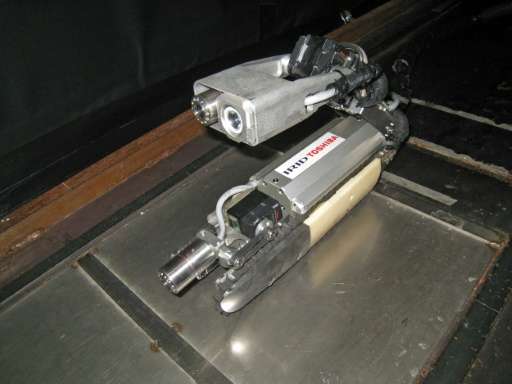
Tokyo Electric Power Co. (TEPCO) said it was trying to inspect and clean a passage before another robot does a fuller examination to assess damage to the structure and its fuel. The second robot, known as the “scorpion,” will also measure radiation and temperatures.
Thursday‘s problem underscores the challenges in decommissioning the wrecked nuclear plant. Inadequate cleaning, high radiation and structural damage could limit subsequent probes, and may require more radiation-resistant cameras and other equipment, TEPCO spokesman Takahiro Kimoto said.
“We will further study (Thursday‘s) outcome before deciding on the deployment of the scorpion,” he said.
TEPCO needs to know the melted fuel‘s exact location and condition and other structural damage in each of the three wrecked reactors to figure out the best and safest ways to remove the fuel. It is part of the decommissioning work, which is expected to take decades.
The remote-controlled “cleaning” robot, bottom, was sent in to inspect and clean a passage for another robot in the damaged nuclear facility. (TEPCO/Associated Press)
During Thursday‘s cleaning mission, the robot went only part way into a space under the core that TEPCO wants to inspect closely. It crawled down the passage while peeling debris with a scraper and using water spray to blow some debris away. The dark brown deposits grew thicker and harder to remove as the robot went further.
More obstacles for second mission
After about two hours, the two cameras on the robot suddenly developed a lot of noise and their images quickly darkened — a sign of a problem caused by high radiation. Operators of the robot pulled it out of the chamber before completely losing control of it.
The outcome means the second robot will encounter more obstacles and have less time than expected for examination on its mission, currently planned for later this month, though Thursday‘s results may cause a delay.
Both of the robots are designed to withstand up to 1,000 Sieverts of radiation. The cleaner‘s two-hour endurance roughly matches an estimated radiation of 650 Sieverts per hour based on noise analysis of the images transmitted by the robot-mounted cameras. That‘s less than one-tenth of the radiation levels inside a running reactor, but still would kill a person almost instantly.
Kimoto said the noise-based radiation analysis of the Unit 2‘s condition showed a spike in radioactivity along a connecting bridge used to slide control rods in and out, a sign of a nearby source of high radioactivity, while levels were much lower in areas underneath the core, the opposite of what would normally be the case. He said the results are puzzling and require further analysis.
TEPCO officials said that despite the dangerously high figures, radiation is not leaking outside of the reactor.
Images recently captured from inside the chamber showed damage and structures coated with molten material, possibly mixed with melted nuclear fuel, and part of a disc platform hanging below the core that had been melted through.
High-level radiation hot spots found at J-Village, the starting point of Tokyo 2020 Olympic Torch Relay
 The Japan leg of the 2020 Tokyo Olympic torch relay will start at a the J-Village soccer facility in Fukushima Prefecture.
Tokyo, Japan, 4 December 2019 – High-level radiation hot spots have been found at the sports complex where the 2020 Tokyo Olympic torch relays will begin, according to a survey to be released by Greenpeace Japan. The radiation levels around J-Village Stadium in Fukushima Prefecture were as high as 71 microsieverts per hour at surface level. This is 1,775 times higher than the 0.04 microsieverts per hour prior to the Fukushima Daiichi triple reactor meltdown in 2011.
Greenpeace’s Nuclear Monitoring & Radiation Protection Advisors detected and documented several radiation hot spots on 26 October during its annual survey, which will be published in spring 2020. On 18 November, Greenpeace Japan sent a letter to Minister Koizumi of the Japanese Ministry of the Environment
, demanding immediate decontamination measures and assurance that the public will not be exposed to radiation hot spots during the Olympics and Paralympics events at J-Village. Copies were also sent to the President of the International Olympic Committee, as well as the Presidents of the International Paralympic Committee, Japanese Olympic and Paralympic Committees, and the Governor of Fukushima Prefecture, who is also the President of J-Village.
Greenpeace has yet to receive a response from the Japanese government but is publicly releasing the information on the radiation hot spots due to an article published today (4 December) by Sankei Shimbun.
The article reports some details of Greenpeace Japan’s letter to the Japanese government and Olympic bodies, which was leaked to the media by an unknown official. The article states that the soil around the particular hotspot with 71 microsieverts per hour at surface level was removed by TEPCO yesterday (3 December).
“While general radiation levels were low at the J-Village, these radiation hot spots are of significant public health concern. Radiation hot spots of such high levels can be found in the closed area around Fukushima (so-called Area 3), but should not be present in publicly accessible areas. Yet, they are at a location that has been the focus of an extensive decontamination program and is also the starting point for the Olympic torch relay in Japan.
These radiation hot spots highlight both the scale of contamination caused by the Fukushima Daiichi disaster, and the failure of decontamination efforts. We have called on the Ministry of Environment to act urgently and to initiate immediate decontamination,” said Kazue Suzuki, Energy Campaigner at Greenpeace Japan.
The radiation hot spots at the parking lot close to J-Village are of particular concern because they are located in an area that is currently visited by a large number of people. The highest figures were: 71µSv/h at contact, 32µSv/h at 10cm, 6µSv/h at 50cm and 1.7µSv/h at 1m, while the official Japanese government’s decontamination threshold is 0.23µSv/h.
“There is a risk that heavy rain will spread these higher levels of contamination on public roads, and thus re-contaminate already decontaminated surfaces. This could partially undo earlier efforts to decontaminate the public areas in J-Village. From our observations, it is unlikely that radiation hot spots of such high levels re-emerged from re-contamination after the previous decontamination. It is more logical that the decontamination was not sufficiently and thoroughly conducted in the first place,” said Shaun Burnie, Senior Nuclear Specialist at Greenpeace Germany and the team leader of the survey.
To protect public safety, Greenpeace Japan demands that the Japanese government conduct an immediate and extensive radiation survey of the public areas in and around J-Village and nearby Olympic/Paralympic venues. Furthermore, they should promptly conduct decontamination if further radiation hot spots are identified. Regular screenings of the radiation levels in J-Village should be also conducted to monitor possible re-contamination of public areas.
Greenpeace’s Nuclear Monitoring & Radiation Protection Advisors will soon re-test the J-Village to determine if subsequent decontamination attempts have been adequately conducted.
OLYMPICS/ S. Korea to bring food, check for radiation at Tokyo Games

December 4, 2019
SEOUL–South Korea’s Olympic committee plans to buy radiation detectors and ship homegrown ingredients to Japan for its athletes at the Tokyo Games because of worries local food may be contaminated by the 2011 Fukushima nuclear disaster.
Japan has posted data to show the country is safe from Fukushima radiation and many countries have lifted Fukushima-related food restrictions.
The Korea Sports & Olympic Committee (KSOC) plans to ship red pepper paste, a key ingredient in Korean dishes, and other foods, and check for radiation in meat and vegetables that can only be sourced locally due to stringent quarantine rules, a KSOC meals plan report shows.
“Apparently, ingredients and food will be transported from South Korea as much as possible, possibly including canned food,” Shin Dong-keun, a ruling Democratic Party member of the parliamentary sports committee who was recently briefed by KSOC, told Reuters in an interview.
“For this Olympic games, food is our team’s main focus so they can provide safe meals for the athletes to erase radiation worries, as opposed to in the past, food was meant to play the supplementary role of helping with their morale.”
KSOC plans to arrange local Korean restaurants to prepare meals for baseball and softball players competing in Fukushima, as shipping boxed lunches from Tokyo is not feasible, it said in the “2020 Tokyo Summer Olympics Meals Support Center Plan.”
“These Korean restaurants should only handle food confirmed as radiation free,”
The Fukushima No. 1 nuclear power plant, located about 220 kilometers northeast of Tokyo, was rocked by a magnitude 9.0 earthquake and subsequent tsunami in March 2011, sparking three reactor meltdowns.
More than 160,000 residents fled nearby towns in the aftermath as radiation from the reactors contaminated water, food and air.
RADIATION HOT SPOTS
Greenpeace said on Wednesday that radiation hot spots have been found at the J-Village sports facility in Fukushima where the Tokyo 2020 Olympic torch relay will begin.
South Korea has stepped up demands for a Japanese response to concerns food produced in the Fukushima area and nearby sea could be contaminated by radiation from the Fukushima plant.
Japan is having trouble removing more than 1 million tons of contaminated water from the crippled plant.
When it finalizes menus around April, the KSOC will consider asking Tokyo to ease its stringent quarantine ban on South Korean produce, an official at the committee said.
The official said South Korea was preparing a separate meals plan due to concerns from the public and politicians over food safety, unlike the United States and Australia whose athletes will mainly eat food provided by the host country, Japan.
The official requested anonymity due to the sensitivity of the matter.
South Korea’s concerns about possible contamination from the nuclear disaster has become a thorn in already contentious ties with Japan.
Seoul has banned imports of seafood from Japan’s Fukushima region since the nuclear disaster, prompting Tokyo to launch a World Trade Organization complaint. Japan has said many nations such as the United States and Australia had lifted or eased Fukushima-related restrictions.
Japanese officials use international events to promote the recovery of areas hit by the 2011 tsunami and nuclear disaster to show produce from Fukushima Prefecture is safe.
Mineral water from Fukushima was served on tables at the last month’s Group of 20 foreign ministers meeting it hosted in Nagoya.
The South Korean Olympic committee plan to purchase radiation detecting equipment by February and station an inspector at its own cafeteria in Tokyo during the games to check contamination levels, according to the KSOC report.
The budget for the Tokyo Olympics meals service is earmarked at 1.7 billion won ($1.44 million or 155 million yen), which includes twice the amount of money for buying and shipping ingredients than previous games, according to the committee.
Olympics-Radiation hot spots found at Tokyo 2020 torch relay start – Greenpeace
 J-village
December 4, 2019
TOKYO, Dec 4 (Reuters) – Radiation hot spots have been found at the J-Village sports facility in Fukushima where the Tokyo 2020 Olympic torch relay will begin, Greenpeace Japan said on Wednesday.
Greenpeace found that radiation levels around the recently refurbished venue, which also hosted the Argentina team during the Rugby World Cup earlier this year, were significantly higher than before the Fukushima Daiichi nuclear reactor meltdown following the March 2011 earthquake and tsunami.
Greenpeace’s survey found radioactivity readings taken at J-Village on Oct. 26 as high as 71 microsieverts per hour at surface level.
People are exposed to natural radiation of 2,000-3,000 microsieverts a year, so anyone staying in the vicinity of J-Village for two or more days could be exposed to more than that.
These readings, although not deemed life-threatening if exposed for a short length of time, are 1,775 times higher than prior to the March 2011 disaster, according to the NGO.
The Olympic flame is due to arrive from Greece in Japan on March 20, with the torch relay officially starting from J-Village on March 26.
Greenpeace said in a statement that it had sent its findings to Japan’s Ministry of Environment, but had received no response.
“There is a risk that heavy rain will spread these higher levels of contamination on public roads, and thus re-contaminate already decontaminated surfaces,” warned Greenpeace nuclear specialist Shaun Burnie, team leader of the J-Village survey, in a statement.
An ministry official acknowledged to Reuters on Wednesday that the ministry had been alerted to higher radiation level readings in an area surrounding J-Village and that decontamination measures had been taken.
“The ministry cooperated with related groups to decrease radiation levels in that area,” said the official.
“On Dec. 3, Tokyo Electric Power (Tepco) took measures to decrease radiation levels in said area.”
The Fukushima Daiichi nuclear station, located about 220 km (130 miles) northeast of Tokyo, was rocked by a magnitude 9.0 earthquake and subsequent tsunami in March 2011, sparking three reactor meltdowns.
More than 160,000 residents fled nearby towns in the aftermath as radiation from the reactors contaminated water, food and air. Greenpeace called on the Japanese government to conduct more extensive radiation surveys in the area and the NGO planned to return to J-Village soon to “determine if subsequent decontamination attempts have been adequately conducted.”
Tokyo 2020 organisers could not be immediately reached for comment.
Worries that local food could be contaminated by the nuclear disaster has prompted plans by South Korea’s Olympic committee to buy radiation detectors and ship homegrown ingredients to Japan for its athletes at the Tokyo Games. (Additional reporting by Mari Saito; editing by Simon Cameron-Moore)
Radiation hotspots ‘found near Fukushima Olympic site’
Greenpeace calls for fresh monitoring of region where nuclear disaster occurred
 The Fukushima Daiichi power plant, which was the site of a nuclear disaster in 2011. Officials are keen to showcase the area’s recovery.
Wed 4 Dec 2019
Greenpeace has said it detected radiation hotspots near the starting point of the upcoming Olympic torch relay in Fukushima.
Japan’s environment ministry said the area was generally safe but it was in talks with local communities to survey the region before the 2020 Games, which open on 24 July.
The government is keen to use the Olympics to showcase Fukushima’s recovery from the 2011 tsunami. It intends to use J-Village, a sports complex located about 12 miles from the nuclear plant that was damaged in the disaster, as the starting point for the Japan leg of the torch relay taking place in March.
Originally designed as a training centre for athletes, J-Village functioned for years as a logistics hub for crews working to control and decommission the defunct reactors.
After a cleanup process, the sports centre became fully operational again in April this year, shortly after the torch relay decision.
Greenpeace urged fresh radiation monitoring and continued cleanup efforts, saying it had detected some spots with radiation levels as high as 1.7 microsieverts per hour when measured one metre above the surface.
This compared with the national safety standard of 0.23 microsieverts per hour, and a normal reading in Tokyo of about 0.04 microsieverts per hour. The hotspots showed a reading of 71 microsieverts per hour at the surface level, Greenpeace said.
However, J-Village’s website said the radiation reading at its main entrance was 0.111 microsieverts per hour on Wednesday, while one of its fields showed a reading of 0.085 microsieverts per hour.
The Tokyo Electric Power Company, which operates the Fukushima plant, said it cleaned the spots on Tuesday after the environment ministry told the firm about them.
Greenpeace said it relayed its findings to the Japanese government as well as local and international Olympic organisers. The group will publish a report of its findings in the region next year.
Fukushima launches first sake promotion event in New York

Fukushima nuclear debris removal to begin in 2021
 (Photo taken in Fukushima Prefecture on Aug. 10, 2018, shows the Fukushima Daiichi nuclear power plant.)
December 3, 2019
Japan on Monday unveiled a revised plan to remove molten nuclear fuel debris from the crisis-hit Fukushima Daiichi power plant in 2021, a process said to be the biggest hurdle in the cleanup of the devastated facility.
The debris removal work should start at the plant’s No. 2 reactor, according to the medium- to long-term road map released by the government.
The plan also called for completing the removal of 4,741 fuel rods left inside the pools of Nos. 1 to 6 units by 2031, giving a specific time frame for the first time.
“As more people return and rebuilding progresses in the areas around the Daiichi plant, we will take measures based on the basic principle of balancing rebuilding and decommissioning,” said industry minister Hiroshi Kajiyama, who heads the government team tasked with decommissioning.
(Photo taken in Fukushima Prefecture on Aug. 10, 2018, shows the Fukushima Daiichi nuclear power plant )
The plan, revised for the fifth time, maintained the outlook of completing the decommissioning of the plant operated by Tokyo Electric Power Company Holdings Inc. in 30 to 40 years following the nuclear meltdowns triggered by a massive earthquake and tsunami on March 11, 2011.
But given issues that have halted work and caused delays so far, it remains uncertain whether the plan will proceed as scheduled.
The No. 2 unit was in operation when the crisis began and some fuel has apparently melted through the reactor pressure vessel that holds the fuel and accumulated at the bottom of the outer primary containment vessel.
Among the three reactors that experienced core meltdowns, the reactor building housing the No. 2 unit did not suffer hydrogen explosions. The radiation levels near the reactor containment vessel are also estimated to be lower than others.
Prior to removing the nuclear debris, an earlier plan called for taking samples from the reactor within fiscal 2019 ending in March, but the revised plan states it will be done in time for the 2021 removal, and the removal to expand to 2031.
Removal of spent fuel has already begun at some of the reactors as they need to be cooled to avert melting. The fuel, including some unspent fuel, which is currently being stored inside respective pools, need to be taken to a common pool to be stored stably, although its final destination is yet to be decided.
All fuel has been removed from the pool of No. 4, which was being halted for a regular checkup at the time of the crisis, and the removal of fuel from No. 3 began in April. The same work will begin at Nos. 1 and 2 in fiscal 2023, according to the latest plan.
METI eyes 2031 end to Fukushima No. 1 cleanup

Fukushima’s contaminated water is an issue affecting all of humanity
An ocean dump could lead to a global ecological disaster
 An image of the Fukushima nuclear power plant, including storage tanks for contaminated water, taken by Greenpeace campaigner and Swedish photographer Christian Aslund on Oct. 16, 2018.
December 1, 2019
As the possibility of Japan dumping contaminated water from the Fukushima Nuclear Power Plant into the ocean has been raised, concerns are being voiced on the Korean Peninsula and through various international organizations. Obviously, it is South Korea that is leading the efforts at international coordination in organizations like the International Atomic Energy Agency (IAEA), International Maritime Organization (IMO), and World Health Organization (WHO).
The biggest issue that stands to arise if the contaminated water is dumped into the ocean is the major impact on the marine environment in the Western Pacific and the health of residents in the region, and South Korea is the closest neighbor to Japan.
In a recent piece published in the UK’s The Economist, Shaun Burnie of Greenpeace Germany warned that if Japan dumped the water into the pacific, radioactive material will begin flowing into the East Sea within a year. As Japan’s closest neighbor, South Korea has maintained that it has a right to sufficiently discuss the potential environmental threat and demand related information. During a South Korean parliamentary audit, expressions of concern about the Fukushima water release were coupled with demands for response measures to be put in place.
Unfortunately, these messages and warnings are not being expressed as part of a system of guidance and cooperation to permit a fundamental resolution. Rather, they amount more to a form of pressure within international discourse, which runs the risk of being shrugged off with pro forma logic. The predictions that radioactive material will begin washing into the East Sea within a year could change with the actual amounts and concentrations of water dumped; in the absence of real announced concentrations of inflowing contaminants, it does nothing more than to raise a threat.
More than the fact of the inflows over the year after release, we need to be aware that there are migrating species that could enter the waters near South Korea at any time. Also, what is to be done about the destruction to the marine ecosystem or the marine life that is being fished in the Pacific by the different countries? The result would be a disaster for humankind. We need a more in-depth and scientific examination to identify a disposal plan that allays the concerns of Japan’s neighbors as well as those of Japanese civil society and fishers, who are the ones suffering the ill effects first hand.
Plans for handling marine contaminants fall into five main categories. The first involves controlling the source. The most basic means of resolution is to replace materials and production processes and ban production and consumption to ensure that contaminants are not released in the first place. The second involves recirculation and reuse. This means either re-circulating contaminants through nature or reusing them for other purposes. The third involves storing the contaminants. In cases where no disposal method has yet been developed and reuse is not an option, the approach has been to contain and process them at a safe distance from areas of human activity.
The fourth involves controlling contamination through a regional quota system. This means applying different standards for management depending on the uses of particular waters; in South Korea’s case, marine protected areas and special management areas fall into this category. The last approach is contamination control through taxation. Under such a system, penalties are imposed in cases where contamination is unavoidable; as a rule, the party responsible bears the costs for compensation and restoration.
 Lee Suk-mo, professor of ecological engineering at Pukyong National University
An ocean dump from a nuclear power plant at the current level, without any international regulations in place, would be utterly unacceptable and an affront to environmental justice for humanity today and future generations. Radioactive material decays naturally; if set apart and stored, it goes away naturally over time. But because of issues concerning time and space, this is not an economical approach, and new and effective disposal technology could be developed while it is being stored.
This is why the nuclear power plant water issue is something that should be approached as an issue affecting all of humanity, rather than one restricted to Fukushima and Japan. In particular, neighbors and countries possessing nuclear power plants of their own should make it a priority to cooperate fully in technological and economic terms.
Human disasters may start in one country, but it is through international cooperation that a country’s disaster can be resolved.
By Lee Suk-mo, professor of ecological engineering at Pukyong National University
http://www.hani.co.kr/arti/english_edition/e_international/919137.html
Safety concerns linger although Onagawa reactor cleared to restart

Possible radioactive water leak at Japan’s crisis hit Fukushima nuke plant

Regulator: Venting at Fukushima reactor failed

Possible water leak from Fukushima exhaust stack

Fukushima Journey, Pt. 2: Olympics Propaganda, Thyroid Cancers, Japanese Govt. Lies – 4 days in Fukushima Prefecture w/Beverly Findlay-Kaneko

November 28, 2019
This Week’s Featured Interview:
- Fukushima Journey: The “Disappearing” Nuclear Disaster – 4 days on-the-ground in Fukushima Prefecture with Beverly Findlay-Kaneko continues. She lived in Yokohama, Japan for 20 years until March 2011 after the Great Eastern Japan Earthquake. She worked at Yokohama National University and The Japan Times. Beverly has a Master’s degree in East Asian Studies from Stanford University, and speaks Japanese fluently.
Since returning from Japan, Beverly and her husband, Yuji Kaneko, have been active in raising awareness about nuclear issues, including the nuclear accident at Fukushima. Their main activities have included organizing speaking tours, giving presentations, networking in activist and nuclear-impacted communities in the U.S. and Japan, and co-producing the annual Nuclear Hotseat podcast “Voices from Japan” special on Fukushima.
This is the second half of the “Fukushima Journey” Nuclear Hotseat interview, based on more than three hours of source material. Pt. 1 appeared in episode #439 from November 19, 2019.
1 This Month
Chernobyl: The Lost Tapes – A good documentary on Chernobyl on SBS available On Demand for the next 3 weeks– https://www.sbs.com.au/ondemand/tv-program/chernobyl-the-lost-tapes/2352741955560

of the week–London Campaign for Nuclear Disarmament

Tell the Ukrainian Government to Drop Prosecution of Peace Activist Yurii Sheliazhenko
To see nuclear-related stories in greater depth and intensity – go to https://nuclearinformation.wordpress.com
-
Archives
- April 2026 (114)
- March 2026 (251)
- February 2026 (268)
- January 2026 (308)
- December 2025 (358)
- November 2025 (359)
- October 2025 (376)
- September 2025 (257)
- August 2025 (319)
- July 2025 (230)
- June 2025 (348)
- May 2025 (261)
-
Categories
- 1
- 1 NUCLEAR ISSUES
- business and costs
- climate change
- culture and arts
- ENERGY
- environment
- health
- history
- indigenous issues
- Legal
- marketing of nuclear
- media
- opposition to nuclear
- PERSONAL STORIES
- politics
- politics international
- Religion and ethics
- safety
- secrets,lies and civil liberties
- spinbuster
- technology
- Uranium
- wastes
- weapons and war
- Women
- 2 WORLD
- ACTION
- AFRICA
- Atrocities
- AUSTRALIA
- Christina's notes
- Christina's themes
- culture and arts
- Events
- Fuk 2022
- Fuk 2023
- Fukushima 2017
- Fukushima 2018
- fukushima 2019
- Fukushima 2020
- Fukushima 2021
- general
- global warming
- Humour (God we need it)
- Nuclear
- RARE EARTHS
- Reference
- resources – print
- Resources -audiovicual
- Weekly Newsletter
- World
- World Nuclear
- YouTube
-
RSS
Entries RSS
Comments RSS
 nuclear-news