Prosecutors innocent TEPCO over radioactive water leakage into the ocean
The court said there is no evidence that proves that radioactive water flew out of the Fukushima nuclear power plant to the ocean. I hope this would finally convince those who haven’t been convinced that the state of Japan denies truth and violates peoples lives. Its time to get rid of Abe et al.
Prosecutors drop TEPCO case over radioactive water leakage
FUKUSHIMA–The Fukushima District Public Prosecutor’s Office announced on March 29 that it will not prosecute Tokyo Electric Power Co. or its executives for violating an environmental pollution law.
The decision came two and a half years after a group of plaintiffs, including residents of Fukushima Prefecture, filed a criminal complaint against TEPCO, operator of the crippled Fukushima No. 1 nuclear power plant, and its 32 current and former executives.
The group sought to bring charges against the utility and its executives for allowing radioactive contaminated water to be discharged into the sea.
In its decision, the prosecutors said there was “insufficient” evidence to press charges against TEPCO and some of its executives, including Naomi Hirose, company president. The remaining executives, the prosecutors said, “had no authority or responsibility to set measures to avoid the leakage in the first place,” therefore, the accusation has “no grounds.”
“The Fukushima police investigated the case for almost two years. It is extremely disappointing,” said Ruiko Muto, 62, the head of the plaintiff’s group, at a news conference in Tokyo on March 29. “We wanted them to look into the case further. We can’t accept this decision.”
The group is planning to appeal to the Committee for the Inquest of Prosecution. The group will meet with its lawyers on March 30 and decide on whether it will pursue further action.
http://ajw.asahi.com/article/0311disaster/fukushima/AJ201603300068
Charges ruled out for Tepco figures over Fukushima No. 1 radioactive water spillage into sea
FUKUSHIMA – Public prosecutors decided on Tuesday not to indict Tokyo Electric Power Co. President Naomi Hirose and other current and former executives of the utility over radioactive water leaks from the crippled Fukushima No. 1 nuclear power plant into the ocean.
Sufficient evidence was not found, the Fukushima District Public Prosecutor’s Office said.
In September 2013, a civic group filed a criminal complaint against 32 current and former Tepco executives, including Hirose and Tsunehisa Katsumata, former chairman of the operator of the northeastern nuclear power plant, saying tainted water leaked from storage tanks into the ocean due to their failure to take preventive measures.
Through its investigation, the Fukushima Prefectural Police concluded that some 300 tons of stored radioactive water had flowed into the sea as of July 2013 because Tepco executives neglected to monitor the tanks or take leak-prevention measures, and sent the case to the prosecutors last October.
The prosecutors said there was no evidence supporting the allegation that the leaked tainted water was carried into the sea by groundwater at the plant, which suffered meltdowns following the massive earthquake and tsunami in March 2011.
The group said it will ask for a prosecution inquest panel’s investigation.
Look At The Millions Of Bags Of Radioactive Dirt That Japan Has No Plan For

Five years after the meltdowns at the Fukushima Daiichi nuclear plant, Japan still faces another four decades or more of cleanup. One of many problems is what to do with the massive amount of contaminated soil from the site—which is now in a growing pile of bags stacked on former farms in Fukushima.
A new photo series from Japan-based photographer James Whitlow Delano documents the sprawl of nuclear waste.
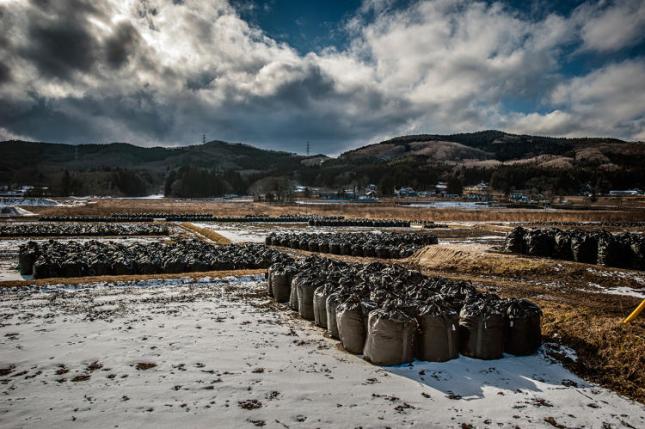
As of 2015, the government reported that there were more than 9 million bags in the prefecture. Some of it will be moved inside the no-entry zone next to the nuclear plant, which is so radioactive that the government has given up on decontamination for the moment. But Japan is also sending radioactive waste to other parts of the country.
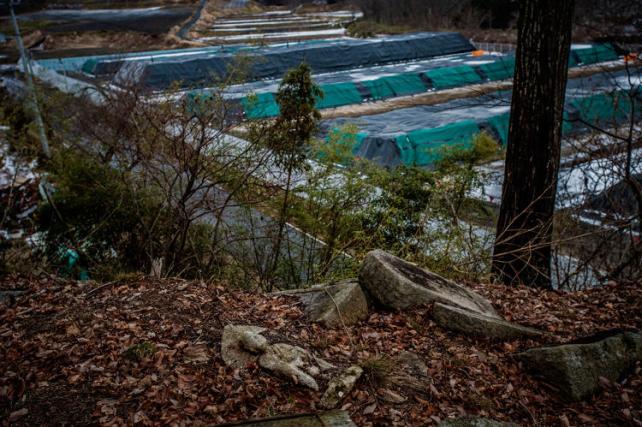
“The Japanese government decided early on in the decontamination process that all prefectures in Japan should share the burden of storing radioactive waste with Fukushima Prefecture,” says Delano, who has been photographing the disaster since it happened in 2011. “This resulted in firm pushback by communities in other prefectures that are adjacent to sites that were selected.”
They have reason to be concerned: In September of 2015, when there were floods in Nikko, Japan, hundreds of bags of radioactive soil were washed into the local river.
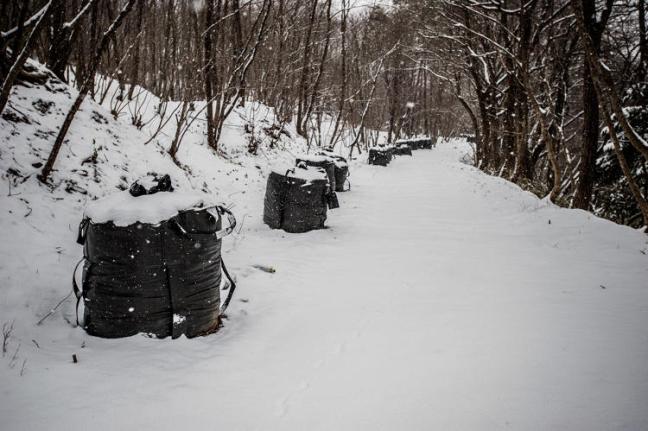
Even in Fukushima itself, in villages where many residents may not be able to return for a decade or more, no one wants a radioactive dump next to their former homes. The dumps are supposed to be temporary and moved in 30 years, but people are skeptical that will happen. “They feel like the presence of the site will be like the last nail in the coffin for their communities,” he says. “So, no one wants this contaminated soil.”
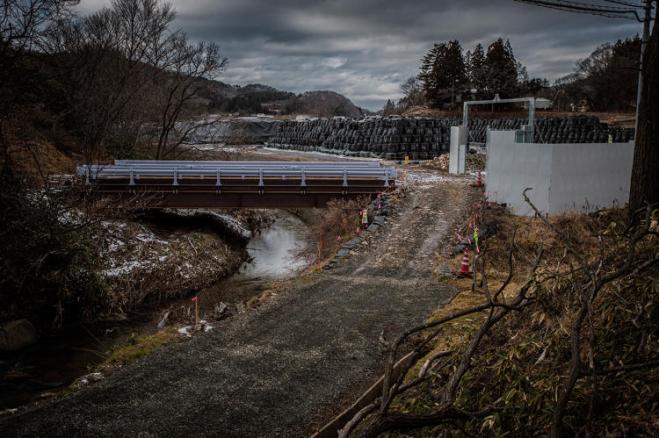
In some areas, a few people have started moving back. “When I used to sneak inside the old 20-kilometer-radius nuclear no-entry zone, I would enter a neighborhood in Minami Soma that was half inside the zone and half outside and hop the barrier to document the absence of humanity,” says Delano. “About one and a half years after the earthquake and tsunami, the no-entry zone was readjusted to reflect the actual radiation levels, instead of being an arbitrary 20-kilometer radius. That meant that the whole neighborhood would be decontaminated and prepared for families to return, if they wanted to do so.”
Some resident returned, but now the fields next to the neighborhood are being cleared for a dump filled with bags of contaminated soil. “People fear the presence of this soil and the dust that every breeze will carry into their neighbor,” he says. “It creates fear and doubt. Many families, especially those with young children, are not returning to this region of Fukushima Prefecture.”

Delano was reluctant to spend much time in the area himself, and carried a Geiger counter and wore a mask while he worked. “I always do my work and get out,” he says. “For example, one hot spot I found in 2012 would expose you to the equivalent of an additional year of natural radiation exposure within 24 hours, if you were to sit there. For obvious reasons, I did not linger there.”
For him, the disaster was personal—he’s lived in Japan for two decades and has Japanese family. Even in Tokyo, the food supply has been affected, and foods are now labeled with the prefecture where they were grown. “You can be careful, but once you go to a restaurant or buy a bento box lunch, all bets are off,” he says.
He also wanted to show how much the area—which was once a peaceful, Vermont-like region of farms—has changed. “It is some of the most beautiful country in Japan,” he says. “This natural beauty only reinforces the sense of loss.”
Nuclear power proponents still scoffing at public safety concerns
An Otsu District Court injunction has suspended operations of two reactors at Kansai Electric Power Co.’s Takahama nuclear power plant in Fukui Prefecture, one of which was online.
Again, the significance of that development should be taken to heart. Proponents of nuclear power, in particular, should squarely face up to the public anxiety that lies in the backdrop of the court decision. But instead they are boiling with disgruntlement.
 “Why is a single district court judge allowed to trip up the government’s energy policy?” Kazuo Sumi, a vice chairman of the Kansai Economic Federation, said resentfully.
“We could demand damages (from the residents who requested the injunction) if we were to win the case at a higher court,” Kansai Electric President Makoto Yagi said, although he prefaced his remark with a proviso that he is arguing only in general terms.
The government is maintaining a wait-and-see attitude.
The decision called into question the appropriateness of the Nuclear Regulation Authority’s new regulation standards and government-approved plans for evacuations in case of an emergency.
But NRA Chairman Shunichi Tanaka argued, “Our standards are nearing the world’s top level.”
And the government has no plans to review its emergency evacuation plans. It has only reiterated that it will “proceed with restarts of nuclear reactors in paying respect to NRA decisions.”
The Otsu decision is the third court order issued against the operation of nuclear reactors since the meltdowns five years ago at Tokyo Electric Power Co.’s Fukushima No. 1 nuclear power plant.
There has, in fact, been no fixed trend in court decisions. Another court rejected residents’ request last year for an injunction against reactor restarts at Kyushu Electric Power Co.’s Sendai nuclear plant in Kagoshima Prefecture.
But courts appear to be playing a more active role now than before the Fukushima disaster.
The nuclear proponents’ reactions reveal an underlying thinking: “The use of nuclear power is indispensable for Japan, which does not abound in energy resources. The government set up the NRA following the Fukushima disaster to increase expert control. Regional utilities have also taken safety enhancement measures. Courts are therefore asked not to meddle.”
But they should have a deeper understanding that this argument is no longer convincing to the public and court judges.
Some critics say the latest decision deviated from the 1992 Supreme Court ruling saying that decisions on the safety of nuclear plants should be made by administrative organs on the basis of expert opinions. But that argument is also off the mark.
The ruling, given in a case over Shikoku Electric Power Co.’s Ikata nuclear plant, certainly presented that point of view. But it also stated that the objective of safety regulations based on the Law on the Regulation of Nuclear Source Material, Nuclear Fuel Material and Reactors is to “make sure that no serious disaster will happen by any chance.”
A safety net, left in the hands of experts, collapsed all too easily during the Fukushima disaster, turning the phrase “by any chance” into reality.
Courts, which are the guardians of law, should rather be commended for trying to find out independently, to the extent that they can, if there is enough preparedness when a nuclear reactor will be restarted.
The latest alarm bell sounded by the judiciary sector provides an opportunity to ask once again why all the safety measures taken after the Fukushima nuclear disaster are still struggling to win the trust of the public.
The Fukushima disaster changed the awareness of the public. The judiciary sector was also affected.
It is high time for a change among nuclear proponents.
Fukushima: Where mountains and forests cannot be decontaminated

In the background, workers in Iitate village go about their daily routine of removing the layer of irradiated topsoil, which are then placed in stacks of black bags
FUKUSHIMA, JAPAN – Up to 20,000 workers have been toiling to decontaminate towns and villages to clear the way for evacuated residents to return following the Fukushima nuclear plant disaster.
In head-to-toe protective gear, their primary task is removing by shovel and machinery topsoil contaminated with radioactive caesium, which leaked from the crippled power station when a tsunami swamped it five years ago.
The soil is put into plastic flexible container bags and transported by truck to isolated temporary storage sites, where they are surrounded with bags of clean soil to “seal” off emitted radiation. The interim facilities will receive some 22 million cubic m of soil from 43 cities, towns and villages across Fukushima prefecture. It will be put there for 30 years.
Soil under trees, in roadside ditches and places such as drain spouts get particular attention. This is where the radioactive pollutants tend to concentrate after being washed off roofs and pavements by rain and snow.

Once considered among the most beautiful villages in Japan, the farmlands of Iitate are now dotted with black bags – called ‘flexible container bags’ – holding contaminated soil.
The cleanup process also includes brushing and wiping rust or stains from roofs, removing sediment, washing roadside ditches and removing leaves from under trees.
But there remains a sizeable area where decontamination was suspended due to high radiation levels, including Futaba district, where the power plant is located.
The disaster also contaminated vast amounts of paddy straw and grass with radioactive material. This has led to plans for facilities for “designated waste”, which from Fukushima alone accounts for around 140,000 tonnes. It is now temporarily stored on farmland and at waste incineration plants.
The radiation reality will last for years to come.
“While it is possible to decontaminate residential areas, the same cannot be done with mountains and forests. You can’t remove all the trees. But radioactive matter has contaminated trunks and leaves, and when rain falls, these particles return to the ground,” said Ms Emiko Fujioka, secretary-general of non-profit group Fukushima Beacon.
Self-censorship sensed as Japan’s TV stations replace outspoken anchors
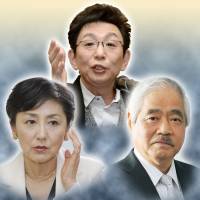
The faces of Japan’s TV news are changing.
Broadcasters are under increasing political pressure from the government and a succession of outspoken anchors and newscasters have resigned.
Experts worry the situation marks a crisis in TV journalism, for it is believed broadcasters are now exercising self-censorship as they seek to toe the administration’s line.
Hosts Ichiro Furutachi of TV Asahi’s influential “Hodo Station” and Shigetada Kishii of the TBS evening news program “News 23″ will both be replaced in April. NHK, too, is considering pulling longtime anchorwoman Hiroko Kuniya from its “Close-up Gendai” news and features program.
Furutachi has often been criticized by the government and its supporters for his commentaries.
He is unrepentant. During a news conference announcing his departure, Furutachi reiterated his motto: “Newscasters at times represent the voices against the powers that be.”
Kuniya’s departure has long been whispered about as she is known for asking big-name politicians tough questions. However, she has survived until now.
Similarly, Kishii expressed opposition to contentious security bills before they cleared the Diet last September and called on fellow opponents to speak up.
“Voices should continuously be raised (for the bills) to be scrapped,” he declared.
Criticism was heaped upon him, particularly from the right. One conservative political group said his statement violated the Broadcast Law, which states broadcasters must be politically impartial.
On Tuesday, TBS named Hiroshi Hoshi, 60, a senior writer with the left-leaning Asahi Shimbun daily newspaper, as Kishii’s replacement.
Some analysts see cause for alarm in the slew of anchor replacements.
“There must be different reasons behind each station’s move, but if three journalists quit in succession, the audience would get the impression that it was the results of their criticism of the administration,” said Hiroyoshi Sunakawa, a professor of media studies at Rikkyo University.
It was around the Lower House election of 2014 that the ruling Liberal Democratic Party began to exert stronger demands on TV stations.
In one example, the government issued a document to Tokyo-based stations demanding that they “ensure fairness, neutrality and correctness” in their election coverage. In 2015, the LDP summoned TV executives for questioning over the content of the “Hodo Station” and “Close-up Gendai” programs.
Having experienced that pressure, the stations now are believed to refrain from running content that criticizes the administration.
“I don’t want to take risks,” said one young employee at a commercial TV station.
A source close to NHK sighed and said there is a growing atmosphere among NHK staff that they should be second-guessing the administration’s expectations.
30,000 Japanese March In Protest of Restarting Nuclear Power Plants
An estimated 30,000 anti-nuclear activists attended a rally in Tokyo’s Yoyogi Park, Friday, to protest against Prime Minister Shinzo Abe’s plan to reopen a number of Japan’s nuclear reactors.
Environment Ministry presents contaminated waste disposal plan for Fukushima

Environment Minister Tamayo Marukawa speaks at the beginning of a meeting on interim storage facilities in the city of Fukushima, on March 27, 2016.
FUKUSHIMA — The Ministry of the Environment announced on March 27 that the government expects to acquire up to 70 percent of land for interim storage facilities for waste contaminated with radioactive materials emanating from the Fukushima nuclear crisis and bring up to 40 percent of contaminated soil into such facilities by the end of fiscal 2020.
The ministry has a rough road ahead, however, since as of March 25 it had only acquired about 1.3 percent of the land needed to build storage facilities straddling the Fukushima Prefecture towns of Okuma and Futaba, and it also faces serious challenges in negotiations with landowners.
On a total of 1,600 hectares of land, the interim storage facilities will be equipped with disposal sites for contaminated soil and other materials, as well as incinerators to reduce the volume of contaminated waste derived from decontamination work around the Fukushima No. 1 Nuclear Power Plant. Delivering of the waste began in March 2015 as a pilot project and it will be stored at the site up to 30 years.
The Environment Ministry presented the projection at a meeting held in the city of Fukushima on March 27. It announced the plan to secure 640-1,150 hectares, or 40-70 percent of the areas for the interim storage sites, by the end of fiscal 2020. A ministry official explained how it calculated the figures, saying that the ministry has already contacted 1,240 landowners by visiting their homes and “there is a feeling” that they will cooperate with the ministry’s plan.
Up to 28 million cubic meters of waste contaminated with radiation that is currently stored across Fukushima Prefecture is planned to be brought to the storage sites, and the ministry expects to deliver 5 million to 12.5 million cubic meters of that to the facilities by the end of fiscal 2020. Environment Minister Tamayo Marukawa told a March 27 news conference in the city of Fukushima that the ministry plans to remove contaminated soil stored at schools and residential areas first, adding, “We’ve allowed a wide range in the projected figures (as negotiations with landowners are underway).”
Meanwhile, Toshitsuna Watanabe, mayor of the town of Okuma where an interim storage facility is planned to be built, expressed appreciation for the figures presented by the ministry to some extent, saying, “Though it appears to be a rough projection, I recognize that they at least presented the target figures.” He added, “With no goals presented before this, local residents were beginning to suspect the central government’s willingness (to put efforts in the storage project). We hope the ministry undertakes the task to reach those targets.”
A 61-year-old landowner who has evacuated from Okuma to the Fukushima Prefecture city of Iwaki questioned the ministry’s plan, saying that 40-70 percent of land acquisition in five years is “too slow.”
“I have decided to sell the land, but the government hasn’t yet shown me the amount of compensation payment,” the man said.
The village of Iitate, currently under radiation evacuation orders, is working toward the lifting of the evacuation orders by the end of March 2017, excluding areas that are designated as “difficult-to-return” zones with high levels of radiation. Iitate Mayor Norio Kanno says, “According to the ministry’s plan, contaminated waste might not be removed (from the village) for five more years. There are piles of bags filled with contaminated soil and they are preventing disaster recovery efforts,” adding, “I want the ministry to speed up the land acquisition process.”
http://mainichi.jp/english/articles/20160328/p2a/00m/0na/011000c
Fukushima evacuee Hiroshi Ueno does not want to return to his old house
FUKUSHIMA, JAPAN – Having settled into a new life with his family outside Fukushima prefecture, Mr Hiroshi Ueno has no intention of returning home.
The 51-year-old, who was a florist in Minamisoma city – around 30km north of the Fukushima No. 1 nuclear plant – now handles data management at a support centre for other evacuees.
His son was 18 and about to start his first job when disaster struck on March 11, 2011. The extended family of 10, including Mr Ueno’s elderly parents and his sister’s family, decided to evacuate the very next day.
At that time, there was no official word from the Japanese government for mass evacuation but many residents feared the worst – a meltdown from the nuclear plant.
“Most of us left our houses without even tidying up our homes which were damaged by the earthquake,” Mr Ueno told The Straits Times.
“No one knew what would happen next.”
They packed only the bare essentials into their car and began their journey as evacuees. Over the next five days, they drove from one place to another before finally arriving at Yonezawa city where they now live. Their former home in Minamisoma had become a no-go zone.
It was only a year later that Mr Ueno and his wife were allowed a brief visit back to retrieve their important documents and other belongings.
“Wearing protective suits, we got on a bus with others who were from the same area,” he said. They were allowed to stay for only two hours and had to wear dosimeters to keep track of radiation levels.
Five years on, he would rather not return home.
“There are many issues like housing, compensation and security that have yet to be fully resolved.”
Damaged and worn out, the house will soon be demolished for redevelopment. But Mr Ueno will not be returning.
“Even looking at it is painful,” he added. “But for my parents, the house is full of memories… it is something that they couldn’t bear to let go of.”
Fukushima evacuee Miyuki Satou returns to ground zero – only to serve up piping hot bowls of ramen
FUKUSHIMA, JAPAN – It was about 2pm on a chilly Tuesday but there were no customers in Ms Miyuki Satou’s makeshift shop next to the Naraha town hall office, where she serves up piping hot bowls of ramen and udon.
The town was evacuated in the aftermath of the triple Tohoku disaster in 2011.
Although Naraha was the first town located entirely within a 20km radius of the crippled Fukushima No. 1 power plant to have its evacuation order lifted in September last year, people have been slow to return. Only 976 of its population of 7,700 have come home – mostly the elderly.
One key reason for this is that families have already rebuilt their lives and bought new homes elsewhere, including Ms Satou’s.
The 51-year-old was a former resident of the coastal town bordering the Pacific Ocean, but now lives with her two daughters who have full-time jobs in the neighbouring Iwaki city.
But her ties with Naraha have led her back to run a food business – one of only two eateries there. Both close at 3pm.
Every day she has about 70 customers – mostly workers tasked with rebuilding the town where black bags of contaminated soil still remain a common sight, or former residents who have come back to visit.
She estimates only 10 per cent of her customers are residents who have moved back home.
“There is really no demand and so there is no point opening late,” she said. “Naraha used to be a much livelier town before the disaster, but now it just feels very lonely.”
It makes no sense for young families to return, when it is more convenient to live near their new workplaces or schools, she added.
But despite the nuclear disaster having changed her life, she offered a moderate take on the use of nuclear power.
Prime Minister Shinzo Abe’s administration has said that Japan “cannot do without nuclear power” and has set a target to have nuclear power make up as much as 22 per cent of the country’s energy needs. Recent attempts to restart reactors elsewhere in the country – halted over public safety concerns following the 2011 disaster – have become entangled in a web of lawsuits.
The use of nuclear energy has split popular opinion in Japan. Ms Satou acknowledged it was a difficult question.
“It is an industry that can create a lot of jobs,” she said. “It will of course be better to use other forms of energy but I don’t think we have found one yet.”
High radiation keeps Fukushima evacuee Mitsue Masukura away from home
FUKUSHIMA, JAPAN – Retiree Mitsue Masukura, 63, who used to live in the coastal town of Namie, knows she will not be returning home anytime soon.
The Japanese government’s target is to declare all areas around the crippled Fukushima No. 1 power plant livable by March next year (2017), except for three towns. Namie is one of the three. Certain parts of the town remain off limits because decontamination works have been suspended given the high radiation dosages.
Residents like Ms Masukura, a former fishmonger, are already allowed to return for only short periods during the day. They are not allowed to stay overnight.
Not that she has any plans to return.
She said: “Even if we move home, there will hardly be any amenities because many of the former merchants have moved out and started new businesses elsewhere.
“Besides, people still do not really feel safe about returning to a town so badly affected by the nuclear fallout.”
Despite official assurances of the contrary, her unwillingness to trust the authorities stems from a case of ‘once bitten, twice shy’.
In the immediate aftermath of the March 11, 2011, disaster, there was poor communication of the situation, and conflicting instructions, which led to a lot of speculation, she said.
“We didn’t know who said what or where we should go,” she said.
As a result, her family of five moved five times from town to town, ryokan (a traditional Japanese inn) to ryokan, before settling in their current temporary living quarters in Fukushima city. Each unit is smaller than the size of a one-room flat in Singapore. Her family used to live together under one roof, but now stay next door to one another across three units.
She looks forward to the family buying a house and moving to Minamisoma next year, after her grand-daughter graduates from senior high school.
When asked how she felt about not being able to return home to Namie, she said: “It’s been already five years since we left. There are all these memories of the past, which will continue to live on in the mind.”
Fukushima Special Report: When is it safe to go home?
FUKUSHIMA, JAPAN – For 72-year-old Mr Nobuyoshi Ito, home is an isolated village with only 40 other residents. Once considered among the most beautiful villages in Japan, Iitate is today a shell of its former self before a nuclear disaster five years ago.
Most of the homes, left behind by around 6,000 residents, are empty. Farmers have been replaced with masked workers tasked with filling up black bags of contaminated soil. Only parts of the village, about an hour’s drive inland from the crippled Fukushima No 1 power plant, have been deemed safe for visitors, and they cannot stay overnight.
But that has not stopped Mr Ito, a former IT engineer-turned-farmer, from returning and staying in open defiance to study the effects of the radioactive plume that hit after the nuclear plant on the east coast of the main island Honshu was destroyed by a tsunami.
“When the government asked us to evacuate … I asked if there would be criminal charges if I continued to live here,” he said. “They said no.”
“I am a test subject, making use of the environment,” added Mr Ito, now a lobbyist opposing nuclear energy. He carries a hand-held meter to record the radiation he is exposed to daily, at his own expense.
Readings in Iitate now can range between 1.1 and 1.9 microsieverts per hour, according to government monitoring posts, which is more than 10 times those in places such as Tokyo, 250km south, where readings are around the globally accepted norm of 0.1 microsieverts per hour. This translates to a benchmark for safe radiation absorption of 1 millisievert (1,000 microsieverts) per year, although the International Atomic Energy Agency and others say anything up to 20 millisieverts per year poses no immediate danger to human health.
Mr Ito spends most of his time in the village but once a month drives three hours to Niigata prefecture on the west coast where some of his grandchildren live.
But many others from Iitate have had to evacuate to cramped temporary housing – smaller than a one-room flat in Singapore.
It is a bitter pill to swallow, said Mr Ito. “For older people like me, a slight exposure to radiation is all right, compared to the stress of living in temporary housing,” he said.
On the wall in his office is a 2011 calendar, which he has not taken down because “the female model is cute”. But it is a sombre reminder of the lives that were lost or upended at 2.46pm local time on March 11 when a 9.0-magnitude earthquake triggered a 10m wall of water that ravaged the northeastern coast of Japan and caused meltdowns in three reactors at the Fukushima plant. It was the world’s worst nuclear accident since the Chernobyl disaster in 1986.
Some 16,000 people died, most by drowning, 2,500 are still missing, and another 100,000 evacuees have not returned home. About 60 per cent of them still live within Fukushima prefecture. After the disaster, residents within a 20km radius of the No. 1 nuclear plant were evacuated, and some areas 30km away such as Iitate were cleared because of high radiation levels.
The health consequences of the leaking radiation are still unclear but more than 300,000 people aged below 18 have been screened for thyroid cancer. About 150 have tested positive, although some attribute this to more rigorous testing rather than the direct impact of radiation.
Last October, Japan confirmed the first case of radiation-linked cancer for a former Fukushima nuclear plant worker. Among evacuees, factors like stress, poor diet and a lack of exercise have also taken a toll.
Japan is halfway through a 10-year reconstruction master plan. Some 26.3 trillion yen (S$319 billion) has been budgeted since 2011 and another 6.5 trillion yen was approved this month to speed up the construction of public housing for evacuees, and for other projects such as medical care and infrastructure.
Decontamination process
Japan Ministry of Environment official Hitoshi Aoki said the government expects to lift evacuation orders by March next year in all but three areas – Namie, Futaba and Ookuma – where decontamination efforts have been suspended because of high air dose radiation. It has not yet been decided when these areas, which are closer to the plant, will be cleaned up.
The cleanup process involves removing topsoil, since cesium – a radioactive byproduct of the Fukushima meltdown – falls to the ground when it rains or snows, said Mr Aoki.
The disaster forced all of Japan’s dozens of reactors offline in the face of public worries over safety but Prime Minister Shinzo Abe said this month that Japan “cannot do without nuclear power”.
This has split public opinion and most of the country’s reactors remain shut down.
Population drain
Iitate village is expected to be one of the areas to reopen next March.
But contamination, and a general mistrust of the Government for not being upfront or transparent about the extent of the nuclear disaster in the immediate aftermath, are among reasons former Iitate residents like Mr Hideji Suzuki, 78, are reluctant to return home.
Once a farmer, he now lives with his wife in temporary housing quarters an hour by car from their old house.
“We can’t go back to Iitate anymore, even if we want to,” he said.
Residents like him will not be able to return to their former lifestyles and jobs in the mountains – which cannot be decontaminated easily – even if they moved back.
The disaster has accelerated a demographic shift away from affected cities within Fukushima prefecture.
Minamisoma city, 30km north of the plant where lower radiation levels have allowed evacuated residents to return, has seen “rapid aging”, said city official Mr Tokio Hayama. Offices have reopened but the working population – over the age of 15 and below 65 – has yet to recover.
“We need to dispel the fear of radiation, which has become a major factor that prevents their return,” said Mr Hayama.
The disaster has also split families, like Mr Yasuhiro Abe’s. The 52-year-old moved his wife and 14-year-old daughter to Kyoto, concerned about their health in the wake of the nuclear fallout.
But he stayed behind in Fukushima City – 90km from the power plant and unaffected by the exclusion order – to continue running a movie theatre he has worked at for almost 30 years.
“As far as possible, we want to raise our child in a place with lower radiation levels,” he said. “When she comes of age, she can choose whether to come back.”
Former residents have been slow to return to the seaside town of Naraha also, which was the first within the exclusion zone to have the evacuation order lifted in September last year. Many families have already rebuilt their lives elsewhere and in the six months since, only 976 of the town’s 7,700 original inhabitants have come home – mostly the elderly.
Former residents like Ms Shinoda Tomoko, 78, have chosen to move out – and move on with their lives. She now lives 60km south of the Fukushima plant in Iwaki city with her children and grandchildren who have new jobs and are attending new schools.
But retiree Tomiko Igari, 69, intends to buck the trend. On one of her regular trips back to Naraha, she said she will return in October this year, after the lease on the flat where she now lives runs out.
Her home is just across the road from a vast field that is still full of black bags with contaminated soil.
“My only hope is that when I come home, all of that will be gone,” she said. “It’s really an ugly reminder of the accident.”
http://www.straitstimes.com/asia/east-asia/fukushima-special-report-when-is-it-safe-to-go-home
Fukushima evacuee Yasuhiro Abe hopes to share same roof as wife and daughter
FUKUSHIMA, JAPAN – For Mr Yasuhiro Abe, 52, seeing his wife and daughter means an eight- to nine-hour drive south from Fukushima to Kyoto.
The mother and daughter have been living as evacuees for the past five years, since a massive earthquake and tsunami triggered a nuclear disaster in their hometown in Fukushima prefecture.
But unlike many others who were issued evacuation orders, they decided to uproot voluntarily because they are worried that harmful radioactive material could spread west with rain or snow.
His daughter was nine when the meltdowns at the Fukushima No. 1 nuclear plant happened, Mr Abe
The family first moved to the neighbouring prefecture of Yamagata before heading further away and finally settling down in the ancient city of Kyoto.
His wife and daughter now rent a home in Kyoto while Mr Abe has returned to his job as the general manager of a theatre where he has worked for almost 30 years. Now, he visits them twice every three months.
“Fukushima city and Koriyama city – inland areas within the prefecture – were never made evacuation zones despite heightened radiation levels right after the disaster,” said Mr Abe, who thinks that a factor could have been the higher population density in cities, compared to coastal towns.
He is skeptical that the heightened levels were still deemed safe.
“As far as possible, we want to raise our child in a place with lower radiation levels,” he said. “When she comes of age, she can choose whether or not to come back.” “As for myself, I’ll always be here.”
Five years on, he finds himself at a crossroads.
“In March next year (2017), the Government will be stopping housing assistance for voluntary evacuees and if we want to continue living elsewhere, it will cost more money,” he said.
While the cost of living will become an issue, he is more concerned about ensuring that his daughter completes high school without disruption. She will begin high school, likely in Kyoto, next year.
“Parents like ourselves have to consider the impact on our children’s lives before deciding if we should relocate,” said Mr Abe.
“Of course, a part of me wants them to come back – for us to live together again.”
Land acquisition for Fukushima dump site may reach 70% by 2020: ministry
FUKUSHIMA – The Environment Ministry will likely be able to acquire about 40 to 70 percent of the site it plans to use as an interim storage facility for radioactive soil and other waste from the Fukushima nuclear disaster by fiscal 2020.
The estimate is part of a five-year road map for building the facility that was presented Sunday to a council in the city of Fukushima representing the prefecture and local municipalities.
The 1,600-hectare (3,953-acre) site straddles the towns of Okuma and Futaba, home to Tokyo Electric Power Co.’s heavily damaged Fukushima No. 1 nuclear plant, where a triple meltdown was triggered by tsunami spawned by the March 2011 Great East Japan Earthquake.
If 640 to 1,150 hectares are acquired, 5 million to 12.5 million cu. meters of radiation-tainted waste can be stored there. By fiscal 2020, the ministry aims to finish transporting radioactive soil now being stored at schools or residential areas.
Environment Minister Tamayo Marukawa told reporters after the meeting that the ministry’s calculations are based on a realistic approach, adding it will continue lobbying local landowners to support the project.
To complete the project, the ministry will have to negotiate with 2,365 landowners whose property is on the targeted 1,600-hectare site. As of Friday, the ministry had visited about 1,240 of them and acquired a mere 22 hectares from 82 of them.
The negotiations are taking longer than expected due to the need to calculate official compensation. The planned facility is slated to store up to 22 million cu. meters of radioactive waste for decades.
By the end of the month, about 50,000 cu. meters of waste are expected to be transported to a provisional storage facility set up at the site.
In fiscal 2016 starting April 1, the ministry plans to transfer about 150,000 cu. meters to the site and increase the amount in stages, depending on progress with the land acquisition process.
How long shall we accept Japan to pollute our skies with incineration of radioactive materials?
I regret that so much energy, so much money was wasted into the making of this « beautiful » documentary, produced by NHK for the 5th year Anniversary, to spin and to twist the truth so as to make it more acceptable to the eyes of the victims themselves and to the eyes of the world, to brainwash world opinion about the present ongoing situation at Fukushima Daiichi and in Fukushima prefecture.
Of course it is fully expected as it is coming from NHK, which is to Japan what the Pravda newspapers was to the Soviet era, the Japanese central government nationwide propaganda organ.
Using foreigners to give more credibility to their delivered spiel is quite slick, those foreigners shills remind me a lot of some of the French collaborators working for the German Gestapo during the the German Occupation of France in exchange of material benefits, those will not be the first nor the last.
Beside the whole positive reconstruction spin, there is only one point that will should remember and take seriously : the whole reconstruction-decontamination program of the Japanese government is entirely based on incineration.
They tell us that their incineration technology will keep contained 99,9% of the radionuclides , that none will end up into our skies.
Why should we trust them, during the last 5 years they haven’t be very trustworthy nor straightforward to say the least.
How long are we gonna accept, tolerate Japan, to pollute our skies, our commonly owned and shared living environment, with their radioactive mess ?
Fukushima Prefecture has become a familiar name worldwide as a result of the nuclear accidents in 2011. Ever since then, the world has been concerned about what’s happening regarding radioactive contamination in the prefecture. To answer that question, the program will squarely face what’s been going on in Fukushima since the accidents.
French documentary filmmaker Keiko Courdy, who has been covering Fukushima since the nuclear accidents, will appear as a guest, along with experts on radiation, and the situation in Fukushima today will be explained in an easy-to-understand manner.
Various people who have appeared on TOMORROW will also take part. The program considers the future of Fukushima by featuring those who continue striving to overcome many hardships. They include villagers who have been carrying out decontamination work in the evacuation zones, hoping to return to their homes, and young people who are showing remarkable progress in re-energizing Fukushima’s farming with their new ideas.
Available until April 11, 2016
http://www3.nhk.or.jp/nhkworld/en/vod/tomorrow/20160326.html
Protesters slam ‘radiation-exposed’ Japanese sake festival
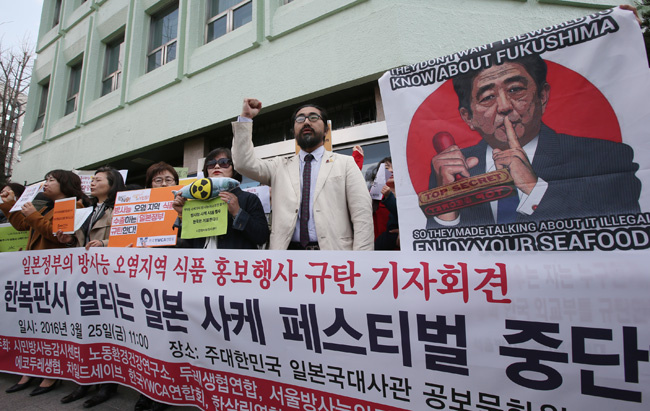
Civic groups protest in front of the Japanese Embassy in Jongno-gu, Seoul, demanding to stop the Seoul Sake Festival 2016 that may bring sakes contaminated with radiation from the Fukushima nuclear plant disaster five years ago.
By Ko Dong-hwan
Civic groups protested against a Japanese sake festival in Seoul on Friday, in a bid to prevent visitors from tasting possibly dangerous alcohol produced in areas near the Fukushima nuclear plant disaster five years ago.
Eleven civic groups held a press conference in front of the Japanese Embassy in Jongno-gu, demanding that Japan stop the Seoul Sake Festival 2016.
“Seven of the participating Japanese breweries made their liquor in areas near Fukushima, where our government has warned of possible danger from radiation,” a protester said. “The breweries must have made their liquor using water and rice from the areas. Such liquors will jeopardize our health.”
Three breweries in Miyagi Prefecture, as well as from Iwate Prefecture, Ibaraki Prefecture, Gunma Prefecture and Tochigi Prefecture participated in the festival. The Korean government stopped importing seafood from those areas in September 2013 to prevent possible radioactive contamination.
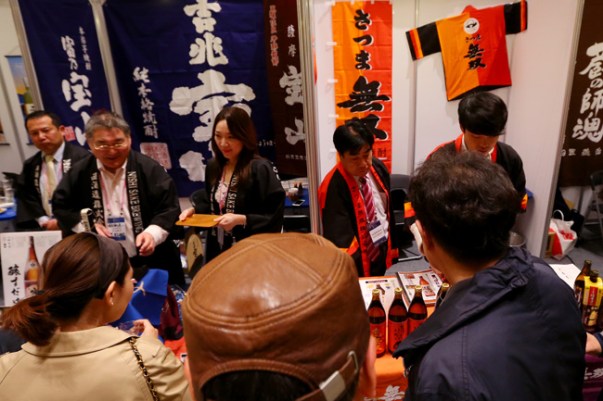
One hundred Japanese breweries introduced about 400 sakes at COEX, eastern Seoul, from Saturday to Sunday.
In March 2011, Fukushima 1 Nuclear Power Plant was hit by an earthquake-triggered tsunami. The impact caused a meltdown and release of radioactive material.
The Japanese embassy, according to Hankook Ilbo, said, “The festival organizers didn’t check whether the participating breweries were from areas that possibly were compromised by radioactive contamination, but all the food and liquor in the festival were tested in Japan and Korea.”
One hundred Japanese breweries introduced about 400 sakes at COEX, eastern Seoul, from Saturday to Sunday.
http://m.koreatimes.co.kr/phone/news/view.jsp?req_newsidx=201227
1 This Month

4 May -West Suburban Peace Coalition to discuss Iran war at May Educational Forum
Monday, May 4, 7:00 – 8:00 PM Central Standard Time
Title: : How Trump’s Narrative Tries to Shape the Reality of the War on Iran.
Contact Walt Zlotow, zlotow@hotmail.com 630 442 3045 for further information
14 May – online event From Bombs to Data Centres: the Face of Nuclear Colonialism
To see nuclear-related stories in greater depth and intensity – go to https://nuclearinformation.wordpress.com
-
Archives
- May 2026 (37)
- April 2026 (356)
- March 2026 (251)
- February 2026 (268)
- January 2026 (308)
- December 2025 (358)
- November 2025 (359)
- October 2025 (376)
- September 2025 (257)
- August 2025 (319)
- July 2025 (230)
- June 2025 (348)
-
Categories
- 1
- 1 NUCLEAR ISSUES
- business and costs
- climate change
- culture and arts
- ENERGY
- environment
- health
- history
- indigenous issues
- Legal
- marketing of nuclear
- media
- opposition to nuclear
- PERSONAL STORIES
- politics
- politics international
- Religion and ethics
- safety
- secrets,lies and civil liberties
- spinbuster
- technology
- Uranium
- wastes
- weapons and war
- Women
- 2 WORLD
- ACTION
- AFRICA
- Atrocities
- AUSTRALIA
- Christina's notes
- Christina's themes
- culture and arts
- Events
- Fuk 2022
- Fuk 2023
- Fukushima 2017
- Fukushima 2018
- fukushima 2019
- Fukushima 2020
- Fukushima 2021
- general
- global warming
- Humour (God we need it)
- Nuclear
- RARE EARTHS
- Reference
- resources – print
- Resources -audiovicual
- Weekly Newsletter
- World
- World Nuclear
- YouTube
-
RSS
Entries RSS
Comments RSS
 nuclear-news