TEPCO examines ice wall at Fukushima Daiichi
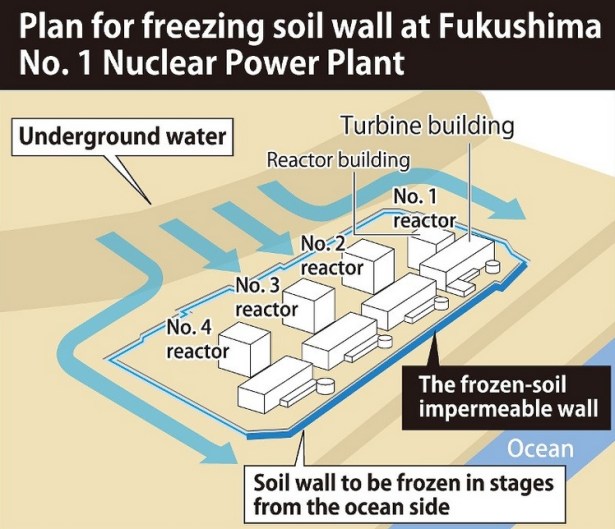
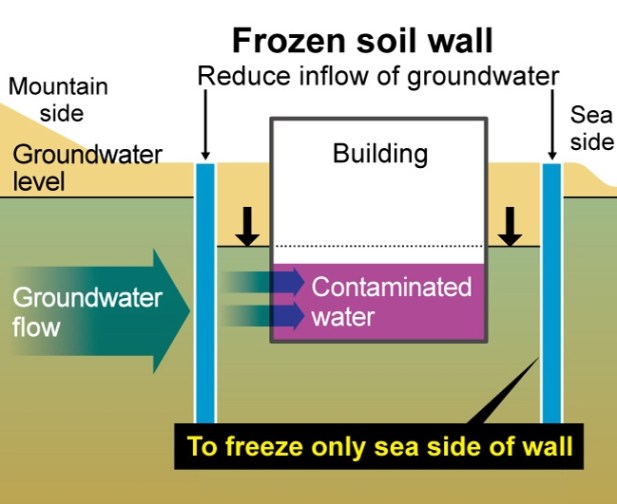
The operator of Fukushima Daiichi nuclear power plant will conduct extra work to help freeze the ground around the buildings housing the 4 crippled reactors.
Tokyo Electric Power Company discussed the idea with officials of the Nuclear Regulation Authority on Thursday.
TEPCO made the proposal after reporting some problems with a 1.5-kilometer-long frozen soil wall it has been building around the 4 reactor buildings since March.
The wall is aimed at cutting the amount of groundwater flowing into the basement of the buildings, where it becomes contaminated with radioactive substances and can flow out of the plant in the direction of the sea.
TEPCO said the amount of groundwater in some areas outside the wall near the sea has not yet fallen.
TEPCO said rainfall may be partly to blame for the problem, and added that it has seen a drop in groundwater levels elsewhere, in areas much closer to where the wall has been completed successfully. TEPCO said that, overall, the wall appears to be proving effective.
But many members of the regulatory agency said TEPCO’s argument is not convincing enough.
TEPCO admitted that underground temperatures at several locations along the wall have not yet fallen to zero, which indicates that the ground is not frozen there.
TEPCO said it will start extra work to pour cement into those locations to help seal off the wall completely.
The utility said it will be about a month before it can determine if the extra work has started producing a positive effect in reducing the amount of groundwater flowing in.
http://www3.nhk.or.jp/nhkworld/en/news/20160602_28/
How the Advertising Giant Dentsu Dominates Japanese Media Presentation on Nuclear Power?
Does the advertising giant Dentsu pull the strings of the Japanese media?
Sachie Mizohata, Translation from French and Introduction
Original French article in INA Global
Japanese translation by Uchida Tatsuru (see May 15, 2016)
Introduction: How the Advertising Giant Dentsu Dominates Japanese Media Presentation on Nuclear Power?
French journalist Mathieu Gaulène describes the business practices of Dentsu and its competitor Hakuhodo, the biggest and the second biggest advertising companies of Japan respectively. Specifically, it examines how their close relations to the media and the nuclear industry play out in the wake of the 3.11 earthquake, tsunami and nuclear disaster. Focusing Dentsu, Gaulène discusses how the marketing and public relations (PR) giant has dominated major media which large advertising contracts from the nuclear industry. The article is particularly timely as Dentsu unveils its deep ties to the Tokyo 2020 Olympic bid and the Panama Papers. Regrettably, however, with rare exceptions, there is little media coverage of the influence of Dentsu in mainstream Japanese newspapers and magazines.
According to the author, a partial translation of the French original was made by Kazparis (username), and quickly received more than 70,000 views on Twitter. Then, Uchida Tatsuru, a specialist in French literature, and HACK & SOCIETAS published two other Japanese translations. Soon after, Tokyo Shimbun and Mainichi Shimbun published long articles about Dentsu. SN
Summary
Dentsu, the fifth largest communication group in the world, holds a large share of the Japanese advertising market, which impacts media freedom in Japan. This is particularly true in relation to the nuclear power industry.
– Dentsu and information on nuclear power
– Indirect pressures on press journalists
– The 2016 comeback of nuclear advertisements and the resignations of TV journalists
The moment remains famous. On the eve of Japan’s Upper House elections, former actor Yamamoto Taro, an anti-nuclear power candidate supported by no party, campaigned on Twitter to win an upper house seat in the Diet. Censored by the media, the young candidate, famous for his verve, had mainly campaigned against nuclear power, but he also called out the big media, accusing it of being in the pay of sponsors and thus of electric companies and of systematically censoring critical information on nuclear power.
A television channel granted him an interview at the end of a program, but only after presenting a journalist to defend his profession. On screen, the young senator was given only one minute to respond. “I will take a simple example. Food can now hold up to 100 becquerels per kilogram; that means even just via eating we are irradiated. It is never said on television… ” Yamamoto had to stop. The ending jingle started, and the presenter at the studio announced, bantering, that the show was over, before launching an advertising page.
The video, which was available online for 3 years, was removed on May 16, 2016 shortly after the publication of this article.
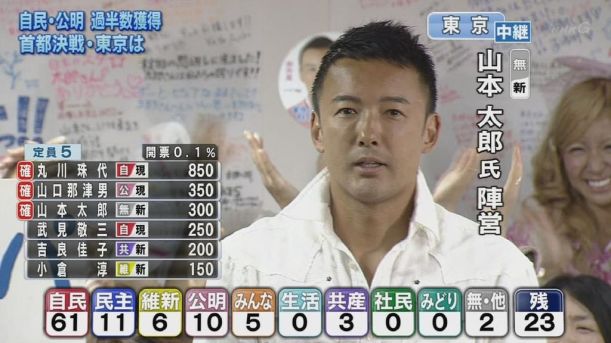
Yamamoto Taro on NHK, 21 July 2013
Advertisements in Japan are literally everywhere: a veritable hell of posters or screens in trains and stations, giant posters on buildings, bearers of advertising placards or lorries with huge posters and loud PA systems in the streets: even advertising displays mounted atop urinals in some restaurants. In this advertising empire, the media are no exception. In the press, naturally, as in France, major companies pay for full page advertisements. But, above all in television. An entertainment show generally starts with the announcement of sponsors, and is interrupted every five minutes by numerous short advertising spots, where we often find the same sponsors. There is virtually no time for thinking, most TV channels offer programs close to the world of pachinko: garish colors, constant noise, and frat humor even of the most vulgar kind.
In this immense television arena, advertising is orchestrated by one of the global giants, Dentsu, the 5th communication group in the world and the number one ad agency. With its rival Hakuhodo, 2nd in the archipelago, the two agencies nicknamed “Denpaku,” combine advertising, public relations, media monitoring, crisis management for the largest Japanese and foreign companies, the local authorities, political parties or the government. Together they hold nearly 70% of the market. A true empire that some accuse of ruling the roost in the Japanese media.
A figure allows sizing up Dentsu’s reach: in 2015, the group secured nearly 7 billion euros in revenue, second only to the French Publicis with 9.6 billion euros during the same period. Most of its business is in TV advertisements. For example, Dentsu has created a commercial series for Softbank for almost ten years: the famous “Shirato” family characterized by a white dog as the father; an American black actor as the older brother; and Tommy Lee Jones as a housekeeper.
In July 2013, the group expanded internationally by acquiring the British Aegis for 3.7 billion euros to establish the Dentsu Aegis Network in London. This international network, consisting of ten advertising agencies in more than 140 countries, allowed the Japanese to beef up their activities, particularly in digital marketing, and to secure a position in the international market which accounts for more than half of its total global business (54.3% in 2015). Dentsu employs 47,000 people worldwide, including 7,000 in Japan.
Dentsu and information on nuclear power
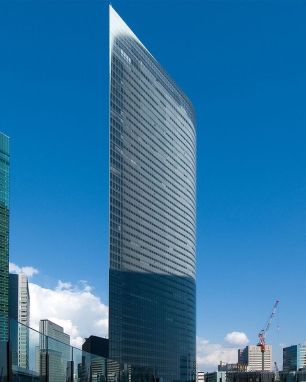
Dentsu headquarters, Shiodome
Located in the business district of Shiodome, not far from Nippon TV, Fuji TV and the Asahi Shimbun newspaper, the Dentsu tower dominates the skyline with its imposing beauty. Designed by the French architect Jean Nouvel, its gentle curves and perfect glass walls soothe the eye. Inside the building, Mr. Kannan Shusaku, communications director of the group, receives us, all smiles for a visit of the site. The ground floor is filled with contemporary art, like a white chessboard by Yoko Ono. From there, a noria of lifts takes employees towards different floors and rigorously separates departments. The group’s customers are the top 5 in each industry, and “everything is done so that employees working for competing enterprises never meet each other.” Mr. Kannan assures us. Dentsu obviously prizes transparency, but is its image that stainless?
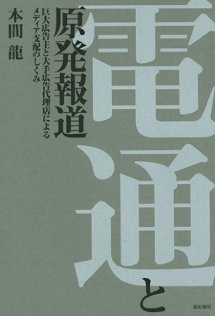
Honma Ryu, Dentsu and Nuclear Coverage
In a book published in 2012, Honma Ryu looked into some of Dentsu’s backstage, and its tight control over the media, especially on behalf of one of its major clients: Tokyo Electric Power Company, Tepco. Honma is not alien to advertising circles; he worked for 18 years at number 2, Hakuhodo, then after one year imprisonment for fraud, he began writing, first about his prison experience, then about his years of advertising and the methods he used to coax the media. In 2012, his book Dentsu and Nuclear Coverage became a bestseller within a few months, despite almost universal media blackout.
Honma meticulously described the mechanisms by which Dentsu, the inevitable intermediary, implicitly imposes on media what can or cannot be written on nuclear power, and under what conditions. “Dentsu occupies a special position since the agency holds 80% of the market for nuclear advertising in Japan,” he reminded us during an interview in a coffee shop at Ueno Station. In 2010, in this huge advertising market, Tepco, a regional firm, indeed ranked 10th in terms of advertising expenses, next to power plant manufacturer Mitsubishi Heavy Industries. That year, on the eve of the Fukushima accident, Tepco had spent more than 2 million euros on advertising. The overall advertising expenses of the 10 regional electrical power companies amounted to 7 million euros.
For decades, especially since the 1990s when public opinion began to become critical of nuclear power following several accidents, Tepco and other power companies stepped up commercials and advertorials in the press.
On television, the advertisements can be enough in themselves to overwhelm criticism. Big groups often sponsor TV programs, talk shows or series for an entire season. Sometimes, entire documentaries are produced by Denjiren, [the Federation of Electric Power Companies of Japan (FEPC)], a key player in the nuclear lobby, to promote the industry. Any dissenting voice is unwelcome for fear of losing sponsors. After Fukushima, Yamamoto Taro paid the price; appearing regularly on TV as a tarento [talent] until then when he suddenly became persona non grata on TV and even in cinema for having expressed opposition to nuclear power. This is hardly new since the great figures of the anti-nuclear movement, best-selling authors such as Hirose Takashi or Koide Hiroaki are almost never invited to appear on TV, especially after the Fukushima accident. This “control by media” denounced by Honma Ryu obviously is not limited to the nuclear power industry. Thus, he reminds us of the case of the millions of Toyota vehicle recalls due to a defective accelerator pedal. It was necessary to wait until the Toyota CEO apologized to the U.S. Congress before that affair really appeared in the Japanese press. “No doubt the advertising agency had succeeded until then in preserving the image of its client, but when the scandal became too big and was in the public eye abroad, the media had no choice but to reveal the affair” he states. It is hardly an exaggeration to say that apart from some programs such as “Hodo Station” on TV Asahi, which provide good quality information, sometimes being critical of the government, most TV news in Japan rarely address subjects that can offend one or another group, relaying communications from the government without critically stepping back, and not introducing international news except when the subject involves Japanese citizens.
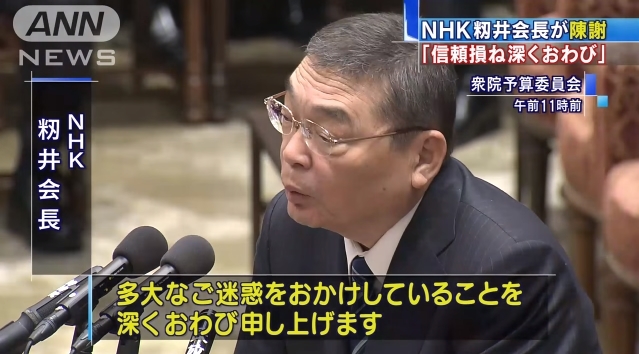
Momii Katsuto apologizing at Lower House Budget Committee session, 13 January 2016
Amid all these private media groups, only NHK escapes this advertising empire and can claim to be independent, receiving its funding directly from viewers. Alas, the situation at NHK is even more disastrous, its president Momii Katsuto having said without embarrassment on several occasions that the chain had to be the spokesman for the Abe government. In a recent statement before 200 retired NHK employees, he even seemingly acknowledged having ordered NHK journalists to confine broadcasts to reassuring communiqués from the authorities about Kyushu earthquakes and potential risks they pose to nuclear plants and instructing them not to interview independent experts.
Indirect pressures on the press
What about the press? Dentsu has long had a special relationship with the two news agencies Kyodo News and Jiji Press: the three entities formed a single information group before the war. If information in the press is more difficult to control, Dentsu not only advertises, but provides after-sales customer service — media monitoring, advice on crisis management, and indirect pressure on newspapers.
Whereas in France, the acquisition of media companies by large industrial groups is the prelude to direct pressure, in Japan pressure comes via advertising agencies that act as true ambassadors for the groups. “I know very well how this happens, as Honma Ryu amusingly relates, I did the same thing when I was at Hakuhodo. If an incident occurs in a factory or a plant and the press reports it, Dentsu directly intervenes and visits the business department of the newspaper in question.” Things are done in the “Japanese” way. “We ask them politely to try to speak less about the case, not to put the article on the front page, or to publish it in the evening paper which is less read.” Such messages are directly transmitted by the business staff of the journal to top management.
Journalists will never know, but the next day their article will be relegated to the inside pages, or sometimes simply not published, or, for example, claiming lack of space. But, suspicions are numerous, and, Honma reports, after the publication of his book, many journalists came to see him confirming cases of censorship. Advertisements of nuclear power are mainly distributed in weekly and daily newspapers. Since the accident at the Fukushima nuclear plant, they stopped; but for Dentsu, a profitable new business emerged: promoting agricultural products from Fukushima. Since 2011, with the participation of star singers, Fukushima Prefecture has never skimped on promoting its peaches, rice, or tomatoes, with slogans like “Fukushima Pride” or “Fukushima is well!”
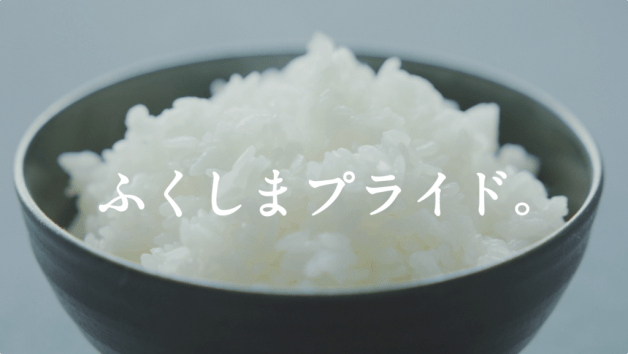
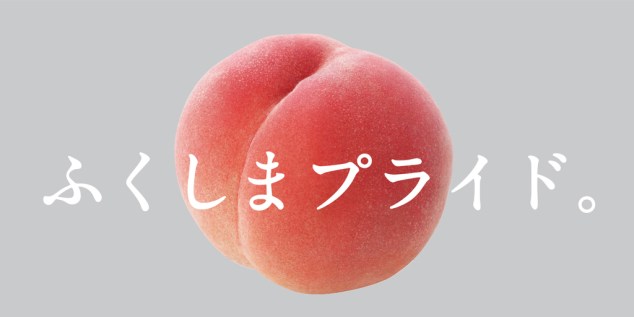
“Fukushima Pride”
All this thanks to the help of Dentsu and Dentsu Public Relations (PR). “Dentsu PR also works for the METI [Ministry of Economy, Trade, and Industry],” explains Ms. Fujii Kyoko, Director of communications at Dentsu PR. “We organized free tours of Tohoku for foreign journalists, such as Thai and Malaysian journalists, to show that the region is recovering from the disaster.” And to expunge the surrounding radioactivity?
Dentsu thus occupies a very special position in the promotion of nuclear power, beside Tepco but also the powerful Ministry of Economy, Trade, and Industry (METI) and the Liberal Democratic Party (LDP), both clients of the advertising company. Under these conditions, can Dentsu not be considered to actively underwrite the “nuclear village”? To this question, Mr. Kannan Shusaku, who received us in his office at the top of the Dentsu tower, answered without beating around the bush. “We have no power to influence the media and we do not practice politics.” Yet when asked why Dentsu is a member of the Japan Atomic Industrial Forum (JAIF), the main organization of nuclear lobbying, along with Japanese electric utility companies and EDF [Electricity of France, Électricité de France], Mr. Kannan became more circumspect. “I do not know this association… Really, are you sure?” he replied, slightly annoyed, before reaching for his smartphone. “Oh, yes, we are members. But, you know we are members of many associations. People ask us to send someone and sign, that’s all.” Apparently unconvinced by his own argument, he finally found a getaway and suddenly exclaimed: “You see, Hakuhodo is also a member!” obviously happy about not being the only one enlisted in the lobby.
The 2016 comeback of nuclear advertisements and resignations of TV journalists
For Honma Ryu, this is a sign of a resumption of promotion activities of nuclear power. “Hakuhodo has actually been a member of the JAIF for two years,” he explained, after the Fukushima accident. Obviously, having been sidelined for several decades from this gold mine of nuclear advertisements, the rival agency wants to restore its share in the promotion of nuclear power in the post-Fukushima era. These ads had, however, completely disappeared since the accident on March 11, 2011. After a final full page apology in the press and broadcast on television by Tepco, the plant operators and manufacturers had chosen to keep a low profile, not broadcasting advertisements on nuclear power for five years.
But, although plant restarts have been hindered by dozens of lawsuits, some victorious as in Takahama, and the general population has generally been reluctant to see resumption of reactors, promoting nuclear power has again become intense. After restarting one plant in 2015, 2016 is the year of a discreet comeback for nuclear advertisements. These appear in the press and on local television of the prefectures with power stations. Honma Ryu reports that since February 2016, full-page advertisements have been published in Fukui Shimbun by the Kansai Electric Power Company, where the Takahama plant was closed a month after its restart due to a lawsuit filed by citizens. Tepco advertisements for restarting Kashiwazaki-Kariwa have also appeared in the Niigata Nippo and on local television in a particular context: the current governor is firmly anti-nuclear and opposes any restart, but elections will be held by the end of this year when his term ends. This resurgence of Tepco nuclear advertising, however, has raised the ire of Niigata citizens, especially refugees from Fukushima who have launched a petition to stop them.
The message of all of these advertisements is identical, revealing the hand of Dentsu behind the scenes. Electric companies promise to make every effort to ensure the safety of power plants, while photographs highlight the plight of nuclear workers who are often poor and sometimes dependent on jobs in the nuclear industry. According to Honma Ryu, these advertisements are certainly only the tip of the iceberg. They are part of a campaign to closely monitor all information published on nuclear power, as well as the quasi-guarantee that local newspapers will limit the voice of opponents.
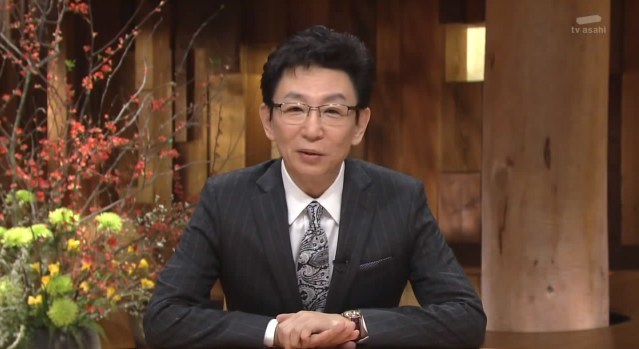
Furutachi Ichiro on “Hodo Station”
In a report on press freedom released in April 2016, Reporters Without Borders ranked Japan 72nd, behind Hungary and Tanzania. Six years ago, it ranked 11th. Visiting Tokyo, a United Nations rapporteur alerted the country to the growing pressures on Japanese journalists who work for private media or NHK. This is because of increasing government pressure, exacerbated by the entry into force in the past year of a law on state secrets, including nuclear related matters. A law with vague outlines threatens journalists with imprisonment for disclosing “secret” information. A sign of the times is that three television journalists known for their independence announced their resignation at the beginning of the year. Among them is Furutachi Ichiro, presenter of “Hodo Station,” which, according to Honma Ryu, was targeted by Dentsu for several years because of his critical views on nuclear power and the Abe administration. No doubt Dentsu, privileged ambassador of the largest industrial groups, will continue to play its role in the great media lockdown ongoing in Japan.
http://apjjf.org/2016/11/Gaulene.html
Japanese gov’t withheld report on Chernobyl disaster’s health effects
The Japanese government has withheld an investigative report it compiled on health effects from the 1986 Chernobyl nuclear catastrophe despite spending 50 million yen on the survey in the wake of the Fukushima nuclear disaster, it has been learned.
The government’s investigation into the aftereffects of the Chernobyl disaster began in November 2012 — the year after the meltdowns at the Fukushima No. 1 Nuclear Power Plant — under the then Democratic Party of Japan (DPJ)-led administration, and was completed in March 2013 after the Liberal Democratic Party returned to power.
The investigative report denies local documents that confirmed far more serious health hazards from the Chernobyl accident in the former Soviet Union than those recognized by international organizations. An expert familiar with information disclosure points out that the report “should be publicized as a resource for verification from a critical point of view, considering that public money was spent on it” amid sharply divided opinions over nuclear power in Japan.
The investigation was budgeted by the Ministry of Education, Culture, Sports, Science and Technology and was commissioned to a Tokyo-based consulting firm funded by power companies. A committee set up to evaluate the survey results was chaired by Nagasaki University professor emeritus Shigenobu Nagataki, who formerly served as chairman of the Radiation Effects Research Foundation. The investigative team primarily examined and assessed two local reports — “Twenty-five years after the Chernobyl accident: Safety for the future” and “Chernobyl: Consequences of the catastrophe for people and the environment.”
The “Safety for the future” report, which was compiled by Ukraine’s Ministry of Emergencies in 2011, points out that the ratio of healthy workers dealing with post-disaster work in Chernobyl plunged from 67.6 percent in 1988 to 5.4 percent in 2008. The latter report, which was put together by local researchers in 2009, estimates that a total of 985,000 people died from the effects of the Chernobyl disaster between April 1986 and December 2004 after their constant exposure to radiation following the disaster triggered cancer, heart and vein disorders and other ailments.
Both reports claim far more serious health hazards than those recognized by international organs, and gained much public attention here in Japan after the reports were highly publicized in the wake of the 2011 Fukushima disaster.
The Japanese government report’s assessment panel examined the two reports with regard to 124 parts concerning blood and lymphatic disorders and analyzed whether radiation dose assessments were carried out where radiation exposure was linked to health damage. The committee also conducted an on-site investigation and concluded that it couldn’t find any resources with which they could determine the relationship between exposure doses and health damage, based on scientific grounds.
Subsequently, the science ministry department that was in charge of the survey was moved to the secretariat of the Nuclear Regulation Authority (NRA) in April 2013, and the Japanese government’s report was not released. The NRA secretariat eventually placed the report in the National Diet Library by way of the Environment Ministry.
Nagataki told the Mainichi Shimbun, “After we filed the investigation report with the science ministry, the ministry department in charge was shifted to the NRA secretariat, leaving us no clues as to what has become of the report. I felt uncomfortable when I heard the report was kept at the National Diet Library, but I also thought it would be inappropriate for us to demand that the report be released.”
A source close to the government told the Mainichi, “The investigation was decided upon under the DPJ administration, and we had to use up the budget. As the government changed hands, we had no intention of proactively publicizing the report.” Another government insider said, “Nondisclosure of the report was also intended to avoid causing fear among people in Fukushima. It was also aimed at preventing harmful rumors.”
http://mainichi.jp/english/articles/20160604/p2a/00m/0na/006000c
Geology graduates investigate Fukushima-derived radioactivity in Hawaii

Trista McKenzie in the lab
On March 11, 2011, following the Tohoku earthquake and tsunami, several reactors at the Fukushima Dai-ichi Nuclear Power Plant suffered damage and released radioactive chemicals into the atmosphere and contaminated wastewater into the nearby Pacific Ocean. Hannah Azouz and Trista McKenzie, two recent graduates from the University of Hawaiʻi at Mānoa School of Ocean and Earth Science and Technology (SOEST) bachelor of science in geology program, assessed the extent to which the soil of Hawaiʻi and locally purchased fish have been impacted by radioactivity from this event.
The students’ mentor, Henrietta Dulai, associate professor of geology, explained the motivation for this work, “My research team has been monitoring Fukushima-derived cesium in the Pacific Ocean since 2011 and we concluded that the Hawaiian Islands were spared from a direct hit of radionuclide plume spread by ocean currents. Yet, fish migrate and so even fish caught locally may accumulate some cesium in waters north of Hawaiʻi. Further, only one week after the disaster, the Department of Health identified Fukushima-derived radionuclides in the air, milk and precipitation over Hawaiʻi Island. We wanted to determine how much cesium was deposited from the atmosphere to the islands.”

Fresh-caught Ahi tuna
Locally-purchased fish
To investigate the impact on locally-purchased fish, Azouz measured Fukushima-derived cesium isotopes in thirteen types of fish that are most commonly consumed in Hawaiʻi.
The FDA-accepted intervention limit for cesium isotope intake is 300 Bq/kg for fish. All fish tested were significantly below intervention limits—the highest cesium concentration in the examined species was in the Ahi tuna, carrying less than 1 Bq/kg.
“These data are informative to the community and they reassure me about the safety of the food we consume,” said Azouz. “The activities of the radionuclides were gratefully low—a person consuming the annual average amount of fish would receive the same dose of radioactivity as if they consumed one banana.”
“I did not know how passionate I would become about earth sciences,” said Azouz, who grew up in California but now calls Kailua home. “The most rewarding thing about this project is providing honest relief and real answers to the public. I can’t wait to publish this study and get it out onto the internet for the rest of the community to see!”
Azouz’s work was funded by the Undergraduate Research Opportunities Program (UROP) at UH Mānoa, with support from the Honors Program and SOEST.
“I recommend the University’s Honors Program as a great way to jump start a future career in your favored field. The research opportunities are endless,” said Azouz.

Soil and mushrooms
To estimate the atmospheric fallout of Fukushima-derived cesium and iodine onto Hawaiʻi, McKenzie analyzed mushroom and soil samples from Oʻahu and Hawaiʻi Island from areas with various average rainfall.
McKenzie’s research confirmed and quantified the presence of Fukushima-derived fallout in Hawaiʻi—the radioactive elements were present in both mushrooms and soil. However, the activities detected were much lower than fallout associated with the nuclear weapons testing in the Pacific. Additionally, they found that Fukushima-derived cesium in soils was correlated with precipitation—the more rainfall, the more cesium.
The levels of cesium activity (factoring both historical and Fukushima-derived fallout) in mushrooms were more than 12 times under the Derived Intervention Limit. For soils, there is no specific safety limit for radiocesium, but McKenzie found cesium inventories were not high—up to 1,200 Bq/m2 cesium in Hawaiʻi soils compared to 200,000 Bq/m2 in forest soils found near the Fukushima Power Plant.
McKenzie’s fieldwork was funded by UROP at UH Mānoa, as was a trip to Vienna, Austria, to present her research at the European Geosciences Union (EGU) General Assembly. Subsequent to her presentation in Vienna, McKenzie also won the American Geophysical Union Multi-Society Undergraduate Spring 2016 Virtual Poster Showcase.
“I chose this project for my undergraduate research because it offered me a chance to investigate a really important question,” said McKenzie. “I’ve enjoyed both the field and lab work, and as a result of attending the EGU, I was able to meet geologists from all over the world and gain valuable presentation experience,” said McKenzie.
Both Azouz and McKenzie will continue working with Dulai in the fall—this time as graduate students.

Hannah Azouz sharing research findings at the 2015 SOEST Open House
Geology graduates investigate Fukushima-derived radioactivity in Hawaiʻi
“The Choices the Evacuee Moms Made:to Protect Precious Life”
This is an English subtitled video recording of the sixth performance of Choices Evacuee Moms Made by Gekidan Q performed in Osaka in August, 2014. The play depicts the lives of some of the evacuees after the Fukushima nuclear disaster in 2011. The plot is a fictionalized account of the actual speeches made by evacuees. Be sure to watch to the end (Part 4) where Akiko Morimatsu speaks after the performance. We hope you will share this video with your friends.
No.1
No.2
No.3
No.4
http://sandori2014.blog.fc2.com/blog-entry-1064.html
Urgent Statement Regarding G7 Summit Heads of G7 countries must face and learn from the tragedy and suffering of people caused by the Fukushima nuclear crisis
May, 27th 2016
Today, the “G7 Ise-Shima Leaders’ Declaration” was announced. The declaration states, “We welcome the steady progress on decommissioning and treatment of contaminated water at Fukushima Daiichi Nuclear Power Station, and Japan’s effort to proceed in an open and transparent manner in close communication with the international community, towards developing accurate global understanding of the situation in Fukushima…it[nuclear power] substantially contributes to the reduction of future GHG emissions and works as a base load energy source.”
However, the declaration does not mention the irreversible damages, loss of beautiful hometowns, and broken communities caused by the nuclear crisis; additionally, the declaration also ignores the reality that the nuclear crisis is still going on.
The nuclear crisis is far from over. Many workers work onsite while being exposed to radiation. Despite efforts, massive amounts of radioactive waste-water is still leaking. There are not enough tanks to keep up with the work that needs to be done. Implementation of the “Frozen ground wall” as a solution for the leaking contaminated water was decided on at the closed meeting by the Ministry of Economy, Trade and Investment. The wall does not seem to work to prevent the leakage of contaminated water. While the Nuclear Regulatory Committee is supposed to regulate these policies, they are pushing for these policies instead.
After the nuclear crisis, at least 100,000 people fled from Fukushima and now spend their lives far from their hometowns. Most of them decided not to return or cannot decide whether they want to go back. However, the government is going to lift the regulation on the no-go zone by next March and decrease housing assistance for voluntary evacuees. This means the government wants to minimize the number of ‘evacuees’ and use it as a pretext to reconstruction from the disaster. According to data collected by the Fukushima Prefectural Health Checks, 166 children are diagnosed with pediatric thyroid cancer.
World leaders must see this reality: the reality that people are still suffering greatly from the nuclear crisis. Learning from the Fukushima nuclear crisis, they must facilitate the shift to renewable energy and an energy efficient society. Currently, we are still living in a materialistic society, which requires massive amounts of energy consumption; therefore, world leaders must also make efforts to move away from this type of society and shift toward an environmentally sustainable society.
Contact:
Friend of the Earth Japan
Tel:+81-3-6909-5983 Fax:+81-3-6909-5986
info@foejapan.org
http://www.foejapan.org/en/energy/doc/160527.html

China hopes to jointly counter Fukushima’s radioactive pollution with S. Korea

BEIJING, June 3 (Yonhap) — China’s foreign ministry said Friday it hopes to strengthen communication with relevant countries such as South Korea to resolve pollution from the Fukushima nuclear disaster.
“Japan should take effective measures with responsibility for its people, neighboring countries and the international community,” China’s foreign ministry spokeswoman Hua Chunying said during a regular press briefing.
Earlier on Friday, China’s official Xinhua News Agency reported that an official from Tokyo Electric Power Co., the plant’s operator, admitted to concealing the harmfulness of the disaster. It also cited a U.S. expert who said “80 percent of the leaked radioactive substances have flown into the sea.”
Hua urged Japan to beef up its capability to deal with the disaster and provide relevant information to international society in a “timely, comprehensive and accurate” manner.
China has been warning its citizens and organizations to be cautious in visiting Fukushima since the disaster took place, and the suggestion is still valid, Hua said.
A devastating earthquake struck off Japan’s northeast coast in March 2011, triggering a tsunami that led to the reactor meltdown and radiation leak.
http://english.yonhapnews.co.kr/news/2016/06/03/0200000000AEN20160603009600315.html
Rosatom, Japan discuss decommissioning of Fukushima installations

A Rosatom installation.
The Russian corporation has developed unique water treating technology.
Tokyo is interested in partnering with the Rosatom state corporation to decommission nuclear power plant installations in Japan, Rosatom Chief Executive Sergei Kirienko told Rossiya 24 on June 1.
“Our partners are showing ever greater interest in the final stage of the life cycle: decommissioning. We are currently discussing this with the Japanese partners,” Kirienko said.
Rosatom enterprises have fulfilled the order to develop unique technology for treating water at Fukushima for the Japanese partners, he added.
Tokyo Electric Power : Giant vacuum cleaner used to remove radioactive debris in Fukushima
Tokyo, Jun 1 (EFE).- The operator of the plagued Fukushima nuclear plant has deployed a large device similar to a vacuum cleaner to clean up radioactive debris scattered over the plant’s Reactor 1, the company explained to Efe.
Technicians of Tokyo Electric Power (TEPCO) on Monday started using the apparatus, 13 meters high and 5 meters wide, which is operated through a crane and is capable of safely absorbing objects of up to 20 kilograms.
The top floor was rocked by an explosion caused by hydrogen concentration one day after being hit by the earthquake and tsunami that devastated northeastern Japan on Mar. 11, 2011.
The blast destroyed the roof of the plant, which remains covered with highly contaminated pieces of debris – from cement to metal fragments – and this will hinder the complicated process of removing the molten fuel inside the reactor vessel.
TEPCO plans to finish this operation in July and then proceed to remove larger debris.
According to the company’s roadmap, the withdrawal of molten nuclear fuel inside Reactor 1 is to be done within about four years.
The accident at the Fukushima Daiichi plant was the worst nuclear accident since the Chernobyl disaster in Ukraine in 1986. Its resultant emissions and radioactive discharges still keep thousands of people who lived near the plant out of the area and have severely affected agriculture, livestock and local fishing.
Why don’t you have a video-showing event of “NUCLEAR JAPAN” in your country?
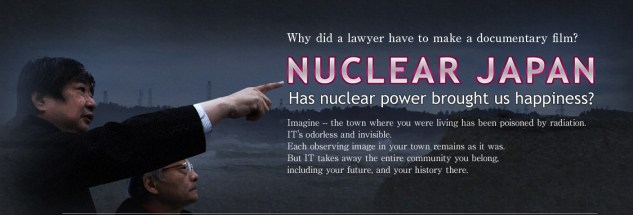
Almost in one year, this film has been shown to more than 70,000 people, and there have been held more than a thousand voluntary movie-showing events since “NUCLEAR JAPAN” was released in November 2014. It has been also presented at many courtrooms as evidence to get a bird’s-eye view of all the issues of nuclear power in order to halt nuclear power plants whole Japan.
If you are planning to have a video-showing event of “Nuclear Japan” (2h 15m), please send an application form to eiga@nihontogenpatsu.com.
It may take time for international shipping, please apply well in advance. Thank you!
SYNOPSIS
This movie strives to provide
a complete picture of nuclear power in Japan.
NUCLEAR JAPAN is a documentary film directed by a 70-year-old lawyer with remarkable record of winning very high-profile cases who elucidates the controversial issue of nuclear power industry in Japan.
On March 11th, 2011, a massive earthquake hit East Japan, which caused a catastrophic accident in Tokyo Electric Fukushima No.1 nuclear power plant. Radioactive materials were released from its four nuclear reactors, and they have contaminated the people’s land as well as ocean. Today, the effort to clean up the radioactive materials is still ongoing, only too little effect.
The film takes you back to a few hours after the earthquake on March 11th, to the shore of Namie Township, 7 kilometers north of Fukushima No.1 nuclear power plant. The local fire brigade in Namie is desperately searching for missing persons swept away by the disastrous tsunami. However, the next morning on the 12th, the question starts to rise for the possible dissemination of radioactive material. The Japanese government consequently declares the area within 10 kilometers from the Fukushima nuclear power plant as an evacuation zone. As a result, the fire brigade in Namie Township is forced to give up the search…
A month after the earthquake, the search for missing persons resumed. During the search, more than 180 bodies were found along the shore of Namie Township.
If it weren’t for the nuclear accident, most of those lives could have been saved.
There was one lawyer who had been actively voicing the absurdity and danger of Japanese nuclear power – Hiroyuki Kawai. Kawai has been fighting in many legal battles to halt nuclear power plants in Japan for over 20 years. Ever since the crisis at Fukushima No.1 power plant, his fight has been fueled by even more drive and dedication.
Then, Kawai had a thought. What if he makes a movie about this issue? If he wants the public to understand the complicated issues of nuclear power, literature has its limits. Also, all the coverage by Japanese media has been biased. Only by providing the visual and giving the objective view, he can communicate the true absurdity and inhumanity of the nuclear power in Japan.
With the help of another lawyer Yuichi Kaido, Kawai’s old ally who also has been fighting in nuclear power plant lawsuits, Kawai completed this documentary film, NUCLEAR JAPAN.
The film not only features the interviews of many experts, a number of facts and evidences, but it also brings to light the immense pain of the people have been suffering from the nuclear crisis. NUCLEAR JAPAN is now being presented as evidence in many lawsuits to halt nuclear power plants all over Japan.
This film is the ultimate nuclear power documentary that takes you on a journey to grasp all the issues of nuclear power in a factual, objective way, and eventually, a journey to find a hope.
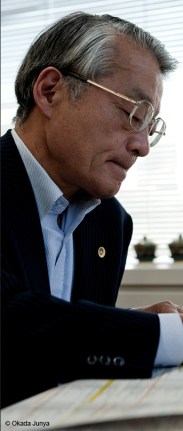
DIRECTOR
Protecting the environment of the planet
as an advocate for future generations;
especially from nuclear disasters
is Kawai’s very purpose.
Profile
Hiroyuki Kawai, a lawyer and a filmmaker, was born in Northeast China, Manchuria, in 1944. Kawai graduated from the University of Tokyo, Faculty of Law in 1968, and has been practicing law since 1970. In 2014, he made a directorial debut with a documentary film NUCLEAR JAPAN.
Today he holds various titles including; President of Sakura Kyoudo Law Offices, Chairman of The Support Group for Japanese War Orphans Left in China Obtaining Japanese Nationality, Head Director of Philippine Nikkei-jin Legal Support Center, and Representative Auditor of Institute of Sustainable Energy Policies.
Kawai is also a representative of National Federation of Lawyers Against Nuclear Power as well as The Complainants for Fukushima Nuclear Disaster Criminal Prosecution legal team. He is the lead lawyer of the legal team for Hamaoka Nuclear Power Plant Suspension Lawsuit and Tokyo Electric Executives Criminal Responsibility Lawsuit. He is also a part of Ohi, Takahama, Sendai Nuclear Power Plants Provisional Suspension Lawsuit legal team.
His motto is–
If you give 100%, you can achieve almost anything.
If you give 100%, you will find anything enjoyable.
If you give 100%, somebody will offer you their hand.
DIRECTOR’S
STATEMENT
“To share the idea of nuclear zero nationwide,
we need a movie.”
Kawai became involved with lawsuits against nuclear power plants from 1994.
The first suit concerned use of MOX fuel in the Fukushima No.1 Reactor 3 plant that exploded in March 2011.
This suit failed, as have many more since that time.
Ever a shrewd lawyer, Kawai was losing his passion to continue such lawsuits just before the Fukushima accident.
The Great East Japan Earthquake rekindled this passion and Kawai has said “I will never give it up. I will continue lawsuits against nuclear plants until nuclear power is eradicated from Japan”.
As part of this process, Kawai decided to make a movie.
Explaining this, he said “in a democracy, a fair legal process is obviously important to protect our rights, especially for minority issues.
Lawsuits in a democracy functions as safety valves.
Justice is justice. I shall stand up to protect life and Japan in courts, even if I would be alone.
But to share the idea of nuclear zero nationwide, we need a movie”.
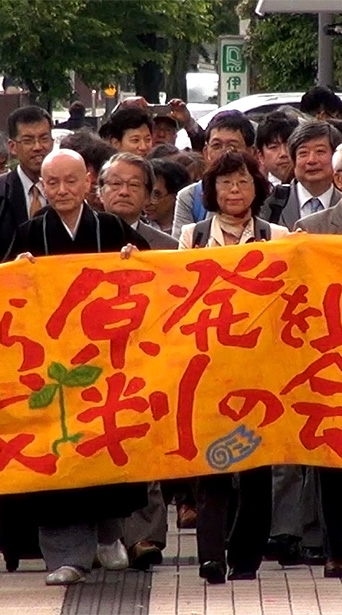
Nuclear accidents strike at the very foundation of our lives.
Economics, culture, art, education, justice, welfare,
frugal and fancy living alike – everything is turned on its head.
Ignorance of nuclear power’s dangers renders every
enterprise meaningless, even irresponsible.
We have come to realize this.
What matters now is what we will do about it.
Hiroyuki Kawai
Woman gives up electricity and goes ‘off grid’ for 4 years
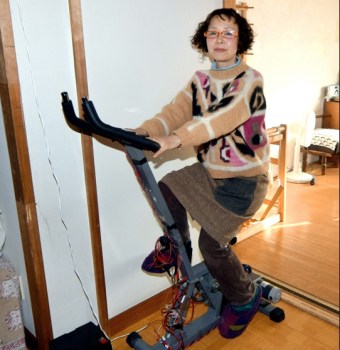
Chikako Fujii says she uses a human-powered dynamo remodeled from a bike-type training machine to generate power in emergencies
Chikako Fujii used to leave the TV on all the time, but since the Fukushima nuclear disaster inspired her to go “off grid” nearly four years ago, she has consumed literally no energy supplied from her regional power company.
Fujii, 55, a textile dyeing artist, uses a tiny amount of electricity generated primarily by solar panels set up on her veranda that measure a total of just 1.6 square meters.
The lifestyle choice means that Fujii cannot power an air conditioner, a refrigerator or a TV with such a small quantity of energy, but those things don’t concern her.
“I enjoy working out how to lead a life without using electricity,” she said.
A resident of Kunitachi, western Tokyo, Fujii terminated her contract with Tokyo Electric Power Co. in September 2012, after rolling blackouts were implemented in the wake of the March 2011 Great East Japan Earthquake and tsunami, which triggered a triple meltdown at the Fukushima No. 1 nuclear power plant.
Fujii said that before the disaster struck, she habitually left the TV on so that she could check the time whenever she wanted.
But when she stopped using her home appliances one by one, she found her electricity bill could be reduced.
While she paid more than 4,000 yen ($36) per month for electricity before the disaster, the figure gradually dropped to around 2,000 yen. When she finally unplugged the refrigerator, which requires much power, the bill reached 800 yen.
“I thought I might be able to live without relying on the power company, and decided to start an off-grid life for the fun of it,” Fujii said.
The solar panels installed on the veranda have a power production capacity of 260 watts and can generate more than 1 kilowatt-hour of power on a typical sunny day–enough to operate a washing machine for three hours to dye fabrics with plant-derived materials.
However, when cloudy weather continues for a week during the June rainy season or due to a typhoon, the electricity stored in the battery dries up. When that happens, Fujii uses a pedal-operated sewing machine and an old charcoal-powered iron for her work instead of electric ones.
One night, Fujii was asked by a business partner to send a document by e-mail on short notice.
She pedaled hard a human-powered dynamo remodeled from a bike-type training machine to generate electricity to use her computer.
As Fujii cannot use an air conditioner, she made small holes in a plastic bag containing water and hung it above the veranda to sprinkle water automatically to cool the surrounding air.
In lieu of an electric kettle, she painted plastic bottles black and exposed them to sunlight to heat the water inside.
In December last year, Fujii also introduced a handmade heater made out of a used tempura oil-based lamp and a flowerpot put over the lamp upside down. According to Fujii, 20 milliliters of oil can keep the flowerpot hot for three to four hours.
She said she daily consumes only 500 to 800 watt-hours of power at home, about one-12th that for an ordinary household.
“I always live while being conscious of the weather,” Fujii said. “For example, when I wake up to find it is sunny, I think I should use the washer today. Thinking this way is fun for me.”

The water heater made of glass tubes can increase the water temperature to 85 degrees in two hours even during winter if it is exposed to sufficient sunlight.

A handmade evaporation heat-based cooler designed to remove heat from flowerpots when water evaporates
http://www.asahi.com/ajw/articles/AJ201606010003.html
Japan’s Nuclear Holy Grail Slips Away With Operator Elusive
Japan is missing its own deadline to find a new operator for a prototype nuclear power program that’s failed to succeed in the two decades since it was built, threatening the resource-poor country’s support of a technology other nations have abandoned.
The country’s nuclear regulator demanded in November a replacement for the government-backed Japan Atomic Energy Agency be found within six months for the Monju fast-breeder reactor. Monju, which has functioned for less than a year since its completion more than 20 years ago, now faces the possibility of being scrapped.
The so-called fast-breeder reactor — a cornerstone of its atomic energy strategy dating back to the 1950s — uses spent nuclear fuel from other plants and is designed to produce more atomic fuel that it consumes. The reactor, named after the Buddhist deity of wisdom, has cost the nation more than 1 trillion yen ($9 billion) and has barely operated since it first generated electricity in 1995.
“The potential closure of Monju would be a major blow not just to the fast-breeder community in Japan, but also those supporting reprocessing of spent fuel,” M. V. Ramana, a professor at Princeton University’s Nuclear Futures Laboratory, said by e-mail. “I wonder if the government will allow Monju to be shut down? I would expect that they will simply create a new agency to oversee Monju.”
1950s Strategy
Monju is currently operated by the JAEA, a quasi-government organization that is under the Ministry of Education, Culture, Sports, Science and Technology. JAEA declined to comment. The nation’s nuclear watchdog, the Nuclear Regulation Authority, didn’t respond to e-mailed questions regarding the status of Monju.
“We don’t have plans to decommission the reactor,” said Hiroki Takaya, director of the ministry’s International Nuclear and Fusion Energy Affairs Division, which oversees Monju. “We are exploring many different options for who will operate the reactor — either a new entity or an existing company.”
The NRA said in November the science ministry must find a new operator or consider closure. The ministry drafted a set of criteria for a new operator, but have yet to name a replacement, it said on May 27. The ministry hopes to find an operator as soon as possible, but hasn’t set a concrete deadline.
“These turn out to be very expensive technologies to build,” Allison MacFarlane, a former chairman of the U.S. Nuclear Regulatory Commission, said by e-mail. “Many countries have tried over and over. What is truly impressive is that these many governments continue to fund a demonstrably failed technology.”
While Japan’s science ministry seeks a new operator of Monju, no power utility has stepped forward.
“Monju’s reactor design is quite different from a normal reactor, and utilities don’t have the expertise to handle it,” Makoto Yagi, chairman of the Federation of Electric Power Companies of Japan, told reporters in May. “Monju is currently in a research and development phase by the government, it isn’t the matter for a private company.”
Taiwan FDA mulls lower threshold for food firm certification
Minister of Health and Welfare Lin Tzou-yien (林奏延) yesterday dismissed media reports that the ministry is planning to lift a ban on food imports from five Japanese prefectures that were affected by radioactive fallout from the Fukushima Dai-ichi nuclear power plant disaster in March 2011.
The Chinese-language United Daily News yesterday said that Japanese media had reported that Taiwan would gradually lift the ban on food imports from the five prefectures.
The United Daily News report also said that Food and Drug Administration (FDA) Director-General Chiang Yu-mei (姜郁美) had stated that there is the possibility of gradually allowing food imports from four prefectures of the five affected prefectures — excluding Fukushima.
Since the disaster, all food imports from five Japanese prefectures — Fukushima, Ibaraki, Tochigi, Gunma and Chiba — have been banned.
“From when I took office on May 20, we have not discussed any issues about radioactive contaminated products from the five Japanese prefectures at all” Lin said in response to media queries.
Regarding rumors that Chiang had admitted the possibility, Lin said: “It is what I say that counts.”
Later, at a meeting of the legislature’s Social Welfare and Environmental Hygiene Committee, Chiang responded to lawmakers’ queries over the issue by saying that his ministry “had not had any contact or discussion” with Japan over the issue.
http://www.taipeitimes.com/News/taiwan/archives/2016/05/31/2003647556
Germany readying law on nuclear waste storage costs
BERLIN – The German Cabinet plans to approve a draft law on Aug. 3 that will require its utilities to pay billions of euros into a state fund to help cover the cost of nuclear storage, according to an Economy Ministry timetable seen by Reuters on Monday.
A commission recommended in April that Germany’s “big four” power firms — E.ON, RWE, EnBW and Vattenfall — pay a total €23.3 billion ($26 billion) to remove unwanted long-term liability for the storage of nuclear waste.
The commission asked utilities to transfer provisions set aside for storage sooner than expected, starting with a first instalment totalling €17.2 billion no later than early 2017. The government is widely expected to adopt the commission’s proposals.
The legacy costs stem from Germany’s decision to end nuclear power by 2022 following the start of Japan’s Fukushima disaster five years ago.
The Bundestag lower house of parliament is due to vote on the law in early November and to be debated in the upper house at the end of November, the timetable showed.
“TEPCO reveals only handful knew meltdown manual existed”
Too Late…
Although a manual existed that outlined the criteria for a meltdown, Tokyo Electric Power Co. admitted that only five or so employees at its main office knew of it at the onset of the 2011 nuclear crisis.
Those employees belonged to a section that manages the manual at the company’s Tokyo headquarters, TEPCO said at a news conference on May 30.
The utility has been under fire for the delay in acknowledging in May 2011 that triple meltdowns took place at the Fukushima No. 1 nuclear power plant, two months after they actually occurred following the Great East Japan Earthquake and tsunami.
TEPCO had maintained that the reactors at the plant suffered “core damage,” rather than more serious meltdowns.
Explaining the delay, the company initially cited a lack of guidelines for determining a meltdown.
But TEPCO admitted in February this year that the company manual did contain entries defining a meltdown, although the company said it was unaware of the descriptions for the past five years. The criteria requires the company to declare a meltdown when damage to a reactor core passes 5 percent.
Takafumi Anegawa, chief nuclear officer with TEPCO, told the news conference that a third-party panel will investigate why it took the company five years to disclose the existence of the manual.
In April, a TEPCO senior official admitted that he knew of the criteria when the crisis was unfolding at the plant.
http://www.asahi.com/ajw/articles/AJ201605310068.html
-
Archives
- October 2026 (104)
- September 2026 (339)
- August 2026 (330)
- July 2026 (355)
- June 2026 (287)
- May 2026 (306)
- April 2026 (356)
- March 2026 (251)
- February 2026 (267)
- January 2026 (308)
- December 2025 (358)
- November 2025 (359)
-
Categories
- 1
- 1 NUCLEAR ISSUES
- business and costs
- climate change
- culture and arts
- ENERGY
- environment
- health
- history
- indigenous issues
- Legal
- marketing of nuclear
- media
- opposition to nuclear
- PERSONAL STORIES
- politics
- politics international
- Religion and ethics
- safety
- secrets,lies and civil liberties
- spinbuster
- technology
- Uranium
- wastes
- weapons and war
- Women
- 2 WORLD
- ACTION
- AFRICA
- Atrocities
- AUSTRALIA
- Christina's notes
- Christina's themes
- culture and arts
- Events
- Fuk 2022
- Fuk 2023
- Fukushima 2017
- Fukushima 2018
- fukushima 2019
- Fukushima 2020
- Fukushima 2021
- general
- global warming
- Humour (God we need it)
- Nuclear
- RARE EARTHS
- Reference
- resources – print
- Resources -audiovicual
- Weekly Newsletter
- World
- World Nuclear
- YouTube
-
RSS
Entries RSS
Comments RSS

