Fukushima Remains “A Nuclear Radiation Nightmare”, In Pictures
“This is an accident that does not exist in the past tense, but in the present progressive form,” exclaimed Fukushima Gov. Masao Uchibori earlier in March, criticizing Japanese Prime Minister Shinzo Abe for not explicitly the disaster in his annual speech. “It’s not possible to avoid using the important and significant terms of the nuclear plant accident of nuclear power disaster.”
As IBTimes’s Juliana Rose Pignataro notes (and exposes in the images below), it’s been an uphill battle for the coastal prefecture of Fukushima, Japan, since an earthquake and tsunami devastated the region in 2011, causing a nuclear disaster at its power plant.
Six years later, workers are still battling to decommission the plant, where radiation is deadly. Officials expect the cleaning won’t be finished for decades.
 In this handout provided by TEPCO, the deformed grating vessel of Fukushima’s No. 2 reactor is shown Jan. 30, 2017.
 Workers remove nuclear fuel rods from a pool inside the No. 4 reactor at the Fukushima nuclear plant in Japan, Nov. 18, 2013
 TEPCO employee looks at the destroyed reactor in Fukushima, Japan, Feb. 25, 2016
 Personal items were left behind in Fukushima, Japan, Feb. 26, 2016.
 A wild boar roams in barren, Fukushima, Japan, Mar. 1, 2017
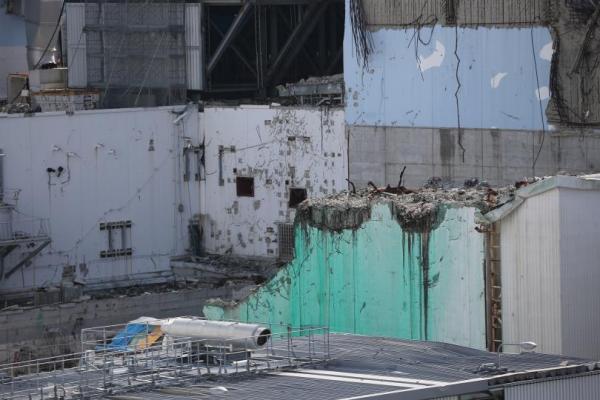 The damaged No. 3 reactor at Fukushima Daiichi plant in Japan is shown Feb. 25, 2016.
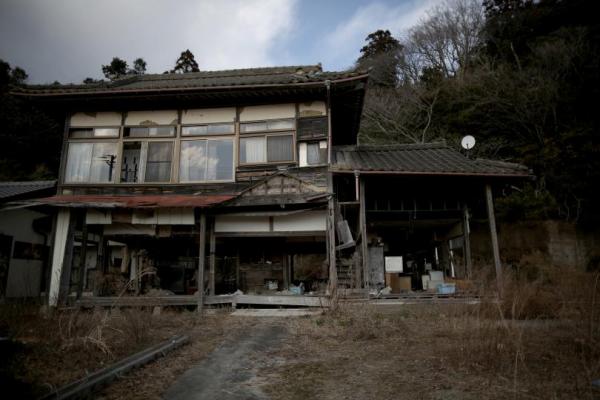 A deserted home is shown in Fukushima, Japan, Mar. 11, 2016.
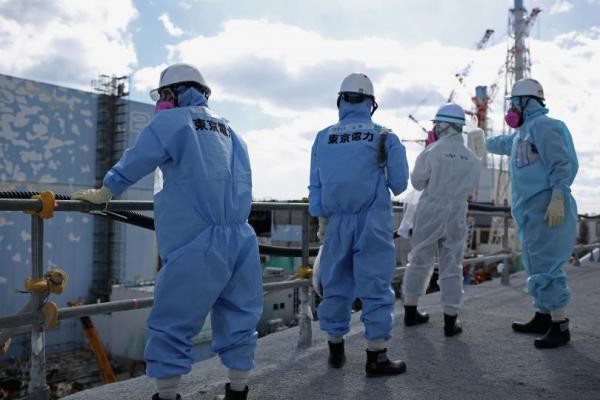 Workers stand near the deserted nuclear power plant in Fukushima, Japan, Feb. 25, 2016.
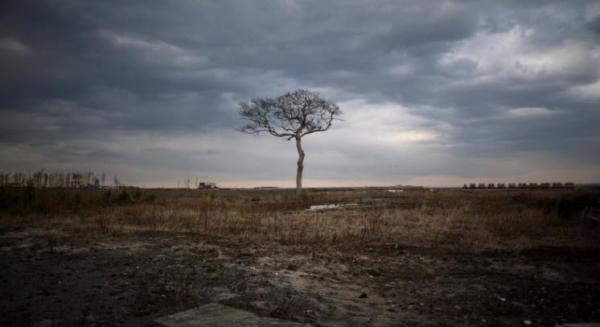 The barren landscape of Fukushima, Japan sits empty, Mar. 11, 2016.
Despite the ongoing decommissioning, increasingly high levels of radiation and wild boar problem, officials have begun welcoming some evacuated people back to their homes. It’s unclear how many residents will choose to return.
http://www.zerohedge.com/news/2017-06-05/fukushima-remains-nuclear-radiation-nightmare-pictures
Fukushima town, Namie, to receive compensation

NHK has learned that a town near the Fukushima Daiichi nuclear power plant is to receive compensation for a drop in the value of its land that was caused by the 2011 nuclear accident.
The plant’s operator, Tokyo Electric Power Company, will pay Namie Town 2.5 billion yen, or more than 22 million dollars.
This is the first time that the operator has agreed to compensate a municipality for assets that were affected by the accident.
In June of last year, Namie officials asked the company to pay about 104 million dollars in compensation for damage to 262 hectares of land owned by the town. Evacuation orders for parts of the town remained in effect for over 6 years.
The officials say they will negotiate with the power company over the remainder of the requested amount.
The Fukushima prefectural government says the town of Futaba has made a similar request and that other municipalities may follow suit.
Tokyo Electric is paying individuals and businesses compensation for damage to properties located in areas where evacuation orders were issued.
Japan Nuclear Lab’s 5 Workers Exposed to Radiation

Secret Plutonium Fuel Shipment Planned for Japan’s Takahama Reactors

Tokyo, 6 June 2017 – With today’s restart of the Takahama 3 reactor in Fukui Prefecture, Greenpeace revealed that the nuclear operator Kansai Electric and the French nuclear company AREVA are planning a secret plutonium fuel shipment from France to the Takahama plant. Plutonium fuel (MOX) reduces the safety of the reactor, increasing both the risk of a severe accident and its radiological consequences. The shipment is scheduled to depart Cherbourg France on 7 July.
This also presents serious security issues, both as it is a potential terrorist target and that the plutonium in the MOX fuel is direct use nuclear weapons material. Due to these risks, the U.S. State Department and other agencies are required to approve the security plan for plutonium shipments to Japan under the terms of the US – Japan Peaceful Nuclear Cooperation Agreement of 1988. The Trump administration has approved this shipment, despite the increasingly unstable conditions in the region.
“The last thing Northeast Asia needs at this time, or at any time, is more nuclear weapons-usable material. Last year, the U.S. removed 331 kilograms of plutonium from Japan due to security risks, while ignoring the 10 tons of material that remained. One year later, at least 500 kg more plutonium is being approved for delivery to Japan. Plutonium is not your normal cargo to be traded as a commodity. It can be used as nuclear bomb material. Japan’s bankrupt plutonium program, and its endorsement by the Trump administration, is a further threat to the peace and security of this troubled region,” said Shaun Burnie, nuclear specialist at Greenpeace Germany in Tokyo.
The shipment comes at a time when Northeast Asia is already destabilized due to threats on the Korean peninsula, the spectre of military conflict, and the increasing risks of nuclear weapons proliferation. Japan’s decades long and multibillion dollar plutonium program has failed to ensure energy security for Japan, but it has led to the nation accumulating over 48 tons of plutonium, 10 of which is stored in Japan, and the rest in the UK and France.
This shipment will consist of at least 16 plutonium fuel (MOX) assemblies, which are planned to be loaded into the Takahama 4 reactor during its next refueling, expected in 2018. The amount of plutonium in the shipment due to leave France next month is estimated to range from between 496-736kg – as little as 5kg is sufficient for one nuclear weapon.
Two lightly armed British vessels, the Pacific Egret and Pacific Heron, are scheduled to leave the French port of Cherbourg on 7th of July, and are expected to arrive in Takahama between mid-August and early September, depending on the route chosen. One of the ships will transport the plutonium fuel, and the other will act as ‘armed escort’.
Both Takahama 3 and 4 already have plutonium MOX fuel in their cores, with 24 and 4 MOX assemblies loaded into each reactor respectively.
“KEPCO’s unjustified restart of the Takahama 3 reactor is made worse by the fact that they are planning a secret plutonium shipment which will increase the amount of dangerous plutonium MOX in their reactors. The Takahama reactors already pose an unacceptable threat to the people of Fukui and Kansai region. This will be compounded by the even greater usage of plutonium MOX fuel,” said Shaun Burnie, Senior Nuclear Specialist with Greenpeace Germany (currently based in Japan).
Due to the severity of the impacts of a nuclear disaster involving MOX fuel, citizens groups, including Greenpeace, have demanded that AREVA release vital safety data on the MOX fuel produced for Japan, including for the Fukushima Daiichi 3 reactor and the Takahama reactors, due to evidence of flawed production and quality control during manufacture.(1) To date, AREVA has failed to release any of the safety data. AREVA also refused to release the same data for MOX fuel loaded into the Fukushima Daiichi reactor 3 in 2000. The AREVA company which has suffered a near meltdown of its business in recent years, is desperate to secure more MOX fuel contracts with Japan, which suffered as a direct consequence of the 2011 Fukushima Daiichi accident leading to the shutdown of the Japanese reactor fleet.
Of the five reactors now operating in Japan, three are operating with varying amounts of plutonium MOX fuel. There is a possibility of additional MOX fuel being in the shipment for other Japanese reactors – Ikata 3 is operating with MOX fuel, and the Genkai 3&4 will operate with MOX fuel if they restart before March 2018.
Notes:
1 – Letter to AREVA Japan Calling for Disclosure of MOX Fuel Quality Control Data, 2016-01-28, and FUNDAMENTAL DEFICIENCIES IN THE QUALITY CONTROL OF MIXED-OXIDE NUCLEAR FUEL, Fukushima City, Japan, March 27th 2000
2 – Tokai plutonium shipment March 2016
http://m.greenpeace.org/japan/ja/high/news/press/2017/pr201706061/#.WTcEEm0pf-M.facebook
A Clean-up Worker’s View Inside Fukushima’s Daiichi Nuclear Power Plant

Ichi-F is rich in detail and strikingly perceptive in analysis, and yet it oddly supports the nuclear industry even as the radiation continues to take its toll.
Kazuto Tatsuta’s account of his work experience at the massive clean-up project at Fukushima’s Daiichi nuclear plant is remarkable on many levels.
The plant—known as Ichi-F for short—was the one which experienced three nuclear meltdowns in the wake of the destructive earthquake and tsunami of 11 March 2011. Since that disaster, a large-scale clean-up effort at the nuclear plant has been underway, simultaneous with broader reclamation and recovery efforts in the surrounding regions that were devastated by the triple disaster.
Tatsuta’s (the name is a pseudonym) true identity remains unknown, but he claims to have been a middle-aged temp worker with a bit of manga illustration background who got himself hired by a subcontractor doing clean-up work at Ichi-F. After he completed his initial work assignment, he returned to Tokyo and began producing manga accounts of the recovery effort. The manga were a smash hit, rapidly consumed by a public still riveted by the disaster and starved for accurate information about what was going on in the still tightly-controlled recovery zone. Between government propaganda on the one hand and activist/media sensationalism on the other, Tatsuta’s manga offered a refreshingly different take on the situation at Ichi-F. He largely avoids politics, simply depicting the day-to-day experience of workers in the recovery effort.
Tatsuta’s work—finally compiled and translated into English—is hard to categorize as a manga. It’s deeply technical, offering layout sketches of the site, detailed explanations of the nature of the work and equipment that’s used. It’s also deeply perceptive in its analysis of the work relationships at the site; almost the equivalent of sociological fieldwork.
It’s sometimes been categorized as a ‘slice of life’ manga; that manga genre which concentrates not on literary technique or telling an exciting story, but on depicting some aspect of real life experience for the elucidation and empathy of readers.
But it’s more than that. Tatsuta’s work described itself as a ‘labour diary’ in the original Japanese version; the English translation calls it “a worker’s graphic memoir”. The terms ‘labour’ and ‘worker’ are important here: the work verges on offering a new genre, a sort of proletarian or working-class manga. This is reflected in Tatsuta’s apparent determination to identify himself and his colleagues as workers. It’s an identity he aims at in opposition to those who would label them either as heroes or as gullible and exploited; as villains or victims. He struggles to assign his colleagues a sense of agency in their work. They’re not heroes, but they’re not slaves either. They’re everyday guys (he depicts an almost exclusively male recovery project) going about their jobs with dignity, pride, and an essential sense of humanity. They care about doing a good job (a uniquely Japanese fastidiousness evident in their focused teamwork), yet eagerly grab the opportunity for a casual nap behind a radiation shield whenever they can.
“Fukushima Daiichi isn’t really some terrifying place full of negligent, unsafe conditions where people are practically forced into slave labor,” he argues in an interview included in the American translated collection. “The folks working there are all just ordinary old guys, most of whom are locals from Fukushima, and the rest coming from all over the country to help. That’s what I want you to know.”
There is a proud albeit masculinist tradition in Japan of the ‘day labourer’—those workers who showed up at big city hiring sites seeking manual labour jobs in the pre- and post-WWII era. A tradition nearing extinction in the ‘90s, it was reborn in the age of the Internet, which managed to precaritize employment not just in manual labour but in all fields of endeavor. Cell phones and Internet terminals became the new hiring site, and precarious labour extended to even skilled and professional jobs. The nuclear clean-up work Tatsuta engaged in is the direct descendant of this lineage of precarious employment. Unfortunately, he doesn’t dwell on the fact, instead chosing to normalize and shrug off the broader social implications of his precarious livelihood as an unemployed man in his late 40s.

An Eye for the Everyday
Tatsuta has an eye for the every day, and the importance it plays in humanizing his subjects—the complexity of needing to use the toilet while wearing a radiation suit, or the difficulty of organizing bath-time in an overpopulated rental unit housing a dozen workers. There’s the beauty of a sunrise breaking over the horizon as they come off a late-night work shift, and the awkwardness of his boss prepping him what to say during a ‘surprise’ safety inspection to come later that day.
His account would indeed be a remarkably working-class, proletarian manga, at least insofar as it depicts in profound detail the experience of working-class life among the precariously employed at the nuclear plant, except for the fact that it lacks any deep political analysis. His structural analysis is first-rate; he breaks down in precise detail the complex work relationships at the plant. But he offers little in the way of judgment, and what little opinion he does offer is startlingly ambivalent. Yes, they’re precariously employed, even exploited in some ways, but he shrugs it off—they’re everyday guys, and that’s the way life goes. His commentary suggests this lack of judgment is the unique strength of his approach in this manga, but it can equally be seen as irresponsible prevarication.
He argues that what he presents is the honest portrayal of workers’ attitudes, apparently trying to forestall his critics. But a shrug in the face of precarious employment is hard to accept as honest and down-to-earth; it reeks of political immaturity. He also offers a broader progress narrative and refreshing though this may be in the context of Fukushima, the world has rightly become cynical of progress narratives.
When I started work, there was a police checkpoint at the intersection next to J-Village… Just about anything within 20km of Ichi-F was an off-limits protected zone. As the zone shrinks, the evacuation orders are slowly removed, but by bit…The lots for sale, which I showed you before, now feature new buildings under construction. You still see those black bags of contaminated dirt and protective green sheets, but there are also more and more fields and paddies replanted Rather than giving credence to the boilerplate “No path to the future,” “sluggish recovery” narratives, why not lend an eye to those areas which are recovering, slowly but surely?.. Nothing will happen that can be worse than what already happened.
Well, that’s the big question now, isn’t it?
Privatization, Profit, and Precarity
Tatsuta’s account may not be inherently critical of the nuclear industry, at least not on the basis of health and safety—he goes to great length to argue that radiation and its hazards are as controllable as any workplace hazard, and that the clean-up and recovery effort is actually proceeding quite well—but his narrative offers indirect yet profound criticism of the industry from a labour rights perspective. He illustrates a complex and privatized network of contractors and subcontractors engaged in the clean-up effort, which his work reveals as inefficient, greedy and deceptive (if not outright dishonest).
This is most clearly demonstrated in his efforts to obtain work in Fukushima. Back in Tokyo, he initially applies to several contractors, and despite offers of work—some of which sound so solid that he quits part-time jobs in preparation for his departure to Fukushima—only to be left hanging, or to discover that the companies have gone out of business and disappeared. When he finally does receive an offer that takes him to Fukushima, he and his co-applicants are left hanging for weeks while they wait for the subcontractor to be offered a gig. During this time, they are accumulating debt for their company-provided food and lodgings and other obligatory expenses that will be deducted from their pay, if they ever get any. They are eventually transferred to other lower-paying jobs as an interim measure while the company awaits a hopeful contract for nuclear or tsunami cleanup. Meanwhile, their lodgings are inadequate as well: ten or more men crammed into a single family living space, with a single bathroom.
Eventually, the subcontractor gets a contract, and Tatsuta gets to do the sort of work he came to do. But the shenanigans he experiences while waiting for that work reveals the inefficient and most likely corrupt sort of schemes that are the inevitable byproduct of such a convoluted and privatized system. Tatsuta may scoff at the health risks of the nuclear industry, but he’s quite open about the shortcomings of the industry from a labour rights perspective.
The thing is, he’s open about its shortcomings but isn’t actually critical. His reaction is to shrug off the complicated and bloated layers of the project. His attitude is one of the most perplexing things about the entire book. His analysis of the layers of subcontractors, and the sociological challenges this presents to workers trying move up within the system (as he observes through first-hand experience, trying to upgrade jobs by switching between companies has an eerie resemblance to pulling off a drug deal), comprises first-rate anthropological fieldwork. It’s a brilliant synthesis and analysis of the political economy and structural organization of the clean-up effort. And from any objective perspective, it’s appalling: a morass of inefficiency and corruption. Yet he concludes his brilliant and penetrating analysis with a cheery send-off:
People might think that the many-layered subcontracting system is problematic, but it’s how we maintain the cleanup efforts. It ensures local hiring and props up the economy here. That’s not to suggest that the system is ideal, but you can say that about almost any place in Japan…
What is that supposed to mean? How is the reader supposed to interpret his take? Is he so unaware that he doesn’t realize that he’s just described an incredibly inefficient, wasteful and corrupt system, with brilliant clarity? Does he simply not care? Are his final comments to be taken as a form of defeatism verging on nihilistic insouciance? Is he simply a prodigal yet immature analyst? Or on the other hand, is he hiding his true colours, pretending to be blasé or even on the side of the nuclear industry subcontractors, while laying out the system in damning enough detail so as to allow readers to draw their own conclusions?

Working-class Machismo
It’s hard to tell how Tatsuta situates himself in this work. On the surface, he situates himself in the working-class, but in an almost over-the-top way. He doesn’t just work at Ichi-F for a job; he actually comes to love the work. Despite the fact that it’s hot, physically grueling and demanding precarious shift-work for low pay, he seems to become addicted to it. He earnestly misses it when he’s back in Tokyo working on his comics, and eagerly jumps at any opportunity to return. Is this macho bravado? Would he, for that matter, be as gleeful at the prospect of being recalled to work at the site if he didn’t have a ready exit visa in hand whenever he wanted, in the form of his alter-ego as a rising manga star?
It is, of course, hard to say. But what is true is that the precarity of the men’s labour is ultimately sacrificed in the narrative, subsumed to Tatsuta’s effort to demonstrate the casual, if occasionally courageous, indifference of Ichi-F workers to their unusual work environment. Radiation exposure is reduced to numbers on a scale, and the men’s primary concern becomes how to reduce their daily exposure not so much for health reasons but rather so that they can extend their paid work at the site. Employees are only permitted to accumulate a certain amount of radiation exposure each year, and once they reach their annual limit they’re laid off and sent home to wait for the chance of a gig the following year, once their exposure levels have dissipated and reset. The narrative is profoundly successful at challenging broad-based fears of radiation exposure: the workers toil away, quite confident that kept within reasonable levels radiation exposure is nothing to worry about. Be that as it may, a job that lays off workers in order to preserve their health from the daily radiation they experience is a form of precarious and exploitative labour regardless of whether the radiation is dangerous or not.
Tatsuta strikes back at his critics, depicting his working-class comrades as everyday guys doing their best under difficult circumstances: hard-working, stoic, dedicated and determined to persevere. He resists efforts of journalists and activists to depict the work as unduly dangerous, or evil, or complicit in hiding truths from the public. They’re no different from any other group of hard-working labourers, he argues. But in his efforts to demonstrate this, Tatsuta’s narrative achieves the dubious success of glamourizing and normalizing precarious labour.
Tatsuta has kept his identity hidden, he says, because he continues to seek work at Ichi-F (at the same time as he cultivates careers in manga and music), and he doesn’t want to compromise his company and colleagues. He implies that he wouldn’t be hired for any more gigs at Ichi-F if it became known who he was. But really, it’s hard to say whether that’s the case. Regardless of his intentions—which he professes to be neutral; neither to promote or oppose the nuclear industry but simply to depict his first-hand experience as a worker—the fact is that his depiction does a tremendous service for the industry by portraying the experience and hazards of life at a recovering nuclear plant as normalized, everyday, routine and controllably safe (so long as one forgets that the reason they’re working there is that the plant experienced three unexpected meltdowns in the first place). This is quite a boon for the nuclear industry, whether he intends it as such or not. His analysis of work relationships are less positive, but he accompanies them with a cheery slap on the back: “the folks working there are all just ordinary old guys” and “you can say that about almost any place in Japan”.
The result is a worker’s manga that’s rich in detail, strikingly perceptive in analysis, and yet winds up siding with the bosses. Not quite the proletarian manga, but a remarkable demonstration of what working-class manga could be. And a thoroughly fascinating read, either way.


Ichi-F: A Worker’s Graphic Memoir of the Fukushima Nuclear Power Plant
Kazuto Tatsuta
(Kodansha Comics)
US: Mar 2017
Seven more Fukushima residents diagnosed with thyroid cancer
7 new thyroid cancers in Fukushima but don’t worry: Hokuto Hoshi, head of the panel and vice chair of the prefectural medical association, called it “unlikely” that radiation was responsible for the increase.
 A boy undergoes a thyroid cancer test at a hospital. The Fukushima Prefectural Government said seven more residents who were aged 18 or under at the time of the 2011 nuclear disaster have been found to have thyroid cancer.
FUKUSHIMA – Seven more Fukushima Prefecture residents who were aged 18 or under at the time of the 2011 nuclear accident have been found to have thyroid cancer, the prefectural government said Monday.
The number of Fukushima residents suffering from thyroid cancer now totals 152, the prefectural government said in a meeting of an expert panel.
Hokuto Hoshi, head of the panel and vice chair of the prefectural medical association, called it “unlikely” that radiation was responsible for the increase.
The prefectural government has conducted three sets of thyroid checkups following the March 2011 triple meltdown at Tokyo Electric Power Company Holdings Inc.’s Fukushima No. 1 nuclear power plant. The checkups also covered people who evacuated to other prefectures.
The second round of checkups from 2014 confirmed five new sufferers, and a third round launched in May last year uncovered two more.
The panel decided to consider improving its counting method, as the cancer can be detected during regular medical examinations, not only the government checkups.
Takahama N°3 Reactor Restarted
Kepco restarts second Takahama reactor as Greenpeace warns of French MOX fuel shipment
 Security guards stand near a gate at the Takahama nuclear power plant in Takahama, Fukui Prefecture, on Tuesday, prior to the restart of a reactor at the facility.
OSAKA – Kansai Electric Power Co. restarted its Takahama No. 3 reactor Tuesday afternoon, bringing to five the number of nuclear reactors nationwide that have come back online since the March 11, 2011, triple meltdown at the Fukushima No. 1 power plant.
“Today marks an important step in the process to restart Japan’s nuclear reactors. It does not mark the end of efforts to ensure the safety of nuclear power, and we’ll continue to make safety our top priority,” said Kepco President Shigeki Iwane shortly after the 2 p.m. restart.
The No. 3 restart comes less than a month after Kepco turned its No. 4 reactor back on. It also came on the heels of reports that a shipment of uranium-plutonium mixed oxide (MOX) fuel will arrive in Takahama, Fukui Prefecture, in a few months from France for use in the No. 4 reactor next year.
Kepco’s push to fire up the 32-year-old Takahama reactors came with promises it would reduce electricity bills. Electricity from the No. 4 reactor, which went back online last month, will go on sale late next week. Electricity from the No. 3 reactor is expected to be sold from early July, during the hottest part of the summer when electricity demand peaks.
Kepco’s return to nuclear power generation, which accounted for nearly half of its electricity prior to March 11, 2011, takes place as renewable energy sources slowly gain ground.
According to one recent expert tally, renewable energy, including large-scale hydropower, accounted for 14.5 percent of total domestic power generation capacity in fiscal 2015 through March 2016.
In “Sustainable Zone 2016,” a joint analysis of Japan’s renewable energy situation by Chiba University professor Hidefumi Kurasaka and the Institute for Sustainable Energy Policies, it was also noted that during the first half of fiscal 2016, the average ratio of renewable energy produced by the nation’s 10 utilities increased to 15.7 percent of total electricity demand. But the ratio of renewable energy, including large-scale hydropower, at Hokkaido Electric Power Co. and Hokuriku Electric Power Co. reached 32 percent during that same period.
The government’s official energy policy calls for renewables to account for between 22 and 24 percent of the country’s electricity by 2030 and for nuclear power to generate between 20 and 22 percent, on average.
On Tuesday, Greenpeace revealed that plans are moving forward to ship at least 496 kg of plutonium from France in the form of 16 MOX fuel assemblies to Japan for use in the Takahama No. 4 reactor when it is reloaded next year. Greenpeace estimates the shipment will depart Cherbourg, France, early next month and — assuming there are no delays — arrive in Takahama sometime between mid-August and early September.
“Kepco’s unjustified restart of the Takahama 3 reactor is made worse by the fact that they are planning a secret plutonium shipment which will increase the amount of dangerous plutonium MOX in their reactors,” said Shaun Burnie, a Japan-based senior nuclear specialist with Greenpeace Germany. “The Takahama reactors already pose an unacceptable threat to the people of Fukui and Kansai region. This will be compounded by the even greater usage of plutonium MOX fuel.”
Japan restarts reactor No 3 at Takahama nuclear plant
Only a handful of reactors have come back online, due to public opposition, since the Fukushima disaster in 2011. Tuesday’s move comes after court clearance.
 Japan’s coast guard patrols in front of the No 3 reactor at the nuclear plant in Takahama, Fukui prefecture, some 350 kilometres west of Tokyo on June 6, 2017
In a small victory for the government’s pro-atomic push, a Japanese utility switched on another nuclear reactor on Tuesday, despite strong public opposition after the 2011 Fukushima meltdown.
The restart of the No 3 reactor at the Takahama nuclear plant brings the number of operational atomic reactors in Japan to five, while dozens more remain offline. Located in Fukui prefecture, the plant which is operated by Kansai Electric Power (KEPCO) is some 350 kilometres (215 miles) west of Tokyo.
Tuesday’s move comes after the utility switched on Takahama’s No 4 reactor last month with the court’s go-ahead, in spite of complaints from local residents over safety concerns. The court also gave the green light to switch on the No 3 reactor.
Japan shut down all of its atomic reactors after a powerful earthquake in March 2011 spawned a huge tsunami that led to meltdowns at the Fukushima nuclear plant.
Fukushima became the worst nuclear accident since Chernobyl in 1986.
Since then, just a handful of reactors have come back online due to public opposition and as legal cases work their way through the courts.
However, Prime Minister Shinzo Abe has aggressively promoted nuclear energy, calling it essential to powering the world’s third-largest economy.
Much of the public remains wary of nuclear power after the disaster at Fukushima spewed radiation over a large area and forced tens of thousands to leave their homes, with some unlikely to ever return.
http://trtworld.com/asia/japan-restarts-reactor-no-3-at-takahama-nuclear-plant-373118
Personal account of situation from Naoko Suzuki, “voluntary evacuee” from Fukushima
From March 11, 2017
TEPCO must regain public trust to ensure Fukushima’s steady recovery

To ensure the steady recovery of Fukushima, Tokyo Electric Power Company Holdings, Inc.’s revised business plan must not be allowed to end up as pie in the sky.
TEPCO has compiled a new business plan. The utility has strengthened its steps to improve profitability to raise funds for costs including decommissioning reactors and compensation related to the March 2011 accident at its Fukushima No. 1 nuclear power plant. This is the second time the plan has been revised.
The total cost of cleaning up the nuclear accident has ballooned from ¥11 trillion to ¥21.5 trillion. TEPCO will shoulder ¥16 trillion of this amount over about 30 years. The ¥300 billion TEPCO spent in fiscal 2016 on compensation and reactor decommissioning costs will be increased to ¥500 billion annually.
TEPCO must boost its “earning power” to secure sufficient capital to meet those costs. Restarting reactors at TEPCO’s Kashiwazaki-Kariwa nuclear power plant in Niigata Prefecture will be essential for this. Each reactor brought back online will raise TEPCO’s earnings by ¥40 billion to ¥90 billion per year.
TEPCO is working to gradually restart all seven reactors at the Kashiwazaki-Kariwa plant from fiscal 2019. However, as things stand, high hurdles remain in its way. This is because even if a reactor passes safety screenings conducted by the Nuclear Regulation Authority, local government authorities also must agree to the reactors’ restart.
The recent revelation that TEPCO did not disclose data about the insufficient earthquake-resistance of the main quake-resistant building at the plant has further heightened local distrust of the utility. Niigata Gov. Ryuichi Yoneyama is not budging from his cautious stance because he believes safety measures at the plant are insufficient. “At the moment, I can’t agree to the restart” of the reactors, Yoneyama said.
An expert panel of the Economy, Trade and Industry Ministry also had some stinging criticism for TEPCO, saying it “has not earned enough trust from the public.”
Transparency vital
On June 23, TEPCO will switch to a new leadership lineup when Hitachi, Ltd. Honorary Chairman Takashi Kawamura becomes TEPCO’s chairman. Kawamura will need to work hard to regain trust in TEPCO so restarting its reactors can become a reality.
Strengthening cooperation with other electric utilities and launching new operations, such as gas retailing, also will be effective in solidifying TEPCO’s revenue base. Another issue that needs to be addressed is the overseas development of its thermal power business, in which TEPCO is pursuing integration with Chubu Electric Power Co.
The new plan stipulates TEPCO will “prepare a basic framework for cooperation with other companies” by around fiscal 2020, keeping in mind the Higashidori nuclear plant TEPCO is constructing in Aomori Prefecture.
TEPCO is considering working with Tohoku Electric Power Co., which has a nuclear power plant in that region. If this tie-up comes to fruition, it will be useful for establishing a stable supply of electricity. TEPCO’s intentions on this issue are understandable.
Other utilities that could become partners with TEPCO during a realignment in the industry hold deep-rooted concerns that cooperating with TEPCO could result in the costs of dealing with the nuclear accident being shunted on to them. TEPCO must lay the groundwork to dispel such concerns.
TEPCO and the government will, as soon as this autumn, establish a forum at which they can listen to the opinions of other electric utilities on steps to reorganize nuclear power and electricity transmission businesses.
Profits will be distributed based on the capital contribution ratio in a joint venture. Other companies should not be forced to shoulder the costs of the Fukushima nuclear accident. Highly transparent rules such as these will need to be drawn up.
Submersible Crawling Robot to Examine Interior of Fukushima Daiichi-3 PCV before Fuel Debris Is Removed

On May 25, the Tokyo Electric Power Co. (TEPCO) released a status report on the ongoing decommissioning work at the Fukushima Daiichi Nuclear Power Plants, which suffered a tsunami-caused meltdown in March 2011.
Starting two months ago, in March, a self-propelled robot has been used to investigate the interior of the primary containment vessel (PCV) of Unit 1 at Fukushima Daiichi—a necessary step before fuel debris can be removed. As of April 6, the robot had sampled deposits twice.
Fluorescent X-ray spectroscopy has now confirmed the presence of elements that had originally existed in the PCV, such as iron and nickel within the reactor core internals, stainless steel in the heat-insulating materials, zinc in the paint, and lead in the shielding materials.
Although uranium was confirmed as the primary radioactive nuclide within Unit 1, it is not necessarily part of the fuel debris there, given that that element exists naturally. TEPCO said that it would carry out more detailed analyses to confirm the uranium’s source.
As the water level in the PCV of Unit 3 is higher than that in Units 1 and 2, its so-called “X-6 penetration”—which would give easier access to the inside of the pedestal (under the reactor pressure vessel)—is submerged. TEPCO plans to investigate the interior of that unit’s PCV at an undetermined date this summer using a submersible robot that can both crawl and swim. Earlier this month, the power utility began taking measurements using muon observation technology to determine the location of fuel debris.
Under the “Mid-and-Long-Term Roadmap” toward decommissioning, TEPCO will determine policies on fuel debris removal at each Fukushima Daiichi unit this summer. According to its May 22 report to an expert panel of the Nuclear Regulation Authority (NRA), the power company has already made investigations to determine general conditions inside the individual PCVs.
TEPCO will continue to focus on gathering information during the current fiscal year (ended March 31, 2018), including that on the forms and distribution of fuel debris—necessary to determine the means to remove it—and safety measures for the actual removal work.
Tepco’s hopes rest on dubious reform plan, new 77-year-old chief
Former Hitachi chairman to become troubled utility’s chairman in June
 Incoming Tepco Chairman Takashi Kawamura, left, speaks at a press conference in Tokyo on April 3, alongside incoming President Tomoaki Kobayakawa and current President Naomi Hirose.
TOKYO — The incoming leadership team at Tokyo Electric Power Co. Holdings. faces an uphill battle. Turning around the struggling utility will require pushing ahead with badly needed reforms and overcoming deep internal divisions.
Takashi Kawamura, a 77-year-old former Hitachi chairman who currently serves as the industrial conglomerate’s chairman emeritus, will become chairman of Japan’s biggest utility, succeeding 76-year-old Fumio Sudo.
Tomoaki Kobayakawa, a 53-year-old Tepco director, will become president, taking over from 64-year-old Naomi Hirose, who will become a vice chairman with no representation rights.
The new team is set to be approved on June 23 at a shareholders meeting.
Difficult target
Tepco, still reeling from the 2011 meltdowns at one of its nuclear power plants in Fukushima Prefecture, on May 11 raised eyebrows by announcing the latest “comprehensive special business plan.” The plan contains what seems to be an overly optimistic target: securing 500 billion yen ($4.46 billion) in funds annually until 2026.
On May 12, the Ministry of Economy, Trade and Industry, which supervises the electric power industry, convened a meeting of experts to discuss Tepco’s reforms. In their hearts, many of the panelists are skeptical about the plan’s feasibility.
Kawamura himself has acknowledged that putting Tepco back on its feet will be quite difficult. “Just making ordinary efforts will not be enough,” he said.
Kawamura is not acquainted with Kobayakawa. The two have yet to sit down and talk about Tepco’s future business strategy.
The costs of dealing with the aftermath of the Fukushima disaster are estimated to reach about 22 trillion yen. Tepco will have to cough up 500 billion yen annually over the next 30 years.
Fukushima Webcam Update
Here is a pdf document with some sample screenshots from the last couple weeks: https://www.dropbox.com/s/vju5r3cpnb5zlgu/May%20and%20June%202017.pdf?dl=1
The cam views have been mostly unremarkable for the last 4 or 5 weeks, which is why I’ve not posted anything about webcam conditions.
For example, here is a screenshot from today:

The screenshot above is pretty representative of what I’ve seen on the cams recently, although conditions were very foggy and (perhaps) steamy on June 1, a couple of days ago, when the site eventually became entirely shrouded in fog on June 2

In general, conditions on the surface look more stable than they were a few months ago. However, appearances can be deceptive and the real drama remains underground as TEPCO struggles to locate and contain missing, melted reactor fuel.
http://majiasblog.blogspot.fr/2017/06/fukushima-webcam-update.html
Evacuation Orders Lifted for Iitate, Kawamata, Namie, Tomioka
The Japanese government has lifted evacuation orders for zones it had designated as “areas to which evacuation orders are ready to be lifted” and “areas in which residents are not permitted to live” as a result of the Tokyo Electric Power Company (TEPCO) Fukushima Daiichi nuclear accident. The orders were lifted in Iitate, Namie and the Yamakiya district of Kawamata on March 31 and in Tomioka on April 1. Evacuation orders for “areas where it is expected that residents will face difficulties in returning for a long time” (or, more briefly, “difficult-to-return zones”) remain in place. The evacuation orders originally affected a total of 12 municipalities, but had been lifted for six of those as of last year. The latest rescission of orders has brought the ratio of refugees allowed to return to their homes to about 70%, with the area still under evacuation orders reduced to about 30% of its original size. TEPCO intends to cut off compensation to these refugees, with a target date of March 2018, roughly a year after the evacuation orders were lifted. Additionally, the provision of free housing to “voluntary evacuees,” who evacuated from areas not under evacuation orders, was discontinued at the end of March 2017.
Lifting of Orders Affects 32,000 People
The number of people forced to abandon their homes due to the Fukushima nuclear accident reached a peak of 164,865 people in May 2012, when they had no choice but to evacuate. Now, even six years later, 79,446 evacuees (as of February 2017) continue to lead difficult lives as refugees.
In the six municipalities for which the evacuation orders were lifted last year, the repatriation of residents has not proceeded well. Repatriation ratios compared to the pre-disaster population have been about 50 to 60% for Hirono and Tamura, about 20% for Kawauchi, and not even 10% for Naraha, Katsurao and the Odaka district of Minamisoma, where radiation doses were high (see Table 1).

The number of evacuees affected by the current lifting of evacuation orders for the four municipalities is 32,169. The ratio of positive responses to a residents’ opinion survey conducted by the Reconstruction Agency from last year to this year saying they would like to be repatriated was rather low, with about 30 to 40% for Iitate and Kawamata, and less than 20% for Namie and Tomioka. During the long course of their evacuation, spanning six years, many of the residents had already built foundations for their lives in the places to which they had evacuated.
House and Building Demolition Proceeding (Namie)
A total of 15,356 evacuees (as of the end of 2016) are affected by the rescission of evacuation orders for Namie, amounting to about 80% of the town’s residents. Results of an opinion survey published by the Reconstruction Agency in November showed 17.5% of the residents saying they wanted to return to Namie. Most replied that they did not want to return or that they could not return yet.
A temporary shopping center named “Machi Nami Marushe” has been newly opened next to the main Namie Town Office building, where the evacuation orders have been lifted. The rail service on the Joban Line to JR Namie Station was restored when the orders were lifted. In the area around Namie Station and the shopping center in front of it, houses and buildings are being demolished and decontamination and road repair work are proceeding at a high pitch.
Meanwhile, Namie’s residents say their houses have been made uninhabitable by damage from various wild animals, including boars, raccoon dogs, palm civets, raccoons, martens and monkeys. Many houses have been ruined, necessitating their demolition.
‘Forward Base’ for Reactor Decommissioning (Tomioka)
A total of 9,601 evacuees (as of January 1, 2017) are affected by the rescission of evacuation orders for Tomioka, about 70% of the town’s residents. Results of a residents’ opinion survey show no more than 16% of them wishing to return to the town.
Last November, a commercial zone called “Sakura Mall Tomioka” was established along National Route 6. A supermarket and drug store opened for business there at the end of March. Nearby is the “Energy Hall”—TEPCO’s nuclear power PR facilities. Right next door to that, housing is being built for reconstruction workers, consisting of 50 detached houses and 140 apartment complex units. There are plans to relocate JR Tomioka Station to a position near these.
The town will play a role as a “forward base for reactor decommissioning.” The Japan Atomic Energy Agency (JAEA) is promoting the construction of an international research center for the International Research Institute for Nuclear Decommissioning (IRID), scheduled for completion by the end of March. It will carry out research on human resource development and methods for the disposal of radioactive wastes. These facilities are not meant for returning residents. Instead, they are being promoted as part of plans for a new “workers’ town” and will have decontamination and decommissioning workers move in as new residents along with decommissioning researchers.
On the other hand, the “difficult-to-return zones” of about 8 km2, including the Yonomori district, famous for its cherry tree tunnel that used to be lit up at night, will remain under evacuation orders. At a residents’ briefing, people expressed worries about matters like having to see the barricades to those zones on a daily basis.
Non-repatriating Residents Cut Off (Iitate)
The village of Iitate, located about 40 km northwest of the Fukushima Daiichi Nuclear Power Station, is making a massive decontamination effort across its entire area, including agricultural fields, to prepare for repatriation of its residents. About 2.35 million large flexible container bags into which contaminated waste is stuffed are stacked in temporary storage areas, accounting for about 30% of the total 7.53 million bags overall in the special decontamination area (for decontamination directly implemented by the national government). Prior to rescission of the evacuation orders, Iitate Mayor Norio Kanno made the controversial remark, “We will honor support from residents who repatriate to the village.” This brought an angry response from the residents, declaring that they were adamantly opposed to an attitude of treating those not returning as non-residents. The village’s position on repatriation is that it should be up to the judgement of the villagers themselves.
Three Requirements for Lifting Evacuation Orders
On December 26, 2011, Japan’s government determined three conditions needed to be fulfilled before evacuation orders could be lifted. These were (1) certainty that the accumulative annual dose at the estimated air dose rate would be 20 mSv or less, (2) that infrastructure and everyday services had been restored and decontamination work had proceeded sufficiently, especially in environments where children would be active, and (3) that there had been sufficient consultation with the prefecture, municipalities and residents. In May 2015, the government decided on a target of March 2017 for lifting the evacuation orders for all but the “difficult-to-return zones.” They proceeded with the decontamination work and provision of infrastructure for the residents’ return, but gaining consent was a hopeless cause.
Requirement 1: Coerced Exposure The annual 20 mSv standard the government established is puzzling. The ICRP’s recommendations and laws such as Japan’s Nuclear Reactor Regulation Law stipulate a public radiation exposure limit of 1 mSv a year. The government is repatriating the residents even at radiation doses exceeding this, and of most concern is how this will affect their health. The residents argue, “We cannot return to places with such a high risk of exposure.”
Trial calculations of the radiation doses received by individuals staying in Namie and Tomioka to conduct preparatory work were published prior to the rescission of evacuation orders for those towns, showing annual doses of 1.54 mSv for Namie and 1.52 mSv for Tomioka. These are below the government’s standard of 20 mSv a year (3.8 μSv per hour)* for lifting evacuation orders, but both exceed the annual limit for public exposure. They are not conditions ensuring “safety and security” as the government says.
At the residents’ briefings, the government explained that its basis for lifting the orders was that decontamination had been completed. However, even if the annual radiation dose has not fallen below 1mSv (the government’s decontamination standard, equivalent to an hourly dose of 0.23 μSv) after decontamination, they will press ahead with lifting the evacuation orders anyway. This drew strong reactions from the residents who said, “Are you making us return just because of the decontamination?” and “Are you forcing us to be exposed?”
Requirement 2: Shopping Close By
Prior to the earthquake and tsunami disaster, the Odaka district of Minamisoma, where the evacuation orders were lifted last July, had six supermarkets, two home centers, six fish shops and three drugstores. All of those, however, were lost in the disaster. At last, after the evacuation orders were lifted, two convenience stores opened, but they are far from the residential area near JR Odaka Station, and cannot be reached on foot. A clinic reopened, but since there is no pharmacy, there is no way for patients to buy prescribed medicines. Repatriated residents have to travel for about 20 minutes by car to the adjacent Haramachi district about 10 kilometers away to supplement their shopping and other necessities. Residents without cars, such as the elderly, have difficulty living there. They say, “Nobody wants to reopen the stores because it is obvious that they’ll run at a loss.” A vicious cycle continues, with stores unable to open because the residents who would be their customers are not returning.
Requirement 3: Spurn Residents’ Wishes Almost none of the residents attending the residents’ briefings have been in favor of lifting the evacuation orders. Nine or more out of 10 have expressed opposition. They are always given the same canned explanation, with the national and municipal governments brazenly and unilaterally insisting on lifting the orders.
“It is too soon to lift the evacuation orders,” complained one resident at Namie’s residents’ briefing on February 7. The 74-year-old woman living as an evacuee in Tokyo had been getting by on 100,000 yen a month in pension payments and compensation for mental anguish and was living in a single-bedroom public apartment (UR Housing) in Tokyo that qualifies as post-disaster public-funded rental accommodation. Her compensation will be cut off, and if she chooses to continue living in the housing where she currently resides, the rent is expected to exceed 100,000 yen. She considers how many years she could continue paying and doesn’t know what she would do if she became unable to pay. Such constant thoughts increase her anxiety. The minute the evacuation orders are lifted, she too will be rendered a “voluntary evacuee.”
The woman said, “Even if they tell me to go back to Namie because it is safe, I will not return.” They have finished decontaminating her house, but high levels of radiation remain, measuring 0.4 μSv per hour in her garden and 0.6 μSv per hour in her living room. With regard to this, Namie Mayor Tamotsu Baba keeps repeating the same response that “the environment is in good order for people to come back and live in our town.”
A multitude of residents expressed a litany of angry opinions, such as, “If the government says it is safe, they ought to send some of their officials to live here first,” “Say we come back, but if we are going to live next to where dangerous decommissioning work is going on, are they still going to cut off our compensation?” and “The government and town officials say they are striving for the safety and security of the residents, but we can’t trust them at all.” Following this briefing, though, on February 27, the town of Namie accepted the national government’s policy of lifting the evacuation orders, formally deciding on the end of March as the date for rescission. They pooh-poohed the views of many of the town’s residents opposed to lifting of the orders.
Conclusion In a Cabinet Decision on December 20, 2016, the Japanese government adopted a “Policy for Accelerating Fukushima’s Reconstruction.” This policy promotes the preparation of “reconstruction bases” in parts of the “difficult-to-return zones” and the use of government funds for decontamination toward a target of lifting the evacuation orders for these areas in five years and urging repatriation. “Difficult-to-return zones” span the seven municipalities of Futaba, Okuma, Tomioka, Namie, Iitate, Katsurao and Minamisoma. By area, they account for 62% of Okuma and 96% of Futaba. The affected population numbers about 24,000 people.
The government’s repatriation policy, however, is resulting in bankruptcies. Rather than repatriation, they should be promoting a “policy of evacuation” in consideration of current conditions. Policies should be immediately implemented to provide economic, social and health support to the evacuees, enabling them to live healthy, civilized lives, regardless of whether they choose to repatriate or continue their evacuation.
Ryohei Kataoka, CNIC
* This calculation is based on a government approved formula which assumes that people will be exposed to 3.8 μSv per hour only for 8 hours per day when they are outside the house. It is assumed that they will be indoors for 16 hours per day and the screening effect will reduce the exposure rate to 1.52 μSv per hour. On a yearly basis, this calculates to slightly less than 20 mSv per year.
Fukushima Food Presents “No Immediate Problem”: UN Food and Agricultural Organization Director General

The other day I read a headline at The Asahi Shimbun that made me pause and read the entire article carefully.
Please note that the headline states that the Director General of the UN FAO is “convinced” that Fukushima food is safe to eat.
However, if you read his actual words, as quoted in the article, you will see that he is not in fact arguing that Fukushima food is safe to eat.
Rather, what he is saying is at this “moment” the agency sees “no immediate problem”:
Yukie Yamao. (2017). U.N. food agency ‘convinced’ that Fukushima food is safe to eat. The Asahi Shimbun http://www.asahi.com/ajw/articles/AJ201705080043.html
ROME–Food produced in Fukushima Prefecture is safe, but continued monitoring will be needed to ensure that remains the case, according to the U.N. Food and Agricultural Organization’s top official.“We’ve been following this issue very closely,” said FAO Director-General Jose Graziano da Silva in a recent interview with The Asahi Shimbun, referring to the safety of agricultural products and other food items grown and manufactured in the prefecture.
“We are also periodically testing samples to certify that the food presents no danger to human beings. For the moment we are convinced that there is no immediate problem with the food coming from that area.”
He added that maintaining control over the situation is crucial.
Whenever I read “no immediate” risk, I know that there are very likely to be long-term risks.
Long-term risks derive from chronic exposure to elevated gamma, beta and alpha radiation from sources internal and external to human bodies.
Concentration of radioactive isotopes – such as cesium-137, iodine-131, and strontium-90 – in food is a well-established problem and poses risk for internal contamination and bio-accumulation in biological bodies.
Japan has historically had strict standards for radionuclides in food compared to the US, but even low-levels of isotopes in food can create problems over time. For example, strontium-90 ends up in bone and teeth. Most isotopes are chemically toxic in addition to being radioactive.
Monkeys living in Fukushima have been found to have bio-accumulated radio-cesium:
Bahar Gholipour Fukushima monkeys show signs of radiation exposure Livescience.com July 24, 2014, http://www.cbsnews.com/news/fukushima-monkeys-blood-shows-signs-of-radiation-exposure/
The results showed Fukushima monkeys had lower counts of red and white blood cells, and other blood parts compared with 31 monkeys from Shimokita Penisula in northern Japan. The researchers also found radioactive cesium in the muscles of Fukushima monkeys, ranging from 78 to 1778 becquerels (units of radioactivity representing decay per second) per kilogram, but they didn’t find any in Shimokita monkeys. [7 Craziest Ways Japan’s Earthquake Affected Earth] Exposure to radioactive materials may have contributed to the blood changes seen in Fukushima monkeys, study researchers Shin-ichi Hayama and colleagues wrote in their study, published today in the journal Scientific Reports. Low blood cell counts could be a sign of a compromised immune system and could potentially make the monkeys vulnerable to infectious diseases, the researchers said.
Here is the relevant academic publication and an excerpt from the abstract, that describes cesium concentrations:
Kazuhiko Ochiai , Shin-ichi Hayama , Sachie Nakiri et al “Low blood cell counts in wild Japanese monkeys after the Fukushima Daiichi nuclear disaster,”Scientific Reports 4, Article number: 5793 (2014) doi:10.1038/srep05793, http://www.nature.com/articles/srep05793
[excerpted] Total muscle cesium concentration in Fukushima monkeys was in the range of 78–1778 Bq/kg, whereas the level of cesium was below the detection limit in all Shimokita monkeys. Compared with Shimokita monkeys, Fukushima monkeys had significantly low white and red blood cell counts, hemoglobin, and hematocrit, and the white blood cell count in immature monkeys showed a significant negative correlation with muscle cesium concentration. These results suggest that the exposure to some form of radioactive material contributed to hematological changes in Fukushima monkeys.
The study in Scientific Reports detected cesium levels ranging from 78-1778 Bq/kg in monkey muscle. What are the implications for monkeys bio-accumulating cesium in their muscles? My guess is that what happens to monkeys is likely to follow what happens to people.
In a 2003 video titled Nuclear Controversies by Vladimir Tchertkoff,Professor Yury Bandazhevsky (former director of the Medical Institute in Gomel), states that based on his research on children exposed to radiocesium from Chernobyl, ‘Over 50 Bq/kg of body weight lead to irreversible lesions in vital organs.’
In a short summary of his work published in 2003, Bandazhevsky described high levels of Cesium-137 bioaccumulation in Chernobyl children’s heart and endocrine glands, particularly the thyroid gland, the adrenals, and the pancreas. He also found high levels in the thymus and the spleen. He found higher levels of bio-accumulation in children than adults. This research demonstrates how radiocesium bioacccumulates within organs and establishes the vulnerability of young people to that process.
Is Fukushima food safe? Based on the monkey research and comments made by the head of the FAO, my conclusion is that Fukushima momentarily poses no immediate risks but long-term consumption could lead to bioaccumulation of radionuclildes, a situation which probably is not, at all, limited to Japan, and poses excess risks for disease and disability.
http://majiasblog.blogspot.fr/2017/06/fukushima-food-presents-no-immediate.html
Fukushima Daiichi H4 Tank Farm Dismantled, Contents Transferred

On May 26 Tepco finished dismantling the 56 tanks from the H4 tank farm. Tepco mentioning some soil remediation having being done, but providing no details about it.
Those tanks were used to contain contaminated water and sludge from the reactors and the contaminated water treatment systems.
Those tanks panels having not been welded but only bolted with rivets, caused numerous leals in 2013. Those tanks panels were removed and sent to an automated cutting system for further dismantling and storage as radioactive waste. Their content was transfered to other more recent tanks, those welded.
http://www.tepco.co.jp/cc/press/2013/1232456_5117.html
http://www.tepco.co.jp/nu/fukushima-np/handouts/2017/images1/handouts_170526_03-j.pdf

1 This Month




No Nuclear in Cwm Llynfi! Stop the nuclear power station near Maesteg.
To see nuclear-related stories in greater depth and intensity – go to https://nuclearinformation.wordpress.com
-
Archives
- September 2026 (144)
- August 2026 (330)
- July 2026 (355)
- June 2026 (287)
- May 2026 (306)
- April 2026 (356)
- March 2026 (251)
- February 2026 (267)
- January 2026 (308)
- December 2025 (358)
- November 2025 (359)
- October 2025 (375)
-
Categories
- 1
- 1 NUCLEAR ISSUES
- business and costs
- climate change
- culture and arts
- ENERGY
- environment
- health
- history
- indigenous issues
- Legal
- marketing of nuclear
- media
- opposition to nuclear
- PERSONAL STORIES
- politics
- politics international
- Religion and ethics
- safety
- secrets,lies and civil liberties
- spinbuster
- technology
- Uranium
- wastes
- weapons and war
- Women
- 2 WORLD
- ACTION
- AFRICA
- Atrocities
- AUSTRALIA
- Christina's notes
- Christina's themes
- culture and arts
- Events
- Fuk 2022
- Fuk 2023
- Fukushima 2017
- Fukushima 2018
- fukushima 2019
- Fukushima 2020
- Fukushima 2021
- general
- global warming
- Humour (God we need it)
- Nuclear
- RARE EARTHS
- Reference
- resources – print
- Resources -audiovicual
- Weekly Newsletter
- World
- World Nuclear
- YouTube
-
RSS
Entries RSS
Comments RSS
 nuclear-news