Hazama Ando pair charged with padding expenses during Fukushima decontaminaton work
 Workers stand on a water tank containing contaminated water at the Fukushima No. 1 nuclear power plant in Okuma, Fukushima Prefecture, in 2014
Two employees of general contractor Hazama Ando Corp. have been indicted without arrest for alleged fraud linked to a Fukushima radiation decontamination project.
The employees, who were indicted by the Tokyo District Public Prosecutor’s Office on Thursday, are Yuichi Yamashita, 48, and Yoshiji Moro, 50, who worked at the Tohoku branch of Tokyo Electric Power Company Holdings Inc. in Sendai. Both have admitted to the allegations, investigative sources said.
According to the indictment, the two padded the accommodation costs for workers involved in the decontamination project by ¥41 million and submitted a false report listing ¥200 million in expenses to the Tamura Municipal Government, which ordered the project, between July and August 2015. They are suspected of cheating the city out of some ¥76 million, and of supplying manipulated receipts as the supporting documents for the expense report.
Hazama Ando said in June this year that it had overstated expenses by some ¥27 million in its report to Tamura and about ¥53 million in its report to Iwaki, another city in Fukushima Prefecture. The prosecutor’s office apparently opted not to pursue the case in Iwaki.
In a statement Thursday, Hazama Ando said the indictment of the employees was a serious matter but denied the contractor had systematic involvement in the misconduct.
An official of the Tamura Municipal Government said the city will consult with the prefectural and central governments on getting back the money it paid to cover the inflated accommodation costs.
The decontamination project is part of the prefecture’s efforts to recover from the March 2011 core meltdowns at the disaster-stricken Fukushima No. 1 nuclear plant.
Radioactive Water “Possibly” Leaked From Reactors For Months “By Error” Says Tepco
 A Tokyo Electric Power Company (Tepco) employee (center) speaks to the media in front of a monitor in the refrigerator building at the company’s Fukushima No.1 nuclear power plant, in Okuma, Fukushima, Japan, on February 23. The company’s attempt to clean up and recover the wrecked site has been beset by frequent delays and rising costs.
Fukushima Nuclear Disaster: Radioactive Water May Have Been Leaking From Reactors for Months
The Japanese company in charge of cleaning up one of the world’s worst nuclear disasters said Friday its latest error may have caused contaminated water to leak into the ground for nearly half a year.
The Tokyo Electric Power Company (Tepco) said it erroneously configured gauges used to measure groundwater levels in six wells near Fukushima No.1 nuclear power plant reactors Nos. 1 through 4, all of which were destroyed when a March 2011 earthquake and tsunami devastated the Japanese coast and caused a series of meltdowns at the plant.
The false readings, which have been relied on since April 19 and were discovered this week, meant that groundwater levels were actually more than two feet below what Tepco was measuring, The Japan Times reported. The company said this mistake caused groundwater levels to fall below the limit set to prevent radioactive water from flowing out of the plant and into the nearby wells, known as subdrains, at least once, in May.
Tepco spokesperson Shinichi Nakakuk said, however, the company’s readings did not show any significant increases in radioactivity outside of the facilities and that a leak was unlikely, according to Sky News.
Between May 17 and May 21, groundwater reportedly fell as much as 7 and a half inches below the safety levels at least eight times. Tepco has not been able to determine how long the dangerous levels persisted because they only measure the site hourly. Company officials said they were still investigating the incident, according to Japan’s NHK news outlet.
More than 15,000 people were killed when an earthquake and subsequent tsunami struck Japan’s east coast, where the Fukushima No. 1 nuclear power plant is located. The threat of radioactive contamination following meltdowns at Fukushima No. 1 nuclear power plant’s Nos.1, 2 and 3 reactors, as well as massive damage to the fourth, forced 150,000 residents to evacuate, most of whom have yet to return.
Since the disaster, plant owner Tepco has struggled through the recovery process, the price tag of which was raised to $192 billion last year, according to Reuters. The leading obstacle that the company faces is extracting the nuclear fuel that remains in the plant’s damaged nuclear reactors. The severe radiation levels have “killed” even robots specifically designed to swim underwater and detect the location of the melted nuclear fuel.
Lava-like rocks believed to be the elusive nuclear fuel were finally discovered in July using a small, custom-built robot known as “Little Sunfish,” according to Sky News. Actually removing the deadly substance, however, has once again been delayed and would not likely begin until 2023, according to Japanese officials.
Japan’s latest plan to clean up the site did not make any mention of what Tepco would do with about 777,000 tons of water contaminated with tritium, a nuclear byproduct that’s notoriously difficult to remove once mixed with water. In July, Tepco chairman Takashi Kawamura said the “decision has already been made” to dump the tritium-tainted water into the Pacific Ocean; however, he later said he would need Tokyo’s support to go through with the measure.
While Tepco and experts have said dumping the tritium-laced water used to cool down the reactors into the ocean would be relatively harmless, local fishermen and environmental activists have condemned the potential solution, saying it would further hurt the already damaged reputation of the region.
http://www.newsweek.com/fukushima-nuclear-plant-radioactive-water-leaking-months-674434
Botched Gauges Mean Radioactive Water Might Be Leaking From Fukushima
Radioactive, contaminated water may have leaked from the destroyed Fukushima Daiichi nuclear reactor in Japan into nearby groundwater, report plant officials. The incident has not been confirmed, but is suspected to have occurred because of a fault in well placement.
The wells around the reactors are designed to pump groundwater away from the facility. Tokyo Electric Power Company (TEPCO), which operates the plant, said that six wells in the vicinity of the reactors were actually a full three feet below the required safe height to avoid contamination. This means it’s possible that radioactive waste water has been leaking into the soil at those sites.
The mistake was noticed in April 2017 during tests that preceded the digging of a new well, and TEPCO launched a full investigation. The mistake was a result of TEPCO erroneously configuring the gauges in the wells, repeatedly giving them false readings of the groundwater levels at those sites.
TEPCO tested all six questionable sites and found that the groundwater has no elevated levels of radioactivity. A leak is therefore unlikely, according to TEPCO spokesman Shinichi Nakakuki.=
The Fukushima plant suffered a triple meltdown following the devastating 9.0 earthquake and tsunami that struck Japan in March 2011, killing around 16,000 people. After the meltdown that forced 174,000 people to abandon their homes, further contamination occurred when melted-down nuclear fuel seeped into the groundwater.
The wells are to prevent radioactive water from leaking into the Pacific, but TEPCO has had repeated troubles with managing thousands of tons of contaminated water. Shortly after the meltdown, an underground barrier of frozen soil was built, but in 2016 they revealed that the measure had been ineffective. In July 2013, TEPCO revealed that radioactive water was leaking from the plant into the Pacific Ocean, something they had previously denied.
TEPCO has been severely criticized by the Japanese government and public for their mishandling of the meltdown and ensuing crisis. In 2016, three of TEPCO’s top executives, including former Chairman Tsunehisa Katsumata, were indicted on charges of criminal negligence.
They are also the subject of 30 class action lawsuits from displaced and injured residents. The most recent lawsuit was resolved earlier in September, when the company was ordered to pay 376 million yen ($3.36 million) to 42 plaintiffs.
https://sputniknews.com/environment/201709301057827423-radioactive-water-fukushima-well-leak/
Botched gauge settings might have contaminated Fukushima groundwater from April onward: Tepco
The discovery of falsely configured monitoring equipment at the stricken Fukushima No. 1 nuclear power plant means the groundwater flowing underneath it might have gotten contaminated from April onward, Tokyo Electric said Friday.
The utility said incorrect gauge settings were used to measure groundwater levels in six of the wells near reactors 1 and 4. This resulted in groundwater readings about 70 cm higher than reality, which means the beleaguered power utility has been mismanaging the groundwater there for months.
To prevent tainted water from leaking from the plant, Tokyo Electric Power Company Holdings Inc. installed water gauges so it could keep the groundwater levels in the wells a meter higher than the contaminated water in the buildings.
Tepco adjusts the amount of water in wells called subdrains around the buildings to keep the groundwater higher than the tainted water inside them, which prevents it from flowing out. If the groundwater levels sink below the level of the radioactive water, it might leak out.
On Friday, Tepco said the estimated groundwater level in one of the six subdrain wells close to reactor 1 fell below the level in the reactor building at least eight times during the five-day period to May 21 because the gauges were set incorrectly.
Groundwater levels were 2 mm to 19 mm lower than the level in the buildings, Tepco said, adding that it does not know precisely how long each of these problematic situations lasted because water level data is collected by the hour.
Tepco said groundwater levels in five other wells affected by the incorrect settings did not fall below the levels in the nearby reactor buildings.
All six are in the area surrounded by an underground ice wall designed to prevent groundwater leakage.
According to Tepco, the incorrect settings date as far back as April 19. The earliest error affected the gauge in a well where groundwater fell to hazardous levels.
In the world’s worst nuclear disaster since Chernobyl, reactors 1, 2 and 3 at the plant experienced core meltdowns and reactors 1, 3 and 4 were severely damaged by hydrogen explosions following a massive offshore earthquake that spawned large tsunami in March 2011.
https://www.japantimes.co.jp/news/2017/09/29/national/radioactive-water-may-leaking-fukushima-reactor-buildings-since-april-tepco/#.Wc8cghdx3re
The hottest drive: Safecasting the newly reopened Route 114 in Namie
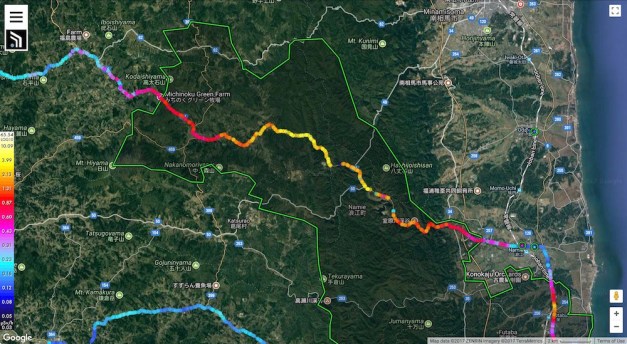 Above: National Route 114 runs through the current exclusion zone in Namie. The area remains evacuated but the road was recently reopened for public use.
National Route 114 in Namie was reopened to public access on Sept 20th of this year. The route, also known as the Tomioka Highway, is a primary thoroughfare which runs east-west in Fukushima, primarily through the mountainous sections of Namie. Prior to the accident it was the major lifeline connecting Fukushima City in the west with the center of Namie and other coastal towns in the east. Since April 2011 the road has been officially closed to public access, as the entire town of Namie was placed under evacuation orders. However, Joe and Kalin shot this video on Rte 114 in Namie in May, 2012, so it was still at least partly accessible then, and to the best of our recollection remained so until Spring of 2013. In March this year, the previously more populated eastern portion of Namie was reopened for residence. But the rest of the town, through which Rte 114 runs, remains part of the “Difficult to return zone” (kikan konnan kuiki), usually marked in red on evacuation maps. It’s been difficult for us to get access to this area in the past, but longtime volunteer KM Aizu recently Safecasted the reopened road. He measured dose rates at 1 meter of up to 5.91 µSv/hr along one stretch. This is somewhat higher than the 5.53 µSv/hr shown by an official survey in August, as reported recently in the Asahi Shimbun. It is also significantly lower than the 19.6 µSv/hr we measured there in Oct-Nov 2011.
KM Aizu commented that while driving on the road, which took about 45 minutes end-to-end, he thought, “It’s been a long time since I’ve been anywhere with dose rates this high.” The portion of Route 6 in front of Fukushima Daiichi is still up to about 5 µSv/hr, he noted, “But this is now the highest dose rate anywhere that is publicly accessible in Fukushima.” As with Rte. 6 and the Joban Expressway, both of which cut through the “Difficult to return zone,” the government advises people not to stop along the way but to enter and leave the area quickly so as to minimize their radiation exposure. Barriers blocking access to side roads have been placed at over 80 locations along Rte 114, and according to our volunteer, the road is regularly patrolled by police cars. (KM Aizu noted that as with other law enforcement teams patrolling and manning roadbocks, the ones he saw were from other prefectures). He also noted that while Rte 6 is lined with houses and businesses to which somewhat efficient decontamination could be done before and after reopening it, Rte 114 runs almost entirely through forested hillsides. The hillsides immediately flanking the road have been remediated to a distance of about 10 meters, but the remainder is essentially untouched. “If people went even a fairly short distance into the mountains,” he observed, “I’m sure the doses would be much higher.”
The reopening of Rte 114 will definitely make travel between Fukushima City and the coast easier for people and goods, and in that sense it will bring benefits and is probably justified. There have been increasing discussions about reopening Rte 399, which runs north-south between Iitate and Katsurao, intersecting Rte 114 in Namie, as well. This would essentially restore the basic road network through the area. Locals generally seem to acknowledge and accept the risks the potential exposures present, but nevertheless we urge people intending to travel in the region to be aware of the situation and to exercise adequate caution.
Fukushima Decontamination Work Racket Yakuza Arrested
 Bags containing debris from decontamination work are piled up in a Bags containing debris from decontamination work are piled up in a tentative storing site in Naraha, Fukushima Prefecture. The location pictured is not where the workers in the article were operating.
Yakuza arrested in Fukushima decontamination work racket
Three men, including a yakuza gang boss affiliated with Yamaguchi-gumi, Japan’s largest crime syndicate, have been arrested on suspicion of illegally supplying workers for government-commissioned decontamination work related to the 2011 Fukushima nuclear power plant accident.
The three are yakuza group leader Hidenobu Maruta, 48, of Tokyo’s Katsushika Ward, construction company executive Shigeki Yamamura, 59, of Koriyama, Fukushima Prefecture, and Akio Kitano, 51, an unemployed resident of Saitama, Tokyo police announced Sept. 27.
All three deny the allegations of employment brokering without a license, a violation of the Employment Security Law, and intermediate exploitation, which is banned under the Labor Standards Law.
Maruta and Yamamura are accused of supplying two workers from January 2015 to March 2016 to a sub-subcontractor who carries out decontamination operations for the government project, and receiving 160,000 yen ($1,430) together in commission without consent from the labor ministry.
The cleanup work was conducted in Tomioka, Fukushima Prefecture.
Maruta and Kitano are suspected of taking commission amounting to about 920,000 yen from the wages of those two workers, according to the police department in charge of organized crime.
The three suspects are said to have shared cut of 2,000 yen to 3,000 yen from each of the workers’ 16,000-yen daily wage.
Further to the exploitation of the aforementioned two workers, the suspects are believed to have received about 10 million yen collectively through brokering about 10 other workers to the sub-subcontractor.
http://www.asahi.com/ajw/articles/AJ201709280045.html
3 nabbed over alleged illicit job mediation for Fukushima cleanup workers
Police on Sept. 27 arrested three people, including a high-ranking member of a gang affiliated with the Yamaguchi-gumi crime syndicate, on suspicion of illicitly introducing workers to other businesses to engage in Fukushima decontamination work.
The three suspects, including a gang member in his 40s, were arrested on suspicion of violating the Employment Security Act by mediating in paid work without permission. Police believe that the service charges the suspects received were being used to fund gang activities.
Investigators said that the three are suspected of having introduced decontamination workers to other businesses since 2014 and charging introduction fees, despite lacking permission from the Minister of Health, Labor and Welfare that is required by law.
A consulting company based in Tokyo’s Nerima Ward that was effectively run by the suspects’ gang dispatched workers to decontamination zones through other businesses. The workers reportedly engaged in decontamination work in Fukushima Prefecture.
In January 2013, Yamagata Prefectural Police arrested a high-ranking member of a gang affiliated with the Sumiyoshi-kai crime syndicate on suspicion of violating the worker dispatch law in connection with the dispatch of workers engaging in Fukushima-related decontamination work.
http://mainichi.jp/english/articles/20170927/p2a/00m/0na/015000c
EU to lift import curbs on rice from Fukushima, more deals likely
 A farmer plants rice seedlings in Minami-Soma, Fukushima Prefecture, in May
The European Commission is set to relax import restrictions on rice from Fukushima Prefecture that were imposed after the 2011 nuclear disaster, sources said.
The import curbs could be eased as early as this year and prompt other countries, including major markets like China, to follow suit, the sources added.
In addition to rice from Fukushima Prefecture, the EU is expected to remove restrictions on some seafood products from Iwate, Miyagi and other prefectures.
All restrictions on products from Akita Prefecture will likely also be lifted, thereby abolishing all curbs on rice grown in Japan.
The United States on Sept. 22 decided to allow imports of milk and dairy products from Fukushima, Iwate, Miyagi, Tochigi and Gunma prefectures without inspection certificates stating they are free of radioactive materials.
The EU move follows a general agreement on an economic partnership in July, during which EU officials informed Japan of plans to relax import restrictions on agricultural products. The two sides have been discussing the issue since then.
Thin Lichen Exhibits Remarkable Radioactivity Bioaccumulation in Iwate

Via Marco Kaltofen
From our sampling with Fairwinds in Iitate, Japan; thin layer of lichen exhibits remarkable bioaccumulation of environmental radioactivity.
Multiple challenges remain to Fukushima nuclear cleanup

This Sept. 4, 2017 aerial photo shows Fukushima Dai-ichi nuclear power plant reactors, from bottom at right, Unit 1, Unit 2 and Unit 3, in Okuma, Fukushima Prefecture, northeastern Japan. The three reactors that had meltdowns together have 1,573 units of mostly used nuclear fuel rods that are still inside and must be kept cool in pools of water. They are considered among the highest risks in the event of another major earthquake, because the pools are uncovered. The plant operator, Tokyo Electric Power Co. or TEPCO, plans to begin removing the rods from reactor unit 3 in the fiscal year beginning next April 1. However, the latest roadmap delays removal of the rods from units 1 and 2 for three years until fiscal 2023, because further decontamination work and additional safety measures are needed.
Japan’s government approved on Tuesday, Sept. 26, 2017 a revision to the decommissioning plan for the Fukushima nuclear plant, delaying by two more years the removal of radioactive fuel rods in two of the three reactors damaged in the 2011 disaster. It still plans for melted fuel to be removed starting in 2021, but the lack of details about the duration raises doubts if the cleanup can be completed within 40 years. Kyodo News via AP, File)
TOKYO – Japan’s government approved a revised road map Tuesday to clean up the radioactive mess left at the Fukushima nuclear power plant after it was damaged beyond repair by an earthquake and tsunami in 2011. Decommissioning the damaged reactors is an uncertain process that is expected to take 30 to 40 years.
A look at some of the challenges:
THE FUEL RODS
The three reactors that had meltdowns together have 1,573 units of mostly used nuclear fuel rods that are still inside and must be kept cool in pools of water. They are considered among the highest risks in the event of another major earthquake that could trigger fuel rods to melt and release massive radiation due to loss of water from sloshing or structural damage because the pools are uncovered. The plant operator, Tokyo Electric Power Co., or TEPCO, plans to begin moving the rods from reactor Unit 3 in the fiscal year beginning April 1.
However, the latest road map delays removal of the rods from units 1 and 2 for three years until fiscal 2023, because further decontamination work and additional safety measures are needed. Ironically, because the building housing reactor 3 was more heavily damaged, it is easier to remove that unit’s fuel rods. The fuel rods will be moved to a storage pool outside the reactors, and eventually sent for long-term storage in what are known as dry casks.
___
THE MELTED FUEL
By far the hardest part of decommissioning Fukushima will be removing the fuel that melted and presumably spilled out of the reactor cores. In July, an underwater robot for the first time captured images inside the primary containment chamber of Unit 3. They showed a large number of solidified lava-like rocks and lumps on the chamber’s floor, believed to be melted fuel mixed with melted and mangled equipment and parts of the structure.
The search for melted fuel in units 1 and 2 has so far been unsuccessful. The water level is lower, so crawling robots have been tried, but they have been obstructed by debris as well as extremely high radiation levels. Despite the unknowns about the melted fuel and debris and their whereabouts, the road map calls for finalizing the removal method in 2019, and starting actual removal at one of the reactors in 2021. The government-funded International Research Institute for Nuclear Decommissioning is developing robots and other technology to carry out the work.
___
CONTAMINATED WATER
TEPCO has treated and stored a massive amount of radioactive water — about 800,000 tons — and the volume is growing every day. Cooling water leaks out of the damaged reactors and mixes with groundwater that seeps into the basements of the reactor building, increasing the amount of contaminated water. The utility has managed to halve the volume to 200 tons per day by pumping up groundwater via dozens of wells dug upstream from the reactors, as well as installing a costly “ice wall” by freezing the ground to block some of the water from coming in and going out.
The water is stored in hundreds of tanks that cover much of the plant property. They get in the way of decommissioning work and pose another risk if they were to spill out their contents in another major earthquake or tsunami. After treatment, the water still contains radioactive tritium, which cannot be removed but is not considered harmful in small amounts. Experts say controlled release of the water into the ocean is the only realistic option, but TEPCO has not moved forward with that plan because of opposition from fishermen and residents who fear a negative image and possible health impact.
___
RADIOACTIVE WASTE
Japan has yet to develop a plan to dispose of the highly radioactive waste that will come out of the Fukushima reactors. Under the road map, the government and TEPCO will compile a basic plan during fiscal 2018. Managing the waste will require new technologies to compact it and reduce its toxicity. Finding a storage site for the waste seems virtually impossible, as the government has not been able to find a site even for the normal radioactive waste from its nuclear power plants. The prospect raises doubts about whether the cleanup can really be completed within 40 years.
___
http://www.miamiherald.com/news/business/article175387901.html
Spent Nuclear Fuel Removal at Fukushima Plant Delayed Again
Japan muddles on with Fukushima’s melted and “spent” fuel. The three year delay for emptying the reactors “spent” irradiated nuclear fuel into a dry cask storage runs the risk of another major earthquake causing a loss of cooling in the pools without containments and another major release of radiation. Plans for removing the melted reactor cores from Units 1, 2 and 3 still defied by inability to locate it.

Fukushima Nuclear Plant Scrapping Plan Faces Another Delay
A key decision in decommissioning the crippled Fukushima Daiichi nuclear plant is being delayed. The Japanese government and operator made the announcement on Tuesday while giving an update on the roadmap for scrapping the plant.
In their first such update in 2 years, officials said they will postpone their decision on the method for removing molten fuel debris by one year, until fiscal 2019.
Experts believe that when the plant went into triple meltdown in 2011, most of the fuel inside the reactors collected at the bottom of containment vessels. They still don’t know the exact location, but possible molten fuel debris was caught on camera in July. The removal of this debris is considered the most challenging part of the plant’s decommissioning.
Originally, officials considered filling the containment vessels with water to block radiation while removing the debris. But now, they say they’re leaning towards a method called dry removal.
Experts say that method comes with safety challenges. “Because the containment vessel will not be filled with water, there is a possibility that radioactive substances may leak and get dispersed,” says Hosei University Visiting Professor Hiroshi Miyano.
Officials also gave an update on plans for the removal of spent nuclear fuel rods in 2 of the plants reactors. The rods are in storage pools and won’t be removed until fiscal 2023. That’s 3 years later than planned. The official timeline for scrapping the plant remains the same — about 30 to 40 years in total.
https://www3.nhk.or.jp/nhkworld/nhknewsline/nuclearwatch/fukushimanuclearplantscrapping/
Spent nuclear fuel removal at Fukushima plant pushed back again
 Cabinet ministers attend a meeting at the Prime Minister’s Office on Tuesday to discuss a delay in the road map for decommissioning the Fukushima No. 1 nuclear power plant.
The government and Tokyo Electric Power Company Holdings Inc. decided Tuesday to further delay the removal of spent nuclear fuel left near two of the three reactors that suffered meltdowns at the Fukushima No. 1 nuclear plant.
In the road map for decommissioning the plant, revised for the fourth time since it was first crafted in 2011, highly radioactive spent fuel will be extracted from the cooling pools of reactors 1 and 2 starting in fiscal 2023 instead of fiscal 2020.
The decision marks the third delay for the removal plan, with the last adjustment coming in June 2015. The government said new technical issues and the need to take safety precautions led to the latest change.
The cleanup process is set to be completed in around 30 to 40 years.
Spent fuel removal at the plant’s reactor 3 will go ahead in fiscal 2018 as planned, having already been pushed back earlier this year.
In the decommissioning process, the removal of fuel rod assemblies from the spent fuel pools in reactor buildings is one of the key steps before extracting melted fuel debris. Reactors 1, 2 and 3 suffered core meltdowns following the March 2011 earthquake and tsunami disaster.
The removal of melted fuel debris has also been delayed, with an extraction plan set to be decided in fiscal 2019, pushed back from the first half of fiscal 2018.
Despite the delay in finalizing specific methods, the road map maintains a 2021 start for debris extraction, the most challenging part of the decommissioning process.
A method currently considered feasible by the government involves removing debris from the sides of the reactors after partially filling them with water.
The road map newly sets the goal of cutting the amount of underground water at the plant to address contaminated water buildup. Underground water — which gets mixed with accumulated radioactive water generated in the process of cooling the damaged reactors — is to be cut to around 150 tons per day in 2020 from the current 200 tons.
The road map does not mention a specific schedule for the disposal of processed water that still contains radioactive tritium.
The plan was first crafted in December 2011 in the wake of the meltdowns, the world’s worst nuclear crisis since the 1986 Chernobyl disaster.
Attempts have been made to confirm the situation inside the damaged reactors using specialized robots. A survey in July this year captured for the first time images of what is likely to be melted nuclear fuel at the bottom of reactor 3.
Isamu Kaneda, deputy mayor of the Fukushima Prefecture town of Futaba, expressed regret over the delay.
“The town’s rebuilding depends on the development of decommissioning. It’s unfortunate,” Kaneda said. “But at the same time, the decommissioning process is an unprecedented project. It needs to be conducted carefully, so we can’t just ask them to speed it up.”
Spent nuclear fuel removal at Fukushima plant to be delayed again

TOKYO (Kyodo) — The government and Tokyo Electric Power Company Holdings Inc. decided Tuesday to delay again the start of removing spent nuclear fuel left near two of the three reactors which suffered a meltdown at the Fukushima complex.
In the road map for decommissioning the Fukushima Daiichi plant, revised for the fourth time since it was first crafted in December 2011, highly radioactive spent nuclear fuel will be extracted from the Nos. 1 and 2 units’ cooling pools starting in fiscal 2023 instead of fiscal 2020.
It is the third time that the schedule for spent fuel removal has been pushed back at the Nos. 1 and 2 reactors, with the previous postponement taking place in June 2015. The government said new technical issues and the need to take safety precautions led to the latest schedule change.
The cleanup process is to be completed in around 30 to 40 years.
For the No. 3 reactor at the Fukushima plant, the schedule to remove spent nuclear fuel during fiscal 2018 is unchanged after having already been pushed back earlier this year.
In the decommissioning process, taking out fuel rod assemblies from the spent fuel pools inside reactor buildings is one of the key steps before extracting melted fuel debris from the Nos. 1 to 3 reactors, all of which suffered core meltdowns following the March 2011 earthquake and tsunami disaster.
The schedule for extraction of the melted fuel debris at the reactors was also revised, with the determination of a specific approach to remove the debris to be made in fiscal 2019, rather than in the originally planned first half of fiscal 2018.
Despite the delay in finalizing specific methods, the road map kept the start of the debris extraction, the most challenging part of the decommissioning process, at 2021.
A method currently considered feasible by the government is debris removal from the side of the three crippled reactors by partially filling them with water.
The road map newly sets the goal of cutting the amount of underground water at the plant to address contaminated water buildup at the site. Underground water, which gets mixed with accumulated radioactive water generated in the process of cooling the damaged reactors — is to be cut to around 150 tons per day in 2020 from the current 200 tons.
It did not mention a specific schedule for disposal of processed water that still contains radioactive tritium.
The road map was first crafted in December 2011 in the wake of the 2011 disaster which triggered at the Fukushima plant the world’s worst nuclear crisis since the 1986 Chernobyl disaster.
Attempts have been made to confirm internal conditions of the damaged reactors using robots. A survey robot captured images of what is likely to be melted nuclear fuel at the bottom of the No. 3 reactor for the first time in July this year.
http://mainichi.jp/english/articles/20170926/p2g/00m/0dm/064000c
FUKUSHIMA : The silent voices
Documentary: A young Japanese filmaker expatriated in France goes back to her birthplace near Fukushima City.
Six years after the nuclear disaster, she’s aiming to re-open the debate
with her family on this catastrophe which became a taboo topic.
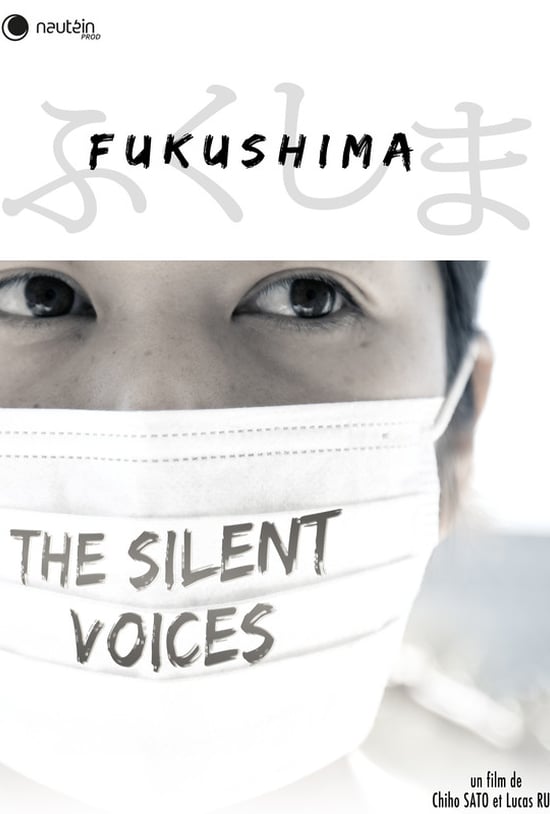
“” My name is Chiho SATO, I live in France for 5 years and I was born in Fukushima.
My parents and grandparents still live 60 km from the Fukushima Daiichi nuclear plant in what is called “the voluntary evacuation zone”.
More than four years after the disaster, radioactivity, invisible but omnipresent, has gradually disappeared from the minds of the inhabitants of the region.
Far from the dramatic and anxiogenic images frequently shown in Europe, I directed an intimate documentary.
A touching testimony about the inhabitants of one of the most radioactive regions in the world.
My objective: Re-open the debate on the situation in Fukushima by including the voice of the inhabitants themselves. “”
https://vimeo.com/ondemand/fukushimathesilentvoices/213498053
Please read also my previous articles about this excellent documentary, the best about Fukushima in my humble opinion:
“The Silent Voices”: what is really to be living within the Fukushima disaster
Chiba court recognizes nuke disaster evacuees’ ‘loss of hometown’ for first time
 Lawyers for the plaintiffs in a lawsuit seeking damages from the government and TEPCO for residents who evacuated to Chiba Prefecture following the 2011 Fukushima nuclear disaster hold up banners reading “Government not liable,” left, and “TEPCO must pay portion of compensation,” right, in front of the Chiba District Court on Sept. 22, 2017.
When on Sept. 22 the Chiba District Court ordered Tokyo Electric Power Co. (TEPCO) to pay some 376 million yen in damages to a group of Fukushima nuclear disaster evacuees, it gave concrete recognition to the evacuees’ loss — of hometowns, jobs and personal relationships — for the first time.
Six and a half years after the disaster, even in areas where evacuation orders have been lifted, the reconstruction of the communities that once thrived there is still a distant prospect. However, though it absolved the government of legal liability, this court ruling — the second in a slew of class action suits filed against TEPCO and the government — can be said to be a breakthrough far exceeding previous compensation levels.
“The Maebashi District Court (in March) recognized the responsibility of both the government and TEPCO, but this ended up feeling like a victory in name only, with no ‘reward.’ But it can be said that the Chiba (District Court) decision finally reaped ‘rewards,”’ commented lawyer Katsuyoshi Suzuki, lead counsel of the plaintiffs’ legal team in the Maebashi court case, who was at a gathering in Chiba awaiting the Sept. 22 ruling.
The Maebashi District Court awarded a total of some 460 million yen in damages. However, based on “interim guidelines” set for TEPCO by the Ministry of Education, Culture, Sports, Science and Technology’s Dispute Reconciliation Committee for Nuclear Damage Compensation in August 2011 to ensure swift payouts, it was decided that TEPCO had already paid about 420 million yen. As such, a total of only 38.55 million yen was awarded to 62 of the 137 plaintiffs. Complaints followed that voices of the evacuees decrying their psychological pain had not been heard.
However, in the Chiba case, TEPCO was ordered to pay 42 out of the 45 plaintiffs a total of roughly 376 million yen, even after some 650 million yen was judged as already having been paid by the company under the “interim guidelines.” It was pointed out that the guidelines only set a minimum baseline for compensation, and upon considering the individual cases, the court granted the large damages award.
What stood out was that the court explicitly recognized the payout as compensation for the loss of hometowns, jobs and personal relationships suffered by the nuclear disaster evacuees. The majority of the plaintiffs in the Chiba case were residents of designated evacuation zones, and claimed they lost their livelihoods, relationships and local customs to the nuclear disaster, and were stripped of their right to live a peaceful life. They had sought 20 million yen in compensation each, saying that the interim guidelines did not accurately reflect the pain of losing their hometowns.
Concerning communities where the evacuation orders had been lifted by this spring, including the village of Iitate, Fukushima Prefecture, TEPCO cited falling radiation levels and infrastructure restoration as evidence that the plaintiffs’ claim that they lost their hometowns permanently was false. As such, TEPCO argued that their current compensation standards were sufficient.
However, even in areas where evacuation orders have been lifted, only roughly 10 percent of former residents have returned. The court decision stated, “(The plaintiffs) have lost their close connections to their local communities over a substantial period of time. Simply lifting evacuation orders will not immediately relieve this suffering,” awarding 36 of the plaintiffs an average of some 3 million yen each. Nevertheless, some of the plaintiffs are not satisfied by the results.
“Our lives were disrupted,” said Michiko Saito, 56, who evacuated from the Odaka district of Minamisoma, Fukushima Prefecture, to Yachimata, Chiba Prefecture. “Even if the money is returned to us, we will never get our hometowns back.”
https://mainichi.jp/english/articles/20170923/p2a/00m/0na/018000c
Over 30µSv / h Along Side of Recently Fukushima Reopened Route 144
Via Oz Yo
Over 30μSv/h was read along side the recently-reopened Route 114 in Fukushima, September 20, 2017. It is insane for the government to give its green light for people to use that road.
6.5 years mean nothing here. Nothing at all.

Japan’s nuclear watchdog chief holds final press conference before stepping down
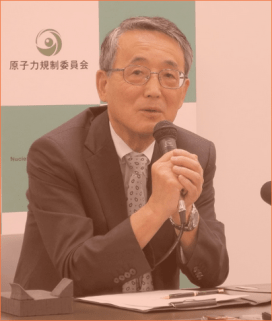
Nuclear Regulation Authority (NRA) Chairman Shunichi Tanaka held his final press conference in Tokyo’s Minato Ward on Sept. 20 before officially stepping down from his role.
Reflecting on his five-year term in office, Tanaka said, “I tried to maintain independence and transparency,” adding that, “I have absolutely no doubt that I’ve made judgments from a scientific and impartial standpoint, and taken actions based on (the NRA’s) philosophies. This is something that I am proud of.”
However, he also stated that, “The distrust of the public who experienced the Fukushima nuclear disaster in 2011 is an issue that cannot be easily rectified.”
Tanaka became the first chairman of the NRA at the same time the organization was established in September 2012, having previously served as the deputy director general of the Japan Atomic Energy Research Institute and acting chairman of the Japan Atomic Energy Commission.
During his time as NRA chairman, he led efforts to draw up new regulatory standards based on the lessons learned from the Tokyo Electric Power Co.’s Fukushima No. 1 Nuclear Power Plant disaster, and carried out nuclear power plant screening.
Originally hailing from Fukushima Prefecture, Tanaka says he is planning to live in the prefectural village of Iitate after stepping down as NRA head. “It would be great if I could contribute to the recovery of Fukushima (using my experience at the NRA),” Tanaka said.
https://mainichi.jp/english/articles/20170921/p2a/00m/0na/004000c
Tepco promises legal safety vow as it seeks to restart reactors
Promises are meant to be broken

The head of Tepco Electric Power company Holdings Inc. promised Wednesday to institute a safety pledge as requested by nuclear regulator, as the company seeks clearance to reactivate undamaged, idle reactors located far from its plant crippled by natural disaster in 2011.
has been calling for the company to make such a pledge part of its legally binding reactor safety program because it operates the Fukushima Daiichi nuclear power plant, the site of a major nuclear disaster in the aftermath of the massive earthquake and tsunami.
President Tomoaki Kobayakawa told the regulator on Wednesday that will stipulate a pledge to build “safety culture” in its program developed for ensuring safe operation of the Nos. 6 and 7 reactors at the company’s power station in Niigata Prefecture on the Sea of coast.
promise will pave the way for the regulator’s safety clearance for the two units — boiling-water reactors that are the same type as the ones that experienced meltdowns in the disaster.
The regulator will soon compile a draft document for the two units that will serve as certification that the utility has satisfied new stricter safety requirements implemented since the nuclear disaster.
It will then consult the economy, trade and industry minister, who oversees the nuclear industry, to confirm that is fit to be an operator. It will also solicit comments from the public before formally giving safety clearance.
Even if the reactors clear the safety checks, local governments in the area on which the Kashiwazaki-Kariwa plant sits remain cautious about their resumption.
Niigata Gov. Ryuichi Yoneyama, for example, has said it will take “around three to four years” for the utility to win the required local consent for a restart.
said last week was “qualified” as a nuclear plant operator, but that it wanted the utility to express its resolve to ensure safety in a legal document, not just in words.
Safety programs drawn up for reactors need to be approved by the regulator and if it finds a grave violation, it can demand a halt to nuclear power operations from the utility.
“We intend to tackle the unending mission of improving the safety of nuclear power and to complete the decommissioning and compensation of the Fukushima Daiichi complex,” Kobayakawa said at the regulator’s meeting on Wednesday. “We will also make efforts to maintain qualification” as operator of nuclear reactors, he said.
The Nos. 6 and 7 units at the Kashiwazaki-Kariwa plant are the newest among the seven units at the plant. The complex is one of the world’s largest nuclear power plants with a combined output capacity of 8.2 million kilowatts.
For a reactor to be restarted, it first needs to clear the safety requirements introduced in the wake of the Fukushima nuclear crisis. filed for safety assessments of the two units in .
, which is facing massive compensation payments and other costs in the aftermath of one of the world’s worst nuclear crises, has been desperate to resume operation of its idled reactors so it can reduce spending on costly fossil fuel imports for non-nuclear thermal power generation.
While some reactors run by other utilities have resumed operations in by satisfying the new safety regulations, has been under close scrutiny by regulators on whether it is qualified to once again operate a nuclear power plant.


Plaintiffs and their lawyers enter the Chiba District Court on Sept. 22 to hear the verdict in the Fukushima nuclear accident compensation case.
TEPCO ordered to pay evacuees of Fukushima nuclear disaster
CHIBA–A district court here on Sept. 22 ordered Tokyo Electric Power Co. to pay 376 million yen ($3.3 million) in compensation to evacuees of the Fukushima nuclear disaster but absolved the central government of responsibility.
Forty-five people in 18 households who evacuated to Chiba Prefecture following the 2011 meltdowns at the Fukushima No. 1 nuclear plant sought a total of about 2.8 billion yen from TEPCO and the government.
About 30 similar lawsuits involving 12,000 plaintiffs have been filed at district courts around Japan.
The Chiba District Court ruling was the second so far.
In March, the Maebashi District Court in Gunma Prefecture found both TEPCO and the government responsible for the nuclear disaster and ordered compensation totaling 38.55 million yen for 62 plaintiffs.
The main point of the lawsuit in the Chiba District Court was whether TEPCO and the government could have foreseen a towering tsunami hitting the Fukushima No. 1 nuclear plant and taken measures to prevent the disaster.
The plaintiffs emphasized a long-term appraisal released by the central government in 2002, which estimated a 20-percent possibility of a magnitude-8 level earthquake occurring between the coast off the Sanriku region in the Tohoku region to the coast off the Boso Peninsula of Chiba Prefecture within the next 30 years.
The plaintiffs argued that this appraisal shows it was possible to forecast a tsunami off the coast from the Fukushima No. 1 nuclear plant, and that measures could have been taken even as late as 2006 to prevent the disaster.
For the first time in a court case involving compensation related to the Fukushima disaster, a seismologist provided testimony on behalf of the plaintiffs.
Kunihiko Shimazaki, a professor emeritus at the University of Tokyo, once served as a deputy chairman of the Nuclear Regulation Authority. He was also in charge of compiling the 2002 long-term appraisal for the government.
“The height of a likely tsunami could have been known if it was calculated based on that appraisal,” Shimazaki said in court. “Even if a specific forecast could not be made, some sort of countermeasure could have been taken.”
The defendants argued that the long-term appraisal did not provide a specific basis for predicting a tsunami and only pointed to the fact that a magnitude-8 level earthquake occurring could not be ruled out.
http://www.asahi.com/ajw/articles/AJ201709220052.html
Tepco again ordered to pay damages in nuclear disaster, but not state
CHIBA, Japan (Kyodo) — A Japanese court ordered Tokyo Electric Power Company Holdings Inc. on Friday to pay damages over the nuclear disaster at its Fukushima Daiichi nuclear power plant following a deadly 2011 earthquake and tsunami, but dismissed claims against the state.
The Chiba District Court ruling follows a Maebashi District Court decision in March that found negligence on the part of both Tepco and the government played a part in the worst nuclear catastrophe since Chernobyl and ordered them to pay damages.
Friday’s ruling stemmed from a lawsuit filed by 45 people who were forced to flee Fukushima Prefecture to Chiba Prefecture near Tokyo as reactors that lost cooling functions caused meltdowns and spewed massive amounts of radioactive materials into the air.
The Chiba court awarded a total of 376 million yen ($3.35 million) to 42 of them, including all four who voluntarily evacuated. In the suit filed in March 2013, the plaintiffs were collectively seeking around 2.8 billion yen in damages from the government and plant operator.
The focal point of the Chiba case was whether the government and Tepco were able to foresee the huge tsunami that hit the seaside plant on March 11, 2011, and take preventive measures beforehand, with conflicting claims made by the parties regarding the government’s long-term earthquake assessment, which was made public in 2002.
The assessment, made by the government’s earthquake research promotion unit, predicted a 20 percent chance of a magnitude-8-level tsunami-triggering earthquake occurring along the Japan Trench in the Pacific Ocean within 30 years, including the area off Fukushima.
Based on the assessment, the plaintiffs argued that, with the plant standing on ground roughly 10 meters above sea level, a tsunami higher than the ground striking the plant could have been predicted.
They then claimed that the disaster was therefore preventable if emergency power generation equipment had been placed on higher ground, and that the government should have made Tepco take such measures by exercising its regulatory powers.
The government and Tepco, for their part, claimed the assessment was not established knowledge, and that even if they had foreseen a tsunami higher than the site of the plant and taken measures against it, they cannot be held liable as the actual tsunami was much higher at around 15.5 meters.
The government also argued that it obtained regulatory powers to force Tepco to take anti-flooding measures only after a legislative change following the disaster.
In Friday’s ruling, the court found the government not liable, saying that while the government indeed has such powers, not exercising them was not too unreasonable.
While ordering Tepco to pay damages, the court determined that the plant operator did not commit serious negligence that would have required a higher compensation amount, saying it did not totally leave anti-tsunami measures unaddressed.
The plaintiffs’ lawyers criticized the ruling as unfair, in that the court did not recognize the state’s liability. But they still positively rated the court’s acknowledgement of the loss of the plaintiffs’ hometown, jobs and personal relationships, and compensation for such a loss.
In March, the Maebashi District Court in Gunma Prefecture recognized negligence on the part not just of Tepco but also the government, saying they were able to foresee a tsunami high enough to inundate the plant.
It was the first such ruling issued among around 30 suits of the same kind and the first to rule in favor of plaintiffs.
The Maebashi court acknowledged that the government had regulatory authority over Tepco even before the accident, noting that “failing to exercise it is strikingly irrational and illegal.”
The court awarded to 62 of 137 plaintiffs a total of 38.55 million yen in damages, far less than the 1.5 billion yen sought in total. Many of the plaintiffs have appealed the district court decision.
In the Chiba suit, the 45 plaintiffs, including four who evacuated voluntarily, sought 20 million yen each for compensation for their evacuation and the loss of their hometown, jobs and personal relationships because their lives were uprooted.
The magnitude-9.0 earthquake and ensuing tsunami struck northeastern Japan on March 11, 2011, causing multiple meltdowns and hydrogen blasts at the nuclear power plant. Around 55,000 people remained evacuated both within and outside Fukushima Prefecture as of the end of August in the wake of the disaster.
http://mainichi.jp/english/articles/20170922/p2g/00m/0dm/081000c
TEPCO ordered to pay damages over nuclear accident
A Japanese court has ordered Tokyo Electric Power Company to pay damages to people who were forced to leave their homes after the accident at the Fukushima Daiichi nuclear power plant.
The Chiba District Court on Friday ordered TEPCO to pay nearly a total of 3.4 million dollars to 42 of the 45 plaintiffs who filed a lawsuit against TEPCO and the government.
The complainants say they lost their homes and jobs because of the March 2011 accident. They were seeking 25 million dollars in compensation.
The focus was whether the defendants were able to predict the tsunami that hit the plant and should therefore have taken preventive measures.
Also at issue was whether the amount of compensation TEPCO is currently paying to evacuees is appropriate.
Presiding judge Masaru Sakamoto said TEPCO did not entirely fail to implement measures against the risk of tsunami, and did not commit a grave error.
But Sakamoto said the psychological suffering of the plaintiffs is linked to the accident, and that TEPCO should pay redress.
He did not hold the government liable for the accident. The judge said that although by 2006 officials were able to predict the possibility that a tsunami could hit the plant compound, the introduction of safety measures would not necessarily have prevented the accident.
This is the second ruling in a series of lawsuits filed by about 12,000 people over the nuclear accident.
In March, the Maebashi District Court ruled that both the government and TEPCO were liable for the accident and ordered the government and the plant operator to pay damages.
https://www3.nhk.or.jp/nhkworld/en/news/20170922_25/

Japan’s bomb in the basement

Under the guise of a civil nuclear program, Japan has become a de-facto nuclear weapons state without so far having to take that next fateful step.
On Thursday, a shipment of 700 kilograms of plutonium arrived in Japan after a journey by sea from the French port of Cherbourg. That’s enough material for more than 100 nuclear weapons.
The plutonium – in the form of atomic fuel known as MOX, a mix of uranium and plutonium oxide – is for use in the Takahama-4 reactor, owned by Kansai Electric Power Co. and located on Wakasa Bay, in western Japan near Osaka.
There have been six shipments of such highly toxic cargoes since 1999, the result of an agreement to send radioactive spent fuel in Japan for reprocessing in France and the UK, and then to be shipped back as plutonium MOX fuel for use in Japan’s reactors.
Putting aside the reactor fuel issue for the moment, Japan’s plutonium program must be seen in the context of the nuclear arms proliferation dynamic that has existed for decades in Northeast Asia, but which today has taken on even greater urgency owing to North Korea’s nuclear weapon program.

Map of Japan’s nuclear plants. Photo: Japan Atomic Industries Forum, 2016.
There is no question that Japan has the technical capability to build an advanced nuclear weapons arsenal.
There have been over the decades multiple references to it taking less than six months for Japan to build an atomic weapon – a credible timeframe if it’s true as reported more 20 years ago that a design or designs already exist in the country.
However, to build a ‘credible’ arsenal of weapons would require several years at least.
More important than any actual timeframe are the external factors that would lead a Japanese government to move to nuclear weaponization.
This debate is stirring in Japan. In a TV Asahi program on September 6, former Defense Minister Shigeru Ishiba suggested a review was needed of Japan’s so-called three non-nuclear principles: Not producing, possessing, or allowing nuclear weapons into Japan.
Ishiba asked the question if Japan is under the US nuclear umbrella then isn’t it necessary to allow US nuclear weapons into the country to deter threats from North Korea?
It’s clear that without a peaceful resolution to the underlying security threats in the region, there is an increasing possibility that policy makers in Tokyo – backed by Washington – will decide that Japan should weaponize its plutonium stockpile.

We have not reached that point yet, but without a fundamental change in thinking and policy, Japan’s nuclear bomb in the basement may not remain there for very much longer.
But back to Japan’s plutonium stockpiles and the question of why the only country attacked by a nuclear weapon and one that espouses the three non-nuclear principles has large amounts of the bomb-making material.
To answer that question requires looking back to the 1950s and a policy that was spearheaded by the United States, but soon adopted by Japan’s Science and Technology Agency established by former Prime Minister Yasuhiro Nakasone.
The policy was to build new types of nuclear power plants, or so-called Fast Breeder Reactors (FBRs), worldwide that would be fueled with plutonium reprocessed from spent uranium fuel. As FBRs produce more fuel than they burn – hence the name “breeder” – they would in turn generate plutonium to fuel yet more FBRs.
The procedure was known as “closing the nuclear fuel cycle.”
While the idea seems a solution for processing spent fuel and producing more fuel for FBRs, the problem is fast breeder reactor programs failed worldwide, including in Japan.
Japan’s principle FBR started up in 1994 and was called Monju – named after a Buddhist deity for wisdom. However, a fire broke out at Monju 18 months after it opened, which shut the plant down for 14 years.
 Monju nuclear reactor. Photo: IAEA Energy/Flickr
It restarted in May 2010, but weeks later a 3.3 metric-ton fuel exchange device fell into the reactor, which shut it down again for good, though to add to the fiasco its computers were later hacked and data stolen.
This effectively ended Japan’s FBR ambitions, though it took two decades and a total investment of more than US$10 billion for the government to finally make the wise decision to terminate Monju in December 2016.
However, Tokyo had other motives for commitment to a plutonium fuel cycle.
By the late 1960’s and early 1970’s, plans to build commercial light water reactors across Japan, such as at Takahama and Fukushima, faced strong opposition from local communities and activists.
To appease the opposition, the government and utilities said the new reactors would not become nuclear waste sites because the spent fuel would be shipped for reprocessing in the UK and France. This solved, temporarily, a major nuclear waste problem at least for Japan.
In total over 7,000 tons of such fuel went off to Europe during the decades up to the mid 1990’s.
During that time, the plants reprocessing Japan’s spent fuel at la Hague in France and Sellafield in the UK became synonymous with accidents, nuclear waste discharges into the ocean and atmosphere, and public health concerns.
While the Japanese contracts were lucrative for the two state owned companies that operated the Sellafield and la Hague plants –Cogema/AREVA in France and British Nuclear Fuels Limited (BNFL) in the UK – both were to become failed entities.
The Sellafield site is now managed by a UK government agency and absorbs most of the nation’s nuclear decommissioning budget estimated well in excess of US$100 billion.
 Sellafield nuclear reprocessing site. Image: Sellafield Ltd.
There is another large wrinkle in this tale.
As failures engulfed Japan’s Monju fast-breeder reactor and shut it down, the government had to figure out what to do with the thousands of kilograms of plutonium that would be returning to Japanese shores to fuel a fleet of FBR’s that didn’t exist.
The answer, which brings us back to the cargo that arrived in Japan this week, was plutonium MOX fuel that could be used in existing commercial light water reactors.
The first MOX shipments in 1999 were for use in Fukushima and Takahama reactors.
However, in the case of the MOX delivered to Takahama, activists revealed that the fuel had been manufactured with falsified quality certification, leading to its return shipment to the UK.
In the case of the Fukushima plant, citizens from the prefecture, supported by evidence from Greenpeace, took Tokyo Electric Power Co., or TEPCO the plant owner, to court over the quality control of the fuel.
While the citizens group lost the case, AREVA was instructed to release vital safety data, which they refused to do. The ensuing controversy led the then Fukushima Governor Eisaku Sato to refuse to permit loading of the plutonium fuel.
It sat in the cooling pool at the Fukushima Daiichi reactor until August 2010 when TEPCO finally loaded the 32 assemblies of 235 kilograms of plutonium into reactor unit 3.
This was just six months before the Fukushima plant was hit by the strongest earthquake ever recorded in Japan and flooded by a tsunami that caused triple reactor meltdowns on March 11, 2011, including reactor unit 3.
 A worker in protective suit works on the roof of the No.4 reactor building of the crippled atomic plant in Fukushima prefecture February 20, 2012. Reuters/Issei Kato
Without the actions of Japanese citizens and others around the world, TEPCO would almost certainly have spent the past decade through to 2011 loading many tons of plutonium MOX fuel into the Fukushima Daiichi reactors.
The meltdown of this fuel would have been far more severe and with greater onsite and offsite radiological consequences than the reality at the accident site today, which itself will take decades and tens of billions of dollars to clean up.
Worse still, tons of high temperature spent MOX fuel would have been sitting in Fukushima’s spent fuel pools.
If the Fukushima reactors had been loaded with plutonium MOX, then the warning from the Atomic Energy Commission to then Prime Minister Naoto Kan in late March 2011 that the loss of control at the spent fuel pools at the plant may require the evacuation of Tokyo, may well have become a reality.
Of the five reactors now operating in Japan, three are loaded with plutonium MOX fuel. However, the threat from Japan’s plutonium obsession could be about to get a lot worse.
Japan has built its own US$21 billion nuclear spent fuel reprocessing facility in Rokkasho-mura in Aomori prefecture, near Hokkaido. (Yes, the same Hokkaido North Korea has recently taken to firing missiles over.)
 The Rokkasho nuclear fuel reprocessing plant in Japan’s Aomori prefecture. Wikimedia Commons.
The Rokkasho story sounds more than a little similar to Monju, just more expensive.
Rokkasho was supposed to be completed in 1997, but due to multiple construction and equipment failures, it was delayed and has since missed repeated start up dates. It’s now 20 years behind schedule and has a new opening set for 2018.
Assuming Rokkasho does eventually open, it was built to process spent fuel to produce plutonium primarily for use in fast-breeder reactors.
As pointed out, Japan’s only fast-breeder reactor, Monju, has been permanently shut so what happens to the 8,000 kilograms of plutonium Rokkasho was to produce each year?
The answer it appears lies in an atomic power plant being built at the northern tip of Aomori prefecture that will contain the Ohma Advanced Boiling Water reactor.
Now planned to start up in 2024, this reactor is intended to have a full MOX core, which would contain over 5 tons of plutonium and an annual demand of around 1.7 tons.
The safety implications of what would be a unique reactor worldwide operating with a full plutonium MOX core are enormous.
One reason why citizens and the city of Hakodate over the Tsugaru straits in Hokkaido have filed court challenges seeking to halt the Ohma plant’s construction. A court judgement is expected later this year.
Like Monju before, the prospects for operation of Ohma are dire and unlikely to solve Japan’s self inflicted plutonium hangover. But that also may be the point – the strategic and national security rationale for the program remains central for a government increasingly nationalistic in tone and outlook.
Under the guise of a civil nuclear program, Japan has become a de-facto nuclear weapons state without so far having to take that next fateful step.
The MOX shipment this week is merely one further fig leaf for a plutonium and nuclear program that was always so much more than about energy.
How long can the Japanese government defend such a policy? We may be about to see in 2018 when the US Japan Peaceful
 Kim Jong-un with nuclear weapon engineers in this undated photo released by Korean Central News Agency in Pyongyang September 3, 2017. KCNA via REUTERS
Nuclear Cooperation Agreement, that provides sanction for Japan’s program, is up for renewal.
Given the incumbents in the Prime Minister office in Tokyo and the White House, don’t expect much deep reflection (or policy reversal) on what it means for a nation in a region on the edge of major conflict to possess the largest stockpile of nuclear weapons plutonium outside the declared nuclear weaponized states.
Instead, ending this decades long multi-billion dollar program will, as ever, be secured by the dedication of the people of Japan and their allies around the world concerned as they are with public safety and real security built on peace.
Shaun Burnie is a senior nuclear specialist with Greenpeace Germany, Tokyo. He is co-author of “Nuclear Proliferation in Plain Sight: Japan’s Plutonium Fuel Cycle–A Technical and Economic Failure But a Strategic Success” Japan Focus, March 2016, available at http://apjjf.org/2016/05/Burnie.html. He has worked on nuclear issues worldwide for more than three decades, including since 1991 on Japan’s plutonium and nuclear policy. sburnie@greenpeace.org
Nuclear physicist, Professor Frank Barnaby, is formerly of the UK Atomic Weapons Establishment and Director of the Stockholm International Peace Research Institute (SIPRI – from 1971-1981). Prof. Barnaby testified to the Fukushima District Court against TEPCO’s plans for MOX use in Fukushima Daiichi 3 in 2000, and is the author of multiple books on nuclear weapons design and policy.
http://www.atimes.com/article/japans-plutonium-proliferation-energy//
1 This Month
23-25 October – on Zoom – World BEYOND War’s annual global conferenc


Shut down the radiation-damaged Heysham nuclear reactors now
To see nuclear-related stories in greater depth and intensity – go to https://nuclearinformation.wordpress.com

Say No to NASA’s Reckless Nuclear Reactor on the Moon
Say No to NASA’s Reckless Nuclear Reactor on the Moon

-
Archives
- October 2026 (247)
- September 2026 (339)
- August 2026 (330)
- July 2026 (355)
- June 2026 (287)
- May 2026 (306)
- April 2026 (356)
- March 2026 (251)
- February 2026 (267)
- January 2026 (308)
- December 2025 (358)
- November 2025 (359)
-
Categories
- 1
- 1 NUCLEAR ISSUES
- business and costs
- climate change
- culture and arts
- ENERGY
- environment
- health
- history
- indigenous issues
- Legal
- marketing of nuclear
- media
- opposition to nuclear
- PERSONAL STORIES
- politics
- politics international
- Religion and ethics
- safety
- secrets,lies and civil liberties
- spinbuster
- technology
- Uranium
- wastes
- weapons and war
- Women
- 2 WORLD
- ACTION
- AFRICA
- Atrocities
- AUSTRALIA
- Christina's notes
- Christina's themes
- culture and arts
- Events
- Fuk 2022
- Fuk 2023
- Fukushima 2017
- Fukushima 2018
- fukushima 2019
- Fukushima 2020
- Fukushima 2021
- general
- global warming
- Humour (God we need it)
- Nuclear
- RARE EARTHS
- Reference
- resources – print
- Resources -audiovicual
- Weekly Newsletter
- World
- World Nuclear
- YouTube
-
RSS
Entries RSS
Comments RSS

