SEVEN YEARS AFTER: Only trickle of former residents returning home to Fukushima

March 22, 2018
Close to a year after evacuation orders were lifted in four municipalities near the Fukushima No. 1 nuclear power plant, only 6.1 percent of evacuees have returned to live in their former communities.
According to a survey of displaced residents, the top reasons cited for not returning were the condition of their homes, concerns about radiation and the lack of hospitals and stores.
The Asahi Shimbun has conducted annual surveys of evacuees since June 2011 with Akira Imai, a senior researcher at the Japan Research Institute for Local Government.
In the latest survey, questionnaires were sent in mid-January to 329 individuals who participated in past surveys. Valid responses were received from 161 individuals now residing in 19 prefectures around Japan aged between 28 and 91.
Of the respondents, 114 were still living as evacuees.
Close to 70 percent of the respondents said the measures taken by the central and local governments leading up to the lifting of the evacuation order on March 31 and April 1, 2017, were insufficient.
Regarding those results, Imai said, “The lifting of the evacuation order was conducted without adequate consideration for the hopes of the evacuees to have their communities returned to their former condition.”
Last year’s lifting of the evacuation order covered areas of the four municipalities of Namie, Tomioka, Iitate and Kawamata that were outside the difficult-to-return zones.
In the joint survey, respondents were asked about measures taken by the central and local governments to decontaminate irradiated areas and construct social infrastructure. A combined 109 respondents said the measures were insufficient or somewhat insufficient.
They were asked their reasons for not returning.
Multiple answers were allowed, and the most popular response given by 59 people was because their homes were not habitable. Forty-eight people raised concerns about radiation exposure on their health.
The inconvenience of not having shops and hospitals nearby was cited by 56 people.
One 46-year-old resident of Namie who lives as an evacuee with her husband and two children in central Fukushima Prefecture has no plans to return because there are no hospitals in the community capable of looking after her oldest daughter, who has an illness that could require emergency care.
While the rates at which evacuees have returned to the four municipalities range between 3.5 percent and 31.1 percent, the rates have not necessarily increased dramatically in the other municipalities where evacuation orders were lifted before spring 2017.
While the rates are between 80 and 81 percent for Tamura and Kawauchi, it is only between 19 and 34 percent in the three other municipalities where the orders were lifted prior to spring 2017.
Amount of food with radioactive cesium exceeding gov’t standards ‘dropping’, so they claim
So they say…..But why should we believe such study coming from the Japanese Health, Labor and Welfare Ministry research team to be true? Especially when we know that their main policy has been a constant denial of the existing risks for the past 7 years…..

March 22, 2018
The number of cases in which radioactive cesium exceeding Japanese government standards was found in food items dropped to less than 20 percent over a five-year period from fiscal 2012, a health ministry study has found.
The government standards for radioactive cesium came into effect in April 2012, which assumed that half of distributed food products contained the radioactive element generated by the 2011 disaster at the Fukushima No. 1 Nuclear Power Plant. It is set at 100 becquerels per kilogram for common food items, 50 becquerels per kilogram for baby food and cow milk and 10 becquerels for drinking water.
Based on central government guidelines, 17 prefectural governments, counting Tokyo, check food products in which radioactive cesium is likely to be detected, including items that have been distributed, for the radioactive element. Other local governments have also been independently inspecting such food products to confirm their safety. A Health, Labor and Welfare Ministry research team analyzed data compiled by local governments, excluding that of beef, which has an extremely low detection rate for cesium, as well as products that go through bag-by-bag inspections such as rice from Fukushima Prefecture.
As a result, the number of cases that exceeded the threshold set under the Food Sanitation Act totaled 2,359 of 91,547 food products inspected in fiscal 2012. In fiscal 2013, it was 1,025 out of 90,824 products, 565 out of 79,067 in fiscal 2014, 291 out of 66,663 in fiscal 2015 and 460 out of 63,121 in fiscal 2016.
Broken down by categories, 641 cases of food items among agricultural produce were found to have exceeded the government standards for radioactive cesium and 1,072 cases were detected among fishery products in fiscal 2012, but the figure had dropped to 71 and 11, respectively, in fiscal 2016. For fishery products, this is believed to be attributed to the reduction of cesium concentration in the seawater as the element had diffused in the ocean. It is also believed that the concentration in agricultural items had dropped as a result of decontamination work and other efforts.
At the same time, the number of cases exceeding national standards totaled 493 for game meat in fiscal 2012, and 378 in fiscal 2016. Researchers suspect that because wild animals continue to feed on wild mushrooms and plants with high concentrations of radioactive cesium growing in forests that have not been decontaminated, the figure does not drop among game meat products.
Almost all the foods that exceeded the government standards for radioactive cesium had not been available to consumers as the contamination was detected during inspections before being shipped to markets. However, Akiko Hachisuka of the National Institute of Health Sciences Biochemistry Division who headed the Health, Labor and Welfare Ministry research team says game meat and wild mushrooms need to be prioritized in inspections for the time being and also in the future.
Among wild mushrooms and other products that had been distributed to markets, 19 cases exceeding government standards were reported in fiscal 2012, seven in fiscal 2013, 11 in fiscal 2014, 12 in fiscal 2015 and 10 in fiscal 2016.
Proposed storage of spent nuclear fuel sparks resistance in Aomori Pref. City

The Recyclable-Fuel Storage Co. interim storage facility is seen fenced off in Mutsu, Aomori Prefecture, on March 6, 2018
March 22, 2018
The selection of a site to house an interim storage facility for spent fuel from nuclear power plants operated by Kansai Electric Power Co. (KEPCO) has run into rough waters. In January, the Aomori Prefecture city of Mutsu surfaced as a candidate, but resistance quickly emerged from locals.
With KEPCO’s nuclear power plants being concentrated in Fukui Prefecture, the prefectural government has set a basic premise of storing spent nuclear fuel outside the prefecture. The utility aims to announce a candidate site this year, but there remains fierce opposition to accepting nuclear fuel from other prefectures, and because of this, its prospects of settling on a site are unclear.
After a 20-minute drive along a national route from central Mutsu during a visit by the Mainichi Shimbun in early March, an imposing fence could be seen along a snowy field. Beyond the fence was a square building — an interim storage facility that is being built by Recyclable-Fuel Storage Co. (RFS), a company founded by Tokyo Electric Power Company Holdings, Inc. and Japan Atomic Power Co. The facility’s storage capacity is around 3,000 tons of spent fuel. There are plans to build a second building in the future.
In January, this facility gained nationwide attention. As the Nuclear Regulation Authority (NRA) came to the final stage of its screening of the facility, news organizations reported that KEPCO was considering transporting spent nuclear fuel from its plants to the facility.
Mutsu Mayor Soichiro Miyashita immediately held a news conference, saying he had heard no such thing from the central government, KEPCO, or RFS. “The feelings of the region are being completely ignored,” he said.
In an interview with the Mainichi Shimbun on March 6, Miyashita suggested it was unlikely KEPCO would bring its nuclear fuel into the facility as things stand. “Operations at the site haven’t started yet. Without the facility having cleared the NRA’s screening, it’s unthinkable that they could change the status quo,” he said.
The Shimokita Peninsula in northern Aomori Prefecture, where the city of Mutsu is located, not only houses the interim storage building, but has a collection of other nuclear facilities including the Higashidori Nuclear Power Plant in the Aomori Prefecture village of Higashidori, the Oma Nuclear Power Plant in the town of Oma and the reprocessing plant for spent nuclear fuel in the village of Rokkasho. But since the outbreak of the Fukushima nuclear disaster in March 2011, construction of nuclear facilities has been suspended or delayed.
“We had expected our nonresident population to increase in line with nuclear power plant construction and inspections. But taxi companies are going out of business, and the economic chill is severe,” Miyashita said.
Alongside concerns about the storage of nuclear fuel, there are also deeply rooted aspirations regarding the operation of nuclear power plants in the region. Katsura Sonoda, head of the Mutsu Chamber of Commerce and Industry, commented, “In local economic circles, there is little resistance to reactivating nuclear power plants, and we want the interim storage facility to go into operation quickly. Fixed property taxes and subsidies will also increase.
A figure in the energy industry commented, “The mayor is up for election for a second term in June. It’s not the case that he lacks understanding of nuclear power-related projects; I guess it’s just that he had to be sensitive toward antinuclear public sentiment in the wake of the nuclear disaster (in Fukushima).”
In late January, KEPCO announced that it would set up an office in Aomori in June to handle payment-related issues, employing about 70 people. A public relations representative for the company maintained that this had nothing to do with the interim storage facility, but this has not swept away the view that the company is entering Aomori Prefecture to warm the region to the idea of hosting the facility.
Fukushima rice to be exported to France
March 21, 2018
The governor of nuclear disaster-hit Fukushima Prefecture appears likely to soon reach an agreement with a French trading house to export rice to France.
Fukushima Governor Masao Uchibori is starting his 4-day visit to France and Britain on Thursday to promote local produce, including rice, beef, and processed fruit.
He seeks to dispel concern about the safety of food products from Fukushima following the nuclear accident in 2011 and expand its sales channels.
Prefectural sources say Uchibori is likely to reach an agreement to ship to France a locally produced rice variety called Tennotsubu . Rice from Fukushima will be exported to France for the first time.
Sources say the governor is also likely to cement a plan to increase Fukushima’s shipments of rice to Britain.
The prefecture exported 19 tons of rice to the country in the fiscal year ending in March 2017.
An official involved in Fukushima trade affairs says the exports will have a significant impact as Britain and France play a central role in passing on information in Europe.
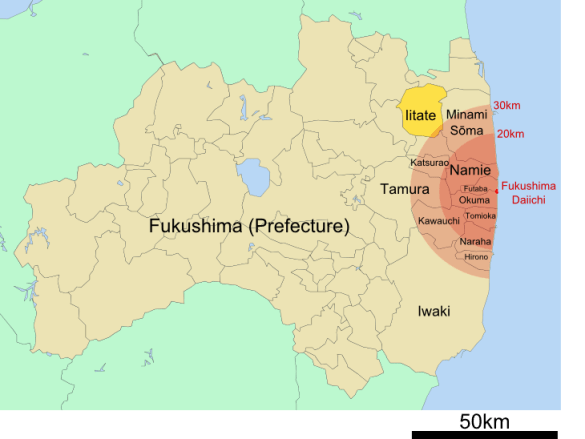
Only 30% of businesses have reopened in Fukushima nuclear disaster-hit areas: survey
March 21, 2018
FUKUSHIMA — Only some 30 percent of businesses have resumed operations in areas within a 30-kilometer radius of the Fukushima No. 1 Nuclear Power Plant or in districts that were previously marked as evacuation zones, a Fukushima Federation of Societies of Commerce and Industry survey has found.
As for the stagnation in the region’s economic renaissance, a representative from the federation said, “There are few residents, and along with anxiety over whether or not business will be able to turn a profit, it is also hard to secure young workers.”
The investigation covered 14 local societies of commerce and industry, recording the business climate as of Feb. 20, 2018. The percentage was particularly low in the four municipalities of Namie, Tomioka, Iitate and Kawamata, for which evacuation orders was partially lifted between March and April 2017.
In the town of Namie, of the 597 members of the local society of commerce, 262 operators, or 44 percent, restarted their companies or shops — but only 34, or roughly 6 percent of the total, did so in Namie itself. The remaining 228 businesses all reopened in the locations to which their owners evacuated after the disaster.
Meanwhile, in Tomioka, 277 businesses of the 478 society members reopened, but only 60, or 13 percent, did so in the town. The numbers were slightly higher for Iitate, where 130 of the 167 operators restarted their businesses — 51 of whom did so in the same area, for 31 percent.
Of 2,804 total members of the prefectural-level federation as a whole, 1,840 companies and shops reopened (66 percent), with 31 percent or 860 businesses returning to open shop in the affected areas. By industry, construction saw the biggest revival rate at 37 percent, followed by manufacturing at 35 percent, stone work and miscellaneous businesses at 32 percent and the service industry at 28 percent, no doubt boosted by reconstruction efforts.
The evacuation locations for the residents of Namie are divided into inland areas like Fukushima city and coastal areas, and it is reportedly hard for owners to restart businesses while commuting from these locations. At the end of February 2018, the population of Namie was 17,954 people, but only 516 people actually lived in the town along with reconstruction workers.
The operator of a supermarket before the disaster commented, “If people don’t return, then it’s difficult to secure enough employees and impossible to run a business.”
Fukushima Accident is Becoming More Severe, Residents Continue to Struggle: Ruiko Muto on 7 Years of the Nuclear Disaster
March 16, 2018

Ruiko Muto is a well-known community activist in Fukushima, associated with ‘Fukushima Women Against Nukes’ and several other citizens’ platforms. She has played a pivotal role in the arduous legal battle to ensure compensation and justice for the Fukushima residents.
DiaNuke.org: It is 7 years of the ongoing accident in Fukushima and the disaster has slipped out of the international media. How serious is the situation now?
Ruiko Muto: The media in Japan is the same with reduced coverage nationwide. Even within Fukushima Prefecture, most of the news coverage focuses on recovery efforts and there are hardly any important articles on the accident or the damage and sometimes nothing at all. However, the reality is that this accident is very far from over and the damage it has caused, while taking on different shapes and forms, is only becoming more severe.
Within the Fukushima Daiichi site, it hasn’t even been confirmed where the melted fuel actually fell to. Every hour 88,000 bequerels of cesium is emitted from the destroyed reactors into the atmosphere. The fuel still has to be cooled and the water used for this becomes radioactive. There is now approximately 1 million tons of contaminated water and it is stored in 900 tanks on the site. METI and the NRA want to release water containing tritium, a radioactive substance which cannot be removed from the water, into the ocean. Filters, which are used in the ALPS system to remove other radioactive substances from the water and which are highly radioactive, are placed in specialized containers and are piling up. The metal structures holding up the Units 1 and 2 exhaust towers have stress fractures and even TEPCO has acknowledged the danger.
At present, there are approximately 5,000 workers at Fukushima Daiichi every day. Giving the reason that radiation levels have dropped somewhat, these workers are not required to wear heavy protective clothing. Even though there are some places which measure dozens of microsieverts per hour (μSv/h), work must be carried out there and on top of this, wages are set to be reduced.
Thyroid cancer testing on children who were under 18 years old at the time of the accident has revealed 193 cases of confirmed or suspected cancer. Even though this is dozens of times higher than before the accident, the authorities say that the accident is unlikely to have had an impact on cancer rates. Private groups have clearly shown that there are thyroid cancer patients who are not included in these figures and there are serious doubts about the entire testing system.
As a result of decontamination, there are 22 million tons of radioactive waste within Fukushima Prefecture. Only 3% of it has been transported to designated storage facilities, the rest is lying around in ‘temporary dumps’ or has been buried in school grounds or parks or in gardens of private houses.
High school and university students are taken on tours of Fukushima Daiichi to see the decommissioning work. They play scissor/paper/rock type games with radiation as the subject and are exposed to advertising and education that makes them believe that radiation is harmless.
DiaNuke.org: You have been working on the legal front, to ensure just compensation for the victims. What have been the challenges in this regard?
Ruiko Muto: Our court case is not a civil action to demand compensation, but rather a criminal case to determine who was responsible for this accident.
In 2012 we collected about 1,500 plaintiffs and lodged a criminal complaint with the Prosecutor’s Office against TEPCO executives, the Director of the Nuclear and Industrial Safety Agency (NISA) and those responsible in regulatory bodies, etc. However, the Prosecutor’s Office dismissed our claim, saying there was insufficient grounds for charges to be laid.
In Japan, in principle, it is the Prosecutor’s Office which lays charges, but it is possible to appeal to a judicial review panel which is made up of ordinary citizens. We did this and the panel ruled that just the 3 TEPCO officials were liable to stand trial.
In this trial, the victims were designated as only the 44 people who lost their lives in the evacuation process immediately after the accident. This means that, myself included, most of the plaintiffs are not officially part of the case and cannot directly participate in proceedings. I have attended each of the trials so far as an observer and make every effort to make sure what happens in the court is made public.
DiaNuke.org: Do you see the ‘nuclear village’ reviving its control since the accident? How have the government and TEPCo undermined their responsibilities?
Ruiko Muto: In the many court cases demanding compensation, administrative tribunals and criminal cases that have been filed, TEPCO has claimed that the nuclear accident was caused by a natural disaster which was impossible to predict, so it does not bear any responsibility. However, it has become clear in subsequent investigations and trials that TEPCO had done simulations and was aware of the threat of a large tsunami flooding the Fukushima Daiichi NPS and that counter measures must be prepared in order to protect the reactors, yet because of the large sums of money required for this, they had simply put it off.
Following the disaster, utilities had voluntarily refrained from advertising but recently they have started again in full force. They claim that if nuclear reactors aren’t re-started then electricity bills will go up. METI continues to underestimate the cost of nuclear power generation.
The giant construction corporations which built the nuclear reactors in the first place are now getting contracts worth tens of billions of yen for decommissioning and decontamination work. They have built multiple massive incinerators and are again reaping huge profits.
DiaNuke.org: The Japanese government has declared newer areas contamination-free last year and has asked people to return. What are the risks involved in such policy?
Ruiko Muto: In March and April last year evacuation orders over large areas were lifted. This policy of trying to make people return is not an invitation to return to a place that is as safe as when you lived there. Before the accident, the annual radiation exposure limit was 1 milli-sievert (mSv), but now the government is saying ‘We’ve decontaminated to below 20 mSv so please go home.’ Last year I went to some of the ‘decontaminated’ areas and there were several places with air dose readings of over 1μSv per hour.
Most of the people who have decided to return are elderly, the younger generation with children have mostly decided not to return. There is no provision for recreation or protection from radiation. And there are not sufficient transport, shopping, hospital or aged care facilities. The areas are infested with wild boars and other wild animals as well as thieves.
DiaNuke.org: Besides compensation, Fukushima evacuees also face problems of social disruption and mental trauma. What are the challenges and how should the governments respond?
Ruiko Muto: After such a long time as an evacuee, many have been unable to find anything to do and have withdrawn into their small temporary homes, some have developed alcohol or gambling addictions and many have become clinically depressed. It’s very difficult to know how to make decisions about the future and there have also been cases of suicide due to the extremely stressful conditions. People who used to live in big extended families have been split up and many family relationships have become difficult due to different opinions on whether or not to return to their homes. There are many cases of divorce between couples where the mother and her children have evacuated.
Also, housing allowances for evacuees from areas where official evacuation orders were not issued have been cut, so the only form of compensation these people received is now unavailable. Many have lost their accommodation and are living in very difficult conditions. Some have received court-orders to vacate because they decided to remain in their evacuee housing.
DiaNuke.org: The Japanese government signed the Convention on Supplementary Compensation(CSC) in 2015, after Fukushima, which has no provision for holding nuclear manufacturers accountable. What has been your experience of the legal fight in this regard?
Ruiko Muto: Within Japan also nuclear manufacturers cannot be held responsible for accidents. A court case was launched claiming that manufacturers did have responsibility, but it was dismissed. However, in a system where manufacturers cannot be held responsible, when there is an accident, there is a real danger that facts will be covered up and important questions will be deliberately unanswered.
DiaNuke.org: The Japanese government continues to export reactor technologies to other countries, besides restarting reactors domestically. How do people in Fukushima see this?
Ruiko Muto: The people in Fukushima Prefecture who are living though the nuclear disaster don’t want anyone in the world to have to experience the massive damage and the suffering that they have experienced. I believe that most of the people of Fukushima are opposed to domestic restarts as well as exports of nuclear technology to other countries.
In this regard, however, the Fukushima Prefecture Governor, although he is opposed to nuclear reactors in Fukushima, has not expressed opposition or even concern regarding nuclear reactors in other prefectures or overseas exports. This is extremely disappointing.
Americans seek $1 bil. in damages over Fukushima nuclear disaster

A U.S. Marine assists Japanese Self-Defense Force members in removing debris from the grounds of Minato Elementary School in Ishinomaki, Miyagi Prefecture, in this file photo taken on April 1, 2011.
TOKYO (Kyodo) — Some 200 U.S. residents filed a suit against Tokyo Electric Power Company Holdings Inc. and a U.S. firm seeking at least $1 billion to cover medical expenses related to radiation exposure suffered during the 2011 Fukushima nuclear disaster, the utility said Monday.
The lawsuit was filed last Wednesday with U.S. federal courts in the Southern District of California and the District of Columbia by participants in the U.S. forces’ Operation Tomodachi relief effort carried out in the wake of the March 11, 2011, earthquake and tsunami that crippled TEPCO’s Fukushima Daiichi nuclear plant.
Many of the plaintiffs are suing TEPCO and the U.S. company, whose name was withheld by TEPCO, for the second time after a similar suit was rejected by the federal court in California in January.
They are seeking the establishment of a compensation fund of at least $1 billion to cover medical and other costs, the utility said.
The plaintiffs claim that the nuclear accident occurred due to improper design and management of the plant by TEPCO. They are also seeking compensation for physical and psychological damage suffered as a result of the disaster, said the utility.
In Operation Tomodachi, which began two days after the natural disasters, the aircraft carrier Ronald Reagan and other U.S. military resources and personnel were deployed to deliver supplies and undertake relief efforts at the same time as three reactors at the Fukushima Daiichi complex suffered fuel meltdowns.
Court rejects call to suspend nuclear reactors in southwestern Japan

The No. 3 (right) and 4 reactors at Kyushu Electric Power Co.’s Genkai Nuclear Power Plant are seen in Genkai, Saga Prefecture, on March 13, 2018.
SAGA, Japan (Kyodo) — A district court in southwestern Japan on Tuesday rejected local residents’ request to suspend the planned restart of nuclear reactors in Saga Prefecture over safety concerns.
Some 70 people sought an injunction to halt the restart of the Nos. 3 and 4 reactors at the Genkai nuclear power plant of Kyushu Electric Power Co., scheduled for Friday and May, respectively, questioning safety standards and citing the risks of a volcanic eruption in the region.
But the Saga District Court’s Presiding Judge Takeshi Tachikawa said the utility’s safety measures are “reasonable” and that the court found “no specific risk of (the reactors) causing serious damage.”
The decision was in sharp contrast with a Hiroshima High Court ruling in December to halt the planned restart of a reactor of Shikoku Electric Power Co.’s Ikata plant on the grounds of a possible eruption of Mt. Aso.
As the 1,592-meter volcano is located some 130 kilometers from the Ikata plant, almost the same distance as from the Genkai plant, attention was on how the Saga court would evaluate the risk.
During the trial, the plaintiffs from Saga, Fukuoka, Nagasaki, Kumamoto and Yamaguchi prefectures expressed doubt about the credibility of the new safety standards introduced after the 2011 Fukushima nuclear disaster, saying they were compiled when the Fukushima crisis had yet to be resolved.
The plaintiffs also claimed that there is no measure to respond to a catastrophic volcanic eruption which cannot be forecasted.
Kyushu Electric argued it has taken safety steps and that there is no imminent danger of a serious accident.
In June last year, Judge Tachikawa dismissed a similar request from a different group of local residents for an injunction to stop the restart of the two Genkai plant reactors.
Separate from the lawsuits seeking injunctions, some 10,000 people in Japan and abroad have filed a suit demanding suspension of the Genkai reactors.
Fukushima evacuee asks for support at UN
A Japanese woman who evacuated Fukushima after the 2011 nuclear accident has called for international support at the United Nations Human Rights Council.
Akiko Morimatsu delivered a speech at the Council in Geneva on Monday. She moved to Osaka with her 2 children after the accident.
Morimatsu criticized the Japanese government for focusing only on policies that encourage former residents to return to the affected areas.
She called on the international community for support to protect children from further radiation exposure.
A Japanese official said the government will do all it can to expedite reconstruction, keeping in mind that those affected still face difficulty in their daily lives.
The Human Rights Council recommended last November that Japan should continue to support affected residents and voluntary evacuees, in line with requests from Germany and other member states.
The Japanese government says it accepts Council recommendations related to the accident. But it also says it has been providing necessary support in accordance with laws.
Hakodate court rejects plea for injunction to halt construction of Oma MOX plant in Aomori

The Oma nuclear plant (right) is shown under construction Monday in the town of Oma, Aomori Prefecture
HAKODATE, HOKKAIDO – A court has dismissed a request from residents of Hakodate, Hokkaido, for an injunction to halt the construction of Electric Power Development Co.’s nuclear power plant in the town of Oma, across the Tsugaru Strait in nearby Aomori Prefecture.
Handing down the ruling Monday at the Hakodate District Court, the presiding judge, Chikako Asaoka, said it is “difficult to assess the particular risk of a severe accident right now” because it is uncertain when the Oma plant will enter operation.
The ruling also noted that the plant being built by Electric Power Development, also known as J-Power, is undergoing Nuclear Regulation Authority screenings under new standards set after the March 2011 triple core meltdown at Tokyo Electric Power Company Holdings Inc.’s Fukushima No. 1 plant.
“It’s not reasonable for a court of law to conduct safety examinations without waiting for the NRA screenings,” the judge said.
The plaintiffs plan to appeal the ruling, which was the first on a nuclear plant under construction since the Fukushima disaster.
“It’s a terrible ruling that makes light of us,” said Toshiko Takeda, 69, the leader of the plaintiff group. “How did the court reflect on the Fukushima accident? It’s really mortifying.”
Construction on the Oma plant started in May 2008. It is about 23 km south of Hakodate, on the other side of the Tsugaru Strait.
In July 2010, a group of citizens including Hakodate residents sued the state and J-Power over the issue. The number of plaintiffs has since risen to 1,164.
The main issue in the lawsuit was the safety of the Oma plant, which will only burn mixed-oxide (MOX) fuel — a blend of uranium and weapons-grade plutonium extracted from spent fuel. The Oma plant will be the world’s first fully MOX-powered plant.
The plaintiffs demanded that the project be canceled, arguing that a MOX plant will pose a higher accident risk. They also claimed that the new regulatory standards are inadequate and that there are geographic faults around the plant site.
J-Power insisted that the use of MOX fuel will not necessarily make it difficult to control the reactors.
The Hakodate court admitted that an injunction against the Oma project could be issued if the regulatory standards contained irrational points. But it concluded that the standards could not be deemed to have such points.
Speaking to reporters in Mutsu, Aomori Prefecture, Oma Mayor Mitsuharu Kanazawa welcomed the ruling.
“We’ve awaited this result, as we hope to proceed steadily” with the nuclear plant project, Kanazawa said.
Separately from the citizens’ lawsuit, the Hakodate Municipal Government took similar action at the Tokyo District Court in 2014, unconvinced by the central government’s explanations about the Oma project.
A municipal official working on the Tokyo lawsuit said that an accident at the Oma plant could devastate the local fishing and tourism industries.
Hakodate Mayor Toshiki Kudo issued a statement saying that the ruling by the Hakodate court is very regrettable. “We will check details of the ruling to draw lessons for the city’s case.”
Fukushima Mother Calls at UN Rights Body Hearing for Full Implementation of “Fukushima Recommendations” by the Japanese Government

Mother calls for full implementation of “Fukushima recommendations” at UN rights body hearing
GENEVA, March 19 (Xinhua) — The UN Human Rights Council (HRC) on Monday adopted the Universal Periodic Review (UPR) outcome of Japan, but a mother from the Fukushima area pleaded at the hearing for the Japanese government to take measures to fully implement the “Fukushima recommendations.”
“The Japanese government has been ignoring people who want to avoid radiation,” Akiko Morimatsu, a mother, and evacuee from Koriyama in Fukushima, told the HRC.
Seven years after the meltdown of three reactors at Fukushima Daiichi, owned by Tokyo Electric Power Company (TEPCO) after a massive earthquake hit Japan, the accident is still ongoing, as was recently admitted by Japan’s nuclear regulator, Greenpeace told the HRC.
The NGO said that its radiation investigations in Fukushima recently reported on the high levels of radiation that evacuees will be exposed to if they were to return to their homes.
It said this will pose an unacceptable risk for 40-100 years or more depending on the level of contamination.
At the UPR the Japanese government accepted UN recommendations to provide essential financial, housing and medical support for self-evacuees.
Yet in 2017 the government removed as many as 29,000 Fukushima citizens from the official record as self-evacuees and terminated housing support, said Greenpeace.
Morimatsu, is one of those who was “disappeared by the government,” said Greenpeace.
“I thank United Nation member states for defending the rights of Fukushima citizens and I call on you to continue to help all the victims and evacuees of nuclear disasters and to protect the people of Fukushima and East Japan, especially children, from radiation exposure,” said Morimatsu.
Fukushima evacuee asks for support at UN
A Japanese woman who evacuated Fukushima after the 2011 nuclear accident has called for international support at the United Nations Human Rights Council.
Akiko Morimatsu delivered a speech at the Council in Geneva on Monday. She moved to Osaka with her 2 children after the accident.
Morimatsu criticized the Japanese government for focusing only on policies that encourage former residents to return to the affected areas.
She called on the international community for support to protect children from further radiation exposure.
A Japanese official said the government will do all it can to expedite reconstruction, keeping in mind that those affected still face difficulty in their daily lives.
The Human Rights Council recommended last November that Japan should continue to support affected residents and voluntary evacuees, in line with requests from Germany and other member states.
The Japanese government says it accepts Council recommendations related to the accident. But it also says it has been providing necessary support in accordance with laws.
A message from Ms. Akiko Morimatsu, an evacuee from Fukushima
Ms. Akiko Morimatsu, an evacuee from Fukushima, sent a message to citizens who live near a nuclear power plant.
“–What is the hardest thing for you, seven years after the evacuation?
The hardest thing is being exposed to low-level radiation. It does not cause any immediate symptoms. It has no color and no odor. It does not cause pain; you do not feel hot or itchy. If you could feel the effects of nuclear exposure, it would be lethal. In Fukushima, when you are facing a low-level radiation exposure, none of the five senses can detect it. Therefore, it’s possible to get the impression that you are not affected by radioactivity while there.
…
According to the logic of those who want to operate nuclear power plants, there is nothing to worry about. These people are taking advantage of the fact that we cannot see radioactivity. It’s not right. In Fukushima, we’ve started to experience cases of thyroid cancer and other health issues, including unknown illnesses.”
“There is a reality that many residents in Japan continue to live away from their homes to avoid radioactivity in contaminated areas due to the nuclear accident.
In this country, there are many so-called “mother-child evacuees” where mothers have evacuated without their husbands to protect their children. However, the Japanese government does not keep the accurate number nor the situation of those evacuees, and continues to promote policies to lift evacuation orders for areas near the Fukushima Daiichi nuclear power plant and encourages residents to return there.
…
A lesson from Hiroshima, Nagasaki, and Fukushima is that we should not create any more nuclear disasters or nuclear victims. It is a fundamental human right to live free from radiation exposure and to have the right to health, which are directly related to people’s lives and health that needed to be respected the most.”
Northern Japan court rejects lawsuit against construction of Ohma nuclear plant

Japan court rejects lawsuit against construction of nuclear plant
A court in northern Japan on Monday rejected a lawsuit to halt construction of a nuclear plant, said the company building the facility, Electric Power Development Co (J-Power).
The ruling by the Hakodate District Court in Hokkaido prefecture on the Ohma plant will be welcomed by many utilities as they push for a return to nuclear power following the 2011 Fukushima disaster, despite strong opposition from chunks of the public.
More than 1,100 residents in Hokkaido, among others, had filed the lawsuit in 2010 to prevent Ohma from starting. The construction of the 1,383-megawatt plant, which will use mixed oxide fuel, a blend of uranium and plutonium recycled from spent nuclear fuel, started in 2008, but work was suspended after Fukushima in 2011.
Building resumed in 2012, but has been delayed as the company has to meet new safety requirements imposed after the 2011 disaster, a company spokesman said. The station is about 38-percent complete, he said.
J-Power in 2016 pushed back the planned start of operation by two years to 2024/25.
“We are doing all we can for the start of operations in the 2024/25 business year,” the spokesman added.
The ruling marks the latest judgement on atomic power in the country, with critics of nuclear energy having more success in some other cases.
A high court in western Japan sided with residents last December to prevent the restart of a nuclear plant idled for scheduled maintenance, although lower court decisions have usually been turned down on appeal.
Court rules against bid to halt Ohma construction
A Japanese court today rejected a lawsuit seeking to stop construction and subsequent operation of Japan Electric Power Development Corp’s (J-Power’s) Ohma nuclear power plant, being built in Aomori prefecture.
More than 1100 residents of Hakodate city filed a suit and claims for damages with the Hakodate District Court against J-Power and the government in July 2010. A further eight complaints have since been filed with the court.
The lawsuit focused on whether there is an active seismic fault in the seabed near the Ohma plant site and the risk of volcanic eruptions in the area. The plaintiffs also expressed concerns about the plant using purely mixed-oxide (MOX) fuel. Ohma 1 would be the first Japanese reactor built to run solely on MOX fuel incorporating recycled plutonium.
“Until now, we have asked the court to dismiss the claims, and we have carefully insisted on and verified that the safety of the Ohma nuclear power plant is secure,” J-Power said.
The company announced today that the Hakodate District Court had “recognised” its argument and ruled in its favour. The ruling dismisses both the injunction on the plant’s construction and the claims for damages, it noted.
Presiding Judge Chikako Asaoka was quoted by the Asahi Shimbun as saying: “At the moment, it is difficult to readily recognise the tangible danger of a grave accident likely to occur at the plant.”
“We will continue to respond appropriately to the conformity assessment by the Nuclear Regulation Authority (NRA) to the new regulatory standards and we will work throughout the entire company to create a safe power plant,” J-Power said. “In addition, we will strive to provide information about the plan of the Ohma nuclear power plant to the people concerned.”
The start of construction of the Ohma plant was originally due in August 2007, with commercial operation planned for March 2012. However, the imposition of more stringent seismic regulations put back the start of construction to May 2008 and commercial operation to November 2014.
Work to build the first unit at Ohma – a 1383 MWe Advanced Boiling Water Reactor – was about 40% complete in March 2011 when a tsunami caused the accident at the Fukushima Daiichi plant. Construction of Ohma 1 was suspended following the accident, but was resumed in October 2012. At that time, J-Power said it would strive to establish a safe power plant by, among other things, ensuring reinforced safety measures are implemented that take into account the lessons learned from the Fukushima accident.
In December 2014, J-Power submitted an application to the NRA to make changes to Ohma 1’s reactor installation to strengthen the unit’s protection. These measures – including tsunami countermeasures, ensuring power supplies, ensuring heat removal functions, and severe accident responses – were originally expected to be completed by the end of 2020.
However, in September 2015, the company announced a one-year delay in the start of safety equipment construction, pushing back the start of operation to around 2021. This delay was attributed to the prolonged screening process by the NRA after the company was requested to submit additional information about its plans.
A year later, J-Power said it expects a further delay of around two years in the completion of the NRA’s review and approval process for Ohma 1. It now expects construction of the safety upgrades to begin this year and to be completed in the second half of fiscal year 2023.
“We are doing all we can for the start of operations in the 2024/25 business year,” a J-Power spokesman told Reuters.
Tepco and other utilities eye joint nuclear plant project in Aomori Prefecture
Tokyo Electric Power Company Holdings Inc. and other major utilities will start talks this spring on jointly building and operating a nuclear power plant in northeastern Japan, sources close to the matter said Friday.
The plan involves Tepco’s Higashidori nuclear power plant in Aomori Prefecture, the construction of which was suspended following meltdowns at the firm’s Fukushima No. 1 power plant in March 2011. Tohoku Electric Power Co., Chubu Electric Power Co., and Japan Atomic Power Co. are expected to participate in the project, according to the sources.
Kansai Electric Power Co. is also considering joining a group to discuss the role of each utility and how to shoulder the huge costs related to the Higashidori plant, they said.
The government, which holds the majority of Tepco’s voting rights through a state-backed bailout fund, is expected to support the move.
Tepco, which began constructing the Higashidori plant in January 2011, hopes to compile a joint venture plan around fiscal 2020.
Struggling under the burden of huge compensation payments and plant decommissioning costs from the Fukushima nuclear crisis, Tepco is aiming to rebuild itself through realigning its nuclear business. The utility has been asking other power companies since late last year to join in with construction of the Higashidori plant.
Other utilities may benefit from the joint business as they can share know-how and resources through the initiative at a time when profitability is deteriorating, due to suspensions of nuclear power plants for tighter safety screening introduced after the Fukushima disaster.
Still, many utilities remain wary that teaming up with the crisis-hit Tepco could result in their share of plant decommissioning costs increasing in the future.
Govt. bans decontamination work by foreign interns
March 16, 2018
The Japanese government has decided to ban companies from using foreign trainees to carry out decontamination work in areas affected by the 2011 accident at the Fukushima Daiichi nuclear plant.
The decision comes after a Vietnamese man complained that he was asked to remove contaminated soil in Fukushima Prefecture. He told a news conference that he would never have come to Japan if he had known that he would be doing this kind of work. He also expressed concern about the possible impact on his health.
The man came to Japan under a government-backed technical internship program that allows foreigners to acquire skills and knowhow.
The ministries in charge of the program say that decontamination is not suitable work for interns.
They say they will make it mandatory for companies to submit a pledge that trainees will not be asked to do this kind of task.
A group that supports foreign interns says there have been similar cases.
The ministries will warn companies if other cases are discovered and may consider revoking their permission to hire foreign interns.
1 This Month
23-25 October – on Zoom – World BEYOND War’s annual global conferenc


Shut down the radiation-damaged Heysham nuclear reactors now
To see nuclear-related stories in greater depth and intensity – go to https://nuclearinformation.wordpress.com

Say No to NASA’s Reckless Nuclear Reactor on the Moon
Say No to NASA’s Reckless Nuclear Reactor on the Moon

-
Archives
- October 2026 (231)
- September 2026 (339)
- August 2026 (330)
- July 2026 (355)
- June 2026 (287)
- May 2026 (306)
- April 2026 (356)
- March 2026 (251)
- February 2026 (267)
- January 2026 (308)
- December 2025 (358)
- November 2025 (359)
-
Categories
- 1
- 1 NUCLEAR ISSUES
- business and costs
- climate change
- culture and arts
- ENERGY
- environment
- health
- history
- indigenous issues
- Legal
- marketing of nuclear
- media
- opposition to nuclear
- PERSONAL STORIES
- politics
- politics international
- Religion and ethics
- safety
- secrets,lies and civil liberties
- spinbuster
- technology
- Uranium
- wastes
- weapons and war
- Women
- 2 WORLD
- ACTION
- AFRICA
- Atrocities
- AUSTRALIA
- Christina's notes
- Christina's themes
- culture and arts
- Events
- Fuk 2022
- Fuk 2023
- Fukushima 2017
- Fukushima 2018
- fukushima 2019
- Fukushima 2020
- Fukushima 2021
- general
- global warming
- Humour (God we need it)
- Nuclear
- RARE EARTHS
- Reference
- resources – print
- Resources -audiovicual
- Weekly Newsletter
- World
- World Nuclear
- YouTube
-
RSS
Entries RSS
Comments RSS

