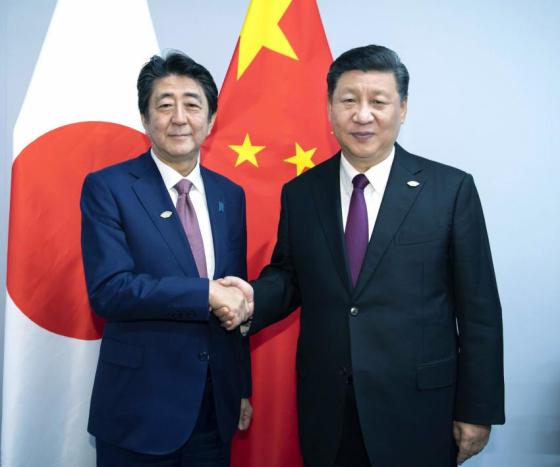
Chinese President Xi Jinping, right, poses with Japanese Prime Minister Shinzo Abe during a meeting on the sidelines of the G20 summit in Buenos Aires, Argentina, on Friday.
December 2, 2018
BUENOS AIRES – Prime Minister Shinzo Abe has asked Chinese President Xi Jinping to lift his country’s ban on Japanese food imports introduced following the 2011 Fukushima nuclear accident, a senior government official said Saturday.
Abe’s request came after Japan’s farm ministry said Thursday that Beijing has allowed rice produced in Niigata Prefecture, more than 200 kilometers away from the crippled Fukushima Daiichi nuclear power plant, to be shipped to China.
During their meeting Friday on the sidelines of the Group of 20 summit in Buenos Aires, Abe, welcoming Beijing’s latest decision, urged Xi to abolish the rest of the import restrictions based on scientific grounds as soon as possible, according to the Japanese official.
Xi responded to Abe by saying that China will take appropriate action in keeping with scientific assessments, the official added.
Aside from Niigata rice, China maintains its ban on all other Japanese foods and feedstuff initially subject to the import restrictions, which include products from 10 of the country’s 47 prefectures, the Japanese Ministry of Agriculture, Forestry and Fisheries said.
Other countries, including South Korea and Singapore, restrict food imports against a backdrop of radiation concerns, while Taiwan has decided to keep its ban on food imports from five Japanese prefectures intact as a result of a referendum on Saturday.
The accident at the Fukushima Daiichi nuclear power complex was triggered by the devastating March 2011 earthquake-tsunami disaster that hit northeastern Japan.
As for the situation in the East China Sea, Abe called on Xi to improve the unstable situation in the contested waters, emphasizing the importance of restarting talks about a 2008 bilateral accord on joint gas development there.
The Japanese and Chinese leaders also reaffirmed that U.N. sanctions — aimed at preventing North Korea from developing nuclear weapons and ballistic missiles — should be fully implemented until Pyongyang achieves denuclearization as promised.
With trade tensions between the United States and China intensifying, Abe told Xi that China should take concrete measures to stem its alleged unfair business practices such as stealing intellectual property and technology from other nations.
The Japanese prime minister expressed hope that Xi will have a “valuable discussion” with U.S. President Donald Trump at their planned meeting on the fringes of the G-20 summit.
In October, Abe arrived in Beijing for the first official visit to China by a Japanese political leader in nearly seven years. Until late last year, Sino-Japanese relations had been at their worst level in decades over a territorial row in the East China Sea.
During his stay in Beijing, Abe held talks with Xi and Chinese Premier Li Keqiang, in which they agreed to accelerate new economic cooperation between Japan and China by changing the dynamics of bilateral relations “from competition to collaboration.”
December 7, 2018
Posted by dunrenard |
Japan | China, Japan Food Import Ban |
Leave a comment
OVER 180 TEENAGERS and children have been found to have thyroid cancer or suspected cancer following the Fukushima nuclear accident, new research has found.
A magnitude 9.0 quake – which struck under the Pacific Ocean on 11 March 2011 – and the resulting tsunami caused widespread damage in Japan and took the lives of thousands of people.
The killer tsunami also swamped the emergency power supply at the Fukushima Daiichi power plant, sending its reactors into meltdown as cooling systems failed in what was the worst nuclear disaster since Chernobyl in 1986.
As of November, the total of dead or missing from the earthquake and the tsunami stood at 18,434 people, according to the National Police Agency.
In addition, more than 3,600 people – most of them from Fukushima – died from causes such as illness and suicide linked to the aftermath of the tragedy, government data shows.
More than 73,000 people still remain displaced, while no one is officially recorded as having died as a direct result of the nuclear catastrophe.
The accident at the nuclear power station in 2011 has also raised grave concerns about radioactive material released into the environment, including concerns over radiation-induced thyroid cancer.
Ultrasound screenings for thyroid cancer were subsequently conducted at the Fukushima Health Management Survey.
The observational study group included about 324,000 people aged 18 or younger at the time of the accident. It reports on two rounds of ultrasound screening during the first five years after the accident.
Thyroid cancer or suspected cancer was identified in 187 individuals within five years – 116 people in the first round among nearly 300,000 people screened and 71 in the second round among 271,000 screened.
The overwhelming common diagnosis in surgical cases was papillary thyroid cancer – 149 of 152 cases.
In May, Japan announced for the first time that a worker at the stricken Fukushima nuclear plant has died after being exposed to radiation, Japanese media reported.
The man aged in his 50s developed lung cancer after he was involved in emergency work at the plant between March and December 2011, following the devastating tsunami.
The Japanese government has paid out compensation in four previous cases where workers developed cancer following the disaster, according to Jiji news agency.
However, this was the first time the government has acknowledged a death related to radiation exposure at the plant, the Mainichi daily reported.
The paper added the man had worked mainly at the Fukushima No. 1 nuclear plant and other atomic power stations nationwide between 1980 and 2015.
Following the disaster, he was in charge of measuring radiation at the plant, and he is said to have worn a full-face mask and protective suit.
He developed lung cancer in February 2016.
December 7, 2018
Posted by dunrenard |
Fukushima 2018 | Fukushima Radiation, Thyroid Cancer |
Leave a comment
A port with orange farms dotting the mountains in the background in Ikata, Ehime Prefecture, which relies on the nuclear power industry for revenue
IKATA, EHIME PREF. – On a side street near a darkened Ikata shopping arcade full of abandoned storefronts, the Sushi Ko restaurant is unusually busy on a weekday.
Balancing a tray full of drinks, Sachiyo Ozaki said most of her restaurant’s customers were there because of an industry shunned elsewhere: nuclear power.
“He drives a minivan to take workers to the plant,” she said, gesturing toward a man sitting at the counter. Pointing to another man sipping a beer, she added, “And he works in construction, so they’ve been busy too.”
“We’re all for nuclear power, and you can print that,” Ozaki said.
In the mostly residential neighborhood around her restaurant, hotel rooms and local inns were also packed with workers preparing to reopen Shikoku Electric Power’s Ikata nuclear plant, nestled on the Shikoku coast at the base of the verdant Sadamisaki Peninsula.
Nearly eight years after an earthquake and tsunami triggered nuclear meltdowns at Tokyo Electric Power Company Holdings Inc.’s Fukushima No. 1 plant, the battered industry is making a quiet and somewhat unexpected return.
Ikata is a poster child for that recovery. In September, a court reversed a decision that had idled Shikoku Electric’s sole nuclear reactor for about a year, paving the way for the operator to reopen the facility in late October.
Regional utilities like Shikoku Electric have aggressively fought a string of lawsuits since 2011, hiring veteran lawyers to beef up their legal teams. At the same time, they wooed towns where nuclear plants are based, visiting with residents door to door while the government kept up a stream of generous subsidies for local projects.
Thanks in large part to this strategy, Japan is on track to have nine reactors running in the near future.
That is a far cry from the 54 running before 2011 — all of which were idled after the Fukushima disaster — but more than analysts and experts expected, considering it seemed at the time like the end of the road for the country’s nuclear industry.
A Reuters analysis calculates that as few as six more reactors are likely to restart within the next five years, eight will mostly likely be mothballed and that the prospects for two dozen others is uncertain.
Despite that cloudy outlook, nuclear power recently overtook renewables like wind and solar in the country’s energy mix for the first time since Fukushima.
Japan embraced nuclear power after World War II, spurred by the promise of clean energy and independence from foreign suppliers.
But the botched Fukushima disaster response sowed public distrust in the industry and the government.
Given that skepticism, some see a recent run of court victories by utilities as the resurgence of an alliance of industry, government and host communities that for decades promoted the construction of nuclear facilities.
“If our losing streak continues, we could see 20 to 25 reactors come back online,” says Hiroyuki Kawai, a prominent anti-nuclear lawyer who represented citizens in a suit against Shikoku Electric.
Since 2011, hundreds of citizens represented by volunteer lawyers like Kawai have filed nearly 50 lawsuits against the central government and utilities in 25 district and appellate courts.
In Ikata, Shikoku Electric spent months gaining approval for a restart from the tougher post-Fukushima regulator, rebooting one of its plant’s three reactors in 2016. But in December 2017, an appellate court issued a temporary injunction keeping the reactor, already idled for routine maintenance, shut down for nine more months.
In response, the company pulled more staff into its legal department and drafted its head of nuclear power to supervise the team. The utility also recruited outside lawyers who had handled cases for other operators.
“There are only a handful of lawyers knowledgeable about nuclear litigation, so they’re popular and sought after,” said Kenji Sagawa, the deputy general manager of the company’s Tokyo office.
Yoshiaki Yamanouchi, 76, began his career in nuclear litigation in 1973 when he represented Shikoku Electric in a landmark suit brought by Ikata residents seeking to stop the plant from opening.
He still represents the utility and works with other companies, advising younger lawyers fighting similar cases, which he calls “superficial,” in far-flung district courts.
“Utilities, in particular Shikoku, have gotten much smarter about fighting for the plants they know they can reopen and mothballing others that would cost too much time and money,” Yamanouchi said. The utility is decommissioning two of the three reactors at Ikata.
Shikoku Electric would not disclose how much it has spent fighting legal challenges, but said it was a fraction of the cost of idling a plant.
Every month a nuclear reactor sits inoperative, the utility spends ¥3.5 billion for additional fuel at its conventional power plants. Shikoku has also spent ¥190 billion on safety upgrades to meet stricter rules set by the Nuclear Regulation Authority.
Activists have seen some victories. Kansai Electric Power Co. has had its reactors slapped with temporary injunction orders multiple times over the years. All of these decisions were later overturned by higher courts.
“Before Fukushima, these utilities won by default — now, they have to work harder,” said Yuichi Kaido, a lawyer who has spent three decades dueling Yamanouchi in court.
Shikoku Electric still faces several lawsuits and injunction requests. A Hiroshima court rejected a request from residents to extend the suspension of the Ikata reactor on Oct. 26, a day before the operator restarted it.
The quiet revival of the industry is most tangible in rural areas like Ikata. Rural regions are home to the bulk of the country’s nuclear plants.
Ikata is best known for its mikan mandarin oranges harvested on terrace farms on the sides of steep hills overlooking the Seto Inland Sea and Uwa Sea.
The town, with 9,500 residents, relies on nuclear power for a third of its annual revenue. Since 1974, Ikata has received more than ¥101.7 billion in such payments.
These funds literally built the town; Ikata’s roads, schools, hospitals, fire stations and even five traditional taiko drums for festivals were all paid for with subsidies.
“My biggest struggle now is finding one or two more pillars for this town other than nuclear power,” said Ikata Mayor Kiyohiko Takakado.
The town and utility’s mutual dependence stretch back decades.
Former Mayor Kiyokichi Nakamoto was a city councilman in Ikata when he successfully wooed the utility to his hometown. On the walls of the dim parlour of his home are framed commendations from two prime ministers, thanking him for his contributions to the national energy policy.
“We were a poor village with only farming and fishing,” the 90-year-old said. Had the town failed to attract the plant, Ikata would have gone broke, he said.
In the wake of the Fukushima disaster, Shikoku Electric campaigned to reassure residents of their plant’s safety. Employees wearing the company’s blue uniforms went from house to house to explain how their plant was different from Fukushima No. 1 — and therefore safe.
“If something like Fukushima happened here, our reputation would be destroyed in an instant,” said orange farmer Shigeto Suka, 54, as he checked still-green mikan on tree branches.
He and other farmers in Yawatahama, a neighboring town 15 km from the plant, worry that even a hint of contamination would devastate their brand.
After the 2011 disaster, Fukushima’s farmers and fishermen were unable to sell their produce because of fears over contaminated food. Dozens of countries still have restrictions on Fukushima produce.
For others in the area, the Ikata plant feels like an inextricable part of life.
Hiroshi Omori, 43, spent most days over the summer at Shikoku Electric’s visitors’ house overlooking the Ikata plant. His three young children take free art classes there while Omori and other parents wait in air-conditioned rooms sipping water and tea.
But Ikata is projected to shrink to 5,000 residents over the next 20 years, and Takakado recently said he found it hard to imagine an industry that could replace nuclear power.
This year he joined dozens of other mayors nationwide to voice their support for the industry and ask the government to clarify its position on building new plants or replacing old ones.
“I’m just trying to prevent the town from losing even more people,” he said.
December 7, 2018
Posted by dunrenard |
Japan | Ehime Pref., Ikata NPP |
Leave a comment
Results of mass screening of children, teens for thyroid cancer following Fukushima nuclear accident
Bottom Line: The accident at Japan’s Fukushima Daiichi nuclear power station in 2011 raised grave concerns about radioactive material released into the environment, including concerns over radiation-induced thyroid cancer. Ultrasound screenings for thyroid cancer were subsequently conducted in the Fukushima Health Management Survey. This observational study group includes about 324,000 people 18 or younger at the time of the accident and it reports on two rounds of ultrasound screening during the first five years after the accident. Thyroid cancer or suspected cancer was identified in 187 individuals within five years (116 people in the first round among nearly 300,000 people screened and 71 in the second round among 271,000 screened). The overwhelmingly common diagnosis in surgical cases was papillary thyroid cancer (149 of 152 or 98 percent).
US screening data from Fukushima shed light on thyroid cancer in kids
November 29, 2018 — The latest results of mass ultrasound screening of children for thyroid cancer after the Fukushima disaster were published online on November 29 by JAMA Otolaryngology — Head & Neck Surgery. The study provides vital data on thyroid cancer and may lead to growing demands outside of Japan for more ultrasound scans in younger people, increasing the risk of overdiagnosis, experts have warned.
In an observational study, Dr. Akira Ohtsuru, PhD, from the department of radiation health management at Fukushima Medical University, and colleagues analyzed the incidence of thyroid cancer in children and adolescents screened with two rounds of ultrasound within five years of the 2011 disaster at the Fukushima Daiichi nuclear power station. The main question they addressed was, what is the pattern by age group of cancer detection via ultrasound screening of the thyroid among children and young adults?
The first round of ultrasound screening was carried out between 2011 and 2013, and the second round between 2014 and 2015. A total of 324,301 individuals younger than 18 years at the time of the disaster were included in the analysis.
Thyroid cancer, or suspected cancer, was identified in 187 patients within five years (116 people in the first round among nearly 300,000 people screened and 71 in the second round among 271,000 screened). By far the most common diagnosis in surgical cases was papillary thyroid cancer (149 of 152, or 98%). Overall, the distribution pattern of the incidence rate by age group in second-round examinations increased with age, according to Ohtsuru and colleagues.
Looming risk of overdiagnosis
Large-scale ultrasound screening can identify many detectable cancers from a sizable pool of nonclinical and subclinical thyroid cancers among individuals of a relatively young age, in an age-dependent manner. However, to avoid overdiagnosis, an improvement in screening strategy based on the understanding of the natural history of thyroid cancer will be urgently needed, Ohtsuru and colleagues explained.
“The fundamental ethical principle of doing more good than harm should be central to accident management, including conducting thyroid screening that is designed to avoid the problems of potential overdiagnosis,” the researchers wrote. “We should not be influenced by the negative experiences or psychosocial issues of the examinees under the potential for overdiagnosis.”
Because the natural progression of thyroid cancer in young patients remains unknown, further studies are required, they believe. Data from the Fukushima Health Management Survey may contribute to understanding how to conduct future screening programs to both limit overdiagnosis and support an accurate evaluation of the effect of low-dose radiation on the thyroid glands of children and adolescents, they stated.
The 2011 disaster raised grave concerns about radioactive material released into the environment, including over radiation-induced thyroid cancer. Ultrasound screenings for thyroid cancer were subsequently conducted in the Fukushima Health Management Survey. The debate over whether a rise in thyroid cancer among children in Japan is related to the nuclear disaster — or whether it’s simply due to overdiagnosis as children near the site of the disaster are screened for the disease — has been ongoing since 2015.
Reaction to latest results
In a linked commentary also published in JAMA Otolaryngology — Head & Neck Surgery, U.S. experts welcomed the research.
“Before the Fukushima Survey, we did not know if there was a substantial reservoir of subclinical thyroid cancer in children and adolescents. These data show that there is a very large reservoir,” wrote Dr. Andrew J. Bauer, from the Pediatric Thyroid Center at Children’s Hospital of Philadelphia Division of Endocrinology and Diabetes, and Dr. Louise Davies, from the VA Outcomes Group at the Department of Veterans Affairs Medical Center in White River Junction, VT.
More children and adolescents are likely to undergo ultrasound of the thyroid in the U.S., leading to the detection of a substantial reservoir of subclinical thyroid cancer. This could open up children to the risks and consequences of overdiagnosis and subsequent treatment that may worsen health, as has happened within a segment of the adult population, Bauer and Davies continued.
“We are still left with the difficult question of how to apply the concepts of overdiagnosis in this scenario. Pediatric thyroid cancer has a 98% rate of survival, even for patients with pulmonary metastasis, so benefits of treatment should not be considered in regard to effects on disease-specific mortality,” they pointed out.
Ohtsuru gave a lecture on this topic at the 5th International Expert Symposium in Fukushima on Radiation and Health, entitled “Chernobyl+30, Fukushima+5: Lessons and Solutions for Fukushima’s Thyroid Question.” His full presentation can be downloaded here.
Association between screening-detected thyroid cancers, radiation exposure ‘unlikely’ in Fukushima children
Many thyroid cancers detected by ultrasound screening in Japanese children in the 5 years after the 2011 Fukushima Daiichi nuclear accident mirror many low-risk, sporadic cases of adult thyroid cancer and are most likely not associated with radiation exposure, according to findings published in JAMA Otolaryngology Head & Neck Surgery.
“Large-scale mass screening of young people using ultrasonography resulted in the diagnosis of a number of thyroid cancers, including potential overdiagnosis cases,” Akira Ohtsuru, MD, PhD, professor in the department of radiation health management at Fukushima Medical University, Japan, told Endocrine Today. “These findings indicate that ultrasonography screening can identify many detectable cancers from large pool of nonclinical and subclinical thyroid cancers among individuals of a relatively young age, in an age-dependent manner.”
The level of radiation exposure in Fukushima immediately after the great earthquake in eastern Japan on March 11, 2011, has been deemed to be much lower than the levels reported in Chernobyl immediately after the 1986 nuclear power station accident, Ohtsuru and colleagues wrote in the study background. However, the researchers noted that there was a divergence in estimations of the thyroid equivalent dose of radiation during the early phase after the accident, as there was little direct measurement of the individuals, whereas radiation-induced thyroid cancers have been rated as causing some of the greatest concern after the accident.
“Thus, health surveillance, including thyroid screening, has been thought to be necessary for both scientific and social reasons,” the researchers wrote.
In an observational study, Ohtsuru and colleagues analyzed data from 324,301 Fukushima residents aged 18 years or younger at the time of the nuclear accident. Researchers assessed the number of detected cases of thyroid cancer during first (fiscal years 2011-2013) and second (fiscal years 2014-2015) rounds of screening, with age groups stratified by 3-year intervals. Researchers compared results against an age-specific incidence of unscreened cancers form a national cancer registry.
Researchers found that, among 299,905 participants screened in the first round (50.5% boys and men; mean age at screening, 15 years), 116 were diagnosed with malignant or suspected thyroid cancer. Among 271,083 participants screened in the second round, (50.4% boys and men; mean age at screening, 13 years), 71 were diagnosed with malignant or suspected thyroid cancer, according to researchers. In both the first- and second-round examinations, mean age at diagnosis was 17 years; however, mean tumor diameter was larger in the first- vs. the second-round screenings (mean, 12.7 mm vs. 9.7).
Papillary thyroid cancer was the most common pathologic diagnosis, they wrote, at 149 of 152 cases (98%). The researchers also noted that the distribution pattern by age group at the time of the accident increased with older age in both screening rounds, with an interval between screenings of about 2.1 years. The number of detected thyroid cancer cases per 100,000 persons was estimated to be approximately 175 for those aged 18 years at the time of the accident in the first round of screening and 97 for those aged 18 years at the time of the accident during the second round of screening.
Researchers calculated that the estimated age-conditional incidence rate of cases per 100,000 person-years was 0.5 for those aged 15 to 17 years, 1 for those aged 18 to 20 years and 1.7 for those aged 21 to 22 years.
“Although a longer observation period is needed, this pattern by age at the time of the accident differs from that of the Chernobyl nuclear power station accident; for example, there was a higher frequency of cases of cancer at younger ages with a relatively short latent period after the Chernobyl nuclear power station accident,” the researchers wrote. “Thus, an association between the large number of thyroid cancers detected and radiation exposure is thought to be very unlikely, in addition to the very low doses of radiation in the Fukushima nuclear power station accident.”
Ohtsuru added that, to ensure the merit of early detection and prevent overdiagnosis via large-scale screening, development of a careful monitoring system is urgently needed based on the understanding of the natural history of thyroid cancer.
In commentary accompanying the study, Andrew J. Bauer, MD, medical director of the Pediatric Thyroid Center at Children’s Hospital of Philadelphia, and Louise Davies, MD, MS, research fellowship director of the VA Outcomes Group at the Veterans Affairs Medical Center in White River Junction, Vermont, wrote that researchers should not assume that every asymptomatically discovered case of pediatric thyroid cancer is a “triumph of early detection.”
“Going forward, research to better define which pediatric thyroid cancers are likely to progress, and a better understanding of the trajectory of the natural history of thyroid cancers detected in early life, is urgently needed,” Bauer and Davies wrote. “The extremely high prevalence of subclinical thyroid cancer shown by the Fukushima Survey, including many with lymph node metastases, suggests that we have much to learn about the natural history of lymph node metastases, but that we should not assume that every asymptomatically identified case of pediatric thyroid cancer is an instance of overdiagnosis.” – by Regina Schaffer
Akira Ohtsuru, MD, PhD, can be reached at Fukushima Medical University, Department of Radiation Health Management, 1 Hikarigaoka, Fukushima 960-1295, Japan; email: ohtsuru@fmu.ac.jp.
Disclosures: One of the authors reports he received grants from commercial sponsor JCR Pharmaceuticals Co. Bauer and Davies report receiving travel funds from the International Agency for Research on Cancer.
December 7, 2018
Posted by dunrenard |
Fukushima 2018 | Fukushima Children, Thyroid Cancers |
Leave a comment
Taiwan to seek understanding as Japan threatens to sue over food ban
Taipei, Nov. 29 (CNA) Taiwan will seek Japan’s understanding in a row over a ban on imports of agricultural and food products from radiation contaminated areas in Japan, the foreign ministry said Thursday, in response to a threat by Japan to take the case to the World Trade Organization (WTO).
Earlier in the day, Japan’s Foreign Minister Taro Kono told lawmakers in Tokyo that the government will not rule out the possibility of filing a complaint with the WTO over the ban, which has been in place since the Fukushima nuclear plant disaster in March 2011.
Kono’s statement came after Taiwanese voted on Nov. 24 in favor of maintaining the ban, by margin of 78 percent to 22 percent in a referendum.
Commenting on Kono’s remarks, Andrew Lee (李憲章), spokesman for Taiwan’s Ministry of Foreign Affairs (MOFA), said the ministry will cautiously engage in talks with Japan over the referendum result to seek understanding and protect the bilateral relations.
The Taiwan government has to respect public opinion, as expressed in the referendum result, but it also has to make sure that its cordial relations with Japan are not affected, Lee said.
He said it is MOFA’s long held stance that any decision on the ban must be based on international standards, scientific evidence and the relevant WTO rules.
In addition, the health of the Taiwanese people must be taken into consideration, Lee said, adding that the final decision on the issue rests with Ministry of Health and Welfare.
In 2015, Japan filed a complaint with the WTO against South Korea over a similar ban and won the case on Feb. 22 this year.
The WTO said the ban was inconsistent with its rules against “arbitrarily or unjustifiably” discriminating against another country and recommended that South Korea take corrective action.
South Korea, however, has appealed the WTO ruling and has maintained the ban.
Taiwan’s ban on food products from radiation-contaminated areas of Japan, namely Fukushima, Ibaraki, Gunma, Tochigi and Chiba prefectures, was imposed in 2011 by the then-Kuomintang government and tightened in 2015 after products from some of the listed Japanese prefectures were found on store shelves in Taiwan.
Since the Democratic Progressive Party came to power in 2016, it has been considering lifting the ban on food imports from all the affected prefectures except Fukushima, but has run into strong public opposition to the idea.
Japan signs trade agreements with Taiwan despite ongoing dispute over nuclear food ban
Japan signed five trade agreements with Taiwan on Friday, despite the ongoing ban on imports of Japanese food products that Taipei imposed after the 2011 Fukushima nuclear disaster.
It had been feared that the ban, which is to be upheld following last week’s national referendum, could upset trade ties between the two sides.
Yet Taiwan-Japan Relations Association President Chiou I-jen and his Japanese counterpart, Mitsuo Ohashi, chairman of the Japan-Taiwan Exchange Association – the closest thing the two have to ambassadors in the absence of diplomatic ties – still signed one agreement and four memorandums of understanding at the Ambassador Hotel in Taipei, signalling their mutual desire to overlook the issue for now.
The agreement pertains to the speeding up of customs clearance process for goods traded between Japan and Taiwan, while the four MOUs deal with a wide range of trade issues, including the exchange of patent information, business partnerships, trade in medical equipment and materials, joint research, and cooperation in promoting small and medium-sized enterprises.
All five were signed only six days after Taiwanese voters approved a referendum requiring the government to maintain a ban on food imports from Fukushima prefecture and nearby Ibaraki, Gunma, Tochigi and Chiba prefectures. In campaigning ahead of last Saturday’s referendum and in the days since, much attention focused on whether its passage would drive a wedge between Japan and Taiwan, especially when they are otherwise working to cooperate more closely on security matters.
According to diplomatic insiders, Ohashi expressed regret over the referendum result when he visited Taiwan President Tsai Ing-wen on Thursday.
Tsai reportedly described bilateral ties as “stable” and “close,” and said Taiwan hopes Tokyo will support its bid to participate in the second round of accession talks to the Comprehensive and Progressive Agreement for Trans-Pacific Partnership, an 11-nation free trade agreement in which Japan plays a leading role.
In the trade talks, Taiwanese negotiators raised that issue, Chang Shu-ling, secretary general of the Taiwan-Japan Relations Association, told a press conference after the signing ceremony. She also dismissed speculation that the food ban referendum would have any negative impact on bilateral relations, saying the trade agreements were a clear demonstration of close ties.
Japanese negotiators had asked Taiwan to ease the food ban on scientific grounds, while Taiwanese officials stressed the civic right of its people to affect policy through referendums.
On Thursday, Japanese Foreign Minister Taro Kono told the Diet that Tokyo did not rule out taking the matter to the World Trade Organisation, which has already ruled that South Korea’s import ban on seafood from Fukushima and other parts of Japan is “arbitrarily and unjustifiably” discriminatory. South Korea has appealed the ruling.
China, meanwhile, on Thursday lifted its ban on rice produced in Niigata Prefecture, but maintained restrictions on nine other prefectures.
Taiwan’s representative to Japan, Frank Hsieh, previously said that if China eased its restrictions before Taiwan, the latter would be “embarrassed” because it would become the only place to retain a comprehensive ban on Japanese food products from regions affected by the 2011 nuclear disaster.
December 7, 2018
Posted by dunrenard |
Fukushima 2018 | Japan, Nuclear Food Ban, Taiwan, Trade agreements |
Leave a comment
China on Nov. 28 lifted its import ban on rice produced in Niigata Prefecture but maintained restrictions imposed since the 2011 Fukushima nuclear disaster on other food from 10 prefectures.
During their summit in October, Japanese Prime Minister Shinzo Abe urged Chinese President Xi Jinping to lift the import restrictions on Japanese agricultural and other products.
China apparently examined the distances and wind directions from the crippled Fukushima No. 1 nuclear plant and decided to remove the ban on Niigata rice.
Japanese private companies have long hoped to resume rice exports to China, which accounts for about 30 percent of the world market for the staple food.
The Japanese government plans to ask the Chinese government to further ease restrictions on other food products.
The Abe administration has been promoting overseas sales of Japanese food products. It has set a goal of 1 trillion yen ($8.8 billion) as the annual export amount of agricultural, forestry and fishery products, as well as processed food.
But after the triple meltdown at the Fukushima No. 1 nuclear plant, 54 countries and regions imposed restrictions on food imports from Japan.
Although the restrictions have been gradually eased, eight countries and regions–China, the United States, South Korea, Singapore, the Philippines, Taiwan, Hong Kong and Macau–still ban imports of certain products from certain areas of Japan, according to the agricultural ministry.
December 7, 2018
Posted by dunrenard |
Japan | China, Import ban lifting, Niigata Prefecture, Rice |
Leave a comment
TEPCO Decommissioning Archive Center in Tomioka, Fukushima Prefecture, will educate the public on the 2011 disaster at the Fukushima No. 1 nuclear power plant and the ongoing decommissioning work.
TEPCO Decommissioning Archive Center in Tomioka, Fukushima Prefecture, which opens Nov. 30, will educate the public on the measures being taken to deal with radioactive water at the Fukushima No. 1 nuclear power plant.
TEPCO Decommissioning Archive Center shows the central control rooms of the No. 1 and No. 2 reactors when the Fukushima No. 1 nuclear plant was crippled by the 2011 Great East Japan Earthquake and tsunami.
Fukushima nuclear-disaster museum opens
FUKUSHIMA, Japan – A facility that exhibits information about the 2011 crisis at Tokyo Electric Power Co.’s Fukushima No. 1 nuclear plant and provides updates about the current condition of decommissioning work opens on Friday in Tomioka, Fukushima Prefecture.
The company unveiled the TEPCO Decommissioning Archive Center to media Wednesday. The renovated two-story building, which has an about 1,900 square-meter space for exhibitions, formerly housed the company’s “Energy Museum,” which was used for public relations activities for its nuclear plant.
A large screen on the first floor shows video footage of the latest conditions inside the plant, explaining the process of the decommissioning work. A model of a robot designed to remove nuclear fuel debris from the plant is also exhibited.
On the second floor, visitors can use an augmented reality device to learn about the 11-day period from when the earthquake struck to the restoration of power. The center also introduces recreated video footage of the central control room of the Nos. 1 and 2 reactors at the time of the accident as well as interviews with five TEPCO employees who dealt with the crisis.
TEPCO center in Fukushima educates public on nuke disaster
TOMIOKA, Fukushima Prefecture–Tokyo Electric Power Co. will open a center here on Nov. 30 to educate the public about the 2011 nuclear disaster and the ongoing decommissioning process in a facility that formerly promoted nuclear power.
In a video for visitors, TEPCO apologizes for the triple meltdown at the Fukushima No. 1 plant, saying, “We fully realized that the faith we placed in the safety (of nuclear power) meant nothing but our arrogance and overconfidence.”
The company said TEPCO Decommissioning Archive Center is also meant for its own employees.
TEPCO renovated the two-story building of about 1,900 square meters, which formerly served as a public relations facility for nuclear power before closing after the nuclear accident.
The center will feature exhibitions in two parts, based on the disaster at the Fukushima No. 1 plant, which was crippled by the Great East Japan Earthquake and tsunami in March 2011.
The first floor is themed on the status of the current decommissioning work.
It has 11 sections, including an exhibition of the equipment that workers wear, and introduces measures to deal with contaminated water at the plant using projection mapping, which projects images onto models.
“We want visitors to understand the decommissioning process, if even just a little bit,” said Yasushi Shimazu, director of the center.
The second floor, which has 10 sections, shows the memories and lessons from the disaster. It includes sections showing images of the central control rooms at the No. 1 and No. 2 reactors at the Fukushima No. 1 plant and explanations of the events that unfolded over the 11 days between the quake and restoration of power to the plant through use of augmented reality technology.
In the first-floor theater hall, visitors can watch an eight-minute video introducing the Great East Japan Earthquake and tsunami, the nuclear disaster and TEPCO’s responses. It ends with the apology for having placed too much faith in the safety of nuclear power.
The center, which is located along National Road No. 6 between the Fukushima No. 1 and No. 2 nuclear plants, is expected to welcome 20,000 visitors a year.
Admission is free. It is open daily between 9:30 a.m. to 4:30 p.m. and is closed on the third Sundays of the month and for the year-end and New Year holidays.
TEPCO educational facility opens in Fukushima Pref.
FUKUSHIMA — A facility that exhibits information about the 2011 crisis at Tokyo Electric Power Co.’s Fukushima No. 1 nuclear plant and provides updates about the current condition of decommissioning work opens on Friday in Tomioka, Fukushima Prefecture.
The company unveiled the TEPCO Decommissioning Archive Center to media Wednesday. The renovated two-story building, which has an about 1,900 square-meter space for exhibitions, formerly housed the company’s “Energy Museum,” which was used for public relations activities for its nuclear plant.
A large screen on the first floor shows video footage of the latest conditions inside the plant, explaining the process of the decommissioning work. A model of a robot designed to remove nuclear fuel debris from the plant is also exhibited.
On the second floor, visitors can use an augmented reality device to learn about the 11-day period from when the earthquake struck to the restoration of power. The center also introduces recreated video footage of the central control room of the Nos. 1 and 2 reactors at the time of the accident as well as interviews with five TEPCO employees who dealt with the crisis
December 7, 2018
Posted by dunrenard |
Fukushima 2018 | Decommissioning Archive Center, Fukushima Daiichi, Tepco, Tomioka |
Leave a comment
The Takahama nuclear power plant in Takahama, Fukui Prefecture
The Nuclear Regulation Authority will reassess the safety risks posed by possible natural disasters to certain nuclear power plants that have been declared to be fit for operation under the new safety standards.
The nuclear watchdog’s unusual decision has been prompted by recent discoveries of new facts concerning possible effects of volcanic eruptions on the Mihama, Oi and Takahama nuclear power plants operated in Fukui Prefecture by Kansai Electric Power Co.
It is a totally reasonable decision based on the principle of putting the top priority on safety in regulating nuclear plants.
Initially, Kansai Electric asserted that volcanic ash posed no threat to the safety of the three nuclear plants. Its claim was based on its own estimate of the amount of volcanic ash that would fall on the plants.
Using research findings and geological surveys as well as simulations of eruptions of Mount Daisen, a volcanic mountain in Tottori Prefecture located about 200 kilometers from the plants, the Osaka-based utility estimated that the nuclear compounds could be coated with up to 10 centimeters of ash from a major volcanic eruption.
The NRA accepted the company’s assessments of volcanic hazards for these plants and allowed the No. 3 and No. 4 reactors at both the Oi and Takahama plants to come back online.
After the NRA’s safety screenings, however, a 30-cm ash layer from an eruption of Mount Daisen that occurred 80,000 years ago was discovered in Kyoto, 190 km from the mountain.
Kansai Electric argued that the thickness of ash from the mountain cannot be estimated accurately because ash from other sources was mixed in.
But the NRA confirmed that the layer of volcanic ash from the mountain is 25 cm thick through its own on-site inspection and other research, concluding that the eruption was greater in scale than the utility’s estimate of a maximum possible incident.
These developments have led to the regulator’s unusual decision to reassess the risks posed by volcanic ash fall to the safety of the plants.
A massive fall of volcanic ash could cause a malfunction of the emergency power generation system at a nuclear power plant and cut off the power supply, which is crucial for preventing a severe nuclear accident during a natural disaster.
The new findings have made it inevitable to re-evaluate the estimate of maximum possible volcanic ash fall for each nuclear plant and consider the necessity of additional safety measures.
One important component of the new tighter nuclear safety standards introduced after the 2011 Fukushima nuclear disaster is the so-called “back-fit” system, which applies the latest safety requirements to existing reactors.
The NRA acted on this new rule when it decided to reassess the threats posed by volcanic eruptions to the safety of the nuclear plants by incorporating the implications of the newly discovered facts.
The body should adopt the same stance toward safety risks posed by other natural disasters such as earthquakes and tsunami.
But the NRA has also decided not to order the utility to suspend the operations of the four reactors, at least for now, because there is a certain safety margin in the measures to deal with volcanic ash fall taken at the three nuclear plants in Fukui Prefecture.
But it should not hesitate to order the shutdowns of these reactors if more new facts are discovered with risk implications for them.
Bodies of scientific knowledge concerning earthquakes, tsunami and volcanic eruptions change constantly due to new findings from research and surveys.
Kansai Electric Power’s response to the new discovery deserves to be criticized as an attempt to escape from an inconvenient new fact.
Electric utilities operating nuclear plants need to make constant efforts to gather the latest information and face new facts concerning the safety of their nuclear plants in a humble and honest manner.
The back-fit system was introduced to ensure the safety of nuclear plants in this nation as a policy response to the lessons learned from the catastrophic accident at the Fukushima No. 1 nuclear power plant. This should never be forgotten.
December 6, 2018
Posted by dunrenard |
Japan | nuclear plants, Volcanic ash |
Leave a comment
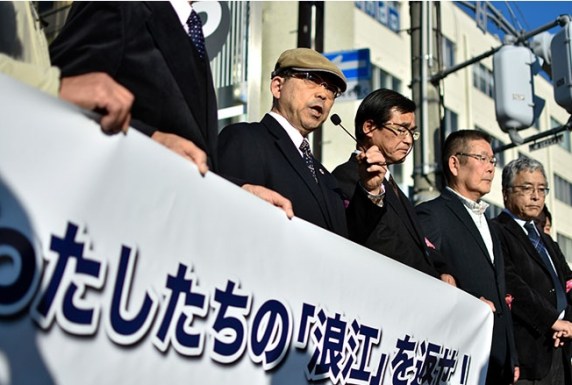 Plaintiffs in the lawsuit against TEPCO and the government gather in front of the Fukushima District Court in Fukushima on Nov 27.
November 28, 2018
FUKUSHIMA–Dismayed at a breakdown in talks for compensation, residents of the disaster-stricken town of Namie filed a lawsuit against Tokyo Electric Power Co. and the central government for damages stemming from the nuclear accident here in March 2011.
The plaintiffs are seeking 1.3 billion yen ($11.4 million) in financial redress.
The entire town was evacuated in the aftermath of a triple core meltdown at TEPCO’s Fukushima No. 1 nuclear power plant triggered by the Great East Japan Earthquake and ensuing tsunami.
The lawsuit was filed at the Fukushima District Court on Nov. 27 after five years of negotiations between the town and TEPCO collapsed in April over the utility’s refusal to meet demands for more compensation.
According to court papers, 109 plaintiffs of 49 households are seeking 12.1 million yen in individual compensation.
They stated that the nuclear accident destroyed their community and forced them to live as evacuees for a prolonged period.
TEPCO, under guidelines established by the central government, has been paying 100,000 yen a month to each resident forced to evacuate.
However, town officials argued that the figure was painfully low and should be increased to compensate for psychological suffering caused by the disaster.
In May 2013, the Namie municipal authorities, acting on behalf of residents, asked the nuclear damage claim dispute resolution center, an organization established by the central government in response to the Fukushima disaster, to mediate in the dispute.
About 15,000 residents, more than 70 percent of the town’s population, signed a petition for the mediation in an alternative dispute resolution (ADR) process at the center.
In March of 2014, an ADR proposal called for the monthly compensation to be uniformly increased by 50,000 yen.
The town accepted the offer but TEPCO rejected it, citing potential unfairness to others who had been compensated. In April, the center discontinued the reconciliation process.
Pointing out that TEPCO had reneged on its promise to “respect ADR reconciliation proposals,” the plaintiffs argued that the utility should pay for betraying the trust of residents.
An additional 2,000 or so townsfolk are planning to join the lawsuit.
In a statement, TEPCO said, “We will listen to the plaintiffs’ requests and complaints in detail and respond sincerely.”
Not only were the lives of residents turned upside down by the nuclear disaster, but more than 180 perished in the tsunami that engulfed the town.
Although the evacuation order was lifted for some parts of the town at the end of March 2017, entry to most of the area remains prohibited.
http://www.asahi.com/ajw/articles/AJ201811280053.html?fbclid=IwAR1O0aNAvKOkAVVRm2UH44C6RT88xLhOntskaKyVvL3VSZmDlYSd7SMC1Vs
November 30, 2018
Posted by dunrenard |
Fukushima 2018 | Fukushima, Lawsuit, Namie, Tepco |
2 Comments

Nov 27, 2018
TAIPEI – Taiwan and Japan will hold annual trade talks in Taipei this week, coming after a weekend referendum in the former that could have a negative impact on bilateral relations.
Sources familiar with the two-day talks from Thursday say that both sides are planning to sign at least six agreements or memorandums of understanding.
They will cover a wide range of areas, including cooperation in management of medical equipment and materials, joint research by young researchers, and the mutual support and advancement of cooperation between small and medium-size businesses.
On Saturday, a majority of Taiwanese voted in favor of maintaining a ban on food imports from five Japanese prefectures that was imposed after the 2011 Fukushima nuclear disaster.
Taiwan’s representative to Japan, Frank Hsieh, earlier warned that if the referendum were approved, Taiwan would have a “grave price” to pay.
That “grave price” could include Taiwan’s bid to join a Japan-led trade pact, the Comprehensive and Progressive Agreement for Trans-Pacific Partnership.
Taiwan has expressed its desire to participate in the second-round of accession talks on numerous occasions.
Taiwan has also been seeking to sign a full-fledged free trade agreement with Japan. However, the ban on the imports of Japanese food products has stalled negotiations on the trade pact.
Despite the absence of diplomatic ties, which were severed in 1972, the unofficial relationship between Taiwan and Japan has remained robust.
Japan is Taiwan’s third-largest trading partner after China, including Hong Kong, while Taiwan is Japan’s fourth-largest trading partner.
Bilateral trade totaled $62.7 billion last year, up about 4 percent from the previous year. Japanese investment in Taiwan last year also increased more than 84 percent from the previous year to $649 million.
https://www.japantimes.co.jp/news/2018/11/27/national/politics-diplomacy/taiwan-japan-hold-trade-talks-shadow-vote-keep-post-fukushima-food-ban/#.W_6-RfZFzIX
November 30, 2018
Posted by dunrenard |
Fukushima 2018 | Food Ban, Fukushima Radiation, Taiwan |
Leave a comment
 Elementary school pupils in Iwaki, Fukushima Prefecture, watch drone footage of their hometown of Futaba, which they are not permitted to enter due to high levels of radiation, and talk to local officials there via a satellite hookup.
 Children living as evacuees are glued to images shot by a drone of their hometown of Futaba during a special presentation at their temporary campus in Iwaki, Fukushima Prefecture, on Nov. 26.
 The children learn about decontamination work under way in Futaba via a satellite hookup during a field trip class held in Iwaki, Fukushima Prefecture, 80 kilometers away from the hometown they were forced to abandon after the 2011 nuclear disaster.
November 27, 2018
IWAKI, Fukushima Prefecture–With barely no recollections of growing up in Futaba, a town rendered uninhabitable by the 2011 nuclear disaster, 11 young evacuees had a “homecoming” of sorts on Nov. 26.
The children, fourth- to sixth-graders at two public elementary schools who currently study at a temporary campus in Iwaki, 80 kilometers south of Futaba, attended a special 45-minute presentation in a school gym to watch drone footage of the area where they were born.
A satellite feed allowed the pupils to talk to local officials about efforts to decontaminate the once-bustling community.
Futaba was transformed into a ghost town by the triple meltdown at the Fukushima No. 1 nuclear power plant triggered by the earthquake and tsunami disaster. High radiation levels mean that entry still remains restricted.
The children watched aerial footage of scenic spots shot by drones on three 70-inch monitors. Beautiful images of beaches and mountains in fall colors caused them to lean forward and express amazement.
Fifth-grader, Mao Oyano, 11, who has few memories of living in Futaba as she left at the age of 3, expressed surprise at seeing “many more houses than I expected.”
The children fell silent when eerie images appeared of the wrecked nuclear plant.
Ninety-six percent of Futaba, a town that co-hosts the stricken nuclear facility, is located in a difficult-to-return zone because of high radiation levels and remains uninhabited.
Adults must receive permission to enter the area, but children under the age of 15 are not allowed access.
The children were aged between 2 and 4 when they left, and have not set foot in Futaba since then.
Prior to the disaster, Futaba had two elementary schools with 309 pupils. In spring 2014, the town opened a temporary school facility in Iwaki, a coastal city to where many Futaba residents evacuated, but the number of pupils dropped to 31.
The “homecoming” was the school’s first attempt to give the children an opportunity to ponder the tragedy that befell their hometown, according to a school official.
http://www.asahi.com/ajw/articles/AJ201811270053.html
November 30, 2018
Posted by dunrenard |
Fukushima 2018 | Drone Footage, Evacuees, Futaba |
Leave a comment
November 14, 2018
Abstract
Plutonium and radiocaesium are hazardous contaminants released by the Fukushima Daiichi nuclear power plant (FDNPP) disaster and their distribution in the environment requires careful characterisation using isotopic information. Comprehensive spatial survey of 134Cs and 137Cs has been conducted on a regular basis since the accident, but the dataset for 135Cs/137Cs atom ratios and trace isotopic analysis of Pu remains limited because of analytical challenges. We have developed a combined chemical procedure to separate Pu and Cs for isotopic analysis of environmental samples from contaminated catchments. Ultra-trace analyses reveal a FDNPP Pu signature in environmental samples, some from further afield than previously reported. For two samples, we attribute the dominant source of Pu to Reactor Unit 3. We review the mechanisms responsible for an emergent spatial pattern in 134,135Cs/137Cs in areas northwest (high 134Cs/137Cs, low 135Cs/137Cs) and southwest (low 134Cs/137Cs, high 135Cs/137Cs) of FDNPP. Several samples exhibit consistent 134,135Cs/137Cs values that are significantly different from those deposited on plant specimens collected in previous works. A complex spatial pattern of Pu and Cs isotopic signature is apparent. To confidently attribute the sources of mixed fallout material, future studies must focus on analysis of individual FDNPP-derived particles.


 Isoscapes of 134, 135, 137Cs and 239, 240Pu for part of the Fukushima prefecture surrounding FDNPP. The green marker is used to highlight an anomalous 240Pu/239Pu atom ratio of 0.64. R1, R2 and R3 correspond to ORIGEN estimated isotope ratio values for Reactor Units 1, 2 and 3, respectively27. SW indicates the mean value for the Cs isotope ratios measured to the southwest of FDNPP by Snow et al.19. 240Pu/239Pu atom ratio for Northern Hemisphere integrated global fallout is denoted by NHF28.
Read more at:
https://www.nature.com/articles/s41598-018-34302-0?fbclid=IwAR3I0oIwIHCCpSin5H3amNyt1ZZ_9kEe1hC6PrI3jLFAo20duwAGqWBL-Ck
November 30, 2018
Posted by dunrenard |
Fukushima 2018 | Contamination, Fukushima Daiichi, plutonium, Radiocesium, Release |
Leave a comment
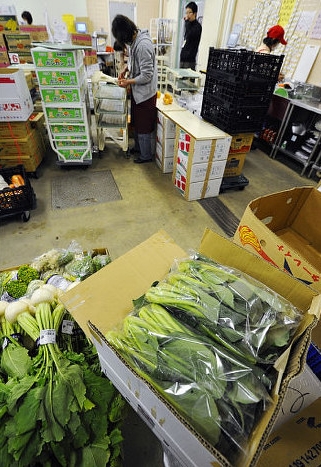 Vegetables produced in Fukushima Prefecture are withdrawn from the shelves of a supermarket in the city of Fukushima on March 23, 2011
November 25, 2018
FUKUSHIMA (Kyodo) — Farmers and fishermen in Fukushima called for further efforts to convince the public that their food is safe to eat on Sunday after Taiwan decided to maintain its import ban on Japanese food from areas affected by the 2011 nuclear disaster.
Taiwan’s public voted in a referendum Saturday to maintain the ban on agricultural products and other food from Fukushima and four other prefectures.
“All we can do is to work harder until people understand that our products are safe,” said Masao Koizumi, a rice farmer in Fukushima.
The prefectural government of Fukushima has been conducting radiation checks on all rice produced in the prefecture. Since 2015, all shipments cleared the screening, with radioactive cesium levels below the 100-becquerel-per-kilogram limit set by the central government.
“When people see the inspection readings, they will know that there is no threat of radioactive materials,” Koizumi said.
Tetsu Nozaki, the head of an association representing fishery cooperatives in the prefecture, said, “We are disappointed, but we just need to make sure that we keep communicating the safety of our products.”
https://mainichi.jp/english/articles/20181125/p2g/00m/0dm/049000c
November 30, 2018
Posted by dunrenard |
Fukushima 2018 | Contaminated Food, Fukushima Food Ban, Japan Food Exports, Taiwan |
Leave a comment
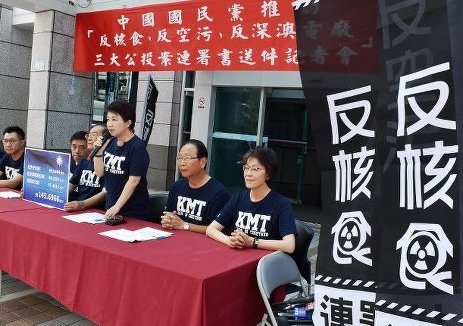 In this file photo dated Aug. 27, 2018, senior officials of the Kuomintang, Taiwan’s major political party, hold a press conference in Taipei to state their opposition to lifting a ban on food imports from Fukushima and four other Japanese prefectures. The banners read “oppose nuclear food.” (Mainichi/Shizuya Fukuoka)
TAIPEI (Kyodo) — A referendum on maintaining a ban on food products from five Japanese prefectures, imposed after the 2011 Fukushima nuclear disaster, saw the restrictions kept in place on Saturday, dealing a major blow to the government of President Tsai Ing-wen and the island’s relations with Japan.
For a referendum to deliver a decisive result in Taiwan, the “yes” vote must account for more than 25 percent of the electorate, or about 4.95 million voters.
The Central Election Commission website showed that more than 15 million of the 19.76 million eligible voters cast their ballots. More than 6 million voters approved the initiative, well over the 25 percent required.
The referendum is legally binding and government agencies must take necessary action.
The result dealt a significant blow to the Democratic Progressive Party government which proposed easing the ban after coming to power in May 2016, but backed away when the main opposition Nationalist Party (KMT) questioned the new government’s ability to ensure the safety of the imported products.
Government officials responsible for the policy declined to comment on Sunday, only saying it is a matter for President Tsai to decide.
Tsai announced her resignation as DPP leader on Saturday following her party’s disastrous defeat in key mayoral elections that day, races viewed as indicators of voter sentiment ahead of the next presidential and island-wide legislative elections in 2020.
Some worry that the result of the referendum on Japanese food imports will have a negative impact on the island’s relations with Japan. Taiwan’s representative to Japan, Frank Hsieh, said the initiative was a KMT scheme aimed at undermining bilateral relations between Taiwan and Japan at a time when the two are seeking closer ties as a way of protecting themselves from an increasingly belligerent China.
He also warned that if the referendum is successful, Taiwan would pay “a grave price” that will affect all its people.
China is the only other country still restricting comprehensive imports from Fukushima Prefecture and nearby Ibaraki, Gunma, Tochigi, and Chiba prefectures.
The referendum, initiated by the KMT, was one of 10 initiatives put to a vote in conjunction with Saturday’s island-wide local elections.
Voters approved two other referendums initiated by the KMT. One sought to stop the construction of new coal-fired power plants or the expansion of existing ones, and the other asked voters if they wanted to phase out thermal power plants.
Beijing will be happy about the result of a referendum on the name the island uses when competing at international sports events. It had sought to change the name used to participate in future international events, including the 2020 Tokyo Olympics, from “Chinese Taipei” to “Taiwan.”
The CEC website showed that more than 8.9 million cast their ballots. About 3 million of the eligible voters approved the initiative, less the 25 percent needed for the referendum to count.
The referendum was highly unpopular among athletes, who were worried that a successful outcome would hamper their right to compete, as the International Olympic Committee resolved in May that it would stand by a 1981 agreement that Taiwanese athletes must compete as “Chinese Taipei.”
The IOC had also warned that Taiwan would risk having its recognition suspended or cancelled if the referendum was successful.
China was annoyed by the proposal and pressured the East Asian Olympic Committee to revoke Taichung’s plan to host the 2019 East Asian Youth Games.
Beijing said that if the referendum was successful, it would not sit idly by and would “definitely respond,” without elaborating.
There were also five referendums relating to same-sex marriage — three initiated by opponents of same-sex marriage and two by supporters.
The CEC website showed that all three of the anti-same sex marriage initiatives passed, while both the pro-same sex marriage referenda failed.
The result also puts the Tsai government in an awkward position as Taiwan’s highest court, the Council of Grand Justices, ruled 18 months ago that the government must, within two years, amend the Civil Code or enact a special law legalizing gay marriage.
https://mainichi.jp/english/articles/20181125/p2g/00m/0in/010000c?fbclid=IwAR0ZlvV-JO_PHes83Gn8mutF6jKkFBzyx6iAYPJPw_2FA-tSqx3W71k9y2c
November 25, 2018
Posted by dunrenard |
Taiwan | Contaminated Food, Fukushima Food Ban, Fukushima Radiation |
Leave a comment




 nuclear-news