TOKYO — William Zeller, a petty officer second class in the U.S. Navy, was one of hundreds of sailors who rushed to provide assistance to Japan after a giant earthquake and tsunami set off a triple meltdown at the Fukushima Daiichi nuclear power plant in 2011. Not long after returning home, he began to feel sick.
Today, he has nerve damage and abnormal bone growths, and blames exposure to radiation during the humanitarian operation conducted by crew members of the aircraft carrier Ronald Reagan. Neither his doctors nor the U.S. government has endorsed his claim or those of about 400 other sailors who attribute ailments including leukemia and thyroid disease to Fukushima and are suing Tokyo Electric, the operator of the plant.
But one prominent figure is supporting the U.S. sailors: Junichiro Koizumi, former prime minister of Japan.
Koizumi, 74, visited a group of the sailors, including Zeller, in San Diego in May, breaking down in tears at a news conference. Over the past several months, he has barnstormed Japan to raise money to help defray some of their medical costs.
The unusual campaign is just the latest example of Koizumi’s transformation in retirement into Japan’s most outspoken opponent of nuclear power. Though he supported nuclear power when he served as prime minister from 2001-06, he is now dead set against it and calling for the permanent shutdown of all 54 of Japan’s nuclear reactors, which were taken offline after the Fukushima disaster.
“I want to work hard toward my goal that there will be zero nuclear power generation,” Koizumi said in an interview in a Tokyo conference room.
The reversal means going up against his old colleagues in the governing Liberal Democratic Party as well as Prime Minister Shinzo Abe, who are pushing to get Japan, once dependent for about one third of its energy on nuclear plants, back into the nuclear power business.
That Koizumi would take a contrarian view is perhaps not surprising. He was once known as “the Destroyer” because he tangled with his own party to push through difficult policy proposals like privatization of the national postal service.
Koizumi first declared his about-face on nuclear power three years ago, calling for Japan to switch to renewable sources of energy like solar power and arguing that “there is nothing more costly than nuclear power.”
After spending the first few years of his retirement out of the public eye, in recent months Koizumi has become much more vocal about his shift, saying he was moved to do more by the emotional appeal of the sailors he met in San Diego.
Scientists are divided about whether radiation exposure contributed to the sailors’ illnesses. The Defense Department, in a report commissioned by Congress, concluded that it was “implausible” that the service members’ ailments were related to radiation exposure from Fukushima.
To many political observers, Koizumi’s cause in retirement is in keeping with his unorthodox approach in office, when he captivated Japanese and international audiences with his blunt talk, opposition to the entrenched bureaucracy and passion for Elvis Presley.
Some wonder how much traction he can get with his anti-nuclear campaign, given the Abe administration’s determination to restart the atomic plants and the Liberal Democratic Party’s commanding majority in parliament.
Two reactors are back online; to meet Abe’s goal of producing one-fifth of the country’s electricity from nuclear power within the next 15 years, about 30 of the existing 43 reactors would need to restart. (Eleven reactors have been permanently decommissioned.)
A year after the Fukushima disaster, anti-nuclear fervor led tens of thousands of demonstrators to take to the streets of Tokyo near the prime minister’s residence to register their anger at the government’s decision to restart the Ohi power station in western Japan. Public activism has dissipated since then, though polls consistently show that about 60 percent of Japanese voters oppose restarting the plants.
“The average Japanese is not that interested in issues of energy,” said Daniel P. Aldrich, professor of political science at Northeastern University. “They are anti-nuclear, but they are not willing to vote the LDP out of office because of its pronuclear stance.”
Sustained political protest is rare in Japan, but some analysts say that does not mean the anti-nuclear movement is doomed to wither.
“People have to carry on with their lives, so only so much direct action can take place,” said Koichi Nakano, a political scientist at Sophia University in Tokyo.
Anti-nuclear activism “may look dormant from appearances, but it’s there, like magma,” he said. “It’s still brewing, and the next trigger might be another big protest or political change.”
Some recent signs suggest the movement has gone local. In October, Ryuichi Yoneyama was elected governor in Niigata, the prefecture in central Japan that is home to the world’s largest nuclear plant, after campaigning on a promise to fight efforts by Tokyo Electric to restart reactors there.
Like Koizumi, he is an example of how the anti-nuclear movement has blurred political allegiances in Japan. Before running for governor, Yoneyama had run as a Liberal Democratic candidate for parliament.
Koizumi, a conservative and former leader of the Liberal Democrats, may have led the way.
“Originally, the nuclear issue was a point of dispute between conservatives and liberals,” said Yuichi Kaido, a lawyer and leading anti-nuclear activist. “But after Mr. Koizumi showed up and said he opposed nuclear power, other conservatives realized they could be against nuclear power.”
Since he visited the sailors in San Diego, Koizumi has traveled around Japan in hopes of raising about $1 million for a foundation he established with another former prime minister, Morihiro Hosokawa, an independent who has previously been backed by the opposition Democratic Party, to help pay some of the sailors’ medical costs.
Koizumi is not involved in the sailors’ lawsuit, now before the 9th U.S. Circuit Court of Appeals in San Francisco. Tokyo Electric is working to have the case moved to Japan.
Aimee L. Tsujimoto, a Japanese-American freelance journalist, and her husband, Brian Victoria, an American Buddhist priest now living in Kyoto, introduced Koizumi to the plaintiffs. Zeller, who said he took painkillers and had tried acupuncture and lymph node massages to treat his conditions, said the meeting with Koizumi was the first time that someone in power had listened to him.
“This is a man where I saw emotion in his face that I have not seen from my own doctors or staff that I work with, or from my own personal government,” said Zeller, who works at the Naval Medical Center in San Diego. “Nobody has put the amount of attention that I saw in his eyes listening to each word, not just from me, but from the other sailors who have gone through such severe things healthwise.”
Koizumi, whose signature leonine hairstyle has gone white since his retirement, said that after meeting the sailors in San Diego, he had become convinced of a connection between their health problems and the radiation exposure.
“These sailors are supposed to be very healthy,” he said. “It’s not a normal situation. It is unbelievable that just in four or five years that these healthy sailors would become so sick.”
“I think that both the U.S. and Japanese government have something to hide,” he added.
Many engineers, who argue that Japan needs to reboot its nuclear power network to lower carbon emissions and reduce the country’s dependence on foreign fossil fuels, say Koizumi’s position is not based on science.
“He is a very dramatic person,” said Takao Kashiwagi, a professor at the International Research Center for Advanced Energy Systems for Sustainability at the Tokyo Institute of Technology. “He does not have so much basic knowledge about nuclear power, only feelings.”
That emotion is evident when Koizumi speaks about the sailors. Wearing a pale blue gabardine jacket despite Japan’s black-and-gray suit culture, he choked up as he recounted how they had told him that they loved Japan despite what they had gone through since leaving.
“They gave their utmost efforts to help the Japanese people,” he said, pausing to take a deep breath as tears filled his eyes. “I am no longer in government, but I couldn’t just let nothing be done.”
As an introduction to this translated article from Japan, I would like to say that the nuclear industry has been manipulating and lying about statistics for decades concerning the health effects of radiation on human and environmental life. Concerning the recent furor about Thyroid cancers in Fukushima, we see that the UK and Japanese specialists in thyroid cancer, have been manipulating the figures to play down the role of radiation from the Fukushima 2011 nuclear disaster. Some points to note concerning the new article from Japan;
1 The age group that the Fukushima Medical Hospital give did not include the 10 to 17 years olds that were effected in the first year of the disaster, thereby skewing the public figures.
2 The lack of early testing on with sophisticated equipment led to the distortion of figures and continues to do so (And at least a recent report one child had cancer spread to their lungs because of the late testing)
3 Ignoring the findings from Chernobyl has been criminally negligent,
4 Figures of actual cancer rates are played down in the media who state 147 cancers when there are actually 183. Also, no reporting of the cancers found in outlying prefectures are reported.
5 Because of the miss-reporting and skewing of the data the UK`s Thyroid expert Prof Geraldine Anne Thomas and Japans expert Prof Yamashita are now trying to limit testing to hide these cancers to reduce the compensation and support to the victims and their families on behalf of TEPCO (Who is financially culpable) and to limit the damage to the UK and Japanese nuclear lobby.
Summary to article post by Shaun McGee aka Arclight
Date of post 31 December 2016
The translation was done through Google translate but the main points and statistics can be easily derived from the below translation, I place it here as documented evidence for you all. The source for this article and material below can be found here in Japanese;
Fukushima Nuclear Accident 2017 Children’s Thyroid Cancer Close to the mystery of thyroid cancer frequently occurring in children in Fukushima Prefecture → Organize by municipality-specific map
Current situation of Fukushima thyroid cancer problem
Release date: December 29, 2016
Close to the mystery of thyroid cancer frequently occurring in children in Fukushima Prefecture → Organize by municipality-specific map
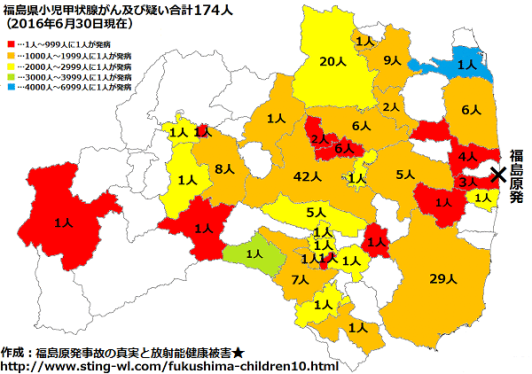
According to the latest Fukushima prefectural survey report released on 27th December 2016, childhood thyroid cancer and suspect children in Fukushima prefecture were three months ago … 9 people increased from the previous 174 people totaling 183 I became a person. ※ 1 ※ 2
Comparison of 30 September 2016 version and 30 June 2016 version of Fukushima kid’s thyroid cancer map by municipality
Then, since it was confirmed that there was a benign nodule by surgery and one who was not a thyroid cancer was originally counted in this thyroid cancer and suspicion, this one counts thyroid cancer and suspicion total of 184 people.
Presentation in Fukushima prefecture is thyroid cancer, malignant … Malignant is cancer, but use the word “malignant or malignant suspicion” as if the children who are not thyroid cancer are also included in this By writing, it blurs the focus making comparison with Chernobyl nuclear accident difficult.
However, among 146 people who completed surgery, only one was a benign nodule, 143 papillary carcinomas, 1 person is poorly differentiated cancer, 1 person is diagnosed with other thyroid carcinoma.
In other words, 99% of “suspicion of malignancy or malignancy” was pediatric thyroid cancer.
So overestimating the word of doubt and reassuring is dangerous.
Table of contents
【1】 Preliminary inspection and full inspection
【2】 Compare by municipality ← ★ Comparison map available!
【3】 Compare by accident year by year
【4】 Compare by gender
【5】 Comparison by age
[1] For the preliminary inspection and the full inspection, it is sufficient if you understand the definition of the preceding inspection and the full inspection.
【2】 ~ 【4】 classified 183 people considered to be thyroid cancer of Fukushima by municipalities, accident years by age from accident, by gender, by age at the time of accident, respectively, Chernobyl nuclear accident It compares with past data of Japan and Fukushima prefecture.
In addition, this article was published on this site on March 14, 2014 [emergency] sudden increase in childhood thyroid cancer? New facts in Fukushima prefecture → 2008 patients 0 people! This is the eleventh revised version that reflects the latest data.
On the northern side of Soma City, Fukushima Prefecture … About two cases of thyroid cancer and suspected children found in Maruomori-cho, Miyagi prefecture 【urgent feature】 2 children in Miyagi prefecture Marumori-machi thyroid cancer → Fukushima prefecture and Please see the comparison.
Fukushima prefecture on the south side of Iwaki City … About 3 children with thyroid cancer found in Kitaibaraki, Ibaraki Prefecture 3 children in Kitaibaraki city, Ibaraki Prefecture → thyroid cancer! Please see the comparison between Kita Kanto and Fukushima prefecture.
【1】 Preliminary inspection and full inspection
Let’s first define the definition of preliminary inspection and full inspection. Otherwise it is now to the children in Fukushima prefecture … what is going on? I can not understand exactly.
That is, many newspaper companies and television stations that publish nationwide newspapers since the start of full-scale inspection … The number of people who confirmed new thyroid cancer in the preceding examination and thyroid cancer found in the preceding examination It is because I am reporting on the total number of patients cleanly and carelessly.
Let’s suppress the definition of the preliminary inspection and the full inspection to know the truth.
The preliminary inspection was conducted at the time of the Fukushima nuclear power plant accident in 2011 … It took about 330 years of 2011, 2012, 2013 for the about 360,000 children who were under the age of 18 who lived in Fukushima prefecture It was. Since it is the first inspection, it may be expressed as “first round” or “first round” inspection.
The objective of this preliminary examination is to assume that the increase in pediatric thyroid cancer of the Chernobyl nuclear accident which is the theory is minimum for 4 to 5 years and which is in one to three years before nuclear accident causes childhood thyroid cancer to increase Is there children in thyroid cancer childhood in Fukushima Prefecture only? It was aimed at investigating.
Full-scale inspection, at the time of the Fukushima Nuclear Accident in 2011 … children who were born in Fukushima Prefecture for about one year after the nuclear accident in addition to the “children who were under 18” who lived in Fukushima prefecture will be covered So the number of people to be examined will increase to about 380,000. It will be held in Fukushima prefecture over the two years of 2014 and 2015. Since it is the second inspection, it may be expressed as “second round” or “second round” inspection.
The objective of this full-scale inspection is that the increase in childhood thyroid cancer of the established Chernobyl nuclear accident is assumed to be a minimum of 4 to 5 years, and there is a possibility that childhood thyroid cancer may increase due to a nuclear accident 4 years later, in Fukushima prefecture Do thyroid cancer actually increase for children? It is aimed at investigating.
Preliminary inspection full-scale inspection
Fiscal Year 2011 – 2013 Fiscal 2014 –
One week in Fukushima Prefecture within 3 years of inspection period One round in Fukushima Prefecture
Target number 367,000 people 381,000 people
As I mentioned earlier in the article, “Childhood thyroid cancer in Fukushima prefecture and suspected children, three months ago … increased from nine people last time to nine people totaling 183 people” The breakdown of the nine people who increased was +0 in the preceding examination and +9 in the full-scale examination. The list of 9 people who increased this time by municipality is as follows.
I distinguished the coloring as follows so that I can understand the incidence rate.
■ 1 person ~ 999 people 1
■ 1000 people ~ 1999 people have a disease onset
■ … one in 2000 to 2999 people
■ 3000 people ~ 1 3999 people have disease onset
■ 1 person in 4000 to 6,999 people developed illness
Full inspection Municipal name June 30, 2016 → September 30, 2016 increase Number of people
Kitakata City 0 person → 3 people + 3 people
Iwaki City 29 people → 31 people + 2 people
Fukushima city 20 people → 22 people + 2 people
Tanagura-cho 1 → 2 people + 1 person
Saigo Town → 2 people + 1 person
Total + 9 people
As I mentioned earlier in the article, “Childhood thyroid cancer in Fukushima prefecture and suspected children, three months ago … increased from nine people last time to nine people totaling 183 people” Of the 183 people in total, 115 people were found in the preceding examination, 68 in the full examination. Let’s make a list.
Fukushima Prefecture Childhood thyroid cancer examination Summary Preliminary examination Full-scale examination examination
Thyroid cancer and suspicion 115 people 68 people 183 people
There are two problems with this childhood thyroid cancer test result.
This is worth a read dear subscribers, If you have time. A great synpsis on a difficult year from am Independent Journalist from the UK.. I wish him well for 2017. Shaun aka Arclight
I’m currently sat on a train from London to Suffolk, a journey which I never envisaged I’d be doing so regularly at the beginning of the year, trying to write my review of 2016.
It really was one of those years for which only “where do I begin” seems an accurate appraisal. The EU referendum, the ‘Chicken Coup’, slaughter in the Middle East and sustained attacks by the Conservative government on disabled people and society’s most vulnerable all feature at the forefront of my mind. But my own life does also, this year, and the (get ready to cringe) ‘journey’ that I’ve been on.
So, here’s my take on 2016.
Mother: if you’re reading, I apologise in advance for the language…
Chaos at home
The EU referendum has to have been one of the greatest mistakes ever made by a sitting government – intentional or not. Simple as.
For anyone interested I have managed to get copies of all the court proceedings of the British Nuclear Test Veterans case from the High Court that occurred in the summer of 2016. To search through these lengthy documents for Keywords, press CTRL F when the PDF is in your browser and enter the search term in the bottom Left of the screen where the search option opens up. You can also do the same thing with the downloaded copy. Here is a list of the PDF n the daily running order beginning with the;
The president of Japan’s largest advertising agency has announced he will be stepping down next month, one year since an employee committed suicide due to working excessive overtime. Meanwhile, the labor bureau says it will refer his firm to prosecutors.
Tadashi Ishii, the president of Dentsu, announced late on Wednesday that he will be stepping down from his post in January, ending his almost six-year tenure at the company.
His announcement came just a day after the Tokyo Labor Bureau said it will be referring the company and one of its executives to prosecutors, on suspicion that the suicide of a worker in 2015 had resulted from their violation of Japan’s labor law.
Matsuri Takahashi, a Dentsu employee, jumped to her death from a company dormitory on Christmas Day last year. The 24-year-old had worked more than 100 hours of overtime every month since joining the company in April of 2015, according to Japanese media. Her death was blamed on overwork. More on link;
In a book published in 2012, Honma Ryu looked into some of Dentsu’s backstage, and its tight control over the media, especially on behalf of one of its major clients: Tokyo Electric Power Company, Tepco. …… 1 June 2016
n 2012, his book Dentsu and Nuclear Coverage became a bestseller within a few months, despite almost universal media blackout.
Honma meticulously described the mechanisms by which Dentsu, the inevitable intermediary, implicitly imposes on media what can or cannot be written on nuclear power, and under what conditions. “Dentsu occupies a special position since the agency holds 80% of the market for nuclear advertising in Japan,” he reminded us during an interview in a coffee shop at Ueno Station. In 2010, in this huge advertising market, Tepco, a regional firm, indeed ranked 10th in terms of advertising expenses, next to power plant manufacturer Mitsubishi Heavy Industries. That year, on the eve of the Fukushima accident, Tepco had spent more than 2 million euros on advertising. The overall advertising expenses of the 10 regional electrical power companies amounted to 7 million euros…. More on link
A private fund in Japan has begun providing financial assistance for young people diagnosed with thyroid cancer after the 2011 Fukushima nuclear accident.
The 3.11 Fund for Children with Thyroid Cancer offers a lump sum of 100,000 yen, or 850 dollars, to help pay for treatment for patients up to the age of 25. The first payments were made to 35 people on Monday.
The fund’s name refers to March 11th, 2011, when a massive earthquake hit northeastern Japan, triggering tsunami that crippled a nuclear plant in Fukushima Prefecture.
People in Fukushima and 14 other prefectures in eastern Japan are eligible to apply.
Fund officials say that 9 of the 35 recipients are not residents of Fukushima Prefecture. They say that in at least one case, the cancer had spread to the lungs when the diagnosis was made.
They are soliciting applications for the assistance as well as donations.
An official says the fund hopes to offer support to as many people as possible, adding that the cost of treatment weighs heavily on some families.
With the government considering splitting Tepco’s nuclear business and forming alliances with other atomic operators, the issue of restarting the utility’s Kashiwazaki Kariwa nuclear plant, the world’s biggest, has faded.
While oil and gas prices have risen in recent weeks, they are still well below highs in the aftermath of the nuclear disaster that led to a shutdown of most of Japan’s reactors, so Tepco’s costs remain manageable.
Tepco is aiming to sell the debt through a unit in charge of its power transmission business, Tepco Power Grid Inc, to separate risks from operations dealing with the disaster.
THE HANS INDIA | Dec 27,2016 , 05:40 PM IST
Tepco, investors discussing first bond sale since Fukushima Tepco, investors discussing first bond sale since Fukushima
Tokyo Electric Power (Tepco) is gauging demand for its first bond offering since the 2011 Fukushima nuclear calamity, with some market participants expecting a sale as early as February, people familiar with the plans said. Once-sceptical investors are now more comfortable with the utility’s outlook after government moves to reassess decommissioning and compensation costs, bankers and investors who asked not to be identified told ThomsonReuters DealWatch. Tepco is likely to have to pay investors a 1 percentage point premium above Japanese government bonds, considered a rich yield pick-up, as potential buyers see an implicit government guarantee for the basically nationalized company, the people said.
That’s about three times more yield pick-up than on other electric utility bonds, they said. While the sale’s size has not been decided, potential maturities are three-, five- and 10-years, the people said.
The company was in discussions last year with investors to sell as much as 330 billion yen ($2.8 billion) of bonds.
A Tepco spokesman said the company plans to issue bonds by the end of March but declined to comment on specific target dates or sizes.
A CHANGE IN TIMING?
The timing could be pushed back as the Japanese government wants Tepco to delay the bond sale until after April, when legal changes that let it give more financial support to the utility are enacted, said a person familiar with the government’s thinking.
But the company may have to hurry as gains in financial markets since Donald Trump‘s election as U.S. president may falter, said one investor.
“If investors switch to risk-off mode because of a waning of the Trump rally in the New Year or the market enters an adjustment phase, selling bonds may be more difficult, so an issue by the end of this year would have been ideal,” Hiroaki Hayashi, director of the investment department at Fukokushinrai Life Insurance Co. said.
Seen as unrealistic only weeks ago, Tepco has a better chance of raising debt after a government panel recently updated its estimates on what compensation the company owes and how costs for decommissioning the wrecked Fukushima plant will be shared.
Tepco was once Asia‘s biggest electricity utility and one of Japan‘s largest corporate borrowers. But the March 2011 nuclear crisis at Fukushima, sparked by an earthquake and tsunami, brought the company to its knees.
Before the calamity, Tepco was a frequent bond issuer with a credit rating as high as the government, and considered a corporate benchmark.
It has 3.45 trillion yen of bonds outstanding with 625 billion yen due in 2017 and 570 billion yen due in 2018, according to its website.
In the year starting April 2010, which ended with the meltdowns at its Fukushima Daiichi station, Tepco sold 235 billion yen of bonds, slightly less than a year earlier.
JUNK RATING
The Fukushima losses caused its credit rating to be cut to junk by most agencies and led to a bailout by the government, which took a controlling 50.1 percent stake.
With the government considering splitting Tepco’s nuclear business and forming alliances with other atomic operators, the issue of restarting the utility’s Kashiwazaki Kariwa nuclear plant, the world’s biggest, has faded.
While oil and gas prices have risen in recent weeks, they are still well below highs in the aftermath of the nuclear disaster that led to a shutdown of most of Japan’s reactors, so Tepco’s costs remain manageable.
Tepco is aiming to sell the debt through a unit in charge of its power transmission business, Tepco Power Grid Inc, to separate risks from operations dealing with the disaster. http://www.thehansindia.com/posts/index/Business/2016-12-27/Tepco-investors-discussing-first-bond-sale-since-Fukushima/270618?fromNewsdog=1
It’s another prize . . . but maybe not one that the management at Dentsu Inc. will be proud of.
The major ad agency has been awarded this year’s Most Evil Corporation of the Year Award, also known as the Black Company Award, a corporate raspberry prize given to companies with a culture of overwork, discrimination and harassment, a group of journalists and rights activists announced Friday.
The suicide of one of its workers, Matsuri Takahashi, 24, was recognized as work-related in October. After pushing more than 100 hours of overtime per month, she committed suicide in her company dorm on Christmas Day last year.
“Dear Dentsu Inc., your 24-year-old new employee, Matsuri Takahashi, committed suicide on Dec. 25, 2015. She worked 105 hours of overtime, which is extremely long. In addition, she was suffering from power harassment from her bosses, and was mentally pressured,” said Tokachi Tsuchiya, a film director who is a member of the selection committee.
“On Twitter, she wrote, ‘I don’t want to work,’ and ‘two hours of sleep everyday is extreme.’ Several days before her death, she retweeted a post about the 2015 Black Company Award. She retweeted about this moment right now. It’s regrettable,” he said.
Before her death, Takahashi sent a message to her mother saying: “Goodbye, my lovely mother.”… More on Link ;
In a book published in 2012, Honma Ryu looked into some of Dentsu’s backstage, and its tight control over the media, especially on behalf of one of its major clients: Tokyo Electric Power Company, Tepco. …… 1 June 2016
n 2012, his book Dentsu and Nuclear Coverage became a bestseller within a few months, despite almost universal media blackout.
Honma meticulously described the mechanisms by which Dentsu, the inevitable intermediary, implicitly imposes on media what can or cannot be written on nuclear power, and under what conditions. “Dentsu occupies a special position since the agency holds 80% of the market for nuclear advertising in Japan,” he reminded us during an interview in a coffee shop at Ueno Station. In 2010, in this huge advertising market, Tepco, a regional firm, indeed ranked 10th in terms of advertising expenses, next to power plant manufacturer Mitsubishi Heavy Industries. That year, on the eve of the Fukushima accident, Tepco had spent more than 2 million euros on advertising. The overall advertising expenses of the 10 regional electrical power companies amounted to 7 million euros…. More on link
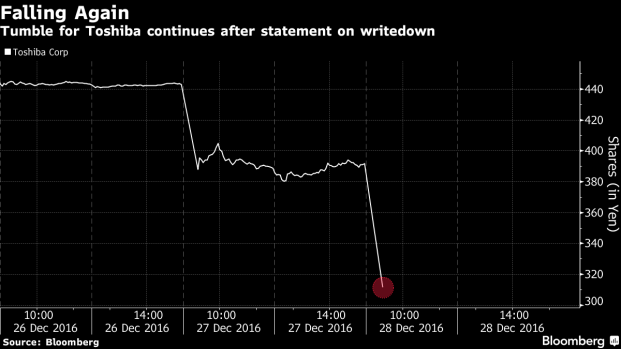
TOKYO (Kyodo) — Toshiba Corp. is in talks with its main creditor banks in hopes it can receive financial support as the company is expected to book a huge asset impairment loss on its U.S. nuclear power business, a source close to the matter said Wednesday.
But the embattled Japanese electronics manufacturer is likely to face tough negotiations as the banks are skeptical about Toshiba management’s record that has overseen an impairment loss of up to several billion dollars, the source said.
As of the end of Sept. 30, Toshiba had shareholders’ equity of 363.2 billion yen ($3.09 billion), or just 7.5 percent of assets, far below the 30 percent required for Japanese electronics makers. The company had shareholders’ equity of around 1 trillion yen the previous year.
As the Tokyo Stock Exchange has put Toshiba shares on its watch list, the heaviest punishment besides delisting, the manufacturer effectively cannot sell its shares through a public offering to boost its capital base.
Toshiba has been focusing on nuclear energy operations as its core business but has been struggling to win orders for new power plants both at home and abroad, particularly after the 2011 Fukushima nuclear disaster. The company booked an impairment loss of about 250 billion yen in the U.S. nuclear business in the last fiscal year.
Following Toshiba’s financial turmoil, Japanese rating agency Rating and Investment Information Inc. said Wednesday it has downgraded its issuer rating by two notches to BB.
“R&I’s evaluation of Toshiba’s overall business risk was adversely affected by the materialization of the risk associated with its core nuclear power systems business, as well as by a possible serious deterioration in its financial base,” the rating agency said in a report.
Toshiba marked a group net loss for the second straight year in the fiscal year through March 2016.
Campaign to stop bad nuclear health practice in Fukushima concerning thyroid cancer epidemic
The usual suspects are trying to cover up the health effects in Fukushima aided by the Japanese Secrets Law of 2013 that makes it illegal to talk about health effects caused by the 2011 Fukushima nuclear disaster under pain of imprisonment.
170 cancers found because of new “screening”techniques.. thats the excuse to reduce the testing in Fukushima for thyroid cancers. In spite of the data from Chernobyl (see below) and the ongoing thyroid cases and other health effects being reported by Chernobyl Children International concerning the 1986 Chernobyl disaster, their work is still ongoing.
I wait in anticipation of Prof Keith Baverstocks response to this outrage .. here is his previous rebuttal and condemnation of Geraldine Thomas`s “dangerous advice” and ergo her colleague Prof Yamashita who left the Fukushima Medical University because of his outrageous and narcissistic claims that were widely publicised and condemned …. .. Thomas versus Baverstock debate in summer of 2016 in full published here; https://issuu.com/fission/docs/fissionline_45
About the Campaign loosely translated from Japan
Regarding the Thyroid inspection regime that currently is in place in Fukushima Prefecture, The Nippon Foundation (Chairman Yohei Sasagawa) held a meeting that was chaired by Niwa Tanuki of the Radiation Effects Institute on December 9th 2016. In attendance were Prof Shunichi Yamashita (who famously claimed that “radiation is good for you” and made many more unscientifically proven comments) who is currently the executive vice president of Nagasaki University, Jacques Lochard vice chairman International Radiation Protection committee (ICRP) and Prof Geraldine Anne Thomas from the Imperial College University department of the Chernobyl Thyroid Tissue bank. The name of the conference is the “Fifth Fukushima International Expert Council Organising Committee December 2016”. Also in attendance was the Fukushima Prefectures and with the main members of the conference asked that the Thyroid testing of children should be changed to a voluntary basis and that this would mean that the testing regime was being reduced in spite of the the increase found after Chernobyl after 5 years by Prof Keith Baverstock who was in charge of the World Health Organisations radiological department during this time (this department was closed down and the workload was amazingly deferred to the more pro nuclear biased IAEA some years later).
The thyroid examination in Fukushima Prefecture actually require further enhancement and expansion because of the increase in the number of “cancer patients or suspects” on each successive report thus far. The “Thyroid inspection” in neighboring polluted prefectures that that have not been included are also necessary and should be incorporated as well. If this proposal is executed, the victims in Fukushima, neighboring prefectures and indeed the whole country will be in “rejected” from the future statistics concerning health monitoring data.
“We call on scientists and citizens nationwide,
We decided to do a “proposal to the Fukushima prefectural governor” to oppose the contraction of the Fukushima prefecture thyroid examination and indeed seek further improvement such as seek its expansion into effected nearby prefectures. (Attached document).”
Contact point for academics and NGOs to join the campaign
Those who can approve please contact me to the following e-mail.
Masa03to@gmail.com To Masato Tashiro
Copy of Letter
“….The thyroid screening should not be reduced by “voluntary participation” but should be expanded and enhanced
December 20, 2016
Toshihide Masukawa Nagoya University Institute for Elementary and Nuclear Sphere Origin Research Organization
Ikeuchi graduated Professor Emeritus, the Graduate University for Advanced Studies
Shoji Sawada Emeritus Professor, Nagoya University
Susumu Shimazono Professor, Sophia University
Katsuma Yagasaki Emeritus Professor, University of the Ryukyus
Michiaki Matsuzaki Dohoku Jobo Cooperative Director Asahikawa North Medical School
Masato Miyaji Emeritus Professor, University of Tokyo
Masato Tashiro Low dose exposure and health project representative (secretariat)
Yasuhiro Sasagawa Chairman of the Nippon Foundation (Chairperson), Etsuko Kita, Chairman of the Sasakawa Memorial Health Cooperation Foundation, Chairman of Niwa Takei Radiation Impact Research Institute, Shunichi Yamashita, Executive Vice President, Nagasaki University, Vice Chairman of the International Radiological Protection Committee, Geraldine Anne Thomas Professors Imperial College London etc are the name of the Fukushima International Expert Council on the 5th radiation and health on December 9, 2016,
To solve the thyroid problem in Fukushima ~ The lesson of Chernobyl 30th anniversary “Utilize the Fukushima nuclear power plant accident in 5 years ~” to the Governor of Fukushima Prefecture.
Over 170 thyroid cancer cases and suspected cases have been discovered in children at thyroid screening conducted to investigate the relationship between the Fukushima Daiichi nuclear accident due to the Great East Japan Earthquake and childhood thyroid cancer.
The point of the committees “Recommendation” is that “Thyroid inspection program should be voluntary participation” from the viewpoint of “risk and benefit about the screening program, and cost effectiveness”. “Recommendation” states that “The increase in thyroid abnormality is not the influence of radiation exposure due to nuclear accident, but due to the screening effect” this is the reason.
Based on the results of examination of the points shown below, we conclude that children’s thyroid cancer found in the Fukushima prefectural health-care survey, although there are various opinions among experts, denied the possibility of being caused by radiation exposure It is important to see what you can not and to watch for the future trends, and I think that it is necessary to continue thorough screening of thyroid cases more firmly than before.
The screening started from October 2011. A preliminary survey was started in advance to grasp the prevalence of naturally occurring thyroid cancer on the premise that it takes several years until carcinogenic symptoms make themselves known. As a result, thyroid cancer-affected people were discovered at a higher rate than expected, but in future the examination should be continued in order to investigate whether there will be an increase in thyroid cancer due to the effects of the accident which was its original purpose. There is no medical basis to reduce these inspections. One of the principles of screening is to target high risk groups. Exposure by radioactive iodine due to the Fukushima Nuclear Power Plant accident this time has produced children in the high-risk group to be examined, and the examination should be continued.
The occurrence of radiation-induced malignant neoplasms is considered medically long-lasting, and it is hoped that we will continue the long-term testing system in the future. Though 6 years have passed since the accident, those who are over the age of 18 who graduate from high school, get a job, go on to university and go out of the Fukushima prefecture should also be treated with thyroid examinations outside the prefecture, this practice is necessary. Including these problems, in order to promote health management by minimizing the health effects of radiation exposure from the nuclear accident which is the responsibility of the nuclear power plant owner, we should be offering the health administration notebook to the nation and to the residents of Fukushima with its surrounding prefectures. …..”
How bad is Prof. Geraldines advice anyway? And why do the BBC support her so much? See this link (And the other links below as source for this article and its claims) debunking her claims using the ICRP dose model 2016 (short video)
A link to a detailed report on the committees arguments are here and some overview from an health worker who has been studying this issues for some years can be found here;
Some of the research and posts concerning Prof. Geraldine Thomas that we here on nuclear-news.net have uncovered can be found on these links in ascending order of date;
A private fund in Japan has begun providing financial assistance for young people diagnosed with thyroid cancer after the 2011 Fukushima nuclear accident.
The 3.11 Fund for Children with Thyroid Cancer offers a lump sum of 100,000 yen, or 850 dollars, to help pay for treatment for patients up to the age of 25. The first payments were made to 35 people on Monday.
The fund’s name refers to March 11th, 2011, when a massive earthquake hit northeastern Japan, triggering tsunami that crippled a nuclear plant in Fukushima Prefecture.
People in Fukushima and 14 other prefectures in eastern Japan are eligible to apply.
Fund officials say that 9 of the 35 recipients are not residents of Fukushima Prefecture. They say that in at least one case, the cancer had spread to the lungs when the diagnosis was made.
They are soliciting applications for the assistance as well as donations.
An official says the fund hopes to offer support to as many people as possible, adding that the cost of treatment weighs heavily on some families.
Nobel laureate scholar criticizes Fukushima’s screening reduction
2016.12.26
“..The Fukushima child’s thyroid cancer screening “shrinking” the objection of Professor Masukawa brought Nobel prize winner to anger…” Source in Japanese;
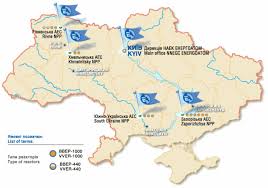
Clashes over energy in Ukraine between the West and Russia could prompt another Chernobyl-type accident or a catastrophe on the order of a Fukushima that will complete the nuclear devastation of the Northern Hemisphere. As news media fixate on conflicts over pipelines that supply Europe with Russian gas, another energy war is erupting over control of Ukraine’s nuclear-power industry, which generates half that nation’s electricity.
Prime Minister Arseniy Yatsenuk’s campaign for “energy independence” from Russian-sourced natural gas and nuclear fuel is not a study in cost control, economic security or even national sovereignty. His corporate-giveaway policies are actually a concession to Western energy interests in return for their influence over the EU, which can provide loans to avert an imminent default on Kiev’s debt to the IMF and World Bank. With an annual budget shortfall of $15 billion and a currency collapse, Ukraine is staggering under external sovereign debt estimated at between $140 and $200 billion.
The IMF and World Bank have halted further transfers of loan tranches to Kiev, which is now unable to make payments on its gas imports from Russia. Kiev policymakers are therefore desperately looking to expand their nuclear industry. Unfortunately two recent accidents at its largest nuclear-power plant highlight the serious risks to a nation still grappling with the long-term effects of the 1986 Chernobyl meltdown.
Boom and Bust
In stark contrast with eco-conscious capitals across Europe, Kiev is unable to resist foreign demands to adopt the Texan model of boom-and-bust energy extraction. Chevron and Shell have launched fracking projects to tap shale-oil deposits across Ukraine, but exploration and revenues have been delayed by the fierce fighting in the Donetsk region.
Ukraine also possesses one of Europe’s few exploitable uranium reserves in its Kirovograd and Dnipropetrovsk regions, now being targeted by the French nuclear giant AREVA in cooperation with local partner VostGOK.
An ongoing series of nuclear-fuel deals between Toshiba-Westinghouse and Ukraine energy monopoly Energoatom is aimed at severing Kiev’s reliance on Russian technology and Kazakh uranium. The competition to supply the global market for MOX (mixed oxides of uranium and plutonium) is pitting a consortium of Westinghouse, AREVA and their US suppliers against their Moscow-based rival Rusatom and nuclear-engineering firm TVE.
Beset by losses of orders from Japan, the AREVA MOX fabrication plant in France is facing a new and strong challenge from the Rusatom pellet facility in Krasnoyarsk, western Siberia, which has replaced the aging Mayak fuel plant.
To reduce stockpiles of plutonium-laced spent fuel rods stored inside power plants, the global nuclear industry is pushing to introduce advanced prototypes of fast-breeder reactors, which burn a variety of nuclear fuels including plutonium. Rusatom is producing MOX pellets for a next-generation fast-breeder to start operation this year at Beloyarskaya. The Russian design is the chief rival for next-generation breeder reactors being developed by the French ASTRID program in the Rhone region and the Hitachi-GE Horizon project along Britain’s Irish Sea coast.
In this global race to revive the fortunes of the nuclear industry, Chernobyl and the ongoing Fukushima cataclysm spewing radioactive waste into the jet stream over Europe have all but been forgotten.
Salvaging Savannah River
The powerful explosion of MOX fuel rods at Reactor 3 in Fukushima nearly four years ago prompted Britain to close its Sellafield MOX fuel-rod production facility and convinced the Department of Energy to suspend construction on the US mixed-oxide project in Savannah River, South Carolina. These setbacks for the US-UK nuclear industry left the AREVA’s Mercoule facility in the southern French region of Languedoc-Roussillon as the only MOX producer in the West.
Ulterior motives lurk behind the Ukraine sales pitch. The year-end push by Toshiba-Westinghouse o supply nuclear fuel to Kiev is a backhanded tactic to overturn the DOE decision to halt construction on the Savannah River MOX fuel fabrication facility. Anti-Moscow rhetoric and geopolitical arguments for switching Ukraine to Western-based energy systems (fracking, tanker-delivered oil imports and MOX fuel) bolster the odds for congressional funding to complete the Savannah River MOX facility.
We reported recently on the mostly censored story on Jihadists acquiring Highly Enriched Fissionable Uranium which was discovered by the Indian police. The reporting of this find was played down and the term “Depleted Uranium” was used instead of Highly Enriched Uranium (HEU) as the purity of the reported Uranium and high cost revealed. The full article with sources can be found here;
Whilst some traction on this story happened in India it was not reported by any western or Russian outlets. In fact I did a short video showing that the story was being heavily managed here;
Instead we got a huge increase in other nuclear stories because President Trump did a “nuclear tweet” (The timing was suspicious if I were a PR guy btw) . Talk about an over reaction to a non story by the media around the world.
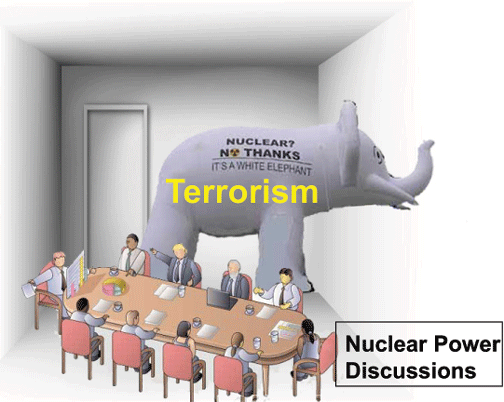
The reality of this Indian report was overlooked and the actual fact that Jihadists have been able to access over 4 million dollars worth (9KG) of the fissionable HEU, means that they are now able to make a small nuclear device cheaply with low tech means with the billions from oil revenues from the Syrian and Iraq conflicts under the noses of the USA and Russia, we might assume they have bought more than just a measly 4 million dollars worth perhaps?
Highly Enriched Uranium, a Dangerous Substance that Should Be Eliminated
“….Furthermore, it is more difficult to detect by technical means. Therefore, in comparison to plutonium, HEU is much easier to divert, smuggle and hide. Moreover, a crude nuclear explosive made of HEU can be constructed in a much simpler way than one made using
plutonium. For these reasons, HEU is the material most wanted by terrorists. A few tens of kilograms are sufficient for one explosive, but the quantities existing in the world add up to hundreds of tons…..” https://www.hsfk.de/fileadmin/HSFK/hsfk_downloads/prif124.pdf
Instead of the IAEA and associated nuclear watchdogs stepping in to stop the sale and movement of HEU and similar products we see nuclear deals are just being struck for billions of dollars to ship this material around the world without finding out who and where this black market nuclear material is being sold.
One such deal has been realised between Rosatom and TEPCO that are possibly two of the most nontransparent companies facing financial problems since the Fukushima 2011 nuclear disaster and the resulting economic collapse in nuclear investments.
The fact that this important story is being ignored should worry us all as it means we are not on our guard for a planned attack.
There are 2 main scenarios with terrorists being obviously able to get a hold of this with the huge financial resources at their disposal as they would likely have paid for more than just 9 Kg as the material was so cheap (as reported by the Indian police). It is likely they could have bought hundreds of kilos of the material at a discount rate with no problem. So is this the only HEU they have?
Scenarios;
1/ They could make small detonating devices with a low kiloton yields. This would mean some planning but they would likely try to get the materials in place and then launch a multiple attack. They would likely find it difficult to make a second such attack, by then, preparations for monitoring for radioactive materials could be put in place and transporting materials would be hard. It would be better to begin looking for these materials now.
2/ they could grind up the metal and feed it into a food processing plant (such as baby milk powder etc) and this would likely result in hundreds of thousands of casualties but would not be discovered for possibly many years. Such an attack could be prolonged and cause great damage before it was discovered.
So what can we do about it? If the authorities and Media ignore the story and hope it goes away then, nothing could be done. As this material can be easily transported and distributed to many cities (they used 2 motorcycles to transport it and were stopped on the road to or from Mumbai) and if this is a large coordinated strategy then other packets are on route as we speak.
Solutions;
1/ The cat is out of the bag and there is no return so we should start to monitor for the movement of these materials across borders and into large cities.
2/ The security services should concentrate their resources on these terrorist networks instead of civil society activists etc.
3/ The wars should stop and we should be trying to win hearts and minds instead of dropping bombs so as to get better intelligence than the cyber warriors can or have supplied (cyber warriors have obviously already failed to stop them getting this material and many reports including testimony from Edward Snowden have proven).
4/ All nuclear waste of both high and intermediate levels needs to be secured worldwide and the failed institutions such as the IAEA need massive reforming and better transparency.
5/ we need to stop making more of this material and need to close the existing nuclear power plants down and create a safer and more sustainable energy network.
6/ The major powers need to stop playing games with politics and start working together as they quietly do in the financial and nuclear sectors.
Anyway, whilst the world slumbers business carries on;
Tenex to start substantive talks with Japan on decommissioning Fukushima in 2017 09:31 December 26, 2016
JSC “TENEX” is one of the world’s major exporters of the NFC front end products, which supplies approximately one third of the uranium enrichment services required for western-type reactors. The Company – which has 100% of its share capital owned by Atomenergoprom – is part of State Corporation Rosatom’s Corporate Development and International Business Unit.
Our mission
TENEX operates to promote the interests of the Russian nuclear industry while making the best possible use of its export potential and competitive advantages in strict compliance with the applicable law and quality assurance, security and “”social responsibility”” standards.
Here is video evidence of the blocking of “the blog” (link below and its name ) on Facebook. I have spent a couple of days taking a lot of video evidence of blocking and have edited the footage to under some 15 minutes. If you value Fukushima 311 Watchdogs that is closely connected to “the blog” and is run by Noel, Herve and Shaun please share and like this video if you can see it in the interests of freedom of speech and in a new post truth society. Sharing and/or liking this video will also enable us to see the extent of the blocking/hiding of “the blog” on Facebook and if this method of reaching you is more efficient.
The links to “the blog” are in the You Tube description which means you need to click on the title in Facebook and under the video in You Tube click more to expand the comments to get to the links to “the blogs” articles you missed.
I hope i don`t have to do another video showing my You Tube channel being blocked/hidden and if is we will have to communicate telepathically or come up with yet another way around it. I hope you had a great Christmas and will have a great New Years celebration and will get back to supporting our work in the coming year by bookmarking “the blog”. I will push the links further down the You Tube description (ie more Tab) to try and make sure FB doesnt pick the links up.. Oh what a web we weave!
Love from the team
Herve Courtois
Noel Wauchomp
Shaun Mcgee
And the other dedicated admins on F31 Watchdogs
Thank you
Here are the links;
UK Nuclear Test Veterans scrooged at Christmas by MOD and courts 2016












 nuclear-news