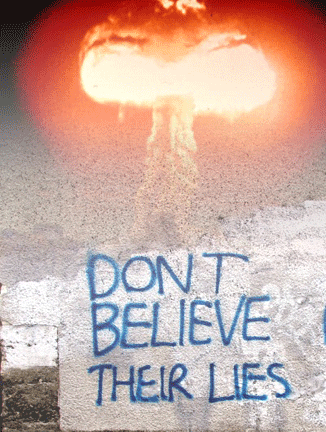
Nuclear power survives on empty promises and false hopes fed by our inability to effectively evaluate risk. We are lulled by long periods of stability and safe operation, and then seem shocked in the face of catastrophe that could have and should have been anticipated. If the costs of just one major disaster were embedded in the price of electricity, the industry would not be even close to economically viable; only massive taxpayer subsidies keep nuclear power alive.
The costs of sustaining nuclear power are too great for society to bear; so why is it still with us? Beyond the obvious, such as effective lobbying, nuclear plants are still online today because society is extraordinarily weak in its ability to assess and manage risks that have a low probability of happening (or that may occur in the distant future), but have catastrophic impact when they do.
The human brain is a marvel of nature, giving us astonishing capabilities while consuming the energy equivalent of nothing more than a 100 watt bulb. This incredible efficiency in computing power is achieved in part because the brain excels at taking shortcuts.
We assume certain aspects of our environment to avoid wasting metabolic energy or time on unnecessary calculations or attention. For example we are very good at perceiving motion, but tend to ignore things at rest. Our assumptions about the physical world are generally a good approximation of nature and serve us well (better in the short-term than out further in time), but they are not perfect; optical illusions exploit our perceptual flaws.
With our innate assumptions about how nature works, we excel at assigning cause to effect as we interact with our environment. We learn quickly that putting our hand in a flame hurts or that eating rotten fruit makes us sick. So too is the human brain extraordinarily adept at posing questions about the natural world; our curiosity leads to innovation and enhanced chances for survival.
The flipside is that we abhor the concept of leaving any questions unanswered. We are unable to turn off this instinct to see patterns and to discern effect from cause when confronted with the unknown. We demand that there be a pattern, that there be cause and effect, and that there be an answer, even when none exist. Generally, this is harmless, like seeing animal shapes in clouds or concluding that your thoughts of grandma caused her to call you.
Unfortunately, our perceptual shortcuts and flawed perception are not always so benign. As amazing as our gray matter may be, we are simply not wired well to evaluate anything but the most immediate risks from the most obvious threats. With our hard-wired assumptions about our physical world, humans are particularly bad at assessing and managing low-chance-high-consequence risks.
The most obvious example is an asteroid hit, but this small-chance-big-impact can come too in less dramatic form: pandemic flu, 100-year flood, the emergence of bacteria resistant to all known antibiotics, or a chemical weapons terrorist attack in a big city. We tend to ignore or dismiss these “outliers” in our short- and long-term planning; and that can and has led to catastrophes.
Nowhere is our poor ability to address low-probability-high-impact events more evident than in society’s approach to nuclear power. Operators of the Fukushima Daiichi nuclear power plant, which was severely damaged the 2011 earthquake and tsunami, initially received a $12.8 billion bailout from the government to help contain the disaster.
Japan announced this week an additional $500 million to further stabilize the continuing contamination. We are witnessing acts of desperation: building a “frozen wall” underground to prevent a flood of groundwater from contacting the contaminated buildings. This has never been tried on such a vast scale or for the decades needed here, and the scheme requires electricity to work; a problem given the number of blackouts suffered by the power plant.
We just learned that 300 tons of water contaminated with radioactive strontium drained into the sea from a faulty tank. There are now 430,000 tons of contaminated water being held at the site, increasing at rate of 400 tons per day.
None of these infrastructure problems cover the tremendous human and economic costs of forced evacuations of more than 160,000 people; the equivalent of a small city evacuated, never to be occupied again, with land permanently lost to high levels of radiation. Imagine abandoning forever Madison, WI, or Akron, OH, because of radiation contamination.
About 700,000 Entergy customers from the New Orleans suburbs to the Arkansas line already are paying to repair the Waterford 3 nuclear plant that has only 11 years left on its license.
Since January, Entergy Louisiana’s typical residential customers — who buy about 1,400 kilowatt hours of electricity monthly — have been paying $5.81 more each month for the nuclear plant repairs, according to the company’s calculations.
The repair is roughly the cost of building a brand-new generating plant that uses natural gas as fuel and would last another half century, said Casey DeMoss Roberts, executive director of the Alliance for Affordable Energy. The Alliance is a New Orleans-based group that advocates on behalf of residential and small-business customers of big utility companies.
“Do we want to invest that much money into about a 30-year-old nuclear power plant, or should we retire the plant and invest that into a new natural gas or some other new generation source?” Roberts asked.
It’s like replacing the engine in an old car. The engine works well, but the electrical system and the other mechanicals are antiquated. “What else has rusted? What else needs to be updated? We’re locking into increased spending on this plant for decades,” Roberts said.
Waterford 3 is licensed by the Nuclear Regulatory Commission to operate until Dec. 18, 2024.
Given the move toward cleaner energy, reduced carbon emissions, and more secure long-term energy sources, uranium supply is becoming more important to utilities worldwide. Currently, in our post-Fukushima demand case, uranium demand is still projected to nearly double by 2030, mainly due to increased demand from Southeast Asia – China in particular.
With the U.S.-Russia HEU Agreement coming to an end this year, resulting in the elimination of 24 million pounds U3O8 per year from the market, and other secondary supplies and mine reserves being depleted, there is much greater emphasis on primary production today than ever before. It has only been until recently that uranium exploration has experienced a revival, but even this is being threatened in the post-Fukushima environment as many suppliers now find it much more difficult to obtain the required financing to bring new projects into production.
As a result, the current menu of worldwide projects is not all that exhaustive due to the fact that most of the recent exploration has been on brownfield sites that were discovered 20, 30, or even 40 years ago.
Although uranium resources are extensive, the vast majority of these are neither delineated nor developed.
As the nuclear industry transforms itself into a safer and robust industry, one of the challenges will be for the supply side of the industry to expand and bring new production to a market still recovering.
The Report sets forth in painstaking detail the actual experience and achievements of nuclear energy around the world”, writes Peter Bradford, former Commissioner of the US Nuclear Regulatory Commission (NRC) in his foreword to the 140-page reference document. In addition to the careful assessment of the global industry, this year’s report also contains chapters on nuclear economics and an overview of the status of the ongoing Fukushima crisis.
Key findings of the 2013 edition include:
A record drop of nuclear electricity generation in the world in 2012.
Rapid aging of nuclear power plants: almost half of the world fleet has operated for at least 30 years.
In 2012, for the first time, China, Germany, India and Japan generated more power from renewables than from nuclear plants.
Water management at the Fukushima site is critical, with an estimated 400,000 tons in precarious storage, containing many times more radioactivity than was released to the air in the weeks after 11 March 2011.
Have a look on the website report www.WorldNuclearReport.org, where a high resolution version of the report can be found.
“…“Peer review is an essential quality control step in any research project,” said Dr. Patsy Thompson, director general and one of the journal article authors. “We are pleased that our work has been recognized for being scientifically sound. It gives us added confidence in our findings.”…”
Nuclear radiation study published, childhood leukemia not a factor around nuke plants
The Canadian Nuclear Safety Commission (CNSC) announced Sept. 3 that its Radiation and Incidence of Cancer around Ontario Nuclear Power Plants from 1990 to 2008 study (the RADICON study) has been peer-reviewed and published in the prestigious Journal of Environmental Protection.
The RADICON study looked at populations living near the Bruce nuclear station in the Municipality of Kincardine, as well as Pickering and Darlington nuclear generating stations in Ontario, and found no evidence of childhood leukemia clusters in the communities within 25 km of the nuclear power plants.
“Peer review is an essential quality control step in any research project,” said Dr. Patsy Thompson, director general and one of the journal article authors. “We are pleased that our work has been recognized for being scientifically sound. It gives us added confidence in our findings.”
The study was conducted using data from the Canadian and Ontario Cancer Registries and the Census of Canada. The CNSC had released a summary of the study in May 2013.
The study also confirmed public radiation doses from Ontario NPPs were extremely low: 100 to 1,000 times below natural background radiation. In Canada, average background radiation is 1.8 millisieverts per year [arclight says wtf??]. The technical article entitled “Radiation Exposure and Cancer Incidence (1990 to 2008) Around Nuclear Power Plants in Ontario, Canada” is available on the Journal of Environmental Protection Web site.
The CNSC regulates the use of nuclear energy and materials to protect the health, safety and security of Canadians and the environment, and to implement Canada’s international commitments on the peaceful use of nuclear energy.
New geology research says radioactive wastes are unlikely to enter groundwater from a proposed Canadian disposal site less than a mile from Lake Huron.
The research raises questions about future disposal on both sides of the border as radioactive waste continues to sit at power plants around the Great Lakes.
Ontario Power Generation is planning an underground disposal site for low and intermediate level nuclear waste at Kincardine on the Bruce Peninsula in western Ontario. The categories include most things in the United States’ classifications for low-level radioactive waste. For power plants, that includes things like contaminated equipment, clothing, protective gear, and cleaning supplies, as well as filters and reactor water treatment residues.
Starting on September 16, the Canadian government’s joint review panel will hold a public hearing on the project’s environmental assessment. Construction could start within two years, says a timetable on the Canadian Nuclear Safety Commission’s website.
Opposition focuses on the site’s location less than a mile from the Great Lakes, which hold 21 percent of the world’s fresh surface water. More than 35 million people rely on the lakes for drinking water.
Meanwhile, the United States is producing growing quantities of its own radioactive wastes. No current plans call for underground disposal in the United States Midwest. Nonetheless, layers involved in the Bruce disposal site extend under several Midwest states.
Digging deep
Ontario Power’s proposed disposal site is about 1,970 feet (600 meters) deeper than the bottom of Lake Huron. Ontario Power plans to put low and intermediate level radioactive wastes in tunnels within limestone roughly 2,230 feet (680 meters) below ground level. That layer sits beneath a shale layer that’s 660 feet (200 meters) thick.
Geologically speaking, both layers are part of the Michigan Basin. The bowl-shaped, multi-layered region is centered in central Michigan. The region’s layers extend into Canada, Wisconsin, Illinois, Indiana, and Ohio.
A scientific team, led by University of Ottawa geologist Ian Clark, analyzed core samples to see how likely the limestone and shale are to let water flow through.
“If the groundwater isn’t moving, then there’s really no way for the waste to escape,” says University of New Brunswick geologist Tom Al, who worked on the study.
The team’s conclusion, published in the journal Geology, is that any contaminated groundwater would have very little chance of escaping through the rock.
“We found that the shale and limestone package together are an incredible barrier,” says Clark. “Below and above, nothing has penetrated into that zone for these many hundreds of millions of years.”
“This rock material, it’s almost like a steel plate,” agrees Al. “There is no permeability of any kind.” The rock has few pores that can hold water, and those pores are poorly connected.
In geology terms, the limestone and shale layers date back to the Ordovician Period. That era was 490 million to 443 million years ago.
“These waters have been there since before the dinosaurs roamed the earth,” observes Clark.
Geologist Christopher Neuzil of the United States Geological Survey reviewed a draft of the research by Clark’s team. He has also done his own research on the Bruce site, which is currently under review.
Neuzil interprets his data to mean that there’s negative pressure at the Bruce site. If so, that’s another reason why contaminated water wouldn’t escape.
Basically, past glaciers squished down all the layers beneath them. When the glaciers melted, “the rock wanted to expand back a little bit,” says Neuzil. To the extent any water can flow, it’s probably moving in, not out.
“Very, very slowly, water is being drawn into it,” says Neuzil. “It’s on the order of centimeters per thousand years.” And, he adds, it doesn’t look like the pressures will balance out for another five or ten thousand years.
Neuzil’s estimates of the rocks’ permeability are “very similar to the values” that Clark’s team found. That suggests the rocks are impermeable over the whole disposal area, says Neuzil, and not just near the boreholes.
“In many cases we can demonstrate, there’s strong indications that they don’t have any fractures that haven’t been detected,” explains Neuzil. Thus, in building an underground facility, “you won’t run into that kind of surprise.”
Meanwhile, in the U.S.…
The Canadian findings are reminiscent of a 2011 report from the Sandia National Laboratory, which identified geologically stable granite deposits in Great Lakes states as a possible candidate for nuclear waste storage.
“….Astonishingly, authors of the RADICON study conclude that the elevations found in their study of thyroid cancer and leukemia, both radiosensitive cancers, could not be due to radionuclide emissions from reactors.
The conclusion for this study should be that the positive findings for thyroid cancer and leukemia are alarming and should be followed up with more definitive research….”
“… The stack sensor was found, after 18 years of operation and several CNSC inspections, to be under-reporting by close to a factor of 10…”
Download document here
Critique of the RADICON Study (Canadian Nuclear Safety Commission)
Cathy Vakil MD (Board Member of CAPE, Physicians for Global Survival)
Linda Harvey MD (President of Physicians for Global Survival)
June 2013
The stated purpose of this CNSC study was “to determine the radiation doses to members of the public living within 25 km of the Pickering, Darlington and Bruce NPPs and to compare cancer cases among these people with the general population of Ontario from 1990-2008.” The CNSC describes this study on their website as “groundbreaking” and providing “science-based and conclusive evidence that children living nearby are as healthy as children living elsewhere in Ontario”. These claims are false for the following reasons:
1) Poor design:
An ecological study, a design which can give no information about causation of any effects found, will be of limited usefulness in answering the question “Are there health effects caused by radiation doses to the public from nuclear power plants?” In placing the population within 25 km of each nuclear power plant (Pickering, Darlington and Bruce) into a single category, it lacks the definition of the more skillfully executed studies already in existence, such as the German KiKK study
(Kaatsch P., Spix C., Schulze-Rath R., Schmiedel S., Blettner M. Leukemia in Young Children Living in the Vicinity of German Nuclear Power Plants. Int. J. Cancer 2008; 1220: 721-26) and French GEOCAP study (Sermage-Faure C, Laurier D, Goujon-Bellec S, Chartier M, Guyot-Goubin A, Rudant J, Hémon D, Clavel J.Int. J. Cancer 131 (12): 2970-1) on childhood leukemia, case-control studies that examined risk as close as a 5 kilometre radius.
Unsurprisingly, it finds “no evidence” of increased childhood leukemia, or cancers in general, around Canadian nuclear power plants. However, absence of evidence is not evidence of absence. In other words, negative findings in a weak study such as this should not reassure the public that there is not indeed an increase in childhood leukemia near nuclear reactors in Ontario.
One good quality, robustly designed and meticulously executed study (such as the KiKK or GEOCAP study) which finds a clear positive result trumps any number of weak studies that fail to find anything.
2) Mathematical Models
Mathematical models were used to recreate the atmospheric plume and to estimate dispersion into the environment of “each nuclear substance”. The models were not described, nor were the “nuclear substances” in question itemized or named.
The data used to develop these models were supposedly of recorded releases into the atmosphere from each of the plants for each substance. However, the data were never shown, nor were monitoring techniques, frequency, and calibration or other validation procedures described. Emissions to water were not considered at all in this paper.
The statement on p. 12 that, “Radioactive iodine, which is the primary cause of radiation-related thyroid cancer, was below detection limits of the in-stack sampling monitors at all three NPPs for the entire study period”, prompts the question of whether their sampling was adequately done.
Information obtained from Ontario Power Generation (OPG) through Freedom of Information indicates that radioactive iodine is detected and measured now on a weekly basis.
Clearly. the measurements done previously underestimated the iodine present in emissions, making one question whether all other measurements done from 1990 to 2008 presented in this study are inaccurate and/or underestimated.
In addition, the emissions from Darlington and Pickering reactors are not all measured daily. (Bruce Power has refused to provide any emissions other than what is on their website which describe mostly annual averages or totals. It is unacceptable that they are allowed to refuse to release this data to the public). Particulates, iodine, noble gases and carbon 14 are only measured weekly,
Therefore, daily spikes in emissions are not always evident. There are however some remarkably high levels on some weeks, some as much as 100 times the baseline weekly levels. Airborne tritium from Pickering reactor is the only radionuclide measured daily, and there were some spikes in 2012, as much as ten times the baseline.
In addition, the total yearly amounts of airborne tritium from Darlington and Pickering are extremely high, measuring about 7 X 10exp14 becquerels per year. This calls into question the small amounts of radioactivity found in the sampling done in this study and contrasts blatantly with the claims in the paper that doses to the public are “miniscule”.
…South Korea, which had previously imposed a ban on 50 fish products from a swath of Japan’s coast near the nuclear facility, also criticized Tokyo for not providing information “sufficient to predict the future evolution” of the situation…
TOKYO – Japan’s government issued a statement Friday defending the country’s food safety standards after South Korea banned all fish imports from the Fukushima region, where a crippled nuclear plant has spilled radioactive water into the Pacific.
Chief government spokesman Yoshihide Suga said Japanese food products were subject to tight international controls and called on Seoul to “adopt measures based on scientific facts.”
“We have provided the South Korean government relevant information since the leaking of contaminated water into the sea was discovered,” Suga said.
He was referring to the acknowledgment in July by the Fukushima nuclear plant’s operator, Tokyo Electric Power Company, or TEPCO, that hundreds of tons of contaminated groundwater were making their way to the Pacific every day.
South Korea on Friday announced a ban on imports of all fish products from eight Japanese regions, including Fukushima, amid heightened concerns at home over the leaks.
Citizens “are increasingly concerned about the fact that hundreds of tons of irradiated water are leaking every day from the site of the Fukushima nuclear accident,” Seoul said.
The plant was battered by a devastating March 2011 earthquake and tsunami.
South Korea, which had previously imposed a ban on 50 fish products from a swath of Japan’s coast near the nuclear facility, also criticized Tokyo for not providing information “sufficient to predict the future evolution” of the situation. EFE
“…The ongoing difficulties in dismantling Fukushima represent a blow to Tokyo’s 2020 Summer Olympics candidacy. The latest reports about the leaks come just days before the International Olympic Committee selects the host city for those Games…”
Tokyo, Sep 5 (EFE). — The operator of Japan’s disabled Fukushima nuclear power plant for the first time has detected an opening through which groundwater is penetrating the basements of the reactor buildings.
After drilling a hole in the soil around the bottom floor of the Unit 1 reactor and inserting a camera, Tokyo Electric Power Company obtained video footage released Thursday of the spot where water is leaking into the building.
TEPCO now will evaluate how much groundwater is flowing into the building through that opening.
Water must be pumped in to cool the reactors after the plant’s refrigeration systems were knocked out by a devastating 2011 earthquake and tsunami.
But, as a result, an estimated 70,000 tons of radioactive water have seeped through cracks and accumulated in the basements of the Unit 1 and Unit 4 reactors and their adjacent turbine buildings.
An additional 400 tons of groundwater also is believed to flow into the basements of the reactor buildings, mixing with water that has already been contaminated.
Russia has handed over an official request to the International Atomic Energy Agency (IAEA) to analyze potential nuclear risks of a US airstrike on Syria, a Russian diplomat said Thursday.
Earlier in the day, the Russian Foreign Ministry said Moscow would raise the issue at a meeting of the International Atomic Energy Agency’s board of governors on Monday.
Russia’s permanent envoy to international bodies in Vienna, Vladimir Voronkov, said he had handed over an official letter to IAEA director general Yukia Amano.
“We request the agency to immediately react to the current situation and provide member states with an analysis of risks, related to potential US strikes on a neutron reactor and other objects in Syria,” he said, adding that similar letters were sent to Vienna envoys of other IAEA member states.
A day before, the Russian Foreign Ministry urged the IAEA secretariat to urgently evaluate nuclear risks of a US strike on the Miniature Neutron Source Reactor (MNSR) near Damascus and other nuclear objects in Syria.
Western intervention in Syria could jeopardize the region’s nuclear security, the ministry said in a statement, adding that any damage caused to a neutron reactor near Damascus would have disastrous consequences.
SOMA, Fukushima Prefecture–With a series of leaks of radioactive water at the crippled Fukushima No. 1 nuclear power plant, fishermen such as Yoshinori Yamazaki are feeling frustrated after being forced to postpone trial operations scheduled to start in September.
Yamazaki, 45, who lives in Soma, about 40 kilometers north of the plant, said time is being wasted as he cannot go to sea with his father Matsuo, 71, and his 23-year-old eldest son.
Before the Great East Japan Earthquake struck in March 2011, the three generations of his family went fishing together.
Matsuo had been excited about his grandson joining in the family tradition.
“We (the family) were doing as well as anyone else,” Yamazaki said. “How many valuable years do we have to lose?”
The city’s Matsukawaura Port had boasted one of the largest fisheries hauls in the Tohoku region before the disaster. For many working at the port, fishing is a family business, with a number of teenagers and those in their 20s deciding to take up the trade each year.
Throughout the season, more than 100 species are caught in the waters off the port. In the morning, the fish market was crowded with the wives of fishermen helping sort the day’s catch.
But the port was devastated by the tsunami, which followed the earthquake on March 11, 2011, and killed 101 members of the Soma-Futaba fishing cooperative association.
In an effort to bounce back from the earthquake and the Fukushima nuclear plant accident, the association started test operations in June 2012 for “mizudako” (North Pacific giant octopus) and two other species.
Conducting monitoring inspections, the association repeatedly checked samples to confirm safety of the catches.
Association members originally planned to triple the fishing grounds and increase the catch to 16 varieties when the trial operation resumed in September.
Yamazaki was well prepared for fishing for whitebait, a new species that was scheduled to be added in September. The fish, which brings high prices, is a lucrative catch for fishermen.
Fish detectors were showing large schools of whitebait, which have increased in number during the past years of suspension of fishing operations.
Yamazaki bought new fishing equipment, costing about 2 million yen ($20,000), to replace the gear that had been washed away in the tsunami.
The announcement by Tokyo Electric Power Co., the operator of the Fukushima nuclear power plant, that highly radioactive water has been leaking at the Fukushima No. 1 plant came during such preparation.
Following the March 2011 earthquake, his son obtained a license as a heavy truck driver and a heavy machinery operator. Yamazaki has told him to wait “until things get better.”
“I cannot keep him from leaving home forever,” Yamazaki said. “This coast will be no more if young people are gone.”
His mother, then 65, who supported the family’s fishing operations, was killed in the tsunami while Matsuo piloted his boat to safety in waters off Soma immediately after the earthquake.
“Even three years after the disaster, I cannot operate the boat I had protected in exchange for my wife’s life,” Matsuo lamented. “It doesn’t seem right that I saved the boat.”
Nobuo Shishido, president of the Soma-based supermarket Super Shishido, has also been discouraged by lagging sales apparently due to media coverage about the contaminated water leaking into the ocean.
“Last summer, 10 times more octopus, caught during the trial fishing period, were sold than this year,” Shishido said. “Even if I want to sell, consumers do not respond.”
Of about 200 kilograms of octopus caught in Fukushima waters and stocked in early August, half have been left unsold.
According to the Soma-Futaba fishing cooperative association, octopus caught during the trial fishing period had been shipped to Tokyo and Nagoya. But wholesalers in Nagoya stopped accepting the octopus in late July, a week after TEPCO announced a leak of radioactive water.
Hiroyuki Sato, who heads the association, has also felt frustrated.
“Products we monitored and found to be safe have been given the cold shoulder (by our customers),” Sato, 57, said. “We have done many things until now, but we are right back where we started.”
Fukushima Prefecture has been monitoring radiation levels of fish since April 2011. The levels have shown recovery from the measurements taken immediately after the accident.
The prefecture measures weekly radiation levels of about 150 fish samples at about 40 locations in the waters off Fukushima Prefecture, except the area within a 5-km radius of the wrecked Fukushima nuclear power plant.
In recent months, radiation levels have been at less than the detection limit of around 16 becquerels per kilogram for most species, such as flatfish, marbled flounder and whitebait.
According to the prefecture’s marine products division, the fisheries haul in coastal waters totaled only 122 tons in 2012, when Soma-Futaba started the trial operation, compared with about 26,000 tons, worth about 9 billion yen, each year before the 2011 disaster.
This year saw improvement, with a total of 386 tons of fish caught during trial operations while the concentration of cesium did not exceed the safety limit at many locations off the prefecture.
Aside from the Soma-Futaba fisheries cooperative association, the Iwaki fisheries cooperative, based in Iwaki, Fukushima Prefecture, south of the Fukushima No. 1 plant, planned to launch a test operation in September for the first time since the 2011 earthquake and tsunami.
(This article was compiled from reports by Takayuki Kihara, Takemichi Nishibori and Shinichi Fujiwara.)
“…“You can’t even sell a small quantity without tests,” she said. “Even for your own consumption, you have to get your crops checked. It’s mandatory. After the crops have been declared safe, we eat them. We hope they are safe.”…”
Image and quote source ; http://www.dw.de/fukushima-farmers-return-to-the-land/a-16446642 The 38th National Action day of Environmental pollution victims negotiation with TEPCO/Japanese government 6th of June, 2013 (Editor’s note: He did a brave speech in front of the Government and Tepco. I am so glad to hear the voice of very sincere Fukushima farmer and he is not the only one. The video doesn’t run smoothly.) (Typescript by Mia) I am still engaged in agriculture full time in Fukushima. I live in Sukagawa in Fukushima prefecture. Last year, cesium exceeding 100Bq was detected in the brown rice produced there. First case nationwide. As a result decontamination of the rice fields started.In my district, farmers were also mobilized to do the decontamination work in the rice fields.I hope you heard me, I am not talking about the radiation reading in the air. We are just tilling deeply and spreading the radiation thinly. We are not removing the contamination. No wonder that radiation level has gone down.
We decontaminated the rice field.
We have not removed the contaminated soil. Of course not!
The environment has not changed at all two years after the explosions.
The guidelines say we cannot use farm materials such as coverings that are contaminated.
But we have no way of measuring the radiation level for those.
Are you going to do something about this? Please don’t take lightly what we farmers are going through.
We grow food.
We eat safe and clean food ourselves.
And we supply them to our consumers. But there is no longer the joy in harvesting our produce.
The farm produce from Fukushima is cheaper than that from other areas. Do you think we can keep our motivation going, knowing that in advance, and expecting the compensation payment for the loss? (Editor’s note: For farmers to be able to claim the compensation to the government to maintain their livelyhood, they need to produce and sell their food accordingly depending on the level of radiation in their food, and see how much loss they had.) The current government limit is 100Bq/kg. The farmers know how many Bq of cesium their produce contains. We can ship them if the reading is lower than 100.
(Editor’s comment: Prof. Koide at Kyoto Research Reactor Institute commented that it was 0.1Bq/kg for cesium in rice before the Fukushima disaster. So 100Bq/kg means 1000 times more radioactively contaminated than before.)
But I would not dare eat them myself. The consumers assume there is no radiation in the food they buy. What do you say about this? We Farmers know better. We feel guilty about growing it and selling it.
We won’t eat it ourselves, but we sell it. I want to hear what you think about this. I would like you to respond to my question.
(Editor’s note: I may type up the other farmer’s voice as well if I have some time.)
Members of Tokyo’s Olympic bid committee have been questioned by journalists about contaminated water leaking from the stricken Fukushima nuclear power plant.
The host city for the 2020 games will be chosen on Saturday in the Argentine capital, Buenos Aires.
The Japanese committee members held a news conference in the city on Wednesday that was attended by about 100 journalists from more than 20 media outlets.
Bid committee president Tsunekazu Takeda said at the beginning that he hopes to spread the value of sports among young people by hosting an Olympics in Asia, home to more than 1 billion people.
4 out of the 6 questions asked were about the safety of Tokyo, in light of the radioactive water leak at the Fukushima plant.
Takeda responded saying Tokyo is safe in terms of radiation levels.
A British journalist said Tokyo officials only emphasize the city’s safety but had still not answered the question. The reporter called it a grave problem that should be taken more seriously.
An American journalist expressed dissatisfaction with the answer and said the question will be asked repeatedly.
A reporter from an Argentine TV station said the Tokyo officials had answered the question sufficiently by saying the city is safe.
After a seeing the National Report article it became apparent that it was a badly crafted article aimed at PARODY.. Whilst I enjoy a Joke myself, I could not bring myself to laugh at other peoples suffering as the writer and commenter’s on the article on their web-site.
It was in very poor taste and likely, is a nasty attack on the struggling fishermen and locals who live on the coast. It was not funny for that reason alone.
It also minimises the health impacts whist insulting the effected population living with the effects of the disaster Fukushima Daichi
I am posting this video from kevin Blanch who spotted it straight away and alerted the blogging community.. Thank you Kevin..
I will not waste time but to say to the readers and subs that this is a spurious attempt at humour in the very worst taste.. And i will let Kevin let you know how he feels (a victim of the USA nuclear testing, and a long time activist against the excesses of nuclear madness).. Some swearing advisory(with some common sense ) below this point…..
“…do not get fooled he knows exactly what he is doing’; it IS NOT Innocent satire, http://nationalreport.net/breaking-fu…
IT IS NOT, SO CALLED SATIRE, THIS IS NO FUCKING GAME, HE KNOWS WHAT HE IS DOING, DON’T LET THEM DO THIS,,, his so called satire I AM TELLING YOU ALL now I saw it before with Chernobyl,….”
“Only an open information policy on the level of the effects, the media and the science community will create the trust needed to heal… and prevent negative socio-economic effects from unwarranted anxiety and fear.”
Thus radiation gradually departs and life in the affected areas of Japan will return to normality.”
“Even people near the damaged power plant received such low doses of radiation that no discernible health effect could be expected.”
“It is important to understand that the risk to health from radiation from Fukushima is negligible, and that undue concern over any possible health effects could be much worse than the radiation itself”
Also citing UNSCEAR, Thomas explained “the worst health effects from Chernobyl came from the fear of what radiation might do, rather than the effects radiation actually caused.”
“Even people near the damaged power plant received such low doses of radiation that no discernible health effect could be expected.”
The letters were published on the website of prime minister Shinzo Abe and his cabinet and explain what is known about the effects of radiation on the human body. As individual comments to the government’s ‘Nuclear Disaster Expert Group’ submitted between late July and the end of August, they collectively underline that the potential effects of radiation exposure are minimal compared to the observable effects of stress and stigmatisation on Fukushima residents.
“It is important to understand that the risk to health from radiation from Fukushima is negligible, and that undue concern over any possible health effects could be much worse than the radiation itself”
Gerry Thomas
Imperial College, London
Werner Burkart, a professor of radiation biology Munich’s Ludwig Maximilians University began his letter, “Nearly two and a half years since the earthquake and tsunami event of March 2011, it is time to reflect on the suffering but also on the resilience of the affected and Japan as a whole, and to develop visions for a future without fears and restrictions.”
Abel Gonzalez of Argentina has served for many years on the UN Scientific Committee on the Effects of Atomic Radiation (UNSCEAR). He explained its conclusion that, “No discernible increased incidence of radiation-related health effects are expected among exposed members of the public and their descendants.” The American representative of UNSCEAR, Fred Mettler, noted that fear of effects on future generations were unfounded: “You should be assured that many scientific studies have shown that this does not appear to happen in humans.”
In March 2011 the Fukushima Daiichi nuclear power plant was struck by a devastating earthquake and tsunami. Three reactors went into meltdown and a maximum, level 7 nuclear disaster was declared, putting it on a par with Chernobyl. Since then the Tokyo Electric Power Company (Tepco) has been managing the crisis but has been accused of making a series of mistakes and attempting to cover up just how bad the disaster really is.
Recent admissions about large and potentially disastrous leaks have shed light on how dire the situation really is at Fukushima. Truthloader decided to have a look at some of the alleged cock-ups and cover-ups Tepco have made along the way.