PLEASE CONDUCT GENE TEST AND EVACUATE KIDS IN FUKUSHIMA! 早急に遺伝子検査を行い、福島の子供たちを避難させてください!
http://savekidsjapan.blogspot.co.uk/2013/09/a-fukushima-teenager-found-to-have-lung.html
児玉龍彦氏(東大教授)と討論
投稿者
Dr. Tatsuhiko Kodama, Tokyo University Radioisotope Center
IMPORTANT!! 重要
「遺伝子研究なら正確。チェルノブイリ汚染地帯の甲状腺がんでは7q11染色体が3つになる。他の甲状腺がんでは起こらない」(11分くらい!)
“Meanwhile, gene studies are accurate. Among thyroid cancer patients in Chernobyl contaminated areas, their chromosome 7q11 become three pieces, which cannot be observed among other types of thyroid cancer patients.” (11 minute)
「疫学や統計学は被害者が出てしまった後のもので、子供妊婦を守るのに間に合わない。」(13分)
“Epidemiology and statistics research results come only after people got victimized by radiation. In order to protect children and pregnant women, we cannot wait for epidemiological research results.” (13 minute)
福島の子供たちの移住は、最重要緊急課題です。
The evacuation of Fukushima children is the most pressing issue.
私には、国連を始め、なぜ世界が動いてくれないのか、全く理解できません。
(それどころか、国連は、福島における被曝で健康に被害はなかったという報告書を準備していると聞きました。)
I really do not understand why the world organizations such as UN, etc are not making any move.
(On the contrary, I heard that the UN is now preparing a report to convince the public that there have been no health damages due to Fukushima radiation!)
福島の甲状腺がんの子でリンパに既に転移している子が多く出ているそうです。ちなみに甲状腺がんはまだ小さいそうです。
Today, on twitter, I just heard that many kids who went through surgery in Fukushima were found to have not only thyroid cancer but also metastasis in his/her lymphs though their thyroid cancer size were reported to be small.
*先ほど、肺に転移という情報が流れましたが、情報ソースの方に確かめたところ、肺に転移はまだ可能性であり、リンパ転移だそうです。リンパ転移は、私の知人曰く、知っているだけで2人出ているという情報です。
There had been some information that there was metastasis in the child’s lung, but actually, it was metastasis in his/her lymph. As a matter of fact, as far as my acquaintace knows, there are two children who already got metastasis in their lymphs.
一刻も早く子供たちを汚染地域から避難が求められます。
It is a matter of urgency to evacuate children from contaminated areas as soon as possible.
また、県立福島高校では、事故のあった年に2人の突然死が出ました。(TVユー福島 -TUFというローカルな放送局の報道局長の大森真氏が、騒ぎを鎮静化するため、なんとツイッターで一人は交通事故死であったという嘘をばらまきました。 TUFは大森氏の虚偽の発信を認めたものの、謝罪はしていません。)
In Fukushima Prefectural High School, two students died of illnesses (one was sudden death) in the year of the accident. (However, TUF-TV You Fukushima, local TV station’s broadcasting chief Mr. Makoto Omori, tweeted a lie saying that the second student died due to traffic accident to calm down the case. TUF admitted that Mr. Omori lied on the twitter but never apologized for it.)
この8月の発表では、全校生徒数959人のこの高校に2人の甲状腺がんが見つかったそうです。
In this August, two students were found to have thyroid cancer out of total number of 959 students in the same school!
Proof that the nuclear industry has been dodging its responsibilities for over 50 years via Greenpeace グリンピースが情報発表:原発産業は今まで50年間の間、責任をとらなくともいいことになっていた。

Image source ; http://www.greenpeace.org/japan/ja/
Posted by Mia
http://fukushimaappeal.blogspot.co.uk/2013/09/proof-that-nuclear-industry-has-been.html
(Source)
Information released today by Greenpeace Japan shows that the builders and suppliers of nuclear reactors were afraid of being held financially responsible for any accidents they might cause from the outset of the nuclear energy era in Japan.
A freedom of information request made by us has turned up documents from 1960 that show nuclear companies pressured the Japan Atomic Energy Commission to make sure they were exempted from all responsibility for a nuclear accident, except in the case of a deliberate act. The Commission was only too happy to agree.
But what if a nuclear company is grossly negligent? It needn’t worry. The Commission’s documents say:
“…we decided to delete ‘gross negligence’ to not make suppliers feel uneasy”
We wouldn’t want nuclear suppliers to feel uneasy, would we? But uneasy is the way the Japanese people must be feeling when they see the size of the costs of the Fukushima disaster that they are now having to pay.
And this is a state of affairs that continues to this day.
What this proves is the nuclear industry has never had any faith in the safety of its nuclear reactors. If it did, why would it have worked so hard to be protected from its responsibilities?
It’s an admission that nuclear power is inherently unsafe and that the nuclear industry is not able and willing to deal with a major accident. They’ve known this from the very beginning.
[…]
This is not a scandal unique to Japan, however.
Greenpeace Canada has copies of letters written to Canada’s government by GE Hitachi (GEH), Babcock and Wilcox, and Westinghouse, all demanding to be let off the hook in the event of a nuclear catastrophe. In its letter, GEH says it wants to avoid what happened to Union Carbide after the disaster at its chemical plant in Bhopal, India. Union Carbide was sued in US courts. GEH wants indemnification from nuclear liability, from being sued the way Union Carbide was.
We know who really needs “an indemnification from nuclear liability”. Us, the people, who have to live with nuclear power and all its dangers and who have its massive costs forced upon us. The nuclear industry has put its own interests and those of its shareholders above the people it is supposed to be serving.
The nuclear industry has been allowed to write its own rules for more than 50 years, as the documents we’ve made public show. It’s time those rules were scrapped and the nuclear industry disqualified from the game it’s been playing with all our lives.
This must stop. Right now.
Read more at Proof that the nuclear industry has been dodging its responsibilities for over 50 years
UNSCEARが被曝による健康被害はなかったという報告を出そうとしている! UNSCEAR is going to publish a report that says there is no health hazards after the Fukushima disaster!
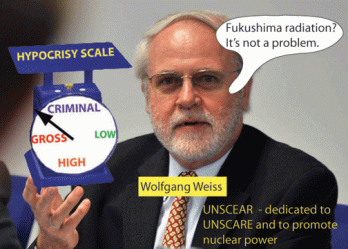
拡散してください!(特に国連の方と日本の憂慮する市民の方々)
Please dissemiante!
ベルギー代表も怒った9月発表のUNSCEAR報告 Even Belgian delegates got mad at the upcoming UNSCEAR report http://vogelgarten.blogspot.de/2013/08/unscear.html(Japanese)
The UNSCEAR Report downplays the Effects of radiation after the Fukushima accident, which infuriated even the Belgian government delegate.
このままでは、日本では事故直後から出ている健康被害、そして先日発表された44人の甲状腺と疑いのことも、なかったことにされてしまいます。
If nothing done, all the health hazards observed since the onset of the Fukushima accident and the recent news of 44 thyroid cancers and suspected cases would be totally ignored.
これを訴えられるのは、日本人しかいません。
Only Japanese can respond to this!
英語ができない?
You say you cannot write English?
関係ありません!今はグーグル翻訳だってあるのです。
Nonsense! You can use google translation!
グーグル翻訳でいいからメールを、以下のUNSCEAR担当者に!Please write a mail to UNSCEAR person below,
We need to tell the UN many Japanese are watching!!!
Contact address: Ms. Jaya Mohan, Communications Specialist UNSCEAR jaya.mohan@unscear.org
国連事務総長、潘基文(パン・ギムンBan Ki-moon)氏宛てにも、Eメールしてもよいね。
大飯原発が事故ったら、韓国にも影響ありだと!!!
汚染地帯の子供たちの健康問題などと一緒に。
Contact address: To UN Secretary General Mr. Ban Ki-moonsg@un.org
国連科学委員会の福島事故の健康影響に関しての最終報告は、9月に出されます。
The final UNSCEAR report will be released in September.
ちなみに私は上記の人に既にオーストリアでお会いし、健康被害を口頭と書面にて訴えました。
By the way, I visited the above UNSCEAR officer in Austria and verbally explained the health hazards occurring in Japan along with the following documents.
そして2013年6月3日に提出した書類が以下の通りで、健康被害を訴えた詳細なものです。
The following are the documents I submitted to UNSCEAR on June 3, 2013.
1. Report from a Citizen from Fukushima
http://takenouchimari.blogspot.jp/2013/08/unscear.html
上記の日本語版;福島県郡山市の市民からの健康被害の訴え→http://takenouchimari.blogspot.jp/2013_08_01_archive.html
2. Open Letter to the UN on Health Hazards
http://savekidsjapan.blogspot.jp/2013/01/open-letter-to-un-on-health-hazards.html
上記の日本語版;国連への手紙は2013年1月のブログに章ごとに日英で掲載されています。
そしてもちろん、6月に発表された甲状腺がん27人、また8月の44人の件もすぐにメールいたしました。
(お返事は頂いていませんが)
Of course I sent mails regarding the 27 thyroid cancer and the suspected cases in June and 44 in August, though there have been any reply.
皆さん、誰かがやってくれると待っていてはいけません。主要な組織は、私が働きかけても動いてはくれませんでした。 だから、気づいた人が一人ひとり立ち上がってやるしかありません。
私が実際にオーストリアまで単独で(正確には3歳の子連れで)行った時の記録がここにありますので、時間のある人はこちらもお読みください。
http://takenouchimari.blogspot.jp/2013/06/blog-post.html
Save Kids Japan 2013年8月31日土曜日
http://savekidsjapan.blogspot.jp/2013/08/even-belgian-delegates-got-mad-at.html?spref=tw
On Fukushima Beach 3 Trailer #2. New release date 9/13/13
Published on 11 Sep 2013
On Fukushima Beach 3 is coming! Not too late for Fuku Protest Contest!
Please support Ebisu Studios in spreading the truth of what is happening in Fukushima. Pre-order your copy of “On Fukushima Beach 3.” Send $A25 to PayPal address ‘ebisu73@gmail.com’ or donate to the studio.
All my documentaries are posted on YouTube for free to anyone to see and remixable versions are posted also. If you cannot purchase or donate, please share and remix and burn your own copies to spread the truth.
The Fukushima Protest contest is going ahead of course. You could win gold for spreading the truth about Fukushima. Please google
‘Visual explanation of the Fukushima Protest Contest‘
to find our how to enter. You can still win as long as you fulfil the entry requirements and demonstrate your passion for truth on or around September 14th, 2013
My Hour Of Silence For Subcritical Nuclear tests – A Kishner
Judge Jenkins found that the U.S. government was guilty for the deaths or cancers of most of the plaintiffs in that court case yet a more conservative-leaning federal appeals court overturned his landmark decision on the grounds of what is called the ‘discretionary function,’ which translates to THE GOVERNMENT CAN DO NO HARM.
My Hour Of Silence
A resurrected essay from 2010 – by Andrew Kishner
http://www.nuclearcrimes.org/index.php
After learning two weeks ago about the U.S. government’s notification that it had conducted a subcritical nuclear test, and also its failure to provide its customary 48 hour advance notice, I took the advice of my girlfriend. I wrote an oped, circulated it widely on the internet and began observing an “hour of silence” every day to bring attention to the heinous and outrageous subcritical nuclear experiment named ‘Bacchus’ that was conducted in Nevada.
The daily ritual lasted until September 25th; during those bizarre interruptions of mundane errands and interesting discussions we got strange looks whenever we stopped shopping to scribble notes to each other in the center of aisles and in parking lots. But, once or twice, a quiet hour-long drive through the countryside gave me time for deep thinking about subcrits.
What I learned was that subcritcal tests are such a great – perhaps, the great – litmus test for how well developed are ones thoughts about nuclearism. Subcritical experiments, I learned, force one to develop an argument why these tests are bad, which is difficult because they are such a ‘grey matter’ subject.
Subcrits aren’t really causing proximate harm to anyone, nor are they part of any overt threat to a sovereign country. How could one persuasively argue they are bad? Because they violate the ‘spirit’ of the CTBT treaty or some promise to one day abolish nukes? Accusing a citizen of ‘violating the spirit of the law’ never landed anyone in jail or resulted in any great reprimand.
SCANDAL!! Norways NGO Bellona uncovers secret nuclear deals at the experimental thorium reactor complex in Norway
“….The Halden reactor’s own ethical guidelines state that it will not “export technology or materials that can be used for another nation’s military capacity without export permits from the Ministry of Foreign Affairs,” the Norwegian daily VG reported…..”

http://www.bellona.org/articles/articles_2013/halden_scandal
A major Norwegian nuclear technology institute has, as the result of Bellona legal pressure, admitted it has carelessly shared nuclear fuel technologies with other countries in contravention of the Norwegian Foreign Ministry’s regulations guiding the release of such sensitive information.
As a result of a police report filed in May by Bellona general director and nuclear physicist Nils Bøhmer, Norway’s Institute for Energy Technology (IFE) – which runs the country’s Halden research reactor – has come clean that it should have handled several research agreements, some involving foreign militaries via the appropriate channels.
The unique qualities of the Halden reactor allow for a wide array of nuclear experiments that can have direct military applications, said Bøhmer. Research contracts with the Halden reactor are therefore overseen by the Ministry of Foreign Affairs in connection with international non-proliferation principles.
The Halden reactor’s own ethical guidelines state that it will not
“export technology or materials that can be used for another nation’s military capacity without export permits from the Ministry of Foreign Affairs,” the Norwegian daily VG reported.
The nuclear research in question involves developing fuel for nuclear submarines that can last substantially longer than traditional fuels, thus allowing military submarines to remain at sea for greater lengths of time without refueling.
 |
| Bellona’s Nils Bøhmer. |
| Tone foss aspevoll/bellona |
According to Bøhmer, that research is likely now in the hands of Russia, the US, Brazil, Argentina, and France.
The agreements the IFE has secured with nuclear research institutes in these countries circumvent Foreign Affairs Ministry approval as well as Halden’s own stated policies, said Bøhmer.
The Norwegian Ministry of Foreign affairs confirmed it had not received any documents pertaining to the deal in place between IFE and Brazil before the case was brought to its attention by Bellona and newspaper reports in late spring.
On May 12, the Brazilian newspaper O Estado de São Paulo reported that the Halden reactor was carrying out so-called irradiation tests for Brazil’s navy as part of the development of the country’s first generation of nuclear submarines, VG reported. The first of these submarines is to be commissioned in 2023.
The IFE emphasized that no uranium fuel was ever to be exported, only reports on the experiments.
Deal sailed under the radar for two years
According to the VG report, the deal between the IFE and Brazil has been in effect for two years prior to its discovery.
According to Bøhmer, “the IFE seems to be selling know-how to the highest bidder” without regard to its possible military application.
This is especially dicey, he said, in the hands of non-NATO bloc nations, such as Russia and Brazil and Argentina.
“Research handling is out of control,” said Bøhmer, who noted that several other stop gaps, such as Norwegian Minister for Trade and Industry, Trond Giske, should have red-flagged the research sharing deals. The Ministry for Trade and Industry oversees IFE.
“What happens at the IFE is [Giske’s] responsibility, but did he know what kind of research the institute was participating in?
Have all customers been civilian?” said Bøhmer. “There is every reason to question the common sense of these scientists when they wait until the case comes out in the media before applying permission from the Ministry of Foreign Affairs.”
The allegations that the IFE skirted Ministry of Foreign Affairs approval for the export of nuclear technological know-how, which could be used for military purposes are currently under investigation.
If found guilty it could lead to fines and even jail time for IFE upper brass, Bøhmer said Tuesday.
“The Japanese Government is lacking, concerning the sense of Crisis”, said former Swiss ambassador. Murata 日本政府は福島事故に対して、危機感をもてないでいる!日本はオリンピックを辞退すべきだ」、という意見が高まっている
” I don’t think it would be sincere to host the Olympics when Japan is not capable of grasping the fact and tackling the problem, but instead they are claiming it’s safe for hosting the Olympics. In fact I hear more and more people around the world, saying Japan should withdraw from hosting the Olympics in 2020.”
Friday, 6 September 2013
Posted by Mia
“Even after the level 7 nuclear disaster and Tepco’s inability to clean-up has been exposed”
Mr. Murata thinks the Japanese government is lacking, concerning the sense of emergency. He believes that’s where the core problem has been. He commented;
” I don’t think it would be sincere to host the Olympics when Japan is not capable of grasping the fact and tackling the problem, but instead they are claiming it’s safe for hosting the Olympics. In fact I hear more and more people around the world, saying Japan should withdraw from hosting the Olympics in 2020.”
日本の政府がどうやっても危機感を持てないということ。これは深刻だ。
政府の無関心を他所に、オリンピック招致についても「国が安全を保証できないところにオリンピックを呼び込むこと自体が不誠実だ。日本はオリンピックを辞退すべきだ」、という意見が高まっている。
http://kaleido11.blog.fc2.com/blog-entry-2309.html
———————————————————————–
Prime Minister Shinzo Abe commented at the press conference in the Prime Minister’s Office on 4th of September, 2013 that his government would step forward and implement all necessary policies” to deal with the flood of radioactive waste building up at Fukushima since the March 2011 reactor meltdown at Fukushima. Therefore it won’t affect hosting 2020 Olympic. http://ji.com/jc/zc?k=201309/2013090400352&g=soc
Japan will allocate 15 billion yen ($150 million) to upgrade a stalled water treatment system co-developed by Toshiba Corp and U.S.-based EnergySolutions that can greatly reduce the amount of harmful radioactive elements in water. […]
The government on Tuesday (on 3rd of September) decided to install a second water filtering system, similar to ALPS, in the year from next April.
http://www.trust.org/item/20130903084602-1xw2b/
(Editor’s note: Why wait until “ next April” ? At this very moment 400tons of radioactive water leaking into the Pacific Ocean! What about the soil contamination in Tokyo area?) [Also, what about the sea sediment transfer mechanisms that will spread the contamination back on to the land? Arclight2011]
3,042.7Bq/kg of Cesium was measured at the one of the site, Yumenoshima Olympic Arena in Koto-ku, Toky! オリンピックの候補会場である江東区の夢の島競技場からセシウム合計 3042.7 Bq/kg検出
http://www.asyura2.com/13/genpatu33/msg/373.html
http://olympicsokuteikai.web.fc2.com/#.UiL5R19sgPE.twitter
The Civil group for measuring ionizing radiation at potential locations for 2020 Tokyo Olympic published their report in the HP magazine. They measured 37 places; all of the different sites if Japan was to host 2020 Olympic.
*Japan Olympic Committee desperately spinning Tokyo’s safety from Fukushima radiation https://nuclear-news.net/2013/09/06/japan-olympic-committee-desperately-spinning-tokyos-safety-from-fukushima-radiation/
*Tokyo radiation is worse than Gomel – Mika Noro’s speech on the impact of radiation in Japan http://www.youtube.com/watch?v=2WYElqKQBnU
*Tokyo almost as irradiated as Fukushima
http://fukushimaappeal.blogspot.co.uk/2013/05/tokyo-almost-as-irradiated-as-fukushima.htm
Abe’s Japan Is Blind to Scary Nuclear Reality 安部首相率いる日本―危険な原発の現実を無視している
http://www.bloomberg.com/news/2013-08-12/abe-s-japan-is-blind-to-scary-nuclear-reality.html
Published on 25 May 2012
Ambassador Murata makes public statement in English: Once an earthquake beyond magnitude 6 or 7 happens, then the world starts heading towards the ultimate catastrophe — #Fukushima Unit 4 a global security issue:
“I’m Mr. Murata former Japanese ambassador to Switzerland.
The voices of the victims are not being heard sufficiently because of the efforts of the minimizers of the accident.
Today I want to only pick up one question, the problem of the Unit 4 reactor at Fukushima.
I’m saying this is a global security issue.
Because once an earthquake beyond a magnitude 6 or 7 happens, then the world starts heading towards the ultimate catastrophe.
According to the expert Robert Alvarez, the amount of cesium-137 is 85 times more than Chernobyl.
[Garbled Speech], but there’s not the sense of crisis.
I would like to ask your cooperation to alert the whole world to this danger.”
Hibakusha Press Conference
Foreign Correspondent’s Club Japan (FCCJ) in Tokyo on
22 May 2012
Find Ambassador Murata’s public statement here:
http://akiomatsumura.com/2012/04/682….
I found this video, here:
http://tinyurl.com/cq7vquz
The Japanese Government announced in Fukushima “No More Repeating of Decontamination”, “Giving up reducing to 0.23uSv/” 自己管理を提案 福島で政府説明会 再除染応ぜず
Tuesday, 2 July 2013
(Resource) 朝日新聞デジタル http://t.asahi.com/bib6
政府が福島県田村市の除染作業完了後に開いた住民説明会で、空気中の放射線量を毎時0・23マイクロシーベルト(年1ミリシーベルト)以下にする目標を 達成できなくても、一人ひとりが線量計を身につけ、実際に浴びる「個人線量」が年1ミリを超えないように自己管理しながら自宅で暮らす提案をしていたこと が分かった…

Image source ; h/t https://www.facebook.com/pages/Evacuate-Fukushima
(Translation by Mia)
http://fukushimaappeal.blogspot.co.uk/
Government officials held a meeting in Tamura-city in Fukushima prefecture to explain to residents that they need to look after themselves from now on.
Originally they were aiming to reduce the level of contamination down to 0.23uSv/h (=added ionizing radiation 1mSv/y). However, they have now abandoned this aim and are now not going to repeat any more decontamination.
The officials have suggested to residents that it’s ok to live there even if the level of radiation doesn’t go down below 0.23uSv/h as long as they monitor their exposure level by wearing a dosimeter and manage to live carefully inside their house so as not to be exposed to more than 0.23uSv/h.
(Editor’s note)
Since 28th of May this year, the radioactively contaminated area in Fukushima prefecture had been dividing into 2 zones;
1. “Hard to return Area” (20mSv/y-50mSv/y)
2. “Evacuation order lifting preparation area ” (up to 20mSv/y)
Tamura cityt is one of the Evacuation order lifting preparation areas.
———————————————————————————————————————
(Reference)
Japan decontamination is a failure – “”No Repeat of Decontamination”
arclight2011part2
The myth of ‘decontamination’ (part 4 of 5)
The ‘decontamination’ effort in Fukushima continues despite the seemingly insurmountable obstacles, among which are:
1. After a specific property (or school) is ‘decontaminated’, it is nearly impossible to prevent it from becoming re-contaminated with radiation from neighboring properties that have yet to be ‘decontaminated’ when it rains or when the wind blows.
2. Short of actually cutting down all the forests and shaving the topsoil (both large sources of radiation) off the surface of the mountains in the entire contaminated area, true ‘decontamination’ will be impossible.
3. Many companies in charge of ‘decontamination’ are simply small, local construction companies that have no experience or expertise in ‘decontamination’ and offer employees nearly no specialized training and even less personal protection.
4. During ‘decontamination’, which often takes place around schools and homes where children live, the actual act of cutting down trees and removing contaminated dirt in and of itself causes radiation to become airborne once again and causes danger to people, and especially to children, breathing in the contaminated dust.
5. ‘Decontamination’ is viewed by many citizens of Fukushima as a way for the government to make residents “feel safe”, therefore terminating the discussion of evacuation and, more importantly, the associated cost to the government of providing financial compensation to those affected.
==========================================================
Maggie Gundersen, founder of Fairewinds Energy Education: “We’re also working with different medical professionals who are talking about how many thyroid cancers have started showing up.
After an accident of the magnitude of Fukushima Daiichi, the thyroid readings that they’re getting now at two years should have been something around 5 years.”
So that must mean that much more radiation came out than anyone suspected […] or at least reported.
Fukushima Monumental Hurdles Before Olympic “Games”
Published on 10 Sep 2013
MORE Leaks into Groundwater at Fukushima admitted.
Fukushima is Key to Success for Olympics 2020
Cabinet ministers discuss Fukushima leak
Talk, discuss, DO Nothing!
Abe asks ministers to draw up new growth measures
a planned consumption tax hike next April.
Decontamination to continue after March deadline
the government should have foreseen the difficulties in securing space for temporary storage of contaminated soil.
the timetable as to when decontamination work would end is a key factor for evacuees in planning how to rebuild their lives.
if progress is slow, the government should not only take steps to speed up the process, but also present measures to support evacuees who are waiting to go back home.
Families of tsunami victims visit tombs
Fishermen ask govt. help to lift S.Korea’s ban
Japanese fishermen want the government to urge South Korea to lift its ban on imports of marine products from 8 prefectures.
South Korea said last week that it would implement the ban from Monday. It said the decision was due to leaks of radioactive water from the damaged Fukushima nuclear plant.
The 8 prefectures include Fukushima, Miyagi, Iwate and Aomori.
Hiroshi Kishi, the head of the National Federation of Fisheries Cooperative Associations, made the request on Tuesday to Fisheries Agency chief Kazuyoshi Honkawa.
Kishi asked Honkawa to urge South Korea to lift the ban as soon as possible. He called on the government to quickly provide information about the safety of marine products to people inside and outside Japan.
Honkawa replied that the agency is coordinating when to send its officials to South Korea to talk with their counterparts there. He said the agency is committed to solving the problem.
Japan asked South Korea on Monday to reconsider the ban. The two governments are now preparing to hold working-level talks this weekend.
Decontamination posing challenges
It says difficulty obtaining residents’ approval and a lack of storage facilities for contaminated soil are key factors in the delay.
But for residences, work is finished on only about 20 percent of the nearly 380,000 units listed for decontamination.
The Environment Ministry says the clean-up will probably take several more years.
Voluntary evacuees from Fukushima returning home
But some of the mothers who returned have moved out of the prefecture again, citing fears about radiation. They also said they felt guilty and isolated from local residents after a period of voluntary evacuation.
Record warm waters around Japan
Sea water temperatures around Japan have risen to record highs, affecting the country’s fishing industry.
The Meteorological Agency says the average water temperature in August was 1.5 degrees Celsius warmer than usual off the western coast of Kyushu in the East China Sea. It was 1.2 degrees warmer off the Shikoku and Tokai regions in the Pacific.
These figures were the highest since the agency began observation using the current method in 1985.
Water temperatures were more than 2 degrees Celsius warmer than usual off the country’s north and west in the Sea of Japan. Higher temperatures were also reported in the ocean around the southernmost prefecture of Okinawa.
Weather officials say a high-pressure system that lingered around the Japanese archipelago this summer brought a heat wave and warmed seawater.
Catches of saury and squid are falling in northern Japan due to warm water.
Oyster farm workers in the western prefecture of Hiroshima have decided to delay the start of the harvest season by 10 days. It was originally scheduled for October 1st.
The workers say they were afraid the oysters may not be fully grown by that time due to higher seawater temperatures.
Hiroshima is the country’s largest oyster producer with a 60 percent share of the market.
215,000 hit by disaster still live away from home
People who used to live near the crippled Fukushima Daiichi nuclear plant still do not know when they will be able to return.
The central government’s efforts to lower radioactive contamination levels in the evacuation areas are far behind schedule.
BOJ says market’s trust in fiscal reform vital
officials were examining various economic data to decide whether to raise the consumption tax from 5 percent to 8 percent next April as planned.
Fukushima debris disposal behind schedule
estimates that debris from the March 2011 disaster amounts to 26 million tons in the hardest hit prefectures of Iwate, Miyagi and Fukushima.
As of the end of July, 62 percent of the waste in Iwate Prefecture and 77 percent of the waste in Miyagi Prefecture had been disposed of.
But in Fukushima Prefecture, only 42 percent of the disposal is complete, even in areas other than the evacuation zones. Of the 11 evacuation zones, intermediate storage facilities have been secured for only 4.
song by Jonathan Mann More than the sum of your parts #1699
http://youtu.be/OWokXK-GnQo
Russian press attacks over alleged Norwegian pollution distracting and ill-informed, say observers
http://www.bellona.org/articles/articles_2013/media_attacks
A steady drum beat of reports in the Russian media based on poorly understood pollution data that cast Norway as a villain in Murmansk’s pollution woes are threatening to damage sensitive negotiations regarding cross-cross border contamination.
The source of the reports were findings presented by the group Green Patrol at an August 18th press conference, saying that Norway, Germany, Finland and Sweden are responsible for 45 percent of the pollution in the Murmansk Region.
Green Patrol’s assertions came shortly after a northern Norwegian Mayor threatened to attempt to prosecute Kola Mining and Metallurgy Company (KMMC) for excessive emissions of sulfur dioxide and other heavy metal concentrations under Norwegian law.
Cross border pollution from the KMMC – a daughter enterprise of the giant Norilsk Nikel – is a decades-old source of tension between Norway and Russia.
Green Patrol, in conjunction with the St. Petersburg institute Atomosfera, laid a large share of the pollution blame on nitrogen compounds migrating from Norway and other northern European countries.
The Norwegian Institute for Air Research (NILU) immediately responded to Green Patrol’s claims by issuing a statement on its website (in Norwegian) saying that it had “critical scientific objections” to the groups accusations.
The statement also noted that nitrogen compounds, which primarily migrate from west to east, are not arriving from Norway in sufficient enough quantities to be considered pollution.
Further, NILU pointed out that Green Patrol’s data has yet to be published or supported in any documentary fashion. In response to an official request from Bellona, the group’s leader Andrei Nagibin said the results would soon be available on Green Patrol’s website.
What’s the real pollution issue?
The assertions have served to distort the real argument over trans-border pollution between Murmansk and Norway, assert observers of the recent flap, who say it is being egged on by certain sectors of the Murmansk media for political purposes.
The barbs thrown in Norway’s direction have become so shrill that, last week, Alexei Smirnov, head of the Murmansk Region’s Ministry of Natural Resources and Ecology was drawn into the debate and held a press conference to explain Green Patrol’s conclusions.
Though cast by the Murmansk-based nord-news web portal as somehow supporting Green Patrol’s assessment, Bellona advisor Larisa Bronder said it was clear Smirnov did not.
“From the minister’s remarks, it is clear that he does not agree with the conclusions forwarded by representatives of Green Patrol during their press conference,” she said.
Japanese breed new fish for the Olympics


http://www.geekosystem.com/three-eyed-fish-nuclear-power-plant/
Westinghouse goes after Saudi nuclear project

Image source ; http://www.theguardian.com/world/2012/feb/24/saudi-arabia-backs-arming-syrian-opposition
Sep 9, 2013,
Westinghouse Electric Co. is partnering with Toshiba Corp. and Exelon Nuclear Partners on a proposed nuclear power plant in Saudi Arabia.
Monday’s announcement calls for the companies to work together on a joint proposal for the building of a nuclear power plant in King Abdullah City. Westinghouse and its corporate parent Toshiba will contribute initiatives related to their nuclear reactors, while Exelon, which is the biggest operator of nuclear power plants in the U.S., would be in charge of operations.
“This joint promotion, bringing together Toshiba and Westinghouse’s proven technologies and Exelon’s operating know-how, allows us to develop proposals for Saudi Arabia for the most advanced and safest nuclear energy technologies in the world today,”said Yasushi Igarashi, Corporate Executive Vice President of Toshiba. “We are confident that we can support the Kingdom in its efforts to diversify its energy mix and ensure long-term energy security.”
Paul J. Gough is digital producer at the Pittsburgh Business Times. Contact him at pgough@bizjournals.com or 412-208-3827. You can also follow him on Twitter.
A message to missmilky1 from Arclight2011
nice catch patrick.. in the uk the insurance underweiting corporations work hand in hand with the mi5 and mi6.. look at the directors and “paid advisors” a anice little pension scheme.. imo i looked and got me arse kicked by them.. aviva increased my insurance on motorbike by 300 percent for no reason losing me my job!! argh!!
death to rip off nuclear insurance imo
This message was blocked by you tube.. on the comments to this video .. so i posted my comment here instead.. 😉
Published on 9 Sep 2013
Plume-Gate: NRC Price-Anderson Act Q and A’s not appropriate for the WEB
http://youtu.be/k6z-2W0B6yo by Patrick Henry
NRC FOIA document page 411 Here: http://tinyurl.com/q53qmu8
Something Wicked This Way Comes: The story of Plume-Gate, the world’s largest, provable cover-up: http://hatrickpenryunbound.com/?p=3683
also, scroll down and read More:
The cost of decommissioning a nuclear power station Conveniently ignored.
It may be the cheaper and easier sell now, but certainly the more expensive in the long run. The spiralling costs at Sellafield are testament to that.
Image source ; http://www.cndcymru.org/
Image source ; http://www.banthebomb.org/


By Mark Brierley Published 09 September 2013
http://www.newstatesman.com/business/2013/09/cost-decommissioning-nuclear-power-station
Much has been made in the press of Britain’s looming energy crisis over the past few years, with the more hysterical among us claiming that rolling blackouts are just around the corner. It is certainly true that if demand for electricity rises as predicted over the next decade or so, Britain will not have the generation capacity to keep up with demand. The problem is exacerbated by the fact that much of the country’s current power supply, especially its aging nuclear power plants, is reaching the end of its design life and will shortly be closed down. In fact, by 2023, all but one of Britain’s currently operating nuclear plants will have ceased operation, with the remaining reactor at Sizewell B soldiering on alone until 2035.
This has spurred the government into action, searching in earnest for new generation capacity to plug the looming gap. The cheapest and quickest solution would be to build larger and larger coal-fired thermal power plants, an especially attractive option given the current low price of coal on the international market, thanks to demand falling in the US as a result of its boom in shale gas production.
Of course, as well as being environmentally-toxic, this solution is also politically-so, with few willing to advocate a non-green solution to our energy needs. This leaves the government with the choice between renewables and nuclear power, both much cleaner alternatives, barring any Fukushima-style meltdowns. At this stage, it boils down to the cost of the electricity produced, on a per megawatt hour (MwH) basis. By the time the first of the new power plants is up and running in the 2020s, experts are predicting nuclear power to sell for around £95/MwH , whereas the leading renewable alternative, offshore wind power, would come in at just over £100/MwH. So, nuclear it is, simple as that.
Having reached this conclusion, so followed a global search for investors willing to stump up the cash for a fleet of new ultra-efficient, ultra-safe nuclear power plants. So far, the Horizon project, with plans to build reactors in Oldbury and Wylfa has been spearheaded by Japan’s Hitachi, and new reactors at Sizewell and Hinkley Point have been agreed with France’s EDF. The Financial Times has also reported that state-owned Chinese and Russia nuclear power suppliers are keen to enter the UK market, showing no shortage of potential options. At £95/MwH, investors know they can turn a profit, despite the large initial capex of nuclear power, estimated by EDF to stand at £14bn for the construction at Hinkley Point.
But what this price prediction fails to recognise is the massive cost of decommissioning nuclear reactors once they are finally closed after decades of service. The Nuclear Decommissioning Authority (NDA), the body responsible for coordinating the dismantling of closed nuclear power facilities and the disposal of radioactive waste, is learning the hard way just how much decommissioning can cost.
UK confusion over nuclear future
“….If they closed, that huge decommissioning liability would have to be shown on the nuclear generator’s balance sheet − figures that would soon overtake the net worth of the company, thus making it technically bankrupt….”
By Paul Brown
http://www.climatenewsnetwork.net/2013/09/uk-confusion-over-nuclear-future/
It’s the nuclear closure programme that never was. The UK government insists it needs new nuclear power stations urgently built to replace ageing installations − and yet its safety watchdog is granting lengthy extensions that could see old ones continue for decades
LONDON, 9 September − The UK Government has been telling its parliament and the public that because eight large nuclear stations are scheduled to close over the next 10 years, the country needs urgently to build some new ones to keep the nation’s lights on.
Yet EDF, the French state-owned company that bought the eight nuclear stations in 2009 for £12.5 billion, has no intention of closing any of them.
A Government spokesman denied that its statements were misleading and explained the apparent contradiction by saying that if the stations did not pass their periodic safety reviews then they would have to close.
However, there is no reason to believe they will fail safety tests. The state safety watchdog, the Office for Nuclear Regulation, told Climate News Network that keeping them open is fine by them.
The stations are constantly monitored, and periodically have major safety reviews. As long as they remain safe, they can remain in operation, provided EDF wants them to. It is a commercial decision, the watchdog says.
“Britain will be getting almost half its electricity from
nuclear power − something it has never told parliament”
This strange situation means that if the Government is successful in its policy of building eight new large nuclear stations, Britain will be getting almost half its electricity from nuclear power − something it has never told parliament or discussed as part of its energy policy.
Currently, EDF’s existing nuclear stations produce nearly 20% of the country’s electricity. Until earlier this year, according to the Government, two of them would be closing in 2016: Hinkley Point B in Somerset, England, and Hunterston B in north Ayrshire, Scotland, both of which came into operation in 1976.
1 This Month





PLEASE OPPOSE HR 8255 AND S.3639 – bills would accelerate satellite deployment, with no environmental review or safeguards – https://ncstd5li.quorum.us/campaign/169331/
To see nuclear-related stories in greater depth and intensity – go to https://nuclearinformation.wordpress.com
-
Archives
- October 2026 (91)
- September 2026 (339)
- August 2026 (330)
- July 2026 (355)
- June 2026 (287)
- May 2026 (306)
- April 2026 (356)
- March 2026 (251)
- February 2026 (267)
- January 2026 (308)
- December 2025 (358)
- November 2025 (359)
-
Categories
- 1
- 1 NUCLEAR ISSUES
- business and costs
- climate change
- culture and arts
- ENERGY
- environment
- health
- history
- indigenous issues
- Legal
- marketing of nuclear
- media
- opposition to nuclear
- PERSONAL STORIES
- politics
- politics international
- Religion and ethics
- safety
- secrets,lies and civil liberties
- spinbuster
- technology
- Uranium
- wastes
- weapons and war
- Women
- 2 WORLD
- ACTION
- AFRICA
- Atrocities
- AUSTRALIA
- Christina's notes
- Christina's themes
- culture and arts
- Events
- Fuk 2022
- Fuk 2023
- Fukushima 2017
- Fukushima 2018
- fukushima 2019
- Fukushima 2020
- Fukushima 2021
- general
- global warming
- Humour (God we need it)
- Nuclear
- RARE EARTHS
- Reference
- resources – print
- Resources -audiovicual
- Weekly Newsletter
- World
- World Nuclear
- YouTube
-
RSS
Entries RSS
Comments RSS

