IDAHO FALLS, Idaho – The U.S. Department of Energy is seeking public comments about its plan to reopen a nuclear testing facility at the Idaho National Laboratory in eastern Idaho.
The agency says that the Transient Reactor Test Facility last operated in 1994. The facility since then has remained on standby status.
The facility uses tests to analyze radiation effects on fuel. The agency says new testing now would help improve the next generation of nuclear reactors.
The agency recently released a draft environmental assessment that has its preferred location for the tests in Idaho.
Another option would start the testing at Sandia National Laboratories’ Annular Core Research Reactor facility in New Mexico.
Right now, Colin Russell, from Australia, is facing three more months in a Russian jail. 29 of the Arctic 30 have now been granted bail, following two long months in prison, but not Colin.
We must not leave Colin behind.
So far, six national governments and the UN have acted to free the Arctic 30. Every other nationality has been granted bail. Australia’s Prime Minister must call President Putin to ensure Colin joins them.
The decision about Colin’s appeal will be made early next week. Australia’s Prime Minister must use his influence to help a climate hero and a fellow Australian.
Colin Russell, 59, from Tasmania, Australia, is the marine radio operator for the Arctic Sunrise. Despite being the only one denied bail, Colin’s calm and determined Aussie spirit is an inspiration. He looked strong in court, and his words were beautiful. Click here to watch his message to the world. or here..
…The Health Department has test albacore tuna caught in the waters off the Pacific coast, one from before the Fukushima disaster and one caught after. In addition, the department has tested one salmon, one steelhead…
In response to questions from diggers, the state said that in tests done to date, no fish or shellfish off the Pacific coast have radioactive contamination that would pose a risk to people who eat them.
Dan Ayres, the coastal shellfish manager for the state Department of Fish and Wildlife, said he has heard from people that razor clams might be contaminated with radioactive material from the damaged nuclear power plant in Fukushima, Japan.
In a message sent to people on a razor clam email list, Ayres said the state Department of Health has tested a limited amount of fish and shellfish to look for radioactivity from nuclear power plant that was damaged in the 2011 earthquake and tsunami.
・・・・・
~From miko~
You have my consent to translate [my story] into English.
I try to limit myself to describing what I personally saw,
experienced, or what I talked about with another person.
So it’s rather low-keyed.
Honestly, I can go on forever about the kind of
health issues that require medical treatment.
For example, the cousin of my acquaintance had a baby
several months after the earthquake
— this baby was born with a hole in the heart.
Or that an acquaintance, my sister and her husband,
and another relative were all diagnosed with cancer
and had to undergo surgery.
And there were nearly 20 cases of “Nii-bon” last year.
(*The first summer “Bon” service held after death.)
There are similar episodes to share,
but I omit them on purpose — or else people will treat me
like I’ve been ‘mentally affected’ by radiation.
I can’t talk about them even if I wanted to.
That’s the tragedy of Fukushima.
Miko Tsukamoto
“Miko”, evacuee from Iwaki City, Fukushima:
I evacuated voluntarily from my hometown Iwaki City to Kitakyushu City last January because of the Fukushima Nuclear Power Plant disaster on March 11.
Today I’d like to talk about what I saw, experienced and felt during the 9 months up to my move to Kitakyushu, as well as my current situation. I lived in Iwaki City, 42 kilometers from Fukushima Daiichi Nuclear Power Plant.
I taught piano lessons and my husband worked as a municipal employee. With our 2 children and my students, we were living happily.
In this episode of Going Underground, Afshin Rattansi talks to blogger Scriptonite on the new ASBO bill which could restrict protests around the country. The new law grants local authorities, police and even private security firms sweeping powers to bar citizens from assembling lawfully in public spaces. Afshin also looks at Britain’s plans to train Myanmar’s army on human rights and fact that not all UK citizens know Britain’s already in the the EU.
As the National Union of Journalists encourages members whose work brings them into contact with the police to challenge their inclusion on the national ‘domestic extremist’ database, NetPol is urging activists and campaigners to do the same.
Using the Data Protection Act, activists can submit Subject Access requests to the Metropolitan Police to check what information is held about them by the National Domestic Extremism Unit (NDEU). NetPol wants to see all secret police databases shut down, because there is every reason to believe that data gathered in secret, with no checks and balances and no effective accountability, is not only unnecessary and intrusive but also riddled with gossip and rumour.
The results of a Subject Access Request remain private – nobody has any obligation to share personal data. However, if you discover inaccuracies or trivial information in any data that the police hold, we would like to work with you, in confidence, to expose this.
NetPol has produced a guide and sample request and follow-up letters to help you make a Subject Access Request. If you are submitting one, please let us know about any delays, other obstacles you experience and what you discover at info@netpol.org
Please share this post on Twitter and Facebook using the hashtag #ScrapNDEU
…President Obama has said any interim agreement would see the bulk of international and US sanctions remain, but that Iran would get sanctions relief worth between $6bn and $7bn.
The essence of the deal would involve Iran making no more advances in its nuclear program and agreeing to “more vigorous inspections”, he said….
James Reynolds: “The decision-makers have been in the room”
Iran and six world powers meeting in Geneva have reached a deal on Tehran’s nuclear programme, foreign ministers say.
No details have been released about the agreement, which has been reached after five days of negotiations.
Negotiators from the UK, US, Russia, China, France and Germany want Iran to stop enriching uranium in return for a loosening of sanctions.
Iran had earlier said it insisted on a “right to enrichment” in any deal.
This deal may be the most significant agreement between the world powers and Iran for a decade, says the BBC’s Iran correspondent, James Reynolds, who is at the talks in Geneva.
Iranian and western negotiators are expected to speak at a news conference shortly.
US President Barack Obama will give a statement at 03:15 GMT.
Tehran denies repeated claims by Western governments that it is seeking to develop nuclear weapons, and insists it must be allowed to enrich uranium for power stations.
French Foreign Minister Laurent Fabius also confirmed the deal.
Minutes earlier, Michael Mann, spokesman for the EU foreign policy chief Baroness Catherine Ashton, who is leading the conference, quoted her as saying: “We have reached agreement between E3+3 and Iran.”
No details have been released. The White House says the US president, Barack Obama – who is in Washington – is preparing to make a statement about the deal.
…Six people linked to Tokuda, including his two sisters, were arrested last November 12 on suspicion of giving out bonus rewards to 563 campaigners who worked on his general election campaign. The “volunteers” were also Tokushukai employees and they received a combined amount of 147.5 million yen ($1.45 million) as a reward, which violates the public offices election law…
Tokyo Governor Naoki Inose says he borrowed 50 million yen (approx. US$494,000) from the Tokushukai hospital group, which is at the center of an election fraud case involving lawmaker Takeshi Tokuda, his father and his campaigners. Inose insists he returned the money once prosecutors started investigating the group this September.
Inose admits he asked for a loan before the gubernatorial elections in December 2012, which afterwards saw him win the race. He said he borrowed it in his personal capacity and when he learned that the hospital group is being investigated, he asked his secretary to return it to the wife of Torao Tokuda, the father of Takeshi and former chief of Tokushukai. An official from the hospital group has not yet confirmed if the 50 million yen was indeed returned. But Inose may be facing charges as he did not declare this amount when he filed the report on his election campaign last December. The report indicates 30 million yen ($297,000) of his own funds and 500,000 yen ($5,000) from his support group. If found to have filed a false report with the electoral management committee, he can be imprisoned up to three years and fined up to 500,000 yen for violating the public offices election law.
…Areva’s Trekkopje project, Valencia, Bannerman and Deep Yellow, were forced to redefine their resources, restructure operations, and retrench workers. The projects have basically been ‘moth-balled’.
Existing mines such as Rio Tinto’s Rössing and Paladin’s Langer Heinrich have also been forced to downscale operations through restructuring and lay-offs….
… the turn of the century when prices spiked and led to the ‘uranium rush’. At one time there were over 40 exploration companies at work…
THE Namibian Uranium Association (NUA) was launched in Swakopmund on Tuesday.
NUA chairman Deon Garbers said the association aims to be the strategic management centre that will coordinate uranium activities and share ideas and facilities.
“NUA is the advocacy body that represents the uranium industry exclusively. It argues for policy change that will let uranium compete on its merits as an energy source appropriate for the needs of the 21st century through research, factual information and advocacy,” he explained.
The association will also enable senior executives in Namibia’s uranium’s industry to shape the context in which the industry operates. Therefore, NUA’s first board members all hold executive management positions at each of the existing and developing uranium projects.
The association’s membership, likewise, includes all the local uranium mining operations and most of Namibia’s leading exploration companies and associated contractors.
The global uranium industry suffered a major blow in 2011 when a tsunami destroyed the Fukushima reactor in Japan, resulting in a price crash. This was aggravated by the selling of vast quantities of weapons-grade nuclear material from the ex-Soviet Union; the global economic slowdown and the natural gas developments in the United States.
These poor conditions, with a uranium oxide price of about US$35 per pound, have led to Namibia’s industry also experiencing a slump.
…Talks in Geneva on Iran’s nuclear programme ‘have reached the final moment’, China’s state-run Xinhua news agency quoted foreign ministry spokesman Hong Lei as saying on Saturday…
The six world powers (five permanent members of the UN Security Council and Germany) and Iran agreed on the text of a treaty by 98 percent and are debating the issue of uranium enrichment, a source in the Iranian delegation told reporters.
“I can say that we have agreed on the text by 98 percent,” he noted. “We continue the talks on problematic issues, particularly uranium enrichment,” he said.
The source noted that the parties to the talks may complete the talks in Geneva within next two hours. He did not give the direct answer to the question whether Iran and the six world powers will sign an agreement. “We will not go out as long as we obtain the signing of a document,” the source said.
Nuclear talks could go into fifth day – Iranian envoy
Six world powers and Iran might have to extend their talks to a fifth day on Sunday, as some differences over an agreement on mutual concessions still have not been bridged, Iran’s Deputy Foreign Minister Abbas Araghchi said.
“We still have considerable differences about the balance of steps that we are to take and those that the 5+1 want to take,” he said, referring to the five permanent UN Security Council countries and Germany.
After exchanging remarks about local weather, Foreign Minister Lavrov and international Syria envoy Lakhdar Brahimi have gone into head-to-head talks at Geneva’s Intercontinental Hotel, which is also hosting consultations between the Security Council’s Permanent Five plus Germany and Iran.Mr Lavrov has already held separate talks with his American and French counterparts, John Kerry and Laurent Fabius.
According to a source in the Russian delegation, talks involving Lavrov, Kerry and Brahimi are likely to be held.
Russian Foreign Minister Sergey Lavrov and US Secretary of State John Kerry have discussed the nuclear energy programme of Iran at a 30-minute meeting in Geneva.Emerging from the talks, they exchanged long handshakes and thanks.
Later today, the two men are expected to discuss matters with UN and Arab League Syria envoy Lakhdar Brahimi.
Lavrov and Kerry begin meeting in Geneva
Russia’s Foreign Minister Sergei Lavrov and the US Secretary of State John Kerry have begun a meeting in Geneva
Lavrov arrived in Geneva on Friday afternoon, and Kerry’s plane landed on Saturday morning.
Russia’s Foreign Minister, Sergei Lavrov and the EU High Representative for Foreign Affairs and Security Policy, Catherine Ashton, on Friday evening in Geneva discussed ways to achieve a mutually acceptable agreement between the Sextet and Iran, Russia’s Foreign Ministry said on Saturday.
“They discussed the situation at the Sextet’s Geneva talks between international mediators and Iranian representatives on settling the situation surrounding the Iranian nuclear programme. They focused on ways to achieve mutually acceptable agreements between the Sextet and Iran,” the foreign ministry reported.
The Russian foreign minister arrived in Switzerland on Friday and headed immediately for the Intercontinental Hotel, to continue various contacts in the framework of negotiations between Tehran and the Sextet (five permanent UN’ Security Council members plus Germany). Besides talks with Catherine Ashton, Lavrov met with Iran’s Foreign Minister Mohammad Javad Zarif, details were not made available.
Russia sees ‘real opportunity’ for Iran nuclear deal
Russian Foreign Minister Sergei Lavrov sees a “real opportunity” for the six-party talks with Iran to reach a deal on Tehran’s disputed nuclear programme, the foreign ministry said Saturday.
In a statement released after Lavrov spoke with Iranian Foreign Minister Mohammad Jarad Zarif in Geneva on Friday evening, the Russian ministry called the meeting “a comprehensive and interested exchange of opinions” about how to end disagreements in the negotiations.
“For the first time in many years, the ‘5+1’ and Iran have a real opportunity to come to agreement,” the statement quoted Lavrov as saying at the meeting.
Hot on nuclear. Secretary Moniz says that advanced reactors could furnish clean industrial heat. He also backs President Obama’s point that new and safer nuclear improves energy security and reduces proliferation risks. The Y12 sign in the background reminds us of the proliferation connection. Y12 is a defense related unit at DOE’s Oak Ridge facility, where Moniz spoke in this June photo.
IRVINE, CALIF. – The notion that nuclear reactors could provide clean, CO2-free heat for industrial process – and thus expand nuclear power’s role beyond electricity generation – got a big boost here when U.S. Energy Secretary Ernest Moniz endorsed the idea.
Speaking via a video link last Friday to a nuclear power and medicine conference, Moniz said that reactors currently under development – often called “advanced” or “fourth generation” reactors and typically small in size – could safely operate at much higher temperatures than conventional models and would be key to broadening nuclear’s role.
“Small modular reactors, especially high temperature ones, may have a particular role there essentially as heat sources,” Moniz told delegates at the Future of Advanced Nuclear Technologies gathering organized by the National Academy of Sciences and the Keck Futures Initiative. He outlined a number of possible applications, including “process heat, water desalination, hydrogen production, petroleum production and refining.”
At the moment, the U.S. lags behind at least one country, China, in supporting the development of advanced reactors such as molten salt and pebble bed reactors. Jiang Mianheng, who heads the development of molten salt reactors (MSRs) in China (Jiang is the son of China’s former president Jiang Zemin), has stated that China plans to use them for hydrogen production, gasifying coal, methanol manufacturing and other purposes. China recently released revised timelines for two of its high temperature reactors. It hopes to build a 2-megawatt pilot pebble bed by around 2015, and a 100-megawatt pebble bed demonstrator by 2024, among others.
SMALL HANDOUTS
Moniz’s remarks came as the U.S. Department of Energy prepares to select a winner for the second tranche of its total $452 million funding award for small modular reactors (SMRs). SMRs represent potential cost savings over large conventional reactors because manufacturers could build them in more of an assembly line fashion, and users could purchase modules in increments and thus reduce upfront capital costs.
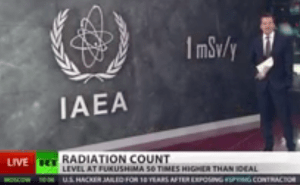
(Posted by Mia) UNSCAR and the Japanese Government announced recently up to 20mSv/y for a long term period is safe after admitting that decontamination work can’t reduce the amount of radiation in the atmosphere. The Japanese Government not only raised the threshold of radiation dose in the atmosphere, but also in food, water, debris, manure and sewage. Also, the Tepco workers’ threshold was raised since the Fukushima Disaster from 100mSv to 250mSv per 5 years. The human body can’t suddenly adjust to deal with such an amount of ionizing radiation. In Chernobyl, nobody has to live in areas where the radiation level is more than 5mSv/y unless they want to. In Japan, the government applies the ICRP model for emergency situations as a normal one, and treats 20mSv/y areas as safe places to live so they do not have to evacuate people from such areas. We shouldn’t allow this false sense of security to remain unchallenged, otherwise it could be foisted on the rest of the world as well. Although ICRP doesn’t consider internal exposure to ionizing radiation, 1mSv/y by the ICRP standard has been considered as an international standard for citizens that was based on the data of Hiroshima/Nagasaki nuclear bombs victims. http://hps.org/publicinformation/ate/q8900.html Radiological limits
Radiological Limits give radiation limits for workers, apprentices and students, and members of the public. The values given are recommended by international organisations such as Euratom, ICRP, and IAEA and the national German authorities. A typical radiological limit for radiation workers is 20 mSv/y (20 milli Sieverts per year). For members of the public, the radiological limit is much lower at 1 mSv/y. References: IAEA Safety Glossary, Terminology Used in Nuclear Safety and Radiation Protection 2007 Edition. ICRP 103 with Glossary, 2007 COUNCIL DIRECTIVE 96/29/EURATOM of 13 May 1996 laying down basic safety standards for the protection of the health of workers and the general public against the dangers arising from ionizing radiation Dose limits for members of public: Euratom ICRP IAEA Germany Japan 1mSv/y 1mSv/y 1mSv/y 1mSv/y 1mSv/y https://nuclear-news.net/2013/11/21/iaea-dose-limit-was-1-msvy/
The Japanese government agreed to the limits set by the ICRP (INTERNATIONAL COMMISSION ON RADIOLOGICAL PROTECTION) at ”1mSv”/year, set up after the Chernobyl accident. This standard was considered as the limit for people evacuation. But today, many children and their families go on living in areas above 1mSv/year, even after decontamination, without anything else being done. This limit was even raised to 20mSv/y with recommendations of half an hour per day outdoors for small children last year.
So we are more determined than ever since Japan was selected to host the 2020 Olympic Games in Tokyo. The country must take its responsibilities towards the Japanese people who live in areas with an exposure of more than 1mSv/y.
…“She said that there have been so many workers dead without being reported. Some died during the 2 days break, some didn’t turn up the next morning and were found dead…. Those who died haven’t been measured for how much exposure they got. Tepco doesn’t count and report the dead unless they die during their work hours.” …
(Editor’s comment: According to Mrs. Mako Oshidori of NPJ and of Yoshimoto Kogyo Co., Ltd., Tepco doesn’t keep a record of the worker’s radiation exposure and number of deaths (See the video: http://www.youtube.com/watch?v=0Pu5iLj7toE There has been some information in the Japanese blogs concerning Tepco worker’s deaths. I picked a few of them for this post.
According to Ms. Chikako Nishiyama, a former member of the Kawauchi village Assembly, the official announcement that 3 Tepco workers being the number who died during their work at the Fukushima Daiichi Nuclear Plant. Ms. Nishiyama commented that Tepco doesn’t count the workers if they died after their contracts ended. She also said that there were 100,000shifts shared between the work force that have worked at the Fukushima Daiichi Nuclear Plant so far, also, 4% of 100,000 (4300) workers have reportedly died. Most of them have died of heart attacks. If they died suddenly then Tepco paid a huge amount of money (about 3 million yen )to their families, to keep them silent about the deaths. If they talk about the deaths then the money that would be taken back. Therefore, nobody has said anything about it in the public domain.
Apart from Tepco workers, 64 members of the Self Defence Force and about 300 policemen have also died. They said that those policemen who work at the security check points of the no go zones in Fukushima prefecture are not wearing any protection, therefore, they have been exposed to huge amounts of ionizing radiation.
The above information came from a whistle blower, Prof. Seto at professor at Tohoku University and was also a Disaster control headquarters inspector general (in 2011). After releasing the information, his blog account was suspiciously closed. 。http://bit.ly/sEGL7d (this account was closed.)
以上、西山さんの情報で精度の高そうなものは、瀬戸教授の内部告発による、行方不明者のうち数名が県立医大に検体として持ち込まれていた。 One other thing Prof Seto said that seemed close to the truthwas that several missing bodies that were found in the Fukushima Daiichi Nuclear Plant were taken into Fukushima Medical University and kept as specimen materials.
University of Tohoku Hospital has been imposing a gag order to stop information concerning 800 Tepco worker deaths. This information is coming from some doctors and nurses who have been it finding hard to keep quite about it.
University of Tohoku Hospital has been imposing a gag order to stop the top secret information on the Fukushima Daiichi Nuclear Accident from leaking outside.One of top secret information is about 800 out of 3000 Tepco clean-up workers died because of high exposure to ionizing radiation at the site. Those patients received some examination at the University of Tohoku Hospital, then had been taken into one of their branch hospital in Niigata prefecture and stayed till they die quietly. Because there was nothing the doctors could do to save their lives.
(1h5m-) The Japanese comedian Makorine of Oshidori interviewed a chief nurse of the medical department for the Fukushima Daiichi Nuclear Plant sometime back in 2011 and got the facts on mortality stories of the clean-up workers. However, she wasn’t able to publish the information at that time. She got a chance to mention it in front of the big audience when she worked as a master of the ceremony at the lecture by Dr. Yablokokv in Tokyo on 18th of May, 2013.
“She said that there have been so many workers dead without being reported. Some died during the 2 days break, some didn’t turn up the next morning and were found dead…. Those who died haven’t been measured for how much exposure they got. Tepco doesn’t count and report the dead unless they die during their work hours.”
(Editor’s note: I would like to pray for those workers who died without being recognized.)
Sorry, this is in Japanese. Maximum 110000 Bq/kg, and the incredible seafood radioactive pollution situation.
Reason analysis of the Tokyo electric power company, is even more likely.
Fish and shellfish are plankton a sandworm, from the food chain, biological enrichment.
Sandworm, krill and not monitoring why?!
Krill is used for seasoning fish sauce, salted fish, fish sausage ingredients.
Chikuwa, kamaboko and hanpen processed food also needs attention.
Fingerling (muscle) 1 F port in (ones lighters near) 10/18/2013 3,800
soleus (muscle) 1 F in the port (Near East Bank except wave) 10/4/2013 1,110
Scorpion ( muscle) 1 F in the port (Near East Bank except wave) 10/29/2013 101,000
シロメバル (muscle) 1 F in the port (Near East Bank except wave) 10/29/2013 3,900
Murthy (muscle) 1 F in the port (near the North breakwater) 10/10/2013 110,000
Murthy (muscle) 1 F in the port (near the North breakwater) 10/31/2013 73,000
Stingray (muscle) 1 F in the port (near the harbour mouth) 10/3/2013 3,100
harbors in the soleus (muscle) 1 F ( Near the harbour mouth) 10/7/2013 1,370
marbled sole pleuronectes yokohamae (muscle) 1 F in the port (near the harbour mouth) 10/7/2013 2,550
black sea bream (muscle) 1 F in the port (near the harbour mouth) 10/17/2013 2,870
Stingray (muscle) 1 F in the port (near the harbour mouth) 10/19/2013 10,800 marbled sole pleuronectes yokohamae (muscle) 1 F in the port (near the harbour mouth) 10/19/2013 18,800
タケノコメバル (muscle) 1 F in the port (near the harbour mouth) 10/29/2013 84,000
marbled sole pleuronectes yokohamae (muscle) 1 F in the port (near the harbour mouth) 10/29/2013 1,270
soleus (muscle) 1 F in the port (port near the middle) 10/9/2013 3,270 Fingerling (muscle) 1 F in the port (port near the middle) 10/22/2013 34,000 (Translated by Bing)
As the National Union of Journalists encourages members whose work brings them into contact with the police to challenge their inclusion on the national ‘domestic extremist’ database, NetPol is urging activists and campaigners to do the same.
Using the Data Protection Act, activists can submit Subject Access requests to the Metropolitan Police to check what information is held about them by the National Domestic Extremism Unit (NDEU). NetPol wants to see all secret police databases shut down, because there is every reason to believe that data gathered in secret, with no checks and balances and no effective accountability, is not only unnecessary and intrusive but also riddled with gossip and rumour.
The results of a Subject Access Request remain private – nobody has any obligation to share personal data. However, if you discover inaccuracies or trivial information in any data that the police hold, we would like to work with you, in confidence, to expose this.
NetPol has produced a guide and sample request and follow-up letters to help you make a Subject Access Request. If you are submitting one, please let us know about any delays, other obstacles you experience and what you discover at info@netpol.org
Please share this post on Twitter and Facebook using the hashtag #ScrapNDEU
International diplomat Akio Matsumura and Fairewinds nuclear engineer Arnie Gundersen discuss the urgent need for a international team of truly independent experts to address the ongoing crisis at Tepco’s Fukushima Daiichi nuclear plant.
Listen to Arnie Gundersen explain what he would do if he were in charge of the Fukushima Daiichi cleanup on Libbe HaLevy’s Nuclear Hotseat podcast #117: http://www.nuclearhotseat.com/nuclear…
Find much more information at Fairewinds.org
THANK YOU for WATCHING!
Please subscribe to the myla reson video channel.