Detected to Plutonium and Uranium at Takahagi City, Ibaraki Prefecture. 茨城県高萩市
Detected to Plutonium and Uranium 茨城県高萩市


On April 5 2013
We had detected the plutonium and uranium in Takahagi City, Ibaraki Prefecture.
Many children has been living also in this city.

[[ Special Thanks ]]
Yuko Sugimoto
Reactor 4 Fuel pool was partially exposed to the air after accident
http://blog.livedoor.jp/home_make-toaru/archives/7424191.html

Given the amount of decay heat in the fuel in the pool, it is likely that in the days immediately following the accident, the fuel was partially uncovered.
(Japanese translation in the above blog was done by google translation.)

著者:Union of Concerned Scientists(憂慮する科学者同盟)の理事David Lochbaum
 発行人:米国原子力規制委員会(NRC)
 http://www.nrc.gov/reading-rm/doc-collections/commission/slides/2012/20120807/lochbaum-ltr-20120807.pdf
Radiation expert admits giving bad information on Fukushima- Doctor Yamashita got it wrong!
Published on 22 Nov 2013
How can an expert on radiation give fallacious advice and counsel?….
WEBSITE: http://www.naturalnews.com
Author credit: J. D. Heyes
Photo credit: http://www.naturalnews.com
Article link: http://www.naturalnews.com/043004_rad…
From article BBC on the
15 March 2011
“….Radiation from Japan’s quake-stricken Fukushima Daiichi nuclear plant has reached harmful levels, the government says.
The warning comes after the plant was rocked by a third blast which appears to have damaged one of the reactors’ containment vessels for the first time.
Nuclear physicist, Professor Paddy Regan, described the potential health risks stemming from problems at the plant….”
The Next Wave
Broadcast: 05/November/2013
Reporter: Mark Willacy
[extract]
PROFESSOR GERALDINE THOMAS: “Following Fukushima I doubt that there’ll be any rise in thyroid cancers in Japan and this is simply because the amount of radio-iodine that was released post-Fukushima was much, much less than released post-Chernobyl. Absolutely if you look for a problem, especially if you’re using incredibly sensitive technique which is what the Japanese are actually doing, you will find something. You will find part of that problem and you have to be careful you don’t over interpret that and worry people unnecessarily”.
WILLACY: Professor Thomas believes that unnecessary worry and fear has driven parents to make unnecessary choices.
PROFESSOR GERALDINE THOMAS: “And even post-Fukushima some women were having abortions because they were worried. The radiation would have done nothing to their prospective offspring, but the fear that that radiation was going to do something, tipped them over into having an abortion which nobody likes to know about.
http://www.abc.net.au/foreign/content/2013/s3884420.htm
Prof Richard Wakeford, Visiting Professor at Dalton Nuclear Institute at the University of Manchester and contributor to the WHO report, said:
February 28, 2013
[extract]
“The release of radioactive materials into the environment during the Fukushima nuclear accident was substantial; but based on measurement data, the radiation doses received by the surrounding population are small, even for the most exposed communities.
“These doses produce an extra risk of cancer over a lifetime of about 1% at most, in addition to background lifetime cancer risks from all other causes of, on average, 40% for men and 29% for women. The extra cancer risk is much lower than this outside the most exposed communities. Radiation exposure from the Fukushima accident has had only a small impact on the overall health of the nearby population, and much less outside the most affected areas.”
http://www.sciencemediacentre.org/expert-reaction-to-the-who-fukushima-health-risk-report/
China to invest in Romanian nuclear power
CHINA’S prime minister says his country will invest in Romanian nuclear and wind energy production as well as a high-speed railway.
November 26, 2013
Li Keqiang arrived in Romania on Monday a day ahead of a summit with leaders from Central and East European countries.
Romanian and Chinese officials signed various deals to co-operate in nuclear and thermoelectric energy projects and to resume beef and pork exports.
No values for the deals were disclosed.
Romanian exports to China have tripled since 2008 and bilateral commerce this year amounted to $US3.27 billion ($A3.5 billion), according to Chinese authorities.
It was the first visit by a Chinese prime minister to Romania in 19 years.
Li said the visit “consolidates reciprocal political trust”.
State Secrets Protection Bill Public Hearing Takes Place in Fukushima

25 Nov 2013
FUKUSHIMA, JAPAN – NOVEMBER 25: (CHINA OUT, SOUTH KOREA OUT) Protesters demonstrate outside the public hearing on November 25, 2013 in Fukushima, Japan. A majority of Japanese view the bill that the Abe administration is trying to ram through the Lower House with distrust and anger. The bill, which will toughen penalties on public servants who leak ‘specified secrets’ that could jeopardize Japan’s national security, is now under discussion at the diet. Under the bill, public servants and other individuals can be imprisoned for up to 10 years if they disclose specified secrets. (Photo by The Asahi Shimbun via Getty Images)
The Case of Former TEPCO President Masataka Shimizu | Gets a new job with big oil (TEPCO affiliate)
Published on 25 Nov 2013
Masataka Shimizu never went away. He serves as an example of the bourgeois power in Japan.
References:
Tepco appointment stirs public anger in Japan
http://www.bbc.co.uk/news/business-18…
Tepco ex-executives get golden parachute
http://www.bbc.co.uk/news/business-18…
Masataka Shimizu`s business profile
http://investing.businessweek.com/res…
Incidents stretch isotope supply chain
New lead-212 facility
A new facility for the production and purification of lead-212 (Pb-212) has been inaugurated by Areva Med. The Maurice Tubiana Facility at Bessines-sur-Gartempe in Fance will provide sufficient amounts of the high-purity isotope for clinical development. Pb-212 is a promising agent for use in the field of Targeted Alpha Therapy (TAT) or alpha radioimmunotherapy, and is currently undergoing clinical trials at the University of Alabama at Birmingham in the USA.
The Maurice Tubiana facility recovers the isotope from recycled uranium fuel and also from thorium from the Areva’s past industrial activities.
22 November 2013
http://www.world-nuclear-news.org/RS-Incidents-stretch-isotope-supply-chain-2211137.html
Separate incidents at research reactors supplying molybdenum-99 (Mo-99) have once again illustrated the fragile nature of the medical isotope’s supply chain. Meanwhile a unique new facility has started production of lead-212.

Canada’s NRU (Image: AECL Chalk River Laboratories)
Production was suspended at South Africa’s Safari 1 after a release of iodine and noble gas during cleaning processes on 2 November. The release, caused in a “very rare combination of circumstances” by a chemical reaction between cleaning materials used in preparation for a new production run was “momentary and minimal,” according to an update issued on 11 November by South African Nuclear Energy Corporation (Necsa) subsidiary NTP Radioisotopes. The release was well within regulatory limits and, apart from the “minimal” atmospheric releases, was contained within the Pelindaba facility with no impact on facility operators or the public, NTP said. However, production at the site was halted pending the completion of investigations, although NTP promised a return to production “as soon as possible” in its 11 November statement.
Supplies of the isotope were further compromised by the temporary closure of molybdenum production lines at NRG’s Dutch facility because of concerns over levels of uranium in a liquid waste tank on 8 November. NRG’s High Flux Reactor (HFR) is currently out of service while investigations are ongoing into control rod issues identified in early October. The company subsequently announced that it has launched a “return to service” program that it says will help it to avoid unplanned outages in the future. As part of that process, it is bringing all nuclear facilities and connected processes at its Petten site into a safe shutdown mode which could last up to three months.
Another major supplier of the Mo-99, Canada’s Chalk River Laboratory, was forced out of action on 19 November for repairs to the flask used to transport fuel rods and other components including Mo-99 rods in and out of the NRU reactor. Operator AECL announced that it would be unable to meet its planned isotope deliveries for the week ending 23 November, although repair activities were started immediately and the company anticipated a return to service within the week.
After the suspension of the South African and Dutch operations, European industrial group the Association of Imaging Producers and Equipment Suppliers (AIPES) said the companies involved had initiated “all possible necessary coordinated actions in order to mitigate the risks for the security of supply” with reserve capacity being activated wherever possible.
Mo-99 is used in hospitals to generate short-lived technetium-99m for medical imaging procedures. Its short half-life of only 66 hours means that Mo-99 cannot be stockpiled, so the world relies on regular and reliable supplies of the isotope. However, recent years have seen global shortages when several of the handful of ageing research reactors used to produce the vital isotope have been out of action. This has prompted efforts to investigate production of Mo-99 via other routes, such as in cyclotrons, as well as efforts to increase capacity at existing suppliers. Australia’s OPAL reactor, which started up in 2007, could potentially supply half of the world’s demand. Work is currently under way on an expanded molybdenum production facility, with the new capacity due to come online in 2016.
Researched and written
by World Nuclear News
Environmentalists and reporters in Sochi targeted by Kremlin’s Olympic fever
…Both journalists concluded that the $51 billion the Russian government is spending on the Olympics will have little impact on security and will do nothing to protect the environment or even make lives better for ordinary Sochi citizens. Even prices for various Olympic events, which, according to Beskova, start at about €800, are prohibitively expensive for ordinary Sochi residents.
“This $51 billion is not about Russia,” said Gordienko. “It is about putting on an international show.”….
http://www.bellona.org/articles/articles_2013/sochi_preview
A clampdown is hovering over Sochi, Russia, the site of the 2014 winter Olympic games, which are touted by the administration of Vladimir Putin as a showcase of the new Russia, but are seen on the ground as a heel grinding into the environmental civil liberties of the region’s residents.
The brunt of authoritarian bullying is being meted out on environmental activists, many of who have been forced to flee the country, and reporters, especially those working for smaller Russian publications not associated with the country’s sprawling state media.
Two Russian journalists this week visited Oslo and spoke of this dark underbelly to the preparations surrounding the Games, set to begin in the Black Sea resort town on February 7th.
Traditionally a vacation spot for Russian’s seeking fresh mountain air, beaches and forests, mammoth construction efforts have transformed much of the once pristine region into an ecological war zone and a security protectorate – and Russian officialdom is doing its solid best to make sure no one hears about it.
“[The Olympics] are an important holiday, but not for Russians,” said Olga Beskova, editor of the Sochinskyie Novosti, or Sochi News, who, unlike many of her counterparts in Russia’s fourth estate, has vowed not to downplay the routine harassment of those who would bring to light the iron-fisted approach of the government to gagging bad news from Sochi.
Indeed, when speaking on Thursday, eight of her paper’s 10 front-page articles dealt with unpleasant consequences of Olympic preparation.
Environmental degradation abounds around Sochi
Both Beskova and Irina Gordienko, a reporter with Russia’s famously and fiercely independent Novaya Gazeta, said in an informal meeting at the Norwegian Helsinki Committee before speaking with Norwegian parliamentarians, that swathes of irretrievable, protected forest land have been lost to Olympic venues: A rail connection, overflowing trash dumps, landslides occasioned by construction, deforestation for ski slopes, and crushed-stone quarries have sprouted up in reserve areas of Sochi National Park and even in Sochi itself.
And the slash and burn policies continue: According to activists from the Environmental Watch of the North Caucasus (EWNC), territories of the Western Caucasus UNESCO World Heritage site continue to be rolled back to make way for Olympic construction.
Beskova’s Sochinskiye Novosti on Friday reported about ongoing battles to protect nature reserves from being stripped of their status to make way for luxury Black Sea mansions for Moscow’s nouveau riche – including one for President Vladimir Putin himself – all of whom wish to buy themselves a front row seat to Russia’s first Olympics since the widely-boycotted 1980 Games.
“With the loss of these national parks, we have lost a huge part of our ecosystem in the area,” said Gordienko. Deforestation for railway construction and toxic waste dumping have all but led to the death of the Mzymta River valley.
“Officials have said the river will return to normal within 10 years, but that is clearly not the case,” she said.
Even though leading partners in the Olympic construction have committed to a United Nations Environmental Program (UNEP) restoration project for the Mzymta River basin, Gordienko is not convinced these Russian structures will follow through.
“The river is dead,” she said.
Where is the International Olympic Committee?
The International Olympic Committee (IOC) charter commits countries hosting the Games to a so-called “zero-waste” policy, meant to ensure that environmentally friendly waste disposal practices and natural preservation are observed. The charter also stipulates free access for the press before, during and after the games.
When asked if the Russian Olympic movement was living up to these conditions, Beskova and Gordienko laughed wryly. The answer is no.
One more recent example of Russia’s own promise to create the “cleanest games ever” has been a giant toxic dump, called the Akhshtyr landfill, in the middle of a water protection zone where dumping industrial waste is banned.
European review of Taiwanese safety
“Since some plants are located in close vicinity, combinations of events, including multi-unit and multi-site effects, should be assessed in order to identify potential cliff edge effects and related safety enhancements,”
[…]
“Apart from local operating consoles and remote shutdown panels, no alternative emergency control rooms exist that would represent an additional hardened alternative to the main control room,” the EC said
[…]
20 November 2013
By Carmen Paun and Jens Kastner
for World Nuclear News
http://www.world-nuclear-news.org/RS-European-review-of-Taiwanese-safety-2011135a.html
Taiwan should update the assessment of all natural hazards that could affect its nuclear power plants, notably for earthquakes and tsunamis, the European Commission (EC) has recommended.
The recommendation followed a peer review performed by the EC and the European Nuclear Safety Regulators Group (ENSREG) of the stress tests carried out on Taiwanese plants in 2012 by operator Taipower and the Taiwanese nuclear safety regulator, the Atomic Energy Council (AEC).
Overall, the peer review found that standards of safety applied to Taiwanese nuclear power plants “seem to be generally high and to conform in most areas to international state-of-the-art practices.” Taiwan currently has three operating nuclear power plants and another one under construction. All four plants were covered by the EC’s peer review.
However, the EC recommended that the island should use more modern techniques in identifying earthquake-related hazards for its plants. It suggested that Taiwanese assessments regarding earthquake hazards do not meet current international requirements and do not take into consideration new geological and geophysical data regarding “capable faults in the site vicinity of the Chinshan, Kuosheng and Maanshan plants.” Older geological records dating back 10,000 years (and not just tsunami data from 1867, as at present) should be considered. Common standards also need to be applied to all Taiwanese plants as there are currently some variations, said the commission.
Chinese nuclear disaster ‘highly probable’ by 2030
…To reduce costs, Chinese designs often cut back on safety….
He Zuoxiu
25th October 2013
h/t http://www.nukefree.org/he-zuoxiu-reactor-disaster-china-likely-2020
As the UK prepares to build a fleet of new nuclear power stations with Chinese capital and expertise, a former state nuclear expert warns: China itself is heading for nuclear catastrophe.
Some members of the nuclear power industry rely too much on theoretical calculations, when only experience can provide real accuracy.
The lifetime of nuclear reactors is calculated in “reactor-years”. One reactor year means one reactor operating for one year. The world’s 443 nuclear power plants have been running for a total of 14,767 reactor-years, during which time there have been 23 accidents involving a reactor core melting. That’s one major accident every 642 reactor years.
But according to the design requirements, an accident of that scale should only happen once every 20,000 reactor years. The actual incidence is 32 times higher than the theory allows.
Some argue this criticism is unfair. After all, 17 of those 23 accidents were caused by human error – something hard to account for in calculations. But human error is impossible to eliminate, and cannot be ignored when making major policy decisions.
Even if we set aside the accidents attributed to human error, technical failings have caused core melting once every 2,461 reactor-years. That’s still more than eight times the theoretical calculation.
Lessons from the US, Russia and Japan
Wind turbine at Fukushima switched on
24 Nov 2013
http://www.machinery-market.co.uk/news/4741/Wind-turbine-at-Fukushima-switched-on

The first turbine at a wind farm 20km off the coast of Fukushima is now feeding electricity to the grid linked to the tsunami-crippled nuclear plant onshore. The wind farm will have a generating capacity of 1GW from 143 turbines; it will help to restore the role of energy supplier to a region decimated by the earthquake and tsunamiin 2011.
Kazuyoshi Akaba — a vice-minister of economy, trade and industry — said: “Many people were victimised and hurt by the accident at the Fukushima Dai-Ichi nuclear power plant, so it is very meaningful to have a new source of energy — renewable energy — based here.”
Japan, whose coast is mostly ringed by deep waters, is pioneering floating wind turbines, suitable for seas more than 50m deep. The 2MW floating turbine in question was built at a dry dock near Tokyo and towed to its location off the north-eastern coast. Six huge chains anchor it to the sea bed some 120m below.
The turbine is linked to a 66kV floating sub-station — the world’s first, according to the project operators — via an extra-high-voltage under-sea cable. There could eventually be dozens of wind turbines off Fukushima’s scenic but deserted coast. The project is meant to demonstrate the feasibility of locating these towering turbines offshore in places where the winds are more reliable and there are fewer “not in my backyard” concerns.
In theory, Japan has the potential for 1,600GW of wind power, most of it offshore. About a dozen projects are already in progress, from Kyushu in the south to Hokkaido in the north.
Watchdog sues for Sandia nuke safety records
http://www.kob.com/article/stories/S3227145.shtml#.UpKh56qmd0x
Created: 11/24/2013 11:59 AM
By: Mike Anderson, KOB Eyewitness News 4
ALBUQUERQUE, N.M. (AP) – A watchdog group has filed a lawsuit seeking the release of nuclear safety records for Sandia National Laboratories.
The suit filed Friday in federal court in Albuquerque alleges the National Nuclear Security Administration has withheld documents and work papers for more than two years about whether nuclear reactors at Sandia have experienced shutdowns, accidents or violated safety regulations.
It also alleges a continuing pattern and practice of wrongful delay by the NNSA to violate the Freedom of Information Act.
The executive director for Citizen Action New Mexico, Dave McCoy, claims Sandia deliberately withheld the documents during the federal Defense Nuclear Facility Safety Board’s investigation of Sandia’s nuclear reactors and during a period of high public concern about the Fukushima reactor meltdowns.
NNSA officials say they can’t comment on pending litigation.
A little kown fact concerning ALBUQUERQUE, N.M. here
Accident Revealed After 29 Years : H-Bomb Fell Near Albuquerque in 1957
EIA: Japan oil market overview
…Wind, solar, and tidal power are being actively pursued in the country and installed capacity from these sources increased in recent years to over 4 GW in 2011, up from 0.8 GW in 2004. However, these sources continue to account for a relatively small share of generation at this time. Most of the growth of renewables in the past year has occurred in solar energy as a result of heavy investment for large-scale PV units. METI is considering 21 additional geothermal projects in addition to the 17 facilities containing 520 MW of capacity that currently exist. The potential for geothermal power is significant because the country has the third largest reserves in the world…
Monday, 25 November 2013
http://www.hellenicshippingnews.com/News.aspx?ElementId=25e2754a-076f-419e-bb74-2f1ef1da10d1
Japan is the world’s largest liquefied natural gas importer, second largest coal importer, and third largest net oil importer.
Japan has limited domestic energy resources. It meets less than 15% of its own total primary energy use from domestic sources. It is the third largest oil consumer and importer in the world behind the United States and China. Furthermore, it ranks as the world’s largest importer of liquefied natural gas (LNG) and second largest importer of coal behind China.
In light of the country’s lack of sufficient domestic hydrocarbon resources, Japanese energy companies have actively pursued participation in upstream oil and natural gas projects overseas and provide engineering, construction, financial, and project management services for energy projects around the world. Japan is one of the major exporters of energy-sector capital equipment, and has a strong energy research and development (R&D) program supported by the government. This program pursues energy efficiency measures domestically in order to increase the country’s energy security and reduce carbon dioxide (CO2) emissions.
In March 2011, a 9.0 magnitude earthquake struck off the coast of Sendai, Japan, triggering a large tsunami. The damage to Japan’s resulted in an immediate shutdown of about 10 GW of nuclear electric generating capacity. Between the 2011 Fukushima disaster and May 2012, Japan lost all of its nuclear capacity as a result of scheduled maintenance and lack of government approvals to return to operation. Two nuclear reactors were re-commissioned in July 2012 and represented the only source of nuclear power in the country for more than one year. However, these two reactors were removed from service again in September 2013, eliminating the country’s nuclear capacity for a second time in more than 40 years.
Nuclear generation in Japan represented about 26% of the power generation prior to the 2011 earthquake and was one of the country’s least expensive forms of power supply. Japan replaced the significant loss of nuclear power with generation from imported natural gas, low-sulfur crude oil, fuel oil, and coal that caused a higher price of electricity for its government, utilities, and consumers. Fuel import cost increases have resulted in Japan’s top 10 utilities losing over $30 billion in the past two years. Japan spent $250 billion on total fuel imports in 2012, a third of the country’s total import charge. Despite strength in export markets, the yen’s depreciation and soaring natural gas and oil import costs from a greater reliance on fossil fuels continued to deepen Japan’s recent trade deficit throughout 2013.
Japan’s current government wants to resume using nuclear energy with necessary safety measures. The government believes that the use of nuclear energy is necessary to reduce current energy supply strains and high energy prices faced by Japan’s industries and end-users. This effort occurs in the context of the government’s focus on reversing two decades of economic stagnation in Japan and providing economic revitalization through public infrastructure spending, monetary easing, labor market reform, and business investment.
Map of Japan
Source: CIA, World Factbook
Total primary energy consumption
In the wake of the Fukushima nuclear incident, Japan’s energy fuel mix has shifted as natural gas, oil, and renewable energy provide larger shares and supplant some of the nuclear fuel. Oil remains the largest source of primary energy in Japan, although its share of total energy consumption has declined from about 80% in the 1970s to 43% in 2011. The decline in oil use occurred as a result of increased energy efficiency and the expanded use of nuclear power and natural gas. Coal continues to account for a significant share of total energy consumption, although natural gas is increasingly important as a fuel source and is currently the preferred fuel of choice to replace the nuclear shortfall. Natural gas rose from 18% in 2010 to 22% of total primary consumption in 2011. Before the 2011 earthquake, Japan was the third largest consumer of nuclear power in the world, after the United States and France, and nuclear power accounted for about 13% of the country’s total energy in 2010. In 2011, the nuclear energy share fell to 7% of the total energy consumption. Hydroelectric power and other renewable energy comprise a relatively small percentage of total energy consumption in the country, although renewable energy is becoming increasingly significant as a fuel source.
Japan total energy consumption, 2011
Oil
Because Japan’s oil resources are very limited, the country relies almost solely on imports to meet its oil consumption needs.
Blanket ban on 209 items of seafood from Fukushima prefecture and sorrounding regions by South Korea
Image source ; http://english.yonhapnews.co.kr/graphic/1000000001.html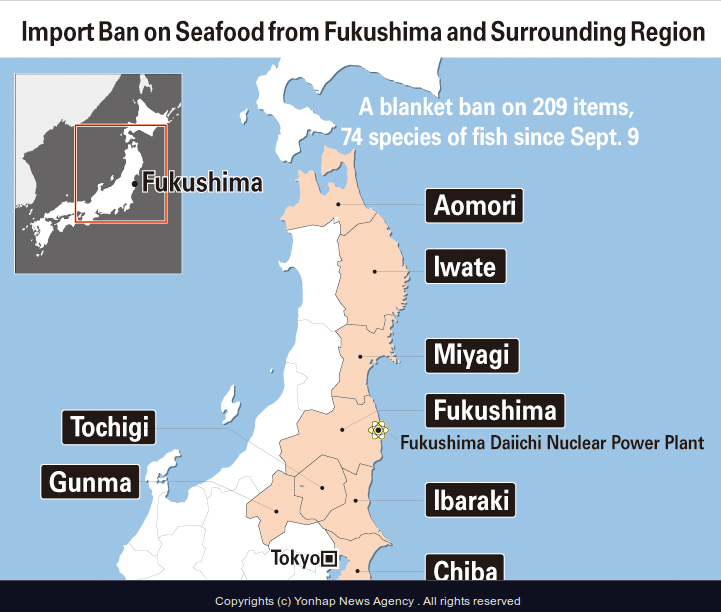
Revered California Physician: The problem we face at Fukushima is absolutely huge — I may leave West Coast during attempt to remove nuclear fuel (VIDEO)
Published: November 24th, 2013 at 7:07 pm ET
By ENENews
The Santa Barbara Independent, Nov. 7, 2013: Doctor Talks Dangers of Fukushima Fallout; Stephen Hosea Expounds on the Problems with Nuclear Power […] The Santa Barbara physician discussed the dangers of nuclear power plants at a lunchtime conference packed with health-care professionals at Cottage Hospital […]
Dr. Hosea’s background is discussed in this Santa Barbara News-Press article: “He is just a phenomenal doctor, as well as just a wonderful guy,” said Dr. Elliot Schulman, health officer and Santa Barbara County Public Health director. “Everyone concurs,” said Peter MacDougall, past president of the Cottage Hospital board of directors. “Not only does he have tremendously strong technical competencies, but his personal modalities with patients, his caring, the deep sensitivity he shows represent just a terrific model for new doctors.” “He’s as close to a model physician as you could ask for,” Mr. MacDougall said. “We are, frankly, blessed to have a man of his talents.” […] Government officials consider him a go-to guy, regularly seeking his advice […]
“The Perils of Fukushima: What You Don’t Know Really Could Kill You”, Dr. Stephen Hosea, Published Nov. 23, 2013:
At 30:45 in
Should an event occur [during attempt to remove fuel from Unit 4], all of the radioactivity is going to go straight up into the air. We saw where it went the last time that that occurred. This is happening in the next two weeks. This is a possibility that could happen to each and every one of us. And I can tell you, it wasn’t until I started looking into this that I realized this was a possibility to happen. I certainly haven’t taken any preparations for this. I’m not exactly sure what the preparations are, but I think we ought to know so we can at least take whatever preparations we want to take. I may have to make a visit back to Boston during this period of time to protect myself from this.
At 37:15 in
In summary, radioactive water continues to leak into the Pacific Ocean. Radioactive materials at Fukushima are in an unstable, potentially explosive situation. The potential effect on the water we drink, the air we breathe, and the food we eat are at best speculative. Immediate information and action are necessary as soon as possible. […] The problem we face at Fukushima is absolutely huge.
1 This Month





PLEASE OPPOSE HR 8255 AND S.3639 – bills would accelerate satellite deployment, with no environmental review or safeguards – https://ncstd5li.quorum.us/campaign/169331/
To see nuclear-related stories in greater depth and intensity – go to https://nuclearinformation.wordpress.com
-
Archives
- October 2026 (81)
- September 2026 (339)
- August 2026 (330)
- July 2026 (355)
- June 2026 (287)
- May 2026 (306)
- April 2026 (356)
- March 2026 (251)
- February 2026 (267)
- January 2026 (308)
- December 2025 (358)
- November 2025 (359)
-
Categories
- 1
- 1 NUCLEAR ISSUES
- business and costs
- climate change
- culture and arts
- ENERGY
- environment
- health
- history
- indigenous issues
- Legal
- marketing of nuclear
- media
- opposition to nuclear
- PERSONAL STORIES
- politics
- politics international
- Religion and ethics
- safety
- secrets,lies and civil liberties
- spinbuster
- technology
- Uranium
- wastes
- weapons and war
- Women
- 2 WORLD
- ACTION
- AFRICA
- Atrocities
- AUSTRALIA
- Christina's notes
- Christina's themes
- culture and arts
- Events
- Fuk 2022
- Fuk 2023
- Fukushima 2017
- Fukushima 2018
- fukushima 2019
- Fukushima 2020
- Fukushima 2021
- general
- global warming
- Humour (God we need it)
- Nuclear
- RARE EARTHS
- Reference
- resources – print
- Resources -audiovicual
- Weekly Newsletter
- World
- World Nuclear
- YouTube
-
RSS
Entries RSS
Comments RSS

