What next for UK’s nuclear waste disposal plans?
Bob CooperPolitical Reporter, BBC Cumbria, 24 Nov 26
The government sees nuclear power as key to its plans to lower bills, improve energy security and decarbonise the grid. But now safe disposal of the industry’s most toxic waste hinges on communities in west Cumbria, where some are impatient for progress on finding a suitable site.
What are the government’s plans for nuclear waste?
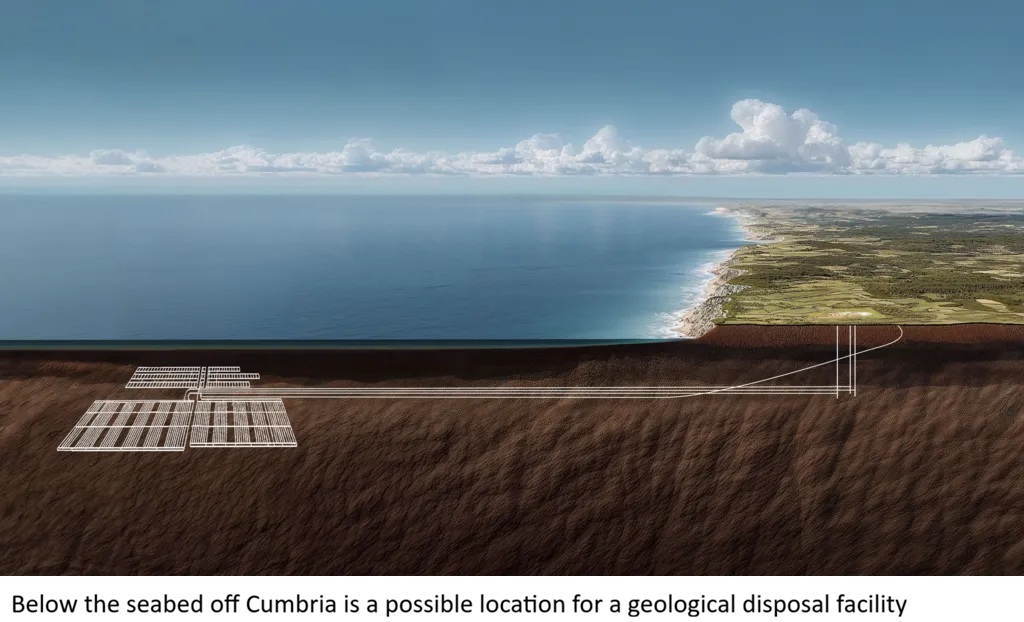
The government wants to build a geological disposal facility (GDF), an engineered structure of vaults and tunnels up to 1km (0.6 miles) below ground or beneath the seabed.
It would be used to dispose of the UK’s most hazardous radioactive waste, including spent fuel from nuclear power stations.
It could be ready to start receiving waste in the 2050s and cost between £20bn and £53bn in 2017-18 prices, according to a recent report by MPs.
Where will it be built?
The body in charge of the project, Nuclear Waste Services (NWS), has been searching for a “suitable site with a willing community”.
Parts of west Cumbria are now the only areas under consideration after Lincolnshire County Council withdrew from the process.1
Officials are now focusing on an area beneath the seabed off the Cumbrian coast and land near Seascale and Haverigg.
The government’s process for choosing a site specifies there must be a “test of public support”, showing the community is willing to host the facility, which could include a referendum, consultation or polling.
Choosing a site is expected to take 10 to 15 years.
Where is nuclear waste currently stored?
About 80% of the UK’s most hazardous nuclear waste is stored at Sellafield in West Cumbria, according to Sellafield Ltd.
NWS says moving it to a GDF would remove the need for “ongoing human intervention” and protect it from environmental changes like rising sea levels.
Why are some people losing patience?
The next stage of the GDF siting process involves detailed investigations into whether the geology of any potential sites is suitable, including deep borehole drilling.
NWS made a recommendation to the government in May about which community or communities should progress to this phase.
The recommendation has not been published and the ultimate decision will be made by the energy security and net zero secretary, Miatta Fahnbulleh.
Conservative Cumberland councillor David Moore, whose Gosforth ward includes Sellafield and Seascale, said the government had “promised” a decision before the summer parliamentary recess.
‘Important for people of Cumberland’
He said local people had been asking for updates but he had been unable to provide any.
“I’m frightened this community is going to get frustrated and walk away from the process,” he said.
The Labour leader of Cumberland Council, Mark Fryer, said: “We have stressed to government that we welcome a decision being made as soon as possible.”
He said the safe disposal of radioactive waste currently stored at Sellafield was “an important issue for the people of Cumberland”.
The National Infrastructure and Service Transformation Authority has rated the GDF project as “red”, meaning there are significant issues to address, while a recent report from the Office for Nuclear Regulation noted slowing progress due to government spending decisions.
A spokesperson for the department for energy security and net zero said: “We remain committed to geological disposal for the safe, permanent disposal of the UK’s most hazardous radioactive waste.”..
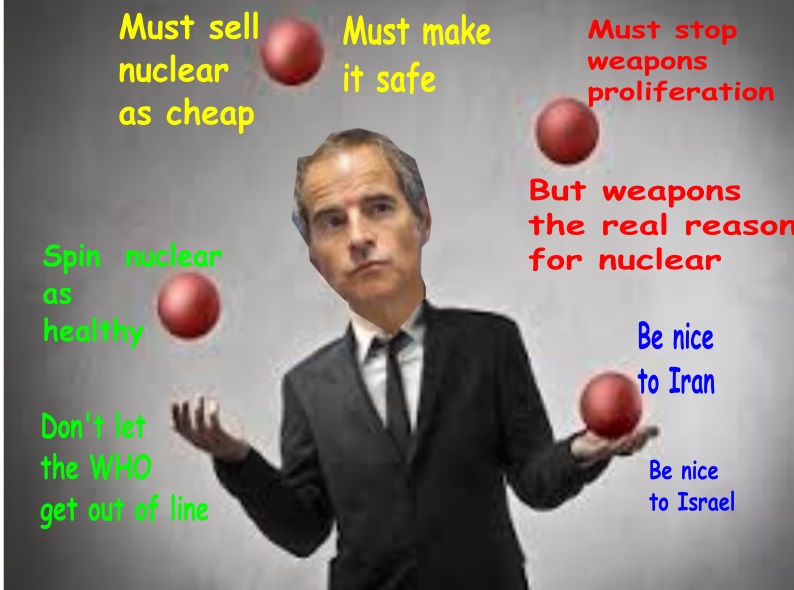
Rafael Grossi is eyeing the UN’s top job.
Aljazeera, 26 Nov 26
The nuclear watchdog chief is seen as technically competent, but questions remain about his plans for UN reform.
International Atomic Energy Agency (IAEA) chief Rafael Grossi is eyeing the position of United Nations secretary-general amid a tense race to replace Antonio Guterres.
The Argentinian nominee has finished second in the latest UN Security Council (UNSC) straw poll behind Costa Rica’s Rebeca Grynspan, with nine “encourage” and four “discourage” votes and eight candidates still in the fray.
Grossi, 65, has earned admiration and criticism in equal measure for his IAEA tenure, defined by his hands-on approach to crisis diplomacy in active war zones, but also by accusations of partisanship, levelled against him, especially by Iran.
He is running on an agenda to reform the UN in a way seen as favourable to United States President Donald Trump and his political ally, Argentinian President Javier Milei.
But China and Russia – two of the five permanent UNSC members with veto power – are unlikely to back a candidate so closely aligned with Washington, analysts say, and a global civil society campaign is throwing its weight behind the selection of the first woman to lead the UN in the organisation’s 81-year history………………………………………………………………………………………………….
To be elected to lead the UN, a candidate needs at least nine votes in favour from the 15-member UNSC while avoiding a veto from any of its five permanent members (P5) – China, France, Russia, the US, and the United Kingdom. The 193-member UN General Assembly (UNGC) then has to sign off on the final choice.
The race is coming down to the wire, as Guterres must leave his post on December 31.
While none of the P5 has publicly announced its preference, the South China Morning Post reported that Beijing has ruled out Grossi for being too close to Washington and would instead back Grynspan.
While Iran is not a member of the UNSC, it has also been vocal in its opposition to Grossi as UN secretary-general. Tehran’s Ministry of Foreign Affairs spokesman, Esmaeil Baghaei, accused the IAEA this month of being overly influenced by the US and European countries in its “one-sided and biased reporting about Iran’s peaceful nuclear programme”…………………………………………………………………………………………………………………………………………………………………………………………………………………………………….. https://www.aljazeera.com/news/2026/11/18/rafael-grossi-wants-to-be-un-chief-will-trumps-support-nuke-his-chances
Labour pledge to divert money from services to fund nuclear weapons

A LABOUR pledge to funnel money from core public services in order to
invest in nuclear weaponry has been branded “absolutely disgraceful”.
On Thursday, Defence Secretary Wes Streeting announced an £8 billion fund
to improve submarine maintenance in response to the UK’s deteriorating
nuclear fleet. Announcing the money, Streeting said: “Even when we have
to move funding from other departments, we will prioritise our nuclear
deterrent and getting Britain warfighting ready.”
“Yet again it seems
there is always money at Westminster for nuclear weapons, but never enough
to eradicate child poverty, repair our public services or ensure that
everyone has a warm and secure home,” Scottish Greens co-leader Gillian
Mackay said.
The National 26th Nov 2026, https://www.thenational.scot/news/26766357.labour-pledge-divert-money-services-fund-nuclear-weapons/
North Korea’s Kim vows to build more nuclear weapons after ignoring Trump’s overture

North Korean leader Kim Jong Un visited facilities that produce nuclear
ingredients and called for building more nuclear weapons, days after
ignoring U.S. President Donald Trump´s offer to meet during his recent
visit to Asia. Kim’s statement signals again that he won’t give up his
evolving nuclear program – the backbone of his authoritarian rule – and is
eager to bolster his country’s status as a nuclear power.
Daily Mail 26th Nov 2026, https://www.dailymail.com/wires/ap/article-16323081/North-Koreas-Kim-vows-build-nuclear-weapons-ignoring-Trumps-overture.html
European Commission Investigates State Aid for EDF’s EPR2 Reactors
According to anonymous sources cited in the press, EDF is reportedly committing to hiring and orders ahead of Brussels’ approval. The probe covers the subsidized loan, the contract for difference and risk sharing.
The newsroom·November 20, 2026, http://energynews.pro/en/european-commission-investigates-state-aid-for-edfs-epr2-reactors.
EDF is reportedly committing to hiring, orders and contracts for its EPR2 reactor program ahead of the European Commission’s final approval, according to press reports dated November 20, 2026 that rely on anonymous sources. No primary document reviewed confirms these reports. The matter comes as French nuclear industry players forecast purchases over ten years. Other countries, such as South Africa, are also setting a timetable for nuclear decisions.
A program announced in February 2022
The French president announced the program in a speech in Belfort, before Russia’s invasion of Ukraine. The European energy crisis and the unavailability of a large share of the existing fleet, caused by corrosion problems, later strengthened its political rationale. The Élysée presents the program as a tool for energy independence, competitiveness and sovereignty.
The EPR2, a simplified version of the Flamanville EPR, are to be built in pairs at the Penly, Gravelines and Bugey sites. Penly is due to host the first commissioning. Bernard Fontana has led EDF since May 2025, after Luc Rémont was ousted in March 2025.
A cost estimate expressed in constant euros
EDF expresses the program’s cost as a forecast estimate in constant euros of an older reference year. According to AFP, this estimate excludes financing costs. It therefore corresponds neither to an amount in current euros nor to a total bill. Estimates have risen with each revision.
The Élysée now refers to a construction cost target that EDF has committed to meet. The Interministerial Delegation for New Nuclear (DINN) audited the estimate and the Élysée acknowledged its conclusions, the content of which is not public. The Court of Audit had asked that the final investment decision be withheld until financing was secured and detailed design studies had progressed. It also warned that an accumulation of risks could lead to the program’s failure.
Three public support measures
State support first rests on a subsidized-rate loan covering a majority share of the program. The loan would be refinanced by the Caisse des dépôts savings fund, and therefore by regulated savings. It is complemented by a contract for difference, which secures EDF’s revenues over the long term, and by a risk-sharing arrangement between the State and EDF for a defined list of events.
The loan rate and the price guaranteed by the contract for difference have not been published. A subsidy is nonetheless included in the draft state budget, and the actual cost to public finances depends on its level.
Brussels’ in-depth investigation
These measures constitute state aid subject to approval by the European Commission, to which France referred them. The Commission has opened an in-depth investigation. It is examining the proportionality of the scheme, in particular the absence of excessive risk transfer to the State, as well as its effect on competition, including the risk of strengthening a dominant position.
Espoo Convention under pressure: member states must confirm violations by French nuclear power plants
Environmental organizations call for compliance with international law regarding nuclear power plant license extensions / Cross-border nuclear risks require cross-border participation by those affected
Basel/Luxemburg/Hamburg, 23. November 2026,
https://www.ausgestrahlt.de/presse/uebersicht/espoo-konvention-auf-dem-prufstand-staaten-mussen/
– Environmental organizations from Germany, Switzerland, and Luxembourg are warning of an impending erosion of international law by countries that continue to rely on nuclear power.
This warning comes in response to France’s attempt to approve lifetime extensions for old nuclear power plants, without first conducting an environmental impact assessment. This violates the Espoo Convention on transboundary environmental impact protection. A conclusion reached by the relevant UN review body, the Espoo Implementation Committee, following a complaint filed by Greenpeace regarding the operating lifetime extension of the Tricastin 1 nuclear power plant.
To avoid a formal finding of non-compliance, France intends to block its adoption at the upcoming Espoo Conference of the Parties, to be held December 1–4 in Geneva. .ausgestrahlt, Greenpeace Luxembourg, and the Trinational Association for Nuclear Safety (TRAS) are calling on the States Parties to the Espoo Convention to oppose this attempt, to accept the ruling, and to advocate for consistent compliance with international law.
“The Implementation Committee has clearly determined that France violated several provisions of the Espoo Convention by extending the operating life of Tricastin 1. The parties to the Espoo Convention must not allow France to shirk its responsibilities,” says Roger Spautz, nuclear campaigner for Greenpeace Luxembourg and France.
“Cross-border risks, such as the continued operation of an ancient nuclear power plant, must also be assessed on a cross-border basis. Neighboring countries and their populations, as potentially affected parties, must have a say in the matter. According to the Espoo Convention, this also means addressing the crucial question: Does this old reactor even need to remain in operation—or wouldn’t renewable energy and storage be the better, far less dangerous alternative?” explains Armin Simon, nuclear policy analyst at .ausgestrahlt.
According to Stephanie Eger, executive director of the Trinational Nuclear Safety Association, what is at stake in Geneva goes far beyond the Tricastin case: “When it comes to environmental impact assessments, we’re not talking about a voluntary gesture of good neighborliness. The Espoo Convention is binding international law. France’s actions are a clear violation of the Espoo Convention. If France gets its way, other countries could also ignore the agreed-upon rules.”
Tricastin is not an isolated case. In France alone, the Espoo Commission has so far identified 13 other operating life extensions that do not comply with the rules. Similar complaints have also been filed against the Swiss Leibstadt nuclear power plant, as well as against two nuclear power plants in Ukraine. Across Europe, dozens more nuclear power plants are set to enter extended lifetime operations in the coming years.The environmental organizations are therefore urging for the ruling on Tricastin 1 to be fully accepted and for the Espoo Convention to be consistently applied in order to ensure the protection of the public and their right to have a say in nuclear projects across national borders.
Why “AI Hacking” Will Make Tech Outages “The New Normal”
Kit Knightly, Nov 25, 2026, https://off-guardian.org/2026/11/25/why-ai-hacking-will-make-tech-outages-the-new-normal/
ast week, we posted an article highlighting all the (allegedly unrelated) tech outages that had afflicted Microsoft, Apple, the FAA, JP Morgan, Anthropic and the NSA.
Since then it’s just gone on and on.
Two days ago, the FBI’s crime database was allegedly hacked. And, for some reason, the FBI rushed to tell everybody about it.
Then the United States Department of Agriculture was hacked as well, with attackers allegedly targeting systems that made payments to farmers.
…and then America’s ports in general, as hackers are said to be disrupting “vital trade routes” with an “onslaught” of cyber attacks.
…and then their warships.
…and then a city in California, exposing under-cover police identities.
…and then the US Treasury’s financial crimes unit.
…and then the CIA itself, though allegedly only their “unclassified” data, and again – for some reason – they told everyone about it.
These were (allegedly) “hacks” this time, by the way. Not “temporary service delays” caused by “outdated hardware” or “internal maintenance”, which is what all the outages were officially blamed on last week.
A ransomware cyberattack blamed on hacking group “non” supposedly breached Chase, VISA and Mastercard’s systems, but – we’re told – this was totally separate from the online banking outage.
And this issue is no longer limited to the US either. You could argue it never was.
We’re less than a month removed from the “hacked” supermarket freezers destroying tons of food across seven countries.
The last week has seen Transport for London hacked, along with UK-based retailer NEXT, and wealth management firm St James’ Place.
Over the weekend, Norwegian government digital identity platform ID-2 porten was hit with a DDOS attack, and the Norwegian-based energy company Equinor – the largest gas supplier in Europe – got attacked.
Three days ago, the European Union announced it had been the victim of a cyber-attack last month, but never told anyone before.
Then, earlier today, the European Commission reported it was being subjected to another cyberattack, which took the European Academy offline.
Spanish football league La Liga was hit with a hack that exposed fan data, Bell Canada got hit with an “agentic attack” that exposed customer data, and Guadeloupe hospital’s IT systems were shut down after yet another cyber-attack.
Again, all reported over this past weekend.
The Indian press reports the Indian government’s Computer Emergency Response Team (CERT-In) is warning that AI-assisted cyber attacks on banks and fintech firms are making unauthorised payments.
Just about an hour ago (at the time of writing), the Israeli police reported they had shut down their communication systems after they were hacked.
…the hacks just keep on coming.
Allegedly.
Because, we should remember, there’s no evidence most of these “attacks” happened as described, or even at all, it’s just a snowstorm of panic words with very little that can be described as substantive verification.
They may be made up in their entirety. Like so much else.
Or, as we saw with food warnings over the summer, they may be perfectly normal activity suddenly elevated to front pages to create the idea of a new problem simply by amplifying the routine.
OffG, for example, is constantly having little niggling hack attempts or DDoS attacks, and if we were to begin broadcasting the fact every time it happened, it would appear to be a spike in nefarious activity.
Clearly, the banking and Microsoft outages really happened, and clearly planes were really grounded…but even here we don’t know how, or why.
Whatever the nature of the chaos-induction, it has has resulted in the US Cyber-Security Commissioner Sean Cairncross resigning his post (or being fired, depending who you ask).
But Cairncross’ departure is unlikely to change things in the near future – we an expect more tech outages and cyber attacks to come.
In fact Jay Clayton, the National Director of Intelligence, has specifically warned that the next two years will see cyber-outages become routine as “companies update their systems” from “decades-old infrastructure”.
And, ominously, speaking at a recent cyber-security conference at Vanderbilt University, retired General Paul Nakasone – former head of the NSA and US Cyber Command – called the past week of cyber attacks and tech outages “the new normal”.
…don’t you just love that phrase?
So, the narrative is set. We are in the midst of a “cyber-pandemic” of tech outages.
But who is to blame?
And what is the real game here?
Last week, US officials were apparently keen to downplay the idea of any of this being due to a single factor. The line was they were all coincidences and there’s no reason to panic.
But, as we noted at the time, the denials were so thin that they basically played like rather clumsy reverse psychology. Because everyone knows a weakly executed refutation – “honestly, there’s no reason to panic, however suss it looks” is, under certain circumstances, exactly what you’d say to try and make people panic.
But that was last week. This week there’s a new play in progress.
After noteworthy reticence to lay blame at any state actor before, accusations are now flying thick and fast.
The EU is blaming China.
Google is blaming Russians.
The ex-CIA “intelligence experts” are telling the press that Iran was behind the tech outages – even as the Chief of Homeland Security says they weren’t – mere months after claiming Iran was constantly trying to hack the US’s infrastructure.
“We’re totally under constant cyber-attacks, but every outage was just an accident and nothing to do with Iran”, that’s the official position.
Again, it looks like an unsubtle attempt at damning with faint apology.
It is already, rather predictably, becoming de rigueur to blame Israel, and Trump’s pick for the new US Cyber Security chief – Kirsten Davies – is adding fuel to that fire, with her close associations with Israeli tech firms.
In apparently unrelated news, earlier this week, General Sir Rob Magowan of the UK’s Uber Warfare Unit told the press they were conducting offensive cyber ops against Russia, China, Iran and North Korea.
That is very odd thing to say, isn’t it?
The article notes that “It is very rare for an official to talk publicly about the UK’s covert offensive cyber missions”.
Which is true. I mean you can guess it’s generally considered poor spycraft to announce your “covert missions” – cyber or otherwise – to the international press corps.
…unless of course you’re just another larper larping away on a TV screen to make an increasingly benumbed and bewildered audience believe you’re engaged in a cyber war, and to begin to associate the deluge of “tech outages” with potential ‘acts of war’.
Is the age of staged warfare to further shared goals expanding into the digital sphere?
The story being constructed seems fairly clear –
We’re being telegraphed the idea we’re in a barely-camouflaged “covert” cyber war with murky enemies of the west. And we’re supposed to divine our “leaders” don’t want us to know about this war – even though they keep making it painfully obvious.
And – of course – just as the physical wars in Iran and Ukraine drove price increases and caused shortages of physical goods, food and energy – this ‘digital war’ is going to disrupt the digital supply chain – meaning tech outages etc.
That’s the “new normal” they’re talking about.
That’s the geopolitics of it all – a story designed to justify declining standards of living.
Which is pretty much what everything boils down to in the end, these days.
If it means anything at all and isn’t just noise for the sake of itself – it means ‘get used to having less and not being especially happy’.
But the true appointed villain of this story – the ultimate perp we are supposed to be shaking our fists at – is not Donald Trump or Israel or Vladimir Putin or Iran –
It is AI.
Not necessarily “rogue” AI, but AI agents being deployed by state or non-state actors.
That’s the constant media refrain.
CrowdStrike is buying ZScaler for $44 million, why? Because “AI is supercharging cyberattacks”.
Google is warning AI is able to make cyberattacks “fully autonomous”. The EU may have blamed China for their hack, but they also made sure to mention it was “AI powered”.
The New York Times reports:
Tech Outages Are Only the Beginning. A.I. Will Bring More Disruptions.
The New York Post is terrified of the “new Chinese AI hacking tool” which allows “anyone with an iPhone to unleash havoc”.
The FBI is “warning” that hackers with AI tools can breach systems in under three hours, with what WIRED calls a “point and shoot” AI hacking tool.
The FT tells us “the AI cyber-threat is already here”, and that firms need to “tighten cyber defences as AI exposes vulnerabilities”.
The Guardian is asking “How freaked out should we be?” in a long article that interviews cyber-security experts who question the “official story” of the tech outages, and blames them all on AI.
As we predicted in our previous article on this, the phrase “digital fragility” is already doing the rounds.
See this piece from Forbes, which notes:
the abrupt fragility of society’s digital infrastructure
It will likely continue to spread, in those words or ones very like them.
That’s the narrative: “Our digital infrastructure is fragile and AI is making cyberattacks – from anarchic digital terrorists or state actors – both easier and more destructive.”
It does get very dull reducing everything down to this dynamic – but we have our problem, we are in the midst of a reaction, and we all know what comes next.
Hint: It starts with “S” and ends with “olution”.
So, what are we going to be told we have to ban, surveil tax or regulate to make this “problem” go away?
Let’s see if we can find some clues…
Writing in the Washington Post, Fareed Zakaria headlines “What grounded planes and downed banking systems say about the AI age”, and his proposed solution is [emphasis added]:
a new digital architecture for the age of AI. The older models of building digital walls are not enough. We must plan for a successful attack. The focus should be on protecting data and restoring functions fast. That means redundancy, segmented or isolated networks, and backups. This is an area where the private sector cannot act alone. An attack on one company or water system can easily spread throughout the country.
This language is edging close to our “worst case scenario” prediction about digital partitions, isn’t it?
Last month, Governor Kathy Hochul of New York signed a new law which age-gates access to AI chatbots. That’s the first law of its type I’m aware of, but we can probably expect them to spread – just as the “social media ban” did.
These morsels gives us a little taste of potential “solutions” to the AI “problem” coming down the line.
The question is if they feel they’ve done enough damage to justify their planned legislation yet, or if we can expect some kind of digital 9/11 first.
Full Tanks of Independence: Gasoline from Russian Gas Stations Leaks to Neighbors- Moscow Will Pay for It All. Meanwhile the fuel oligarchs profit.

COMMENT. Whichever side of the Ukraine war you are on – no worries -oligarchs running feul or weapons companies are making a killing, about the killings.
Rostov Tsargrad TV, October 26,
While gasoline and diesel prices rise across Russia’s regions and restrictions are imposed at gas stations, duty-free tankers of Russian fuel continue to flow to “friends” in the CIS. Moscow is feeding other countries’ economies while its own is already adopting austerity measures. Benefits, loans, and debt write-offs—all for the benefit of countries that, in return, increasingly flirt with regimes unfriendly to Moscow. Russia supports its neighbors to its own detriment—but is this game worth the candle?
…………………………… Armenia receives gas and oil products at preferential rates established by the intergovernmental agreement upon joining the EAEU. This is effectively an energy subsidy that supports the republic’s budget and industry, but does not guarantee strategic loyalty—Yerevan continues to pivot its policy toward the West, taking advantage of Russian fuel
Kyrgyzstan and Tajikistan previously had significant debts to Russia—hundreds of millions of dollars—that were completely written off in the 2010s. In exchange, Russia received only symbolic promises of “forever friendship” and the countries’ participation in the Eurasian Economic Union (EAEU) and the Collective Security Treaty Organization (CSTO). Similar write-offs have occurred in other cases as well: Moscow forgave tens of billions of dollars in debt to CIS and African countries, thereby funding their budgets instead of its own.
Against this backdrop, Russia continues to experience fuel shortages on the domestic market……………………………………..
Moscow remains the main supplier of vital energy for post-Soviet states, but is receiving less and less political or economic return from this.
What does Russia get in return and why it doesn’t pay off?
At first glance, Russia maintains influence in the post-Soviet space through preferential oil and gas supplies. But if we break this system down into economic and political outcomes, it becomes clear: the benefits of this “friendship” are minimal, and the costs are disproportionate.
…………………….Damping payments to oil companies and reduced export revenues create a hole that is being plugged with domestic taxes. Even the Ministry of Finance acknowledged that the tax maneuver was a mistake—it enriched producers but weakened the budget.
The political payoff of these sacrifices is also questionable. Recipients of Russian subsidies have not demonstrated consistent loyalty……………………………Subsidies do not convert into political capital—allies take resources but do not accept obligations.
Even economic dependence on neighbors doesn’t translate into allied loyalty. Russia supplies them with oil, but refining, trade, and distribution are controlled by local oligarchies. For example, in Kyrgyzstan and Tajikistan, subsidies are lost in intermediary networks and never reach consumers. In effect, Moscow subsidizes the social stability of other countries, while the dividends in the form of political influence accrue to their ruling elites.
Russia supplies fuel to countries where Turkish and Chinese investments, Western funds, and even military programs operate. The result is a paradox: Russian fuel and loans fuel the stability of regimes that are turning toward other centers of power………… https://rostov.tsargrad.tv/articles/polnye-baki-nezavisimosti-benzin-s-russkih-zapravok-utekaet-sosedjam-za-vse-zaplatit-moskva_1403741
Nuclear weapons facility seeks contractor interest in decommissioning job
25 Nov 2026 By Harmsworth, https://www.constructionnews.co.uk/buildings/nuclear-weapons-facility-seeks-contractor-interest-in-building-decommissioning-25-11-2026/
The Atomic Weapons Establishment (AWE) has launched preliminary market engagement for a £9m contract to decommission and decontaminate an unspecified building at a site in Berkshire.
In a procurement notice published yesterday (24 November), AWE said the proposed works would enable it to reclassify the building following the removal of all remaining major plant and services.
The two-year contract is expected to run from 1 April 2027 to 31 March 2029, with works delivered under an NEC4 Engineering and Construction Contract Option C (target cost).
WE values the work at £10.8m including VAT
The proposed scope includes decommissioning building services and plant, alongside works to associated infrastructure and the management of legacy waste.
AWE said it is seeking to establish market capacity, contractor capabilities and the availability of suitably qualified, experienced and security-cleared personnel.
Suppliers will also be asked about their experience of delivering nuclear decommissioning projects under the proposed contract model and the feasibility of the delivery timetable.
Expressions of interest are due by 5pm on 27 November, with individual market engagement sessions scheduled to take place between 30 November and 4 December 2026.
Construction News contacted AWE for further information.
The Ministry of Defence (MoD) body is undertaking a wider programme of decommissioning and demolition as facilities across its estate reach the end of their operational lives.
It is also planning a £900m construction programme at its Aldermaston site in Berkshire to replace ageing infrastructure.
Following a public consultation over the summer, AWE expects to submit an outline planning application to West Berkshire Council this winter, with a decision anticipated in 2027.
In September, the MoD confirmed that the latest cost estimate for Project Mensa, which will include a new warhead assembly and disassembly facility at AWE’s Burghfield site, stood at £3.6bn.0
EDF and nuclear SMR start-ups lobby to extend France’s green industry tax break

EDF, its subsidiaries and small modular reactor start-ups such as Jimmy
have mobilised their allies in the French Senate to extend the green
industry investment tax credit to nuclear power. Several right-wing and
centrist senators have taken up their proposals.
La Lettre 24th Nov 2026,
https://www.lalettre.fr/fr/english-corner/2026/11/24/edf-and-nuclear-start-ups-lobby-to-extend-france-s-green-industry-tax-break,110936326-gra
From the archive: Dismantling Sellafield: the epic task of shutting down a nuclear site

We are raiding the Guardian long read archives to bring you some classic pieces from years past, with new introductions from the authors
This week, from 2022: Nothing is produced at Sellafield anymore. But making safe what is left behind is an almost unimaginably expensive and complex task that requires us to think not on a human timescale, but a planetary one
By Samanth Subramanian. Read by Raj Ghatak Guardian 25th Nov 2026, https://www.theguardian.com/news/audio/2026/nov/25/from-the-archive-dismantling-sellafield-the-epic-task-of-shutting-down-a-nuclear-site-podcast
Torness could keep generating power for years beyond 2030
TORNESS Power Station could continue generating electricity until 2034,
the leader of East Lothian Council has suggested. The nuclear power
station, near Dunbar, is currently due to stop generating in 2030, after
its closure was previously pushed back from 2028. But Councillor Norman
Hampshire believes its lifespan could yet be extended again, potentially
until 2032 or even 2034.
East Lothian Courier 24th Nov 2026,
https://www.eastlothiancourier.com/news/26746091.torness-keep-generating-power-years-beyond-2030/
Plans to shake up Natural England and Environment Agency spark green backlash
Edie 24th Nov 2026,
https://www.edie.net/plans-to-shake-up-natural-england-and-environment-agency-spark-green-backlash/
The First Secretary of State has confirmed arms-length Government bodies like Natural England are under review, drawing criticism from green groups.
Louise Haigh placed arms-length environmental regulators firmly in the Whitehall crosshairs during her address at the Confederation of British Industry conference. Whitehall now targets bodies such as the Environment Agency and Natural England for potential dissolution or devolution as part of a wider state overhaul. Ministers insist that decisions must sit closer to the communities they affect.
Conservation leaders immediately condemned the move as an ideological crusade against vital ecological safeguards. Environmental groups argue that dismantling these watchdogs merely serves corporate interests at the expense of collapsing habitats. Legal watchdogs simultaneously warn that successive administrations have already failed in their fundamental statutory duties to protect native wildlife.
Legal and planning specialists argue that ministers are misdiagnosing the primary drivers of construction delays. They suggest that targeting quangos obscures deeper structural failures within the wider planning system. The debate exposes a widening fissure between Whitehall economic ambitions and statutory environmental obligations.
Israeli military suicides reach 16-year high – Haaretz
24 Nov, 2026, https://rt-english.com/news/649295-israel-idf-suicide-gaza/
The annual death toll has nearly doubled compared with the pre-Gaza war averagePublished 24 Nov, 2026
The number of suicides among active-duty Israeli military personnel has reached a 16-year high, according to military data cited by Haaretz on Monday. A total of 23 soldiers and officers have died by suicide so far in 2026, nearly double the annual average in the decade preceding Israel’s military offensive in Gaza.
The number of suicides has continued to rise despite a significant reduction in the number of troops called up for service this year, the newspaper noted.
Another 17 soldiers who served in regular or reserve forces during the Gaza war died by suicide this year after leaving active duty, Haaretz said. Five Israeli police officers also took their own lives.
The official Israel Defense Forces (IDF) suicide tally excludes former servicemen. The military assessed that ten of the 17 deaths among former soldiers this year were highly likely to be linked to military service. Another case remains under examination.
Suicides in the IDF have increased since Israel launched its military offensive in Gaza in October 2023. A total of 21 soldiers took their own lives in 2024, followed by 22 in 2025. In the ten years before the conflict, the military recorded an average of 12 suicides annually.
An unnamed officer in the Israeli military’s Personnel Directorate acknowledged to Haaretz that previous figures may have underestimated the number of suicides among former servicemen. The officer said that “it is impossible to deny that there is an increase.”
The head of the Center for Suicide and Mental Pain Studies at the University of Haifa, Yossi Levi-Belz, identified soldiers, particularly reservists, as an at-risk group. He warned that “the coming years are critical, perhaps even dramatic, when it comes to suicide rates.”
Earlier this year, the Israeli Defense Ministry said it had recorded an almost 40% rise in cases of post-traumatic stress disorder (PTSD) among military personnel since September 2023. The ministry projected a further increase of 180% by 2028.
The head of combat veteran research at Emek Medical Center in northern Israel, Ronen Sidi, previously told Reuters that sources of psychological trauma among Israeli troops included fear for their lives on the battlefield and feelings of guilt over their conduct during the conflict in Gaza.
“Living with the feeling that you have killed innocent people… is a very difficult feeling and you can’t correct what you have done,” Sidi said.
AP reported last year that hundreds of Israeli troops had either refused to fight in the Palestinian enclave or expressed their intention to do so. Some argued that what they had seen and done there crossed their ethical lines. One soldier told the agency that he had witnessed at least 12 Palestinians being killed by fellow soldiers who had orders to shoot at anyone who entered an IDF-controlled buffer zone without authorization. Those people died “as part of the policy of staying there and not seeing Palestinians as people,” he said.
The IDF launched its military operation in Gaza in response to a Hamas assault on southern Israel on October 7, 2023, in which around 1,200 people lost their lives and more than 250 were taken hostage. According to Gaza’s health authorities, over 74,000 Palestinians have been killed and more than 176,000 others injured in the enclave since then. The conflict has caused widespread destruction of civilian infrastructure and displaced almost 2 million people.
1 This Month

Tell Congress: Prevent Nuclear Catastrophe in Iran

Tell Congress: Prevent Nuclear Catastrophe in Iran

Read the Public Inquiry Report, the Commissioners’ report, Surrendering Australia: The AUKUS Deception is available to download for free at aukuspublicinquiry.com. Or just watch the replay of the National Press Club Luncheon.
To see nuclear-related stories in greater depth and intensity – go to https://nuclearinformation.wordpress.com
Say No to NASA’s Reckless Nuclear Reactor on the Moon
-
Archives
- November 2026 (284)
- October 2026 (302)
- September 2026 (339)
- August 2026 (330)
- July 2026 (355)
- June 2026 (287)
- May 2026 (306)
- April 2026 (356)
- March 2026 (251)
- February 2026 (267)
- January 2026 (308)
- December 2025 (358)
-
Categories
- 1
- 1 NUCLEAR ISSUES
- business and costs
- climate change
- culture and arts
- ENERGY
- environment
- health
- history
- indigenous issues
- Legal
- marketing of nuclear
- media
- opposition to nuclear
- PERSONAL STORIES
- politics
- politics international
- Religion and ethics
- safety
- secrets,lies and civil liberties
- spinbuster
- technology
- Uranium
- wastes
- weapons and war
- Women
- 2 WORLD
- ACTION
- AFRICA
- Atrocities
- AUSTRALIA
- Christina's notes
- Christina's themes
- culture and arts
- Events
- Fuk 2022
- Fuk 2023
- Fukushima 2017
- Fukushima 2018
- fukushima 2019
- Fukushima 2020
- Fukushima 2021
- general
- global warming
- Humour (God we need it)
- Nuclear
- RARE EARTHS
- Reference
- resources – print
- Resources -audiovicual
- Weekly Newsletter
- World
- World Nuclear
- YouTube
-
RSS
Entries RSS
Comments RSS

