What next for UK’s nuclear waste disposal plans?
Bob CooperPolitical Reporter, BBC Cumbria, 24 Nov 26
The government sees nuclear power as key to its plans to lower bills, improve energy security and decarbonise the grid. But now safe disposal of the industry’s most toxic waste hinges on communities in west Cumbria, where some are impatient for progress on finding a suitable site.
What are the government’s plans for nuclear waste?
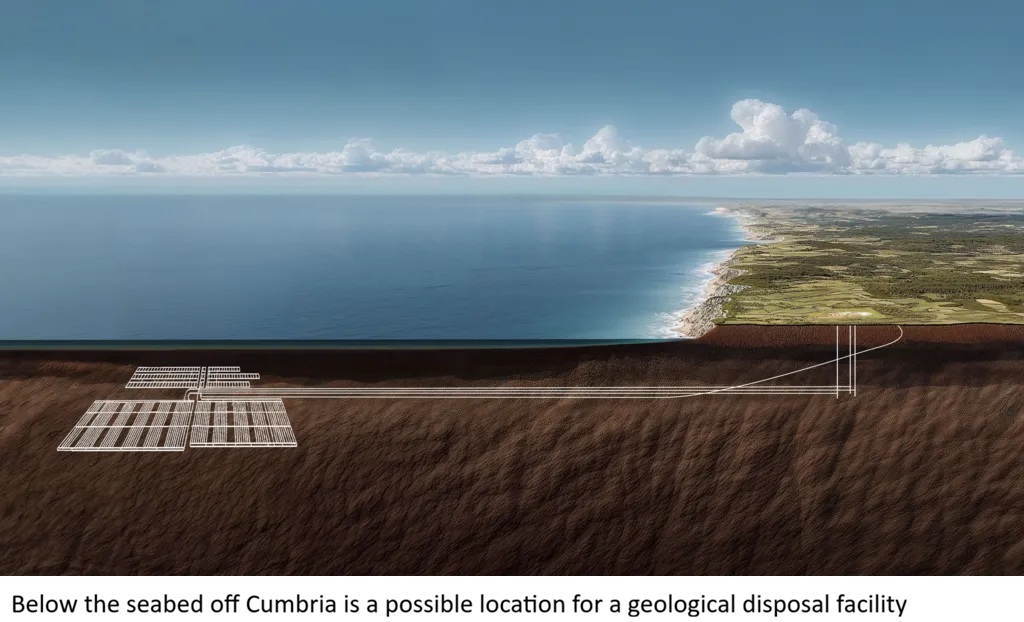
The government wants to build a geological disposal facility (GDF), an engineered structure of vaults and tunnels up to 1km (0.6 miles) below ground or beneath the seabed.
It would be used to dispose of the UK’s most hazardous radioactive waste, including spent fuel from nuclear power stations.
It could be ready to start receiving waste in the 2050s and cost between £20bn and £53bn in 2017-18 prices, according to a recent report by MPs.
Where will it be built?
The body in charge of the project, Nuclear Waste Services (NWS), has been searching for a “suitable site with a willing community”.
Parts of west Cumbria are now the only areas under consideration after Lincolnshire County Council withdrew from the process.1
Officials are now focusing on an area beneath the seabed off the Cumbrian coast and land near Seascale and Haverigg.
The government’s process for choosing a site specifies there must be a “test of public support”, showing the community is willing to host the facility, which could include a referendum, consultation or polling.
Choosing a site is expected to take 10 to 15 years.
Where is nuclear waste currently stored?
About 80% of the UK’s most hazardous nuclear waste is stored at Sellafield in West Cumbria, according to Sellafield Ltd.
NWS says moving it to a GDF would remove the need for “ongoing human intervention” and protect it from environmental changes like rising sea levels.
Why are some people losing patience?
The next stage of the GDF siting process involves detailed investigations into whether the geology of any potential sites is suitable, including deep borehole drilling.
NWS made a recommendation to the government in May about which community or communities should progress to this phase.
The recommendation has not been published and the ultimate decision will be made by the energy security and net zero secretary, Miatta Fahnbulleh.
Conservative Cumberland councillor David Moore, whose Gosforth ward includes Sellafield and Seascale, said the government had “promised” a decision before the summer parliamentary recess.
‘Important for people of Cumberland’
He said local people had been asking for updates but he had been unable to provide any.
“I’m frightened this community is going to get frustrated and walk away from the process,” he said.
The Labour leader of Cumberland Council, Mark Fryer, said: “We have stressed to government that we welcome a decision being made as soon as possible.”
He said the safe disposal of radioactive waste currently stored at Sellafield was “an important issue for the people of Cumberland”.
The National Infrastructure and Service Transformation Authority has rated the GDF project as “red”, meaning there are significant issues to address, while a recent report from the Office for Nuclear Regulation noted slowing progress due to government spending decisions.
A spokesperson for the department for energy security and net zero said: “We remain committed to geological disposal for the safe, permanent disposal of the UK’s most hazardous radioactive waste.”..
No comments yet.
1 This Month

Tell Congress: Prevent Nuclear Catastrophe in Iran

Tell Congress: Prevent Nuclear Catastrophe in Iran

Read the Public Inquiry Report, the Commissioners’ report, Surrendering Australia: The AUKUS Deception is available to download for free at aukuspublicinquiry.com. Or just watch the replay of the National Press Club Luncheon.
To see nuclear-related stories in greater depth and intensity – go to https://nuclearinformation.wordpress.com
Say No to NASA’s Reckless Nuclear Reactor on the Moon
-
Archives
- November 2026 (281)
- October 2026 (302)
- September 2026 (339)
- August 2026 (330)
- July 2026 (355)
- June 2026 (287)
- May 2026 (306)
- April 2026 (356)
- March 2026 (251)
- February 2026 (267)
- January 2026 (308)
- December 2025 (358)
-
Categories
- 1
- 1 NUCLEAR ISSUES
- business and costs
- climate change
- culture and arts
- ENERGY
- environment
- health
- history
- indigenous issues
- Legal
- marketing of nuclear
- media
- opposition to nuclear
- PERSONAL STORIES
- politics
- politics international
- Religion and ethics
- safety
- secrets,lies and civil liberties
- spinbuster
- technology
- Uranium
- wastes
- weapons and war
- Women
- 2 WORLD
- ACTION
- AFRICA
- Atrocities
- AUSTRALIA
- Christina's notes
- Christina's themes
- culture and arts
- Events
- Fuk 2022
- Fuk 2023
- Fukushima 2017
- Fukushima 2018
- fukushima 2019
- Fukushima 2020
- Fukushima 2021
- general
- global warming
- Humour (God we need it)
- Nuclear
- RARE EARTHS
- Reference
- resources – print
- Resources -audiovicual
- Weekly Newsletter
- World
- World Nuclear
- YouTube
-
RSS
Entries RSS
Comments RSS


Leave a Reply