Nuclear weapons – the elephant in the room in Ukraine peace talks

Europe can no longer host the nuclear chessboard of Russia and the US. Russian weapons in Belarus should be removed; as should the US weapons in six European countries.
euobserver, By Florian Eblenkamp, Zurich, 14 November 2026
American, Ukrainian and Russian negotiators have restarted peace talks with a limited agreement to swap prisoners of war.
But Jared Kushner, president Donald Trump’s envoy, says Washington is working on “a broader European security architecture” built on five goals: permanent security consultations, reliable crisis communications, greater military transparency, reciprocal measures to reduce escalation risks, and an enduring framework for long-term stability.
Russian foreign minister, Sergei Lavrov, agrees, calling for a wider European security arrangement before a deal to end the Ukraine war.
European capitals have been alarmed, and with reason.
The future security of a continent is being discussed with a government that is still bombarding Ukrainian cities every night. European governments are trying to insert themselves into the talks and seemingly now have US backing.
If a new order for Europe is being drawn up, Europeans should insist on writing into it the one word absent on Kushner’s list: nuclear.
It is a striking omission, because every one of his five goals is at heart a nuclear question.
Crisis communication, transparency and escalation risk matter so much precisely because this war is being fought – and tensions with Moscow are increasing – in the shadow of the bomb……………………………………………………………………
there are no guardrails. For almost a year, the United States and Russia have had no binding limits on their strategic arsenals.
Who nuclear deterrence really rewards
Nuclear deterrence is a contest over who is more believably prepared to kill millions. A system that pays out to whoever appears most reckless is not a source of stability. It is an incentive to aggression. A path to disaster.
This is why any settlement of this war matters far beyond Ukraine. If the terms of peace reward territory seized under nuclear coercion, the message will be heard by every would-be proliferator.
Europe must not copy Moscow’s playbook
Europe’s current response risks mirroring the logic it fears.
In March, president Emmanuel Macron announced the first increase in France’s nuclear arsenal in more than three decades and launched a still undefined “forward deterrence” concept.
Macron has also had himself photographed watching the test launch of a ballistic missile from a submarine accompanied with bellicose rhetoric, eliciting satirical comparisons with the North Korean leader Kim Jong Un………………………………………………………………
What Europe should put on the table
If Washington wants to talk about European security, Europe should answer with concrete nuclear demands:
First, declare nuclear threats inadmissible. In 2022, G20 leaders, following the lead of states that have joined the UN Treaty on the Prohibition of Nuclear Weapons, agreed that the use or threat of use of nuclear weapons is inadmissible. Any framework for European security should turn that principle into a binding commitment, with consequences for breaking it.
Second, Europe can no longer host the nuclear chessboard of Russia and the US. Russian weapons in Belarus should be removed; as should the US weapons in six European countries.
After that, interim verified limits to nuclear weapons must be agreed. Greater military transparency must mean warhead numbers and inspections, not just notifications of exercises.
Finally, the elimination of nuclear weapons must be anchored in law that already exists. The Treaty on the Prohibition of Nuclear Weapons, already signed or ratified by a global majority, bans not only the use and possession of nuclear weapons but also the threat to use them.
In three weeks, countries meet at the UN for the treaty’s first review conference. European governments that want a security order resistant to blackmail should be in the room, at the very least as observers.
Moscow and Washington cannot dictate Europe’s future. Neither should nuclear threats, whoever makes them. A peace that leaves the bomb as the final arbiter of borders is not a lasting peace. It is a pause before the next blackmail attempt. https://euobserver.com/248713/nuclear-weapons-the-elephant-in-the-room-in-ukraine-peace-talks/
COP31: Campaigners reject nuclear energy as climate solution

byJanefrances Chibundu, November 10, 2026, https://www.thecable.ng/cop31-campaigners-reject-nuclear-energy-as-climate-solution/
Campaigners at the 31st Conference of the Parties to the United Nations Framework Convention on Climate Change (COP31) have rejected nuclear energy as a solution to the global energy and climate crisis.
The campaigners, who staged a protest at the Blue Zone of the COP31 venue in Antalya, Turkey, holding aloft placards and banners bearing messages such as “Nuclear is no solution,” called for increased investment in renewable energy sources, particularly solar and wind power.
Rachita Gupta, an activist with the Global Campaign to Demand Climate Justice, told TheCable that the push for more electrification is creating renewed pressure for nuclear energy to fill gaps in energy access.
Murat Kurum, COP31 president, is pushing the 35×35 electrification goal, which seeks to increase the share of electricity in final energy consumption to 35 percent by 2035.
Gupta said nuclear power is being promoted despite the environmental and social consequences associated with uranium mining and nuclear waste.
“Most of this nuclear energy is being pushed on indigenous lands and it is our communities that are subjected to uranium mining and its devastating consequences,” she said.
She added that nuclear power is increasingly being promoted in countries like India and Japan, partly to provide electricity for energy-intensive industries such as artificial intelligence data centres.
Gupta added that the energy transition should instead prioritise renewable sources that can provide electricity to communities without reproducing what she described as the extractive model associated with fossil fuels.
“If there is a push for energy, the energy needs to be clean energy, renewable energy, and not a polluting energy like nuclear energy,” she added.
‘NUCLEAR REMAINS A WASTE PROBLEM’
Nuclear power plants are among the most capital-intensive energy projects to build. The International Energy Agency (IEA) said nuclear projects are difficult to finance because of their large scale, high upfront costs, long construction periods and technical complexity, with delays and cost overruns capable of significantly increasing the final bill. The agency said the long timelines can push the breakeven point for a new large reactor to 20 to 30 years after a project begins.
Gabriel Manyangadze, climate justice coordinator at the Southern Africa Faith Communities’ Environment Institute, said nuclear energy is often presented as a solution without sufficient consideration of its long-term consequences.
Manyangadze said South Africa’s experience with nuclear power demonstrates some of the challenges associated with radioactive waste management.
He said the country has struggled with the disposal of radioactive waste, raising concerns about the potential impact on surrounding communities and water sources.
He also questioned whether communities living near nuclear facilities are adequately prepared to respond to accidents.
Manyangadze said civil society organisations in South Africa previously challenged the government’s nuclear expansion plans in court.
According to him, the court ruled in 2017 that a proposed nuclear procurement agreement was unconstitutional and unlawful.
Manyangadze added that African countries should instead take advantage of their abundant solar and wind resources.
“Nuclear is very, very expensive, especially for countries in Africa or for developing countries,” he said.
“We have the sun and we can actually build our energy around renewables, the sun and the wind.”
‘NUCLEAR CANNOT SOLVE AFRICA’S ENERGY CRISIS’
Amos Wemanya, senior climate advisor at PowerShift Africa, said nuclear power is not the most appropriate solution to Africa’s energy deficit because millions of people on the continent still lack access to electricity.
He said nuclear projects typically require lengthy planning, construction and large financial investments, making them unsuitable for addressing Africa’s immediate energy needs.
“Millions of Africans don’t have electricity. These people must have electricity,” Wemanya said.
He noted that scarce public resources should instead be directed towards technologies that can deliver electricity more quickly, particularly solar power.
Wemanya said the continent’s geography also makes decentralised renewable energy systems attractive because many communities live far from major electricity grids.
He said solar and other renewable technologies could provide power to such communities without requiring the huge infrastructure and investment associated with nuclear plants.
“Nuclear is expensive. It is not possible to invest in an energy system that is not tailored for our situation,” he said.
The campaigners urged governments and financial institutions at COP31 to increase funding for renewable energy and prioritise energy systems that can expand access to electricity while reducing environmental and social risks.
Trump will have historic meeting with Xi, Putin in China to talk nuclear arms control
By Steven Nelson,. 13, 2026, https://nypost.com/2026/11/13/us-news/trump-will-have-historic-meeting-with-xi-putin-in-china/
WASHINGTON — President Trump will hold a historic summit with Chinese President Xi Jinping and Russian President Vladimir Putin next Thursday on the sidelines of the annual APEC conference in Shenzhen — with the discussion expected to focus largely on developing an ambitious nuclear arms control pact.
It will be the first-ever trilateral meeting between leaders of the three countries.
A White House official told The Post that discussions in the Chinese boomtown near Hong Kong also could touch on the war in Iran and North Korea.
The summit was first reported by The Post and later described to a broader group of reporters on a Friday evening call previewing Trump’s trip next week to Asia, which will feature an initial stop in the Philippines.
Trump hasn’t met with Putin in person since a summit last August in Alaska focused on his efforts to broker an end to the war in Ukraine, a topic that one US official said was unlikely to be raised in Shenzhen.
Trump hosted the Chinese leader at the White House in September, showing Xi a framed photo of himself on the West Wing’s wall and praising the strongman’s knowledge of stone after viewing Trump’s new granite helipad.
Zelensky’s Reported Rejection Of An Alleged Early 2023 Peace Deal Is Incriminating

Andrew Korybko, Nov 11, 2026, https://korybko.substack.com/p/zelenskys-reported-rejection-of-an
Zelensky’s fateful decision was responsible for killing an unthinkable number of Ukrainians over the intervening nearly four years, and if Trump is serious with his claims of wanting to stop the killing, then he can cut Ukraine off to force Zelensky into peace and therefore save the country from him.
Ukrainian lawmaker Alexey Goncharenko, who was recently placed on Myrotvorets’ de facto “kill list” for floating a detailed peace proposal, confirmed the Financial Times’ report last month alleging that Zelensky rejected a peace deal with Russia in early 2023. According to him, the terms would have essentially mirrored those of spring 2022’s peace talks that were sabotaged at the time by the UK (and Poland), which is very generous if true since it would have entailed significant compromises by Putin:
“Russia withdraws its troops from most of the four oblasts it had just declared ‘annexed.’; The new line of demarcation runs roughly along the line as of February 24, 2022: Crimea and the part of Donbas that Russia controlled before the full-scale invasion; Ukraine recognizes Russian control over Crimea; Ukraine grants Russia an unobstructed land corridor to Crimea; The ceasefire regime is guaranteed by NATO countries that provide protection for Ukraine; Russia begins negotiations with the US on its own security guarantees.”
Leaving aside the veracity of this hitherto undisclosed peace deal that Goncharenko presented himself as having corroborated, the importance rests less in whether all the details are true and more in the fact that Zelensky is now faced with much worse terms nearly four years later after rejecting those putative ones. The timing of these claims by the Financial Times and one of his country’s own lawmakers, neither of which friendly to Russia by any measure, couldn’t have been worse for Zelensky.
“Trump Is More Serious Than Ever About Cutting Deals With Putin”, part of the reason being that he wants to tap into “The Five Most Promising Russian-US Economic Opportunities”, to which end he and Elon Musk are suspected of having throttled Starshield and Starlink respectively to pressure Zelensky. Given the indispensability of these satellite communication systems to Ukraine’s war effort, the message sent was that they could let the frontlines collapse if he doesn’t soon agree to a peace deal with Putin.
The grand trade-off could include freezing the frontlines in exchange for a US-brokered energy deal between Russia, the EU, and Ukraine as the quid pro quo for the Kremlin allowing the deployment of European peacekeepers to Ukraine without the US’ Article 5 protection. Other issues like the size of Ukraine’s post-war armed forces and the rights of its Russian minority would be discussed later. Putin might already be onboard, but Zelensky certainly isn’t, ergo why Trump has had to pressure him.
Zelensky fatefully decided to keep fighting in spring 2022 at the cost of an unknown number of Ukrainian lives that’s nevertheless estimated to be significant, but instead of accepting basically the same terms a year later, he thought that he’d get better ones after that summer’s counteroffensive. It ultimately failed, after which he probably could have returned to the aforesaid terms, but he then decided to keep fighting indefinitely despite the military-strategic dynamics having resolutely shifted against Ukraine since then.
So many Ukrainians have died because Zelensky remains deluded with dreams of inflicting a strategic defeat upon Russia, thus resulting in a sunk-cost fallacy that combined with the conflict’s profitability to indefinitely perpetuate it at an unthinkable cost to his country. If Trump has the political will, then he can cut Ukraine off to force Zelensky into peace and therefore save the country from him, otherwise this will remain a forever war that’ll kill countless more Ukrainians. It’s up to Trump whether that’ll happen.
Stop Rejoicing! The Next Wave May Not Be Blue

Donald Trump grasped the resentment simmering beneath American politics better than many professional politicians.
The man who promised to drain the swamp came to personify its excesses.
The Democrats cannot defeat Trumpism permanently by simply offering a more polite version of the same rigged economic arrangements.
Voters did not send Democrats to Washington to restore the way things were before Trump. They sent them to tear down the system that produced him. But Democrats are already misreading the mandate.
November 13, 2026, Blake Fleetwood ScheerPost
The blue wave was a desperate demand to overthrow the status quo
Democrats should put away the champagne. Forget the victory laps, the self-congratulation, the triumphant television appearances and the inevitable declarations that the American people have finally come to their senses.
Yes, the midterm elections delivered an extraordinary Democratic victory. The party administered a humiliating rebuke to Donald Trump.
But do not misinterpret the mandate. Voters did not reward Democrats because they trust them. They used them as the nearest available weapon against the man in charge. Just this spring, only 28 percent of Americans viewed the Democratic Party favorably in a CNN poll,
But Democrats should be asking themselves a profoundly uncomfortable question:
Did Democrats win, or did Donald Trump lose?
The exit polls point to the second answer. About 60 percent of voters disapproved of Trump’s job. Roughly three in four said they were dissatisfied with the country’s direction, and nine in ten said the cost of living weighed heavily on their vote. These are the numbers of an electorate in revolt against whoever holds power, not one that has fallen back in love with the opposition.
Are Double Haters the Majority?
The growing double-hater phenomenon provides an enlightening insight into recent elections. It can certainly be postulated that the majority of Americans have become “double haters”- voters and non-voters who dislike the Democrats and Republicans status quo over the last 40 years. Democrats have 27 percent of the electorate; Republicans have roughly the same number.
Independents have grown quickly to 46 percent of voters. A 2024 poll found that 26 percent of voters held unfavorable views of both Biden and Trump. Up to 40% of eligible voters do not vote, many of whom are double-haters and convinced their votes will not change anything. The US trails 31 other countries in voting participation among 49 nations.
The question is: do double-haters represent temporary dissatisfaction with individual candidates or a more enduring crisis of confidence in the workings of America’s two-party political system and what it is doing to help or destroy the lives of ordinary Americans?
The Democrats have to understand the populist anger that propelled Trump to win the presidency twice.
Trump was prescient. He didn’t create the anger; he didn’t start the fire, but he recognized it, jumped ahead of the parade, and exploit on ed it.
In 2016 and again in 2024. While Democratic strategists were parsing suburban swing voters, he was talking to people in shuttered factory towns with overdrawn checking accounts who believed, with good reason, that the system was rigged against them.
But his diagnosis was right. Democrats spent a decade arguing with the patient instead of treating the disease.
Voters did not send Democrats to Washington to restore the way things were before Trump. They sent them to tear down the system that produced him. But Democrats are already misreading the mandate.
A party that mistakes a rejection of its opponent and the status quo for an embrace of itself is setting itself up for the next wave, and the next wave in 2028 may not be blue.
A Nation Desperate for Change
The American electorate has been trying to deliver the same message for decades. It has little faith in the political establishment, little confidence that either party represents its economic interests, and an increasingly desperate conviction that the American system, which brought us so much prosperity after World War II, is fundamentally broken and rigged against them.
For generations, both parties presided over an economy that stopped sharing its gains with ordinary people. From 1979 to 2020, American workers’ productivity rose about 62 percent, according to the Economic Policy Institute. The hourly pay of a typical worker rose about 17.5 percent. The difference did not vanish. It flowed to shareholders, executives, and the top of the income ladder.
And unless Democrats quickly address these underlying causes, the country will eventually sink into more division and lead to another populist autocrat — perhaps one more disciplined, more intelligent, and far more dangerous. This is how democracies die.
Consider the extraordinary political whiplash of the past two decades.……………………………………………………………………………………………………………………………………………………………………………………………
Decades of failure, with both parties’ fingerprints
The rot did not start with Trump, and Democrats cannot pretend their hands are clean.
This is the great economic betrayal of middle-class America.
Republicans championed tax reductions for the wealthy, deregulation, and the systematic weakening of organized labor.
Democrats increasingly embraced Wall Street, corporate globalization, and the financial interests of their major donor paymasters……………………………………………………………………………………..
The Richest Country in the World Is Failing Its Citizens
Consider America’s dismal statistics compared with other prosperous democracies.
The United States spends more on health care than any other wealthy nation, yet 500,000 generally die younger, needlessly, every year, than those in comparable countries.
A 2026 Commonwealth Fund report found that Americans are more likely to forgo medical treatment because of its cost and have fewer primary care physicians per capita than many international peers.
The United States also performs poorly on several international measures of educational achievement………………………………………………………………………………………….
Donald Trump grasped the resentment simmering beneath American politics better than many professional politicians……………………………………………….
The man who promised to drain the swamp came to personify its excesses………………………
The Democrats cannot defeat Trumpism permanently by simply offering a more polite version of the same rigged economic arrangements.
The Democratic Party Must Confront Its Own Oligarchy of Donors……………………………………………………….
America Needs Another Franklin D. Roosevelt………………………………………..
Stop Financing Endless Wars While America Falls Apart………………………………………………………………………https://scheerpost.com/2026/11/13/stop-rejoicing-the-next-wave-may-not-be-blue/
Mystery surrounds Navy’s secret purge of entire nuclear submarine leadership team after collision
The Navy has quietly removed several top
officers recently, breaking from its usual practice of public
announcements. Congress has accused the Navy of keeping it in the dark
about the dismissal of an entire submarine leadership team following an
underwater collision.
Independent 13th Nov 2026, https://www.independent.co.uk/news/world/americas/navy-congress-south-dakota-submarine-firings-b3084318.html
Dublin summit: European leaders double down on the Zelensky disaster

Tarik Cyril Amar, Thu, 12 Nov 2026, https://www.sott.net/article/509429-Dublin-summit-European-leaders-double-down-on-the-Zelensky-disaster
With Moscow absent and peace efforts elsewhere advancing, the gathering was just a show of stubborn loyalty to a failing proxy war.
Let’s start with the obvious, which, oddly enough, remains largely unnoticed: If the summit of the European Political Community (EPC), a formally informal gathering that brings together the high and mighty of NATO-EU Europe plus friends, was serious about reflecting Europe, then Russia (and, by the way, Belarus, too) would have been invited.
The fact that Moscow is not present is, once you think about it, a striking anomaly, even if Western mainstream media framing has been quite effective at making the obviously strange appear to be the new normal.
Russia’s longstanding exclusion is, of course, also very telling. At the risk of re-stating the obvious, it reflects NATO-EU Europe’s fundamentally flawed, catastrophically costly (including for Ukraine), and very obstinate policy of waging a proxy war against Russia, while using up Ukraine and Ukrainians.
It’s a shame: Europe could have been the ideal framework for preventing, or at least quickly ending, the Ukraine War by offering honest mediation, facilitating real compromise, and, last but not least, helping review and revise a continental security structure destabilized and, in effect, ruined by a reckless NATO expansion based on brazen Western cheating.
Yet, unsurprisingly, NATO-EU Europe has always done the opposite: from being too arrogant to listen to Russian President Vladimir Putin’s clear warning in Munich in 2007, through the foul compromise of the Bucharest summit one year later and the perfectly misguided EU Association Agreement designed to force Kiev to make an impossible choice between the EU and Russia, to taking over from Washington as the main proxy war promoter and key obstacle to peace – NATO-EU Europe has a consistent record of making things go awfully wrong and then making them worse and worse again.
If only Washington had really fully retreated from the proxy war! Perhaps the war would be over already, and many Ukrainians and Russians would still be alive.
Yet Macron’s slightly hysterical misreading of US behavior does betray something very real, namely an acute and deep sense of abandonment among Washington’s vassals. One day, probably far in the future, some of them may even begin to draw the correct conclusions from it.
But today is not that day. Instead, it seems that the Dublin summit’s main message regarding its proxy war and the authoritarian, man-hunting, ultra-corrupt Zelensky regime deployed to manage it on the ground is “stay the course.”
Halfway self-respecting proxy war sponsors would long have refused to touch Zelensky with a bargepole – “here’s the money but we really can’t be seen with you” – due to his regime’s outrageous and essentially open embezzlement of their funds (they do not care about his massive brutalization of ordinary Ukrainians, it goes without saying). Not a week goes by without another “Mindich,” “Carthage,” “Khimprom,” or “Sokolov” mega-scandal.
Halfway self-respecting proxy war sponsors would long have refused to touch Zelensky with a bargepole – “here’s the money but we really can’t be seen with you” – due to his regime’s outrageous and essentially open embezzlement of their funds (they do not care about his massive brutalization of ordinary Ukrainians, it goes without saying). Not a week goes by without another “Mindich,” “Carthage,” “Khimprom,” or “Sokolov” mega-scandal.
What may be even worse, Zelensky is also permitted – or, most likely, encouraged, for instance by his most submissive fan, German Chancellor Friedrich Merz – to publicly gripe at a recent key shift in serious diplomacy about ending the Ukraine War: alert to dangers to his income streams, power, and political survival, Ukraine’s de facto dictator has used Dublin to complain about, in essence, Washington’s apparent willingness to finally take seriously Russia’s demand for a comprehensive review of security structures. And yet without that, peace won’t come.
Zelensky’s unshaken – at least in public – permission to play dissatisfied-consumer-from-hell and berate his sponsors is even more remarkable as the Dublin summit is being held against an international context with which it clashes profoundly. Consider a few places and what they stand for regarding the Ukraine War: Abu Dhabi, Moscow, and, soon probably, Shenzhen. Different as the specific formats are or will be, what they all have in common is that real if not yet successful work is done or likely to be done there to bring peace about.
And yet, quite like their creature Zelensky, the NATO-EU establishments resist precisely that outcome. It is true that we are seeing signs of – auspicious – disunity. Norway and Finland, for instance, have emitted weak but intriguing signals of rediscovering a sense of reality.
Yet, overall and as of now, Dublin shows us another, still dominant side of NATO-EU Europe: too weak and too submissive to Washington to be a power on its own in the emerging multipolar order, but hellbent to use all its resources to be a spoiler. It is sad to have to say this as a genuine European, but NATO-EU Europe is a caricature of our common identity. If there’s hope, it lies in its weakness.
Tarik Cyril Amar is a historian and expert on international politics. He has a BA in Modern History from Oxford University, an MSc in International History from the LSE, and a PhD in History from Princeton University. He has held scholarships at the Holocaust Memorial Museum and the Harvard Ukrainian Research Institute and directed the Center for Urban History in Lviv, Ukraine. Originally from Germany, he has lived in the UK, Ukraine, Poland, the USA, and Turkey. He is working at Koç University, Istanbul, on Russia, Ukraine, and Eastern Europe, the history of World War II, the cultural Cold War, and the politics of memory. Find him on Twitter; @tarikcyrilamar Substack: tarikcyrilamar.substack.com and on his own page: www.tarikcyrilamar.com
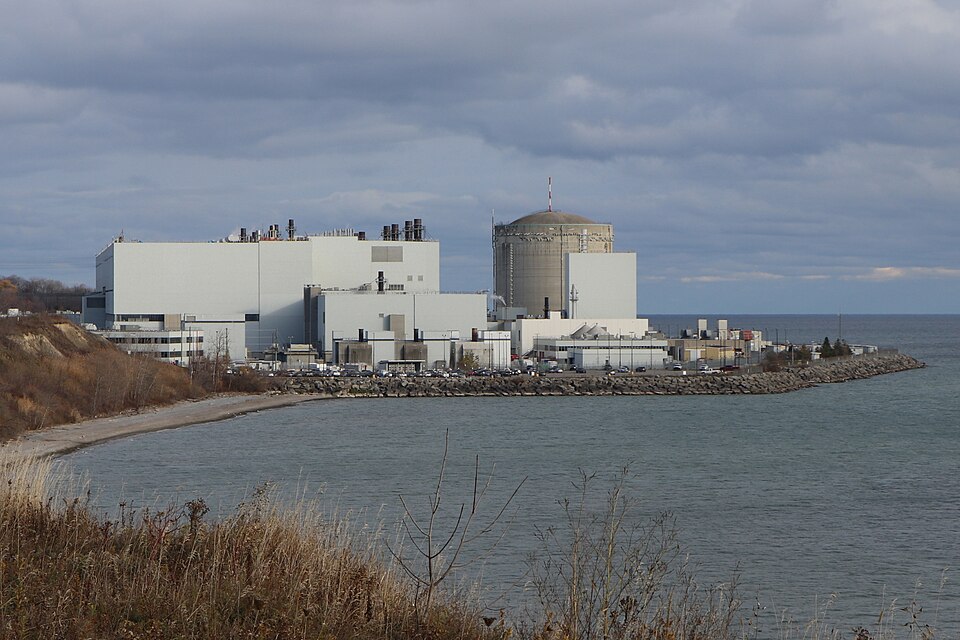
Ontario spent nearly $13-billion and 20 years refurbishing the Darlington nuclear station. Why has it struggled?
“These reactors were fine when they were designed in the 1960s. Their time is gone. No reason to refurbish them … we should junk these things.”
Matthew McClearn, 13 Nov 26, https://www.theglobeandmail.com/business/article-ontario-refurbish-darlington-nuclear-station-why-has-it-struggled/
The cavernous turbine hall at the Darlington Nuclear Generating Station is more than half a kilometre long. In late October, the plant’s Unit 3 was nearing the end of a prolonged outage. Green covers had been placed back on its turbines and workers were already laying down materials near Unit 2’s yellow turbines in preparation for an outage next year.
Freshly emerged from an extensive overhaul that took 20 years and cost $12.8-billion, the nuclear station in Clarington, about 70 kilometres east of Toronto, is not yet purring like a kitten. Unit 3’s outage is merely the first in a series the station’s owner, Ontario Power Generation, has planned over the next several years. In addition, the station suffered several unexpected outages this year caused by leaking pipework, faulty pumps and other problems. During August, when Ontario’s electricity demand typically nears its annual peak, just one of Darlington’s four units was operating.
OPG and Ontario’s government promised the refurbishment would position Darlington for 30 years of reliable service. It’s too early to know whether its recent unplanned outages amount to teething pains, or indicate deeper reliability challenges of the sort that have plagued other refurbished stations featuring Candus, the country’s homegrown reactors. But OPG plans additional, lengthy outages over the next few years to replace equipment that was not addressed during the refurbishment – work Ontarians will pay for through their utility bills.
Nuclear stations are enormously complex machines; it would be unreasonable to expect one to continue operating for years on end with little more than occasional oil changes. But the billions of additional spending planned at Darlington are worth keeping in mind as OPG embarks on a $26.8-billion overhaul in Pickering, about 40 kilometres east of Toronto. It’s the most expensive refurbishment of a Candu station ever contemplated.
The refurbishment dilemma
To venture inside Darlington is to be confronted with a dizzying puzzle of wires, pipes, ducts tanks and stairwells. Crews attend to daily tasks in the stationʼs hot, noisy bowels, co-ordinated from an office adjacent to the control room. Theyʼre monitoring wear-and-tear and plotting when and how to intervene, often years in advance.
Developed during the 1950s and 60s, the Candu’s unique design allowed it to consume natural uranium, and had the added benefit that Canadian manufacturers could build almost every part of it.
But the Candu’s design had significant maintenance consequences. Most of the world’s reactors feature a robust, thick-walled cylindrical structure called a pressure vessel. A Candu core, in contrast, contains thousands of much thinner pressure tubes, each with its own fittings on either end, and pipes conveying water in and out known as feeders – the stuff of plumbers’ nightmares.
Pressure tubes deteriorate and weaken over time, eventually reaching the point when they’re unsafe to continue operating. David Keith, a physicist and professor of geophysical sciences at the University of Chicago, said the Candu’s elaborate piping and numerous connections make it inherently more costly and challenging to maintain than other reactors.
OPG has asserted that Darlington’s cables, laid end-to-end, could stretch to the moon and back. A single unit can have well over 100,000 components. Using inspections, experience and intuition, utilities must decide what to replace, rebuild or leave be.
Steam generators, which faintly resemble giant light bulbs and use the reactor’s heat to produce steam, are among the big-ticket items of Candu plants. Replacing them requires massive cranes to lift them out through holes cut in the powerhouse roof.
Nuclear units each have their own generator and set of turbines, which harness steam to produce power. These complex machines, too, wear down over decades of use.
Even a limited nuclear overhaul can be more expensive than building brand new conventional power plants. On the other hand, the plant will be offline for years and much of it will already be disassembled, allowing workers to reach normally inaccessible components. Misjudgments about equipment longevity can lead to lengthy, expensive outages.
Sunil Nijhawan, a reactor safety expert who once performed consulting work for OPG and foreign Candu owners, said the term “refurbishment” can be misleading because so much of the plant is left untouched.
“Refurbishment is a misnomer because you have replaced only a small part of the total system, whose original cost was only a small fraction of your whole reactor’s cost. There are 20 other systems which are obsolete and old.”
A legacy of misjudgments
New Brunswick’s Point Lepreau was among the first Candu stations to undergo refurbishment, completed in 2012 following massive cost overruns and delays. Just like OPG, NB Power expected it would be rewarded with 30 years of reliable service.
There’s no longer any doubt that refurbishment was botched. NB Power officials have acknowledged that it focused mainly on restoring the reactor. Less attention was given to turbines and other components in the plant’s “conventional” side. Point Lepreau consequently suffered a series of lengthy outages, rendering the utility incapable of paying down its sizeable debts, which it had been ordered to do by the provincial government.
OPG studied previous refurbishments before attempting Darlington. It nonetheless faced difficult calls. For example, Darlington’s steam generators are far larger than those at other Candu stations, so replacing them would be even more daunting.
Instead, OPG opted to inspect and clean them using a process called “water lancing.” In a 2018 video, Michael Allen, OPG’s on-site leader at Darlington, declared that Unit 2’s “are in excellent condition. They’ve been cleaned and prepared for 30 more years of service.”
Nuclear stations are enormously complex machines; it would be unreasonable to expect one to continue operating for years on end with little more than occasional oil changes.Sammy Kogan/The Globe and Mail
A different picture emerged after OPG began refurbishing Unit 3. Each steam generator contains more than 100 components known as primary moisture separators, located in the bulbous section at its top. They’re crucial for supplying dry steam to the turbines, but Unit 3’s had deteriorated. OPG decided to replace them in all of four units, costing hundreds of millions of dollars.
Further surprises awaited once OPG had turbines and generators apart for inspection. Components inside the generators of Units 1 and 2, known as stators, had suffered damage; those repairs are expected to cost $300-million.
Most consequentially, OPG determined turbine rotors in all four units must be replaced. The first, Unit 3, is scheduled to begin in 2029. The tab for the first three units: $2-billion. (There’s a silver lining: OPG expects this work will increase each unit’s output by a minimum of 21 megawatts, which combined would be enough to power roughly 80,000 homes.)
Some of this additional work was completed during the refurbishment, and some was pushed into future outages. But none of it was added to the refurbishment budget; rather, it was paid for from OPG’s budget for sustaining capital.
This allowed officials, including Ontario’s Energy Minister Stephen Lecce, to present the refurbishment as an unqualified success. “Darlington refurbishment was nearly 5 months ahead of schedule and $150M below budget,” he declared in a social media post in September.
But OPG estimates it will spend $3.5-billion over the next few years on the additional maintenance at Darlington. That spending has already begun: For the nine months ended Sept. 30, OPG reported that capital spending had increased by $386-million over the same period last year, largely reflecting additional work at the station. OPG seeks to recover that from consumers through increased rates.
The Association of Major Power Users in Ontario represents industrial consumers. Its president, Brad Duguid, says there’s “no question” OPG’s capital investments will significantly raise rates over the long term. That spending is necessary to preserve reliability, he added, so his organization doesn’t oppose it. But he called on the provincial and federal governments to direct taxpayer support to help mitigate rate increases.
Ibrahim Attieh, a reactor physicist who once worked on designing Candu reactors, describes the additional work at Darlington as “refurbishment by stealth.”
“‘Ahead of schedule and under budget’ is a bogus claim,” Dr. Attieh said.
The road ahead
Moving through questions about Darlington’s unplanned outages during a Sept. 2 hearing, Canadian Nuclear Safety Commission president Pierre Tremblay (who once served as OPG’s chief nuclear operating officer and was responsible for the operation and maintenance of its nuclear plants) observed: “You know, the expectation is a unit coming out of refurbishment would have pretty high reliability.”
Not necessarily.
David Novog, a professor of engineering at McMaster University who specializes in nuclear safety and maintenance, said failure rates of complex systems such as nuclear plants often follow a “bathtub-type curve.” There can be an initial period during which new equipment fails at a higher rate. It can be followed by a “random mode” during which the probability of failure is constant (and hopefully low.) This can be followed by a “wearout” mode in which failures increase again.
Students are taught the “bathtub” concept to illustrate broad trends in reliability, but patterns in individual systems vary, Dr. Novog wrote in an e-mail.
“I don’t think there is enough data to draw any conclusions from the [Darlington] events as yet.”i
OPG expected initial hiccups. Its business plan anticipated “reliability outages” following Darlington’s refurbishment, with the station reverting to historical performance by 2028. If achieved, this year’s mishaps might soon be forgotten.
Allan Grace, OPG’s senior vice president for Darlington, said Unit 4 suffered more problems than expected after returning to service. But he pointed out Darlington’s other units have so far performed much better.
One hallway inside Darlington is lined with plaques from the Institute of Nuclear Power Operations recognizing “excellence in nuclear power plant performance.” Those are awarded bi-annually after intrusive inspections from a couple dozen foreign experts, he said.
“It’s effectively 15 years we’ve been at the top echelon of power plant operations for North America,” he said, adding that utilities from other countries regularly seek out OPG’s experience before overhauling their own stations.
“People want to come and see how we’ve done it, because not many other utilities have come even close.”
Bruce Power, an independent power producer which is in the middle of an extensive overhaul at its Candu station along Lake Huron’s eastern shore, reports that the first refurbished unit (Unit 6) has shown “excellent performance” since its restart in 2023. Such is the company’s confidence that it’s expecting overhauled Bruce units will run for up to 35 more years.
The four Pickering B units east of Toronto shut down in late September for their own overhaul. The budget for that, $26.8-billion, was approved by the province in November 2025. That is as much as the combined budgets for refurbishing 10 larger units at Bruce and Darlington. The Pickering units are expected to return to service by the mid-2030s.
OPG previously decided against refurbishing Pickering B because its board of directors warned the units were at significant risk of performing poorly once returned to service, with high operating costs.
In its latest rate application, OPG reported that “very limited sustaining work” had been done at Pickering in the run-up to what was long expected to be its permanent retirement in 2024. (That year, it spent just $6.7-million on station maintenance.)
OPG now plans a lot of additional work at Pickering to renew infrastructure “that is not required for refurbishment but nevertheless needed to support reliable, safe operations during Pickering’s second life.” This work is expected to cost more than $900-million over the next few years.
Dr. Nijhawan said refurbishing Pickering will be tremendously lucrative for the companies involved. But if the station lasts as long as OPG hopes, he added, “it’ll be 90 years old. No concrete structure is designed to last that long, nor any wiring, nor any of these other vessels.
“These reactors were fine when they were designed in the 1960s. Their time is gone. No reason to refurbish them … we should junk these things.”
COMMENTS
Read more: Ontario spent nearly $13-billion and 20 years refurbishing the Darlington nuclear station. Why has it struggled?- B.B.S.H9 min agoNuclear costs more and takes longer to build than any other system.Nuclear requires extensive, expensive maintenance.Nuclear produces forever toxic waste.Nuclear Fission plants are obsolescent technology; oversold!For far less money, Ontario can invest in renewables with storage.Quietly reliable, long lasting; more responsive to the grid.Nuclear has bamboozled no-nothing politicians for far too long.Time to make the sensible change to current technology.Somebody explain this to Doug Ford;Please!Read morereply0sharereport
- Comment by James Bolt.JBJames Bolt22 min agoRefurbishment and maintenance were never accurately estimated during the sales pitch era.They were wrong.reply1sharereport
- Comment by xcumbrian.xcxcumbrian34 min agoIt looks like most of the problems have nothing to do with the nuclear end. All power stations incorporate essentially the same ancillary equipment, the only difference is how the heat is generated.I am surprised the turbine problems had not been picked up during routine maintenance.After any major refurb you expect teething issues. Take the time to do the work properly and things will work out.It is a good idea to address equipment that looks OK now but future failure could impede production. Take your lumps now.Read morereply3sharereport
- Comment by app_76601493.apapp_7660149356 min agoThose who are thinking of buying electric cars, “THINK TWICE”. Brace yourself for the hefty electricity price increase and near future unreliable power outages!reply3 replies1sharereport
- Reply by James Bolt.JBJames Bolt24 min agoReply to app_76601493As my gas prices jump from $1.50 to over $2.00 in a week my electricity price remains the same.reply2 replies3sharereport
- Reply by Wilkins_P.WiWilkins_P17 min agoReply to James BoltElectricity prices are regulated in most jurisdictions. Gasoline prices vary wildly according to global events.reply2sharereport
- Comment by app_78073423.apapp_780734231 hr agoThe feds continue to support Candu technology even thought the world is committing to light water reactors. 85% of the world’s reactor fleets are LWR. 11% for Candu. I get wanting to support Canadian technology etc., but we are throwing good money after bad at this stage.reply2 replies1sharereport
- Reply by Wilkins_P.WiWilkins_P56 min agoReply to app_78073423Recent light water reactor builds in Europe have gone way over budget. They need enriched uranium. We know how to build, refurbish and operate Candus.reply1 reply4sharereport
- Reply by S_C74.S_S_C7445 min agoReply to Wilkins_PAnd all according to the Iron Law of megaprojects: “Over budget, over time, under benefits, over and over again.”reply1sharereport
- Comment by Cameron Conroy.CCCameron Conroy1 hr agoThe cost of nuclear is a good reason to promote green power as a supporting energy source.reply3sharereport
- Comment by PHILCO3.PHPHILCO31 hr agoExcellent journalism. Keep it up.Ontario plans to spend $100 billion on new and refurbished nuclear capacity.But there is very little public understanding about the efficacy of this complex and costly technology. Just, ‘trust us, we got this’ from the Ford govt.The nuke industry, the thousands of construction workers and the banks (up to 40% of overall cost of these mamouth builds goes to interest payments on money borrowed to build them) are all licking their lips in aticipation of the King Midas windfall profits to be made.But as the nuclear safety specialist says in the article:”Their time is gone. No reason to refurbish them … we should junk these things.”Read morereply6sharereport
- Comment by Joe9047.JoJoe90472 hrs agoIt seems likely that parts of the unit 3 sat idle for years without being properly mothballed.reply1sharereport
- Comment by Douglas333.DoDouglas3332 hrs agoI have a question. In a nuclear-dependent future, what is the backup plan for nuclear plant failures? Spare nuclear plants? I have another question. If we electrify the heating of buildings in an effort to decarbonize our energy system, how will we supply the resulting winter peak, with nuclear plants that sit idle the rest of the year? It seems like a technology that is not fit for purpose.reply4 replies1sharereport2 older repliesshow older replies
- Reply by Wilkins_P.WiWilkins_P1 hr agoReply to Douglas333Ontario’s demand peak is hot summer days. Reactors run constantly. Gas and hydro vary according to demand. Nuclear has proven itself in Ontario over the last 50 years.reply1 reply4sharereport
- Reply by Douglas333.DoDouglas33325 min agoReply to Wilkins_PBut if we electrify buildings in an effort to decarbonize the economy, the resulting winter peak will be much larger (and longer) than the summer peak in every part of Canada, even allowing for hotter weather and more air conditioning. Right now in most parts of Canada we meet that seasonal heating demand with gas furnaces that sit idle in the off-season. As that heating load moves to the grid we will need an emission-free generating source with low capital cost and that does not cost too much to maintain in the off season. Wind beats out nuclear on that criterion.Read morereply0sharereport
- Comment by foolonahil.fofoolonahil2 hrs agoReactors use closed loops for generating power. Biggest one of the plant? Government Funds. Money poured in. Much of which is poured back out for paying people. Paying for stuff. Gets recycled back via taxes. Oh, almost forgot. Usually, but sometimes not, a corollary benefit. A service or goods. Here? Electricity.Politicians don’t see a dollar the way of a investor. We want to see a profit. They? All about spending and spreading. Tossing billions of taxpayer dollars at Darlington? Most eventually loops back to the provincial coffers. editedRead morereply0sharereport
- Comment by app_74080768.apapp_740807682 hrs agoBruce, a private sector entity, seems to have figured this out, bringing in its most recent refurbishment under-time and under-budget. Sadly, all these cost overruns will ultimately be reflected in Ontario power rates rendering the province’s cost-sensitive manufacturing sectors even more disadvantaged.reply3sharereport
- Hampson072 hrs agoAnother excellent and very informative article by Mr. Mcclearn. Two thumbs up! Our province is going in the wrong direction on nuclear power.reply5sharereport
- Comment by kidspeed.kikidspeed2 hrs ago”Leaky pipes” and “faulty pumps” on today’s refurbishment. Are the parts still all manufactured in Canada, or are we importing?Science and engineering, and the education thereof, is not what it was in the 50s, 60s, 70s. Students were homegrown. Regularly scheduled trips to the moon stopped in 1972.Can’t do it anymore.reply1 reply3sharereport
- Reply by CanadianTaxPayingCitizen.CaCanadianTaxPayingCitizen1 hr agoReply to kidspeedThere was no point in going to the moon. There is still not a good reason.reply1sharereport
- Comment by Wilkins_P.WiWilkins_P3 hrs agoA Candu core has up to 480 pressure tubes, not “thousands”. Pressurized vessel reactors have experienced major cost overruns in Europe. They also use steam turbines and would not be immune to the turbine problems seen at Darlington.reply7sharereport
- Comment by stewf.ststewf3 hrs agoThey struggled with completing and getting Darlington on line the first time. The debt from this build was one of the reasons for Mike Harris breaking up Ontario Hydro. Pickering is so antiquated that any attempt to refurbish it will be a nightmare logistically and financially. It literally is 1960’s technology that hasn’t been refurbished since the 1980’s.reply1sharereport
- Comment by Albert74.AlAlbert743 hrs agoRoof top solar on every home and industry that will take it. Reduce the demand for OPG produced electricity. Way cheaper for everyone. Subsidize batteries for home use during the night. Off grid was our best decision ever at our recreational property.reply5 replies5sharereport3 older repliesshow older replies
- Reply by patterk.papatterk32 min agoReply to Douglas333Note that Denmark consumes less than half of what we consume in terms of kWh per capita. It also has the ability to import power from several other countries. Still 70% is impressive but it gets increasingly difficult to replace fossil fuels for the remaining 30%. Canada as a whole gets only 20% of its electricity from fossil fuels.reply1 reply1sharereport
- Reply by Douglas333.DoDouglas33321 min agoReply to patterkYes, I should have mentioned the important roles that efficiency and productivity play in the Danish story. European energy productivities are generally well ahead of Canada, especially in Scandinavia, something else we should try to emulate. I think if we had true cross Canada connectivity (a coast to coast high voltage HVDC line) the supply issue would get a lot easier for the carbon-challenged provinces. There is an analogy here to Denmark’s imported electricity, which comes mainly from Norway and Sweden and has lower emissions than Denmark’s domestic supply.editedRead morereply1sharereport
Emergency incident at Rolls-Royce nuclear site as staff told ‘stay inside’
Emergency services responded to an incident at a Rolls-Royce site in Derby this afternoon, with local residents told to stay inside and keep their doors and windows closed
Zahra Khaliq News Reporter and Rucsandra Moldoveanu Live News Reporter, .https://www.mirror.co.uk/news/uk-news/rolls-royce-raynesway-emergency-derby-37872335
Residents living near a Rolls-Royce site in Derby were urged to keep their doors and windows closed as emergency services responded to an incident earlier
Derbyshire Fire and Rescue Service was called to the scene on Raynesway shortly after 4pm today. They arrived after alarms blared across the site, alerting residents in surrounding areas..
Police and ambulances were spotted outside the factory, while a number of roads surrounding the building were closed, reports Derbyshire Live. Staff had been asked to stay inside the building as a precaution while further work was carried out.
The site designs and manufactures the nuclear reactors and fuel that power the Royal Navy’s submarines, as well as supporting their operation and maintenance, according to the Ministry of Defence.
A Rolls-Royce spokesman said there was a suspected gas leak of a product used in the manufacturing process, confined to the main production area.
“We were in the process of rectifying the situation when the alarms went off,” the spokesperson said. “As a precaution we have asked staff to stay inside the building while further work is carried out.
“The emergency services have turned out in force because that is the procedure when the alarms go on this site. We will let people know if there is any further news as we are notified.”
A cordon was put in place and a number of road closures were in operation, including on Royal Scot Way, Pride Park Way from Derby Audi to the London Road roundabout, Harrow Street, London Road from the junction of Harrow Steet to Meadow Lane.
Residents living along the affected routes were advised to remain indoors and keep their doors and windows closed. Reports suggested traffic was gridlocked around the Pride Park area.
In an update issued at 9.45pm, Derbyshire Constabulary confirmed the cordon and road closures had been lifted. Residents were also told they no longer needed to remain indoors, with the incident now handed over to Rolls-Royce.
The force said: “A 300 metre cordon with road closures has now been lifted. Local residents no longer need to remain indoors. Emergency services and Rolls-Royce would like to thank local residents and businesses for their cooperation while the incident was resolved safely and as quickly as possible.
“The incident has now been handed over to Rolls-Royce.” The incident was not nuclear-related.
The Rolls-Royce site in Derby plays a key role in powering the Royal Navy’s submarine fleet, with the company responsible for designing and supplying the nuclear reactors used in the vessels.
The facility also supports the reactors through their working lives, including providing maintenance and technical assistance to submarines operating around the world.
Ontario Power Generation (OPG) Acknowledges the West’s First SMR is Behind Schedule

Immature reactor engineering and stretched GE Hitachi resources threaten Darlington’s cost and schedule.
Decouple 10th Nov 2026
Ontario Power Generation (OPG) has acknowledged that “DNNP Unit 1 is no longer expected to achieve the previously disclosed commercial operation date target of October 2030 or be completed within the previously disclosed estimated cost of $7.7 billion.”
OPG explicitly identifies unfinished engineering by GE Vernova Hitachi as the primary contributing factor going on to say…
“This reflects GE Vernova Hitachi (GEVH) Nuclear Energy’s ongoing engineering for its first-of-a-kind SMR, which has impacts on construction execution and supply chain performance.”
OPG has not yet provided updated cost or schedule estimates indicating the extent of the anticipated budget increase or delay. According to CEO Nicolle Butcher, the assessment informing these revised estimates is expected to be substantially complete by mid-2027.
What can be inferred is that detailed engineering is falling behind construction, causing costly delays, rework, and lost productivity. These pressures are compounded by the departure of several senior engineers at a critical stage of the project, when GVH’s already stretched engineering resources are needed most.
Meanwhile, GVH is pursuing an expanding portfolio of projects, including Clinch River in Tennessee, where TVA aims to begin construction with a design more than 95 percent complete and benefit directly from lessons learned at Darlington. Ontario is thus absorbing the risks of pioneering the first BWRX-300 while the vendor prepares to deliver its successors.
The admission exposes a troubling Canadian vulnerability. Having committed billions to pioneering an American reactor design, Ontario now depends on a foreign vendor whose scarce engineering resources are being pulled in competing directions.
The question is whether Queen’s Park and Ottawa can use the considerable financial and commercial leverage at their disposal to demand that GE Hitachi prioritize the engineering resources needed to get Darlington back on track, and whether Ontario will repeat this mistake as it weighs another American reactor design, the AP1000, for its next generation of large nuclear plants.
The Engineering Challenge Behind Darlington’s Delays
The BWRX-300 was sold on the promise of simplicity. At 300 megawatts, its smaller output, passive safety systems and simplified configuration were supposed to avoid the complexity that has plagued large Western nuclear construction projects.
For decades, the nuclear industry developed progressively larger reactors from proven designs. Scaling down was expected to be easier, but the BWRX-300 may be challenging that assumption. The physics of boiling water, coolant circulation and heat transfer do not scale neatly with reactor dimensions. Although the BWRX-300 draws on decades of GE boiling water reactor experience, its integrated design is new. Translating it into thousands of coordinated engineering specifications, fabrication drawings and installation instructions is proving an enormous undertaking.
Construction becomes especially unforgiving when engineering falls behind. A late change to a seismic calculation can require modifications to structural supports, piping routes and equipment layouts. Engineers must revisit interconnected analyses while construction teams decide whether to proceed at the risk of expensive rework or stand idle awaiting finalized designs.
Experienced engineers are particularly valuable at this stage. Their familiarity with the design’s evolution, regulatory commitments, and complex interfaces cannot be readily replaced by adding inexperienced personnel. Yet GVH has been losing precisely this sort of expertise……………………………………………………………………………………………………………………………………………………………………………………………………………………………………………………………………………….
Are We About to Make the Same Mistake Again?
Ontario is considering the American AP1000 for its next generation of large nuclear reactors, competing against Canadian CANDU technology. Yet the vulnerabilities emerging at Darlington could recur if Canada finds itself competing with an ambitious American nuclear construction program for scarce engineering resources…………………………………………………………………………………………………………….
There are also unresolved questions about AP1000 design maturity. Westinghouse has updated its standard design to incorporate lessons from Vogtle, but thousands of field modifications and change orders must be reconciled with engineering calculations, three-dimensional models and fabrication drawings to produce a repeatable, construction-ready design.
How much of Vogtle’s engineering has been incorporated into that package? And does Westinghouse have the experienced personnel to adapt it for Canadian requirements while meeting its expanding American and international commitments?
These questions deserve serious scrutiny before Ontario commits billions more to a second American vendor facing competing demands from Washington’s own nuclear ambitions.
The Larger Lesson for Canada
………………………………………………………………………………………………….. The larger lesson concerns the next generation of nuclear construction. Canada has already assumed extraordinary first-of-a-kind risks to establish an American reactor design as an international commercial product. We cannot afford to repeat this arrangement with the Westinghouse AP1000, committing billions of dollars and decades of energy planning to foreign vendors whose scarce engineering resources and strategic priorities ultimately lie elsewhere………………… https://www.decouple.media/p/opg-acknowledges-the-wests-first
1 This Month
19 November – Webinar – The Reality of Reprocessing
Time: 11:00 AM Pacific Time (US & Canada) / 2:00 PM Eastern / 7:00 PM UK / 8:00 PM CET
Register for the Zoom Event Here

Tell Congress: Prevent Nuclear Catastrophe in Iran

Tell Congress: Prevent Nuclear Catastrophe in Iran

Read the Public Inquiry Report, the Commissioners’ report, Surrendering Australia: The AUKUS Deception is available to download for free at aukuspublicinquiry.com. Or just watch the replay of the National Press Club Luncheon.


Shut down the radiation-damaged Heysham nuclear reactors now
To see nuclear-related stories in greater depth and intensity – go to https://nuclearinformation.wordpress.com

Say No to NASA’s Reckless Nuclear Reactor on the Moon
Say No to NASA’s Reckless Nuclear Reactor on the Moon
-
Archives
- November 2026 (166)
- October 2026 (302)
- September 2026 (339)
- August 2026 (330)
- July 2026 (355)
- June 2026 (287)
- May 2026 (306)
- April 2026 (356)
- March 2026 (251)
- February 2026 (267)
- January 2026 (308)
- December 2025 (358)
-
Categories
- 1
- 1 NUCLEAR ISSUES
- business and costs
- climate change
- culture and arts
- ENERGY
- environment
- health
- history
- indigenous issues
- Legal
- marketing of nuclear
- media
- opposition to nuclear
- PERSONAL STORIES
- politics
- politics international
- Religion and ethics
- safety
- secrets,lies and civil liberties
- spinbuster
- technology
- Uranium
- wastes
- weapons and war
- Women
- 2 WORLD
- ACTION
- AFRICA
- Atrocities
- AUSTRALIA
- Christina's notes
- Christina's themes
- culture and arts
- Events
- Fuk 2022
- Fuk 2023
- Fukushima 2017
- Fukushima 2018
- fukushima 2019
- Fukushima 2020
- Fukushima 2021
- general
- global warming
- Humour (God we need it)
- Nuclear
- RARE EARTHS
- Reference
- resources – print
- Resources -audiovicual
- Weekly Newsletter
- World
- World Nuclear
- YouTube
-
RSS
Entries RSS
Comments RSS

