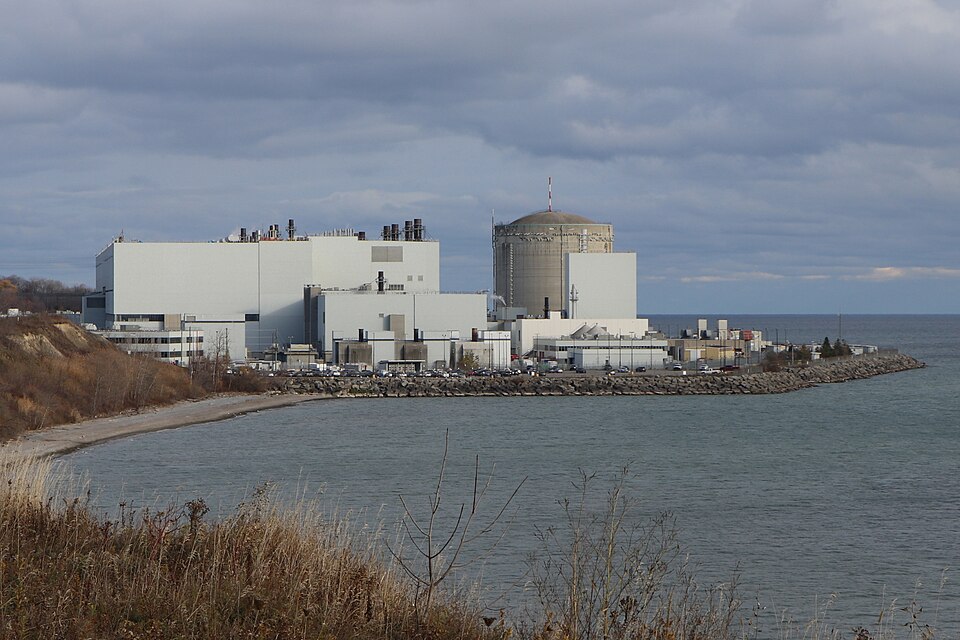
Ontario spent nearly $13-billion and 20 years refurbishing the Darlington nuclear station. Why has it struggled?
“These reactors were fine when they were designed in the 1960s. Their time is gone. No reason to refurbish them … we should junk these things.”
Matthew McClearn, 13 Nov 26, https://www.theglobeandmail.com/business/article-ontario-refurbish-darlington-nuclear-station-why-has-it-struggled/
The cavernous turbine hall at the Darlington Nuclear Generating Station is more than half a kilometre long. In late October, the plant’s Unit 3 was nearing the end of a prolonged outage. Green covers had been placed back on its turbines and workers were already laying down materials near Unit 2’s yellow turbines in preparation for an outage next year.
Freshly emerged from an extensive overhaul that took 20 years and cost $12.8-billion, the nuclear station in Clarington, about 70 kilometres east of Toronto, is not yet purring like a kitten. Unit 3’s outage is merely the first in a series the station’s owner, Ontario Power Generation, has planned over the next several years. In addition, the station suffered several unexpected outages this year caused by leaking pipework, faulty pumps and other problems. During August, when Ontario’s electricity demand typically nears its annual peak, just one of Darlington’s four units was operating.
OPG and Ontario’s government promised the refurbishment would position Darlington for 30 years of reliable service. It’s too early to know whether its recent unplanned outages amount to teething pains, or indicate deeper reliability challenges of the sort that have plagued other refurbished stations featuring Candus, the country’s homegrown reactors. But OPG plans additional, lengthy outages over the next few years to replace equipment that was not addressed during the refurbishment – work Ontarians will pay for through their utility bills.
Nuclear stations are enormously complex machines; it would be unreasonable to expect one to continue operating for years on end with little more than occasional oil changes. But the billions of additional spending planned at Darlington are worth keeping in mind as OPG embarks on a $26.8-billion overhaul in Pickering, about 40 kilometres east of Toronto. It’s the most expensive refurbishment of a Candu station ever contemplated.
The refurbishment dilemma
To venture inside Darlington is to be confronted with a dizzying puzzle of wires, pipes, ducts tanks and stairwells. Crews attend to daily tasks in the stationʼs hot, noisy bowels, co-ordinated from an office adjacent to the control room. Theyʼre monitoring wear-and-tear and plotting when and how to intervene, often years in advance.
Developed during the 1950s and 60s, the Candu’s unique design allowed it to consume natural uranium, and had the added benefit that Canadian manufacturers could build almost every part of it.
But the Candu’s design had significant maintenance consequences. Most of the world’s reactors feature a robust, thick-walled cylindrical structure called a pressure vessel. A Candu core, in contrast, contains thousands of much thinner pressure tubes, each with its own fittings on either end, and pipes conveying water in and out known as feeders – the stuff of plumbers’ nightmares.
Pressure tubes deteriorate and weaken over time, eventually reaching the point when they’re unsafe to continue operating. David Keith, a physicist and professor of geophysical sciences at the University of Chicago, said the Candu’s elaborate piping and numerous connections make it inherently more costly and challenging to maintain than other reactors.
OPG has asserted that Darlington’s cables, laid end-to-end, could stretch to the moon and back. A single unit can have well over 100,000 components. Using inspections, experience and intuition, utilities must decide what to replace, rebuild or leave be.
Steam generators, which faintly resemble giant light bulbs and use the reactor’s heat to produce steam, are among the big-ticket items of Candu plants. Replacing them requires massive cranes to lift them out through holes cut in the powerhouse roof.
Nuclear units each have their own generator and set of turbines, which harness steam to produce power. These complex machines, too, wear down over decades of use.
Even a limited nuclear overhaul can be more expensive than building brand new conventional power plants. On the other hand, the plant will be offline for years and much of it will already be disassembled, allowing workers to reach normally inaccessible components. Misjudgments about equipment longevity can lead to lengthy, expensive outages.
Sunil Nijhawan, a reactor safety expert who once performed consulting work for OPG and foreign Candu owners, said the term “refurbishment” can be misleading because so much of the plant is left untouched.
“Refurbishment is a misnomer because you have replaced only a small part of the total system, whose original cost was only a small fraction of your whole reactor’s cost. There are 20 other systems which are obsolete and old.”
A legacy of misjudgments
New Brunswick’s Point Lepreau was among the first Candu stations to undergo refurbishment, completed in 2012 following massive cost overruns and delays. Just like OPG, NB Power expected it would be rewarded with 30 years of reliable service.
There’s no longer any doubt that refurbishment was botched. NB Power officials have acknowledged that it focused mainly on restoring the reactor. Less attention was given to turbines and other components in the plant’s “conventional” side. Point Lepreau consequently suffered a series of lengthy outages, rendering the utility incapable of paying down its sizeable debts, which it had been ordered to do by the provincial government.
OPG studied previous refurbishments before attempting Darlington. It nonetheless faced difficult calls. For example, Darlington’s steam generators are far larger than those at other Candu stations, so replacing them would be even more daunting.
Instead, OPG opted to inspect and clean them using a process called “water lancing.” In a 2018 video, Michael Allen, OPG’s on-site leader at Darlington, declared that Unit 2’s “are in excellent condition. They’ve been cleaned and prepared for 30 more years of service.”
Nuclear stations are enormously complex machines; it would be unreasonable to expect one to continue operating for years on end with little more than occasional oil changes.Sammy Kogan/The Globe and Mail
A different picture emerged after OPG began refurbishing Unit 3. Each steam generator contains more than 100 components known as primary moisture separators, located in the bulbous section at its top. They’re crucial for supplying dry steam to the turbines, but Unit 3’s had deteriorated. OPG decided to replace them in all of four units, costing hundreds of millions of dollars.
Further surprises awaited once OPG had turbines and generators apart for inspection. Components inside the generators of Units 1 and 2, known as stators, had suffered damage; those repairs are expected to cost $300-million.
Most consequentially, OPG determined turbine rotors in all four units must be replaced. The first, Unit 3, is scheduled to begin in 2029. The tab for the first three units: $2-billion. (There’s a silver lining: OPG expects this work will increase each unit’s output by a minimum of 21 megawatts, which combined would be enough to power roughly 80,000 homes.)
Some of this additional work was completed during the refurbishment, and some was pushed into future outages. But none of it was added to the refurbishment budget; rather, it was paid for from OPG’s budget for sustaining capital.
This allowed officials, including Ontario’s Energy Minister Stephen Lecce, to present the refurbishment as an unqualified success. “Darlington refurbishment was nearly 5 months ahead of schedule and $150M below budget,” he declared in a social media post in September.
But OPG estimates it will spend $3.5-billion over the next few years on the additional maintenance at Darlington. That spending has already begun: For the nine months ended Sept. 30, OPG reported that capital spending had increased by $386-million over the same period last year, largely reflecting additional work at the station. OPG seeks to recover that from consumers through increased rates.
The Association of Major Power Users in Ontario represents industrial consumers. Its president, Brad Duguid, says there’s “no question” OPG’s capital investments will significantly raise rates over the long term. That spending is necessary to preserve reliability, he added, so his organization doesn’t oppose it. But he called on the provincial and federal governments to direct taxpayer support to help mitigate rate increases.
Ibrahim Attieh, a reactor physicist who once worked on designing Candu reactors, describes the additional work at Darlington as “refurbishment by stealth.”
“‘Ahead of schedule and under budget’ is a bogus claim,” Dr. Attieh said.
The road ahead
Moving through questions about Darlington’s unplanned outages during a Sept. 2 hearing, Canadian Nuclear Safety Commission president Pierre Tremblay (who once served as OPG’s chief nuclear operating officer and was responsible for the operation and maintenance of its nuclear plants) observed: “You know, the expectation is a unit coming out of refurbishment would have pretty high reliability.”
Not necessarily.
David Novog, a professor of engineering at McMaster University who specializes in nuclear safety and maintenance, said failure rates of complex systems such as nuclear plants often follow a “bathtub-type curve.” There can be an initial period during which new equipment fails at a higher rate. It can be followed by a “random mode” during which the probability of failure is constant (and hopefully low.) This can be followed by a “wearout” mode in which failures increase again.
Students are taught the “bathtub” concept to illustrate broad trends in reliability, but patterns in individual systems vary, Dr. Novog wrote in an e-mail.
“I don’t think there is enough data to draw any conclusions from the [Darlington] events as yet.”i
OPG expected initial hiccups. Its business plan anticipated “reliability outages” following Darlington’s refurbishment, with the station reverting to historical performance by 2028. If achieved, this year’s mishaps might soon be forgotten.
Allan Grace, OPG’s senior vice president for Darlington, said Unit 4 suffered more problems than expected after returning to service. But he pointed out Darlington’s other units have so far performed much better.
One hallway inside Darlington is lined with plaques from the Institute of Nuclear Power Operations recognizing “excellence in nuclear power plant performance.” Those are awarded bi-annually after intrusive inspections from a couple dozen foreign experts, he said.
“It’s effectively 15 years we’ve been at the top echelon of power plant operations for North America,” he said, adding that utilities from other countries regularly seek out OPG’s experience before overhauling their own stations.
“People want to come and see how we’ve done it, because not many other utilities have come even close.”
Bruce Power, an independent power producer which is in the middle of an extensive overhaul at its Candu station along Lake Huron’s eastern shore, reports that the first refurbished unit (Unit 6) has shown “excellent performance” since its restart in 2023. Such is the company’s confidence that it’s expecting overhauled Bruce units will run for up to 35 more years.
The four Pickering B units east of Toronto shut down in late September for their own overhaul. The budget for that, $26.8-billion, was approved by the province in November 2025. That is as much as the combined budgets for refurbishing 10 larger units at Bruce and Darlington. The Pickering units are expected to return to service by the mid-2030s.
OPG previously decided against refurbishing Pickering B because its board of directors warned the units were at significant risk of performing poorly once returned to service, with high operating costs.
In its latest rate application, OPG reported that “very limited sustaining work” had been done at Pickering in the run-up to what was long expected to be its permanent retirement in 2024. (That year, it spent just $6.7-million on station maintenance.)
OPG now plans a lot of additional work at Pickering to renew infrastructure “that is not required for refurbishment but nevertheless needed to support reliable, safe operations during Pickering’s second life.” This work is expected to cost more than $900-million over the next few years.
Dr. Nijhawan said refurbishing Pickering will be tremendously lucrative for the companies involved. But if the station lasts as long as OPG hopes, he added, “it’ll be 90 years old. No concrete structure is designed to last that long, nor any wiring, nor any of these other vessels.
“These reactors were fine when they were designed in the 1960s. Their time is gone. No reason to refurbish them … we should junk these things.”
COMMENTS
Read more: Ontario spent nearly $13-billion and 20 years refurbishing the Darlington nuclear station. Why has it struggled?- B.B.S.H9 min agoNuclear costs more and takes longer to build than any other system.Nuclear requires extensive, expensive maintenance.Nuclear produces forever toxic waste.Nuclear Fission plants are obsolescent technology; oversold!For far less money, Ontario can invest in renewables with storage.Quietly reliable, long lasting; more responsive to the grid.Nuclear has bamboozled no-nothing politicians for far too long.Time to make the sensible change to current technology.Somebody explain this to Doug Ford;Please!Read morereply0sharereport
- Comment by James Bolt.JBJames Bolt22 min agoRefurbishment and maintenance were never accurately estimated during the sales pitch era.They were wrong.reply1sharereport
- Comment by xcumbrian.xcxcumbrian34 min agoIt looks like most of the problems have nothing to do with the nuclear end. All power stations incorporate essentially the same ancillary equipment, the only difference is how the heat is generated.I am surprised the turbine problems had not been picked up during routine maintenance.After any major refurb you expect teething issues. Take the time to do the work properly and things will work out.It is a good idea to address equipment that looks OK now but future failure could impede production. Take your lumps now.Read morereply3sharereport
- Comment by app_76601493.apapp_7660149356 min agoThose who are thinking of buying electric cars, “THINK TWICE”. Brace yourself for the hefty electricity price increase and near future unreliable power outages!reply3 replies1sharereport
- Reply by James Bolt.JBJames Bolt24 min agoReply to app_76601493As my gas prices jump from $1.50 to over $2.00 in a week my electricity price remains the same.reply2 replies3sharereport
- Reply by Wilkins_P.WiWilkins_P17 min agoReply to James BoltElectricity prices are regulated in most jurisdictions. Gasoline prices vary wildly according to global events.reply2sharereport
- Comment by app_78073423.apapp_780734231 hr agoThe feds continue to support Candu technology even thought the world is committing to light water reactors. 85% of the world’s reactor fleets are LWR. 11% for Candu. I get wanting to support Canadian technology etc., but we are throwing good money after bad at this stage.reply2 replies1sharereport
- Reply by Wilkins_P.WiWilkins_P56 min agoReply to app_78073423Recent light water reactor builds in Europe have gone way over budget. They need enriched uranium. We know how to build, refurbish and operate Candus.reply1 reply4sharereport
- Reply by S_C74.S_S_C7445 min agoReply to Wilkins_PAnd all according to the Iron Law of megaprojects: “Over budget, over time, under benefits, over and over again.”reply1sharereport
- Comment by Cameron Conroy.CCCameron Conroy1 hr agoThe cost of nuclear is a good reason to promote green power as a supporting energy source.reply3sharereport
- Comment by PHILCO3.PHPHILCO31 hr agoExcellent journalism. Keep it up.Ontario plans to spend $100 billion on new and refurbished nuclear capacity.But there is very little public understanding about the efficacy of this complex and costly technology. Just, ‘trust us, we got this’ from the Ford govt.The nuke industry, the thousands of construction workers and the banks (up to 40% of overall cost of these mamouth builds goes to interest payments on money borrowed to build them) are all licking their lips in aticipation of the King Midas windfall profits to be made.But as the nuclear safety specialist says in the article:”Their time is gone. No reason to refurbish them … we should junk these things.”Read morereply6sharereport
- Comment by Joe9047.JoJoe90472 hrs agoIt seems likely that parts of the unit 3 sat idle for years without being properly mothballed.reply1sharereport
- Comment by Douglas333.DoDouglas3332 hrs agoI have a question. In a nuclear-dependent future, what is the backup plan for nuclear plant failures? Spare nuclear plants? I have another question. If we electrify the heating of buildings in an effort to decarbonize our energy system, how will we supply the resulting winter peak, with nuclear plants that sit idle the rest of the year? It seems like a technology that is not fit for purpose.reply4 replies1sharereport2 older repliesshow older replies
- Reply by Wilkins_P.WiWilkins_P1 hr agoReply to Douglas333Ontario’s demand peak is hot summer days. Reactors run constantly. Gas and hydro vary according to demand. Nuclear has proven itself in Ontario over the last 50 years.reply1 reply4sharereport
- Reply by Douglas333.DoDouglas33325 min agoReply to Wilkins_PBut if we electrify buildings in an effort to decarbonize the economy, the resulting winter peak will be much larger (and longer) than the summer peak in every part of Canada, even allowing for hotter weather and more air conditioning. Right now in most parts of Canada we meet that seasonal heating demand with gas furnaces that sit idle in the off-season. As that heating load moves to the grid we will need an emission-free generating source with low capital cost and that does not cost too much to maintain in the off season. Wind beats out nuclear on that criterion.Read morereply0sharereport
- Comment by foolonahil.fofoolonahil2 hrs agoReactors use closed loops for generating power. Biggest one of the plant? Government Funds. Money poured in. Much of which is poured back out for paying people. Paying for stuff. Gets recycled back via taxes. Oh, almost forgot. Usually, but sometimes not, a corollary benefit. A service or goods. Here? Electricity.Politicians don’t see a dollar the way of a investor. We want to see a profit. They? All about spending and spreading. Tossing billions of taxpayer dollars at Darlington? Most eventually loops back to the provincial coffers. editedRead morereply0sharereport
- Comment by app_74080768.apapp_740807682 hrs agoBruce, a private sector entity, seems to have figured this out, bringing in its most recent refurbishment under-time and under-budget. Sadly, all these cost overruns will ultimately be reflected in Ontario power rates rendering the province’s cost-sensitive manufacturing sectors even more disadvantaged.reply3sharereport
- Hampson072 hrs agoAnother excellent and very informative article by Mr. Mcclearn. Two thumbs up! Our province is going in the wrong direction on nuclear power.reply5sharereport
- Comment by kidspeed.kikidspeed2 hrs ago”Leaky pipes” and “faulty pumps” on today’s refurbishment. Are the parts still all manufactured in Canada, or are we importing?Science and engineering, and the education thereof, is not what it was in the 50s, 60s, 70s. Students were homegrown. Regularly scheduled trips to the moon stopped in 1972.Can’t do it anymore.reply1 reply3sharereport
- Reply by CanadianTaxPayingCitizen.CaCanadianTaxPayingCitizen1 hr agoReply to kidspeedThere was no point in going to the moon. There is still not a good reason.reply1sharereport
- Comment by Wilkins_P.WiWilkins_P3 hrs agoA Candu core has up to 480 pressure tubes, not “thousands”. Pressurized vessel reactors have experienced major cost overruns in Europe. They also use steam turbines and would not be immune to the turbine problems seen at Darlington.reply7sharereport
- Comment by stewf.ststewf3 hrs agoThey struggled with completing and getting Darlington on line the first time. The debt from this build was one of the reasons for Mike Harris breaking up Ontario Hydro. Pickering is so antiquated that any attempt to refurbish it will be a nightmare logistically and financially. It literally is 1960’s technology that hasn’t been refurbished since the 1980’s.reply1sharereport
- Comment by Albert74.AlAlbert743 hrs agoRoof top solar on every home and industry that will take it. Reduce the demand for OPG produced electricity. Way cheaper for everyone. Subsidize batteries for home use during the night. Off grid was our best decision ever at our recreational property.reply5 replies5sharereport3 older repliesshow older replies
- Reply by patterk.papatterk32 min agoReply to Douglas333Note that Denmark consumes less than half of what we consume in terms of kWh per capita. It also has the ability to import power from several other countries. Still 70% is impressive but it gets increasingly difficult to replace fossil fuels for the remaining 30%. Canada as a whole gets only 20% of its electricity from fossil fuels.reply1 reply1sharereport
- Reply by Douglas333.DoDouglas33321 min agoReply to patterkYes, I should have mentioned the important roles that efficiency and productivity play in the Danish story. European energy productivities are generally well ahead of Canada, especially in Scandinavia, something else we should try to emulate. I think if we had true cross Canada connectivity (a coast to coast high voltage HVDC line) the supply issue would get a lot easier for the carbon-challenged provinces. There is an analogy here to Denmark’s imported electricity, which comes mainly from Norway and Sweden and has lower emissions than Denmark’s domestic supply.editedRead morereply1sharereport
No comments yet.
1 This Month
19 November – Webinar – The Reality of Reprocessing
Time: 11:00 AM Pacific Time (US & Canada) / 2:00 PM Eastern / 7:00 PM UK / 8:00 PM CET
Register for the Zoom Event Here

Tell Congress: Prevent Nuclear Catastrophe in Iran

Tell Congress: Prevent Nuclear Catastrophe in Iran

Read the Public Inquiry Report, the Commissioners’ report, Surrendering Australia: The AUKUS Deception is available to download for free at aukuspublicinquiry.com. Or just watch the replay of the National Press Club Luncheon.


Shut down the radiation-damaged Heysham nuclear reactors now
To see nuclear-related stories in greater depth and intensity – go to https://nuclearinformation.wordpress.com

Say No to NASA’s Reckless Nuclear Reactor on the Moon
Say No to NASA’s Reckless Nuclear Reactor on the Moon
-
Archives
- November 2026 (166)
- October 2026 (302)
- September 2026 (339)
- August 2026 (330)
- July 2026 (355)
- June 2026 (287)
- May 2026 (306)
- April 2026 (356)
- March 2026 (251)
- February 2026 (267)
- January 2026 (308)
- December 2025 (358)
-
Categories
- 1
- 1 NUCLEAR ISSUES
- business and costs
- climate change
- culture and arts
- ENERGY
- environment
- health
- history
- indigenous issues
- Legal
- marketing of nuclear
- media
- opposition to nuclear
- PERSONAL STORIES
- politics
- politics international
- Religion and ethics
- safety
- secrets,lies and civil liberties
- spinbuster
- technology
- Uranium
- wastes
- weapons and war
- Women
- 2 WORLD
- ACTION
- AFRICA
- Atrocities
- AUSTRALIA
- Christina's notes
- Christina's themes
- culture and arts
- Events
- Fuk 2022
- Fuk 2023
- Fukushima 2017
- Fukushima 2018
- fukushima 2019
- Fukushima 2020
- Fukushima 2021
- general
- global warming
- Humour (God we need it)
- Nuclear
- RARE EARTHS
- Reference
- resources – print
- Resources -audiovicual
- Weekly Newsletter
- World
- World Nuclear
- YouTube
-
RSS
Entries RSS
Comments RSS


Leave a Reply