Nuclear war and malicious use of AI could end humanity by 2100, scientists warn

By Jonathan Benton, 12/10/2026 , https://www.euronews.com/2026/10/12/nuclear-war-and-malicious-use-of-ai-could-end-humanity-by-2100-scientists-warn
They are among 17 global threats to human health according to a new study by The Lancet which aims to drive global action to address them.
The malicious use of AI or nuclear war could end humanity as we know it by 2100, according to a new global health risk assessment.
They top a pyramid of 17 major threats to human health identified in a study published in The Lancet, including antimicrobial resistance, climate change, pandemics, income inequality and a range of health issues such as tobacco, obesity and mental health.
According to the study, nuclear conflict does not just cover the impact of the missiles but the consequences too, such as nuclear famine, while the malicious use of AI includes the use and development of bioweapons against us.
The research was conducted by the new Lancet Commission on 21st-century global threats to health, a group made up of 37 experts in health, economics, security and technology.
Together they used disability-adjusted life years, also known DALYs, as a metric to compare each threat from the year 2025 to 2100 from 204 countries and territories across age, sex and cause.
The research essentially shows how many healthy years of human life could be lost to each global threat, according to their best- and worst-case scenarios. This also gives an idea of how much of an impact humanity can have if it acts now or chooses to do nothing.
Together they used disability-adjusted life years, also known DALYs, as a metric to compare each threat from the year 2025 to 2100 from 204 countries and territories across age, sex and cause.
The research essentially shows how many healthy years of human life could be lost to each global threat, according to their best- and worst-case scenarios. This also gives an idea of how much of an impact humanity can have if it acts now or chooses to do nothing.
They also call for more investment in “breakthrough solutions,” such as nuclear fusion and carbon removal technologies that could radically affect climate change outcomes and other globally threatening issues, or the vaccines developed during the pandemic.
The Commission also calls for regular monitoring and risks assessments of these risks, with findings presented to international organisations such as the G20 and the UN to increase the urgency in addressing the issues before they escalate and become crises, and encourage wider action rather than individual countries going it alone.
Researchers believe the current “competitive approach” of tackling major challenges one by one is hindering humanity’s chances.
The Commission’s findings were presented on Sunday at the World Health Summit in Berlin, Germany. Their assessment will be updated each year to re-evaluate each of the 17 threats identified, incorporating new data and any emerging challenges.
2026 George Monbiot Nuclear Greenwash Award goes to the UK Green Party for Abandoning Nuclear Opposition
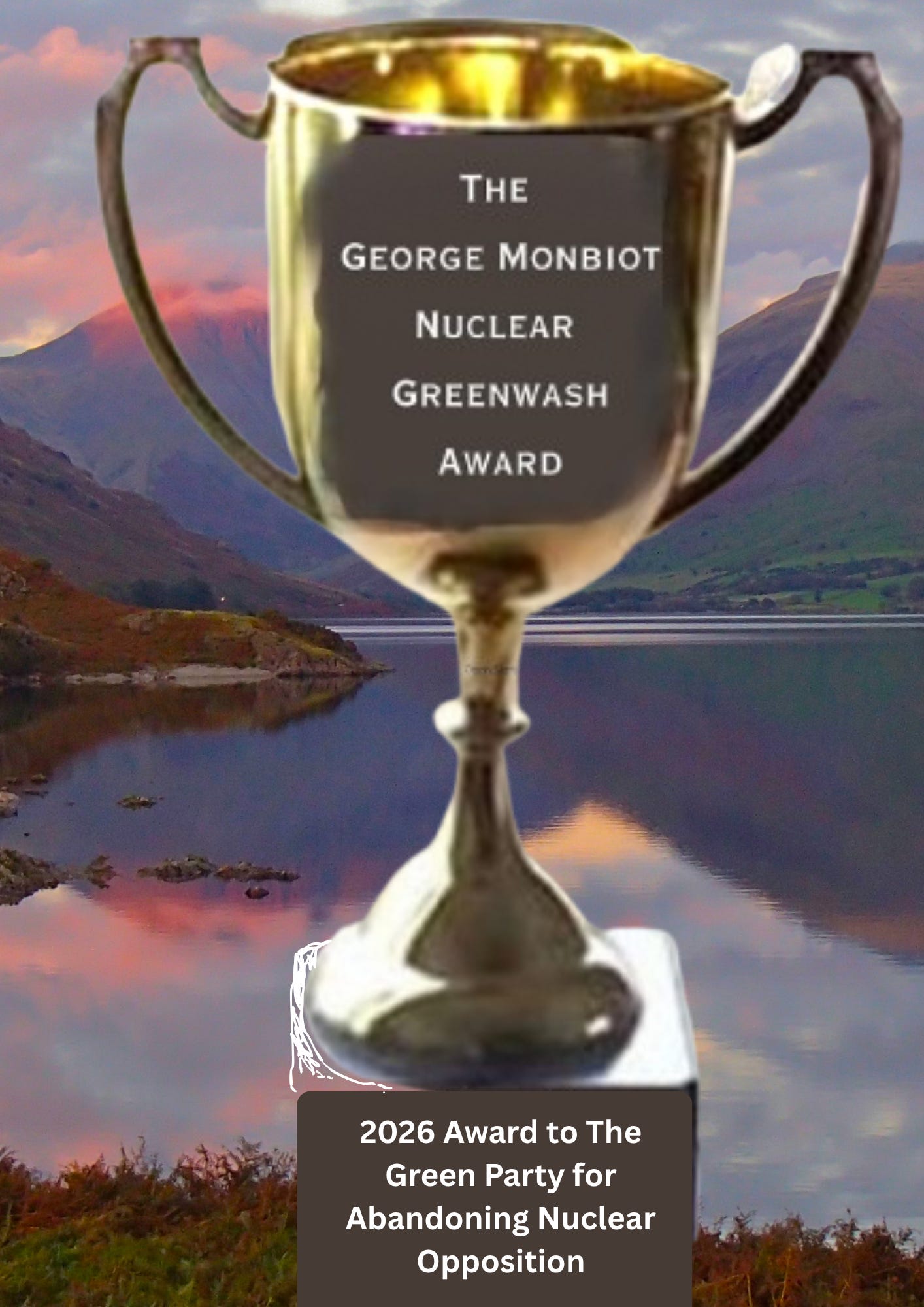
Image: The George Monbiot Nuclear Greenwash 2026 Award to The Green Party for Abandoning Nuclear Opposition. George Monbiot’s famous “I love nuclear” in the wake of the Fukushima disaster deflected an otherwise inevitable crisis of nuclear confidence and was of course key to the push for the building of the first new nuclear plant in the UK in decades at Hinkley C which he now says (after facilitating the damn thing) should be scrapped in favour of, even more dangerous. fast breeder reactors,
Lakes Against Nuclear Dump, Oct 12, 2026, https://lakesagainstnucleardump.com/2026/10/12/2026-george-monbiot-nuclear-greenwash-award-goes-to-the-green-party-for-abandoning-nuclear-opposition/
Just days before the 69th anniversary of the UKs worst nuclear accident to date , the Windscale Fire, the Green Party announced their abandonment of their opposition to nuclear, and with it their reason for being. The Green Party used to call the nuclear industry the “nuclear military industrial complex” for good reason, the “civil” nuclear industry is necessary in order to produce elements for military use, including plutonium, tritium and americium.
Here in Cumbria we won’t notice much difference as the Green Party have spectacularly failed to publicly voice strong opposition or lead any charges against nuclear developments for many years with Green Party members seemingly much more concerned with the horrible nitty gritty of political advancement than protecting the health and wellbeing of the public and our environment from nuclear developments.
Having said that we wait more in hope than expectation to be surprised and delighted by vigorous, strong and principled Cumbrian Green Party opposition to the tsunami of nuclear developments coming our way.
It has not gone unnoticed that despite there being more Green councillors than ever before on Cumberland council, the Council as a whole is like never before, acting as a facilitating arm of the nuclear industry. Cumberland council and its Green Party members are partners in the geological nuclear dump plan and partners in the plan to bring Japanese sodium coolant to Cumbria amongst other things.
Bizarrely the Green Party in Cumbria even had to be persuaded long and hard by Radiation Free Lakeland to oppose the earth quake inducing coal mine near Sellafield with the Green Party’s candidate, in the 2017 Whitehaven hustings Jack Lenox actually saying he was “a big fan of coking coal” this despite its close proximity to Sellafield. The coal mine was finally refused largely on the grounds of induced seismicity.
Professor Chris Busby has this to say: “the Green Party began as an anti-nuclear party in Germany, with Petra Kelly. When I chained myself to the gates of Trawsfynydd Nuclear Power Station in Wales in 1992, Petra Kelly had agreed to come and support our campaign against opening the nuclear site, which was dangerous. The station operators had applied to run the reactors at a high temperature to anneal the cracks in the pressure vessel. This was not long after the experiment at Chernobyl. And the contamination of Wales by Chernobyl (which led to sharp increases in cancer and child leukemia)…..The nuclear police had pistols and we were told they would shoot us. Petra Kelly was assassinated a few months after this. How can I say this? How do I know? Well, of course I don’t know and cannot be sure. But here is something you don’t know about this. The story now widely accepted (look at Wikipedia) is that her man, General Gert Bastiaan killed her.
The police determined that Kelly was shot dead while sleeping by Bastian, who then died of suicide.
Well and Good. But I spoke with Prof Ernest Sternglass about this. He knew both of them, and said it was impossible that Bastiaan would have killed her and himself. They were full of positive energy and life, when he met them in Berlin some 6 weeks before she died. She was very excited. She had received an offer of considerable financial support by German TV to make a series of documentaries with Russian and Belarussian scientists including Dr. Shevchenko, to report on the real health effects of the Chernobyl accident contamination. At the time, the nuclear operators and their tame scientists in the IAEA and the WHO were stating that there were no measurable health effects. It was the same at Fukushima some twenty years later. But back in those days they killed you, rather than using media to destroy your credibility.”
The market is being brutal with nuclear companies that are still years away from making real money.
Oil Price By Alex Kimani – Oct 11, 2026
Nuclear energy stocks have suffered heavy losses over the past year, even as technology companies commit billions of dollars to securing nuclear electricity for AI data centers. The Global X Uranium ETF (URA) has lost more than 20% over the past 12 months, compared with gains exceeding 40% for the Energy Select Sector SPDR Fund (XLE). Investors have grown increasingly concerned about valuations, financing requirements and the long development timelines for companies that don’t yet generate any meaningful commercial revenues.
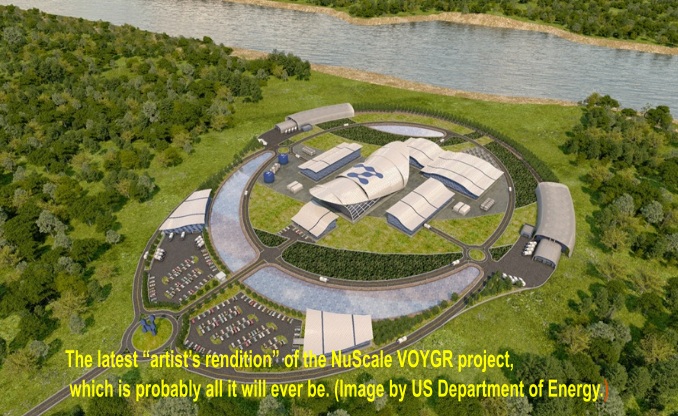
The market has been brutal with nuclear companies that are still years away from making real money. NuScale Power Corp. (NYSE: SMR) has lost about 82% of its value over the past year, Oklo Inc. (NYSE: OKLO) is down roughly 75%, and Nano Nuclear Energy (NASDAQ: NNE) has fallen nearly 68%. All three are developing technologies that could eventually feed enormous new demand for nuclear power, but investors are no longer paying nearly as much for what could happen years from now.
NuScale received standard design approval from the Nuclear Regulatory Commission (NRC) for its 77-megawatt SMR technology in May 2025, but continues to burn cash as it works toward commercial deployment. In January, Sam Altman-backed Oklo and Meta Platforms (NASDAQ: META) announced an agreement supporting development of a 1.2-gigawatt nuclear energy campus in Pike County, Ohio, to supply electricity for Meta’s regional data centers and AI infrastructure. Initial generation is targeted for as early as 2030, with the full 1.2 GW potentially coming online by 2034. Nano Nuclear, which is developing portable microreactors, also faces a long road to commercialization.
Uranium fuel suppliers and miners have suffered substantial losses of their own. Centrus Energy Corp. (NYSE: LEU) has dropped some 62% over the past year, Uranium Energy Corp. (NYSE American: UEC) has fallen roughly 32%, and BWX Technologies (NYSE: BWXT) has lost around 27%………………………….https://oilprice.com/Alternative-Energy/Nuclear-Power/3-Stocks-To-Play-The-Nuclear-Energy-Boom.html
A Shadow of Fear Hangs Over Gazans Amid Israeli Defense Minister’s Threats

October 11, 2026 By Dalia Abu Ramadan, https://scheerpost.com/2026/10/11/a-shadow-of-fear-hangs-over-gazans-amid-israeli-defense-ministers-threats/
This article was originally published by Truthout
Israel Katz says Israel will forcibly displace 1 million Gazans if “even one Israeli soldier” is abducted.
We are about to close out three years and enter another since Israel invaded Gaza, but we are not leaving the war behind to begin a new life. We are entering yet another year without knowing when this war will end — or whether it will end at all.
The fear remains. The destruction remains. The threats remain. It feels as though each passing year does not bring us closer to an end, but closer to the possibility of another war.
Despite everything we are living through in Gaza, we understand what it means to live one day at a time — to hold on to every simple moment we can still have. Imagine planning for another morning, perhaps for the simplest of things: going out with the friends you still have, or taking your family to the sea in the morning, amid all this destruction, simply to experience a moment that feels like life.
Then, as you are planning that ordinary morning, you hear a statement from Israeli Defense Minister Israel Katz, who said on September 22: “If even one Israeli soldier or civilian is abducted, the city of Gaza — with its homes and terrorist towers — will be evacuated southward of its one million residents.”
Words like these are enough not only to disrupt your day, but to shake your entire future. The first question we asked ourselves was: Where would we go? Is there anywhere left for us to go?
“Everyone is talking about how the possibility of an Israeli soldier being captured has become impossible, that it will not happen, and that it could be an excuse to provoke people in Gaza and pave the way for the war to return,” Haneen Salem, a photographer in Gaza City, told me. “I am certain something will happen. No one knows what, but there is a shadow of fear hanging over Gaza’s civilians.”
Even my father said, “Expect it to happen at any moment,” warning that we could be forcibly displaced yet again, especially because we are living through another difficult period in Gaza. The intensity of Israeli bombardment had increased in the weeks leading up to Katz’s statement, and warplanes had not stopped flying overhead at night.
We are being asked to imagine another war while we are still living inside the aftermath of the one that was supposed to have ended.
The so-called ceasefire took effect at noon local time on October 10, 2025. A year has passed since that announcement, but the war has not ended. It is true that the intensity of the escalation and displacement has eased compared to the height of Israel’s war, but the bombardment and destruction have continued. So, what does it mean to hear threats of the war returning with the same ferocity when we have not even begun to recover from what has already happened?
When the “ceasefire” was announced, I believed the war would end as the wars of 2021, 2014, and previous years had ended — with a clear conclusion, a moment when we would know that the war was truly over. I expected that, immediately after the announcement, we would begin clearing the rubble, rebuilding what had been destroyed and slowly putting our lives back together.
But that did not happen.
Instead, it felt as though the war continued in another form, behind the scenes — a reality visible only to the people of Gaza who have been living through its consequences every day. Today, we still have not recovered. Even the most basic medical necessities remain unavailable, the siege is tightening, and the consequences of the war continue to surround every part of our lives.
The collapse of the Al-Sadah building in Tal al-Hawa is one example of what this unfinished recovery looks like. The building had been home to approximately 80 displaced Palestinians. In the early hours of September 16, it collapsed, with parts of the structure also falling onto nearby buildings and tents that were sheltering other displaced families. Rescue teams initially estimated that around 100 people, including at least 50 children, were trapped beneath the rubble. After rescue operations ended, Civil Defense teams confirmed that 21 people had been killed, including 12 children and five women, while 45 injured people were taken to hospitals.
With rubble left uncleared and too little being done to address the dangers left behind by the destruction, many partially damaged buildings across Gaza have been left standing in a fragile state, at risk of collapsing at any moment.
The Al-Sadah building had sustained structural damage from Israeli bombardment during the war and was struck several times in 2024 and again in March 2025. Civil defense teams had warned residents not to return to the building. Yet some had no other choice but to live there. With tents and homes unavailable, displaced Palestinians have been forced to shelter in cracked and damaged buildings, despite the risk that they could collapse around them.
But the danger does not end when people are pulled from the rubble. Those who survive still face a health system struggling to meet even the most basic needs. As World Health Organization Director-General Tedros Adhanom Ghebreyesus said on September 24, “Essential medicines, diagnostics, equipment and fuel remain in critically short supply.”
These shortages are not limited to life-saving medicines and hospital equipment; they reach into the most ordinary forms of care, turning even a visit to the dentist into a struggle.
It may be one of the most basic forms of health care, but anyone who has experienced severe tooth pain knows how unbearable it can be — especially as poor nutrition and the effects of prolonged hunger have taken a toll on people’s dental health.
“Getting dental supplies and materials into Gaza has become extremely difficult,” dentist Dr. Ghalib Zimmo told me. “And when they do enter, they are prohibitively expensive. The cost of dental materials has risen to 10 times what it was before the war.”
The consequences are painful. “Many patients come to us needing root canal treatment, which can involve unbearable pain,” Dr. Ghalib said. “But because of the cost, they choose to have the tooth extracted instead of treating it.”
“Before the war, a root canal cost around $40,” he explained. “Now, it can cost as much as $250.”
Imagine how deeply exhausted we have become. We search for medicine, and it is not there. We search for wheelchairs for those who have lost limbs in the war, and they are not there. We search for the simplest things that make life possible, and they are not there.
Fear has become part of the way we respond to every sound. Sometimes, when we hear a sudden noise, we immediately think it is the sound of a missile just before it strikes. We can even find ourselves startled by the sound of a chair moving.
We are living with a trauma that no one can truly feel the way we do. Three years of relentless bombardment have left their mark on us. We search for life itself, and we cannot find it.
Caitlin Johnstone -Advanced Technology Will Not Save Us
Caitlin Johnstone, Oct 12, 2026, https://www.caitlinjohnst.one/p/advanced-technology-will-not-save?utm_source=post-email-title&publication_id=82124&post_id=219861019&utm_campaign=email-post-title&isFreemail=true&r=1ise1&triedRedirect=true&utm_medium=email
Techno-utopianism is the naive belief that technological innovation is going to create a paradise on earth for all of humanity. In the age of AI this notion has been enjoying a bit of a resurgence.
Techno-utopianism is an infantile worldview to hold in the year 2026, because it is assumes we live in some kind of children’s cartoon show with wild-haired inventors in laboratories lined with beakers and microscopes who create helpful new machines which are then either purchased by consumers on the free market or implemented by the government to make the country a nicer place to live in.
In reality, we live under a globe-spanning empire run by plutocrats and secretive government agencies who manipulate our entire society to ensure that all outcomes expand their wealth and power. They’re not interested in making the world a better place. The most powerful among them are not even simply interested in money. They are interested in dominating the planet and maintaining the political status quo which allows them to rule.
The plot hole in techno-utopianism is that technologies don’t emerge in a vacuum: they are always controlled by somebody, and those somebodies always wind up being the people who control everything else. They’ve been doing it with the internet, they’re doing it with AI, and they’ll keep doing it with anything else that comes up for as long as they hold power.
If anything like free energy ever emerged, the empire managers would immediately restrict access to it and then start working on turning it into a weapon.
If we ever developed neurological implants which allowed our brains to interface wordlessly with machines, the CIA and the NSA would with absolute certainty have a backdoor into every single one operating inside the western empire.
Anything that could end poverty and lack would be suppressed, because capitalism doesn’t work without scarcity and have-nots. Artificial superintelligence would be used solely to preserve and bolster the imperial status quo. Nanobots and anti-gravity would be immediately weaponized by the Pentagon. Dramatic lifespan extension would be priced to accessibility only by billionaires and trillionaires.
And that’s assuming our capitalist system is still capable of producing major improvements to human life anymore, which doesn’t really seem to be the case. These days most “innovation” takes the form of coming up with an app designed to extract labor from the working class in some new form of exploitation, or these new AI technologies that we all know are going to end up being used for domestic surveillance and horrifying weapons of mass military slaughter. Apart from that, innovation has largely stagnated, because it turns out that only permitting inventions which both (A) generate profit and (B) do not threaten existing power structures is an incredibly constricting limitation to hamstring ourselves with.
So we’re not going to innovate our way out of this mess. The technological deus ex machina solution to all our problems is not going to arrive at our doorstep while we sit on our couches scrolling Instagram. If we are to survive the existential hurdles our species is approaching and begin building a healthy world, we’re going to have to actually change how we are and how we live.
That’s what I find so off-putting about techno-utopianism: it’s a faith-based belief system which discourages humanity from changing. We don’t need to push toward revolution; the robots are coming to save us. We don’t need to change our collective behavior and stop destroying our ecosystem; the superintelligent AI gods will change the world around us. We don’t need to adapt as a species beyond this awkward evolutionary transition phase and shatter the bonds of the ego; all we need to do is passively wait around for High Tech Jesus to come and rapture us all to paradise.
It ain’t gonna happen, kids. The metallic messiah’s not coming. If we survive as a species, it will be because we grew up and made the necessary changes to our hearts and our minds to transcend our self-destructive patterning.
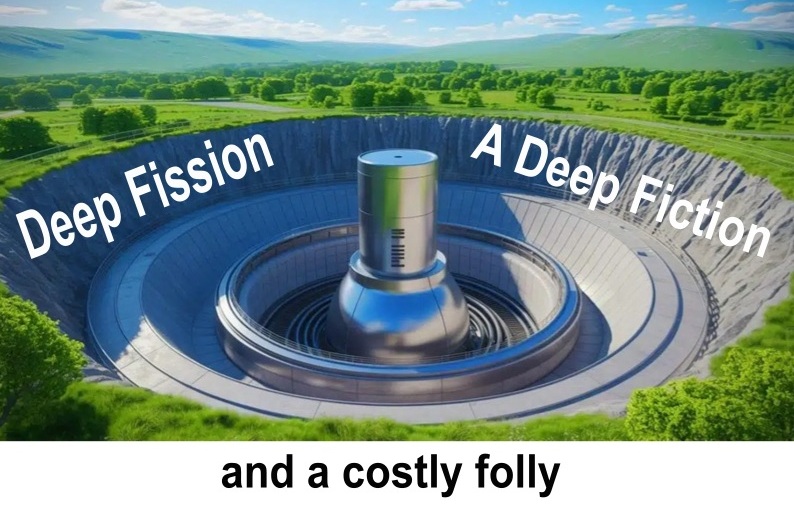
DEEP FISSION, INC. (NASDAQ: FISN) INVESTIGATION: Johnson Fistel Investigates Potential Securities Claims Following Short-Seller Report
05. Oktober 2026, Johnson Fistel, PLLP,
https://www.globenewswire.com/de/news-release/2026/10/05/3374519/0/en/deep-fission-inc-nasdaq-fisn-investigation-johnson-fistel-investigates-potential-securities-claims-following-short-seller-report.html
SAN DIEGO, Oct. 05, 2026 (GLOBE NEWSWIRE) — Johnson Fistel, PLLP, a leading stockholder rights law firm, is investigating Deep Fission, Inc. (NASDAQ: FISN) on behalf of investors who may have suffered losses following a report questioning the Company’s projected funding needs and path to commercial deployment. If you purchased Deep Fission securities and suffered losses, please click the following link: https://www.johnsonfistel.com/investigations/deep-fission-inc/
Why Is Johnson Fistel Investigating Deep Fission?
In June 2026, Deep Fission completed its initial public offering of 2.5 million shares at $16.00 per share. Its prospectus estimated that, beyond its available cash and the offering’s anticipated net proceeds, the Company would need approximately $138 million in additional capital to develop, license, and commercially deploy its first commercial reactor. The prospectus also described a phased strategy intended to move toward commercialization within three years and a target construction period as short as six months for a single reactor in later deployments.
On September 24, 2026, Iceberg Research published a short-seller report questioning Deep Fission’s economics and commercialization prospects. Separately, the Company’s January 2026 investor presentation, filed with the SEC before the IPO, projected $261 million in spending during 2026 and 2027 and a negative ending cash balance of $237.3 million under its then-current assumptions. That projection preceded subsequent financing and excluded as much as $750 million in development and construction costs for the first commercial projects before project-level financing became available.
Deep Fission shares closed at $6.95 on September 24, down approximately 10.9% from the prior day’s $7.80 close.
Johnson Fistel is investigating how Deep Fission developed the additional-capital estimate in its June 2026 prospectus, including how that estimate accounted for the Company’s earlier spending projections, subsequent financing, and anticipated costs and financing arrangements for its first commercial projects.
About Johnson Fistel, PLLP | Top Law Firm, Securities Fraud, Investor Rights
Johnson Fistel, PLLP is a nationally recognized shareholder rights law firm with offices in California, New York, Georgia, Idaho, and Colorado. The firm represents individual and institutional investors in shareholder derivative and securities class action lawsuits. The firm also represents foreign investors who have purchased securities on U.S. exchanges.
Attorney advertising.
Past results do not guarantee future outcomes.
Services may be performed by attorneys in any of our offices.
Johnson Fistel, PLLP has paid for the dissemination of this promotional communication, and Frank J. Johnson is the attorney responsible for its content.
Contact:
Johnson Fistel, PLLP
501 W. Broadway, Suite 800
San Diego, CA 92101
James Baker | (619) 814-4471
jimb@johnsonfistel.com
The Big Questions Facing Nuclear Fusion Energy

Welcome to the 20th edition of the Cleaning Up newsletter.
The Cleaning Up Newsletter and Angus McCrone, Oct 13, 2026, https://cleaninguppod.substack.com/p/issue-20-the-big-questions-facing
Fusion energy is going through one of its periods of excitement. Entrepreneurs have received $14 billion of early-stage funding, and pioneers have heralded the first instances of projects producing more energy than was put in to sustain the plasma – yielding a positive ‘fusion energy gain factor’, or Q for short.
The AI boom has also fed enthusiasm: could fusion, the energy that drives the sun, one day power artificial intelligence data centres? And could AI itself do the complex problem-solving to accelerate the development of fusion as an economically viable energy source?
There are more hard-headed questions too, as raised in Cleaning Up’s 7 October episode, in which Michael Liebreich interviewed Sir Steven Cowley, director of the Princeton Plasma Physics Laboratory (see Show Snippets below).
One of these is the danger of excessive exuberance (that over-promising by the fusion sector might lead to investors and policy-makers losing faith). Another is about economics. Fusion reactors might be able to produce energy reliably within 10-20 years, but will fusion ever be competitive with alternatives such as zero-marginal-cost solar or wind power?
1 B1 Mapped: Who’s building nuclear SMRs?
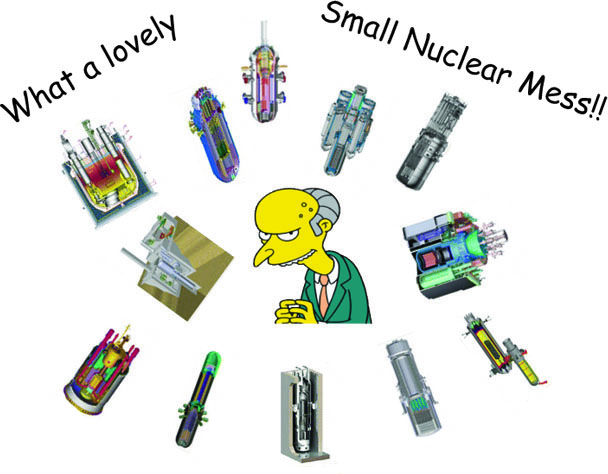
none of the new generation of land-based SMR plants in the western world have yet made it from the drawing board to become a commercial reality.
Neil Gerrard, Senior Editor, Construction Briefing, 12 October 2026
One of the big challenges of the data centre boom is how to power all those electricity-hungry computing facilities.
One possible answer is small modular nuclear reactors (SMRs). The concept of nuclear plants that can be built cheaply and safety with a repeatable, modular design, has held promise for years.
But none of the new generation of land-based SMR plants in the western world have yet made it from the drawing board to become a commercial reality.
However, some SMR projects are now starting to get off the ground and could provide a major new source of construction work in the coming years if ambition survives reality.
That is why there has been a flurry of news stories about SMRs recently, from Rolls-Royce SMR launching a new supplier programme for £1.4 billion worth of contracts as it prepares to build three reactors in the UK, to Samsung C&T, GE Vernova Hitachi, and Studsvik teaming up to advance a 1.2GW power project in Sweden.
Keeping track of who plans to build what, where, when and with whom is becoming an increasingly bewildering exercise.
That’s why the Construction Briefing team has put together a map and article that track exactly that.
The global pipeline of SMRs ranges from licensed projects to preliminary agreements. To complicate matters further, several programmes have already changed direction, stalled, or hit the buffers completely.
Projects in Canada, China and the US have progressed into construction or commissioning. Elsewhere, developers have secured customers and engineering contracts but still face decisions on financing, licensing and construction.
Our tracker looks at the different nascent SMR technologies out there and charts how far advanced projects involving those reactors are.
Although SMRs are typically defined as reactors with a rated electrical power of 300 MWe or less, it also includes larger modular designs marketed alongside SMRs, such as Rolls-Royce’s reactor (470 MWe) and TerraPower’s sodium-cooled Natrium reactor (345-500 MWe).
The global pipeline of SMRs ranges from licensed projects to preliminary agreements. To complicate matters further, several programmes have already changed direction, stalled, or hit the buffers completely.
Projects in Canada, China and the US have progressed into construction or commissioning. Elsewhere, developers have secured customers and engineering contracts but still face decisions on financing, licensing and construction.
Our tracker looks at the different nascent SMR technologies out there and charts how far advanced projects involving those reactors are.
Although SMRs are typically defined as reactors with a rated electrical power of 300 MWe or less, it also includes larger modular designs marketed alongside SMRs, such as Rolls-Royce’s reactor (470 MWe) and TerraPower’s sodium-cooled Natrium reactor (345-500 MWe)…………………………………………………………………………………………………………………………………………………………………………………………………………………………………………………………………………………. https://www.constructionbriefing.com/news/mapped-whos-building-nuclear-smrs/8133242.article
“No economic case:” Global experts say nuclear has role in some countries, but makes no sense in Australia

Giles Parkinson, Oct 12, 2026, https://reneweconomy.com.au/no-economic-case-global-experts-say-nuclear-has-role-in-some-countries-but-makes-no-sense-in-australia/
As Australia’s ultra conservative political parties embark on a headlong race towards nuclear and away from renewables, a major new report by global experts says nuclear has a role in some countries, but makes no sense and will only cause delays and increased costs in Australia.
The new report from the Energy Transitions Commission, a think-tank comprising dozens of energy experts around the world, including those in the nuclear industry, says nuclear capacity could double over the next three decades or so, but it will stay play a relatively minor role in the overall transition away from fossil fuels.
And, they point out in the report – “The Role of Nuclear in the Energy Transition: Complementary but Limited” – it will only make sense in a few countries – a situation the report suggests will not be greatly changed by the hype and interest generated by AI and the push for massive energy-hungry data centres around the world.
For countries like Australia, rich in lower cost renewable resources like wind and solar, the report says nuclear makes no economic sense at all, and trying to build a system around them will simply lead to delays and increased costs.
“In these countries, which include most of Africa, and much of Latin America and Australia, renewables (particularly solar) and batteries will provide the fastest and cheapest option for scaling electricity supply at suitable increments to align with financing availability and system needs,” the report says.
“In these markets, investing in nuclear concentrates scarce capital in a small number of centralised projects, committed roughly a decade before operations, during which the power system could change substantially.
“Developing nuclear would deliver no total system cost benefit, and would require a reliance on foreign nuclear supply chains, which would reduce energy security. Pursuing nuclear programmes in these countries would divert resources from cheaper alternatives, and nuclear shares should remain close to 0%.”
These conclusions, of course, are well understood by the energy industry in Australia, from the Australian Energy Market Operator, the CSIRO, policy makers and regulators, the network operators, the renewables industry and the major utilities who currently burn coal and gas for a living.
But the global fossil fuel and climate denial industry still has its tentacles around the conservative parties in Australia – particularly One Nation and its less popular sidekicks in the Liberals and Nationals – all of whom are determined to slow or even stop the renewable transition in Australia, legalise nuclear and have the government invest countless billions into the tech.
The Energy Transitions Commission highlights the folly of such an approach, and the report would make sobering reading for those politicians, assuming they would be bothered to read it.
Like the World Nuclear Status report released more than a week ago, it punctures a major hole in the nuclear hype, including the assumption that small modular reactors (SMR) will somehow change the game.
- “Small modular reactors remain 1-2 decades away from wide deployment, despite attracting large investment and political attention amid surging AI-driven power demand,” the report notes.
“Early US cost estimates range from ~$US140–$US270 per MWh, well above the large reactor cost range of $US40–$US190 per MWh. Similar reactor designs can cost 4–9 times more to build in the US and Europe than in China and South Korea – financing costs are key factor.”
The report also notes that depending on nuclear power would intensify supply chain risks, rather than easing them. Russia, it notes, controls 40% of global uranium enrichment capacity in 2025, and key nuclear equipment manufacturing is concentrated in just six countries.
“Nuclear supply chain concentration poses the greatest risk, rather than safety and waste management,” the report says.
The report looks at the recent commitment to treble nuclear capacity across the globe by 2050 to around 1,500 gigawatts of capacity. This it says, would require around 500 GW of nuclear extensions (although that itself might be too optimistic), and it struggles to see how 1,000 GW of new capacity could be built.
It says that would require a six-fold increase in contraction compared to recent years. And even if it was delivered, it wouldn’t reduce the need for new wind and solar, which would still have to be built at a rate of 1,500 GW each year, rather than over the next 25 years.
“While this contribution to the energy transition is useful in targeted countries, even this scale of nuclear buildout would be dwarfed by the required scale of investment in renewables to transition to low-carbon energy systems,” the report says.
“An investment of $200 billion per year in new nuclear build is likely to be less than 10% of the $2,200 billion per year needed in renewables, grids and storage.”
The report is at pains to note that nuclear technology may make sense in some countries, those with limited renewable resources and also those with billions already invested in the nuclear industry, including those with nuclear weapons.
More importantly, nuclear’s system value is highest where land is scarce and solar and windresources are weakest
Ukraine’s worst diplomatic nightmare just got closer
The fuel deal’s real significance lies in diplomacy: Trump and Putin found a way to work together without making Ukraine part of the bargainPublished 11 Oct, 2026 12:36 | Updated 11 Oct, 2026 13:40
11 Oct, 2026 , By Sergey Poletaev, information analyst and publicist, co-founder and editor of the Vatfor project, https://rt-english.com/russia/647043-ukraine-diplomacy-trump-putin/
On the evening of October 9, the presidents of the United States and Russia spoke by phone. The announcement that followed was straightforward: Russia would sell the US 1.8 million metric tons of diesel over the next three months, followed by a million tons a month, and the US would issue temporary licenses authorizing the shipments.
The news drew a furious, bordering on hysterical, response from Kiev and stunned silence from Europe.
Let’s look at why this deal matters, what it has to do with Ukraine, and what might come next.
The tug-of-war championship
Ever since US President Donald Trump returned to office, the central aim of Russian diplomacy has been to separate relations with the US from the Ukraine issue. The White House is open to the idea, too: The US needs Russia as a counterweight to China, and there are substantial economic opportunities. But as we explored in an earlier piece, until recently, neither side managed to pull it off.
Ukraine and its supporters in Europe and the US, meanwhile, have pursued the opposite goal: keeping US-Russia relations tied to the Ukraine conflict.
In February and March 2025, Trump relieved America of responsibility for Ukraine’s fate and handed the job of financing it squarely to Europe. The US retained just three commitments: the relatively modest military supply programs already approved under former President Joe Biden, intelligence sharing, and weapons sales for cash, with Ukraine waiting in line like any other customer.
This maneuver cemented a status quo that neither Europe and Ukraine on one side nor Russia on the other would allow to change, with their respective allies in the US also weighing in. Everyone tried to bring Trump over to their side on Ukraine. Nobody succeeded.
This is why the understandings reached in Anchorage went nowhere: Ukraine’s supporters torpedoed them. It is also why those supporters failed to use Trump to escalate the conflict. Russia prevented deliveries of Tomahawk missiles, the expansion of Starlink coverage over Russian territory, and so on.
Despite the apparent stalemate, Russian officials kept talking to Witkoff and Kushner. The aim was to maintain a channel to Trump and deny Ukraine’s supporters an opening to drag the US back into the war on their side or steer him back onto Biden’s course.
This is why Russian officials at every level distinguish between US and European actions, often explicitly contrasting the two.
A few numbers on oil
Russia is one of the world’s largest diesel exporters, supplying just under 40 million metric tons to the global market in 2025. On July 8, 2026, Ukrainian attacks on Russian refineries prompted a temporary ban on diesel and gasoline exports.
Since then, Russia’s refining situation has improved considerably. Gasoline remains in short supply, but a domestic diesel surplus has emerged, and the export ban has begun to loosen in practice. According to Reuters, diesel deliveries to Central Asian countries were already up 19% in September.
A few numbers on oil
Russia is one of the world’s largest diesel exporters, supplying just under 40 million metric tons to the global market in 2025. On July 8, 2026, Ukrainian attacks on Russian refineries prompted a temporary ban on diesel and gasoline exports.
Since then, Russia’s refining situation has improved considerably. Gasoline remains in short supply, but a domestic diesel surplus has emerged, and the export ban has begun to loosen in practice. According to Reuters, diesel deliveries to Central Asian countries were already up 19% in September.
The Krivoy Rog school of diplomacy
Back to geopolitics. Until yesterday, Russia had been unable to separate its relationship with the US from the Ukraine issue. Even the war with Iran failed to do the trick, despite keeping oil and petroleum product shipments from the Persian Gulf blocked for more than six months.
Help came from an unexpected quarter. Hoping to bring US diesel prices down at least a little before the congressional elections, Trump asked Zelensky to stop attacking Russian refineries.
Zelensky responded by demanding a sweeping energy truce. We’ll stop hitting refineries, he effectively said, if Russia stops attacking our energy infrastructure and blockading our ports. And you, Trump, have to supply us with missiles for our Patriot systems, and so on.
Getting nowhere with Zelensky, Trump struck a deal directly with Russian President Vladimir Putin, who offered to supply diesel in exchange for a suspension of sanctions, without any preconditions.
The transaction itself is not particularly consequential. Yes, it could cool speculative trading ahead of the elections and push prices down somewhat. But the 1.8 million metric tons due to arrive over three months will cover just three or four days of American consumption.
For Russia, the US is an ordinary customer in purely commercial terms. Moscow will make some money selling to America, but it could just as easily have sold these volumes elsewhere. Petroleum products are in short supply worldwide, while Russia has a diesel surplus.
Yet the deal gave both sides what they had been seeking since February 2025: a bilateral relationship detached from Ukraine. So far, that applies to just one specific issue, but getting started is the hard part. Zelensky tried to twist Trump’s arm, pushing him to make Putin stop bombing Kiev, and overplayed his hand. Now Kiev can be bombed relentlessly, and Trump has no reason to care. He got what he wanted.
This does not mean sanctions are finished or that the two powers are entering an era of warm friendship. Oil sanctions are probably here to stay, and as soon as global market conditions change, Washington will turn them back up to full blast. But the sanctions wall can now be taken apart brick by brick, restoring ties wherever both sides stand to gain: launching new energy projects in the Arctic, for example, jointly taking over the surviving Nord Stream 2 pipeline, or resolving the sale of Lukoil’s overseas assets. Ukraine no longer has anything to do with that process or any influence over it.
The art of the backroom deal
Cynics insist that the Trump administration is a complete mess, with the right hand oblivious to what the left is doing. The way this agreement came together suggests otherwise.
After the campaign of long-range strikes against Russia went badly off script, Zelensky once again tried to secure a ceasefire through Trump. He has been trying since early 2025, with no success, but he still held out hope.
Trump could have publicly given Zelensky the boot again. But on Ukraine, he faces opposition not only from Congress but also from parts of his own administration. And an election is just around the corner.
Instead of staging a public showdown, Trump’s team spent more than two months visibly engaged in intensive talks with Ukraine about an energy truce. His envoys, Witkoff and Kushner, traveled to Kiev, and Trump himself showered Zelensky with compliments. In reality, all of it proved to be a screen for a quiet, swift, informal deal with Moscow.
It has since emerged that the first tanker carrying diesel to the US left St. Petersburg on September 22 and is expected to reach the US any day now. In other words, the deal was already well advanced three weeks ago, and both sides were confident it would go through.
That takes some skill. This episode shows that Trump keeps a firm grip on his team and can prevent leaks when he needs to. Even Rubio, prone to breaking ranks, played his part exactly as the boss wanted.
And once the deal was done, there was no longer any need to smile at Zelensky in public. The masks came off. For the first time, Trump publicly declared that Ukraine needs a new president and must hold elections.
The liberal media will inevitably say that Trump is repeating Russian propaganda narratives. In fact, he was saying what he thinks.
The diesel deal does not mean Moscow and Washington will now live in perfect harmony. The differences between them are deep and fundamental, and the recently enacted ‘Graham law’ makes lifting any sanctions impossible for at least the next five years.
But this Friday, Putin and Trump finally managed to get past Ukraine and leave it behind. US-Russia relations now depend on Russia and the US alone.
1 This Month
15 October. Joint Appeal for Nuclear Abolition Day -presentation to the UN on October 15 will be live on UNWebTV
Endorse the Nuclear Abolition Day Appeal
23-25 October – on Zoom – World BEYOND War’s annual global conference

To see nuclear-related stories in greater depth and intensity – go to https://nuclearinformation.wordpress.com
-
Archives
- October 2026 (149)
- September 2026 (339)
- August 2026 (330)
- July 2026 (355)
- June 2026 (287)
- May 2026 (306)
- April 2026 (356)
- March 2026 (251)
- February 2026 (267)
- January 2026 (308)
- December 2025 (358)
- November 2025 (359)
-
Categories
- 1
- 1 NUCLEAR ISSUES
- business and costs
- climate change
- culture and arts
- ENERGY
- environment
- health
- history
- indigenous issues
- Legal
- marketing of nuclear
- media
- opposition to nuclear
- PERSONAL STORIES
- politics
- politics international
- Religion and ethics
- safety
- secrets,lies and civil liberties
- spinbuster
- technology
- Uranium
- wastes
- weapons and war
- Women
- 2 WORLD
- ACTION
- AFRICA
- Atrocities
- AUSTRALIA
- Christina's notes
- Christina's themes
- culture and arts
- Events
- Fuk 2022
- Fuk 2023
- Fukushima 2017
- Fukushima 2018
- fukushima 2019
- Fukushima 2020
- Fukushima 2021
- general
- global warming
- Humour (God we need it)
- Nuclear
- RARE EARTHS
- Reference
- resources – print
- Resources -audiovicual
- Weekly Newsletter
- World
- World Nuclear
- YouTube
-
RSS
Entries RSS
Comments RSS

