The normalising of nuclear

6 October 2026 Noel Wauchope, https://theaimn.net/the-normalising-of-nuclear/
The facts on the nuclear industry’s effects on health and environment are now seen through a blur of discussion on climate change, and costs, and connection with military power, and it all seems too hard to grasp. When the UK’s Green Party decides to go sorta kinder pro-nuclear, well, nuclear power and nuclear weapons are beginning to look sort of OK and normal.
We are in a strange period of time, in which things previously agreed on, are now up for doubts and denial. Just as an example, in Australia, free infant vaccinations supplied by the government have pretty much been for many decades considered mandatory (although not legally mandatory). Now infant vaccination rates are falling. This fall reflects a loss of trust in health authorities. Most Australian children still do receive the full schedule of vaccines, but there’s a lessening of understanding of the reasons behind the programme. That’s combined with misinformation about vaccination as the cause of autism, among other false claims.
That’s just one very important example of the atmosphere of doubt and distrust that is becoming more prevalent in society at large, and Australia is not immune from this “fog of disbelief” about public health.
The vaccination issue is particularly misunderstood and dangerous, because that programme depends on “herd immunity.” A century ago, Australian families were all too likely to lose several of their many children to infectious diseases. In any old country cemetery in Victoria, you will find a whole lot of graves of infants, who died 100 years ago, many from the same families. Over the 20th Century a universal programme of infant vaccination revolutionised that, and survival rates for children rocketed up.
Well, I certainly have strayed away from my main theme – which is the growing acceptance of the nuclear industry as probably OK. I do think that social media, with its briefness and lack of fact-checking has contributed to the blurring of information, and the growing distrust of genuine experts.
What is happening in the UK, under a Labour government, is a definite case of the blurring of information about the nuclear industry. This started in 2006, with Tony Blair reversing Labour’s opposition to new nuclear, and it steadily moved on to Keir Starmer’s enthusiasm for it in 2025. Now the UK Labour government has a seemingly more moderate and “leftish” Prime Minister, with a more nuanced approach to things nuclear. Their latest effort is acting on the report of the Nuclear Regulatory Taskforce Review, which recommends a “radical reset” of the UK’s nuclear regulatory framework to streamline approvals, reduce costs, and support safe, rapid delivery of civil and defence nuclear projects. So, the The UK’s Environment Agency is moving towards treating nuclear energy more like other industries by implementing a Nuclear Transformation Programme. It is an almost imperceptible change.
But it is such a telling change. No other industry has this extraordinary feature – that it involves the highly toxic fuels of uranium and plutonium, that its very essence is in splitting the atom to release ionising radiation As there has not been a nuclear disaster since 2011, it seems to be accepted by the powers that be that there will never be another one. At the same time, today’s warfare of drones and missiles raises a scary idea that a weapon might strike a nuclear facility. No other industry has this unique vulnerability that a great spread of toxic radiation would result from such a hit.
The dangerous effects of ionising radiation have been recognised since 1896, and confirmed more recently in several scientific studies, such as cancer mortality after low dose exposure to ionising radiation in workers in France, the United Kingdom, and the United States (INWORKS): cohort study. And we all think it’s fine, we don’t think twice, as the radiographer darts out of the room when we have an X-ray.
So the nuclear industry is not like other industries. It has always had exceptional regulations to deal with this unique danger. Now the USA under Trump is denying the danger, and trashing the safety regulations. You might expect a British Labour government to have a more principled approach to health and safety. But, under the pressures of propaganda, of industry lobbying, of determination to stay in power, this process of normalisation of nuclear is underway in the UK.
Who can we turn to, to speak truth to power? Not the UK Greens. They have just voted to end the party’s opposition to nuclear power, dropping a commitment to phase out the technology in a major shift in its energy policy. Matthew Pearce, The Guardian, has explained this – “The Green MP Carla Denyer said the decision recognised there was a role for nuclear while the country moved towards an electricity system based primarily on renewables.” The article quotes Professor Andrew Stirling, who commented that “the motion was “completely irrational”. “Why would a party that pioneered concerns about nuclear power that have been so broadly vindicated by history, choose now to shift its position?”
One does wonder how long it will be, before something happens. We have been extraordinarily lucky in that the big accidents have been relatively few, and not in recent years. Unfortunately, while people are shocked and concerned about big dramatic accidents, the slow insidious spread of “low level” ionising radiation just goes on, unnoticed. It’s “normal”.
I for one am quite saddened at the UK Greens’ decision. You wonder who is left – anyone in politics, in power, in the media, who is not so hell-bent to hang on to their job, that they might stick their head above the parapet and say NO to nuclear.
Flying Scared: The Evacuation of US Bombers from RAF Fairford

From the aggressively pro-American terrain of the Australian Strategic Policy Institute, Malcom Davis claimed to have identified the crucial lesson: “that in an age of drone warfare, it is no longer sufficient to assume that aircraft parked in the open are invulnerable to attack.”
7 October 2026Dr Binoy Kampmark, https://theaimn.net/flying-scared-the-evacuation-of-us-bombers-from-raf-fairford/
The evacuation of a dozen B-1B bombers of the US Air Force from the RAF Fairford in Gloucestershire is another instalment in the latest rippling of the Iran war that began as a pre-emptive, illegal assault by the US and Israel on the Islamic Republic in late February. This, arguably, came in two parts, the first scripted with the detention and arrest of five men on September 27 in the vicinity of the base on suspicion of committing offences under the Explosives Act and suspicion of preparation of a terrorist act. (Another was arrested on October 1.) All were British nationals based in London and speedily released on police bail. At the time, Assistant Commissioner Laurence Taylor, head of Counter Terrorism Policing (CTP), floated the suggestion that “this may be activity committed by proxies, or individuals either knowingly or unknowingly, working on behalf of a foreign state.” The dust had barely settled before the finger pointing at Iran began. The men in question, according to the police, remained under investigation, with their release “subject to stringent conditions on their movement and contact with others.”
On October 4, the Pentagon announced that “all bombers that were deployed to RAF Fairford have been re-deployed to their home stations in the United States.” The department, wishing to blunt the significance of this hasty decision, added that the US military bomber force of B-1s, B-2s, and B-52s remained “ready to deliver precious global strike capabilities – including through operations that launch and recover from the continental United States.”
Two days later, Counter Terrorism Policing announced that a further arrest had been made of a dual UK-Iranian man regarding “activity that took place close to RAF Fairford.” The arrest was made “on suspicion of terrorist acts under Section 5 of the Terrorism Act 2006.” The Senior National Coordinator for CTP, Vicki Evans, reiterated the line that this remained “a live investigation and our specialist teams continue to pursue multiple lines of enquiry into the circumstances surrounding events near RAF Fairford.”
When asked about whether the movement of the bombers was linked to the September 27 incident, US Secretary of State Marco Rubio proved platitudinous and undetailed. “It’s not unusual to see movement of assets to different parts of the world based on exercises, redeployments, people changing out and new people coming in, new planes coming in and old planes going out.” This front of airy meaninglessness did not take long to vanish. The US Vice President JD Vance added salt to the otherwise dull mix in stating that the bombers had exited the base out of an “abundance of caution.” It was felt that Iran was doing what it had “done for 49 years… which is to engage in acts of terrorism against the US and against a lot of other people.”
President Donald Trump, tongue ever loosened, also told reporters when asked if the bomber redeployment had arisen from any “specific threat” did not hesitate: “Yeah, I think we can say that. They didn’t fly out by accident.” What followed was the usual combination of adulterated facts and twisted tales. There had been “some threats. And rather than tempting the enemy, we’ll capture the enemy and beat the enemy. But why should we leave them there? So we moved them around a little bit. Not very far.” Never one to accept the premise that the US security establishment might err on occasion, the president reiterated the familiar, if long fossilized line: Washington “actually knows the people that made the threat.”
This dramatic decision to move the bombers from a base that hosts the US Air Force’s 501st Combat Support Wing, an important component in the illegal war against Iran, is very much the opposite of what was initially done when a farmer noted the presence of three white vans and a “large group of hooded and masked men” who then attempted to alert the Ministry of Defence police at the airbase. When no response was forthcoming, she made a 999 call to police at 01:36 BST. Within 10 minutes “the village was full of armed police.” She ruminated on the effect of the call: “I believe that my 999 call foiled whatever plans they had.” She was also “absolutely staggered that it was left to me, as a member of the public, to see and report this.” The UK Defence Secretary, Wes Streeting, despite thanking the farmer for her call, suggested she only had “a partial picture” of what was unfolding, while Trump, claimed that the men were placed under surveillance “for a long time, and we got them.”
The swift relocation of such costly, vulnerable military hardware in the face of a threat that would, if inflicted, have cost a fraction of any budget, is also a startling reminder of the turns in modern warfare. The Ukrainians demonstrated with formidable efficacy in Operation Spider’s Web how its drones could strike Russian nuclear-capable bombers, allegedly crippling a third of its capacity. Taking place in June last year, it involved the use of 117 modestly priced drones that had been smuggled into Russia via lorries by unwitting drivers. The strikes, taking place across five different time zones with the assistance of the commercial autopilot software ArduPilot and the use of artificial intelligence for targeting purposes, led to an estimated bill amounting to US$7 billion. Some 41 planes were damaged or destroyed.
Operation Spider’s Web drew swooning praise from the cognoscenti. Katja Bego of Chatham House thought it “offered a glimpse into the future of warfare, transformed by access to cheap, widely available technology such as small drones, in which anything, anywhere can become a target.” This, she went on to say, raised “urgent questions” about NATO’s own preparations in the face of such an attack.
Before mighty odds and expensive machinery, new methods of war are proving resourceful, daring and devastating. One palpable absurdity of the Iran War has been the eye-popping costs accruing from the use of heavy weaponry in offence and anti-ballistic missiles such as the THAAD system in defence. This has drained the US inventory, sending Washington’s allies into fits of concern. On a relatively meagre budget, labouring in the face of superior odds and numbers, Tehran has caused mayhem with its drone and missile strikes across the Gulf region. In the case of RAF Fairford, the Iranians, whatever the speculation, did not even need to launch a single drone for an expensive fleet of bombers to be relocated to the continental US.
Despite no official confirmation that Tehran was actually involved, the commentary circuit has been clogged by assessments of a victory for the Islamic Republic. “I think it is hard to conclude anything other than that this will be seen as a success by Iran,” suggests former UK first national security advisor, Lord Peter Ricketts. “Whether it was the intention or whether it’s the inadvertent outcome, it is certainly the outcome that they have now forced the US into a public bring-back of their forces from one of their allies.”
From the aggressively pro-American terrain of the Australian Strategic Policy Institute, Malcom Davis claimed to have identified the crucial lesson: “that in an age of drone warfare, it is no longer sufficient to assume that aircraft parked in the open are invulnerable to attack.” The US needed “to invest in hardening bases, including developing new hardened aircraft shelters for forward deployed aircraft.” Another, surely cheaper solution would be to refrain from launching criminally foolish wars in the Middle East, or anywhere else, for that matter.
The war against Iran was meant to conclude in a popular insurrection against the theocrats in Tehran and the blooming of various flowers in the Orangerie of democracy. There was no insurrection and certainly no flowering. Instead, the successor regime to those slayed continues to resist with steeliness and wage its battle in the fields of briefings, psychology and economics. So far, it is winning.
The Pentagon’s Secret Budget
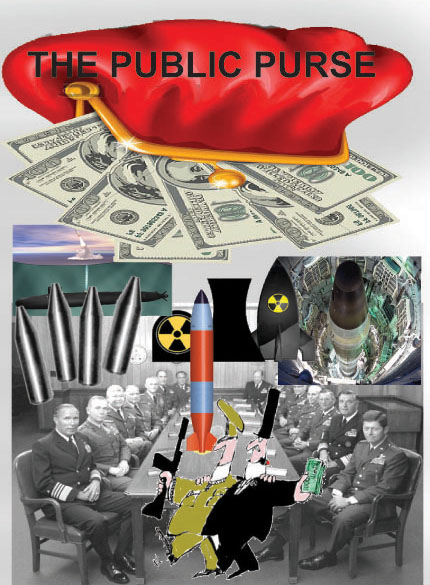
The most obvious place where Congress and the executive branch hide military spending is in the Department of Energy’s budget. That’s where taxpayers can find the bill for the U.S. nuclear weapons arsenal, which cost around $33.5 billion in 2025.
hundreds of billions of dollars are effectively hidden in the budgets of at least 17 other government agencies and entities. In total, each of these additional sums are larger than what Congress appropriates for every non-military agency
David Vine, CounterPunch. October 2, 2026
News reports that next year’s U.S. military budget will top out at $1.5 trillion if President Donald Trump gets his way are misleading at best. The true total, if Trump’s proposal passes, could be at least $1 trillion higher.
Long before Trump took office, U.S. taxpayers have spent far more on the Pentagon — and its wars — than most know. For decades, Congress, the White House, and the Pentagon have hidden the military’s true cost through little-known bureaucratic practices and budgeting tricks. Journalists, academics, and think tank experts have, with rare exceptions, perpetuated the problem by repeating “official” numbers that don’t come close to telling the full story.
Data shows that the budget was already between $1.5 trillion and $1.8 trillion in the last full fiscal year, 2025, as detailed by a recent Project on Government Oversight, or POGO, report I co-authored. Trump’s requests would add another $781 billion, bringing the potential total to at least $2.581 trillion in 2027.
The troubling revelation that the government is misleading the public and effectively hiding hundreds of billions in military spending reflects the out-of-control nature of the Pentagon budget. It’s also the only sector of government spending that seems largely insulated from public scrutiny: Imagine the outrage if news broke that the government was hiding hundreds of billions in spending for public housing, Medicaid, or hunger prevention programs.
People have a right to know how much tax money goes to military spending. This is critical to debating the proper size of the military budget both on its own and compared to other spending priorities, particularly any program related to education or the social safety net. Understanding the military’s true cost means understanding where and how the government has been hiding the money.
Spending Hidden in Other Budgets
It’s difficult to untangle how much the country actually spends on the military in part because Congress pays for the armed forces and wars from many budgets rather than one. Beyond the agency controlling the military branches that Trump calls the “Department of War” (the official name is still the Department of Defense), hundreds of billions of dollars are effectively hidden in the budgets of at least 17 other government agencies and entities. In total, each of these additional sums are larger than what Congress appropriates for every non-military agency.
For years, TomDispatch and a small but mostly ignored group of budget experts have warned that total military spending is far higher than reported. Our new POGO report consolidates this prior work and five different methodologies for calculating the true military budget. The report shows a consensus that military spending was at least $1.5 trillion, with three of five methods reaching similar estimates of $1.7 trillion to $1.8 trillion.
The newest of the five methodologies provides the easiest way for anyone to see the hidden spending. The methodology uses data from a government website, USAspending.gov, the product of a 2006 law requiring the government “to give the American public access to information on how their tax dollars are being spent.” The site includes the closest thing to actual spending receipts, making it easier to identify military spending beyond the Department of War’s budget.
Let’s take a look at where the money’s hiding.
Hidden Nuclear Weapons Costs: $33.8 Billion
The most obvious place where Congress and the executive branch hide military spending is in the Department of Energy’s budget. That’s where taxpayers can find the bill for the U.S. nuclear weapons arsenal, which cost around $33.5 billion in 2025.
The Department of War controls and deploys these weapons, and their costs should properly be part of its budget, not rolled into the Department of Energy. While the Energy Department plays a role in overseeing the U.S. nuclear weapons stockpile, putting nuclear weapons spending in the DOE’s budget is like a city putting the costs of its police department’s bullets in its transportation department budget rather than in the police budget.
Another $300 million in nuclear weapons spending hides in the budgets of the Defense Nuclear Facilities Safety Board and the Army Corps of Engineers, bringing the total to nearly $34 billion.
Hidden Military Personnel (Veterans) Costs: $393.3 Billion
Taxpayers spend huge sums on the military in the Department of Veterans Affairs and related budgets. The existence of a separate veterans’ agency is a sleight of hand that leads the public to believe this is not military spending. It is. The only difference is the appropriation of money to still another agency……………………………………………………………………………………………………………………………………………………….
The True Cost of the Department of War: $1.3 Trillion
The bulk of military expenditures still appear in the Department of War’s budget, which pays for the armed forces and the rest of the Pentagon’s sprawling bureaucracy, including all the weapons, salaries, some benefits, military construction, fuel, maintenance, operational expenses, and much more. USAspending.gov receipts show the Department of War alone spent $1.273 trillion in 2025. The Pentagon controlled another $480 million in spending that hid in the budgets of the State Department, the U.S. Agency for International Development, and the Department of Transportation.
Combined with the $444.8 billion tallied previously, total military spending hits $1.718 trillion. That’s more than double the military budget usually reported for 2025: the $850 billion Congress appropriated to the Department of War.
Still Other Costs
The $1.7 trillion estimate for last year is conservative and still may be too low. While the War Department budget contains classified funding for the CIA, National Security Agency, and other intelligence agencies, the government may hide more intelligence spending elsewhere. NASA space research involves considerable military work, which could add another $10.5 billion, according to USAspending.gov data. Some would also count $1.9 billion in FBI salaries and expenses found in the Department of Justice budget.
Other experts consider much larger expenditures in the DHS budget to be military spending, given that department’s role in protecting the “homeland” and the increasingly militarized nature of Immigration and Customs Enforcement as well as Border Patrol. This would add at least $216.9 billion after excluding DHS’s Federal Emergency Management Agency spending. Alternate methodologies also include $211.9 billion in interest payments on the more than $40 trillion in national debt stemming from past military spending and wars.
You can add and subtract forms of spending that you think belong or don’t belong in the true total, thanks to the transparency of the POGO report’s methodologies. In total, these excluded sums could add another $441.2 billion to the USAspending.gov method’s prior total of $1.718 trillion for 2025.
Growing Opposition to Unchecked Pentagon Spending
POGO report’s conservative estimates of the FY2025 budget being $1.5 trillion to $1.8 trillion reveal that the true military budget for 2027 could hit $2.6 trillion if Congress gives Trump what he wants. This includes requested increases totaling $781 billion for just the Department of War ($500 billion), the Iran war ($70 billion), veterans ($144.9 billion), nuclear weapons ($53.9 billion), and the Coast Guard ($12.5 billion), let alone other smaller forms of hidden Pentagon spending.
When mind-numbing numbers like these reach the trillions, it can be tempting to think, What does it matter if it’s $1 trillion or $1.5 trillion or $2.6 trillion?
It helps me to remember that every single dollar spent on the Pentagon is a dollar not spent on our children, on healthcare, on affordable housing, on efforts to slow catastrophic climate change, and much more……………………………………………………………………………………………………………. https://www.counterpunch.org/2026/10/02/the-pentagons-secret-budget/
Fukushima N-Plant Starts New Round of Treated Water Release

Tokyo, Oct. 5 (Jiji Press)–The Fukushima No. 1 nuclear power plant began its sixth release of treated water for fiscal 2026 on Monday, its operator, Tokyo Electric Power Company Holdings Inc., said.
The release from the disaster-stricken nuclear plant in Fukushima Prefecture, northeastern Japan, will involve about 7,800 tons of treated water containing radioactive tritium diluted with large volumes of seawater. The water will be discharged through an undersea tunnel to a point about 1 kilometer offshore by Oct. 23.
This is the 24th release since discharges began in August 2023. In fiscal 2026, which ends in March next year, the plant is set to release 62,400 tons of treated water in eight rounds.
Jiji 5th Oct 2026
https://jen.jiji.com/jc/eng?g=ind&k=2026100500570
Tory plan to cut Scotland’s powers poses a question they cannot dodge.

Andrew Bowie – the shadow energy secretary – who has made crystal clear
what a General Election win for his party would mean: fewer powers for
Scotland.
“We will legislate to ensure that Scotland can host new nuclear
power generation,” Bowie said. The message is this: should the Tories
re-enter No 10, the devolution of planning powers to the Scottish
Government will be stripped back. Bowie did not shy away from this, telling
party faithful at the Tory conference:
“If John Swinney and SNP ministers
want to have a fight over any plans that would deliver thousands of jobs
and protect energy security, then I say bring it on.” The SNP responded
with their own challenge. “Tory politicians proposing to force nuclear
power plants on Scotland should tell us who among them wants one of these
extortionate, wasteful, and unnecessary nuclear plants built in their
constituency,” SNP MSP Laura Mitchell said.
The National 5th Oct 2026,
https://www.thenational.scot/news/26609474.tory-plan-cut-scotlands-powers-poses-question-cannot-dodge/
Tories pledge ‘Britannia Shield’ to protect UK from drone attacks.
Aplanned network of radar, command and control systems and interceptor
missiles would strengthen defences against aerial threats. The
Conservatives have pledged to build a £10bn integrated air-defence system
to protect the UK from missile and drone attacks if they win the next
general election. The proposed system, dubbed “Britannia Shield”, would
involve an improved network of radar, command and control systems, and
interceptor missiles to protect critical national infrastructure and
military bases from aerial threats.
FT 5th Oct 2026,
https://www.ft.com/content/f30a1afc-2aa8-4cdd-a6e8-b18523298456
Labour Government will not override Holyrood to bring in new nuclear, says UK energy minister
Labour Government will not override Holyrood to bring in new nuclear, says
UK energy minister. Michael Shanks said that “ripping up the Scotland Act
to force through new nuclear isn’t the right approach”. The Labour
Government will not override Holyrood to bring in new nuclear reactors, a
UK energy minister has said.
Scotsman 6th Oct 2026, https://www.scotsman.com/news/politics/labour-government-will-not-override-holyrood-to-bring-in-new-nuclear-says-uk-energy-minister-9268139
Scotland could get large nuclear reactor under Tories, says shadow energy secretary
Conservatives vow to change the law to override SNP ban on new nuclear
The Scotsman, By Andrew J Quinn, Westminster Correspondent, 5th Oct 2026,
cotland could get a large nuclear reactor under the Tories, the shadow energy secretary has said.
Andrew Bowie told the Conservative Party Conference that “no part of Britain will be off limits” when building a third large-scale reactor in the UK.
The Aberdeenshire West and Kincardine MP vowed to change the law to override the SNP’s ban on new nuclear.
He told the conference in Birmingham: “We will need a third large-scale reactor. We will build that reactor, and no part of Britain will be off limits, including Scotland.
“We will legislate to get it done. No more Mr Nice Guy. No more devolve and forget.
“Energy is a reserved power of the sovereign Parliament of our United Kingdom, and I am fed up with the SNP playing games with devolved planning policy to block our nuclear renewal.
“So we will legislate to ensure new nuclear can and will be built in Scotland, and if the Nationalists want to stop us from delivering thousands of jobs, economic growth, and energy security for Britain, I’ve one thing to say: bring it on.”
The UK government wants to build small nuclear reactors in Scotland. But the SNP, which holds control over planning, has so far blocked it.
Torness in East Lothian, Hunterston in Ayrshire, and Dounreay in Caithness have all been cited as potential sites.
But the prospect of a new large nuclear reactor north of the Border has not been seriously considered before.
Hinkley C in Suffolk and Sizewell C in Somerset are two large nuclear power stations which are being built in the UK.
Torness is Scotland’s last remaining active nuclear power plant. The facility is scheduled to close by 2030.
Hunterston A in North Ayrshire shut down in 1990, while Hunterston B shut down in 2022.
Mr Bowie said: “We once led the world in nuclear power, and we can do so again, ensuring that Britain will always have reliable, plentiful electricity. Cheap energy drove the industrial revolution. Abundant nuclear power will drive Britain’s renewal.
“We will supercharge the rollout of new nuclear in Britain. We will deliver at pace and go further. Where there’s a block, we will break it down. Where there’s red tape in the way we will cut it full steam ahead.
“We’ll invest in small modular, advanced modular reactors and open this country to the newest and most exciting technology in the world.
“But to ensure stability and reliability, we need further large-scale reactors, a gigawatt-scale reactor, standing along Hinkley and Sizewell.
“Now, when I was nuclear minister, I was delighted and proud to be able to announce existing new developments that would create jobs and boost Britain’s energy security across the country, from Wales to the southwest, Hartlepool to East Anglia………………………………….. https://www.scotsman.com/news/politics/scotland-could-get-large-nuclear-reactor-under-tories-says-shadow-energy-secretary-9266799
The Decommissioning Waste Challenge
The IAEA, the European Commission and the OECD Nuclear Energy Agency are
working with the World Nuclear Association to consolidate the information
gathered from different initiatives on assessing waste into a single
publication, Status and Trends in Spent Fuel and Radioactive Waste
Management.
The publication is an attempt to systematically summarise the
global status and trends of programmes and inventories for spent fuel and
radioactive waste management. Previous reports were published in January
2018 (covering the situation to the end of 2013) and 2022 (covering the
situation to the end of 2016).
The third edition (up to the end of 2019) is
now available in pre-print. The basic information in this publication has
been collected through submissions to the Spent Fuel and Radioactive Waste
Information System (SRIS), complemented with openly available Joint
Convention National Reports. Approximately 90% of states with operating
nuclear power plants submitted their data to SRIS or their Joint Convention
National Reports, representing almost 92% of all nuclear power reactors.
Data are not available for every country, but available data provide a
clear representation of the radioactive waste that exists and an indication
of the challenges that will arise in the future as facilities still in
operation, or planned, come to the end of their useful lives.
NS Energy 5th Oct 2026, https://www.nsenergybusiness.com/analysis/the-decommissioning-waste-challenge/
UK’s Committee on Radioactive Waste Managemen (CoRWM) visit to Sweden’s radioactive waste facilities
Members of CoRWM recently visited the Forsmark and Clab sites in Sweden.From:Committee on Radioactive Waste Management
5 October 2026
CoRWM members had been hoping to visit Sweden’s radioactive waste
facilities for some time, and our visit in September was well worth the
wait. Sweden is frequently discussed internationally as one of the
countries that has made significant progress towards the geological
disposal of both spent nuclear fuel, and low and intermediate level
operational wastes.
We wanted to understand more about how that progress
had been achieved, and particularly what we might learn from Sweden’s
experience of siting and public engagement. Our visit began at the Forsmark
nuclear site, in the municipality of Östhammar, where the repository for
short-lived radioactive wastes, SFR, has been operational since 1988. In
2009 the Forsmark site was also selected to house Sweden’s deep
geological spent fuel repository.
Construction has been underway since
2025. Our SKB hosts gave us an illustrated account of the history of the
Swedish siting process, drawing attention to what had gone well, as well as
the mistakes made in the early years. We were told that by the late 1980s
it had been established that there was suitable rock everywhere, but the
industry had yet to learn that however suitable the geology, “you can’t
just turn up with a digger”.
The SKB response to initial angry protests
was to embark on a major project of public engagement that began with the
posing of a basic question at a national level. They simply asked whether
people would be interested to find out how a repository for spent nuclear
fuel could affect their municipality? Eight municipalities from across the
country expressed an interest. What followed was much more than a search
for a willing community or a suitable geology. SKB invested heavily in
producing detailed socio-economic surveys of each of the candidate
municipalities, to see if they could identify mutual interests between
industry and residents.
CoRWM 5th Oct 2026, https://www.gov.uk/government/news/corwm-visit-to-swedens-radioactive-waste-facilities
1 This Month





PLEASE OPPOSE HR 8255 AND S.3639 – bills would accelerate satellite deployment, with no environmental review or safeguards – https://ncstd5li.quorum.us/campaign/169331/
To see nuclear-related stories in greater depth and intensity – go to https://nuclearinformation.wordpress.com
-
Archives
- October 2026 (91)
- September 2026 (339)
- August 2026 (330)
- July 2026 (355)
- June 2026 (287)
- May 2026 (306)
- April 2026 (356)
- March 2026 (251)
- February 2026 (267)
- January 2026 (308)
- December 2025 (358)
- November 2025 (359)
-
Categories
- 1
- 1 NUCLEAR ISSUES
- business and costs
- climate change
- culture and arts
- ENERGY
- environment
- health
- history
- indigenous issues
- Legal
- marketing of nuclear
- media
- opposition to nuclear
- PERSONAL STORIES
- politics
- politics international
- Religion and ethics
- safety
- secrets,lies and civil liberties
- spinbuster
- technology
- Uranium
- wastes
- weapons and war
- Women
- 2 WORLD
- ACTION
- AFRICA
- Atrocities
- AUSTRALIA
- Christina's notes
- Christina's themes
- culture and arts
- Events
- Fuk 2022
- Fuk 2023
- Fukushima 2017
- Fukushima 2018
- fukushima 2019
- Fukushima 2020
- Fukushima 2021
- general
- global warming
- Humour (God we need it)
- Nuclear
- RARE EARTHS
- Reference
- resources – print
- Resources -audiovicual
- Weekly Newsletter
- World
- World Nuclear
- YouTube
-
RSS
Entries RSS
Comments RSS

